I began to follow F1 way back in the late 1960’s. I’m not sure what first attracted me to the sport. I liked cars and back then I subscribed to a free magazine from Corgi, the makers of die cast model cars. They used to send me out a little monthly magazine which was nothing more than an advertising pamphlet and one of those thin missives was dedicated to model F1 cars. As well as reading about model cars I started to find out more about the actual cars and drivers of the time. It was probably 1969 when the cars first flirted with aerodynamics and later in 1970 the grids began to look very colourful as outside advertisers brought their brand colours to the sport.
 Yardley sponsored the BRM team and John Player Tobacco sponsored the Lotus cars, even to the extent of naming the cars the John Player Specials. I also started to learn more about the history of the sport. Who was Juan Manuel Fangio, the guy who had won an incredible 5 world championships? Well he was an Argentinian driver who once drove for Mercedes in the 1950’s. His team mate back then was an Englishman named Stirling Moss. What had happened to him I wondered?
Moss was born in September 1928. His parents were amateur racing drivers. His father competed in the 1924 Indianapolis 500 and his mother competed in Hillclimb events. Even his sister Pat Moss became a rally driver so motorsport seems to have been in his blood.
His father got him his first car at the age of 9 and he drove it around the fields near his boyhood home, Long White Cloud House, on the banks of the river Thames.
Moss’s first racing car was a Cooper 500 which he bought using winnings from competing in horse racing events. He was good in the saddle as well as behind the wheel.
His first major international race victory came at the RAC Tourist Trophy in Northern Island driving a Jaguar XK120. That was the beginning of an incredible career in which Moss won 212 of the 529 races he entered including 16 Grands Prix, the most ever won by an English driver until that record was equalled by Nigel Mansell.
Moss came close to winning the world championship although he never quite managed it, becoming known as the greatest driver never to become world champion.
In 1953, Alfred Neubauer, the famous Mercedes team manager, was impressed by Moss. He made it clear he was willing to sign up the Englishman but wanted to see what he could achieve in more competitive machinery. He suggested Moss buy a Maserati 250F for 1954. Moss did so and was impressive; at the Italian Grand Prix that year Moss beat world champions Ascari and Fangio to the lead and only gave it up when his engine failed. Neubauer duly signed Moss for the 1955 season when he would be teamed with Fangio.
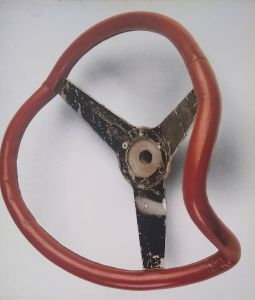
The mangled steering wheel from Moss’s crash.
Fangio and Moss worked well together and although it was Fangio who won another world championship Moss beat him at his home race, the British Grand Prix. The race was held that year at Aintree. The racetrack was in the grounds of the famous horse racing course and in fact used the same grandstands as the horse racing event. For the rest of his life, Moss questioned Fangio as to whether he, Moss, had actually won or had Fangio gifted him the win. Fangio always maintained that Moss was better than him on that day and won on his own merit.
In 1955 Fangio won his third championship and retired some years later having won 5, a feat unmatched until the modern era when Schumacher and later Lewis Hamilton upped the record to 7 titles.
By this time in 1955 Moss was a household name, probably as famous as Lewis Hamilton is today. In 1955 he also won the famous Italian race the Mille Miglia with Dennis Jenkinson as his navigator. Jenkinson was a journalist for Motor Sport magazine and famously signed himself off on his racing articles as DSJ. A few years later the classic race was discontinued after numerous fatal accidents during the race.
In 1962, Moss was competing in a Lotus at the Goodwood circuit. He came off the road and crashed. He was trapped in his car for three quarters of an hour while various people tried to free him from his mangled car. He had sustained a shattered eye socket but more serious was a severe impact to the right side of his brain and this sent him into a coma. Moss was driving for Rob Walker at the time who was in France. Once he heard the news, Rob and his wife drove back to the UK, their radio tuned into the BBC Home Service which issued hourly updates on Stirling’s condition.
 Moss had moments of lucidity but didn’t fully wake up for 38 days. In the excellent biography by Robert Edwards, the author describes Moss’s presence at the hospital in Colchester as ‘something of a sensation’. The switchboard was jammed with callers enquiring after Moss. Even Frank Sinatra called for information. The accident occurred on the 23rd April, 1962. Moss would not leave hospital until July that year.
Over a year later on Wednesday May 1st 1963 he drove a racing car again. It was a Lotus 19 sports car. He put in respectable lap times but the brain injury had resulted in subtle consequences. Moss reported that driving was for him now a disjointed, disconnected experience. Nothing flowed and now he had to think about what to do when before, all the aspects of driving fast would come naturally to him. He said this to a journalist about his decision to retire;
It was an easy decision to take at the time, because it was the only decision to take. I had to think. I had to give orders to myself -here I’ll brake, here I must change down and so on. And another thing: I used to be able to look at the rev counter without taking my eyes off the road -not only that but I could see the rev counter and a friend waving to me all at the same time. I’d lost that, that had gone.
 He was by then divorced from his second wife and he was still a celebrity so he settled down at his impressive home at 46 Shepherd Street in London’s Mayfair. Moss had bought the vacant bombed out lot after the second world war and designed what was to him the perfect house. He retained an architect, a female architect to translate his ideas into reality. A spiral staircase takes one up to the first floor where there is a large sitting room and a smaller ‘snug’ and also an office. Upstairs again is a large kitchen and dining area and going up again there is the master bedroom where there are wardrobes with motorised shutters. He had remote controlled garage doors which were pretty amazing for 1962 when the house was built and also a descending table where Stirling could send a meal down from the kitchen to the dining room. He did love gadgets.
Just recently I saw an advert on the TV for a tap which could deliver hot, boiling or cold water at the touch of a button; Moss had one in 1962.
He married for the third and final time in 1980. He worked as a commentator on US TV and in public relations. He became involved in historic car racing but finally gave up competitive driving when he was 81.
He died in 2020 aged 90 after a long illness.
I’ve saved my favourite Moss story till the end. At a memorial service for Stirling this year, 2024, Jackie Stewart revealed that after winning his third world championship he was stopped by the police for speeding. Stewart was pretty famous himself by then. He had been called the world’s first superstar racing driver but as he wound down his window the police officer looked at him and said ‘who do you think you are, Stirling Moss?’
All the information and pictures in this post are from the excellent book by Robert Edwards, Stirling Moss; The Authorised Biography.
 Letters from an Unknown Author!