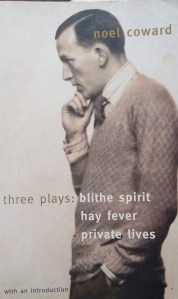
I can’t remember when I first discovered Noël Coward. I had known about him for a very long time of course but perhaps I really only discovered him after picking up a paperback copy of Blithe Spirit. Included in that slim volume were two other plays, Hay Fever and Private Lives. Together they are a lively, witty and hugely enjoyable read. A few years ago, Liz and I were on holiday in France and I took along his autobiographies to read. This is what I wrote about them back then.
I’ve spent most of this holiday reading the autobiography of Noël Coward and it’s actually three books in one. The first part is his first autobiography, Present Indicative, part 2 is an unpublished segment of his unfinished third autobiography, Past Conditional and finally his second published autobiography Future Indefinite.
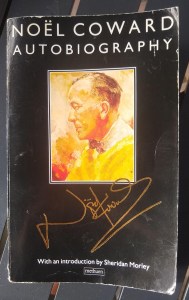
Book one, Present Indicative was published in 1937 and concerns Noël’s early years, his childhood and his first tentative steps into the theatre. It’s an account of a vanished world of repertory companies, writers, actors and actresses who have long gone and whose names mean little today in the 21st century. Even so it is hugely fascinating and interesting and as always enlivened by Noël’s supremely witty text. Noël was a homosexual in a time when homosexuality was illegal and most of his private life he keeps private although armed with a little knowledge of Noël we can read between the lines and assume that Jack Wilson who comes to live with him at his home, Goldenhurst in Kent, was presumably his lover.
Book two, Past Conditional is an unpublished and unfinished autobiography that was intended to fill in the gap between his first two autobiographical books. It starts where the first one finished off, in the early 1930s and differs considerably in tone as it was written much later in the mid-1960s and Noël was able to look back at himself in the 1930s and examine himself from a greater perspective. Such a pity it was unfinished. An interesting segment concerns the death of his brother who is scarcely mentioned in the text as he and Noël were never close. The brother was clearly never part of Noël’s theatrical world and the family send him off to South Africa only for him to return and die of cancer.
The final book in the autobiographical series was Future Indefinite in which Noël recounted his time during the Second World War. He seems like many to have had a very low opinion of Prime Minister Neville Chamberlain, although to be fair to Chamberlain, he was doing his utmost to avoid the horrors of war. Sadly, and clearly unknown to Mr Chamberlain, Adolf Hitler did not want to avoid war, he was in fact wanting war very badly and happily it was Mr Churchill who understood this only too well.
In June of 1939 Noël, who was a great globetrotter, decided to take a tour of Europe in the light of Mr Chamberlain declaring peace in our time. He visited Warsaw and Danzig, Moscow, Leningrad, Helsinki, Stockholm, Oslo and Copenhagen. He found that many of those people were just waiting for Hitler to invade, particularly the Poles. In Russia he found a state that declared it had found freedom in Communism but was in fact quite the opposite as the Stalinist regime had choked any kind of criticism or free thinking whatsoever.
When war was declared Noël was asked to be part of an Anglo-French PR unit in Paris which he seems to have enjoyed for a while and then became a little bored with. He was sent on a tour of the USA to gauge opinion there on the war and was on his way back when the Nazis invaded France. He also did a tour of Australia and New Zealand to entertain troops and did charity work for various organisations helping those who were bombed out in London.
 By far the most interesting part was his account of the filming of In Which We Serve, a very patriotic film showing the activities of a ship in the Royal Navy that was eventually sunk and the lives of those who served in her. In his very first autobiography, the names of the many actors and actresses he worked with meant very little to me but now I can recognise a few names, John Mills and Richard Attenborough for instance and David Lean who co-directed the film with Noël although in actual fact, Lean directed most of the film when Coward became bored with the long-winded filming process.
Coward goes on to talk about Blithe Spirit, my favourite of Coward’s plays which was made into a film in 1945. Coward was not keen on the resulting film. David Lean added an ending in which Charles Condomine, played by Rex Harrison, dies and joins his ex-wives in the spirit world. Coward complained that David Lean had f**ked up the best thing I had ever written! Personally, I loved it.
Final verdict of the Noël Coward biographies; fascinating, always interesting and hugely entertaining.
Just recently I’ve finished reading The Letters of Noël Coward edited by Barry Day. It’s a massive volume and I’ve read it over a long period of time, sometimes turning to other books but this year I decided I would make a big effort to finish it. How the author/editor would even go about collecting Noël’s letters I really don’t know unless Noël typed his letters and kept carbon copies. Anyway, this collection goes from Noël’s youth to his final days. Some of his letters describe his theatrical successes as well as disappointments when things didn’t go so well. Coward made friends all over the world and was fond of visiting them, especially those in the warmer climes of the world when England was cold and frosty. His letters cover his love of the theatres of London and also those of Broadway. After many months of hard work Noël would travel, sometimes with friends but many times on his own and he would talk about the places he visited in his letters. Travelling was his way of relaxing although he always found time for writing new plays.
 The book is a huge volume and the editor has woven Noël’s letters with some interesting text about what was happening to Noël in between his letter writing. In 1941 Noël was invited to stay at the Welsh resort of Portmeirion where, many years later, the famous TV show The Prisoner starring Patrick MacGoohan would be filmed. His friend, Joyce Carey was hoping to write a play away from the bombs that were dropping on London. Her play never materialised but Noël wrote Blithe Spirit during the five days that he was there.
The original theatre production starred Cecil Parker as Charles Condomine and Kay Hammond as Elvira. On July 18th, 1941 Noël wrote to Jack Wilson to review the performance. He praised everyone but wasn’t happy with Margaret Rutherford as Madame Arcarti. He finished by mentioning that “I need hardly say that she got a magnificent notice. So much for that.”
My first introduction to Blithe Spirit was the wonderful film version made in 1945 by David Lean. The two stars of the film, to my mind anyway, were Rex Harrison and Margaret Rutherford, although Constance Cummings as Mrs Condomine and Kay Hammond as Elvira, Mr Condomine’s late wife, were equally good.
If you don’t know the story to the play then here it is. Author Charles Condomine is writing a novel and one of the characters is a medium. To obtain information for his book, Charles asks local medium Madame Arcati round for dinner to perform a séance. The outcome is that Charles’ late wife Elvira is conjured up but only Charles can see her. Even so, she manages to cause mayhem in the Condomine household and upset Ruth, Charles’ current wife, no end.
That brings me to what you might call the punch line to this post. Last Thursday Liz and I went to see a production of Noël’s fabulous play at the Grand Theatre in Blackpool. Apart from a few pantomimes when I was a child this was my first visit to the theatre. (Having said that, I did go to a performance of Calendar Girls, the musical version, in Lytham a few years ago.) This however was a classic play written by an outstanding author at a venerable classic theatre. I was excited as we entered and found our seats.

Blithe Spirit at the Blackpool Grand Theatre
The stalls were 90% full. The announcement came to take our seats, the lights went down and the performance began. It was an enjoyable performance but a couple of things struck me. Although the actors were good, they weren’t in the same class as the actors in David Lean’s film version. The action is set in the 1940s and Rex Harrison and the British actors from that period seem to have a unique smooth diction and rhythm of speech which however hard they try, actors today just really cannot reproduce. Adam Jackson-Smith as Charles Condomine was pretty good but the play needs a really good comic actor to play Madame Arcati and Susan Wooldridge was good but hardly the equal of the wonderful Margaret Rutherford.
Bridgette Amofah played Elvira quite well but in Noël’s original production the character had pale makeup with a hint of green and was followed around the stage by a green spotlight. Bridgette is a black woman so perhaps the make up wouldn’t have worked but I do feel that something could have been done with makeup and lighting to make her look a little more ghostly.
These minor things apart, I enjoyed my visit to the theatre and it was good to see that Noël Coward can still entertain the public many years after his death in 1973.
 Letters from an Unknown Author!
Pingback: Another Film Connections Post | Letters from an Unknown Author!