This week’s post is about pseudonyms and people who use different or other names.

Lenin aka Vladimir Ilyich Ulyanov

Oleh Isaak Brodsky – http://www.art-in-exile.com/forums/39783-post61.htmlh, Domain Publik, https://commons.wikimedia.org/w/index.php?curid=1398898
Last week in a post about Painters and Paintings, I mentioned Lenin who was the first Communist leader of the Soviet Union. In fact, it was he who created the Soviet state but his real name was not Lenin. He was born in 1870 as Vladimir Ilyich Ulyanov. He studied at Kazan University and later became a Marxist activist after moving to St Petersburg, later renamed Petrograd. In 1897 he was arrested and exiled to Siberia for three years. In 1903 the Russian Democratic party (later renamed the Communist Party) split into two and Lenin led the Bolsheviks against the Menshiviks. In the unsettled world of the late 19th and early 20th century, political activism in The Russian empire was a dangerous game and Ulyanov began to use a pseudonym to protect himself. The name he chose was Lenin.
After his exile ended Lenin left Russia for the relative safety of western Europe, even living in London for a time. He returned to Russia when a revolution broke out in 1905 but when that failed, he returned to Europe and continued to organise and write essays and propaganda for the Bolshevik cause.
After the revolution which toppled the Tsar, the Germans who were then at war with the European allies in the First World War, sent Lenin into Russia on a sealed train. Churchill famously commented that
“Lenin was sent into Russia by the Germans in the same way that you might send a phial containing a culture of typhoid or cholera to be poured into the water supply of a great city, and it worked with amazing accuracy.”
Lenin was welcomed in Russia as the leader of the Bolsheviks and was helped by Stalin to escape the forces of the provisional government controlled by Alexander Kerensky. The Bolsheviks however soon engineered a second revolution; the provisional government was overthrown and Kerensky, his brief entry into history over, had to flee.
Lenin presided over the new government. He made peace with Germany despite having to negotiate away a huge swathe of land to the Kaiser’s Germany. He waged a civil war within Russia against those who tried to restore the Tsar. He renamed his party the Communist party.
In 1921 Lenin became ill, finally dying in January of 1924. In his last days he tried to remove Stalin from power but failed.
Stalin aka Joseph Vissarionovich Dzhugashvili
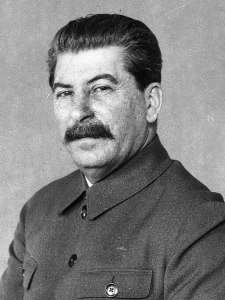
James Abbe, Public domain, via Wikimedia Commons
Stalin was born into a poor peasant family in Georgia in 1878. Later he became a bank robber, providing funds for Lenin and the Bolshevik party. He was born Joseph Vissarionovich Dzhugashvili and like Lenin, adopted a pseudonym. The name Stalin came from the Russian word for Steel and is often said to mean ‘man of steel’. In his early days as a Bolshevik, Stalin robbed banks to fund the revolution. Later, Stalin organised and edited Bolshevik newspapers for Lenin and Lenin promoted him to the party’s central committee in 1912.
When Lenin died, Stalin took control of Lenin’s funeral and began to cultivate a cult of personality around himself, gradually removing all those who opposed him on the central committee. After expelling Leon Trotsky who was exiled and later deported in 1929, Stalin was unopposed as the supreme leader. His regime oversaw mass repression with millions consigned to forced labour in the Gulag camp system and others who Stalin perceived as threats, imprisoned or murdered in his purges.
Stalin died in 1953. After collapsing, he was discovered by his security staff who were too scared to approach him at first. Later they moved him to a couch thinking the heavy drinking dictator might have been drunk. He died on the 6th March and later Khrushchev emerged as the new Soviet leader.
Trotsky aka Lev Davidovich Bronstein
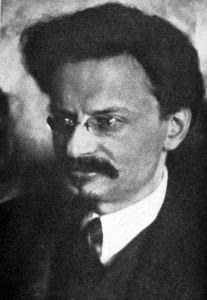
By Isaac McBride – Barbarous Soviet Russia, Public Domain, https://commons.wikimedia.org/w/index.php?curid=3363312
Trotsky was another Bolshevik who used a pseudonym. He was the creator of the Red Army and the man Lenin thought would be a good successor. He, like Lenin and Stalin, suffered exile to Siberia and later met Lenin in London where he worked on the party newspaper. He returned to Russia in 1917 and became chairman of the Petrograd Soviet. After the Bolsheviks took power Lenin appointed Trotsky to the post of foreign minister, later becoming the Commissar for Military and Naval Affairs. He built up the Red Army and led it to victory in the civil war.
After Lenin’s death Trotsky was sidelined by Stalin and expelled from the Communist party and later from Russia itself. He finally settled in Mexico until his murder by Stalin’s agents in 1940.
Elton John aka Reg Dwight
That’s enough Soviet history for now so let’s move swiftly on to the music business. Reginald Dwight was born on the 25th March 1947. He lived in Pinner in Middlesex with his mother and father, Stanley and Sheila, although they divorced when Reg was 14.
Something that had a big effect on the young Reginald was his parents’ love of music. He began tapping out tunes on his grandmother’s piano and the age of 11 won a scholarship to the Royal Academy of Music.
 At the age of 15 Reg got himself a job playing the piano at the local pub and in 1962 he and some friends formed a small band called Bluesology and they soon picked up a regular gig supporting singer Long John Baldry.
In 1967 Reg answered an advertisement in the New Musical Express. It had been placed by Liberty Records who were looking for new talent. Reg went to audition for the A & R manager, Ray Williams but Ray appeared to be unimpressed when Reg sang an old Jim Reeves hit and by way of ending the interview Ray handed Reg a sheaf of unopened lyrics written by someone who had answered the same ad.
That someone was Bernie Taupin. He and Reg hit it off instantly and Reg began writing music to Bernie’s lyrics. Six months later Reg changed his name. He took his new name from Bluesology bandmates Elton Dean and Long John Baldry and put them together to become Elton John.
In 1969 Elton’s album Empty Sky became a minor hit and was followed by the eponymous Elton John in 1970. ‘Your Song’, a single from the album went to number 7 in the UK singles chart and Elton John had arrived.
Archie Leach aka Cary Grant
Grant was born Archibald Leach in Bristol, England in 1904. He had a poor upbringing and his mother suffered from depression and his father was an alcoholic. The young Archie was interested in the theatre and performing and his mother was keen on him having piano lessons. His older brother had died before reaching the age of one and this perhaps made his mother a little over protective of the young Archie. Even so, his mother was not a woman who was able to give or receive love easily and the older Cary Grant blamed his childhood relationship with his mother for his problems with women in later life.
When Archie was 9 years old his father placed his mother in Glenside Hospital, a mental institution, telling his son that she had gone away on a long holiday and later, that she had died.
Archie befriended a group of acrobatic dancers known as The Penders and he was able to eventually join them and there he trained as a stilt walker and became part of their act. Later the group toured America and Archie decided to stay, following in the footsteps of others before him like Charlie Chaplin and Stan Laurel who had made their way to the USA in an almost identical way.
On Wikipedia they mention that on the trip over to the USA, Archie met Douglas Fairbanks and was greatly impressed by him, so much so that Fairbanks became a role model for the young Archie Leach.
In New York Archie worked in vaudeville with various comedy and theatrical groups. He joined the William Morris theatrical agency and began to pick up many theatre roles. In 1932 he had his first screen test and was given a five year contract with Paramount Pictures. B P Schulberg the general manager of Paramount decided that Archie Leach was not a good enough name for films so Archie came up with the name Cary Grant taking Cary from a stage character he had played and Grant chosen randomly from a telephone directory.
Cary Grant retired from acting in 1966 when his only daughter was born. He died in 1986 aged 82.
Ayrton Senna aka Ayrton Da Silva
It might come as a surprise to many to learn that the legendary racing driver Ayrton Senna did not use his real name. Instead, he chose to race under his mother’s maiden name, Senna. He decided to use the name Senna as in Brazil, his home country, Da Silva is a very common name and Ayrton hoped the use of Senna would make him stand out and be more recognisable in the world of motor sport.

Ayrton Senna in the McLaren Mp4/4 in 1988. Photo by the author
Ayrton was born and raised in the Brazilian city of Sao Paulo. He was born in 1960 and began racing karts at the age of 13. After twice finishing as runner up in the world kart championships Ayrton moved to Europe to compete in Formula Ford and later Formula 3. It was quite an achievement for the young Brazilian. He spoke little English and he and his wife were fishes out of water in the UK. Only his massive desire to succeed and to make it into Formula One kept him going. Alas his young wife was not up to the challenge and returned to Brazil.
Senna went on to enter Formula 1 and with the McLaren F1 team he won all of his three world championships fighting constantly with his great rivals Alain Prost and Nigel Mansell. He was killed on the 1st of May 1994 at the San Marino Grand Prix in Italy after leaving McLaren for the Williams team. He crashed at the Tamburello corner when he hit the concrete wall there and a suspension arm, forced back in the impact pierced his most vulnerable area, the visor of his crash helmet.
T E Lawrence aka John Hume Ross and T E Shaw
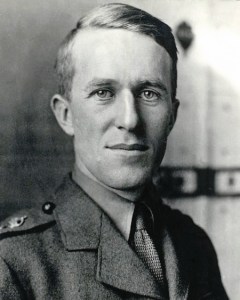
By Unknown author – pavellas.blogspot.com, Public Domain, https://commons.wikimedia.org/w/index.php?curid=7367070
Thomas Edward Lawrence is a fascinating character. He was a British army officer and writer best known for his role in the Arab Revolt during the First World War. He became known to the public through a series of film presentations by writer and documentary film maker Lowell Thomas.
After the war Lawrence tried to vanish into anonymity by joining the RAF as an aircraftsman using the alias of JH Ross. Later when his real identity was exposed he left the RAF and joined the army using the alias TE Shaw. He was unhappy in the army and was eventually readmitted to the RAF.
His account of his work in the Arab Revolt was published in his book Seven Pillars of Wisdom. Lawrence actually lost his manuscript at one point and was forced to reconstruct the entire book. Later, the book was used as the basis for the film Lawrence of Arabia starring Peter O Toole as Lawrence. A stage play was also written about him by Terrence Rattigan titled Ross which explored Lawrence’s alleged homosexuality. Alec Guinness featured in the play in the title role as Ross/Lawrence.
On the 13th May 1935 Lawrence was severely injured in a motorcycle accident and died six days later on the 19th May.
Thanks to Wikipedia for the source information.
 Khrushchev was the first Soviet leader who tried to humanise the Soviet Union. This huge monolithic state that represented tyranny and state control had been created by Stalin and though Stalin himself brought Khrushchev into his inner circle, it was Khrushchev who later rejected the brutality of the Soviet State.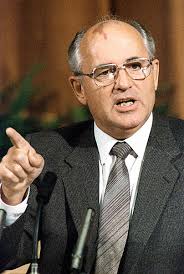
 Letters from an Unknown Author!