This week’s theme is about underwater adventures. I’m come up with a few films, TV shows and books on the subject so, to start, I’ll have to cast my mind back to my childhood and remember what underwater TV series caught my imagination back then.

Stingray
Stingray was a puppet TV series created by producer Gerry Anderson and his wife Sylvia and it was the first of their shows to be filmed in colour. Stingray was a submarine in the service of the WASP, the World Aquanaut Security Patrol and was captained by Troy Tempest and his colleague ‘Phones’ who was a master at using sonar equipment. The duo discover an undersea kingdom where King Titan holds sway over his people, the Aquaphibians. Troy and Phones rescue the mute undersea girl Marina who joins them onboard Stingray. Most of the characters had sea related names like, Marina, Commander Sam Shore and his daughter, Atlanta. Atlanta was voiced by Lois Maxwell who played the original Miss Moneypenny in the James Bond films.
Stingray was probably my favourite of Anderson’s TV shows. I particularly loved the opening sequence in which commander Shore exclaims ‘Anything can happen in the next half hour!’ As a child I used to own quite a few Stingray models. One was a plastic kit I had to put together and another was a plastic Stingray shaped water pistol.
Voyage to the Bottom of the Sea
Voyage started out as a film made in 1961. It had some big stars including Peter Lorre, Walter Pidgeon and Joan Fontaine. I actually saw the film after the TV series so I was never impressed with seeing the submarine Seaview without what was to me, its regular crew of actors. The film and the series were produced by Irwin Allen. The film version is about an amazing new submarine, the Seaview, which travels to the Arctic and finds that the sky is on fire! It turns out that a flaming meteor has set the Van Allen belt on fire and Seaview must fire a nuclear rocket into space to blow out the flames.
That has always seemed a bit silly to me but the TV series was much superior. Richard Baseheart played Admiral Nelson and David Hedison was Captain Crane. The crew met with various undersea aliens as well as sea monsters and many of the episodes had espionage and cold war themes.
In the TV series, the Seaview was equipped with a mini submarine which could also fly and was dubbed the Flying Sub. Looking over on Wikipedia, I see the flying sub only appeared in the later seasons but like Stingray, I also had a plastic model kit of it.
The show lasted for four seasons from 1964 to 1968 and in many ways was a sort of undersea forerunner to Star Trek. Producer Irwin Allen went on to make three other TV sci-fi shows, Lost in Space, Land of the Giants and The Time Tunnel.
The Undersea World of Jacques Cousteau
This was a documentary series about the undersea research done by Jacques Cousteau and he travelled the world’s oceans in his research vessel the Calypso. I remember it from the late 1960’s although over on the internet I see that the series ran from 1968 to 1976. Jacques and his team studied underwater things like sea turtles and coral reefs and I always found it very fascinating. The series was narrated by Jacques himself as I remember it but over on Wikipedia they claim that Richard Johnson narrated the BBC version. Perhaps it was a mix of the two with Jacques stepping in to talk about particular elements.
Thunderball
Thunderball was a novel by Ian Fleming and was one of the adventures of his hero, James Bond 007. The novel and the film were subject to litigation as it was based on a film script on which Fleming had collaborated with Kevin McClory. McClory wasn’t happy that Fleming had used the screenplay for the basis of his novel and the result was that after suing Fleming, McClory won certain rights to the story which is how a rival Bond film came to be made in 1983. Never Say Never Again appeared as a rival to the official Eon production Bond films.
Anyway, in Thunderball, a Vulcan bomber with two atomic bombs on board is stolen by SPECTRE and they blackmail the UK government for their safe return. Bond finds the Vulcan underwater in the Caribbean. SPECTRE agent Emilio Largo has a wonderful boat with an underwater hatch through which an army of frogmen descend on various underwater vehicles to hide the bombs. 007 and his colleagues engage in an underwater battle with Largo and eventually get the upper hand.
The Spy Who Loved Me
This film was the one that appeared in competition to Never Say Never Again. Numerous legal issues surrounded the film as producer Harry Saltzman was in financial trouble. Various issues arose with his fellow producer Cubby Broccoli but eventually the two owners of the Bond franchise managed to come to agreement and Broccoli bought out Saltzman.
Another issue with the production was that Fleming was so disappointed with his original novel he had stipulated that the film producers could use only the title and not the story. Various writers were employed to come up with a new story which eventually revolved around villain Karl Stromberg who wants to create a new civilisation under the sea and at the same time destroy all terrestrial life.
To film this, Pinewood studios created a new stage, the 007 stage in which to accommodate the interior of Stromberg’s super tanker which manages to swallow numerous submarines.
Another interesting element was Bond’s car, a Lotus Elite which was able to travel underwater. This was achieved by the special effects team using various mock ups as well as models. One version was towed out of the water using hidden ropes when Bond, played by Roger Moore, calmly opens a window and drops out an errant fish.
Ice Station Zebra
I’ve written a few posts in the past about the eccentric billionaire Howard Hughes and it just so happens that his favourite film was Ice Station Zebra. Hughes had a projector and watched the film, presumably on 16mm, many times in his blacked out suite in Las Vegas. The film is a cold war story based on a novel by Alastair MacLean about a satellite which crashes in the Arctic and has photographed various secret sites in the Soviet Union as well as the USA and both the Americans and the Russians want the film from the satellite. A major storm has locked in the Arctic so a submarine is sent under the ice ostensibly to rescue anyone stranded at the eponymous research station. Rock Hudson starred as the submarine captain and Patrick McGoohan as an agent whose secret mission is to retrieve the film from the satelite.
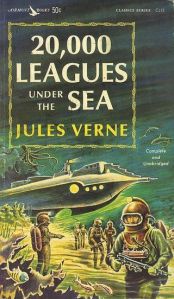 20,000 Leagues Under the Sea
This was a novel by the celebrated author Jules Verne, first published in serial form in a French magazine in 1869 and published in book form in 1871. The book is highly regarded as one of Verne’s greatest works and features a futuristic submarine, the Nautilus, years ahead of its time. The story concerns an American expedition to capture or destroy a huge sea monster terrorising shipping. The expedition meets the monster but professor Aronnax, a French marine biologist and master harpooner Ned Land are thrown overboard only to find the monster is actually a submarine. They are taken aboard and meet the ship’s commander, Captain Nemo.
The novel was made into a film in 1954 starring James Mason as Captain Nemo.
Finally
Many years ago, I decided to try and become a certified scuba diver. I joined a club and went for lessons at Warrington baths in Cheshire. I completed the course and it was a lot of fun, pottering about underwater with oxygen tanks in the baths. The final part however involved taking your mask off underwater, filling it with air and replacing it back on your face. I tried and tried but I could not do it; every time I ended up thrashing about having swallowed half of the water in the swimming pool. I even tried it a few inches under the water in the shallow end but sadly I always managed to inhale water so unfortunately I failed and never managed to gain certification.
Years later I bought one of those little action cams with an underwater housing and managed to make a short film about me swimming, not in a beautiful underwater coral reef location as I would have liked but up and down in a French swimming pool.
I’ve probably only scratched the surface on this fascinating subject. I could have mentioned the films Titanic and Raise the Titanic or even The Abyss. What was your favourite underwater film?
 Letters from an Unknown Author!
Pingback: 2025: My Blogging Year | Letters from an Unknown Author!