Not much has happened to me lately so it’s time to take a look back in time and see what kind of things have happened in April in the past.
1st April 1918. Formation of the RAF
 The First World War was still underway in 1918 but at least it was the last year of that terrible conflict. The new invention, the aeroplane, was used at the beginning of the war for observation. Aircraft would fly over enemy lines and pilots would fly back home and relay the new information back to the army HQ. Later, photography was used and photographic interpretation gradually became a new science.
The pilots began to take weapons aboard their flimsy aircraft and would take pot shots at each other in the air and then guns were attached to the aircraft themselves. In April 1915 Anthony Fokker produced an aircraft for the German air force with a machine gun synchronised to the aircraft’s propellor so the gun could fire through the arc of the rotating blades. Now the pilot only had to point his aircraft at the rival plane and fire. The war in the air had begun to escalate.
On 17th August 1917 South African General Smuts presented a report to the British Government that recommended that a new service should be formed combining the Air Force of the British Army (The Royal Flying Corps) and the similar service in the Navy (The Royal Naval Air Service). This meant that the underused resources of the RNAS could be immediately transferred over to the western front.
The two forces were finally amalgamated on the 1st April 1918 and by the end of the war later that year the new RAF became the largest air force in the world.
The RAF went on to be fundamental in preventing the Nazi invasion of Great Britain in the second world war. Winston Churchill famously said that “never before in the field of human conflict was so much owed by so many to so few.”
30th April 1945. Death of Hitler
On this date, the man who had single handedly created the madness of the second world war died by his own hand. April 1945 was a time of impending doom and despair in Berlin. Hitler and his staff had left the Reich Chancellery building and gone into the underground bunker where Hitler pored over maps and sent instructions to squadrons and battalions that were no longer in existence.
Göring sent over a message asking that as Berlin was surrounded, was this was the time for him, Göring, to take over the leadership. Hitler was enraged and ordered Göring’s arrest. More bad news came about Himmler, the head of the SS and a loyal Nazi. Himmler was trying to negotiate with the allies and had even sent a train load of Jews to Switzerland and freedom to show how serious he was. Hitler stripped Himmler of all his titles and offices and expelled him from the Nazi party. The same day, the 29th April, Hitler wrote his last will and testament.
Many staff urged Hitler to leave but he announced he was determined to die in Berlin before being taken by the Russians. Later that day he married his longtime girlfriend Eva Braun and a small wedding party commenced. The next day, the 30th, the sound of gunfire was all around and the Russian forces were close by. Hitler tested a poison capsule on his dog, Blondi and then he and his new wife retired to the bedroom. There, Eva Braun swallowed a poison capsule and Hitler shot himself in the temple. Their bodies were buried outside in a shallow shell hole.
Grand Admiral Karl Dönitz was Hitler’s nominated successor and he finally surrendered to the allied forces on 8th May 1945.
15th April 1912. Titanic Sinking
The story of the Titanic, the ship that hit an iceberg and sank in 1912, is one of those stories that seems to be forever in the news. It’s a story that seems to have caught the imagination of pretty much everyone. Numerous films and TV documentaries have been made about the disaster including the most recent one Titanic, written and directed by James Cameron in 1997.
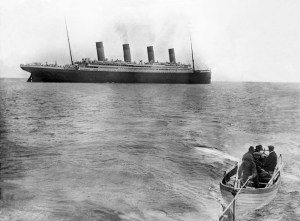
Last ever photo of the Titanic
The Titanic was designed to be the new premier ship of the White Star Line. It had been built By Harland and Wolff in Belfast and built alongside its sister ship the Olympic and was launched on the 31st May 1911 and was then towed to another berth where its engines and superstructure were installed as well as its majestic interior. The sea trials of the ship were undertaken on the 2nd April 1912, just eight days prior to leaving Southampton on its maiden voyage.
The Titanic left Southampton on the 10th April 1912 and stopped at Cherbourg in France to pick up more passengers before heading out across the Atlantic to New York. Four days into the voyage it hit an iceberg. On the night of the 14th April lookouts had been sent aloft to look for icebergs but their task was difficult. It was a moonless night and pitch black. The sea was very calm which meant that the lookouts could not see waves crashing against the icebergs that they had been warned to look out for. When an iceberg was finally spotted the lookouts rang down to the bridge and the officers there ordered the ship to turn hard to port. Some reports say that the engine room was ordered to stop engines which would not have helped the turn. Either way the ship brushed the iceberg and the resulting contact made a gash along the side of the ship and water rushed in.
The Titanic has several water tight compartments, 16 in fact and the ship was designed to stay afloat with four flooded but the resulting gash damaged at least five compartments. Not long ago I remember watching a TV documentary which claimed that the Titanic was put together with rivets made from defective iron which were brittle and snapped easily in the collision. Either way, the ship sank in the early hours of the 15th.
Over 1500 people lost their lives that night. The survivors, just over 700 people, were rescued by the RMS Carpathia.
12th April 1606. Adoption of the Union Flag
This was the day the first union flag became the official flag of Great Britain. It was the forerunner of today’s flag but in 1606 it only combined the English flag, the St George’s Cross and the Scottish flag, the St Andrew’s Saltire. The modern design came into force in 1801 when the red Saltire of Ireland was added when the Kingdom of Ireland joined the Kingdom of Great Britain.
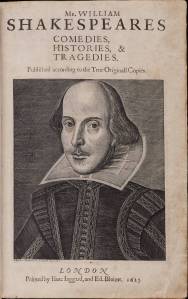
title_page_william_shakespeares_first_folio via creative commons
In some ways the British flag has become controversial as there are some who feel it has become a symbol of the extreme right wing in the UK. Recently a Raise the Flag campaign began in which ordinary people have placed thousands of Union flags on lampposts, bridges and other public places. Supporters feel the flag should be a symbol of national pride while others have linked it to anti-immigration causes. At the end of the day, we expect to see French flags in France and American flags in America. Why should we not expect to see British flags in Britain?
23rd April 1616. Death of Shakepeare
William Shakespeare died on this day in 1616. It is not sure how he died but he was 52 years old and the month before he had prepared his last will and testament. Fifty years after his death the vicar of Stratford wrote that Shakespeare expired after a night of drinking with Ben Johnson and Michael Drayton. Whether this is true or not is unknown.
Shakespeare was buried in the Holy Trinity church in Stratford two days after his death. The inscription of his grave bears a curse on anyone who moves his bones.
Incidentally, the 23rd of April is St George’s Day, St George of course is the patron saint of England.

