F1 in Numbers

A long time ago I wrote a post called Blogging by Numbers in which I wrote about various numbers that linked to the world of writing and blogging. This week I thought I’d try and do a similar thing with Formula One racing. I haven’t written much about the sport this year even though it has been quite an interesting season. Recently, Max Verstappen, who a few races ago was really out of contention for the World Championship, now seems to have caught up with the top two drivers, Norris and Piastri and it is even possible he could swipe the title from under the noses of those two, both driving for McLaren. Currently, Lando Norris leads Oscar Piastri by a single point so it looks like a three way fight for the title. Anyway, let’s take a look at those numbers.

1950

That’s a pretty good number to begin with. The world driver’s championship commenced in 1950 and the very first winner was Nino Farina who won the title after only 7 races. The very first race of the season was the British Grand Prix held at Silverstone and Farina won that one driving his Alfa Romeo.

5

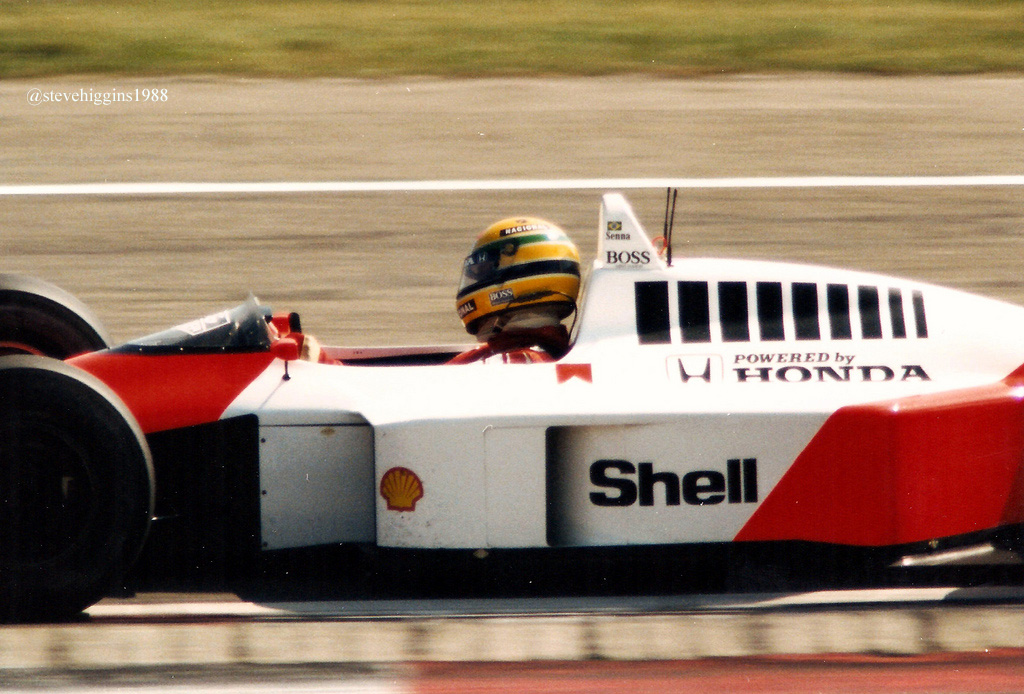
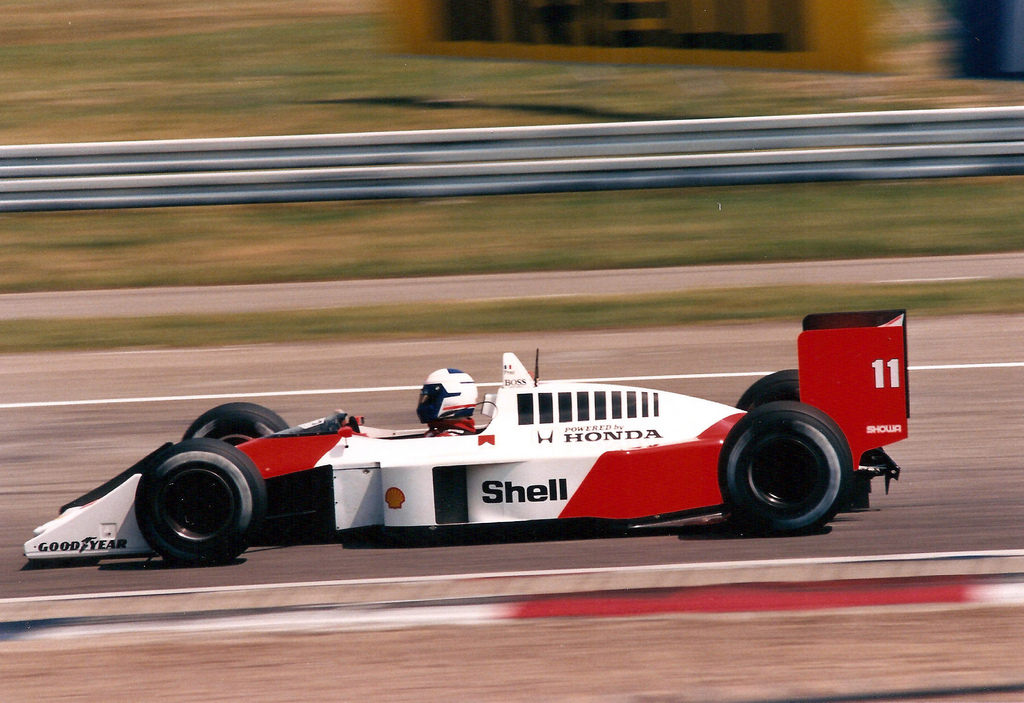
Nigel Mansell German GP 1988 photo by author

The famous Red Five was Nigel Mansell’s race number. In the 1980s Nigel Mansell, Ayrton Senna, Alain Prost and Nelson Piquet were a quartet that dominated the sport for many years. Piquet won three titles in 1981, 1983 and 1987. Mansell joined Piquet at Williams Honda in 1985. Honda felt that Piquet could have won the championship in 1986 if Williams had nominated a number one driver. Frank Williams declined to do so and so Honda withdrew their engines prematurely at the end of 1987 and began a new relationship with McLaren instead. Together, McLaren drivers Prost and Senna dominated the 1988 season winning every race between them but one. Williams were forced to use the engine of a privateer, John Judd, and were hopelessly outclassed. Mansell signed for Ferrari, the last driver to be personally signed for the famous team by the Commendatore himself, Enzo Ferrari.

Designer Adrian Newey joined the team in 1990 and with a new Renault engine the Williams team began to return to form. Mansell was tempted back to Williams from Ferrari. He won the world championship in 1992 but was dismayed to find that Frank Williams had signed Alain Prost as his team mate for 1993. Mansell had been teamed with Prost at Ferrari and was not happy at the way Prost schemed behind the scenes. Mansell declined to sign for the 1993 season and instead opted to move to the USA and compete in Indycars. There the Haas team made him a gift of his new race number, Red Five.

Fangio (Picture courtesy Wikipedia)

Still on the subject of number 5, that was the total of world championships won by the Argentine driver Juan Manuel Fangio. He was the original Formula One legend, the one everyone else spent decades trying to catch. He raced in the 1950s, when cars were twitchy beasts with no seatbelts and drivers wore polo shirts instead of fireproof suits. And yet, Fangio made it look effortless. He won five World Championships with four different teams, Alfa Romeo, Ferrari, Maserati and Mercedes, an incredible effort which no other driver got close to until Alain Prost won his fourth in 1993 and finally Michael Schumacher equalled in 2001.

Decades later, when people discuss who the greatest driver of all time is, Fangio’s name still floats effortlessly to the top, a reminder that grace and talent once shared the same racing seat. Fangio retired from racing aged 47; he died in 1995 aged 84.

105

Image courtesy Wikipedia ceative commons

Lewis Hamilton currently holds the record for the most ever Formula One wins, 105. The previous record was held by Michael Schumacher at 91. Hamilton’s last win was the 2024 British Grand Prix. It was also his last win for Mercedes. In 2025, Lewis Hamilton moved to Ferrari. With the exception of a single sprint race victory, he has yet to win a full Grand Prix.

7

The record for the most world championships is held jointly by Michael Schumacher and Lewis Hamilton. Many feel that Hamilton’s 7 championships should really be an 8. The result of the final race of the 2021 season, the Abu Dhabi Grand Prix, was controversial. Title contenders Hamilton and Max Verstappen both had 369.5 points coming to the race meaning that whoever won would take the title. It would either be Verstappen’s first or Hamilton’s eighth.

What happened was that Lewis Hamilton was leading the race but on lap 53 of the 58 lap race, there was a crash and the safety car came out. Mercedes realised there was no time to restart the race and so Hamilton would win behind the safety car. The Red Bull team decided to change the tyres of their driver, Verstappen, and he rejoined the field, still in second place but with 5 lapped cars ahead of him. The race controller controversially decided that the cars in front of Max, and no others, could unlap themselves and restarted the race with a final lap remaining. According to the rules there should have been a mandatory final lap behind the safety car but this was ignored and the race restarted for one racing lap. With fresh tyres Verstappen overtook Hamilton and won, taking his first world championship.

Various protests were made by Mercedes but the race result was upheld although the race controller, Michael Masi, was later sacked.

65

65 was the tally of pole positions made by Ayrton Senna which at the time of his death in 1994 was the record. Together, Senna, Alain Prost, and Nigel Mansell dominated most of the eighties and early nineties in Formula One racing. Mansell had left the stage for Indycar racing in the United States and Prost had retired, leaving Senna to take his vacant seat at Williams, or perhaps he retired because Senna had been offered a seat at Williams. Certainly, after the intense animosity that developed between the two at McLaren you can hardly blame Prost for not wanting to work in that same situation again.
Ayrton Senna 1988. Photo by the author

Those retirements left Senna in 1994 as the Elder Statesman of Grand Prix motor racing. Now that his two closest competitors had gone perhaps Senna had hoped that he could relax, let up the pace a little bit, just as Prost had thought in 1988 before Senna began to push him harder. But a new phase had begun for Aryton Senna, a new Young Pretender had appeared to challenge him in the shape of Michael Schumacher. Schumacher had won the first two Grands Prix of the year and Senna came to Imola for the San Marino Grand Prix without a single point. “For us the championship starts here,” he told the TV cameras, “fourteen races instead of sixteen.” Further pressure mounted on Senna when fellow Brazilian Rubens Barrichello was injured in a crash and then Roland Ratzenberger was killed, the first fatality at a Grand Prix meeting since that of Riccardo Paletti 12 years before.

In the race as we all know, Senna went off the track at Tamburello and was killed when a suspension arm, crushed in the impact, flipped back and injured the Brazilian driver fatally in the head.

1

I thought I’d finish with some one hit wonders, drivers who only ever won one race. According to my research there are currently 25 drivers who have won just a single F1 race. The most recent single race winner is current Alpine driver Pierre Gasly who won the 2020 Italian Grand Prix. Gasly started the race in tenth, but gained positions due to a well-timed pit-stop prior to a safety car. Lewis Hamilton, who led the race until this point, was given a penalty for entering the pit lane when it was closed and so passed the lead to Gasly.

Jean Alesi was a hugely promising driver who sadly signed for Ferrari just as they entered a very dismal period in the Italian team’s long history. His one win came in 1995 at the Canadian Grand Prix when he was running second to Schumacher in a Benetton and the German retired with a gearbox problem.

Peter Gethin courtesy creative commons

Here is one final one hit wonder and the winner was a driver you may never have heard of but the race he won has been considered by many to be one of the most exciting of all time. Peter Gethin was driving for Yardley BRM in 1971. Back then before the arrival of the chicanes, Monza, the venue for the Italian Grand Prix, was a super fast slipstreaming event.

Gethin in his BRM won the race from Ronnie Peterson in a March 702 by an incredible by 0.01 seconds. The top five were covered by just 0.61 seconds, with François Cevert finishing third and Mike Hailwood in his debut race for Surtees finishing fourth and Howden Ganley fifth. With an average speed of 150.754 mph, this race stood as the fastest-ever Formula One race for 32 years, until 2003. The following year, 1972, chicanes were added to the Monza circuit to reduce the ever growing speeds of the cars.

Gethin retired from F1 in 1974.


What to do next: Here are a few options.

Share this post on your favourite social media!

Hit the Subscribe button. Never miss another post!

Listen to my podcast Click here.

Buy the book! Click here to purchase my new poetry collection.

Click here to visit Amazon and download Floating in Space to your Kindle or order the paperback version.

Click here to visit amazon and purchase Timeline, my new anthology.

Three Champions of Formula One

I’m not a great sports fan. I’ve no interest in football and cricket does nothing for me but formula one racing is something I’ve followed since my school days. What I’ve always loved about racing are the true champions of the sport, those drivers that have gone down in the annals of motor sporting history as the greats. My own personal favourite driver and the driver who to me is the greatest driver ever, is Sir Jackie Stewart.

Jackie Stewart Image courtesy wikipedia

Jackie Stewart Image courtesy wikipedia

You’ve heard of course of the great natural talents of Ayrton Senna and also of the man known as the professor, Alain Prost and his intelligent and calculating approach to racing. Imagine then those two disciplines put together in one man, well if that were possible the result would be Jackie Stewart. Jackie has all the qualities of a great driver: Fast in qualifying, fast in racing. Fast in the dry, fast in the wet. He also has those other great qualities, car control and understanding of the car as well as a great race craft. You’ve heard of Michael Schumacher and his reputation as the rainmeister I’m sure but well before Schumacher was even a glint in his father’s eye Jackie was winning the foggy and washed out 1968 German Grand Prix by four minutes from his nearest rival. Four minutes! Can you believe that?

Believe it my friend because that was one of the great wet weather drives of all time.

My personal favourite of Jackie’s wins was the 1969 Italian Grand Prix at Monza. Monza at that time had still not been hampered by the chicanes that were to be added a few years later. It was a fast high speed track and the event was a slip streaming formula one sprint. Cars hurtled along sucking the following cars along in their wake and the following driver would use this slipstream to hurtle past. The trick to win the Italian Grand prix was to exit the last corner in second place, slipstream the leader and take the win.

In 1969 however wily Scotsman Jackie Stewart reasoned that if he added an extra-long fourth gear to his car the difference between hanging on to fourth for a while longer when his fellow racers were changing up a gear could enable him to win. In the race when the cars arrived at that all important last corner Jackie dived in front and exited in the lead. Jochen Rindt who was second, latched onto Stewart’s lead and was sucked up in his slip stream then ducked out to take the lead. His momentum eased momentarily as he flicked into fifth but Jackie hung on in his extra-large fourth gear and when Rindt slipstreamed past it was too late; they were past the chequered flag and Jackie had just won the race.

Senna by the author 1988

Ayrton Senna McLaren 1988 German GP

In 1988 two great drivers became teammates at McLaren-Honda, Ayrton Senna and Alain Prost. 1988 was a classic season for the Mclaren squad winning 15 out of the season’s 16 races but it could have been so different. The Williams team and their driver Nigel Mansell could have been in prime position to take the championship. The previous year, 1987, Mansell and team mate Nelson Piquet battled against each other and ultimately Piquet took the title but he had left for Lotus and Honda, who had been Williams’ engine partners for the previous few years had switched their allegiance to McLaren. The move had come a year earlier than had been planned and Williams were left in the lurch. Their relationship with Honda had soured when they declined to replace Nigel Mansell with Honda’s man Saturu Nakajima and they were forced to turn to a private engine manufacturer, John Judd. 1988 would not be their year. The McLarens were dominant. The only possible challenge could come from Lotus, the only other team with the unbeatable Honda engine. That challenge never appeared.

nelson Piquet Lotus 1988 German Grand Prix

Nelson Piquet Lotus 1988 German Grand Prix

Towards the end of the year, Lotus arranged for Jackie Stewart to test their car as part of a TV spot. Stewart, who had been retired for over a decade, took the wheel of the Lotus and almost straight away spotted the very issue that had dogged Lotus for the season. I well remember Peter Warr, the Lotus Team manager saying to TV cameras very diplomatically that Jackie had ‘correctly identified an issue the team were already working on.’ If only Jackie had tested the car earlier in the season, perhaps then they could have challenged the McLarens.

Jackie Stewart at Oulton Park in 1988 with son Paul

Jackie Stewart at Oulton Park in 1988 with son Paul

Three factors then cement Jackie’s position as one of the best drivers ever: his natural ability and car control, his affinity with the motor car and ability to translate that intuition back to the engineers and designers and his canny wisdom, intelligence and pure race craft. After he retired from the sport Jackie Stewart spent years as a PR man for companies like Ford. Later he built up his Stewart formula one team which later sold to Ford for it to become the Jaguar F1 team. Later still, Ford began to reduce its investment in motor sport and the team was sold again this time for it to morph into Red Bull Racing which won four world championships with driver Sebastian Vettel.

In later years Jackie Stewart and Ayrton Senna came together in a television interview where Stewart famously challenged Senna about his driving style and his collisions with other drivers. Senna brushed it off but later admitted that Stewart was right and that he had deliberately pushed Alain Prost off the track in Japan 1990. According to an interview with Stewart in the Daily Mail, Senna apologised to Jackie before admitting to the press what he had done.

Alain Prost Mclaren 1988 German Grand Prix

Alain Prost Mclaren 1988 German Grand Prix

Alain Prost, like Jackie became a team owner in the late 1990s with Ligier, renaming it Prost Grand Prix. Sadly the team went bankrupt in 2002.

Senna and Prost as is well known, had numerous battles together on and off the race track. Prost left McLaren believing that team boss Ron Dennis supported Senna rather than him and left to drive for Ferrari. He joined Williams in 1993 but declined to partner Senna in 1994 and retired from driving.

Ayrton Senna was killed in the 1994 San Marino Grand Prix. In formula one the event is known as ‘Black Sunday.’ Happily, Prost and Senna were reconciled in the days before the tragedy. Senna had done an in car lap of the race track for French TV  and Prost was working there as a TV pundit. Senna passed a message to Prost saying ‘we miss you Alain.’

The death of Senna and Ratzenberger at Imola were the first formula one tragedies for over twelve years and that was due in no small way to the campaigns began in the 1970’s by Jackie Stewart for better safety in formula one.


What to do next:

Share this post on your favourite social media!

Hit the Subscribe button. Never miss another post!

Buy the book! Click here to visit Amazon and download Floating in Space to your Kindle or order the paperback version.

Touching The Glass

The 2014 formula one season is well under way and like me, many people must speculate about those who race these incredible machines at such high speeds. Measuring high speed lap times against car control and the desire to go ever faster is the juggling act performed by the Grand Prix drivers every time they step into their high-tech carbon fibre cockpits. The consequences of a mistake can range from an embarrassing spin in the gravel trap to a cruel death.

sennab copyeditbbThis year, 2014, marks the twentieth anniversary of the death of Ayrton Senna, one of the greatest racing drivers of all time. Aryton was killed on the 1st of May 1994 at the San Marino Grand Prix at Imola in Italy. Anyone who knows anything about motor sport can tell you that. The date lingers in the back of the collective mind of all racing fans, along with other tragedies of the sport, like the deaths of Gilles Villeneuve and Jim Clark to name but two. Clark’s death is unexplained to this day. His formula two Lotus left the track at an easy, straight section of road. The facts of Villeneuve’s accident are well known -he crashed into a slow moving car- but his death is perhaps only really explained under close analysis. Villeneuve was on a slowing down lap, on his way back to the pits after a handful of fast qualifying laps but still, he kept the hammer down, his right foot pressed down to the floor when there was no real need for absolute speed. So why? Why was he going so fast?

One answer is simply that was the way he drove; fast. Foot down to the floor. Full stop. Another was that he was still estranged from team mate Didier Pironi, who he thought had unfairly beaten him in the previous Grand Prix at San Marino in Italy. The two had diced together for the length of the race, team leader Villeneuve thought they were putting on a show, Pironi thought they were racing. When Pironi took the chequered flag it was an act of betrayal, or so Villeneuve thought and when they arrived at Zolder for what would be Villeneuve’s last Grand Prix, Villeneuve was still seething. And so perhaps that state of passion was a factor on his last lap.

For Ayrton Senna in 1994 that intense rivalry with a fellow driver seemed to be a thing of the past. Together, Senna, Alain Prost, and Nigel Mansell dominated most of the eighties and early nineties in formula one racing. Mansell had left the stage for Indycar racing in the United States and Prost had retired leaving Senna to take his vacant seat at Williams, or perhaps he retired because Senna had been offered a seat at Williams –it depends on which story you believe. Certainly after the intense animosity that developed between the two at McLaren you can hardly blame Prost for not wanting to work in that same situation again.

So now, the Young Pretender had become the Elder Statesman of Grand Prix motor racing and his two closest competitors had gone. Perhaps he even hoped that he could relax, let up the pace a little bit, just as Prost had thought in 1988 before Senna began to push him harder. But a new phase had begun for Aryton Senna, a new Young Pretender had appeared to challenge him in the shape of Michael Schumacher. Schumacher had won the first two Grands Prix of the year and Senna came to Imola without a single point. “For us the championship starts here” he told the TV cameras, “fourteen races instead of sixteen.” Further pressure mounted on Senna when fellow Brazilian Rubens Barrichello was injured in a crash and then Roland Ratzenberger was killed, the first fatality at a Grand Prix meeting since that of Riccardo Paletti 12 years before.

Many sources have said that after these twin disasters Ayrton did not want to race in the Grand Prix. It is hard to believe, Senna -not wanting to race? The man for whom racing was everything? Could it be that he was finally becoming more like his once deadly rival Alain Prost? Prost had always put his own life before winning motor races and as a consequence had driven a dismal race at the rain soaked 1988 British Grand Prix and completed only a token lap at the similarly affected 1990 Australian Grand Prix. Events may have pushed Ayrton’s thinking from the neutrality and detachment of the past towards a greater concern, a concern beyond the continual winning of races.
Whatever his inner feelings he started the San Marino Grand Prix in his usual fashion, leading into the first corner from pole position. Behind him though, JJ Lehto stalled his Benneton and was hit from behind by Pedro Lamy. Lesser events had stopped races in the past but on this occasion the organisers sent out the new safety car and the grid cruised round after it in formation for five laps while the crash debris was removed.

At the end of the fifth cruising lap the safety car pulled off, the lights turned to green and Senna, Schumacher and the rest floored their throttles. The Williams was not handling well and it felt nervous through Tamburello, that evocatively named but most dangerous of corners. Still, Senna kept ahead of Schumacher, he kept the hammer down. On lap six the Williams entered deep into Tamburello and Schumacher saw the spray of sparks as the car bottomed out and side stepped slightly. Senna caught and corrected the Williams and throttled onwards for the charge down to Tosa, the next bend. Both Senna and team mate Damon Hill knew their cars were nervous and to a certain extent unsuited to the bumpy surface at Imola. Someone like Alain Prost might have eased off slightly, settled for second or third, collected some points, and used the rest of the San Marino Grand Prix as part of a learning curve, collecting mental and electronic data to develop the car into another Williams race winner. For Ayrton Senna, a third defeat by Michael Schumacher was not acceptable. Putting points on the scoreboard held no interest for him either, except for the ten points that came for a win.

The next time round Ayrton entered Tamburello at 192 mph. We know his exact speed from his car’s electronic management system, which records such data. Tremors went through the car as it bottomed out again on the undulating track surface. This time Senna couldn’t catch the Williams, or perhaps something failed on the car. Later on the steering column was found to be fractured. Did it fail before the crash or was it damaged in the impact?. Some have speculated that his tyres were not up to pressure after many laps circling the track at low speed. We will never know. Whatever happened, the car went straight on towards the tyre barrier masking the concrete wall that lay behind. Senna’s last act was to slow the car down to 131 mph, but it was not enough.

I have never met Ayrton Senna. The last time I had seen him, in person, was at the Silverstone tyre tests of 1991 and even then he was a blur of yellow in the red and white of his McLaren. To understand someone we have never known is not an easy task. Sometimes we can only do so by looking into ourselves and searching for similar experiences. A long time ago, I must have been eight or nine, my Mother took me to visit my Grandmother. Sitting alone in the lounge while the two women gossiped in the kitchen, I became fascinated by my Grandmother’s new fireplace. It was a coal fire and the fire glowed dormantly behind a glass door. A real fire was not new to me, indeed we had one at home but the glass door seemed to attract me, so much so that I reached forward and held my hand a fraction of an inch from the glass. On an impulse I reached out further and put my hand on the glass. As you can imagine, I recoiled in agony having burnt my hand.

That moment, in 1994, as I watched my television images in disbelief, I came to think of that small boy, reaching out towards the glass door that enclosed a coal fire almost as one with Ayrton Senna, reaching towards the barriers of absolute speed, touching the zenith of his car control and going ever so slightly over his limits. He had done it before and had come back from the brink. Indeed it may have even been vital to him to occasionally push and go over his limits just to fix in his own mind where those limits lay. Ayrton was a man who could learn from his mistakes and could go on to better and faster things, but on that tragic day fate stepped in and stopped the process. A suspension arm crushed in the impact sprang back and hit Ayrton, piercing his most vulnerable point, the visor of his helmet.

sennab copy

Senna at the German GP 1988. Photo by the author.

Prost and Stewart, two of the all time greats of motor sport were men who came closer than anyone to touching the glass -without ever being burned. Perhaps that was their secret. Stewart was a man in absolute control of his skills as a racing driver, both on and off the track. After three world championships and twenty-seven grand prix wins Stewart was able to say goodbye to it all without ever looking back. What other driver can boast of doing that? Schumacher retired again after a disappointing comeback only for tragedy to strike while skiing. The careers of both Nelson Piquet and Gerhard Berger fizzled out inconsistently at Benneton. Mansell called it a day after joining McLaren and then realising that their epic run of success had run out of steam. Alain Prost retired after cantering to his fourth championship. It was clear that in Prost’s final year he was no longer willing to push hard. The motivation of his youth had evaporated with the grand prix seasons and with the relentless high-speed sprints of formula one. The day had arrived, as it will no doubt one day arrive for Hamilton, Alonso, and Vettel, when he was no longer trying to touch the glass.


If you enjoyed this post why not try my book Floating in Space, a novel set in Manchester 1977. Click the links at the top of the page for more information.