 I haven’t done an F1 post for a while so I reckon it’s time for a new one. F1 in 2023 seems to promise much but so far has failed to deliver. Red Bull seem to be winning everything which is great for them but makes things a bit boring for the average F1 fan. It’s in times like these that I tend to look back to the past for a little F1 drama.
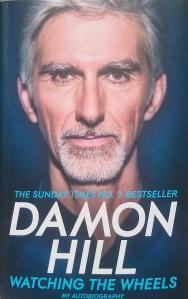
Damon Hill is not exactly my favourite racing driver. He pops up these days as a pundit on Sky TV’s F1 coverage and I’m sorry to say that I tend to fast forward past him until I find someone a little more interesting to listen to. Back in the day when he beat Michael Schumacher to the F1 world title in 1996 I cheered for him but even then, that was mostly a reaction to the tactics of the highly ruthless Michael Schumacher. Anyway, when Liz handed me a copy of Damon’s autobiography, I thought it might be worth scanning through.
Hill starts his story not with himself but with his celebrated father Graham Hill. Hill was a great driver, a double world champion but also one of the great, if not the greatest, characters in the sport. What F1 fan would not instantly recognise the prominently chinned and moustached Graham Hill with his swept back hair and his witty and straight to the point remarks?
Graham didn’t even pass his driving test until he was 24 yet went on to win two world championships. He began by seeing an advertisement offering some laps of Brands Hatch in a racing car for five shillings. He went along, paid his money and subsequently was hooked on motor sport. He got himself a job working as a mechanic for Colin Chapman’s Lotus team and soon talked his way into actually driving one of Colin’s cars.
In the 1960’s, Colin’s star driver was Jim Clark, one of motorsport’s absolute greats. Jim was universally respected as being the star driver of the day and won the world championship for Lotus in 1963. In that year Jim won seven of the year’s races (there were only 10) a record that stood until 1984 when Alain Prost won seven races for McLaren.
Graham Hill had left Lotus for the BRM team and won his first world championship in 1962. In 1967 Hill returned to partner Clark in Colin Chapman’s new Lotus 49 powered by the new Ford Cosworth DFV engine.
In 1968 Clark was entered in a Formula 2 race for Lotus at Hockenheim in Germany. In those days, F1 drivers regularly competed in other events apart from F1 including sports car racing, saloon cars and of course, Formula 2. During the race, Clark’s Lotus veered off the track into trees and Jim suffered a broken neck and was killed. A deflating rear tyre was thought to be the cause of the crash but the racing community was devastated. Clark was a quiet unassuming Scotsman, born into a farming family but is still remembered today as one of the greats of all time.
The Lotus team looked then to Graham Hill to lead them forward into the next round of F1 races and despite initial difficulties with the car and engine, Graham was able to win his second championship title. In 1969 he suffered a terrible crash in the USA when, after getting out to push his car after a spin, he jumped back into the cockpit but was unable to fasten his safety belts. He crashed and was thrown from the car breaking both legs. He later drove for Brabham and finally started his own F1 team with sponsorship from Embassy cigarettes. He was killed in a plane crash in 1975 along with key personnel from his team.
In Damon’s book, he gives an interesting insight into the events above, telling them from a son’s point of view. He knew many of the great drivers and team bosses of the time, meeting them as a child and he tells of Graham’s life from a family perspective; Dad being away from home a lot and always being so busy. He was the first to hear of his father’s death, seeing TV reports of a light aircraft crash just when the family was expecting him home. Graham was an accomplished pilot and owned his own Piper Aztec light aircraft. He had flown back from testing his new car in France but when he arrived back at Elstree, the weather was cold and foggy and he crashed on his final approach killing all on board. Not only was Damon distressed about the loss of his father but he resented the press who reported on not only the plane crash but also the subsequent funeral.
 After Graham’s death it was found that his pilot’s license had expired and this and some other things invalidated his insurance which meant that the other families who had lost loved ones in the crash were forced to sue Graham’s estate for compensation. This meant the Hills had to sell their home and move to a smaller house. These things seem to have weighed on young Damon’s mind for a long time, even into his own days as a racing driver.
Damon initially took up motorcycle racing and worked in a variety of jobs to fund this, including being a motorcycle courier. Later his mother arranged for him to take a course at a car racing school thinking cars would be safer than motorbikes and so Damon began his career in car racing. In his book he describes the difficulties of getting drives and wrestling with the issues of bringing money to the table through sponsorship.
He managed to get drives in Formula 3 and then Formula 3000 and I personally saw Damon quite a few times at Oulton Park in the late 1980’s. I remember meeting his mum in the paddock at Oulton Park when I was photographing her son’s car. She went off to bring Damon back for a picture but alas, she wasn’t able to find him.
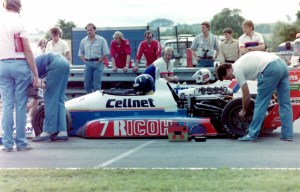
Damon at Oulton Park. Photo by the author
Damon struggled with the issues of sponsorship as many race teams were looking for drivers who could bring personal sponsors into a team but Damon was able to get himself a F3000 drive which also led to an F1 drive with the faltering Brabham team. At the same time, he had also replaced Mark Blundell as the test driver for Williams. After a difficult year with Brabham, Williams were having a tough time with their driver line up. Mansell had won the world championship in 1992 but he wasn’t happy about having Alain Prost as a team mate in 1993. Williams were still expecting Nigel to drive for them, after all he had just won the title, but Mansell decided to up sticks and go to the USA to drive in Indycars. Williams signed Prost and Hill got the promotion from test driver to full time driver for the 1993 season.
1993 was an interesting season. The Williams was without a doubt the best car of the field but Prost had just come back from a season out of the sport and was on a learning curve with the new car while Hill, who had been testing was actually pretty familiar with it.
Prost won the championship and Damon scored his first win but for 1994 Frank Williams had signed Ayrton Senna and Prost decided he wasn’t going to work with Senna again and promptly retired. That left Damon to partner Senna. In 1994 active suspension, a system where the suspension and ride height of the car was controlled by an onboard computer, was banned and the car had become rather difficult to drive. When the team came to Imola that year, Senna had scored no points at all and was desperate for a win. Damon says he had not settled into the team well and he was clearly still trying to get used to the way the Williams team operated. In the race Senna had a major accident.
Damon passed the scene of the crash, not knowing it was serious and felt for Senna thinking it would be three races in a row without points for the Brazilian driver. When the race was stopped he sat in his car on the grid waiting for information but little was forthcoming. Later, the team’s press officer advised him that things were serious but it was only after the restarted race had finished that news came through that Senna was indeed dead.
It was almost a familiar scenario to that which Graham Hill had experienced in 1968. The team leader had been killed and Graham had to step up and lead the team. Now Damon had to do the same.
Damon Hill won the world championship in 1996 but his team boss Frank Williams had for whatever reason decided Damon was not the driver he wanted for 1997 and his contract was not renewed. Damon ended up driving for Arrows in 1997 which he thought was a middle of the grid team trying to move up to the front. It turned out to be a back of the grid team, trying to move up to the middle. Damon won once more for the Jordan team and then retired. In some ways it almost seems that Damon had his F1 career in reverse, he started at the top and then drove for lesser teams until he decided to call it a day.
Damon’s book is not one I really fancied but in fact it was really a pretty good read. His younger years as the son of the great Graham Hill are fascinating, especially his behind-the-scenes motorsport memories. His recollections of his early racing days and the complexities of sponsorship and his experiences of F1 also make great reading. The book falters a little when Damon tries to interest the reader in his problems with depression, brought on possibly as a result of losing his father in such a tragic way, however, I do feel I have a little more respect and time for Damon and perhaps in future, when he comes on my TV screen as an F1 pundit, I might not be so quick to fast forward past him.
 Letters from an Unknown Author!