Books are one of the great loves of my life and when I go on holiday, one of the delights of lying under a warm sun on my sun bed is a good undisturbed read. I read a lot at home but some books, as we all know, are just made for a really long, uninterrupted read.

I’ve just returned from a holiday in France and I thought I might share the contents of my ‘book bag’ with you. I’m a really big second hand book buyer and I buy my books from many sources. Second hand book shops, car boot sales, charity shops and of course, the internet. Even the occasional book comes my way as a gift. Anyway, without further ado, here are my holiday books:
Death in the Clouds; A Hercule Poirot Mystery by Agatha Christie
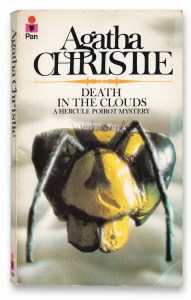 I do like a good crime read and for a long while I’ve been wanting to try a book by a writer who is the acknowledged master (or mistress) of the crime mystery genre, Agatha Christie. Agatha wrote over 66 detective novels as well as numerous short stories and created the famous detectives, Miss Marple and Hercule Poirot. I picked this book up ages ago at a second hand book shop and recently found it filed away in a box of books unread. Perfect for a holiday read I thought.
The murder happens on board a flight from Le Bourget to Croydon. A woman is found dead just prior to landing and Hercule Poirot travelling on the same flight sees that she has been murdered, possibly from a poisoned dart. A further investigation finds a blowpipe hidden on the aircraft so clearly the culprit must have been one of the passengers, but who?
This was a short read but a very entertaining one and very well thought out and put together. The author introduces her cast of characters, all passengers on the fatal flight and scatters various clues throughout the book. Once the flight arrives in England Poirot begins his investigations alongside Inspector Japp of Scotland Yard and an officer of the French Sûreté but of course it is Poirot who ultimately unmasks the murderer.
I was pleasantly surprised to find this was a short but highly enjoyable read. I must look out for more of Agatha’s books.
Death of a Village: A Hamish Macbeth Mystery by MC Beaton
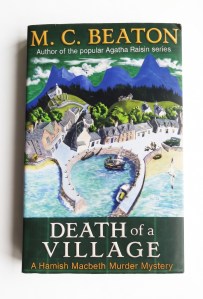 Some time ago I set myself the task of reading all the Hamish Macbeth books written by author MC Beaton. I haven’t read one for a while and I thought this would be a good opportunity to read another. Quite a lot happens in this story, the 18th in the series. Hamish as usual has to solve various issues but of course needs to avoid promotion so he can stay in his beloved village of Lochdubh. He has to deal with a husband beating wife, an old people’s home that seems to be murdering its residents and an entire village that seems to be behaving oddly. Nice to see a little more personal stuff thrown in about Hamish. He’s still pining for his old girlfriend who is about to marry someone else but at least he seems friendly enough with reporter Elspeth although romance doesn’t seem to be blossoming for the couple yet.
As usual, an entertaining read but the main story about the village was a little bit farfetched.
Eve’s Hollywood by Eve Babitz
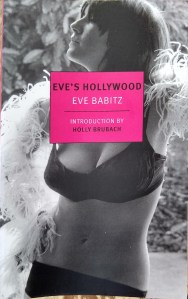 I ordered this from an online bookshop after reading another of Eve’s books Slow Days, Fast Company. Eve was born and bred in Hollywood and worked as a writer and artist. She designed album covers for a while and wrote essays and articles that were published in magazines like the Village Voice, Cosmopolitan and Esquire.
I picked up this book because I mistakenly thought the title referred to Hollywood as the centre of American film making rather than the place where Eve grew up. The book is actually a series of essays and thoughts about her life growing up and living in Hollywood both as a child and as an adult. Eve talks about the people she meets and gets involved with. The book is really a sort of wandering stream of thoughts going off in various directions and although parts of it are interesting, for the most part I just wanted to get to the end. I read another review of this book on Goodreads and the reviewer said that reading Eve’s Hollywood was like hopping along the stepping stones of Babitz’ memories and not stopping until you reach dry land. I couldn’t agree more.
The sure sign of a book that fails to keep my attention is when I pick up another book and begin to read that one instead.
Sorry Eve but this just didn’t do it for me. It was a bit of an up and down read with passages that were really fascinating and others that just couldn’t get me interested.
American Prince: A Memoir by Tony Curtis
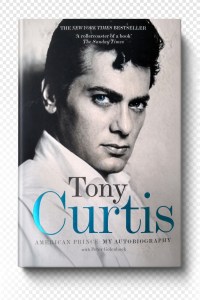 This was a little more in my line. I am a great fan of film and cinema and especially Hollywood. This is Tony Curtis’ own account of how he made it as a film star in Hollywood and it was interesting reading. Curtis clearly loved the film business and being a part of it and he seems to have especially loved his fame and success. The other thing he loves is women and to a certain extent this is a sort of voyeuristic journey through Hollywood and the stars (and non stars) that he has loved and bedded. One particular woman he married after being captivated by her beautiful breasts so I can’t say I was surprised when that one didn’t work out.
Tony spends a lot of time detailing his relationship with Marilyn Monroe, seeming to imply they were in love or at least close to being in love but their careers gave them little time for relationships. Later when the two made Some Like it Hot Together Tony goes to great lengths to explain his famous remark that kissing Marilyn was like ‘kissing Hitler’. Apparently, so he says, it was a sarcastic response to some crew member asking what was it like to kiss Marilyn. Obviously, so he says, it was great so he sarcastically responded with the Hitler comment.
Well I’m sure I’ve seen him years ago on TV actually denying he ever said it. Anyway, it was a good read and I loved hearing his stories about Sinatra, Kirk Douglas, Janet Leigh (wife number 1) Monroe and many more.
In the 1970s Tony was determined to keep working and making money and so when the film work dried up he appeared in the TV show The Persuaders with Roger Moore. He didn’t get on well with Joan Collins who starred in one of the episodes but Moore became a great friend. What is really interesting about Tony Curtis’ body of work is that even though he has given great performances in classic films like Some Like it Hot, Spartacus, and The Sweet Smell of Success, he has also appeared in some really poor features.
Anyway, his ethic seems to have been to keep working no matter what and even if the film was poor, he gave his absolute best.
Verdict: A great read even though Tony comes over as being obsessed with women but then again, it’s his story, and he certainly doesn’t seem to have been short of them.
What have you been reading this summer?
 We arrived in France at the end of August. The weather in the Loire was lovely and the only cloud on our horizon was that our favourite gite in France, a lovely villa which we regularly rent, was booked on the exact week we wanted it.
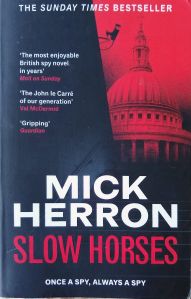 This book was on a shelf in my late brother’s lounge and I picked it up when I went to clear his place out after his death. Despite all the praise and good reviews on the back cover, I really found it hard to read. It’s about a group of people who work for the UK intelligence service and all of them are either out of favour with the service or have fouled up in some way. They are all assigned to Slough House instead of the main HQ and they are all a bit fed up and disgruntled.
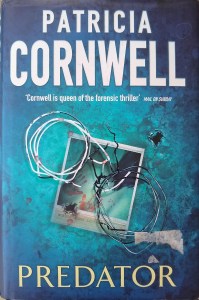 Author Patricia Cornwell first introduced Medical Examiner Kay Scarpetta in the book Postmortem originally published in 1990. The character is an Italian American. She is a perfectionist and workaholic and lives in a custom-built home where she cooks many Italian meals while she ponders her cases. She also, and perhaps this is me looking at the character from a UK perspective, seems to be overly obsessed with guns although on one occasion, having a gun under her pillow in the bedroom saves her life. In the first book Scarpetta has to deal with a series of murders and works with Benton Wesley from the FBI to create a profile of the murderer. The book also introduces DNA testing as a new technique and later Scarpetta hatches a plot to flush out the murderer. The murderer however, targets Scarpetta herself but is shot dead by policeman Pete Marino.

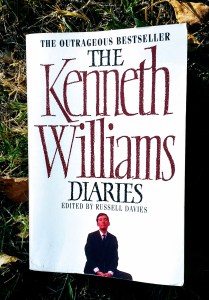 I’ve always rather liked Kenneth Williams, the slightly over the top star of many a Carry On film as well as many radio comedy shows, however it did feel rather odd reading his private thoughts through his diary, although sometimes it was hard to keep track of what was happening. In a lot of the diary entries Kenneth refers to people by their initials rather than their name. The habit of using initials can be rather annoying as the editor will mention in one of the many footnotes that SB for instance refers to his friend and fellow performer Stanley Baxter. Later on, SB will turn up again and I find myself flipping back through the footnotes because I have forgotten who SB was.
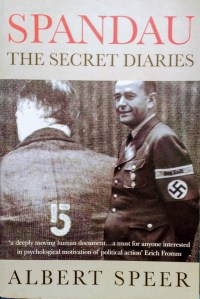 Albert Speer was Hitler’s armaments minister and favoured architect and this book is made up of diary entries he had secretly smuggled out of Spandau prison where he was incarcerated for 20 years after the Second World War. Speer admits he was one of those people seduced by the power of Hitler’s personality. Looking back at Hitler today in grainy old black and white films, it is hard to understand how this strange and dour man who ranted and raved while speech making could seduce anyone, however many have testified to the startling power of his personality. I remember watching that interesting BBC documentary ‘The Nazis: A warning from History’. In one segment various people were interviewed who declared their youthful love for Hitler; a young girl who looked into his eyes and saw goodness or an old man who testified he had once seen the great side of Hitler. Sadly Hitler let them down and many more like them. Speer maintained that he knew nothing of concentration camps and the final solution but author Gitta Sereny claimed in her book Speer: His battle with Truth that Speer knew more than he let on.
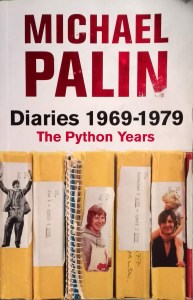 This is the first of Michael Palin’s diaries and it’s been pretty interesting, especially being a fan of the TV show Monty Python. Anyway, Palin started his diaries soon after packing in smoking. Perhaps it was a way of helping get over his tobacco addiction, or perhaps not. The diaries also begin just as Monty Python, the comedy TV show, was starting and Palin mentions this in his introduction, his aim not to record the start of the ground breaking comedy but more to record things about his new family, his wife having recently given birth to their first child.
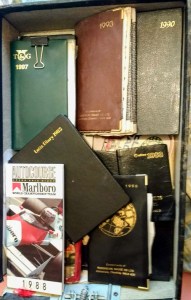 My diaries are definitely not for publishing. Looking back at them I notice that whenever something interesting has happened to me I have never written about it at the time, it has always been some time later when I have set down my feelings about the incident, whatever it may have been. The diary may be a confessional for some people but for me, as I said earlier, I started writing a diary as a way of making myself write when I couldn’t think of anything else to write about. In the early 2000’s I started writing a diary on my laptop, only to lose all my recollections from 2005 to 2006 when the file somehow became corrupted and refused to open. I was quite excited when the latest version of Microsoft Word came out because it gives you the option to repair a damaged file. Alas, that option would not work on my diary file. Then of course there are my big boxes of pre-2000 diaries. What shall I do with this lot I wonder? Will they add something to social history or grace the rubbish tip when I’m gone?
 The first thing that comes to mind when one thinks about spies and espionage is probably James Bond, perhaps not the version of Bond as written by Ian Fleming but more the version given to us by the producers of the Bond films and portrayed by a succession of actors like Sean Connery, George Lazenby, Roger Moore and latterly Daniel Craig.
 I was probably first introduced to Tinker Tailor Soldier Spy by the 1979 TV series starring Alec Guinness as George Smiley. In the story Smiley has retired but he is brought back into the intelligence fold after Lacon, the senior civil servant responsible for the service, asks him to investigate a story that has been brought to him by a missing agent named Ricki Tarr. The story concerns a ‘mole’ working for British Intelligence but passing information to the Soviet Union.
 Kathy Burke plays Connie Sachs, an old Soviet watcher who became convinced Soviet diplomat Polyakov was a spy but her idea was rejected by the new Circus leaders but Smiley realises Connie might have been on to something. There are various suspects for the mole and they have all been given code names by Control; Tinker, Tailor, Poorman and so on. Control expected Prideux to come back with a code word but he did not and by the time he was exchanged and returned to the UK, the poorly Control had passed away.
 I’ve always been a writer, even as a school kid I was writing stories and screenplays. I used to write scripts and do all the casting. Not sure whether Steve McQueen would have appreciated the roles I was planning for him though.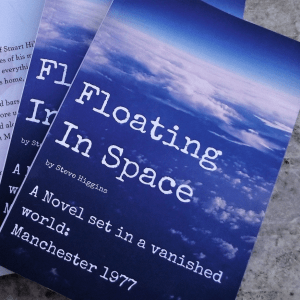
 Well, more of the same really. I’ve begun to work on a follow up novel to Floating in Space but a novel is hard work and I sometimes wonder if I’m up to the task. Even my latest book, Timeline, which is just a collection of stories and blog posts was pretty hard work. The big problem is just me, being motivated and just getting myself geared up to work and write. Writing short stories is much more enjoyable and I’m really pleased at how my stories have turned out. A few are available for readers to download and enjoy, just click on the download link above.
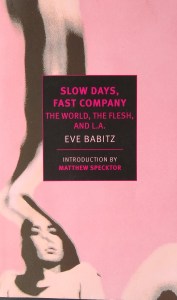 Slow Days, Fast Company
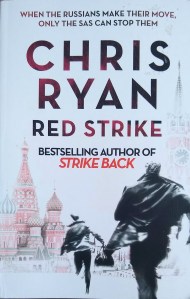 Red Strike by Chris Ryan
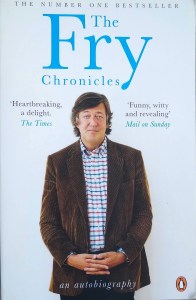 The Fry Chronicles by Stephen Fry
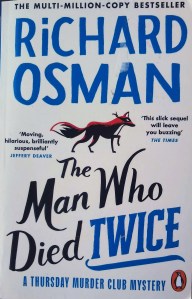 The Man who Died Twice by Richard Osman
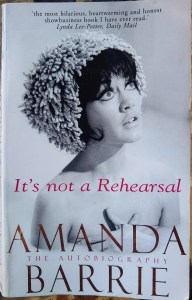 Amanda appeared in Coronation Street for a number of years but I’ve always known her as the girl who played Cleopatra in the Carry On film Carry on Cleo, you know, the one where Kenneth Williams says ‘Infamy, infamy; they’ve all got it in for me!’
 Fry reveals his thoughts about homosexuality and his feelings, either obsession or lust over a boy at his school. Fry went to a public school which confusingly for our American readers is actually a private school. Actually, a private boarding school which eventually Fry was expelled from.
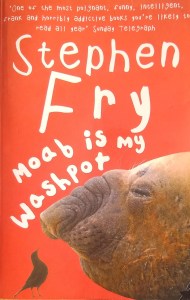 When I was a child I used to have, just like Stephen Fry, lots of daydreams and fantasies. One of them was that the school would be taken over by terrorists and that they would be methodically trying to find someone who was actually a secret agent. That secret agent of course would be me and after biding my time I would, just like Bruce Willis in the Die Hard films, sort out the terrorists one by one. My daydream would usually be shattered by one of the teachers asking me a question like ‘how many degrees in a right-angled triangle?’ and I would suddenly be brought down to earth and desperately try to answer before revealing the inevitable truth that I had not been paying attention.
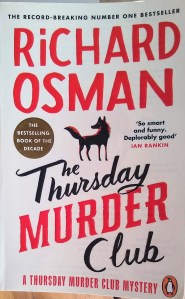 I know I’ve written about this first book already but as it’s part of this month’s holiday read, I feel I have to talk about it once again. As I mentioned in a
 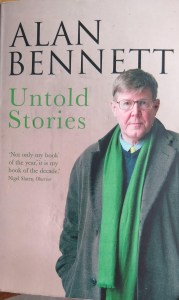 I sought this book out on the internet after reading Bennett’s The Lady in the Van which was a very enjoyable although short book. This volume is a collection of various essays and diaries by the author and it begins with the title essay, Untold Stories which is a series of observations mostly about his mother and father. He describes the life of his family in Yorkshire as he saw it evolve. It is perhaps a very ordinary story of a working class family and their fairly uneventful journey through life. It is very sharply observed and the author takes us through the lives of not only his parents but also of his two aunts as well as other family members. I found this section hugely interesting and with many parallels to my own life, especially when Bennett deals with his aging parents and he has to take them to numerous hospital appointments. His mother suffered with depression and was even hospitalised on a couple of occasions. Later in life she begins to suffer with dementia.
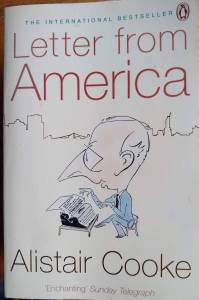 I picked this book up in a sale ages ago, in fact actually a few years ago. I think it was one of those offers like ‘buy two and get one free’. This was my free choice and as such it’s been lying around waiting to be read. It’s a collection from the author’s radio series ‘Letters from America’ which used to be broadcast many years ago on BBC Radio 4. I can’t say I’ve ever listened to the broadcast but I do remember watching a quite exceptional TV documentary series called ‘Alistair Cooke’s America’ which detailed the history of the USA.
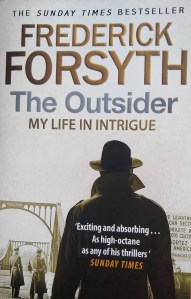 This is not one of Forsyth’s thrillers but an autobiography and it was a really interesting read. Forsyth spoke many languages and he puts this down to learning them with local people. He studied French and German at school of course but then spent the summer holidays in France learning from a French family and then later did the same with a German family and even later with a family in Spain. His observations in France were really interesting. The French welcomed Forsyth as an English hitchhiker with the union flag on his backpack but later when travelling in what had been Vichy, France, he felt the English were not as popular.
 As usual Liz and I have left behind cold and unpleasant England for the much warmer climes of Lanzarote. We’re renting a place that we first found two years ago but were unable to rent last year as it was fully booked. This time Liz got in early and so here we are for four weeks. The villa is very comfortable with a great outlook, sunny on the patio all day and it has a great pool and comfy outdoor couches.
 In March I was getting a little stuck for ideas and I had to recycle an old post,
  I’ve written many posts about books and a regular series is one in which I compare books to their filmed counterparts. In August I added a post about one of my favourite book/film series,

