My Holiday Book Bag Summer 2025

One of the great things about having a lazy relaxing time in France is that I have plenty of time to settle down after a meal or a swim and have a long relaxing read. Here are a few more of my holiday reads.

The Eagle has Landed by Jack Higgins

I’ve seen the film of this numerous times and although it isn’t a particular favourite I’ve always enjoyed it. My brother died earlier this year and when I cleared his flat out, I noticed this book. He had urged me a number of times to read it as he said it was rather different to the film so I brought it along on holiday and thought I’d give it a read.

It actually reminded me a little of The Day of the Jackal, in that the book focusses mainly on the preparations for the operation and the action only occupies a small portion of the book.

In the opening pages Hitler has a rant about various things but praises the operation of Otto Skorseny who brilliantly freed the Duce, Mussolini, from captivity and brought him to Hitler. He chastises Admiral Canaris for not being able to do a similar operation such as kidnapping Churchill and Himmler, always wanting to please his Führer, takes note.

Canaris feels he has to placate Hitler and following on from a comment from Himmler decides to put forward a feasibility study. He assumes Hitler will forget about the whole project but Himmler gets wind of the study which he feels could work and forces one of Canaris’ aides to follow through with the project.

Colonel Radl, the aide in question, recruits Lieutenant-Colonel Kurt Steiner and his team who are veterans of fighting in Russia and various other places but due to Steiner’s defence of an escaping jewish girl, have now been relegated to a penal unit. Radl also engages Liam Devlin, an IRA soldier, to act with a British spy who has advised the details of a visit by Winston Churchill to a remote English village.

Verdict: The author builds up all the elements of this story in a tense and exciting fashion and the result is a really enthralling read. This result was much better than the film version even though the film is a great watch. I think I might look out for more books from Jack Higgins.

Mandy by Mandy Rice-Davies and Shirley Flack

This was another of my late brother’s books. He had mentioned to me that he was interested in the Profumo scandal and in fact, many years ago, he and I went to see the film Scandal at the cinema.

This book is an autobiography of sorts by Mandy Rice Davies who wasn’t really connected directly to the Profumo affair although she was a friend and flatmate of one of the principals, Christine Keeler.

As a young girl Mandy aged 16, real name Marilyn, left home in Birmingham and caught the train into London. That same day she auditioned for a job as a dancer in a night club and after getting the job she was given lodgings for 12 weeks after which she and Christine Keeler, a fellow dancer, became flatmates. There was a strict rule at the club which was that employees could not fraternise with the club’s members. The members were all very well-off gentlemen and many of the dancers flouted the rules. Christine and Mandy were invited out by various people and taken to exclusive clubs and restaurants and met many of the rich and famous of the day.

Marilyn did a lot of modelling assignments and was encouraged to use a different name to Marilyn so after some thought she came up with Mandy. She and Christine were youngsters who sought out fun and adventure and the two befriended an osteopath by the name of Stephen Ward.  Ward introduced the girls to many celebrities of the day and one day Christine confided in Mandy that she was having an affair with a government minister, John Profumo.

Mandy was called a sex worker in the famous court case but as she points out in this book, she was not a sex worker or prostitute even though she was promiscuous and had a number of affairs. Neither was Stephen Ward a pimp or someone who lived off the earnings of prostitutes. Mandy was famous for admitting in court that she had had sex with Lord Astor. When she was told that Astor had denied the claim she famously replied ‘well, he would, wouldn’t he’?

Mandy had a long affair with Peter Rachman who later became infamous as someone who rented out run down properties to immigrants and used various thugs to make sure the rent was paid. Rachman was a self-made millionaire who survived concentration camps in both Nazi Germany and the Soviet Union. He died of a heart attack aged only 43 and Mandy was shut out of his properties by Rachman’s widow. Not only that but various gifts Rachman had made to her including a brand-new Jaguar car were swiftly repossessed.

In later life Mandy married and moved to Israel and describes life there as the owner of one of Tel Aviv’s first nightclubs as well as life during the 6-day war and other conflicts.

Verdict: This was a really well written and insightful book, whether that was due to Mandy or her co-writer I’m not sure but it was a hugely interesting and enjoyable read.
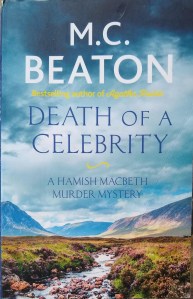
Death of a Celebrity by MC Beaton

This was another Hamish Macbeth mystery and I’m slowly ploughing on through the entire series. In this one a brash young TV presenter decides to make a new TV series exposing various scandals in Scotland and when she appears in the village of Lochdubh in search of new stories for her TV show, many people are not happy. When she gets murdered Macbeth has to find the culprit.

Verdict: This was a pleasant enough read but I began to lose interest somewhere in the middle and although the case was finally wrapped up, I didn’t find it quite as enjoyable as some of the previous entries in the series.

Young Stalin by Simon Sebag Montefiore

You wouldn’t think that new information about a character like Stalin could be forthcoming in this day and age, however, with the fall of the Soviet Union in the 1990s, the author has searched various archives in Russia and Georgia and unearthed much that is new about Josef Vissarionovitch Djhugashvili.

The future Soviet dictator was born in Georgia. His father was a shoemaker and his mother wanted him to become a priest. Stalin did study as a priest but later became an atheist and left the church to join local revolutionaries in Georgia.

Stalin became one of the leading providers of funds for the revolutionaries. He did this by masterminding numerous bank robberies and sending the funds on to Lenin.

He eluded the Tsarist authorities many times but even so, he had to endure prison as well as exile to Siberia.

Later Stalin ran various printing presses and also edited newspapers for the revolutionaries. In 1917 he was exiled to a place close to the Arctic circle. In exile he read voraciously and became close to the hunters who used the reindeer in much the same way as the Native Americans used the buffalo. They used them for food, their used skins for clothing and protection from the cold and to a great extent worshipped these creatures for their sustenance.

When the revolution of 1917 broke out, Stalin headed for St Petersburg to link up with Lenin, even at one point disguising Lenin and helping him evade the police.

When Lenin and the Bolsheviks were able to take power from the provisional government after convincing the Soviets, councils of workers and soldiers, to side with them, Stalin was made a commissar, a minister, in Lenin’s new government.

The various faces of the young Stalin

It has always seemed to me that Stalin was the cruel and hardline man and Lenin was the thinker, the politician. In fact, Lenin was a hard and ruthless man too. When someone decreed that no more shootings would take place under the Bolsheviks it was Lenin who called for more shootings. It’s a revolution he said, people must be shot! He liked Stalin because he knew Stalin was ruthless and could get things done. Later, when he realised that Stalin craved power for himself, he tried to have him removed from the leadership but by then he was sick and dying and it was too late.

This is a book about young Stalin and so the book finishes with the October revolution and Stalin’s appointment as one of Lenin’s commissars or ministers. There is an interesting epilogue though and reveals Stalin as an old man visiting his Dacha on the Black Sea coast. He invites many former friends and comrades who he had known in the past and even laments the death of many old comrades even though they were all shot on his orders.

It also gives the chance for the author to reveal the fates of various characters that have crossed paths with Stalin during his early life.

One interesting story which I read in the author’s other book, The Court of the Red Czar, occurred in 1941 when the Nazis invaded Russia. Stalin was a great reader as I mentioned earlier and he was sure after reading Hitler’s Mein Kampf that the Nazi leader would never attack Russia when he was still fighting a war with the west. Despite many warnings, the attack came and Stalin was silent for many weeks. Eventually his generals came to see him. They wanted orders and plans to combat the Nazis. Stalin clearly thought they had come for another reason. His first words were ‘have you come to arrest me?’

It would probably have been better for them and the country if they had.

Verdict: A excellent and well researched biography.


What to do next: Here are a few options.

Share this post on your favourite social media!

Hit the Subscribe button. Never miss another post!

Listen to my podcast Click here.

Buy the book! Click here to purchase my new poetry collection.

Click here to visit Amazon and download Floating in Space to your Kindle or order the paperback version.

Click here to visit amazon and purchase Timeline, my new anthology.


AKA (Also Known As)

This week’s post is about pseudonyms and people who use different or other names.

Lenin aka Vladimir Ilyich Ulyanov

Last week in a post about Painters and Paintings, I mentioned Lenin who was the first Communist leader of the Soviet Union. In fact, it was he who created the Soviet state but his real name was not Lenin. He was born in 1870 as Vladimir Ilyich Ulyanov. He studied at Kazan University and later became a Marxist activist after moving to St Petersburg, later renamed Petrograd. In 1897 he was arrested and exiled to Siberia for three years. In 1903 the Russian Democratic party (later renamed the Communist Party) split into two and Lenin led the Bolsheviks against the Menshiviks. In the unsettled world of the late 19th and early 20th century, political activism in The Russian empire was a dangerous game and Ulyanov began to use a pseudonym to protect himself. The name he chose was Lenin.

After his exile ended Lenin left Russia for the relative safety of western Europe, even living in London for a time. He returned to Russia when a revolution broke out in 1905 but when that failed, he returned to Europe and continued to organise and write essays and propaganda for the Bolshevik cause.

After the revolution which toppled the Tsar, the Germans who were then at war with the European allies in the First World War, sent Lenin into Russia on a sealed train. Churchill famously commented that

“Lenin was sent into Russia by the Germans in the same way that you might send a phial containing a culture of typhoid or cholera to be poured into the water supply of a great city, and it worked with amazing accuracy.”

Lenin was welcomed in Russia as the leader of the Bolsheviks and was helped by Stalin to escape the forces of the provisional government controlled by Alexander Kerensky. The Bolsheviks however soon engineered a second revolution; the provisional government was overthrown and Kerensky, his brief entry into history over, had to flee.

Lenin presided over the new government. He made peace with Germany despite having to negotiate away a huge swathe of land to the Kaiser’s Germany. He waged a civil war within Russia against those who tried to restore the Tsar. He renamed his party the Communist party.

In 1921 Lenin became ill, finally dying in January of 1924. In his last days he tried to remove Stalin from power but failed.

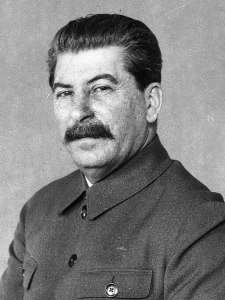
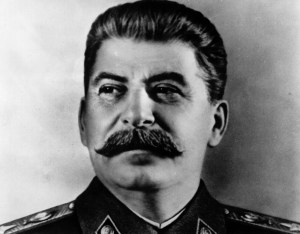
Stalin aka Joseph Vissarionovich Dzhugashvili

James Abbe, Public domain, via Wikimedia Commons

Stalin was born into a poor peasant family in Georgia in 1878. Later he became a bank robber, providing funds for Lenin and the Bolshevik party. He was born Joseph Vissarionovich  Dzhugashvili and like Lenin, adopted a pseudonym. The name Stalin came from the Russian word for Steel and is often said to mean ‘man of steel’. In his early days as a Bolshevik, Stalin robbed banks to fund the revolution. Later, Stalin organised and edited Bolshevik newspapers for Lenin and Lenin promoted him to the party’s central committee in 1912.

When Lenin died, Stalin took control of Lenin’s funeral and began to cultivate a cult of personality around himself, gradually removing all those who opposed him on the central committee. After expelling Leon Trotsky who was exiled and later deported in 1929, Stalin was unopposed as the supreme leader. His regime oversaw mass repression with millions consigned to forced labour in the Gulag camp system and others who Stalin perceived as threats, imprisoned or murdered in his purges.

Stalin died in 1953. After collapsing, he was discovered by his security staff who were too scared to approach him at first. Later they moved him to a couch thinking the heavy drinking dictator might have been drunk. He died on the 6th March and later Khrushchev emerged as the new Soviet leader.

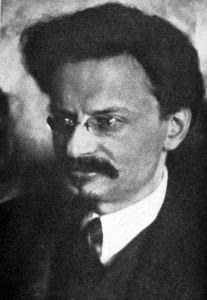
Trotsky aka Lev Davidovich Bronstein

By Isaac McBride – Barbarous Soviet Russia, Public Domain, https://commons.wikimedia.org/w/index.php?curid=3363312

Trotsky was another Bolshevik who used a pseudonym. He was the creator of the Red Army and the man Lenin thought would be a good successor. He, like Lenin and Stalin, suffered exile to Siberia and later met Lenin in London where he worked on the party newspaper. He returned to Russia in 1917 and became chairman of the Petrograd Soviet. After the Bolsheviks took power Lenin appointed Trotsky to the post of foreign minister, later becoming the Commissar for Military and Naval Affairs. He built up the Red Army and led it to victory in the civil war.

After Lenin’s death Trotsky was sidelined by Stalin and expelled from the Communist party and later from Russia itself. He finally settled in Mexico until his murder by Stalin’s agents in 1940.

Elton John aka Reg Dwight

That’s enough Soviet history for now so let’s move swiftly on to the music business. Reginald Dwight was born on the 25th March 1947. He lived in Pinner in Middlesex with his mother and father, Stanley and Sheila, although they divorced when Reg was 14.

Something that had a big effect on the young Reginald was his parents’ love of music. He began tapping out tunes on his grandmother’s piano and the age of 11 won a scholarship to the Royal Academy of Music.

At the age of 15 Reg got himself a job playing the piano at the local pub and in 1962 he and some friends formed a small band called Bluesology and they soon picked up a regular gig supporting singer Long John Baldry.

In 1967 Reg answered an advertisement in the New Musical Express. It had been placed by Liberty Records who were looking for new talent. Reg went to audition for the A & R manager, Ray Williams but Ray appeared to be unimpressed when Reg sang an old Jim Reeves hit and by way of ending the interview Ray handed Reg a sheaf of unopened lyrics written by someone who had answered the same ad.

That someone was Bernie Taupin. He and Reg hit it off instantly and Reg began writing music to Bernie’s lyrics. Six months later Reg changed his name. He took his new name from Bluesology bandmates Elton Dean and Long John Baldry and put them together to become Elton John.

In 1969 Elton’s album Empty Sky became a minor hit and was followed by the eponymous Elton John in 1970. ‘Your Song’, a single from the album went to number 7 in the UK singles chart and Elton John had arrived.

Archie Leach aka Cary Grant

Grant was born Archibald Leach in Bristol, England in 1904. He had a poor upbringing and his mother suffered from depression and his father was an alcoholic. The young Archie was interested in the theatre and performing and his mother was keen on him having piano lessons. His older brother had died before reaching the age of one and this perhaps made his mother a little over protective of the young Archie. Even so, his mother was not a woman who was able to give or receive love easily and the older Cary Grant blamed his childhood relationship with his mother for his problems with women in later life.

When Archie was 9 years old his father placed his mother in Glenside Hospital, a mental institution, telling his son that she had gone away on a long holiday and later, that she had died.

Archie befriended a group of acrobatic dancers known as The Penders and he was able to eventually join them and there he trained as a stilt walker and became part of their act. Later the group toured America and Archie decided to stay, following in the footsteps of others before him like Charlie Chaplin and Stan Laurel who had made their way to the USA in an almost identical way.

On Wikipedia they mention that on the trip over to the USA, Archie met Douglas Fairbanks and was greatly impressed by him, so much so that Fairbanks became a role model for the young Archie Leach.

In New York Archie worked in vaudeville with various comedy and theatrical groups. He joined the William Morris theatrical agency and began to pick up many theatre roles. In 1932 he had his first screen test and was given a five year contract with Paramount Pictures. B P Schulberg the general manager of Paramount decided that Archie Leach was not a good enough name for films so Archie came up with the name Cary Grant taking Cary from a stage character he had played and Grant chosen randomly from a telephone directory.

Cary Grant retired from acting in 1966 when his only daughter was born. He died in 1986 aged 82.

Ayrton Senna aka Ayrton Da Silva

It might come as a surprise to many to learn that the legendary racing driver Ayrton Senna did not use his real name. Instead, he chose to race under his mother’s maiden name, Senna. He decided to use the name Senna as in Brazil, his home country, Da Silva is a very common name and Ayrton hoped the use of Senna would make him stand out and be more recognisable in the world of motor sport.

Ayrton Senna in the McLaren Mp4/4 in 1988. Photo by the author

Ayrton was born and raised in the Brazilian city of Sao Paulo. He was born in 1960 and began racing karts at the age of 13. After twice finishing as runner up in the world kart championships Ayrton moved to Europe to compete in Formula Ford and later Formula 3. It was quite an achievement for the young Brazilian. He spoke little English and he and his wife were fishes out of water in the UK. Only his massive desire to succeed and to make it into Formula One kept him going. Alas his young wife was not up to the challenge and returned to Brazil.

Senna went on to enter Formula 1 and with the McLaren F1 team he won all of his three world championships fighting constantly with his great rivals Alain Prost and Nigel Mansell. He was killed on the 1st of May 1994 at the San Marino Grand Prix in Italy after leaving McLaren for the Williams team. He crashed at the Tamburello corner when he hit the concrete wall there and a suspension arm, forced back in the impact pierced his most vulnerable area, the visor of his crash helmet.

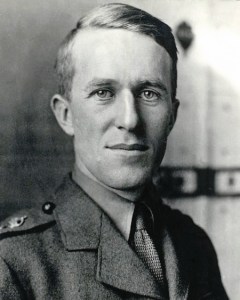
T E Lawrence aka John Hume Ross and T E Shaw

By Unknown author – pavellas.blogspot.com, Public Domain, https://commons.wikimedia.org/w/index.php?curid=7367070

Thomas Edward Lawrence is a fascinating character. He was a British army officer and writer best known for his role in the Arab Revolt during the First World War. He became known to the public through a series of film presentations by writer and documentary film maker Lowell Thomas.

After the war Lawrence tried to vanish into anonymity by joining the RAF as an aircraftsman using the alias of JH Ross. Later when his real identity was exposed he left the RAF and joined the army using the alias TE Shaw. He was unhappy in the army and was eventually readmitted to the RAF.

His account of his work in the Arab Revolt was published in his book Seven Pillars of Wisdom. Lawrence actually lost his manuscript at one point and was forced to reconstruct the entire book. Later, the book was used as the basis for the film Lawrence of Arabia starring Peter O Toole as Lawrence. A stage play was also written about him by Terrence Rattigan titled Ross which explored Lawrence’s alleged homosexuality. Alec Guinness featured in the play in the title role as Ross/Lawrence.

On the 13th May 1935 Lawrence was severely injured in a motorcycle accident and died six days later on the 19th May.


Thanks to Wikipedia for the source information.


What to do next: Here are a few options.

Share this post on your favourite social media!

Hit the Subscribe button. Never miss another post!

Listen to my podcast Click here.

Buy the book! Click here to purchase my new poetry collection.

Click here to visit Amazon and download Floating in Space to your Kindle or order the paperback version.

Click here to visit amazon and purchase Timeline, my new anthology.

The Democratic Way

As I write this latest blog post it’s the 20th January and Donald Trump is about to be sworn in as the 47th president of the USA. This was apparently the 60th such ceremony according to the first speaker although how that has been worked out, I’m not sure. Going by the huge amount of coverage on British TV, you might think that Trump had been elected president of the UK also.

When you look at it, Trump has pulled off an incredible comeback, He was defeated in the last election by Joe Biden and universally condemned for instigating a riot after claiming that his defeat by Mr Biden was a fix. He has been at the centre of various legal actions and prosecutions for numerous things including a pay off to a porn star hoping she would keep quiet about their affair. The porn star in question did not keep quiet and I’m pretty certain Mr Trump would be within his rights to ask for his money back although I doubt if he will.

The only other political comeback as impressive as Trump’s was the comeback by Richard Nixon.

Vice President Nixon as he was then was beaten by John Kennedy in the Presidential Election of 1960. He decided then to run for Governor of California but he was beaten in that contest too. He looked up at the assembled reporters and journalists and told them bitterly that that was it, ‘You won’t have Nixon to kick around anymore.’ He appeared to be retiring from politics. Even so, eight years later he was back as the Republican nominee in the election of 1968 and on that occasion, he won.

Picture courtesy Wikipedia

Some years later, things weren’t going too well for Nixon. He was caught in the middle of the Watergate scandal. Watergate would ultimately be the end of his presidency but his downfall would be his own presidential recordings. He tried to hang on to his tapes but when he appointed a special prosecutor and that same prosecutor began to want more and more tapes, Nixon fired him and various others in what became known as the Saturday Night Massacre.

Did he order the bugging of the Watergate building? Of course he did! Did he try to justify it? Well, he did say famously, ‘when the President does it, then it’s not illegal.’

As I mentioned last week, I’ve been watching a BBC documentary about King Charles the 1st and Charles, like Richard Nixon, was removed from office although in a much bloodier fashion. After his defeat in the English Civil War, he was put on trial and asked to plead either guilty or not guilty. Charles declined to plead. He was the King and had a divine right to rule over his kingdom. The court decided that his refusal to plead could only be interpreted as an admittance of his crimes. He was pronounced as guilty and only a few days later was put to death. The day of his execution was on the 30th January 1649. It was a cold and chilly day and Charles asked for an extra shirt in case the assembled crowd though he might be shivering with fear. He gave a short speech in which he said he was ‘going from a corruptible to an uncorruptible crown.’ Below is the King’s final scene from the film Cromwell.

Oliver Cromwell ruled England as the Lord Protector until his death in 1658 and two years later Charles II was recalled from exile and asked to return as the King.

Anyway, back in 2017 Donald Trump was declared the victor in the election and duly became the Chief Executive and Commander in Chief of the United States for the first time on January 20th of that year and all seemed to go fairly smoothly. The chap who introduced the proceedings back then -I’m afraid I can’t remember his name- commented on the inaugural speech of President Ronald Reagan which I quote here:

“To a few of us here today this is a solemn and most momentous occasion, and yet in the history of our nation it is a commonplace occurrence. The orderly transfer of authority as called for in the Constitution routinely takes place, as it has for almost two centuries, and few of us stop to think how unique we really are. In the eyes of many in the world, this every 4-year ceremony we accept as normal is nothing less than a miracle.”

Ronald Reagan via Wikipedia Commons

Reagan touched on the whole essence of democracy in that speech which is essentially this, that of the leader of a nation voluntarily handing over power to the new leader, the victor of the election process. In the news that same day in 2017 was a story about The Gambia’s long-term leader Yahya Jammeh who had, until then, refused to accept that Adama Barrow had defeated him in the election the previous December. He finally decided to hand over power as threats from other West African nations forced him to concede defeat. It would have been interesting if Barack Obama had said in 2017, ‘sorry, no, I’m not stepping down, I’m not ready yet!’ The last president who had to be forced from office was the man I mentioned earlier, Richard Nixon who finally accepted that the Watergate scandal had destroyed his presidency in 1973 and resigned, handing over to Vice-President Gerald Ford.

Joseph Stalin continued as leader of the Soviet Union until his death in 1953 at the age of 73. When he did not arise from his bedroom one morning at his dacha in Kuntsevo, just outside Moscow, his guards were too nervous to enquire if the feared dictator was alright. When they finally entered the room, they found he had collapsed and assumed he was suffering from a bout of heavy drinking the previous night. The guards made him comfortable on a couch and then withdrew. When he was found unable to speak the following day, only then were the doctors summoned.

Adolf Hitler and the Nazi party swept to power in Germany not by a revolution or by a military takeover but by the ballot box. Hitler’s Nazi party was the largest party in the Reichstag, the German parliament. Various other parties supported the Nazis all with the same thought, that Hitler was a simple man who could be controlled. They supported Hitler and convinced President Hindenburg to appoint him as chancellor. The thing is, once Hitler gained power and became chancellor, he gave himself emergency powers and began to imprison his political enemies. When Hindenburg died, Hitler combined the office of president and chancellor in one office. He outlawed other political parties and stopped elections.

Seen in that light, the events in the USA are, as Ronald Reagan said, nothing less than a miracle.

A US president can only serve two terms as the US senate, perhaps resentful of Franklin D. Roosevelt’s three terms in office, voted to limit a president to only two four-year terms. Eight years, not much time to change the world, is it? And there are only four years left for Donald Trump to make America great again, part of which seems to be the reappraisal of drug cartels as terrorist organisations, to rename the Gulf of Mexico the Gulf of America and to take over the Panama Canal.

What will happen then when Trump’s four years are over? Will he hand over to the next president as easily as Biden has handed over to him? Will he anoint a successor? His vice president, JD Vance perhaps? Or will he even try to stay on somehow for a third term?

Donald Trump. Picture courtesy Wikipedia

The election last year was interesting in that Joe Biden declined to run again. His decision was perhaps a little late and his chosen successor, vice president Kamala Harris, didn’t have a great deal of time to start her election campaign.

The very last time a sitting president decided not to run again was when Lyndon Johnson decided against being a candidate in 1968. Johnson wanted to create a great society for the American people but his administration was completely caught up in the Vietnam war. In one of 1968’s first primaries, anti-war candidate Eugene McCarthy featured well against Johnson, prompting LBJ’s arch enemy Robert Kennedy to enter the contest. Johnson withdrew and Kennedy was assassinated by Sirhan Sirhan. The Democratic candidate eventually turned out to be LBJ’s Vice President, Hubert Humphrey. I don’t think Humphrey even entered any primaries so how he eventually won the nomination I really don’t know. Either way he ran but was ultimately soundly defeated by Richard Nixon.

I personally didn’t rate Trump’s inaugural speech that well, it was hardly up there with ‘ask not what America can do for you but what you can do for America.’ Interestingly, many of the TV pundits I watched seemed to think it was all pretty wonderful stuff. Can he end the war in the Ukraine in one day like he claims?

Well, I’ll give him at least a week.


What to do next: Here are a few options.

Share this post on your favourite social media!

Hit the Subscribe button. Never miss another post!

Listen to my podcast Click here.

Buy the book! Click here to purchase my new poetry collection.

Click here to visit Amazon and download Floating in Space to your Kindle or order the paperback version.

Click here to visit amazon and purchase Timeline, my new anthology.