 Just recently I saw a short video on a social media site, I think it was Instagram, one of those sites where you are constantly scrolling along until you find something slightly interesting and then after a few minutes or even seconds, you carry on scrolling again. After a while you find that an hour of your life has been lost and it’s time to put your phone or tablet down and do something else.
On this occasion the video in question was one of Tom Hanks who was asked to name four pictures he saw at the cinema and to name the actual cinemas where he saw those films.
That short video has gone and I cannot remember the films Tom saw or the picture houses that he visited but well, that’s modern social media for you. You watch, you scroll and move on to something else. Anyway, here are four pictures I saw at the cinema.
The Greatest Story Ever Told
Once, many years ago back in the 1960s, my school friends and I were taken on a Christmas school trip to watch the film. We walked it as I remember in crocodile fashion from our junior school, Crossacres, down Wiggins Hill and into Gatley, a small nearby village that boasted a lovely old cinema, the Tatton. That trip to watch this film did more for me than any teacher or RE lesson had ever done before or since and although I cannot claim to be overtly religious, I am certainly not an atheist and my respect for the person of Jesus has never been greater.
The Greatest Story Ever Told was directed by George Stevens who made such classic films as Shane and James Dean’s last film Giant. Stevens was a director who worked the way I would work if I was a director. He shot a great deal of film then sat back, reviewed everything and put his film together one brushstroke – or film clip – at a time. He chose Max von Sydow to star as Jesus as he wanted a performer who was unknown to the general public.
Max was in a way an unusual choice to play Jesus; he was pale and blue eyed and had a faint Swedish accent. Even so, he played a good part, so much so that whenever I see another portrayal of Christ, I always mentally compare it to that of Max. As for being pale and blue eyed, I suppose it is inevitable that people everywhere will envisage their religious icons in their own terms.
He might have been better in choosing unknown actors for the other roles too because the many star appearances seem to stop the viewer in his or her tracks as we spot various top actors and actresses in minor roles.
On Her Majesty’s Secret Service.
This is probably the most stand out Bond film of all time. Sean Connery was the first to play the role of James Bond 007 but eventually he tired of the part and moved on. The producers at Eon productions decided on an unknown actor to take over the Licence To Kill, George Lazenby, a former male model and star of the Big Fry chocolate bar TV ads. My brother and I were taken to see the film by our mother. This must have been 1969 and once again we saw the film at the Tatton cinema. The Tatton was a large cinema with a very grand façade and like many old cinemas there were the stalls downstairs and the balcony upstairs. If I’m not very much mistaken, the film was shown as a double bill with one of The Man From Uncle films which for me and my brother was a very exciting double bill.
Above you can see the Tatton as it is nowadays. No longer a cinema but a Co-op supermarket. How times change.
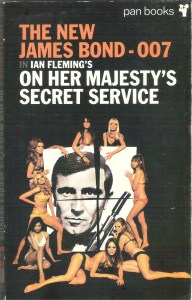 OHMSS was the very first Bond film I saw at the cinema and to me it was everything I had imagined it would be and what I liked about George Lazenby, the new 007, was that he looked pretty much as I had imagined Bond. He had the authentic ‘comma of black hair’ as Fleming had always described Bond having and not only that, Diana Rigg was probably my favourite Bond girl too.
The Bond films were not then a staple of UK TV but there was always a Bond documentary, usually on TV at Christmas time which built up, as it was supposed to do, the public interest in Bond. It certainly built up mine. There was one documentary I remember which showed the viewer how Ian Fleming suffered with back pain and was sent to recuperate at a rest home where they put him on a back stretching machine which he later incorporated into ‘Thunderball’. Aha, I thought, this is how writers think!
Around the World in Eighty Days
This was a wonderful film based on the book by Jules Verne. In the film David Niven stars as Phileas Fogg who, while playing cards at the Reform gentlemen’s club in London, enters into a wager than he can circumnavigate the globe in 80 days. Fogg bets £20,000, a huge sum back in 1872, that he will meet his gentleman friends back in the same club exactly 80 days later after traversing the globe.
The film then takes us on a tour of the globe with Fogg and his new manservant Passepartout played by Mexican actor and comedian Cantinflas.
The film was produced by Mike Todd and stars a mesmerising assortment of guest stars including Frank Sinatra, Noel Coward, John Gielgud, Charles Boyer, Ronald Colman, George Raft, Marlene Deitrich and numerous others. The production was a tour de force by Mike Todd who sadly was later killed in a plane crash in 1958.
The film was released in 1956, the year I was born so I certainly didn’t see it at the time. It was re-released in 1968 which was probably when I saw it at the cinema, again with my mother and brother. We saw it at the Gaumont cinema on Oxford Road in Manchester and I’m pretty sure we bought a very lavish programme with pictures and information about the film.
The Gaumont opened on 21st October 1935 with Robert Donat in The Thirty-Nine Steps. It was a beautiful cinema. There were 1,300 seats in the stalls and 1,000 in the circle, all with good sightlines. There was a Wurlitzer organ which was considered one of the best instruments in the UK which was later moved to the Granada Studios, cared for by the Lancastrian Theatre Organ Trust.
The exterior on Oxford Road was in the Italian Renaissance style and the entrance was dominated by one of the largest neon displays in the city. The Gaumont name alone was four feet high and below this there was a triple bordered panel which could take up to 12 rows of 18 inch letters in red neon announcing the attractions.
When the cinema closed it was turned into a nightclub. First it became Romanoffs and then later Rotters. Rotters closed in 1990 and the building was sadly demolished to make way for a multi storey car park. Why anyone would even attempt to drive into Manchester city centre in 2026 I really don’t know so how long that car park will last is anybody’s guess.
Henry V
I really don’t know much about the plays of William Shakespeare. Despite taking English Literature at school, we never studied Shakespeare, but then again I left school at 16 clutching my 4 O’ levels. Anyway, in later life I began to read some of the Bard’s plays and my first real introduction was the 1989 film by Kenneth Branagh. It’s a really wonderful film with some great supporting players including Paul Scofield, Derek Jacobi, Ian Holm and Emma Thompson. I saw it at the Odeon in Manchester where I saw many other films over the years. I think my mother took myself and my brother to see The Sound of Music there and my brother and I went there to see numerous films. I think I had my very first kebab at a fast-food place next door.

The Odeon all closed up in 2013
The Odeon opened as the Paramount in 1930. It was a massive venue seating nearly 3000 people. It eventually became a seven-screen cinema but closed in 2004. The building sat empty until 2017 when it was demolished.
Those are my four films. The Odeon and the Gaumont have both been demolished and the Tatton is now a supermarket although despite being extensively remodelled, the developers kept the old façade of the cinema. At least those four films are still going strong and finding new audiences on the TV screen.

