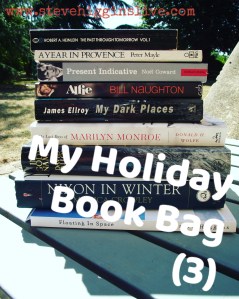
The re’s nothing I love more than a good book and as usual, here’s a quick round-up of the books I’ve taken on holiday to Lanzarote in the Canary Islands. As I’m flying I’ve not brought any hardbacks, just four paperbacks. All my books are usually sourced from the Internet or second-hand book shops but the ones below, with one exception, were gifts.
Lennon, the Definitive Biography by Ray Coleman.
This is a book first published in 1984 that has been revised and updated. It’s been subtitled the ‘definitive biography’ although that’s not a phrase I’d use to describe it. It’s a decent enough book don’t get me wrong but as for ‘definitive’, that’s another matter. The writer has known Lennon as a journalist since the heady days of the early sixties when the Beatles had their big breakthrough in the pop charts so has had the opportunity to talk with Lennon first hand regarding many events in his life.
The first part of the book appears to be the new revised section and details what has happened to Lennon’s work and image in the years since the book first appeared although really, this section would be better placed at the end of the book.
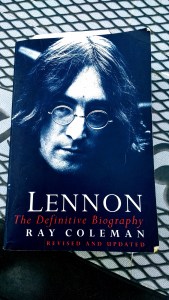 The writer has no time for music journalists who waxed less than lyrical about later Beatles’ records released in the last thirty odd years, things like The Beatles at the BBC released in 1994 or the Beatles Anthology. Reviewers who gave those records a poor reception get short shift indeed and the reader is quickly reminded of their chart topping sales. In their defence though pop music journalists tend to look forward to new music, not back to the old. More scorn is saved for Albert Goldman who wrote the book The Lives of John Lennon. Personally I thought that was rather a good book; it’s certainly more compelling than this one although it tends to focus on Lennon in a negative way whereas this book is very generous towards Lennon. It’s the book of a Lennon fan and focuses on the events in Lennon’s life in a very positive way.
Another annoying aspect of the book is that when Lennon and the Beatles achieve fame, the book drifts off into a lot of general observations about Lennon’s life and music and the narrative tends to lose the thread of his life story. A similar thing happens when discussing John’s son Julian when the narrative jumps forward to discuss things that have not yet happened in the story’s timeline. Sorry but I like my biographies to stick to a certain amount of chronological sequence.
Both John and Yoko emerge from this book as whiter than white although the truth of John Lennon is, I suspect, somewhere between Albert Goldman’s critical book and this work of praise.
After writing this review, here in Lanzarote, we went for a meal at the Casa Carlos restaurant. As I scanned through the menu I could hear something familiar playing in the background. I couldn’t recognise what it was at first. It was an instrumental version of something, then I realised what it was: Love me Do. I’m sure the sharp-tongued John Lennon would have some choice words for the restaurateur after hearing an easy listening version of his work as background music.
Being Elvis by Ray Connelly
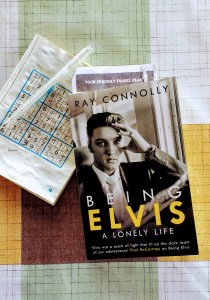 Subtitled A Lonely Life, this is a biography of Elvis Presley by another music journalist, Ray Coleman. Elvis became the King of Rock ‘n’ Roll who inspired Lennon, McCartney and a whole host of others to become musicians and pop stars. I’ve read quite a few biographies of Elvis, all much thicker than this one but this is a great holiday read being both interesting and informative. The foreword to the book was particularly insightful regarding the impact Elvis had on other musicians. The author recounts two phone calls, one to Bob Dylan and one to John Lennon where he happened to mention that he had been to Elvis’ 1968 comeback concert. Both those highly regarded stars bombarded Coleman with a series of questions about Elvis showing that despite their own success and achievements, they were still at heart Elvis fans.
The book goes on to recount Elvis’ beginnings as a poor white boy in segregated Mississippi who became an incredible phenomenon; revolutionising pop music, earning hundreds of millions of dollars and yet at the end of his life was dependent on loans from his bank to keep going as he had made few investments with his money.
Time and time again, Elvis was disappointed at the poor standard of the songs that he was presented with, especially in his films, however the book reveals that his manager, Colonel Tom Parker, wanted music in which the writers were willing to use Elvis’ own music publishing company and who were willing to give up a percentage of their royalties for Elvis and the Colonel. Elvis just appears to have put up with this intrusion into his artistic life as he didn’t like confrontations with his manager. The result was that he went from the cutting edge of pop music to somewhere at the back. It was only after his comeback concert in 1968 that he decided ‘enough is enough’ and decided to sing whatever took his fancy, no matter who wrote or published it.
In his later years Elvis was fat, bloated and addicted to amphetamines, sleeping tablets and diet pills. He worried how his fans would react to a tell-all book written by former members of his entourage. A final confrontation appeared with Tom Parker. Elvis threatened to sack him but Parker demanded back payments of 2 million dollars. Free of Parker, Presley could have got himself a new manager who perhaps could have sorted out his personal issues and engaged a new record producer, more in tune with the times. Sadly, he decided to stay with the ‘Colonel’.
Elvis died in 1977 of a heart attack. At the autopsy some months later 14 different drugs were found in his body, some in toxic quantities. It seems clear that drug abuse was a significant factor in his death.
A pocket-sized introduction to Elvis but nevertheless, an interesting and fascinating read.
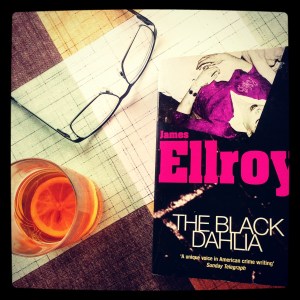 The Black Dahlia by James Ellroy.
This is the only novel I’ve brought with me on this holiday. I particularly chose it because I’ve read two of Ellroy’s non fiction books on previous book bags and I wanted to read some of his fiction. This is a detective story set in 1940’s Los Angeles and is a fast-moving story of cops and murderers and how to get on in the LAPD of the time. It’s written in the first person and is laced with LA jive talk and slang that really evokes the time and place. A good read but a little gruesome for me and I didn’t like the ending when you think the case is solved and then something else happens, and after that, something else.
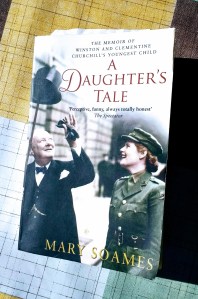 A Daughter’s Tale by Mary Soames.
This is a memoir by Winston Churchill’s youngest daughter, Mary. I had it down on my reading list as I supposed it was a biography of her father, however, it’s not a biography at all but a personal memoir of her life as Churchill’s daughter. It starts off with her early years living with her family in Winston’s famous house Chartwell. It’s a record of life in a different time and the writer talks about her retinue of animals, her nanny, the servants and all the things you might imagine surround her in an upper class home in the 1930’s. One interesting observation is that in 1935, Churchill, strapped for cash after the Wall Street collapse of 1929, considers selling Chartwell and his daughter quotes a letter he has written to an estate agent saying that his family has mostly flown the nest and that his life is probably in ‘it’s closing decade’. How wrong he was! The portrait the author gives us is an oblique one, Churchill seen from a different angle.
The early part of the book is not so interesting and the author constantly quotes from school girl diaries giving us a sort of Enid Blyton world of lunch and dinner menus, dog walks and pony rides and debutantes balls and a time when ‘coming out’ meant something far removed from what it does today.
The later part when Hitler plunges the world into war was when the book finally began to interest me. On the back cover the Sunday Express is quoted saying the book is a ‘delightful memoir’. I don’t think I can sum the book up any better.
As usual, here’s the video version below. I shot a couple of versions, one was too dark and another had problems with wind noise. I should have gone for take 3 really but the lure of the swimming pool was too much . .
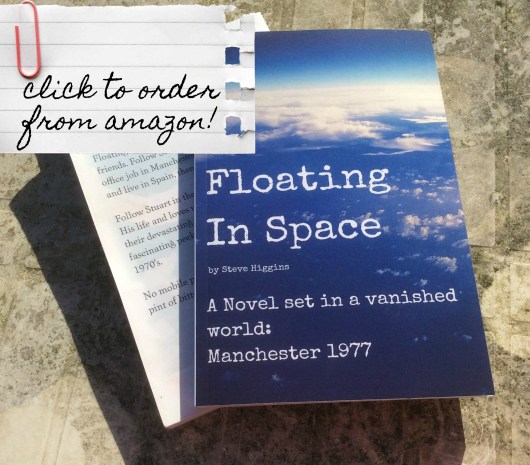
One final book, Floating in Space set in Manchester, 1977. You can buy the book by clicking the icon below to go straight to Amazon!
 As you will probably have gathered if you have read more than a few of my posts, I really do love books. There is nothing better than curling up with a good book anywhere, on a bus or train, in a chair, on a sun lounger, anywhere in fact. Books are a tonic for the brain. An education and a cerebral treat, both at the same time. Books enable the reader to travel not only geographically but in time too. Take one of my interests for instance. Classic cinema. Books like David Niven’s Bring on the Empty Horses has taken me on a journey to Hollywood and back to the golden years of classic cinema, the 1930s and 40s. Niven has told me about the Brown Derby, Romanov’s, Schwab’s drug store and Summit drive and a hundred other places I have never visited. But lets not stop there, let’s go even further. Marcus Aurelius’ book Meditations was written by a great emperor of Rome who died in the year 180AD, so his book is at least 1837 years old. Just imagine, the thoughts of a man who lived nearly 2000 years ago, travelling intact to me, the reader, in the year 2017.
 I’m just not into busy, rushed holidays. I prefer the quiet, relaxing type; the ones that involve sunny days, swimming pools and plenty of leisure time to read books. I read at home too but that is a different sort of reading; a few minutes here, a few minutes there. I’ll read on my lunch break at work in between eating my sandwiches and drinking tea but the best way to read, the way to really get into a book is a long uninterrupted read while you lie on your sun lounger with the pool handy nearby for when it gets a little too hot. A quick dip then you are back to the thoughts of your chosen author.
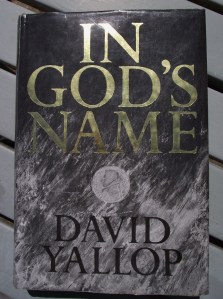 I bought this book originally on the 3rd March, 1987. I know that for a fact because back then I used to write the date on all my book and record purchases. I have read it a number of times and it is a fascinating read. It ticks all my personal boxes of history and modern mysteries. Why, you might ask would anyone want to murder the Pope? Good question and the answer, according to the author is the Vatican Bank. The Vatican, thanks to Mussolini, is a separate independent state and so the Vatican bank, registered in the Vatican state is not answerable to the banking laws and inspectors of Italy. This idea appealed to various unscrupulous individuals, notably Licio Gelli – the head of an illegal and secret masonic organisation known as P2, Roberto Calvi – a banker with ties to P2 and the Mafia, and Michele Sindona, another criminal. Together they engineered the movement of various shares and monies, using the Vatican bank. A man called Albino Luciano, the bishop of Venice, became aware gradually of various wrongdoings in the bank and was particularly dismayed by the action, or inaction of Bishop Paul Marchinkus, the head of the Vatican Bank. In 1978, after the death of Pope Paul VI, Luciano was elected Pope. He was a man dedicated to the ideas of Jesus, a simple carpenter from Nazareth and he wanted the church to follow his example. He did not want a church that had a multi million dollar profit in stocks and shares, he wanted a poor church, a church that properly reflected the feelings of its founder. When he was elected the new Pope, Luciano’s ideas and those of the aforementioned individuals were on a collision course. David Yallop’s investigation is intensive and revealing and I came away from the book feeling an intense sadness that a good and decent man, a man who would have been a great Pope and spiritual leader had been stolen from us by the greed of a few men.
 A Year in Provence by Peter Mayle.
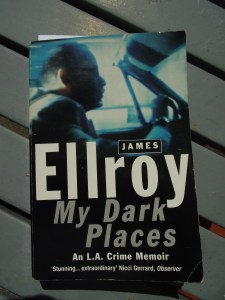 My Dark Places by James Elroy.
 Letters from an Unknown Author!