This is part 2 of a post about the books and films in the James Bond franchise. It’s recently been announced that Steven Knight, the writer who created the TV series Peaky Blinders, has been engaged to write the next film in the James Bond spy series. Bond appeared to die in the last 007 epic No Time To Die which, certainly for me, wasn’t a particularly great film. I honestly think that the producers have got the character mixed up a little with either Ethan Hunt from the Mission Impossible series, Bruce Willis from the Die Hard franchise or perhaps Jack Bauer from 24. Bond isn’t a rogue agent. He isn’t a maverick cop or spy either. He’s a former naval intelligence officer and a serving officer of the secret intelligence service who is trained to follow orders and use his initiative in certain situations. In order to get back to the original James Bond it’s time to look at the source material, namely the books by Ian Fleming, and see how they compare to the films.
Goldfinger
 Goldfinger is probably one of the best books in the Bond series and only the second 007 book that I ever read. (I’ll tell you about the first one later). I was at school at the time and for one of our assignments in English, we were asked to bring in a book which contained a really good description of a character. I chose Goldfinger as in it, Ian Fleming describes Goldfinger as a man who appeared to have been made using bits of other peoples’ bodies. This must have been in the mid-1960s and although the character of James Bond was pretty well known, the films had not begun to permeate down to the television screen.
The book is in three parts, based on a quote from Goldfinger who tells Bond of a saying he learned in Chicago. ‘Once is happenstance, twice is coincidence, the third time it’s enemy action’. In a similar situation to that in Moonraker, Bond is asked to take a close look at Goldfinger by an acquaintance from the first book Casino Royale. The man reckons that Goldfinger is cheating him at cards and asks Bond if he can see how this is being done. M tasks Bond to meet with Goldfinger who is suspected of gold smuggling. Eventually, Bond is captured by Goldfinger who correctly surmises that ‘enemy action’ has begun. Later Bond is taken to the USA where he learns of Goldfinger’s plan to rob Fort Knox.
The film version was hugely popular and to a certain extent became a sort of template for future Bond films.
For Your Eyes Only
Not one of my favourite Bond books, this was a collection of short stories and some of the titles, but not the plots, were used in some of the later Bond films.
Thunderball
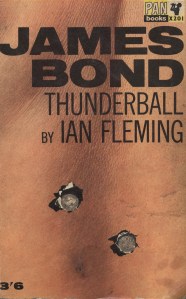 This is an interesting story and the resulting film has perhaps become the quintessential Bond film even more so than Goldfinger. The story is about a criminal underworld organisation (SPECTRE) that steals an aircraft with nuclear weapons and holds the west to ransom threatening to explode the bombs.
Prior to Thunderball, Fleming had been working on a screenplay with two others and when the project fell through, Fleming decided to use the material in his new novel. Later, Kevin McClory and Jack Whittingham, his two erstwhile writing partners, sued Fleming and won rights to certain elements of the story. This enabled them to years later produce the film Never Say Never Again with Sean Connery returning to the role of James Bond.
The book is well put together and as usual I found it a hugely enjoyable read. Fleming once again manages to inject the story with elements of his own life. Bond’s visit to a health clinic was inspired by Fleming’s own similar visit. In the book, Bond’s health record is revealed including details of his large intake of alcohol and cigarettes.
On Her Majesty’s Secret Service
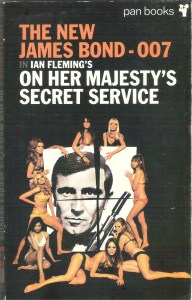 In this book the secret service find that Blofeld, the head of SPECTRE, is trying to assume the identity of the Comte Balthazar de Bleuville. Bond poses as Sir Hilary Bray of the College of Arms in order to meet with Blofeld. Interestingly, Sir Hilary gives Bond a quick resumé of Bond’s family history including the Bond family motto ‘the world is not enough’ which was used by the film producers for the title of a later 007 film unrelated to Fleming’s books.
While taking a break from the search for Blofeld, Bond meets Tracy, the daughter of Marc-Ange Draco, the head of the French criminal organisation the union corse. Draco offers Bond a million pounds to marry his troubled daughter but Bond declines although he agrees to meet with her again. Later she proves instrumental in helping Bond escape from Blofeld.
In the film, George Lazenby became the new 007, sadly only lasting for one film after taking advice from his agent who felt the days of the Bond films were over. Former Avengers girl Diana Rigg portrayed Tracy. She and Bond fall for each other and are married but sadly, Blofeld takes revenge and she is murdered. Personally, I’ve always felt that this film was one of the best in the 007 film series.
You Only Live Twice
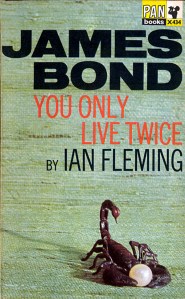 This book follows on from the previous one and we find James Bond depressed and disillusioned with his job after the death of Tracy. M considers sacking Bond but instead sends him on a diplomatic mission to meet the head of the Japanese secret service. The British want access to Russian documents which the Japanese are currently decoding. The Japanese decide to offer this information to Bond if he will assassinate a British resident who has created a garden of death, a garden full of poisonous plants which are attracting many Japanese citizens who want to commit suicide. Bond realises that this man is Blofeld and decides to keep this quiet until after he has killed him.
At the end of the book Blofeld is dead but Bond, who has been masquerading as a Japanese fisherman, is badly hurt and suffering from amnesia. The Japanese woman who has been pretending to be his wife decides to hide Bond in order for him to stay with her. At the end of the book, Bond reads something about Russia which triggers a memory and decides he has to go there.
The only real similarity of the film to the book was that the film was also set in Japan.
The Man with the Golden Gun
This was the last novel in the Bond series and the first Bond book I ever read. It’s a rather disappointing read as Fleming had died before completing his revision of the manuscript.
The novel opens up with Bond reappearing after going missing after his last mission. In fact he has been brainwashed by the Russians into murdering the head of the secret service. His attempt fails but Bond is deprogrammed and M decides to test Bond by sending him after a notorious hitman, Francisco Scaramanga, who has eliminated numerous British agents.
Fleming’s writing process was to create a first draft and then edit and add in more detail with a second draft. Fleming had told friends that James Bond was becoming harder to write and he wanted The Man with the Golden Gun to be his last. He also wanted to finish on a high and was concerned that the book wasn’t good enough for a grand finale. He had told his editor that he had thought about spending another year back at Goldeneye in Jamacia working on the book. Sadly, he suffered a heart attack on the morning of 12th August 1964 and died.
The film version starred Roger Moore playing his usual lacklustre and slightly camp 007 but a memorable screen villain was Ian Fleming’s cousin, Christopher Lee starring as Scaramanga. Britt Ekland joined the ranks of the Bond Girls by playing Mary Goodnight, Bond’s secretary.

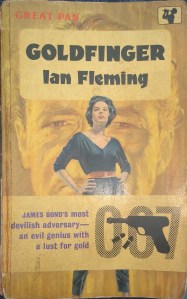 The James Bond Books by Ian Fleming.
 The Hamish Macbeth series by MC Beaton
 The Kay Scarpetta Series by Patricia Cornwell
 Letters from an Unknown Author!