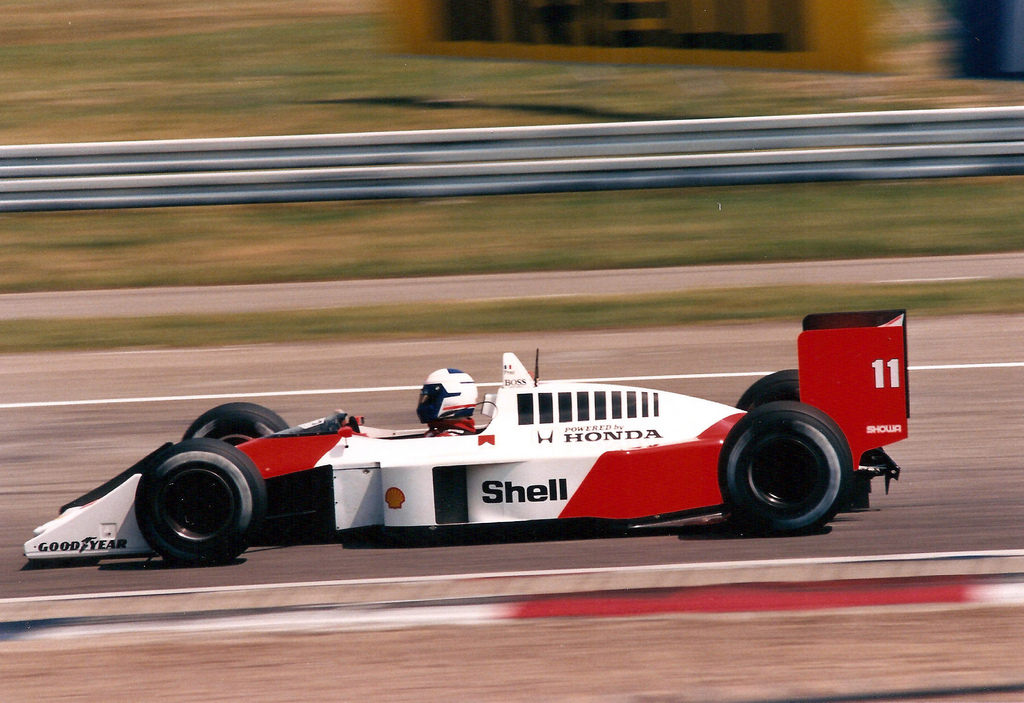
Remembering Stirling Moss

I began to follow F1 way back in the late 1960’s. I’m not sure what first attracted me to the sport. I liked cars and back then I subscribed to a free magazine from Corgi, the makers of die cast model cars. They used to send me out a little monthly magazine which was nothing more than an advertising pamphlet and one of those thin missives was dedicated to model F1 cars. As well as reading about model cars I started to find out more about the actual cars and drivers of the time. It was probably 1969 when the cars first flirted with aerodynamics and later in 1970 the grids began to look very colourful as outside advertisers brought their brand colours to the sport.

Yardley sponsored the BRM team and John Player Tobacco sponsored the Lotus cars, even to the extent of naming the cars the John Player Specials. I also started to learn more about the history of the sport. Who was Juan Manuel Fangio, the guy who had won an incredible 5 world championships? Well he was an Argentinian driver who once drove for Mercedes in the 1950’s. His team mate back then was an Englishman named Stirling Moss. What had happened to him I wondered?

Moss was born in September 1928. His parents were amateur racing drivers. His father competed in the 1924 Indianapolis 500 and his mother competed in Hillclimb events. Even his sister Pat Moss became a rally driver so motorsport seems to have been in his blood.

His father got him his first car at the age of 9 and he drove it around the fields near his boyhood home, Long White Cloud House, on the banks of the river Thames.

Moss’s first racing car was a Cooper 500 which he bought using winnings from competing in horse racing events. He was good in the saddle as well as behind the wheel.

His first major international race victory came at the RAC Tourist Trophy in Northern Island driving a Jaguar XK120. That was the beginning of an incredible career in which Moss won 212 of the 529 races he entered including 16 Grands Prix, the most ever won by an English driver until that record was equalled by Nigel Mansell.

Moss came close to winning the world championship although he never quite managed it, becoming known as the greatest driver never to become world champion.

In 1953, Alfred Neubauer, the famous Mercedes team manager, was impressed by Moss. He made it clear he was willing to sign up the Englishman but wanted to see what he could achieve in more competitive machinery. He suggested Moss buy a Maserati 250F for 1954. Moss did so and was impressive; at the Italian Grand Prix that year Moss beat world champions Ascari and Fangio to the lead and only gave it up when his engine failed. Neubauer duly signed Moss for the 1955 season when he would be teamed with Fangio.
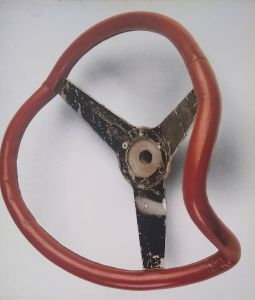
The mangled steering wheel from Moss’s crash.

Fangio and Moss worked well together and although it was Fangio who won another world championship Moss beat him at his home race, the British Grand Prix. The race was held that year at Aintree. The racetrack was in the grounds of the famous horse racing course and in fact used the same grandstands as the horse racing event. For the rest of his life, Moss questioned Fangio as to whether he, Moss, had actually won or had Fangio gifted him the win. Fangio always maintained that Moss was better than him on that day and won on his own merit.

In 1955 Fangio won his third championship and retired some years later having won 5, a feat unmatched until the modern era when Schumacher and later Lewis Hamilton upped the record to 7 titles.

By this time in 1955 Moss was a household name, probably as famous as Lewis Hamilton is today. In 1955 he also won the famous Italian race the Mille Miglia with Dennis Jenkinson as his navigator. Jenkinson was a journalist for Motor Sport magazine and famously signed himself off on his racing articles as DSJ. A few years later the classic race was discontinued after numerous fatal accidents during the race.

In 1962, Moss was competing in a Lotus at the Goodwood circuit. He came off the road and crashed.  He was trapped in his car for three quarters of an hour while various people tried to free him from his mangled car. He had sustained a shattered eye socket but more serious was a severe impact to the right side of his brain and this sent him into a coma. Moss was driving for Rob Walker at the time who was in France. Once he heard the news, Rob and his wife drove back to the UK, their radio tuned into the BBC Home Service which issued hourly updates on Stirling’s condition.

Moss had moments of lucidity but didn’t fully wake up for 38 days. In the excellent biography by Robert Edwards, the author describes Moss’s presence at the hospital in Colchester as ‘something of a sensation’. The switchboard was jammed with callers enquiring after Moss. Even Frank Sinatra called for information. The accident occurred on the 23rd April, 1962. Moss would not leave hospital until July that year.

Over a year later on Wednesday May 1st 1963 he drove a racing car again. It was a Lotus 19 sports car. He put in respectable lap times but the brain injury had resulted in subtle consequences. Moss reported that driving was for him now a disjointed, disconnected experience. Nothing flowed and now he had to think about what to do when before, all the aspects of driving fast would come naturally to him. He said this to a journalist about his decision to retire;

It was an easy decision to take at the time, because it was the only decision to take. I had to think. I had to give orders to myself -here I’ll brake, here I must change down and so on. And another thing: I used to be able to look at the rev counter without taking my eyes off the road -not only that but I could see the rev counter and a friend waving to me all at the same time. I’d lost that, that had gone.

He was by then divorced from his second wife and he was still a celebrity so he settled down at his impressive home at 46 Shepherd Street in London’s Mayfair. Moss had bought the vacant bombed out lot after the second world war and designed what was to him the perfect house. He retained an architect, a female architect to translate his ideas into reality. A spiral staircase takes one up to the first floor where there is a large sitting room and a smaller ‘snug’ and also an office. Upstairs again is a large kitchen and dining area and going up again there is the master bedroom where there are wardrobes with motorised shutters. He had remote controlled garage doors which were pretty amazing for 1962 when the house was built and also a descending table where Stirling could send a meal down from the kitchen to the dining room. He did love gadgets.

Just recently I saw an advert on the TV for a tap which could deliver hot, boiling or cold water at the touch of a button; Moss had one in 1962.

He married for the third and final time in 1980. He worked as a commentator on US TV and in public relations. He became involved in historic car racing but finally gave up competitive driving when he was 81.

He died in 2020 aged 90 after a long illness.

I’ve saved my favourite Moss story till the end. At a memorial service for Stirling this year, 2024, Jackie Stewart revealed that after winning his third world championship he was stopped by the police for speeding. Stewart was pretty famous himself by then. He had been called the world’s first superstar racing driver but as he wound down his window the police officer looked at him and said ‘who do you think you are, Stirling Moss?’

All the information and pictures in this post are from the excellent book by Robert Edwards, Stirling Moss; The Authorised Biography.

What to do next: Here are a few options.

Share this post on your favourite social media!

Hit the Subscribe button. Never miss another post!

Listen to my podcast Click here.

Buy the book! Click here to purchase my new poetry anthology.

Click here to visit Amazon and download Floating in Space to your Kindle or order the paperback version.

Weekend of a Champion

As this weekend is the start of the Formula One season, I thought I’d have a look through my motor sporting DVDs and recordings to get myself in the mood for a new season of the sport.

The official season reviews are rather expensive although I do have a few that I’ve picked up in stores like HMV when they are in the sales. I scanned through the season review for 2007 and fascinating stuff it was.

Kimi Raikkonen won the championship by 1 point after the final race of the season and McLaren were excluded from the results and fined an incredible $100 million because of the great McLaren/Ferrari espionage scandal! An employee of Ferrari was accused of passing confidential technical info to a colleague at McLaren. Further problems arose between Hamilton and Alonso at McLaren when Alonso blocked Hamilton in the pit lane. Yes, it was all exciting stuff.

Another F1 DVD I have is the Senna movie made in 2010. It’s a documentary film made for the big screen and consists of archive TV footage transferred to film. There is no commentary as such and the film focusses on Senna’s rivalry with Alain Prost although it is clearly slanted in Senna’s favour. It’s quite a fascinating film to watch and it was great to relive the epic battles of the 80’s with stars like Mansell, Prost and Senna.

Senna was killed in 1994 at the San Marino Grand Prix at Imola. Senna’s Williams hit the concrete barrier at the Tamburello corner, the scene of numerous accidents in the past. I remember watching the crash, convinced Senna would be all right, after all, Piquet had crashed there years earlier and Gerhard Berger had also had a terrible crash in the same spot, his Ferrari bursting into flames. Both Piquet and Berger survived. For Senna though time had run out. His front wheel and suspension assembly had hit his head and fatally pierced his helmet. Senna was airlifted to hospital where he later died.

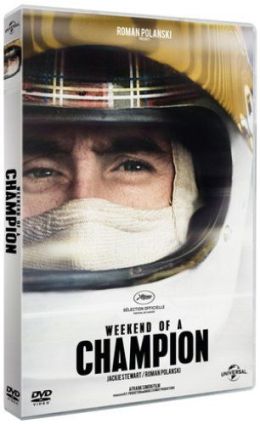
After I’d finished my F1 TV marathon I started searching about in my VHS video box and unearthed a forgotten gem: Weekend of a Champion, a documentary film by Roman Polanski about Jackie Stewart and the Monaco Grand Prix. I was surprised to find that the video was sharp and clear and I settled down to watch the events of the 1971 Monte Carlo event. It was so good to be taken back to my youth and see Jackie Stewart, my all time favourite driver as he once was, not an elder statesman of the sport as he is today but as a great Formula One star, cheered and hailed by the crowds at the trackside as he made his way down from his hotel to the pit lane. It was raining that weekend at Monte Carlo, much to the dismay of Stewart but the grandstands of the principality were packed with fans.

Jackie Stewart

My autographed picture of Jackie Stewart

Jackie pointed out to Polanski the relative skills of the Formula 3 drivers as they sped past, Stewart explaining ‘he had the wrong line’ or ‘he was in the wrong gear’ and so on. Later, Stewart explained his gear choices to new team-mate Francois Cevert. Cevert was eager to learn from the number 1 race driver of the day. He looked vital and fresh in the film. Sadly, Cevert was later killed in 1973, just as he was about to become the team’s number one driver as Stewart retired.

One particular scene stood out for me. Shot in Jackie’s hotel room, he is on the balcony talking to his wife Helen and director Polanksi. As they chat the camera comes back into the room and reveals Nina Rindt, the widow of the 1970 world champion Jochen Rindt, killed at Monza in practice for the Italian Grand Prix. She looks sad and ill at ease and later Helen explains that in the past she and Nina, Jackie and Jochen spent time together travelling the world as they competed in motor races. She had come to Monaco at Helen’s invitation, to spend time together and perhaps remember the happy times of the past. The Formula One of the 1970’s was no less glamorous than that of today, although perhaps tinged with a sadness for the many who lost their lives back then.

After a little bit of research I see that Roman Polanski restored the film some years ago and added a twenty minute interview with himself and Jackie Stewart. I must look out for that on DVD.

Today Sir Jackie Stewart is one of the elder statesmen of F1 racing. He speaks his mind as he always has done but I do get the feeling he is not universally popular with the fans of today. Quite a few times I have defended him in internet forums only to get into one of those annoying on-line arguments. Jackie pulls no punches and in the Senna video I mentioned earlier, Jackie took Ayrton to task for his on track actions although many of his meatier comments were not to be found on that video. I hope I will get a glance of Sir Jackie at the Australian Grand Prix this weekend although Lewis Hamilton, Sebastian Vettel and co will take centre stage, and rightly so.


Floating in Space is a novel set in Manchester, 1977. Click the links at the top of the page for more information!

Three Champions of Formula One

I’m not a great sports fan. I’ve no interest in football and cricket does nothing for me but formula one racing is something I’ve followed since my school days. What I’ve always loved about racing are the true champions of the sport, those drivers that have gone down in the annals of motor sporting history as the greats. My own personal favourite driver and the driver who to me is the greatest driver ever, is Sir Jackie Stewart.

Jackie Stewart Image courtesy wikipedia

Jackie Stewart Image courtesy wikipedia

You’ve heard of course of the great natural talents of Ayrton Senna and also of the man known as the professor, Alain Prost and his intelligent and calculating approach to racing. Imagine then those two disciplines put together in one man, well if that were possible the result would be Jackie Stewart. Jackie has all the qualities of a great driver: Fast in qualifying, fast in racing. Fast in the dry, fast in the wet. He also has those other great qualities, car control and understanding of the car as well as a great race craft. You’ve heard of Michael Schumacher and his reputation as the rainmeister I’m sure but well before Schumacher was even a glint in his father’s eye Jackie was winning the foggy and washed out 1968 German Grand Prix by four minutes from his nearest rival. Four minutes! Can you believe that?

Believe it my friend because that was one of the great wet weather drives of all time.

My personal favourite of Jackie’s wins was the 1969 Italian Grand Prix at Monza. Monza at that time had still not been hampered by the chicanes that were to be added a few years later. It was a fast high speed track and the event was a slip streaming formula one sprint. Cars hurtled along sucking the following cars along in their wake and the following driver would use this slipstream to hurtle past. The trick to win the Italian Grand prix was to exit the last corner in second place, slipstream the leader and take the win.

In 1969 however wily Scotsman Jackie Stewart reasoned that if he added an extra-long fourth gear to his car the difference between hanging on to fourth for a while longer when his fellow racers were changing up a gear could enable him to win. In the race when the cars arrived at that all important last corner Jackie dived in front and exited in the lead. Jochen Rindt who was second, latched onto Stewart’s lead and was sucked up in his slip stream then ducked out to take the lead. His momentum eased momentarily as he flicked into fifth but Jackie hung on in his extra-large fourth gear and when Rindt slipstreamed past it was too late; they were past the chequered flag and Jackie had just won the race.

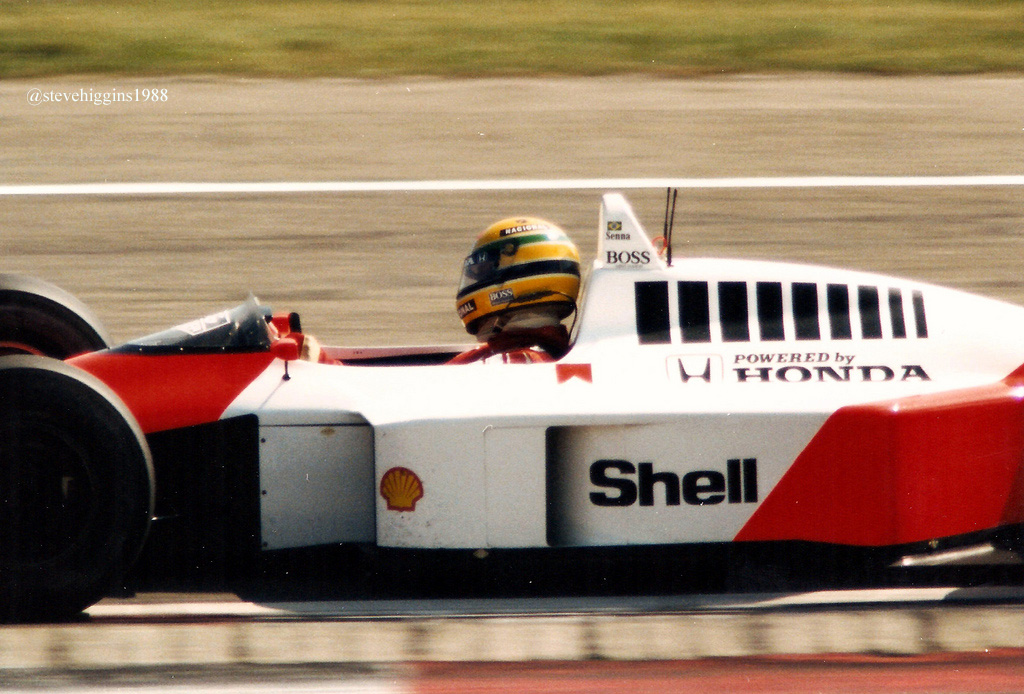
Senna by the author 1988

Ayrton Senna McLaren 1988 German GP

In 1988 two great drivers became teammates at McLaren-Honda, Ayrton Senna and Alain Prost. 1988 was a classic season for the Mclaren squad winning 15 out of the season’s 16 races but it could have been so different. The Williams team and their driver Nigel Mansell could have been in prime position to take the championship. The previous year, 1987, Mansell and team mate Nelson Piquet battled against each other and ultimately Piquet took the title but he had left for Lotus and Honda, who had been Williams’ engine partners for the previous few years had switched their allegiance to McLaren. The move had come a year earlier than had been planned and Williams were left in the lurch. Their relationship with Honda had soured when they declined to replace Nigel Mansell with Honda’s man Saturu Nakajima and they were forced to turn to a private engine manufacturer, John Judd. 1988 would not be their year. The McLarens were dominant. The only possible challenge could come from Lotus, the only other team with the unbeatable Honda engine. That challenge never appeared.

nelson Piquet Lotus 1988 German Grand Prix

Nelson Piquet Lotus 1988 German Grand Prix

Towards the end of the year, Lotus arranged for Jackie Stewart to test their car as part of a TV spot. Stewart, who had been retired for over a decade, took the wheel of the Lotus and almost straight away spotted the very issue that had dogged Lotus for the season. I well remember Peter Warr, the Lotus Team manager saying to TV cameras very diplomatically that Jackie had ‘correctly identified an issue the team were already working on.’ If only Jackie had tested the car earlier in the season, perhaps then they could have challenged the McLarens.

Jackie Stewart at Oulton Park in 1988 with son Paul

Jackie Stewart at Oulton Park in 1988 with son Paul

Three factors then cement Jackie’s position as one of the best drivers ever: his natural ability and car control, his affinity with the motor car and ability to translate that intuition back to the engineers and designers and his canny wisdom, intelligence and pure race craft. After he retired from the sport Jackie Stewart spent years as a PR man for companies like Ford. Later he built up his Stewart formula one team which later sold to Ford for it to become the Jaguar F1 team. Later still, Ford began to reduce its investment in motor sport and the team was sold again this time for it to morph into Red Bull Racing which won four world championships with driver Sebastian Vettel.

In later years Jackie Stewart and Ayrton Senna came together in a television interview where Stewart famously challenged Senna about his driving style and his collisions with other drivers. Senna brushed it off but later admitted that Stewart was right and that he had deliberately pushed Alain Prost off the track in Japan 1990. According to an interview with Stewart in the Daily Mail, Senna apologised to Jackie before admitting to the press what he had done.

Alain Prost Mclaren 1988 German Grand Prix

Alain Prost Mclaren 1988 German Grand Prix

Alain Prost, like Jackie became a team owner in the late 1990s with Ligier, renaming it Prost Grand Prix. Sadly the team went bankrupt in 2002.

Senna and Prost as is well known, had numerous battles together on and off the race track. Prost left McLaren believing that team boss Ron Dennis supported Senna rather than him and left to drive for Ferrari. He joined Williams in 1993 but declined to partner Senna in 1994 and retired from driving.

Ayrton Senna was killed in the 1994 San Marino Grand Prix. In formula one the event is known as ‘Black Sunday.’ Happily, Prost and Senna were reconciled in the days before the tragedy. Senna had done an in car lap of the race track for French TV  and Prost was working there as a TV pundit. Senna passed a message to Prost saying ‘we miss you Alain.’

The death of Senna and Ratzenberger at Imola were the first formula one tragedies for over twelve years and that was due in no small way to the campaigns began in the 1970’s by Jackie Stewart for better safety in formula one.


What to do next:

Share this post on your favourite social media!

Hit the Subscribe button. Never miss another post!

Buy the book! Click here to visit Amazon and download Floating in Space to your Kindle or order the paperback version.

The French grand Prix

sennab copyeditThe European grand prix season is well underway and it would have been rather nice to have combined my visit to France with a trip to the French F1 event, of course that’s clearly impossible as despite being the most historic race of all -there is no French Grand Prix.

Why ever not you may ask? The answer is this : the formula one season is a tv event first and foremost. It is the tv companies of the world that pay money into Bernie  Ecclestone’s F1  franchise and a race in France doesn’t fit into his the global tv vision of F1.

What does fit in then?  The Abu Dhabi grand prix,  with its multi million dollar circuit that is used only a handful of times  per year? Where there is no local motor sporting infrastructure, no local race teams and no local race drivers, in fact no local interest at all! There is interest though in publicising this small Arab nation to the western world through the power of tv and the same holds for Bahrain, another new race in the F1 firmament where the primary focus is Bahrain, not F1. Similar events now crowd the F1 calendar, China, Korea, Russia,  and Singapore.  Speciality non events far from the hub of traditional formula one racing like Spa Francorchamps, Monza, Zandvort, Silverstone, and the Nurburgring.

Recently Bernie Ecclestone was asked about the return of the French race. No, he said we will be having a race in Azerbaijan next year!  What? Can this man be serious? Clearly he is.

Ecclestone, who is currently facing bribery charges in a Munich court can clearly see the cash register jingling on the F1 till.  Still, when you consider he has been accused of slipping someone a forty four million dollar bribe, well,  the potential profits in that deal must presumably be in excess of, well. forty four million dollars!

The time has come for formula one racing to hand the managerial reins over to someone who is more interested in the sport than the million dollar pay check. OK, the sport has to make money, who would argue with that?  After all, the costs of todays race machinery, cars, engines, race tracks, drivers and logistics, is fantastic and teams like Marussia are desperate for points in order to tap into the incoming TV revenue to stay afloat.

My advice as a long time race fan; ditch Bernie, ditch the exotic locations and go back to basics. recruit a CEO like Jackie Stewart, a highly respected F1 elder statesman who loves the sport and from that one standpoint will be on a level field with formula one fans the world over.