Many years ago when reading a biography about Richard Burton, I was interested to hear about Burton’s love of books and that when he went on holiday he looked forward with delight to the contents of his ‘book bag.’ I know it’s a pretty tenuous link but one thing I have in common with Richard Burton is a love of books and when I go on holiday, one of the delights of lying under a warm sun on my sun bed is a good undisturbed read. So without further ado, let’s take a closer look at the books I have been reading in Lanzarote this winter.

The Thursday Murder Club
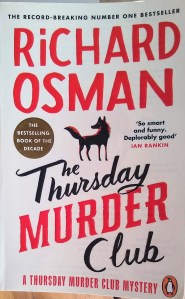 I know I’ve written about this first book already but as it’s part of this month’s holiday read, I feel I have to talk about it once again. As I mentioned in a previous post, I saw the film version over on Netflix and enjoyed the first part but then lost interest during the middle and finally picked up again to watch the end. It is a rather complicated plot so I picked up the book hoping to understand things better but also I’ve always found it interesting to compare book and film versions of the same story.
The book and film are about a group of people in a retirement village who meet to discuss cold case crimes but then find a murder committed on their very own doorstep. The group of mostly eighty-year-olds then get on with the task of solving the murder. There seem to be a lot of things going on and a great deal of characters to remember which put me off a little at first but a great device used by the writer is having alternate chapters written as diary entries by Joyce, one of the club members. She goes over the past events, adding in details of her own life along the way, talking about her neighbours and daughter amongst other things and sometimes previewing the next chapter for us.
It’s a very original and witty novel and I’m already thinking about getting the follow up book. One minor complaint though; there is a large cast of characters and things do get complicated, making it not always easy to follow. After reading the book and realising that our villa here in Lanzarote comes complete with Netflix, we watched the film again and this time I managed to pay attention all the way through. Both the book and film are very enjoyable but I’d have to say I think the book is generally better than the film.
Verdict; 8/10. Great read but complicated plot.
Untold Stories by Alan Bennett
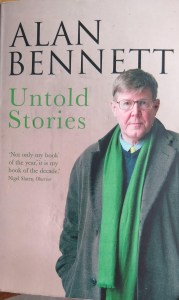 I sought this book out on the internet after reading Bennett’s The Lady in the Van which was a very enjoyable although short book. This volume is a collection of various essays and diaries by the author and it begins with the title essay, Untold Stories which is a series of observations mostly about his mother and father. He describes the life of his family in Yorkshire as he saw it evolve. It is perhaps a very ordinary story of a working class family and their fairly uneventful journey through life. It is very sharply observed and the author takes us through the lives of not only his parents but also of his two aunts as well as other family members. I found this section hugely interesting and with many parallels to my own life, especially when Bennett deals with his aging parents and he has to take them to numerous hospital appointments. His mother suffered with depression and was even hospitalised on a couple of occasions. Later in life she begins to suffer with dementia.
He ponders about the worth of a life, are children in some ways worth more than older people? If a child went missing there would be a public outcry but if an older person goes missing, no one is interested. His aunt, suffering with dementia in old age goes missing from a nursing home and the police seem uninterested. Later, Alan and his brother go searching for her themselves, taking what they think might be a logical way to walk from the home where she resides. They find her dead body in a field and the author wonders, why wasn’t there a search, why didn’t the police find her? Was it because she was just an old lady and they assumed that she would just ‘turn up’ one day?
There is a lot of humour also and I enjoyed hearing about the author’s father who had two suits, his ‘suit’ and his ‘other suit’.
His diaries were not so interesting, in fact most of the entries were rather boring and I found myself skipping various entries. Another section deals with his work in TV and the portrait he paints of actress Thora Hird is one of great warmth and affection.
Overall this was a good read but I found myself unable to agree with the comment on the back cover by a reviewer from The Sunday Times who says ‘I have never read a book of this length where I have turned the last page with such regret.’ I was glad to move on to something else.
Verdict: Interesting in parts. 7/10
Letter From America by Alistair Cooke
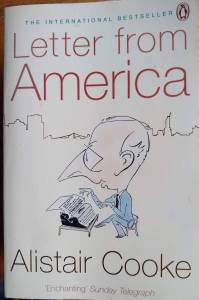 I picked this book up in a sale ages ago, in fact actually a few years ago. I think it was one of those offers like ‘buy two and get one free’. This was my free choice and as such it’s been lying around waiting to be read. It’s a collection from the author’s radio series ‘Letters from America’ which used to be broadcast many years ago on BBC Radio 4. I can’t say I’ve ever listened to the broadcast but I do remember watching a quite exceptional TV documentary series called ‘Alistair Cooke’s America’ which detailed the history of the USA.
The book is divided into decades starting with the 1940’s and records Cooke’s views of various things and people in the USA.. Some of the letters, which incidentally would be perfect for modern day publishing as a series of blog posts, are hugely interesting, others not. Cooke is a very eloquent writer and like one of the reviews on the back cover said, I felt I could actually hear his voice as I read them.
Cooke was in the Ambassador Hotel in California the night Bobby Kennedy was shot and he records what happened but little else. It mentions Watergate also on the back cover but I’ve just finished his 1970s writings and there was no mention of Watergate so perhaps he returns to it much later. The assassination of JFK is mentioned but Cooke seemed to be more interested in President Johnson than Kennedy but then perhaps that was the feeling of Americans back then, shocked by the murder of Kennedy and looking to Johnson to move the country forward.
Verdict: I felt the book was a case of more style than content. 7/10
The Outsider by Frederick Forsyth
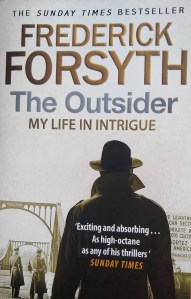 This is not one of Forsyth’s thrillers but an autobiography and it was a really interesting read. Forsyth spoke many languages and he puts this down to learning them with local people. He studied French and German at school of course but then spent the summer holidays in France learning from a French family and then later did the same with a German family and even later with a family in Spain. His observations in France were really interesting. The French welcomed Forsyth as an English hitchhiker with the union flag on his backpack but later when travelling in what had been Vichy, France, he felt the English were not as popular.
His ambition was to be a fighter pilot and he trains privately as a pilot and then later gets accepted into the RAF indeed becoming a fighter pilot. He spends only two years in the RAF and then leaves to follow another ambition, that of being a foreign correspondent. After training with a local newspaper, he moves to Fleet Street and with the advantage of his language skills joins Reuters, first in Paris and later in a very fascinating chapter, he is stationed in East German Berlin.
He joins the BBC which he is not complimentary about, especially their civil service style hierarchy. Forsyth covers the Nigerian/Biafran war but is not happy with the BBC coverage and so resigns to work as a freelance. He clearly blames the Wilson Labour government for escalating the war in Biafra and supplying weapons to Nigeria which the Wilson government denied.
Out of work and broke, he decided to write a novel based on his time reporting in Paris. The Day of the Jackal was rejected by many publishers but then he explains why he thinks that was. Who is charged with reading submissions at a publishing company? The lowest of the low, students, new employees charged with making suggestions after reading perhaps one chapter.
Forsyth was lucky in that he met a publishing executive at a party and then decided to visit him and try to cajole him into reading his manuscript. Happily, the executive agreed, was duly impressed and The Day of the Jackal was finally published.
The final part of the book was not so good. It was as if the author had run out of ideas and decided to add some quick chapters detailing various situations, once when he was under mortar attack, another on a fishing boat when a cyclone hit and a chance he got to fly in a Spitfire.
Overall, a great read but a pity about the last few chapters.
Verdict: 9/10
 Letters from an Unknown Author!