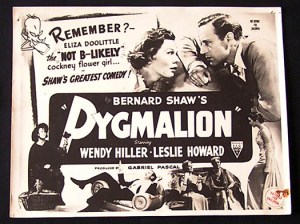
 This the third instalment of a post on the theme of transformations. The very first one (which you can read by clicking here) started off with the transformation of the common market flower seller Eliza Doolittle into a refined lady. I hope that explains the basic idea so let’s get cracking with a few more interesting transformations.
One that came to me while lying in bed one morning was a story told to me by my mother. Walking down our old street many years ago she pointed out a tall, thin man who we used to let on to whenever we passed. He was, I assumed, very old as he had a great mop of white hair. Mum had lived on that street most of her life. She had come to Nuffield Road with her mother and father as a child and when mum grew up and married they gifted the house to her. She told me that the tall lanky man wasn’t old at all. He had gone away to war in the 1940’s and had been captured by the Japanese. He had endured a terrible time as a prisoner of war and when he returned he was a shattered man and his hair had turned snow white.
Shirley Valentine
Shirley Valentine started life as a play by Liverpool writer Willy Russell. Later the story was turned into a film with Pauline Collins starring as the eponymous heroine. Shirley Valentine was a lonely Liverpool housewife who spent a lot of her time talking to her kitchen wall. Her children had left home, she had lost touch with many of her friends and she felt alone, sitting at home all by herself when her husband was out at work.
Her husband Joe, played by Bernard Hill, demands a steak dinner every Thursday. He sets so much by this that Shirley calls it the 11th commandment; thou shalt have steak on a Thursday. The thing is, Shirley gives the steak to the neighbour’s dog and makes chips and egg for tea. I personally rather like chips and egg. If I am ever on my own on a Saturday, the first thing I think about making is chips and egg. I always think of it as the perfect Saturday evening meal. Shirley’s husband however does not like chips and egg on a Thursday; he likes steak and this is the catalyst for a big row and for Shirley going on holiday with her friend Jane and leaving Joe to fend for himself.
While on holiday Jane deserts Shirley for an affair with a man she meets on the flight over. Shirley however, begins to gain confidence in herself and far from being lonely, she begins to come out of her shell. She meets Costas, a Greek bar owner with whom she has a brief dalliance.
Shirley is at the airport ready to leave when she decides not to go. Returning to the bar she asks Costas for a job. Meanwhile Jane tells Joe that Shirley has been having an affair but she denies this saying the only affair she is having is one with herself.
The film finishes as Joe arrives in Greece to speak with her but she has changed so much he fails to recognise her at first. Shirley has finally found herself.
Educating Rita
This was a breakthrough film for Julie Walters and I remember Michael Caine who also stars in the film saying that this film would do for Julie what Alfie did for him. Maybe it did, maybe it didn’t. The film is about a Liverpool hairdresser played by Julie who wants to better herself. She decides to take an Open University course in English Literature. Her tutor played by Caine is initially confused as he has the name of Susan White on his documents and Susan explains that she has now changed her name to Rita after reading Rubyfruit Jungle by Rita Mae Brown. Frank Bryant (Caine) is not keen on taking Rita on as a student but she convinces him otherwise. Rita finds Frank has ignited her passion for literature but has to contend with her husband who wants her to be a traditional wife and produce babies. Husband and wife finally split leaving Rita to pursue her studies. She moves in with a fellow student and gradually, as she mixes with more students and studies more, she becomes less and less like her former self. Frank becomes more and more fond of her, possibly even in love with her but his position as a university lecturer is compromised by his heavy drinking.
Just like Shirley Valentine, this story began life as a play by Willy Russell and the film shared the same director, Lewis Gilbert, who also directed Alfie, mentioned above. In a lot of ways this is such a good film. Julie Walters is outstanding as Rita and Michael Caine is excellent too. The big problem for me is that while Julie plays Rita as a typical scouser with a superb Liverpool accent, the setting clearly isn’t Liverpool. Not only that but the other accents in the film all grate with Julie’s as they are a mix of various northern accents. Caine of course as the lecturer, doesn’t have to have to be a Liverpudlian but the hotchpotch of brogues, some from Manchester, some from Liverpool just seemed to jar to my ear. The film was apparently filmed in Ireland so why not make Rita and her family Irish? That would have made more sense although filming in Liverpool with a local cast would have been the better option. Perhaps production finances made that impossible.
The Incredible Hulk
Back in the days when I used to read comic books, I used to read plenty of Marvel comic strips and one was the Incredible Hulk. The origin of the Hulk (every superhero has an origin story!) is a story about a scientist called Bruce Banner who is exposed to gamma radiation during an experiment. Gamma radiation featured in quite a lot of the Marvel comics as I remember but, on this occasion, the result of exposure to gamma rays means that when Bruce gets angry, he mutates into a green skinned, muscular giant with incredible strength and while he cannot fly like other super heroes he manages to get about in some incredible jumps or leaps.
Back in the 1970’s there was a TV version starring Bill Bixby as Bruce Banner although for some reason, perhaps because he was travelling incognito, he used the name David. I can’t remember the opening episode but Bruce travels about the USA and gets involved in various incidents. He tells a lot of people to not make him angry as they won’t like him when he is angry but as you can imagine, various people just go ahead and make him angry anyway which turns him into the green skinned monster. Rather than beef Bill Bixby up with green makeup and fake muscles, the production team brought in the already muscular Lou Ferrigno. He appeared as the Hulk and when he calmed down after a good bout of rampaging and smashing stuff up, he morphed back into Bill Bixby again.
The first film version starred Eric Bana as Bruce Banner and was released in 2003. The Hulk himself was a creation of CGI, computer generated images, although director Ang Lee provided the motion capture movements and the voice of the Hulk. This being the early days of CGI the result appeared to be rather cartoon like, at least to me.
The follow up film was The Incredible Hulk starring Edward Norton as Bruce Banner who is on the run from the military and living in Brazil but still trying to continue his experiments. He does so partly by collaborating with an anonymous individual online known only as ‘Mr Blue’.
The military trace Banner to Brazil and try to capture him but fail. It’s a pretty thoughtful and interesting film until the CGI takes over and a character called Emil Blonsky is injected with a substance aimed to produce a ‘super-soldier’ causing him to become a similar mutant like the Hulk. The two engage in a CGI battle which the Hulk wins.
Later Bruce Banner begins to be able to control his mutations into the Hulk and meets with Tony Stark, alias another Marvel super-hero, Iron Man, which preps the viewer for the next super hero film.
All in all it’s not a bad film and much superior to the first one but please, less CGI in future please.
The History of Mr Polly
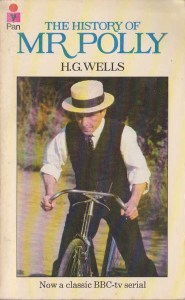 This is not a science fiction story despite being penned by H G Wells. Our hero, Mr Polly, finds himself in a very dull job with a very dull wife and resolves to commit suicide. Anyway, events unfold and instead of committing suicide, Polly accidentally starts a fire which threatens the whole street and he then mounts a brave rescue of an old lady. Instead of dying, Mr Polly becomes a hero and when the insurance money comes in, he leaves his wife nicely settled with the insurance money, takes a little for himself and departs for pastures new. He sends some money to a post office in another village and gradually meanders in that direction, sleeping in fields and hedges, getting himself a tan. He works occasionally when he wants and sleeps when the mood takes him at other times.
He comes across the Potwell Inn and asks for work and right away finds himself at home. He potters about happily at the Inn, cleaning, serving and doing various odd jobs. One day the landlady’s nephew, ‘Uncle Jim’ appears. He is a violent bully having been in and out of prison for years. He doesn’t like Mr Polly getting in the way so he decides to scare him off. What should Polly do, stay and help or just leave? He decides to stay and after various battles scares off Jim.
Some time later he returns to see if Miriam, his former wife is alright. He finds that Jim has drowned wearing clothes stolen from Polly so now Mr Polly is presumed to be dead. Polly leaves, content with the transformation of his life.
I first read this book many years ago and I’ve always liked its simple philosophy. If you don’t like your situation, change it.
 A film version was made in 1949 starring John Mills as Mr Polly and Megs Jenkins as the landlady of the Inn where Polly finds happiness.
I might as well finish with a transformation close to home. Yes, I’m talking about me. Once I was a ‘six shifts on, three shifts off’ motorway Traffic Officer, setting signals in our control room for the travelling public and now I’m retired, a man of leisure whose only worry is ‘what can I write about next week’.
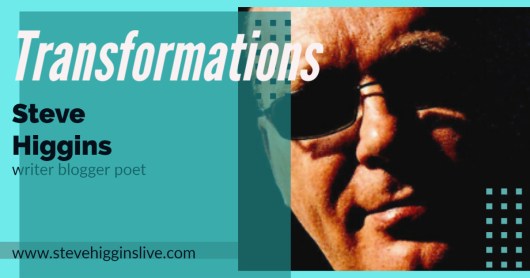
I’ve also used artificial intelligence to transform me further, well, my digital image anyway. That’s me just above, or at least a version of me that’s similar to the original.
What transformations have you experienced?
What to do next: Here are a few options.
Share this post on your favourite social media!
Hit the Subscribe button. Never miss another post!
Listen to my podcast Click here.
Buy the book! Click here to purchase my new poetry collection.
Click here to visit Amazon and download Floating in Space to your Kindle or order the paperback version.
Click here to visit amazon and purchase Timeline, my new anthology.
 ge has transformed me too. In the picture over on the right you can see me as I was when I was aged 19 or 20. It was taken in France by my best friend Chris. Now I am older, at least older on the outside. On the inside I’d have to say that I haven’t really changed that much. You might think that now I’m probably much wiser with different ideas and different thoughts. Actually though, I’m pretty much the same on the inside with similar ideas and similar thoughts.
 Letters from an Unknown Author!