A long time ago I wrote a post called Blogging by Numbers in which I wrote about various numbers that linked to the world of writing and blogging. This week I thought I’d try and do a similar thing with Formula One racing. I haven’t written much about the sport this year even though it has been quite an interesting season. Recently, Max Verstappen, who a few races ago was really out of contention for the World Championship, now seems to have caught up with the top two drivers, Norris and Piastri and it is even possible he could swipe the title from under the noses of those two, both driving for McLaren. Currently, Lando Norris leads Oscar Piastri by a single point so it looks like a three way fight for the title. Anyway, let’s take a look at those numbers.

1950
That’s a pretty good number to begin with. The world driver’s championship commenced in 1950 and the very first winner was Nino Farina who won the title after only 7 races. The very first race of the season was the British Grand Prix held at Silverstone and Farina won that one driving his Alfa Romeo.
5

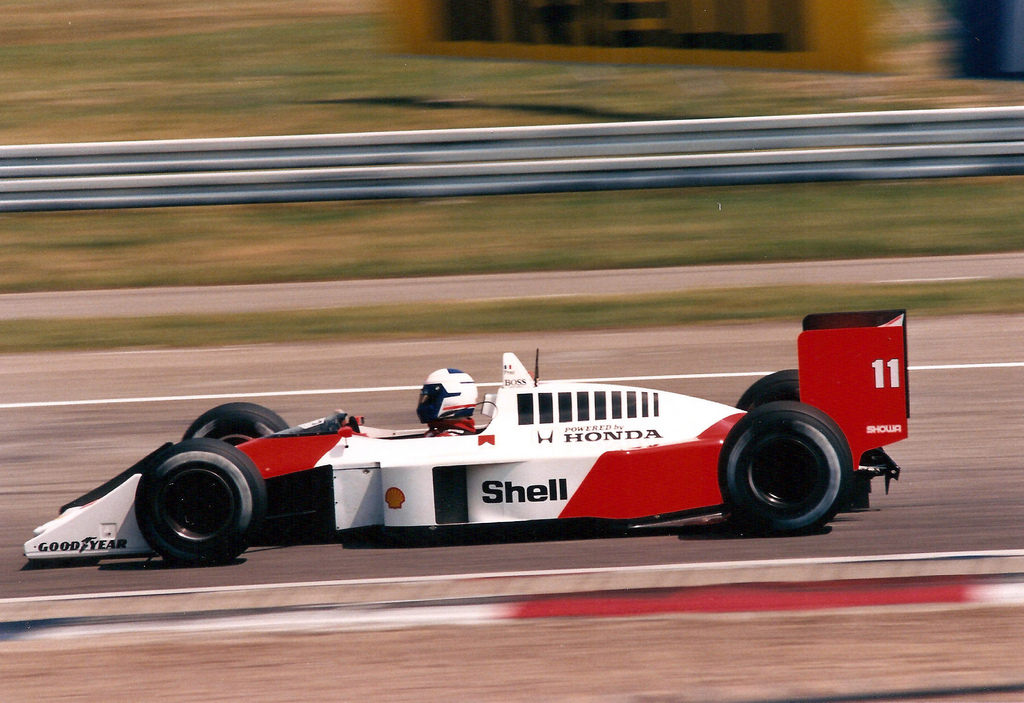
Nigel Mansell German GP 1988 photo by author
The famous Red Five was Nigel Mansell’s race number. In the 1980s Nigel Mansell, Ayrton Senna, Alain Prost and Nelson Piquet were a quartet that dominated the sport for many years. Piquet won three titles in 1981, 1983 and 1987. Mansell joined Piquet at Williams Honda in 1985. Honda felt that Piquet could have won the championship in 1986 if Williams had nominated a number one driver. Frank Williams declined to do so and so Honda withdrew their engines prematurely at the end of 1987 and began a new relationship with McLaren instead. Together, McLaren drivers Prost and Senna dominated the 1988 season winning every race between them but one. Williams were forced to use the engine of a privateer, John Judd, and were hopelessly outclassed. Mansell signed for Ferrari, the last driver to be personally signed for the famous team by the Commendatore himself, Enzo Ferrari.
Designer Adrian Newey joined the team in 1990 and with a new Renault engine the Williams team began to return to form. Mansell was tempted back to Williams from Ferrari. He won the world championship in 1992 but was dismayed to find that Frank Williams had signed Alain Prost as his team mate for 1993. Mansell had been teamed with Prost at Ferrari and was not happy at the way Prost schemed behind the scenes. Mansell declined to sign for the 1993 season and instead opted to move to the USA and compete in Indycars. There the Haas team made him a gift of his new race number, Red Five.

Fangio (Picture courtesy Wikipedia)
Still on the subject of number 5, that was the total of world championships won by the Argentine driver Juan Manuel Fangio. He was the original Formula One legend, the one everyone else spent decades trying to catch. He raced in the 1950s, when cars were twitchy beasts with no seatbelts and drivers wore polo shirts instead of fireproof suits. And yet, Fangio made it look effortless. He won five World Championships with four different teams, Alfa Romeo, Ferrari, Maserati and Mercedes, an incredible effort which no other driver got close to until Alain Prost won his fourth in 1993 and finally Michael Schumacher equalled in 2001.
Decades later, when people discuss who the greatest driver of all time is, Fangio’s name still floats effortlessly to the top, a reminder that grace and talent once shared the same racing seat. Fangio retired from racing aged 47; he died in 1995 aged 84.
105

Image courtesy Wikipedia ceative commons
Lewis Hamilton currently holds the record for the most ever Formula One wins, 105. The previous record was held by Michael Schumacher at 91. Hamilton’s last win was the 2024 British Grand Prix. It was also his last win for Mercedes. In 2025, Lewis Hamilton moved to Ferrari. With the exception of a single sprint race victory, he has yet to win a full Grand Prix.
7
The record for the most world championships is held jointly by Michael Schumacher and Lewis Hamilton. Many feel that Hamilton’s 7 championships should really be an 8. The result of the final race of the 2021 season, the Abu Dhabi Grand Prix, was controversial. Title contenders Hamilton and Max Verstappen both had 369.5 points coming to the race meaning that whoever won would take the title. It would either be Verstappen’s first or Hamilton’s eighth.
What happened was that Lewis Hamilton was leading the race but on lap 53 of the 58 lap race, there was a crash and the safety car came out. Mercedes realised there was no time to restart the race and so Hamilton would win behind the safety car. The Red Bull team decided to change the tyres of their driver, Verstappen, and he rejoined the field, still in second place but with 5 lapped cars ahead of him. The race controller controversially decided that the cars in front of Max, and no others, could unlap themselves and restarted the race with a final lap remaining. According to the rules there should have been a mandatory final lap behind the safety car but this was ignored and the race restarted for one racing lap. With fresh tyres Verstappen overtook Hamilton and won, taking his first world championship.
Various protests were made by Mercedes but the race result was upheld although the race controller, Michael Masi, was later sacked.
65
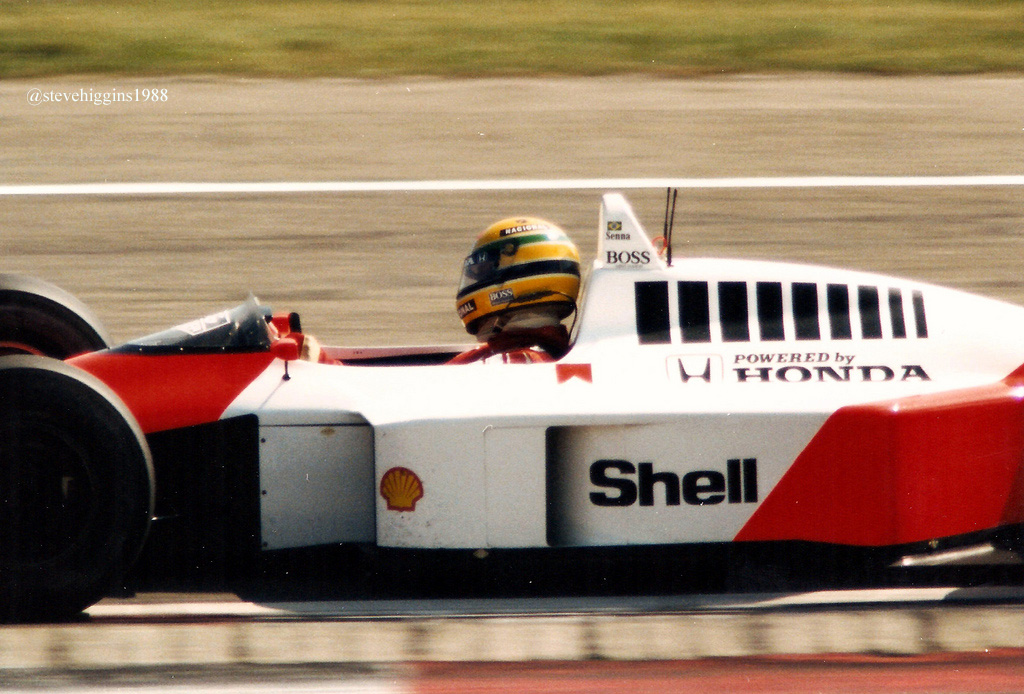
65 was the tally of pole positions made by Ayrton Senna which at the time of his death in 1994 was the record. Together, Senna, Alain Prost, and Nigel Mansell dominated most of the eighties and early nineties in Formula One racing. Mansell had left the stage for Indycar racing in the United States and Prost had retired, leaving Senna to take his vacant seat at Williams, or perhaps he retired because Senna had been offered a seat at Williams. Certainly, after the intense animosity that developed between the two at McLaren you can hardly blame Prost for not wanting to work in that same situation again.
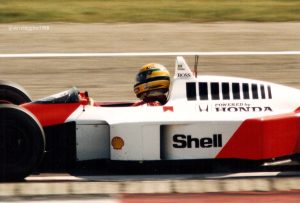
Ayrton Senna 1988. Photo by the author
Those retirements left Senna in 1994 as the Elder Statesman of Grand Prix motor racing. Now that his two closest competitors had gone perhaps Senna had hoped that he could relax, let up the pace a little bit, just as Prost had thought in 1988 before Senna began to push him harder. But a new phase had begun for Aryton Senna, a new Young Pretender had appeared to challenge him in the shape of Michael Schumacher. Schumacher had won the first two Grands Prix of the year and Senna came to Imola for the San Marino Grand Prix without a single point. “For us the championship starts here,” he told the TV cameras, “fourteen races instead of sixteen.” Further pressure mounted on Senna when fellow Brazilian Rubens Barrichello was injured in a crash and then Roland Ratzenberger was killed, the first fatality at a Grand Prix meeting since that of Riccardo Paletti 12 years before.
In the race as we all know, Senna went off the track at Tamburello and was killed when a suspension arm, crushed in the impact, flipped back and injured the Brazilian driver fatally in the head.
1
I thought I’d finish with some one hit wonders, drivers who only ever won one race. According to my research there are currently 25 drivers who have won just a single F1 race. The most recent single race winner is current Alpine driver Pierre Gasly who won the 2020 Italian Grand Prix. Gasly started the race in tenth, but gained positions due to a well-timed pit-stop prior to a safety car. Lewis Hamilton, who led the race until this point, was given a penalty for entering the pit lane when it was closed and so passed the lead to Gasly.
Jean Alesi was a hugely promising driver who sadly signed for Ferrari just as they entered a very dismal period in the Italian team’s long history. His one win came in 1995 at the Canadian Grand Prix when he was running second to Schumacher in a Benetton and the German retired with a gearbox problem.

Peter Gethin courtesy creative commons
Here is one final one hit wonder and the winner was a driver you may never have heard of but the race he won has been considered by many to be one of the most exciting of all time. Peter Gethin was driving for Yardley BRM in 1971. Back then before the arrival of the chicanes, Monza, the venue for the Italian Grand Prix, was a super fast slipstreaming event.
Gethin in his BRM won the race from Ronnie Peterson in a March 702 by an incredible by 0.01 seconds. The top five were covered by just 0.61 seconds, with François Cevert finishing third and Mike Hailwood in his debut race for Surtees finishing fourth and Howden Ganley fifth. With an average speed of 150.754 mph, this race stood as the fastest-ever Formula One race for 32 years, until 2003. The following year, 1972, chicanes were added to the Monza circuit to reduce the ever growing speeds of the cars.
Gethin retired from F1 in 1974.


 At the age of 15 Reg got himself a job playing the piano at the local pub and in 1962 he and some friends formed a small band called Bluesology and they soon picked up a regular gig supporting singer Long John Baldry.




 Letters from an Unknown Author!