It’s always great to get away from things and to take a break. Writers though just cannot stop writing even on holiday. Well at least I can’t. I’m currently on holiday in a motorhome in France so how do I mix relaxation with writing? Let’s see if I can successfully answer that. Here we go.
Morning.
 It takes me a while to get used to sleeping in our motorhome. It’s only small and there is a little dip in the bed just at the point of my lower back which has given me some backache in the past but lately I’ve learnt to either avoid it or just live with it. Another issue that affects our sleep is the way the van is parked and parking properly is very important. A tilt to the left and Liz will be rolling over and crowding me. Over to the right and I’ll be crowding her. A slight tilt forward and we tend to slide off our pillows and down the bed. If we have to have a tilt it’s better to tilt back toward our pillows but we do have chocks which we can slip under the wheels to level us up. My place on the bed is over by the window and there is no way out for me except by climbing over Liz so one of my rules is to not have beer prior to going to bed. Otherwise I’ll be waking in the night wanting to wee and struggling to get out.
On holiday I find myself waking up pretty early. I’m not totally comfortable sleeping in the motorhome but I usually wake up with my head full of various thoughts for either a blog post or a short story. I tend to lie there and get those thoughts in some sort of order before dragging myself up.
I’m usually the first one up so I’ll shuffle over to the small bathroom for a wash and a shave.
Despite being late September it’s still very warm in the Loire so in a morning I can handle a wash in cold water but when the warm weather comes to a close I’m less inclined to do that. I can switch on the water heater but usually I just put a pan of water on the hob.
Despite the bathroom being small, actually very small, there is a basin, toilet and even a shower in there. To shower it’s important to switch on the water heater first, pull round the panels that keep the water away from the toilet and basin and then switch on the water. In a motorhome I’m always aware that there isn’t an endless supply of water so a good idea is to apply shower gel liberally to the body, switch on the water and get washed as quickly as possible using as little water as you can.
Note to self: Don’t drop the soap as it’s pretty difficult to bend down and pick it up in these cramped conditions.
Shower over, towel yourself down, get dressed and get the kettle on before hanging your towel out in the sun on the bike carrier to the rear of the van.
Next I’ll check my emails while the van chef, Liz, gets herself ready too.
I’m a big lover of breakfast, in fact I’m even tempted to say it’s my favourite meal of the day and I love a standard English breakfast. Bacon, sausage, black pudding, mushrooms, tomatoes and eggs, preferably poached, served with toast. That can be a little difficult on the cramped three ring stove in the van so lately we’ve been having a bacon omelette with some French bread. I’ll either walk to a bakery if there is one nearby or we usually have some bread in our little freezer which always keeps pretty well and defrosts quickly in the sun.
Noon
Another option is to not have breakfast at all but to save ourselves for lunch. In France there are many places that serve a cheap lunchtime menu which will consist of a buffet starter, a simple main meal, a cheese course and a dessert.
 We found an excellent restaurant near to Parçay-les-Pins called the Restaurant De La Gare, the Station Restaurant. The buffet starter is always my favourite and I fill my plate with pâté, cold meats, coleslaw and various salad items. A basket of French bread will appear and is usually topped up when it gets low. Vin de table is provided as well as some chilled water and a large bottle of cider. Not bad for 15 euros each!
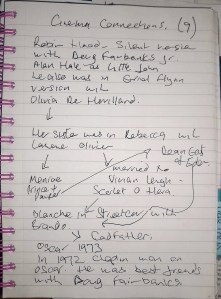
OK, breakfast (or lunch) over it’s time to grab my laptop and tap out in rough form my ideas for this week’s blog post. Sometimes I can’t be bothered to drag my laptop out of its safe place in the boot so I’ll just write notes in my notebook. The notes you can see here in the photo are typical notes for a one of my Film Connections posts.
We will usually be parked in an aire in France and these special parking places, reserved for motorhomes, tend to have all the necessary things we might need. A very important thing is a place to empty the van toilet. It’s not a pleasant task but I tend to empty it whenever we get the opportunity. A lot of French aires have a water tap to help you rinse your toilet cassette but many require a token, a jeton that is usually available from nearby local shops although there are many aire de camping cars that are completely free.
The van navigator (Liz) will usually have perused google maps for a plan d’eau, a French swimming lake and we’ll be off to find it. We usually factor in a stop for some French bread and some more French cheese as well as a box of wine. This year is probably the first in which we haven’t really been interested in cheese, having said that I’ve still enjoyed the cheese course in a restaurant.
It’s important of course to keep a check on our fuel. We usually fill up with diesel at French supermarkets as they tend to be cheaper than the usual petrol stations, however we were chatting with a couple of English people in a restaurant one evening who told us that ‘TotalEnergies’ petrol stations were considerably cheaper than the supermarkets. It seems that they are under the control of the French government and they are keeping prices lower, approximately 20p a litre for diesel, but consequently most of them had run out and those that hadn’t had long queues.
Our fridge and cooker are powered by LPG, liquid petroleum gas and we always keep a look out for stations that provide gas. The big problem when we first came to France was finding a petrol station with LPG. There didn’t seem to be any until eventually, we realised that in France it’s called GPL! Duh!
Swimming
Over the years we have made a note of our favourite places to stop. A typical camping spot we prefer will have a swimming lake and a parking place for camping cars, (that’s what they call motorhomes in France) and at this time of the year they usually won’t be too busy.
The locals usually arrive around 12 noon with picnic baskets for lunch and few might have a pre lunch swim. I’ve noticed that this year the water levels in many lakes have been low due to the hot summer and in one particular lake we visited the water was only a couple of feet deep.
At another lake we watched a couple of fishermen dip their rods in the water and wait patiently for the fish to bite. We read our books, competed against each other to finish that day’s sudoku and then it’s time for a dip.
Later on we need to find somewhere to stop for the night. Usually, we will stay by the lake or if we are trying to make our way to somewhere in particular, we might get a few miles under our belt before stopping again.
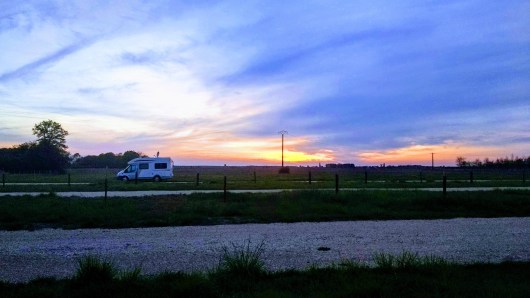
The sun going down after a day by a plan d’eau
Evening
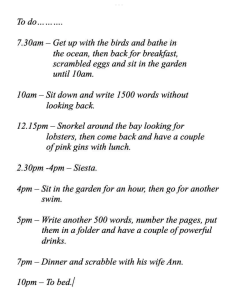 When evening comes we will have sorted out a place to stay the night. I usually get out our little gas barbecue and we will cook some sausages, burgers and maybe a steak to have with our salad. A glass of red wine is always good to wash the food down with and after clearing up I’ll go back to what I’ve written earlier and develop it a little and tidy it up.
I happened to notice something on the internet this week about Ian Fleming and the way he used to work at his holiday home in Jamaica. He was up at 7:30, had breakfast and then at 10am he began writing. He aimed for 1500 words before going for a swim at about 12:15. Later in the day at about 5pm he would write some more, put the pages in a folder and it was time for a drink. Perhaps that is what I need to do, plan my day like Ian Fleming’s day. Then again, I think I prefer things my way!
This year one of our stops was at La Meilleraie-Tillay. It’s a place we have stopped at before and one of the great things about it is that there is a toilet block with hot water. Sounds pretty normal doesn’t it but believe me, when you have not washed with hot water for a week, having a wash and shave in hot water is wonderful.
In the park next to the motorhome aire, a circus had set up, the Zanatteli circus and one night as we sat outside in the twilight we got chatting to Rico, the circus clown. He told us that he was the latest in six generations of his family that were circus people. After that first meeting Rico came to see us every night and told us stories of the circus. Despite a huge array of vehicles and equipment, there were only five people in the circus; him, his wife, his two sons and a daughter. The two sons were jugglers and acrobats. The daughter did some acrobatics too. Rico was the clown and his wife ran the box office, gave out tickets, sold refreshments in the intervals and also acted as a scene arranger. We attended their first afternoon performance before moving on to pastures new.
We usually relax in the evenings with a book but a problem this year with our leisure battery meant that our lights faded very early. If I’ve got a good internet signal I’ll transfer this week’s blog to wordpress then access it on my iPad and refine it a little more before passing it to my proofreader Liz for a final check up. Then I’ll add the graphics, pictures and videos and everything is ready for my publishing deadline of 10am on Saturday.
The next problem is what shall I write about next week?

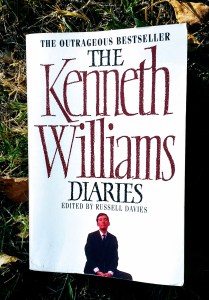 I’ve always rather liked Kenneth Williams, the slightly over the top star of many a Carry On film as well as many radio comedy shows, however it did feel rather odd reading his private thoughts through his diary, although sometimes it was hard to keep track of what was happening. In a lot of the diary entries Kenneth refers to people by their initials rather than their name. The habit of using initials can be rather annoying as the editor will mention in one of the many footnotes that SB for instance refers to his friend and fellow performer Stanley Baxter. Later on, SB will turn up again and I find myself flipping back through the footnotes because I have forgotten who SB was.
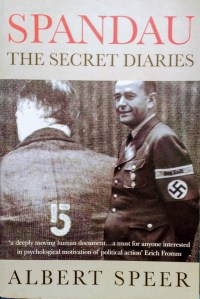 Albert Speer was Hitler’s armaments minister and favoured architect and this book is made up of diary entries he had secretly smuggled out of Spandau prison where he was incarcerated for 20 years after the Second World War. Speer admits he was one of those people seduced by the power of Hitler’s personality. Looking back at Hitler today in grainy old black and white films, it is hard to understand how this strange and dour man who ranted and raved while speech making could seduce anyone, however many have testified to the startling power of his personality. I remember watching that interesting BBC documentary ‘The Nazis: A warning from History’. In one segment various people were interviewed who declared their youthful love for Hitler; a young girl who looked into his eyes and saw goodness or an old man who testified he had once seen the great side of Hitler. Sadly Hitler let them down and many more like them. Speer maintained that he knew nothing of concentration camps and the final solution but author Gitta Sereny claimed in her book Speer: His battle with Truth that Speer knew more than he let on.
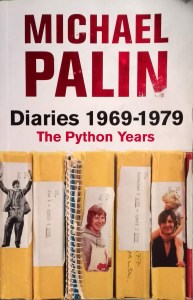 This is the first of Michael Palin’s diaries and it’s been pretty interesting, especially being a fan of the TV show Monty Python. Anyway, Palin started his diaries soon after packing in smoking. Perhaps it was a way of helping get over his tobacco addiction, or perhaps not. The diaries also begin just as Monty Python, the comedy TV show, was starting and Palin mentions this in his introduction, his aim not to record the start of the ground breaking comedy but more to record things about his new family, his wife having recently given birth to their first child.
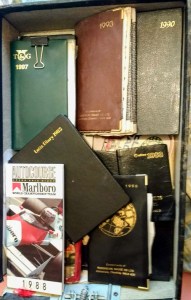 My diaries are definitely not for publishing. Looking back at them I notice that whenever something interesting has happened to me I have never written about it at the time, it has always been some time later when I have set down my feelings about the incident, whatever it may have been. The diary may be a confessional for some people but for me, as I said earlier, I started writing a diary as a way of making myself write when I couldn’t think of anything else to write about. In the early 2000’s I started writing a diary on my laptop, only to lose all my recollections from 2005 to 2006 when the file somehow became corrupted and refused to open. I was quite excited when the latest version of Microsoft Word came out because it gives you the option to repair a damaged file. Alas, that option would not work on my diary file. Then of course there are my big boxes of pre-2000 diaries. What shall I do with this lot I wonder? Will they add something to social history or grace the rubbish tip when I’m gone?
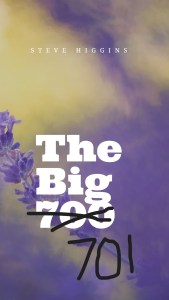 700 is quite a milestone, certainly for me anyway. I started writing my blog posts back in 2014 and I’m quite pleased to have got to this point. 700 hundred blog posts. Anyway, after all that and a quick recount later I see that this is actually blog 701. Last week was my 700th post and I didn’t realise. It’s a bit like missing my birthday or waking up on the 2nd of January and realising you’ve missed New Year’s Day.
 have written about all kinds of things although I mainly stick to books, classic films, Formula One and me and my little life. Some of those posts I have worked quite hard on and I’ve written and rewritten them and researched and sometimes rewritten again. At other times I have found myself on a Friday staring at my laptop wondering what on earth can I write about and then, right at the last moment, I have either thought of something or remembered a post that was made up of various short elements and decided to take one of those elements and develop it into a new post.
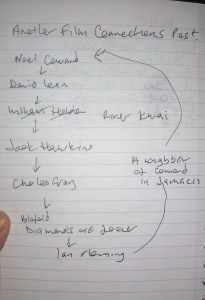 I always jot down notes for blogs, especially those where I try to connect various classic films together so for instance I’ll start with a director or an actor, let’s say Noël Coward for example and then try to go through various films and link together different actors or personalities and eventually end up back with another Noël Coward production. The links on the right are a bit thin but Coward worked with director David Lean, Lean worked with Jack Hawkins on The Bridge on the River Kwai. When Hawkins contracted throat cancer later in life and was unable to speak, his voice was dubbed by Charles Gray. Gray played Blofeld in the Bond film Diamonds are Forever. Diamonds was written by Ian Fleming who was a friend and neighbour of Coward in Jamaica.
  We came over on the ferry from Portsmouth to Caen after spending the night in a small pub called the Jolly Boatman somewhere in the south of England, actually Kidlington, I think. We have visited this pub once before back in May and it was nice to find that the staff remembered us even after just one visit. The trip over on the ferry was good. We paid a little extra for a top of the range cabin and it was well worth it. We had a little balcony, a tv, kettle and various cold drinks in the fridge. After a bit of a sleep and a shower, we awoke refreshed and ready to find a place to stop for the night in France.
 To be honest, I do use ai, not to write posts but to make the quirky memes and graphics that I use to promote my blogs. This is one over to the right. I had never even thought about using ai to actually write a post. Even so, I thought as I was a bit low on ideas it might be interesting to ask ai what I should write about. It came up with a plan for a post asking me to answer various questions about my work. Anyway, here are a few of them.
 I see that I started this blog page back in 2014 and my first post went out on the 23rd of May. It wasn’t anything exciting, in fact it was pretty much a sort of advertisement for my book

 I first started posting in 2014 and that year I managed to get 2341 views which I was pretty pleased about. If I had also managed to sell 2341 copies of any of my books, I would have been even more pleased but hey, that’s another story.
 It’s always good to pick up my iPad and see that my scheduled post has been successfully posted but the next task is to start thinking about a new one for next week. What can I write about? Has anything interesting happened to me? Have I read a great book or watched something good on TV? No? Well, that’s me up the creek without a paddle then.
 Once, many years ago, I had a cigarette vending round. I visited pubs in Merseyside, serviced their ciggy machines, filled them with cigarettes and took away the cash. A lot of the time I was in a hurry to get going to the next site. Even so, I would never turn down a cuppa and so many times I would have to drink a steaming hot cup of tea quickly so I could move on. The faster I worked, the earlier I finished and I very soon developed the knack of drinking hot tea,
 If the weather stays warm we might stay outside for a barbecue and these days rather than getting the coals ready, lighting them three or four times before they finally get going and getting my favourite shorts covered in coal dust and grease, we nowadays use our little portable gas barbecue. Perhaps I could write a barbecue post? Well, I could probably write a barbecue section of perhaps another foodie post but an entire barbecue post? Probably not.


 Once again Liz and I are on holiday in France and as usual I’ve filled up my book bag with books to read. My selection this year was a mix of new books and some books from my collection which I haven’t read for years. The one I’d like to focus on this week is Random Harvest by one of my favourite writers,
  The book tells the story in an entirely different way. It begins with a chance encounter on a train with Rainier and a young man who is looking for work. The two strike up a sort of friendship and Rainier invites the young man to work for him, He explains that he was in the war, was injured and woke up in a German hospital with loss of memory. He was repatriated through Switzerland but got his memory back after a fall and a collision with a taxi in Liverpool. The time between his earlier life and waking up in Liverpool is a blank. The young man becomes Rainier’s assistant and the two sometimes talk late into the night discussing what might have happened. Later in the book, Rainier is called to intervene at a dispute at the Melbury factory and his memory begins to return. He asks a local taxi driver about the hospital. The man asks does he mean the new or the old one? Rainier thinks the old one and goes on to describe it. ‘That doesn’t sound like either of them,’ answers the man but adds, ‘would you be meaning the asylum sir?’
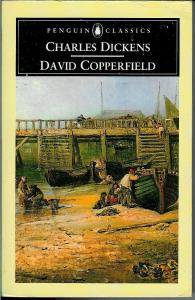
 Charles Dickens is one of my writing heroes. He is a giant in the world of literature and the author of one of my favourite books of all time, David Copperfield. He was a man with an incredible imagination and was a prodigious producer of numerous books and stories. Many of his works are still loved and appreciated today and the magic of his story telling is also reflected in film and television adaptations of his work.