Book Bag: Frederick Forsyth

It was sad to read in the news the other day of the passing of journalist and novelist Frederick Forsyth. He was 86 years old and had published more than 25 books. I’ve read quite a few of his novels and I wrote a segment about him some time ago in a blog post about novels that were rejected by publishers. A number of his books were made into films and so many people must be familiar with his work.

Forsyth did his national service in the RAF and was commissioned as an Acting Pilot Officer in 1956. After leaving the RAF he became a journalist working for the news agency Reuters and later he joined the BBC. He was the perfect choice for a foreign correspondent as he spoke numerous languages including French, German and Russian. In 1967 he was reporting on the war between Biafra and Nigeria when the BBC decided they were no longer interested in that particular war. Forsyth resigned from the BBC and continued to report on the war as a freelance. He even admitted later that this was when he was recruited by MI6 as an informant.

His most famous book and actually one that he struggled to get published was The Day of the Jackal. He apparently had no interest in becoming a novelist but turned to fiction as he was out of work and in dire straits financially.  The Day of the Jackal was rejected numerous times but finally one publisher decided to try a limited print run. The book took off first in the UK and then in the USA. It was a mixture of fact and fiction and Forsyth’s description of how to obtain a fake passport was used by John Darwin, the man who faked his own death in a canoe and later tried to make a new life in Panama. This true story was made into a book and TV mini series called The Thief, his Wife and a Canoe.

Forsyth followed up with The Odessa File, a book about the Odessa organisation which helped former nazis escape detection from the authorities after World War II. He wrote numerous other books but when The Day of the Jackal was re-imagined as a TV series recently on Sky TV, he earned nothing as he had already signed away the TV and film rights with the earlier screen version.
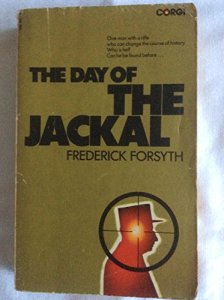
The Day of the Jackal

It was a very long time ago when I first read this book. Someone once called it an assassin’s handbook although I’m not sure that’s really fair. The book is set in the early 60s. The OAS was a terrorist organisation made up of ex-army personnel who were angered at De Gaulle’s decision to give independence to Algeria after many of their comrades had died fighting Algerian nationalists. They were trying to assassinate De Gaulle but their organisation had been penetrated by French Intelligence. To prevent any leaks the OAS top leadership decide to hole up in a hotel and arrange for a professional assassin to kill De Gaulle. The book follows the assassin, code named Jackal, as he plans the murder step by step. The French secret service however decide to kidnap a man who functioned as an aide to the leadership. Under torture he revealed the basic plot but how could the French track down the assassin?

The Jackal arranges three fake identities and the author explains meticulously how he does this. He met with a specialist rifle maker and explained how he wanted a rifle that could be dismantled and fitted into a series of metal tubes, the full import of this is only revealed on the planned day of the assassination.

The Jackal also asks for a number to ring for up to date information and the OAS arrange for an informant to seduce a member of the government and pass vital info to the Jackal.

Forsyth apparently wrote the book in 35 days and continued with a similar non stop workflow for all his subsequent books. He didn’t like the writing process and was anxious to get it all over with as quickly as possible. Even so, the result is a tense and gripping read. Forsyth’s books are heavily researched and often including real-life procedures, political contexts, or military operations. He includes authentic settings and terminology that lend a strong sense of realism to his stories. The characters in his books though are usually pretty functional, just there to carry the plot forwards although in The Jackal we find perhaps his most rounded characters, certainly in the few books that I have read.

The Day of the Jackal was made into a film in 1973 directed by Fred Zinneman.

The Odessa File

Again, it’s a long time since I have read this book but it’s really well put together with a real twist at the end. It’s about a German journalist who discovers a diary written by an old Jewish man who has committed suicide. The man was a former concentration camp prisoner and killed himself after seeing a sadistic SS officer known as ‘the butcher of Riga’ walking free in the city.

The journalist decides to try and track the SS man down and finds out that the nazis run an organisation known as the Odessa, which helps former SS men evade justice, assisting them with fake papers and even travel to friendly countries.

The journalist decides to pose as an ex-SS man seeking help from the Odessa and this leads him on a very dangerous path indeed.

The Odessa File was also made into a film starring John Voight as the journalist and the resulting publicity brought about the exposure of the real life ‘Butcher of Riga’, on whom the fictional character was based. Eduard Roschmann was arrested by Argentine police but then skipped bail and escaped to Paraguay.
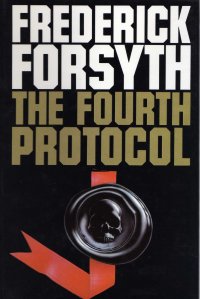
The Fourth Protocol

I started reading this book a while ago and like all of Forsyth’s other books it is a very exciting read. I was also surprised to find that it was really quite different to the film which starred Michael Caine.

In the book, a professional jewel thief robs the safe of safe of a well to do civil servant. He takes away some pretty expensive jewels but breaks a golden rule by also taking what appears to be an expensive hand crafted leather briefcase.

It turns out that hidden in the briefcase are some top secret documents which the civil servant has been passing to a member of the South African security forces.

This gentleman then organises a group of thugs to find the case but the jewel thief is alerted just in time and is able to round up some tough guys of his own to combat the thugs. After finding out the thugs were after the briefcase, he discovers the secret documents and mails them to the authorities.

Robert Preston, our local MI5 man, then has to find out where the documents came from and who has been leaking them.

Eventually, Preston discovers that the civil service man was passing the documents to a south African diplomat who was also a Russian spy.

This whole episode was glossed over in the film and in fact in the film version it is John Preston played by Michael Caine who robs the safe forcing the traitor to meet with his contact.

The main story though involves a Soviet plot to destabilise NATO by causing an atomic explosion at a US Air Force base in the UK. Components for the bomb are to be smuggled into the country, set up at a safe house just by the air force base and later detonated.

Luckily, our man Preston manages to save the day.

Once again, this is an excellent read peppered with fascinating information about the workings of spies in MI5 and MI6 and also the KGB.


What to do next: Here are a few options.

Share this post on your favourite social media!

Hit the Subscribe button. Never miss another post!

Listen to my podcast Click here.

Buy the book! Click here to purchase my new poetry collection.

Click here to visit Amazon and download Floating in Space to your Kindle or order the paperback version.

Click here to visit amazon and purchase Timeline, my new anthology.

4 Showbiz Stories

I started this post off with three ‘showbiz’ autobiographies of actresses/comediennes of the stage and screen. Despite trawling through my book collection I couldn’t see a fourth so I added one which is the odd one out; a biography, rather than an autobiography and a male actor/comedian rather than a female. Either way, all four are stars who made their respective names in the 1950s and 1960s era of radio, TV and film and together make up a quartet of much loved British comedians.

Fenella Fielding: Do You Mind If I Smoke?

This is an autobiography by Fenella Fielding, co-written with Simon McKay, and the title comes from her part in Carry On Screaming when she played a seductive character, possibly derived from the Adams Family, Valeria. In one scene Valeria tries to seduce Harry H Corbett standing in for the absent Sid James as a detective. Valeria asks ‘do you mind if I smoke?’ and then rather than smoking a cigarette, a cloud of smoke seems to arise from her body and envelop her. Harry H Corbett adds ‘just when I was trying to give it up’ before embracing her in the smoke.
Simon met Fenella at a London Pilates class in 2011. The two became friends and began meeting regularly for coffee. McKay realised that Fenella was a wonderful raconteur and asked if he could record her stories. Fenella agreed and later they used the transcriptions as the basis for a themed evening, An Evening with Fenella Fielding. Later the conversations became an audio book and finally this printed version. It was hugely enjoyable and rather than being a standard story of her life, the book talks about various things in no particular order.

Fenella describes her early life in Clapton and her first forays into the acting world. She won a scholarship to RADA but her parents, who were keen at first, don’t seem to have realised what RADA was, that their daughter was becoming an actress which they seem to have seen as just one step away from prostitution.

Anyway despite only completing one year at RADA, Fenella did manage to become an actress. After one particular success on the stage she began to pick up various small parts on television and on film and as I mentioned above, her most famous part was in Carry On Screaming. She devotes a whole chapter to Kenneth Williams who of course could be a very difficult man to work with. She also played a part in Doctor in Clover and was heard as the village announcer in the TV series The Prisoner. In fact a great deal of her work was voiceovers for various things especially TV adverts.

This was a lovely read and came over as very chatty and talkative, based as it was on recorded conversations.

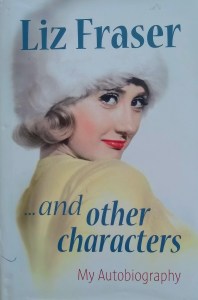
Liz Fraser …. and other characters

In Fenella’s book above, she mentions that she hoped her book would not go the way of a lot of other showbiz autobiographies, interesting at first but then dissolving into lists of plays and films and other celebrities. Sadly, that seems to be the way this book does go, even so I enjoyed it.

Liz was brought up in Southwark, in London. Her mother ran a small shop, one of those shops that used to sell everything that Tesco might sell these days from bags of coal, wood bundles to fresh food. Her father was a travelling salesman but died in 1942 aged only 40.

Like Fenella, Liz attended RADA and afterwards won her breakthrough part in I’m All Right Jack which starred Peter Sellers as a union official. She tells the story of playing minor parts in small plays and eventually got some walk on parts on TV. One day her mother said to her “Was that you last week, walking past Peter Cushing?” It was!

Liz worked on TV shows that were live back in the day. On an episode of Dixon of Dock Green she forgot her line but the crew had a ‘cut key’ which cut out the broadcast sound while they called out the line to the hapless Liz.

To get the part in I’m All Right Jack Liz had to lie about her age as the producers wanted someone younger which led to a career long confusion about her age.

She appeared with Peter Sellers in various films and she reveals that although she liked Sellers she had to fight off his amorous advances several times. Liz shares lots of anecdotes about various people she worked with including Tony Hancock, Benny Hill and Sid James.

She tells about appearing in a few of the Carry On films but like many others is critical of the producers. There was only a one off payment for each film and despite the enduring popularity of the Carry On films, the actors earned nothing from their later success on TV. In later life Joan Sims had a lot of financial difficulty but was helped by actors’ charity organisations. Liz herself was very thoughtful, investing in property and stocks and shares which sustained her during the times when acting work was thin on the ground.

She doesn’t share much about her personal life although her first husband features in a chapter called I Married a Thief. Peter Yonwin was something of a fantasist and their marriage soon broke down.

One shocking disclosure was an incident one night after appearing in a pantomime. Liz took an acquaintance home thinking she could deal with any problem man only to be raped. She doesn’t expand on the incident but seems to just mention it quickly and then move on as if perhaps by talking about it however briefly she could perhaps exorcize this dreadful ordeal.

Liz’s second husband, a TV producer, died of cancer and Liz suffered with cancer herself. She enjoyed fast cars and finishes by talking about her old age.

Liz Fraser died in 2018 aged 88.

According to Dora

I do love my showbiz biographies and autobiographies and one I picked up a while back was an autobiography by Dora Bryan. I love Dora from her many appearances in British films but my favourite film is probably A Taste of Honey. The screenplay was by Shelagh Delaney and director Tony Richardson, adapted from Delaney’s own play which she famously wrote when she was only 18.

Dora Bryan gives an outstanding performance; at times comic but always supremely natural. Dora grew up on an Oldham housing estate. She was a great performer as a child and so her mother took her to dancing school and further encouraged by her mother, she joined Oldham Repertory before moving to London to develop her stage career. She had a great career on the stage as well as on film and TV and appeared in many successful West End productions. The first part of the book is very interesting but then as I mentioned earlier, this becomes one of those books in which the latter part seems to wander off into lists of productions and theatre and TV personalities. Even so, it was a lovely read.

When the Wind Changed (The Life and Death of Tony Hancock) by Cliff Goodwin

This final book is the odd one out in this quartet of British comedy stars. It’s a biography rather than an autobiography. I don’t think Tony Hancock ever wrote one.
Back in his day Tony Hancock was a giant among television performers. Pub landlords complained that their establishments used to empty because people would drink up and rush home to watch Hancock’s Half Hour. I can’t even imagine that happening today to any contemporary comedian not withstanding the emergence of TV recording devices.

Hancock’s half hour was first broadcast on the radio in 1954 and then transferred to television in 1956.

Hancock’s co star on television was Sid James and Hancock decided to part with Sid believing that the public had begun to think of the two of them as a sort of double act. His final comedy series for the BBC was called Hancock but even without Sid James, it was a great success.

An interesting TV interview at this time saw Hancock as a guest on Face to Face, an intensive interview which revealed Tony Hancock to be a different man to the bumbling buffoon of his radio and TV shows, in fact the entire transcript of the interview is repeated in the book. Many felt that this interview made him more and more self-critical which led to him dispensing with many who were important to his professional life such as Sid James and his scriptwriters Galton and Simpson.

After a minor car crash Hancock had to use an autocue for perhaps his most famous TV episode, The Blood Donor. After that, he used the autocue more and more finding it too hard apparently to continue to learn scripts.

His drinking increased. He left his wife for his mistress Freddie Ross who worked as his publicist. Freddie and Hancock eventually married but their relationship later broke down also.

Hancock committed suicide in 1968. He took an overdose of pills and left behind a note which said ‘things seemed to go wrong too many times.’

This is such a fascinating and well written book and if you are interested in actors and performers as I am, it is well worth seeking out.

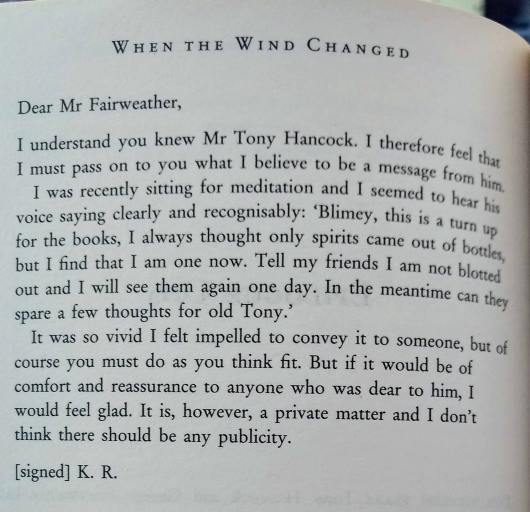
There are a couple of postcripts to the book but one was so intriguing I have to mention it here. George Fairweather was a great friend of Tony Hancock. When Hancock was delighted to find he had been chosen for the royal command performance he told George that he wished his late father could have been there to see it. George commented that perhaps his father would see it and Hancock replied dismissively that ‘only spirits come out of bottles’.

22 days after Hancock’s death, George received a typed letter with no name or address. It said simply that the writer had received a message from Hancock in the afterlife and wished to pass it on. The message is reproduced below.


What to do next: Here are a few options.

Share this post on your favourite social media!

Hit the Subscribe button. Never miss another post!

Listen to my podcast Click here.

Buy the book! Click here to purchase my new poetry collection.

Click here to visit Amazon and download Floating in Space to your Kindle or order the paperback version.

Click here to visit amazon and purchase Timeline, my new anthology.

Holiday Book Bag 2024 Part 4

As usual I always take a number of books with me to read when I’m on holiday. There is nothing better than having a long pleasant read in the sun interrupted only by visits to the pool. This year we only had a swimming pool for just over a week and even then there wasn’t much sun but I still managed to get in some reading. Anyway, time to open up my book bag and see what’s in there.

The Dark Side of Camelot by Seymour Hersh

This was a book which I read a long time ago and thought it was ready for a re-read. It is essentially a book which tries to shatter the image of the long dead President Kennedy. It’s an exercise in character assassination and talks exclusively about JFK’s numerous faults without any balancing stories about what he actually did well.

The Bay of Pigs was a great disaster for Kennedy. He inherited the invasion plans from the Eisenhower administration in which Vice President Nixon was a prime mover. Nixon felt that an invasion would boost his chances in the election contest against Kennedy but the CIA seemed to be relying on the assassination of Castro to kick off the invasion but that planned murder, for whatever reason, never happened.

JFK told the CIA that US forces would not be assisting in the operation but it turned out that the CIA was relying on exactly that, intervention by US forces. The invasion was a disaster and Kennedy privately blamed the CIA who he felt were trying to force his hand in committing American forces. Hersh of course, blames Kennedy.

The most shocking element of the book probably comes from interviews with four former secret servicemen who tell numerous stories of JFK’s aides, Dave Powers and Kenny O’Donnell, bringing in call girls and prostitutes to service the President whenever his wife Jackie wasn’t around. The White House pool seems to have been a particular favourite of Kennedy’s, not for a relaxing swim but for naked skinny dipping and sex with various women, some of whom were White House secretaries.

Throw into the mix father Joe Kennedy’s booze smuggling activities and relentless spending to get his son elected and the author paints a pretty dark picture of the Kennedy White House. Still, as I said earlier, this book is a one sided view. It’s worth reading more about JFK before you make your mind up.

Ten Days to Destiny by John Costello

I’ve always been interested in the Rudolf Hess mystery. Why did Hess fly to England? Why are the Hess files sealed for so long? What was the real story? This was a book about the mystery or so I thought. Actually it’s about the various peace initiatives that were made even while Churchill, the new prime minister, had vowed to fight on and which eventually culminate in Hess arriving in the UK in the latter part of the book.

After the declaration of war in 1939 the government had to bring in Churchill who had long warned about the Nazi menace. Later, when the government realised that a national government was needed, comprising all the main parties, the opposition, the labour party led by Clement Attlee, refused to serve under Neville Chamberlain who they believed had actually caused the crisis by his policy of appeasement. Chamberlain wanted Lord Halifax to take over as prime minister and even put the question to Churchill, asking him would the country be willing to accept a leader in the Lords rather than the Commons. Churchill declined to answer and of course it was later that Chamberlain recommended Churchill to the King.

The author seems to think that part of the deal with Churchill was that Chamberlain should stay in the government and also still retain the leadership of the Conservative party. He even seems to think that Chamberlain had plans to return to number 10 Downing street at a later date. However, Chamberlain died of cancer not long afterwards.

Various others though, in particular Lord Halifax, seemed to be putting out peace feelers to representatives of Hitler who wanted to turn his attention to the Soviet Union rather than fight with the UK. Various people seemed to be trying to negotiate including Mussolini and the Pope. The flight of Hess seems to have come about because of letters intercepted by MI5 from Hess to the Duke of Devonshire. MI5 sent fake replies to Hess which encouraged him to come to the UK for unofficial talks.

Overall this was an interesting book but not not an easy one to read.

Bill Clinton: Mastering the Presidency by Nigel Hamilton

This book was the sequel to another book about Bill Clinton. The first one dealt with Clinton’s early life and his election to the presidency; this one takes us through his first four years as president. The author takes us through the years of the Clinton White House and documents the issues like Troopergate; when the former Governor Clinton’s State Troopers revealed the comings and goings of Bill’s various mistresses, as well as the disaster of his healthcare reform work which he entrusted to his wife Hillary. The public clearly weren’t keen on Clinton’s ‘co-president’ – his wife, and their healthcare proposals were rejected by Congress. The mid term elections were another disaster for Clinton and the Democrats and the book goes on to show how Clinton turned the final two years of his first term presidency around and was able to win a second term.

Unlike the book above, this one was a very easy read and each chapter comes in easily digestible bite size sections.

Encore Provence by Peter Mayle

This is the second follow up to the wonderful A Year in Provence by Peter Mayle. The first follow up was Toujours Provence and neither seem to me to have captured the essential warmth of the first book. This one, just like Toujours is a series of unconnected essays about life in France. It’s a pleasant enough read but not a patch on the original.

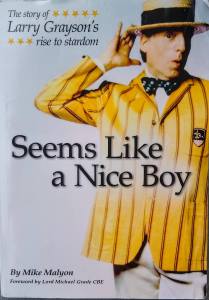
Seems Like a Nice Boy by Mike Maylon.

This is a short biography of Larry Grayson the comedian and one time host of the BBCs Generation Game. I’ve always kind of liked Larry and his camp performances. He was an old style entertainer who found fame in later life after years of summer seasons and working men’s clubs. In a lot of ways his act was similar to the stand up comedy of today; it was a chatty, observational style of comedy that concerned his many creations such as Everard and Slack Alice.

Many have speculated about his true sexuality but it’s clear that Larry enjoyed being labelled as camp rather than gay. The main relationship in his life was with his sister who became a mother figure to him when his adoptive mother died. The two lived next door to each other for many years in later life.
Larry’s career seemed to end when he stepped down from The Generation Game, assuming the BBC would find him some other TV vehicle. They never did. Larry died in 1994.

All in all, an enjoyable read with some interesting insights into the world of entertainment.


What to do next: Here are a few options.

Share this post on your favourite social media!

Hit the Subscribe button. Never miss another post!

Listen to my podcast Click here.

Buy the book! Click here to purchase my new poetry anthology.

Click here to visit Amazon and download Floating in Space to your Kindle or order the paperback version.


My Holiday Book Bag: Winter 2023

A long time ago I was reading a biography about Richard Burton called ‘Rich’ by Melvyn Bragg. The book used Burton’s own diaries and mentioned, amongst other things, Burton’s love of books. When Burton went on holiday he looked forward with delight to the contents of his ‘book bag’. I know it’s a pretty tenuous link but one thing I have in common with Richard Burton is a love of books and when I go on holiday, one of the delights of lying under a warm sun on my sun bed is a good, undisturbed read. I read a lot at home and on my lunch breaks at work but it’s a few minutes here and a few minutes there and whenever I get interrupted it kind of breaks the flow. Some books, as we all know, are just made for a really long, uninterrupted read so here are the books I took on holiday with me recently, all sourced from either the internet or secondhand bookshops.

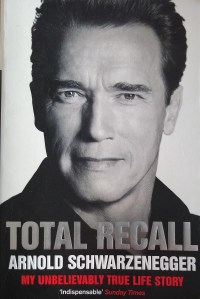
Total Recall by Arnold Schwarzenegger

This book was a Christmas gift from Liz. She knows I’m a big film fan and I do love reading about the background to films and how they are made. Arnold is from Austria and he tells us a little of his life there but mainly focuses on his desire to be a great bodybuilder and to eventually go to America. There is a lot of talk about the process of competitive bodybuilding and the different muscles, muscle definition, reps and squats and all that stuff. Arnold eventually wins various competitions and is wondering how he can compete in the USA when he gets an invitation to do just that. The bodybuilding industry is a close knit one and there seem to be various people welcoming him to California, helping him to find a place to stay and so on. He wins more competitions and makes a little money. He starts a mail order business selling magazines and pamphlets about himself and his body building techniques. He brings one of his Austrian friends over and the two begin a bricklaying and home improvement business. His big break is getting a film part as Hercules and even though the production eventually goes bust it seems to give him a taste of the film business and he wants more. He plays Conan the Barbarian in the film version of a comic book hero and pretty soon he plays the Terminator and goes on to success after success, even becoming governor of California.

I’m not sure I actually came away liking Arnold. I know this is an autobiography but it’s a very me, me, me book and Arnold is constantly bigging himself up. The final chapters about his political career are perhaps the most interesting. He had thought about running for governor but senior republicans seemed to have been more interested in another candidate. However, when Gray Davis was elected in 2000, there seems to have been something of a backlash and there is a curious precedent in Californian politics. The public can demand a recall, a new election in which the public either go for the elected governor or someone new. Arnold entered into the recall and won. He seems to have been in an odd position politically. He was a Republican but had married into the Kennedy family who are Democrats but his success as a politician seems to have come from holding the centre ground in California and bringing Republicans and Democrats and getting them to work together.

At the end of the book Arnold gives us his personal philosophy and his rules for success.

Verdict: I’m not sure whether Arnold wrote this book just to give us his story or to further promote himself but if I had to choose, I’d probably say the latter. Having said that, Mr Schwarzenegger is a man who gets things done and has a positive attitude. Perhaps I should take another look at his rules for success.

Great Expectations by Charles Dickens

This is not a book I brought on holiday but one I found on the shelves of our rented villa in Lanzarote. I started reading it when I got a little bored with Arnold Schwarzenegger and liked it so much I just carried on to the end. It is a real pleasure to read something by a master wordsmith and I enjoyed every minute even though I had read this novel years ago. Young Pip, apprenticed to be a blacksmith, is invited to the home of an eccentric rich woman, Miss Havisham, purely for her amusement. Later in his young life he finds he has ‘great expectations’ and is to inherit a remarkable property. He is taken to London to be brought up as a gentleman and although he is told that his benefactor has asked to remain a secret, he naturally assumes it is Miss Havisham. At the beginning of the book, Pip encounters Magwitch, an escaped convict on the marshes near his home. He compels Pip to bring him some food and a file. He is captured and transported to Australia and later we find, much to Mr Pip’s shock and amazement that Magwitch is the mysterious benefactor.

The book is rightfully one of Dickens’ best loved stories and is a wonderful read. I’ve always thought it had a rather ambiguous ending and in fact in my edition back home, it is one of those with various notes and background information, I am advised that Dickens felt that it was important to assure the reader that Pip had a future with Estella, the spoilt adopted daughter of Miss Havisham and so changed the ending slightly. Pip of course did want a future with Estella but I still feel the book leaves a happy ending slightly uncertain.

Verdict: An absolute classic from a master storyteller.

A Mad world, My Masters by John Simpson

This is a collection of globe trotting stories from John Simpson who has travelled the world as a journalist for the BBC. These though are travel stories with a difference, for instance in the first chapter he talks about airports, not the airports that I generally use, tourist destinations like Spain and Greece. The ones Mr Simpson mentions are airports in war torn Angola and Bosnia, and places like Kabul in Afghanistan and other places where he has had his passport and papers routinely torn up or thrown into a river by laughing revolutionaries and mercenaries. He tells us about headlong dashes to catch flights, including one somewhere in eastern Europe where he was in such a mess after weeks living rough the stewardess was reluctant to let him on board, especially as he had a first class seat. His fellow passenger in the next seat asked to be moved. Luckily John wasn’t flying on a budget airline like the ones I travel with.
On one occasion in Afghanistan with the Mujahadeen, a bearded man appears dressed in white robes. He tries to get the Mujahadeen to murder Simpson for $500. It later turned out that the man was Bin Laden. Simpson talks nonchalantly about many other encounters with revolutionaries such as Arkan, the Bosnian warlord. There are other chapters on dictators that he has met and other sometimes ordinary people who have impressed him, like the simple village priest trying to make life safer for his fellow villagers in Colombia, one of the great drug producing countries of the world.

Most of his stories are hugely fascinating although the more interesting ones are about people, either the ones he has interviewed or the ones who work with him, his fellow journalists and sound-men, cameramen and so on. Most of this book is about the days when a BBC crew consisted of a cameraman, a sound-man, a producer and sometimes even others. Today, Simpson’s crew would consist of him and one other doing the filming and editing. There are some TV journalists today that even have to film and edit themselves.

The last part of the book where the author talks about his love for middle eastern rugs and antiques and the process of bartering that goes with buying those things was perhaps not my cup of tea. Verdict: A patchy read with some very fascinating chapters as well as some not so interesting ones. Generally, though, this was indeed an excellent read.

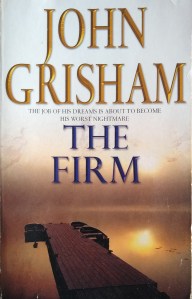
The Firm by John Grisham

There is a process by which I choose books to take with me on holiday. I like to think it’s a thoughtful process combining different genres of books, some novels, maybe the odd classic, and some biographies and autobiographies. What actually happens is that the day before our trip I’ll just grab something near to hand that I know I haven’t read yet and shove it in my suitcase. Anyway, that’s how I ended up with the books you see above. Last year I read The Rainmaker by John Grisham and I thought it was a pretty good read. I must have mentioned that to Liz so she filed that away and got me a stack of Grisham novels for my last birthday. The Firm isn’t a bad read and in my case it was a nice change of pace after reading Dickens and John Simpson’s globetrotting memories. It’s a good story but like a lot of Grisham’s works, its more plot driven than character driven. The characters are sort of bland templates that I’ve recognised in a lot of his novels and so far I’ve only read three. Anyway, characters aside, this is a really original story about a young guy who graduates from law school and gets head hunted into a firm he has never heard of but which offers tremendous financial benefits, a brand new BMW, and an ultra cheap mortgage as well as other financial bonuses. The downside as he comes to learn later is that the firm is just a cover operation to launder money for a big mafia crime family and the FBI wants our hero James McDeere, to help them.
Verdict: Highly enjoyable and a great holiday read but nothing more, although that didn’t stop the book from becoming a best seller as well as a hit film in the 1990’s.

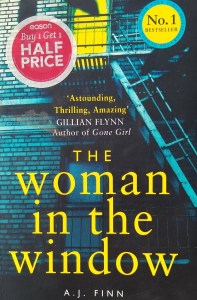
The Woman in The Window by AJ Finn

I’m not sure I would normally have picked up this book if I hadn’t run out of books to read. I saw this on the shelf in our rented villa and Liz had read it and mentioned about numerous references to old black and white films which were right down my alley, apparently.

Anyway, I thought I’d give it a go and I’m very happy that I did. It’s about a woman called Anna Fox suffering from agoraphobia who cannot venture outside her house. She is in effect almost imprisoned there but spends her time playing online chess, seeing two therapists, one physical and one psychological as well as taking medication and drinking a whole lot of Merlot. She also spends a lot of time watching old films on TV and DVD as well as watching her neighbours.

She hears a terrible scream one night although no one else seems to hear it. She questions her tenant who lives in her basement but at the time in question he was doing some work while wearing earphones.

She meets Jane Russell from across the road, not the Jane Russell from the films but a pleasant lady whom she invites in and has a glass of wine with. Later through the windows of Jane’s house, she sees her get stabbed.  Anna calls the police and tries to go across to the house but she cannot get over the road due to her agoraphobia and she ends up in the park where she is found by paramedics.

When she surfaces, we find that no one believes her story and also that Jane Russell is still alive, except, she’s a different Jane Russell to the one Anna saw murdered.

The tension builds nicely in this thriller and a number of shocks are dropped in front of the reader along the way as we find out what has caused the agoraphobia and what really happened over the road.

This was also made into a film starring Amy Adams as Anna Fox although I’ve yet to see it.

Verdict: Great read, so much so that when we left the villa, I had to take it with me to finish on the plane home. To be fair I did leave behind The Firm to replace it.


What to do next: Here are a few options.

Share this post on your favourite social media!

Hit the Subscribe button. Never miss another post!

Listen to my podcast Click here.

Buy the book! Click here to purchase my new poetry anthology.

Click here to visit Amazon and download Floating in Space to your Kindle or order the paperback version.

My Holiday Book Bag 2021

A long time ago I was reading a biography about Richard Burton, in fact it was ‘Rich,’ the biography by Melvyn Bragg. Bragg used Burton’s own diaries in his work and wrote, amongst other things, about Burton’s love of books and when Burton went on holiday he looked forward with delight to the contents of his ‘book bag.’ I know it’s a pretty tenuous link but one thing I have in common with Richard Burton is a love of books and when I go on holiday, one of the delights of lying under a warm sun on my sun bed is a good undisturbed read. I read a lot at home and on my lunch breaks at work but it’s a few minutes here and a few minutes there and whenever I get interrupted it kind of breaks the flow. Some books, as we all know, are just made for a really long, uninterrupted read.

It’s a long time since I’ve been able to produce a Holiday Book Bag post, simply because I haven’t had a holiday which has mostly been the fault of Covid 19 so here are the books I’ve brought on holiday with me to Lanzarote.

Peter Sellers by Alexander Walker

I’ve always been interested in the comedy actor Peter Sellers. It’s probably because of a documentary I saw years ago on BBC’s Arena programme, a film about Sellers which used Sellers’ home movies and what has been good about this particular book is that it has filled in the gaps that were missed in the film.

Sellers was an only child, born into a theatrical family in 1925, he was in fact the second child of Bill and Peg Sellers. Their first child, also called Peter died in infancy and because of that, the family, in particular mother Peg, lavished a great deal of love and affection on Peter. The result was that he was not a nice child, in fact he was spoilt rotten and got his own way in everything and developed many traits he would take into adulthood with him.

Peg, Sellers’ mother, had a stage act in which she used to dress in a white outfit and pose on stage while various slides were projected over her. Father Bill was a musician and Peter claimed that he had taught George Formby to play the ukulele. Sellers was called up in the second world war and Peg used her theatrical contacts to get Sellers into the entertainment unit ENSA. She even travelled about the country to be near him until he was posted overseas. After being demobbed Sellers tried to get work as a comedian and eventually got work on a radio show by impersonating the star of that show, Kenneth Horne over the phone to the producer and saying how good that new comedian Peter Sellers was. Sellers admitted the deception but the radio producer was impressed so Sellers was asked to join the cast of the show.

From there, Sellers met Spike Milligan, Michael Bentine and Harry Secombe and together the group started the Goon Show, the famous hit radio show for which Sellers provided numerous comedy voices.

The next step for Sellers was into films and his big break was getting a part in the film The Ladykillers in 1956. His film hero Alec Guinness was the star. He starred or co-starred in numerous British comedy films before appearing with Sophia Loren in The Millionairess in 1960. The Millionairess made him an international star.

The book tells of his various film roles including his most famous one, that of Inspector Clouseau, a part which he only got after Peter Ustinov turned it down. The author also recounts Peter Sellers’ odd behaviour, his numerous purchases of cars and gadgets, his wives and how his staff had to deal with his various tantrums. His final wife, Lynne Frederick even gets a good review from the author although in other books and documentaries she has not come out looking as good.

Sellers died of a heart attack in 1980, aged only 54.

I do love books about films and film making and this one was an excellent read.

Death of a Glutton by MC Beaton

This is a novel in the Hamish Macbeth series and part of my mission to read all the Macbeth books. The last few have not been great reads. Death of a Prankster wasn’t exactly riveting but this one is much better. It’s not a classic of literature by any means, it’s just a pleasant read. It follows what I have come to think of as the Agatha Christie style of a whodunnit. You know what I mean, a group of suspects gathered together by the detective, in this case Hamish Macbeth and we know one of them is the murderer. This eighth entry in the Macbeth series is about an overweight woman, a part owner in a dating agency who alienates all the potential lovebirds with her constant eating. The co-owner of the agency wants to get rid of her. Is she capable of murder or does Hamish have his eye on someone else?

A pleasant holiday read, nothing more.

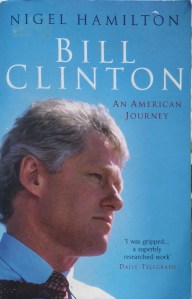
Bill Clinton: An American Journey by Nigel Hamilton

I’m a great fan of biographies and I picked this book up ages ago in one of those remainder book shops. I keep starting it and then moving on to something else so I grabbed it for this holiday book bag, determined to finish it. Bill Clinton was born Bill Blythe and took the name Clinton when his mother married Roger Clinton. It wasn’t a good choice on his mother’s part as Roger was an alcoholic and Bill had to cope with the consequences of Roger’s drinking for many years. Bill was a bright youngster. He did very well at school, he seemed to remember everything he had read, he was very intelligent and a born networker. Perhaps as a consequence of his home life he was good at sorting out feuds and disputes and when he grew tall and strong, he was able to intervene in the often violent disputes between his mother Virginia and Roger.

Bill won a scholarship to Oxford in the UK where he widened his circle of friends. Back in Arkansas he had worked on Senator Fulbright’s election team and also discovered women. Like JFK his hero, Clinton had numerous liaisons which didn’t stop when he met Hilary Rodham. She was nothing like the usual girl he became involved with. She wasn’t good looking, wore huge goggle like spectacles, had greasy hair and apparently wasn’t keen on too much deodorant. After university she went on to be part of the Senate’s Watergate Investigation staff but later joined Bill in Arkansas where he decided to run for Attorney General and later, for the Governorship. The two married and formed a wonderful political partnership that would ultimately take them to the White House.

In his election campaign President Bush thought Clinton would be easy to defeat and began to focus on the third-party candidacy of millionaire Ross Perot. Perot withdrew from the race, and then re-entered. A key moment was in the last of the debates when Bush was unable to properly answer a question from a member of the public about the personal effects of the recession. Bush was confused but Clinton answered the woman directly and had seen many issues in his home state of Arkansas concerning loss of jobs, loss of homes by people unable to pay mortgages and so on.

Another moment was when on live TV the Clintons were asked about Gennifer Flowers. Hilary jumped to her husband’s defence and asked for privacy and then told the viewers that if they didn’t like Clinton then they shouldn’t vote for him. The public did vote for Clinton and in large numbers.

Author Nigel Hamilton has produced an interesting book that is conveniently put together in bite sized and subtitled short sections. I’m not sure whether he really gets close to who Bill Clinton really is but all the information is there to make your own deductions. One of the interviewees for the book comes right out and calls Clinton an inveterate liar. He lies about many things but particularly about his personal life, his many affairs while governor and in particular his twelve year relationship with Gennifer Flowers. There are many comparisons with Clinton’s hero JFK, partly because Hamilton wrote a book about him too. I remember reading that he declined to add a second volume because he didn’t like what he had learned about Kennedy in his research. This book, subtitled An American Journey is only volume one although nowhere on the book does it state that.

The book comes to an abrupt end when Clinton wins the election. There is no description of Clinton’s joy or reaction to his victory. I suppose I’ll have to buy volume II to read about that.

An Autobiography by Agatha Christie

A while ago I was thinking that it’s about time I read something from one of the best selling authors of all time. Searching through the internet I came across Agatha Christie’s autobiography so I thought that might be a good starting point. A lot of the media stuff I do for Floating in Space portrays it as a lost world, the world of 1977 when the book is set. Agatha Christie was born in 1890 and her book truly is a portrait of a lost world. She claims she didn’t come from a rich family yet her mother and father lived in a large house. They had cooks, nannies, nurses and other servants. Her father, who she says was a very agreeable man, had a private income. His father had made investments that paid him handsomely so he was never obliged to work. He left every day for his club, returned home for lunch and then returned to his club to play whist. During the season he spent his time at the cricket club where he was president. Agatha tells various stories of her childhood in Torquay. They are all well observed tales of life in a Victorian house. Later her father dies and the family is struggling for money so they rent out the house and decamp to various places in France, including Paris. Agatha’s lifelong love of travel must stem from these early visits to the continent.

Later she leaves home and marries an airman from the newly formed Royal Flying Corps and tells of her voluntary work as a nurse in WWI. For a while she works in a pharmacy and after being introduced to various poisons gets the idea of writing a murder story. She does so and takes it to various publishers. None seem very enthusiastic about it but eventually she gets to have the work published. She is quite pleased with herself although she only makes a little money. Her first book featured Hercule Poirot, a Belgian detective. She chose a Belgian as there were then many Belgian refugees in England as Belgium had been invaded by the Germans. Later she writes more books and is buoyed when a newspaper asks to serialise one of them. She realises then how poor her publishing contract is and engages a literary agent who stays with her for many years.

To conclude then, this is a very enjoyable well observed book and has made me want to add some Agatha Christie novels to my reading list.


What to do next: Here are a few options.

Share this post on your favourite social media!

Hit the Subscribe button. Never miss another post!

Listen to my podcast Click here.

Buy the book! Click here to purchase my new poetry anthology.

Click here to visit Amazon and download Floating in Space to your Kindle or order the paperback version.

Summer Book Bag 2021

There is nothing nicer than pottering around the garden on a summer’s day, gardening, barbecuing and of course, reading. The pandemic and some sick leave have given me plenty of time to read this summer although most of the books I have bought recently have been not from my usual charity and second hand shops but from the internet.

A Right Royal Bastard

Serves Me Right

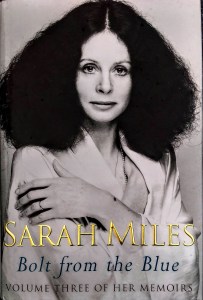
Bolt From the Blue (Three volumes of autobiography by Sarah Miles)

A long time ago I picked up A Right Royal Bastard somewhere in a charity shop. I have a feeling it was whilst walking round Skipton a few months ago but anyway, I didn’t know much about Sarah Miles except that she was a film actress and had appeared in Those Magnificent Men in their Flying Machines and also Ryan’s Daughter, that latter film being one of director David Lean’s less appealing films. Apparently, as Sarah reveals in Serves Me Right, Lean was so upset by the bad reviews he didn’t make another film until A Passage to India, many years later.
The first part of Volume I was rather dull I thought, only really becoming interesting when the author leaves home and becomes an actress. It is a very forthright and frank book and Sarah explains how she once lived with a girl who was a prostitute and wanting to know more about sex, hid in the girl’s closet while she serviced a customer. An abortion was another shocking revelation.

In volume II, Serves Me Right, Sarah goes on to talk about her dog Addo, who she was devoted to, so much so that she would not accept film roles abroad as she couldn’t bear to leave him behind. She talks about the swinging 60’s and her film debut as a ‘husky wide eyed nymphet’ in Term of Trial in 1962. She met Laurence Olivier in that film and went on to have a long affair with him.

She owned a house in London and one day an old friend from RADA turned up and quickly moved herself in. The friend, Nona, had mental health issues and paid no rent and caused Sarah a great deal of distress. Eventually she asked Nona to leave but sadly she committed suicide in the house. It wasn’t the only death she would have come into her life. She had a brief liaison with a man called David Whiting. He was a pushy individual who inveigled himself into her life first as a journalist working for Life magazine and then when he was fired as a PR man on a film her husband, screenwriter Robert Bolt was producing. Whiting was later found dead in her hotel room causing a great scandal. After the incident had died down and her infidelity was revealed, she and Bolt parted.

I’ve only just finished Bolt from the Blue, her third volume of memoirs and it was written in the same frank and forthright style as the preceding volumes. An interesting part for me was about Robert Bolt and the great time and effort he put into crafting his plays and screenplays, spending long hours in his office writing. Towards the end of his life he wrote a screenplay for the film Nixon, one that he was really proud of but Oliver Stone decided not to use it and wrote his own. Bolt also wrote a final screenplay for David Lean, Nostromo. The film was ready to shoot when Lean’s illness meant that the project would go unfinished. Alas the rest of this volume was not quite as interesting as the first two and hearing about Sarah’s homes, dogs and the problems of her spoilt and undisciplined son and his drug problem was not my cup of tea.

The last two volumes I ordered from the internet but annoyingly, Bolt from the Blue arrived as a big hardback book when I really wanted the paperback. I don’t know about you but I like my books to be compact and easy to fit into pockets and bags. I really should pay more attention to internet small print.

Death of a Gossip

Death of a Cad

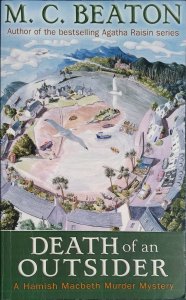
Death of an Outsider (Hamish Macbeth novels by M C Beaton)

I wrote in an earlier post about being a fan of the Hamish Macbeth TV series and finding a copy of one of the books in a charity shop. The book, Death of a Dreamer was enjoyable and quirky and quite different from the TV series. After reading that book, I wanted to read some more and no point in carrying on with the next one I thought, I might as well start from the beginning and read the novels in order. Liz obviously picked up on that and she found the first three novels for me. The first two were compiled together in one volume, Death of a Gossip and Death of a Cad. I was expecting the first one to be something special and looked forward to the introduction of Hamish himself. All the main characters in the series were there, Inspector Blair who looks down on Hamish as a simple village bobby even though he has a knack of solving the local murders and Prunella, daughter of Colonel Harbuton-Smythe, who thinks his daughter is far too good for Hamish even though Hamish clearly likes his daughter. Both the deaths of the gossip and the cad have kept me amused on my garden sun lounger for a while but both were a little contrived. The third instalment in the series though, Death of an Outsider was much better. The characters were better, the plot and the storyline all had me hooked. The setting too was interesting, not the village of Lochdubh that I was beginning to get used to but another village where Hamish was filling in, as their local constable was on holiday. I do love a good murder mystery and already I’m looking forward to number 4 in the series.
Manhunt.

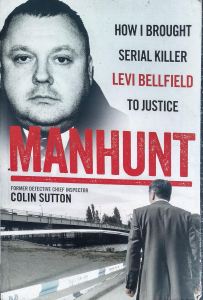
I always find it interesting just how I seem to hook up with a particular book. In this case I had an email from the ITV Hub telling me about a great new series of Manhunt and how I could watch the previous one on the ITV hub.  Now what criteria ITV uses to send me an email like that I don’t know because not only had I never watched Manhunt, I’d never even heard of it. Looking at the ITV website I found that Manhunt was a three part thriller based on the real life case of killer Levi Bellfield. Having nothing more interesting lined up to watch that evening, Liz and I settled down to watch and actually got pretty interested, so much so that I immediately went to Abebooks and ordered a copy of the book that the series had been based on. It had been written, in fact written quite well by former Chief Inspector Colin Sutton who was in charge of the real life investigation of a young French student murdered in Twickenham, London.
Sutton tells the story of how the student living in London was found critically injured on Twickenham Green in 2003. She was taken quickly to hospital but died from her injuries having been hit on the back of the head, possibly with a hammer.

Sutton explains how the Metropolitan Police deal with situations like this and how an ‘on call’ team quickly attend and then hand over to a full murder investigation team led on this occasion by Sutton himself. The first things to do were to secure the crime scene and set up a mobile police station asking for anyone with information to come forward. Various people mentioned a man resembling Maradona, the famous footballer, smoking and standing by the cricket screens. The area was thoroughly searched and the cricket screens fingerprinted. The next step was to check CCTV footage from the area and the cameras soon found the victim alighting from a bus. She had spent the evening at a French bistro with friends and had left to catch her bus home. She had missed her stop and then had to walk across the Green to get home where sadly she was murdered. A small white van was noticed on various CCTV cameras and later when her mobile phone signal was last registered by the river, an underwater search by divers located her house keys and other personal items.

There was no special key to solving this case, no moment like in TV fiction when the detective spots a clue pointing to the killer, just dogged routine footwork and research. Later something approaching that TV moment did occur. At the onsite mobile police station erected on Twickenham Green, an informant had mentioned that her previous partner, Levi Bellfield could be a suspect. He was a violent man, owned a small Ford van and was familiar with the area. The investigation team were about to start on the leads generated by the public when a local PC who had taken the information asked about it. Bellfield looked like a possible murderer straight away and after a surveillance operation the police were to finally arrest him. Keeping him in custody and proving he was a murderer and finding he was linked to other murders and attempted murders was another thing altogether and the author takes us through the investigation step by step.

This was an excellent read and having time off work I was able to lie in the garden, glued to the book until I got to the end.


What to do next: Here are a few options.

Share this post on your favourite social media!

Hit the Subscribe button. Never miss another post!

Listen to my podcast Click here.

Buy the book! Click here to purchase my new poetry anthology.

Click here to visit Amazon and download Floating in Space to your Kindle or order the paperback version.

My Top 10 Books of All Time

The other day I was looking through one of those writer’s pages I subscribe to. One particular page is for writers to talk about stuff, you know, publishing, agents, even actual writing but writers being a self-indulgent selfish lot, they usually just post links to their new books. Being similarly selfish I tend to add links to my new blog posts but on this occasion, I noticed something different, someone had asked a question. What are your 5 favourite books of all time?
Straight away I jotted down four, I struggled for a fifth and then remembered I had already started a post about my top 100 books of all time. It was waiting there quietly in my drafts folder and I’m sorry to say I was well short of a 100. I had got as far as 21 books and so for the purposes of this blog post, I’ve whittled it down to 10. I’ll give you five this week and five the next so here we go, in no particular order . .

The Great Gatsby by F Scott Fitzgerald

What can I say about this modern classic that hasn’t be said before? I’ve tried reading other books by Fitzgerald, but they haven’t really hooked me. This one though is nothing short of wonderful. It’s a sad haunting book and the text is so lovely, so lyrical it could almost be a poem, especially the very last page.

Gatsby is an enigma. A millionaire rumoured to have made his money during prohibition who holds lavish parties in the New York neighbourhood of West Egg. The bright and beautiful of New York are drawn to these parties like moths to a flame and one day, or so Gatsby hopes, Daisy, his lost love, will come too.

Things don’t work out as Gatsby has planned because Daisy has a husband and children. A hot summer in New York adds to the tension and Fitzgerald presents the jazz age to the reader with warmth and nostalgia. Read this book and revel in the author’s lyrical elegance.

Billy Liar by Keith Waterhouse

I’ve always loved this book. It’s a very northern book, written by Keith Waterhouse and it’s about a young lad who fantasises a lot. So much so that he has a whole fantasy world up there in his head. It’s called Ambrosia. In Ambrosia the army traditionally salute with the left hand, a tribute to survivors of the revolution who all lost their right arms in battle. Billy fantasises about writing a great novel, the one like mine that he is always going to start tomorrow. He has two girlfriends on the go, both of whom he has proposed to and has given them both the same ring. He wants to be a TV scriptwriter and has gone as far as sending his scripts to a TV comedian. He dreams of going to London to work. The book was a successful film and someone once told me they saw the stage version which used a revolving stage for Billy to enter into Ambrosia.

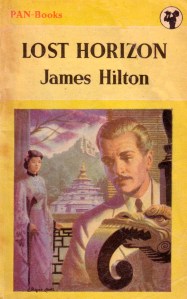
Lost Horizon

James Hilton is one of my personal writing heroes and yet his name may be unfamiliar to many of you reading this blog. He was a journalist and an author and made the trip from his home in Leigh, Lancashire, (now Greater Manchester) in the UK to the Hollywood Hills in the United States to become a screen writer. He is probably more well known for his book ‘Goodbye Mr Chips’ which was made into a film with Robert Donat (actually another northerner from Didsbury in Manchester) but my favourite of his books and quite possibly my all-time favourite book is ‘Lost Horizon’.

Lost Horizon is a book I found in a second-hand shop many years ago. A battered 1940s paperback, I paid twenty-five pence for and yet that small investment has paid me back many times over for sheer reading pleasure as Lost Horizon is a book I re read every year or so and I often pull it down from my bookshelf when a current read fails to entertain me.

Lost Horizon is a completely original idea and is about British consul Robert Conway in the dark days before World War II. Conway is helping his fellow British citizens escape from civil war in China and he and his small party escape in the last plane, only to be kidnapped and taken to a distant Tibetan monastery. Conway meets the High Lama and after a time it is revealed that the Tibetans want to preserve the best of world culture and art and make it safe from the coming war.

Hilton is one of those few people who have invented a word or coined a phrase that has become part of the English language. In this case it was the name of the Tibetan monastery, Shangri-la which has since become a byword for a peaceful paradise, a distant haven. Camp David, the US President’s retreat was originally called Shangri-la until renamed by Eisenhower for his son, David.

Lost Horizon was made into a movie by Hollywood director Frank Capra and starred Ronald Colman as the urbane British diplomat of the novel. It’s a movie that was restored some time ago and is a great DVD if you happen to see it.

A Year in Provence by Peter Mayle

You might possibly be wondering about this book and how it got into my top ten. OK, it isn’t one of the classics and it isn’t exactly by a world-renowned author but what the heck, I’ve always liked it and it’s one of my favourite books. Books come in all shapes and sizes and while some books focus on strong and emotive subjects like love, life, tragedy and the universe, some books lift you up in other ways. I’ve always had a dream of living in France in a big old country house and in this book the author and his wife move to a village in Provence. In a quietly amusing way the author documents his new life which involves things like dining out, sorting out a new boiler and engaging French workmen to remodel his house. They once made it into a rather badly received TV series but the book is a gentle, relaxing summer read.

A Kind of Loving by Stan Barstow

Whenever I plug my own short novel, Floating in Space, I usually try to link it to classic kitchen sink novels of the past like this one. The sixties were a great time for working class novels and many of them were made into films.

The story is a very simple one; Vic Brown is a draughtsman in a Yorkshire factory and he gets involved with a secretary called Ingrid. When Vic learns Ingrid is pregnant, he does the ‘proper’ thing for the 1960’s and offers to marry her. Sounds simple but this is a complex and fascinating book and looks at the subtleties of relationships and how the characters make their way through a series of difficult choices. For a northerner like me, it’s also nice to read about things and places I can directly relate to. The first part of the book where Vic, who narrates the book, talks about a family wedding brings back so many memories of similar weddings when I was a child. Barstow was a Yorkshire writer and A Kind of Loving was the first part of a trilogy. My well thumbed copy has all three parts in one volume.


What to do next:

Share this post on your favourite social media!

Hit the Subscribe button. Never miss another post!

Buy the book! Click here to visit Amazon and download Floating in Space to your Kindle or order the paperback version.

My Lockdown Book Bag 2020

Things don’t always go as planned, especially when an unexpected pandemic hits the country so instead of presenting what might have been another holiday book bag, here’s the pandemic version instead:  A review of the books I’ve been reading lately, all sourced as usual from second hand book shops or the internet.

A Right Royal Bastard by Sarah Miles.

Sarah Miles is a famous actress from the 60s and 70s. She appeared in films like Ryan’s Daughter and The Servant. A Right Royal Bastard is the first volume in her autobiography and is mostly about her childhood. I suppose normally you might expect a film star to devote a chapter or two to his or her childhood but here Sarah gives us pretty much a complete volume devoted to hers.

After the opening chapter I expected the book to move on but no, Sarah Miles tells us everything she can think of about her childhood and her schooling as well as her background and her family. I have to say I was getting a little bored but after a few chapters the book finally began to get interesting.

It’s a very frank book indeed and I wonder if it was a confessional experience for the author. Sarah tells us about her first period and then later about her first sexual experience. The story about when she was almost raped was shocking but then she proceeds to tell us about the time she shared a flat with a prostitute. One memory from that time was when she agreed to hide in a wardrobe during one her flatmate’s encounters with a male client. Sarah and that particular lady later have a bath together and Sarah soon begins to suspect that perhaps someone has got the hots for her.

Later she falls in love with James Fox. He is in the army at the time and when he goes off to join his regiment Sarah finds she is pregnant and suffers a dreadful back street abortion.

Sarah emerges from these pages as utterly different from what I had imagined, she always looks so prim and proper in her films. The book finishes with her first big part in a film and I have to say, I did find myself wishing I had the second volume. I’ll have to look out for it.

Alan Turing: The Enigma.

I’ve been reading this book for a long time and the lockdown was the perfect opportunity to finish it off and finally put it aside. This book is well researched which must have been difficult as Turing was not well known or even famous during his lifetime and his greatest achievements were made in the greatest of secrecy during wartime. The first part of the book I found slow but tedious and it finally livened up when Alan Turing joins the staff at Bletchley Park and sets about decoding the secret messages from Nazi Germany; then it gets interesting.

Turing joined the Government Code and Cypher School in 1938 which was the UK’s code breaking organisation. In 1939 the British cypher experts were given details of code breaking by their Polish colleagues including details of the Nazi Enigma code machine and their methods of decoding the Enigma messages.

Turing recognised the importance of a machine the Poles used to help break the codes and he designed and made his own improved version known as the Bombe. In 1941 Turing and his colleagues appealed directly to Winston Churchill for more resources to help their work and Churchill, recognising the importance of what they were doing responded immediately. As a result, more than 200 bombe machines were in operation by the end of the war.

German naval Enigma messages were even more difficult to break and Turing worked hard on these codes, finally breaking them with a statistical technique that was later known as sequential analysis. It was later estimated that the work at Bletchley Park shortened the war by 2 years and saved countless lives.

Turing worked at Manchester university after the war. In 1952 he became involved with a young unemployed man named Arnold Murray who was later involved in a robbery at Turing’s home in Wilmslow. During the inquiries Turing acknowledged a homosexual relationship with Murray and was prosecuted, homosexuality being illegal at the time. He was found dead two years later in 1954 and it is thought he took his own life using cyanide although it may have been that his death was accidental.

Apart from the wartime work decoding Enigma messages I actually found this book rather heavy going. Towards the end when Alan is working in Manchester I found myself skipping through long passages about mathematical theory but I was glad to have finally reached the end. One interesting thing was that Alan lived in Wilmslow during this latter part of his life. I once lived in Wilmslow too and travelled into Manchester every day on the bus, a journey of about an hour. Alan did the same journey by bicycle so he must have been pretty fit.

Over on Goodreads readers seemed to be all in favour of the book but sadly it just wasn’t my cup of tea.

Khrushchev Remembers.

This book has a remarkable history. Khrushchev was ousted from the Soviet leadership in 1964 in favour of Brezhnev and he was retired to a small dacha with a pension. There Khrushchev fell into a deep depression but his son suggested he record his memoirs on audio tape which he did. The KGB kept an eye on Khrushchev and demanded he turn the tapes over to them which he also did. His son however had copies secretly smuggled into the west and they were published in the form of this book. My copy is quite an old one and has a commentary by Edward Crankshaw putting Khrushchev’s memories into perspective.

The book is a fascinating read and the author takes us through his early life and we see him move ever closer to the centre of power which in Khrushchev’s early years meant closer to Stalin. Khrushchev in some ways thinks of Stalin as a good comrade and communist but in others as what he really was, a ruthless dictator. Khrushchev survives the years of Stalin’s purges when many disappeared after a knock on the door in the middle of the night. Khrushchev defends the Nazi-Soviet pact saying the Soviets knew it would never last but that it gave them time to build up defences against Hitler. Hitler finally attacked Russia with Operation Barbarossa in 1941 and for a time Stalin disappeared from view. He was finally urged into action by his generals and I have read elsewhere that when they first approached him he asked ‘have you come to arrest me?’

It would have probably been better for the Soviets if they had but they rallied around their leader and went on to defeat Hitler, and Stalin consolidated even more power. Stalin died in 1953 and he was left lying on the floor for a day as his staff were too scared to approach him. Beria, head of Stalin’s secret police initially grabbed power but Khrushchev was able to overcome him and have him arrested by the military.

In 1964 it was time for Brezhnev to snatch power himself. Khrushchev did not resist. His contribution he said, was the smooth change of power without murders or arrests.

‘Could anyone have dreamed of telling Stalin that he didn’t suit us anymore and suggesting he retire? Not even a wet spot would have remained where we had been standing. Now everything is different. The fear is gone, and we can talk as equals. That’s my contribution. I won’t put up a fight.’

Brezhnev reversed many of Khrushchev’s reforms and the world and the Soviets had to wait for Gorbachev for more enlightened leadership. To sum up, this was a great read and very interesting but one in which I was glad of the commentary to put the author’s views in perspective.

That was my lockdown book bag. What books do you have in yours?


What to do next:

Share this post on your favourite social media!

Hit the Subscribe button. Never miss another post!

Buy the book! Click here to visit Amazon and download Floating in Space to your Kindle

Holiday Book Bag 10 Winter 2020

As you may know I’m a second hand book enthusiast and when we jet away to places like Lanzarote, I always have a stack of books to read, usually sourced from local second hand book shops or the Internet on sites like Abebooks.com or Awesomebooks.com

These are the books I have taken away to read and to review during my winter break in Lanzarote.

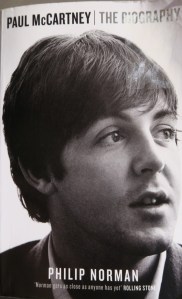
McCartney: A biography by Philip Norman.

I’ve always been fascinated by the Beatles, four northern lads who changed the face of popular music in the 1960’s and Paul McCartney was at the very centre of the group started by John Lennon. This book tells us the story of the Beatles through the eyes of McCartney and then on through the Wings years to the present day.

To start with it tells the story of McCartney in deep focus, taking the reader through McCartney’s younger years, his friendship on the school bus with the younger George Harrison and finally meeting the older John Lennon at a village fête in Woolton. Those few years age difference was a big thing to the budding teenage musicians but together they were the nucleus of the Beatles. There were other members, other guitarists and other drummers but when in their late teens they got the chance to play a regular spot in Hamburg, Germany, they needed a drummer and they chose Pete Best, another local lad but a quieter lad who perhaps did not really fit in on a social level with the other three. The Beatles were not well thought of by fellow Liverpool musicians but after long months playing 6 hours a day at a Hamburg night club they gradually became a better and tighter knit musical group.

Later back in Liverpool they met Brian Epstein, a local businessman who became their manager and the rest as they say, was history. Not for Pete Best though, in the unkindest cut of all, he was replaced by Ringo Starr right on the eve of success and Paul had a key part in his removal, even phoning Brian Epstein to ask had the deed been done just as Epstein was giving Best the bad news.

The book then goes on to tell the story of the Beatles and their success in a wider focus and even seems to jump forward a little talking about the Beatles’ recording days and their various albums ending finally with the splitting of the group and the various arguments between the band members. Then the author goes on to talk about Paul McCartney’s ‘Wings’ years and his marriage to Linda. The book finishes with his marriage and subsequent divorce with Heather Mills and ends with his latest marriage to divorcee Nancy Shevell.

A good insight into the Paul McCartney of today comes at the end of the book when the author is invited to meet Paul in person but finds it’s not a personal meeting but one where Paul is meeting a number of people and everyone is kept waiting for the great man and informed not to take personal pictures. Paul apparently strictly controls what images are taken of him.

It’s an interesting read and I am personally always eager to hear how Paul developed his songs and his recordings and I enjoyed reading about the background to his music and his recording sessions as well as the dance music tracks he has created under the name ‘the Fireman’ in his later years. I have to say I don’t think the author really got into the real McCartney although many background details and insights into his personality were revealed. Perhaps one day Paul himself might produce an autobiography revealing what it was really like being inside the tornado that was the Beatles as well as being one of the greatest singer/songwriters of all time. If he does I will look forward to reading that but until then this volume was a good read, but I’ve read better books on the subject.

Our Man in Havana by Graham Greene.

Not so long ago I read a blog post on the lines of 100 books to read before you die and as now I’m in my sixties I thought I’d better get a move on and read some more. I’m not sure if this book was on the list but I’m sure its author, Graham Greene was. Greene wrote the screenplay for ‘the Third Man’ and later the novel which I’ve always admired so I was very happy indeed to find this book in my Christmas box not so many weeks ago.

I’m not sure what I was expecting, some kind of 1950’s espionage thriller and I suppose it could be considered to be that but actually it’s a very humorous book. Our hero Mr Wormold, I don’t think the book ever mentions his christian name, is a vacuum cleaner salesman living in Havana and bringing up his daughter Milly by himself. His daughter wants her own horse which of course is expensive especially considering food for the animal, stabling, saddles and riding gear and so on. Like many a single parent he wants the best for his daughter but wonders how on earth he can pay for it all. Just then the solution appears. He meets a mysterious man in a bar who recruits him into the secret intelligence service, tasks him to recruit a network of informers and pass the information, in code, back to London.

At first Wormold feels this is impossible but his contact assures him that he will be well paid, as will his informants and receive generous expenses. Wormold then creates a fantasy network of agents, and files various meaningless reports with information gleaned from Cuban press releases and public documents and pockets the resultant cash and expenses that come from London. His fake agents are of course all real people so that they can be checked out by MI5 or MI6 but later one is murdered and then another survives a murder attempt and so Wormold begins to wonder what is happening.

The book is a hugely entertaining story told by an excellent writer. The crazy thing is while I read the book I began to imagine it as an Ealing comedy film starring someone like Alec Guinness only to find that Guinness had actually had played the part on film. I’ve never seen it but what perfect casting!

Our Man in Havana was a short book but an excellent and enjoyable read.

Great Expectations by Charles Dickens.

One of my all time favourite books was Dickens’ David Copperfield but sadly there are only two of Dickens books I have ever been able to get to grips with, one is the aforementioned Copperfield and the other is this one, Great Expectations. It’s a long time since I have read this book so I was very pleased to find it on the bookshelf of our rented villa rubbing shoulders with books by David Baldacci and Sophie Kinsella.
The book is about young Pip, a blacksmith’s apprentice who is advised by a lawyer that he is going to come into ‘great expectations’ and Pip believes his good fortune to be on account of the rich and slightly mad local woman, Miss Haversham. In fact Pip’s fortune is on account of Magwitch, an escaped convict that he helps and brings food and drink to one cold morning.

I do love how Dickens packs so much information into his sentences like this from when young Pip is staying with Uncle Pumblechook and for breakfast he gives Pip such a large quantity of warm water into his breakfast milk that ‘it would have been more candid to have left out the milk altogether.’ There are many others I could quote, full of Dickens’ colourful and descriptive language which delight the reader, sometimes so much so that my own writings seem to pale into insignificance.

The last time I read this book there were two endings as Dickens added a new ending to ensure that the reader was left with the understanding that Pip and Estella stay together. Happily this version has the latter ending and was therefore a much more enjoyable read.

Niv, the authorised biography of David Niven by Graham Lord.

This book has been an absolute delight, in fact the perfect holiday read. The author tells the story of Niven’s life, pretty much as Niven himself set it down in his best selling autobiography The Moon’s a Balloon. However in this version the author tries to fill in the bits Niven left out of his book and correct many inaccuracies. Niven was notorious for embellishing the truth and the character of ‘Nessie’ to whom Niven lost his virginity in his book was, this author claims, pure fiction. Personally, I find that hard to believe even though no corroboration could be found with David’s many friends and those interviewed for this biography. Nessie seemed to be just such a fundamental part of his life I just don’t see how he could have invented her.

In The Moon’s a Balloon Niven paints a disappointing picture of his mean stepfather and his financially stretched mother. Neither according to the author were true. Niven’s stepfather splashed out to help Niven numerous times and his mother, far from being poor was very secure financially. Niven says he never spoke to his stepfather after a disagreement over upkeep of his mother’s grave but in fact corresponded warmly with him and the author even puts forward a case for the stepfather actually being Niven’s actual father though the man he thought of as a father died in the First World War.

Niven went to Sandhurst and was later posted to Malta. Later, he left the army and made his way to Hollywood becoming an extra and later, after obtaining a contract with the legendary Sam Goldwyn, a star. His affair with Merle Oberon, missing from A Moon’s a Balloon, is documented here and the book follows his life as a movie star, the death of his first wife Primmie in a terrible accident only 6 weeks after coming to Hollwood and his unhappy second marraige to the swedish model Hjordis.

An interesting part of the book detailed how David wrote his own best selling books; The Moon’s a Balloon and Bring on the Empty Horses, the latter, a book I reviewed a while ago as the best book ever written about Hollywood. Niven struggled like many writers to keep focused on his project but living in the south of France with the Rainiers as close friends and neighbours and many other celebrity friends close by, plus his jet setting life style, writing must have been difficult; much more difficult than for me with, as I write this, only the winter sun and a sun lounger as a distraction.

Niv as his friends called him, comes over as a lovely man and this biography as I said earlier is a perfect holiday read.


Steve Higgins is the author of Floating in Space set in Manchester, 1977. Click the links at the top of the page to buy or for more information.

Holiday Book Bag Summer 2019

To me, one of the great things about a summer holiday are the books I take in my book bag. The chance to relax and read something in a good lengthy book reading session. These are the books I took away to read this summer.

The Secret Life of Marilyn Monroe by J. Randy Taraborelli.

I’ve always found Marilyn Monroe to be just about the most fascinating of all the great Hollywood movie stars, not only her life and career but also her strange and mysterious death. This book written in 2008 is interesting in that it focuses on her early life as well as her movie career, but also looks closely at her private life and her issues with her own mental health which give us a clue to understanding her unhealthy obsession with drugs and medication. Clearly, as the author shows, it was more than the usual Hollywood addiction to uppers and downers, essential perhaps back then to deal with late night publicity and early film calls but actually for Marilyn a way to deal with the mental anguish that plagued her and her mother for most of their lives.

Marilyn was terrified of ending up like her mother in a mental institution and when in the early 1960’s she was voluntarily admitted to a mental hospital, supposedly for a rest cure, she was terrified to find she had been locked into what she described as a madhouse. Former husband Joe DiMaggio came to her rescue but the experience must have reminded her of her own mother who herself was desperate to escape the institutions she was kept in.

A lot of elements of her early life I wasn’t really aware of until reading this book and also the author makes a good point in showing that Marilyn herself wasn’t always honest about what she told the press and others about herself.

Well written, very interesting and apart from the last chapter on the Kennedys which I think has been dealt with better in some more recent books, a great addition to any Monroe book collection.

My Turn by Norman Wisdom.

I have to say that until reading this book I had no interest whatsoever in Norman Wisdom. I used to see his films regularly on television as a child but I have to say, I have never found him funny and his slapstick gormless antics have always left me unmoved.

Liz picked this book up for me at a church charity sale and I had a quick look at it one day relaxing in the garden. It sounded pretty interesting and I do love showbiz life stories so I popped it into my holiday book bag and finished it off on holiday.

Norman tells us the story of his early life in which his parents were clearly not happy together. His father was violent and eventually his mother left and divorced her husband. This being the 1930s when divorce was not so prevalent as in the present day she was unable to take her children with her and they were sadly neglected by their father.

He left them alone for long periods and their education and welfare suffered. At one point Norman remembered going to school in bare feet, something not so uncommon he says at the time. His father put Norman and his brother in various foster homes and at one point they even found themselves living on the streets. Norman himself was saved by the army. He joined as a child as a band boy and credits the army and the army way of life as the making of him. After leaving the army he found his father had remarried and went to see him hoping to be taken in. He knocked on the door and a lady answered. Norman told her who he was and she asked him to wait.

Later his father returned and without a thought for his son and his situation, threw him out. He is never mentioned again. It’s amazing that someone who has suffered so much in this way should go on to a career of making people laugh. I did wonder whether Norman, living in a lovely home in the Isle of Man, surrounded by a collection of exclusive motor cars, ever once thought about his father, who incidentally was a chauffeur.

Later he was reunited with his mother and brother and was supported by his mum and her new husband as he made his way into the world of comedy.

The first part of the book is truly sad and at the same time refreshing to see how Norman copes with all this and yet still goes on to fame and fortune. The latter part of the book is not so interesting; more of a list of his numerous successes but one anecdote was rather funny.

Norman was invited to Spain for a film festival where apparently his films were very popular, his visual style of comedy transcending the language barriers. At the festival he is the star attraction and due to go on last but Hollywood star James Mason thinks he should go on last as he is the bigger star. Norman agrees and goes on before Mason. He then wows his audience with a short speech in Spanish, leaves to a standing ovation and poor James Mason walks on to only a trickle of applause!

Tricks of the Mind by Derren Brown.

This is another book I picked up at a charity book shop. Derren Brown is an enigmatic TV fella whose shows are a sort of combination of magic, psychology, hypnotism and some just general weird spooky stuff. I’m not sure what I was expecting from his book. I suppose I guessed it was a sort of autobiography of sorts but in fact it’s really about the things that interest the author, pretty much in the realms of magic, psychology and hypnotism and have contributed towards his performances both on the stage and on TV.

He starts off with a little background to magic and how it works, things like sleight of hand and then how the magician uses various techniques to divert attention away from something that he doesn’t want you to see to something he wants you to see.

Another interesting technique, vital to a magician is memory. Imagine a magician, or anyone for that matter being able to memorise an entire shuffled deck of cards. Sounds impossible doesn’t it but no, it can be done by using various methods which the author describes which are also pretty good for remembering anything like passwords, telephone numbers or shopping lists for instance. The way to do it is by linking something –whatever it is you are trying to remember- to something you can remember like a really striking image. So when trying to remember the name of a new acquaintance called Mike for instance, we should create an image of someone with a really big nose, shaped like a mic –a microphone.

There are more highly interesting sections on hypnotism, and body language and then the author moves on to discrediting things like mediums who try to contact the spirit world. Everything they do he claims can be done by ‘cold reading’, a way of interpreting not only body language but verbal language tricks too.

Overall a fascinating book but one theme that Derren plays too much with is how he has rejected Christianity because science cannot prove that Jesus was who he says he is, the son of God and has been resurrected. Surely Derren especially should realise that everything is not as it seems.


Floating in Space is a novel set in Manchester 1977. Click the links at the top of the page to buy or for more information.