As you may know I’m a second hand book enthusiast and when we jet away to places like Lanzarote, I always have a stack of books to read, usually sourced from local second hand book shops or the Internet on sites like Abebooks.com or Awesomebooks.com
These are the books I have taken away to read and to review during my winter break in Lanzarote.
McCartney: A biography by Philip Norman.
I’ve always been fascinated by the Beatles, four northern lads who changed the face of popular music in the 1960’s and Paul McCartney was at the very centre of the group started by John Lennon. This book tells us the story of the Beatles through the eyes of McCartney and then on through the Wings years to the present day.
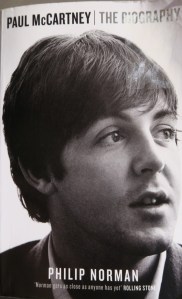 To start with it tells the story of McCartney in deep focus, taking the reader through McCartney’s younger years, his friendship on the school bus with the younger George Harrison and finally meeting the older John Lennon at a village fête in Woolton. Those few years age difference was a big thing to the budding teenage musicians but together they were the nucleus of the Beatles. There were other members, other guitarists and other drummers but when in their late teens they got the chance to play a regular spot in Hamburg, Germany, they needed a drummer and they chose Pete Best, another local lad but a quieter lad who perhaps did not really fit in on a social level with the other three. The Beatles were not well thought of by fellow Liverpool musicians but after long months playing 6 hours a day at a Hamburg night club they gradually became a better and tighter knit musical group.
Later back in Liverpool they met Brian Epstein, a local businessman who became their manager and the rest as they say, was history. Not for Pete Best though, in the unkindest cut of all, he was replaced by Ringo Starr right on the eve of success and Paul had a key part in his removal, even phoning Brian Epstein to ask had the deed been done just as Epstein was giving Best the bad news.
The book then goes on to tell the story of the Beatles and their success in a wider focus and even seems to jump forward a little talking about the Beatles’ recording days and their various albums ending finally with the splitting of the group and the various arguments between the band members. Then the author goes on to talk about Paul McCartney’s ‘Wings’ years and his marriage to Linda. The book finishes with his marriage and subsequent divorce with Heather Mills and ends with his latest marriage to divorcee Nancy Shevell.
A good insight into the Paul McCartney of today comes at the end of the book when the author is invited to meet Paul in person but finds it’s not a personal meeting but one where Paul is meeting a number of people and everyone is kept waiting for the great man and informed not to take personal pictures. Paul apparently strictly controls what images are taken of him.
It’s an interesting read and I am personally always eager to hear how Paul developed his songs and his recordings and I enjoyed reading about the background to his music and his recording sessions as well as the dance music tracks he has created under the name ‘the Fireman’ in his later years. I have to say I don’t think the author really got into the real McCartney although many background details and insights into his personality were revealed. Perhaps one day Paul himself might produce an autobiography revealing what it was really like being inside the tornado that was the Beatles as well as being one of the greatest singer/songwriters of all time. If he does I will look forward to reading that but until then this volume was a good read, but I’ve read better books on the subject.
Our Man in Havana by Graham Greene.
 Not so long ago I read a blog post on the lines of 100 books to read before you die and as now I’m in my sixties I thought I’d better get a move on and read some more. I’m not sure if this book was on the list but I’m sure its author, Graham Greene was. Greene wrote the screenplay for ‘the Third Man’ and later the novel which I’ve always admired so I was very happy indeed to find this book in my Christmas box not so many weeks ago.
I’m not sure what I was expecting, some kind of 1950’s espionage thriller and I suppose it could be considered to be that but actually it’s a very humorous book. Our hero Mr Wormold, I don’t think the book ever mentions his christian name, is a vacuum cleaner salesman living in Havana and bringing up his daughter Milly by himself. His daughter wants her own horse which of course is expensive especially considering food for the animal, stabling, saddles and riding gear and so on. Like many a single parent he wants the best for his daughter but wonders how on earth he can pay for it all. Just then the solution appears. He meets a mysterious man in a bar who recruits him into the secret intelligence service, tasks him to recruit a network of informers and pass the information, in code, back to London.
At first Wormold feels this is impossible but his contact assures him that he will be well paid, as will his informants and receive generous expenses. Wormold then creates a fantasy network of agents, and files various meaningless reports with information gleaned from Cuban press releases and public documents and pockets the resultant cash and expenses that come from London. His fake agents are of course all real people so that they can be checked out by MI5 or MI6 but later one is murdered and then another survives a murder attempt and so Wormold begins to wonder what is happening.
The book is a hugely entertaining story told by an excellent writer. The crazy thing is while I read the book I began to imagine it as an Ealing comedy film starring someone like Alec Guinness only to find that Guinness had actually had played the part on film. I’ve never seen it but what perfect casting!
Our Man in Havana was a short book but an excellent and enjoyable read.
Great Expectations by Charles Dickens.
 One of my all time favourite books was Dickens’ David Copperfield but sadly there are only two of Dickens books I have ever been able to get to grips with, one is the aforementioned Copperfield and the other is this one, Great Expectations. It’s a long time since I have read this book so I was very pleased to find it on the bookshelf of our rented villa rubbing shoulders with books by David Baldacci and Sophie Kinsella.
The book is about young Pip, a blacksmith’s apprentice who is advised by a lawyer that he is going to come into ‘great expectations’ and Pip believes his good fortune to be on account of the rich and slightly mad local woman, Miss Haversham. In fact Pip’s fortune is on account of Magwitch, an escaped convict that he helps and brings food and drink to one cold morning.
I do love how Dickens packs so much information into his sentences like this from when young Pip is staying with Uncle Pumblechook and for breakfast he gives Pip such a large quantity of warm water into his breakfast milk that ‘it would have been more candid to have left out the milk altogether.’ There are many others I could quote, full of Dickens’ colourful and descriptive language which delight the reader, sometimes so much so that my own writings seem to pale into insignificance.
The last time I read this book there were two endings as Dickens added a new ending to ensure that the reader was left with the understanding that Pip and Estella stay together. Happily this version has the latter ending and was therefore a much more enjoyable read.
Niv, the authorised biography of David Niven by Graham Lord.
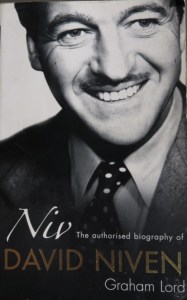 This book has been an absolute delight, in fact the perfect holiday read. The author tells the story of Niven’s life, pretty much as Niven himself set it down in his best selling autobiography The Moon’s a Balloon. However in this version the author tries to fill in the bits Niven left out of his book and correct many inaccuracies. Niven was notorious for embellishing the truth and the character of ‘Nessie’ to whom Niven lost his virginity in his book was, this author claims, pure fiction. Personally, I find that hard to believe even though no corroboration could be found with David’s many friends and those interviewed for this biography. Nessie seemed to be just such a fundamental part of his life I just don’t see how he could have invented her.
In The Moon’s a Balloon Niven paints a disappointing picture of his mean stepfather and his financially stretched mother. Neither according to the author were true. Niven’s stepfather splashed out to help Niven numerous times and his mother, far from being poor was very secure financially. Niven says he never spoke to his stepfather after a disagreement over upkeep of his mother’s grave but in fact corresponded warmly with him and the author even puts forward a case for the stepfather actually being Niven’s actual father though the man he thought of as a father died in the First World War.
Niven went to Sandhurst and was later posted to Malta. Later, he left the army and made his way to Hollywood becoming an extra and later, after obtaining a contract with the legendary Sam Goldwyn, a star. His affair with Merle Oberon, missing from A Moon’s a Balloon, is documented here and the book follows his life as a movie star, the death of his first wife Primmie in a terrible accident only 6 weeks after coming to Hollwood and his unhappy second marraige to the swedish model Hjordis.
An interesting part of the book detailed how David wrote his own best selling books; The Moon’s a Balloon and Bring on the Empty Horses, the latter, a book I reviewed a while ago as the best book ever written about Hollywood. Niven struggled like many writers to keep focused on his project but living in the south of France with the Rainiers as close friends and neighbours and many other celebrity friends close by, plus his jet setting life style, writing must have been difficult; much more difficult than for me with, as I write this, only the winter sun and a sun lounger as a distraction.
Niv as his friends called him, comes over as a lovely man and this biography as I said earlier is a perfect holiday read.
 The Secret Life of Marilyn Monroe by J. Randy Taraborelli.
 My Turn by Norman Wisdom.
 Tricks of the Mind by Derren Brown.
 re’s nothing I love more than a good book and as usual, here’s a quick round-up of the books I’ve taken on holiday to Lanzarote in the Canary Islands. As I’m flying I’ve not brought any hardbacks, just four paperbacks. All my books are usually sourced from the Internet or second-hand book shops but the ones below, with one exception, were gifts.
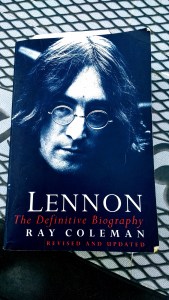 The writer has no time for music journalists who waxed less than lyrical about later Beatles’ records released in the last thirty odd years, things like The Beatles at the BBC released in 1994 or the Beatles Anthology. Reviewers who gave those records a poor reception get short shift indeed and the reader is quickly reminded of their chart topping sales. In their defence though pop music journalists tend to look forward to new music, not back to the old. More scorn is saved for Albert Goldman who wrote the book The Lives of John Lennon. Personally I thought that was rather a good book; it’s certainly more compelling than this one although it tends to focus on Lennon in a negative way whereas this book is very generous towards Lennon. It’s the book of a Lennon fan and focuses on the events in Lennon’s life in a very positive way.
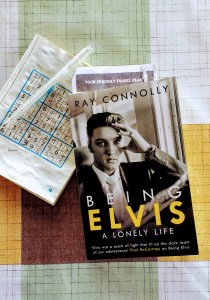 Subtitled A Lonely Life, this is a biography of Elvis Presley by another music journalist, Ray Coleman. Elvis became the King of Rock ‘n’ Roll who inspired Lennon, McCartney and a whole host of others to become musicians and pop stars. I’ve read quite a few biographies of Elvis, all much thicker than this one but this is a great holiday read being both interesting and informative. The foreword to the book was particularly insightful regarding the impact Elvis had on other musicians. The author recounts two phone calls, one to Bob Dylan and one to John Lennon where he happened to mention that he had been to Elvis’ 1968 comeback concert. Both those highly regarded stars bombarded Coleman with a series of questions about Elvis showing that despite their own success and achievements, they were still at heart Elvis fans.
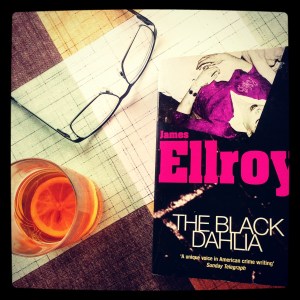 The Black Dahlia by James Ellroy.
 A Daughter’s Tale by Mary Soames.
 As you will probably have gathered if you have read more than a few of my posts, I really do love books. There is nothing better than curling up with a good book anywhere, on a bus or train, in a chair, on a sun lounger, anywhere in fact. Books are a tonic for the brain. An education and a cerebral treat, both at the same time. Books enable the reader to travel not only geographically but in time too. Take one of my interests for instance. Classic cinema. Books like David Niven’s Bring on the Empty Horses has taken me on a journey to Hollywood and back to the golden years of classic cinema, the 1930s and 40s. Niven has told me about the Brown Derby, Romanov’s, Schwab’s drug store and Summit drive and a hundred other places I have never visited. But lets not stop there, let’s go even further. Marcus Aurelius’ book Meditations was written by a great emperor of Rome who died in the year 180AD, so his book is at least 1837 years old. Just imagine, the thoughts of a man who lived nearly 2000 years ago, travelling intact to me, the reader, in the year 2017.
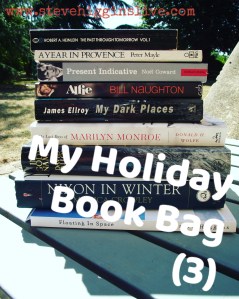 I’m just not into busy, rushed holidays. I prefer the quiet, relaxing type; the ones that involve sunny days, swimming pools and plenty of leisure time to read books. I read at home too but that is a different sort of reading; a few minutes here, a few minutes there. I’ll read on my lunch break at work in between eating my sandwiches and drinking tea but the best way to read, the way to really get into a book is a long uninterrupted read while you lie on your sun lounger with the pool handy nearby for when it gets a little too hot. A quick dip then you are back to the thoughts of your chosen author.
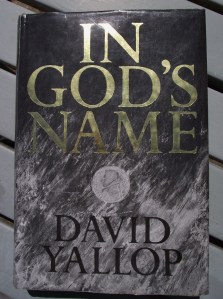 I bought this book originally on the 3rd March, 1987. I know that for a fact because back then I used to write the date on all my book and record purchases. I have read it a number of times and it is a fascinating read. It ticks all my personal boxes of history and modern mysteries. Why, you might ask would anyone want to murder the Pope? Good question and the answer, according to the author is the Vatican Bank. The Vatican, thanks to Mussolini, is a separate independent state and so the Vatican bank, registered in the Vatican state is not answerable to the banking laws and inspectors of Italy. This idea appealed to various unscrupulous individuals, notably Licio Gelli – the head of an illegal and secret masonic organisation known as P2, Roberto Calvi – a banker with ties to P2 and the Mafia, and Michele Sindona, another criminal. Together they engineered the movement of various shares and monies, using the Vatican bank. A man called Albino Luciano, the bishop of Venice, became aware gradually of various wrongdoings in the bank and was particularly dismayed by the action, or inaction of Bishop Paul Marchinkus, the head of the Vatican Bank. In 1978, after the death of Pope Paul VI, Luciano was elected Pope. He was a man dedicated to the ideas of Jesus, a simple carpenter from Nazareth and he wanted the church to follow his example. He did not want a church that had a multi million dollar profit in stocks and shares, he wanted a poor church, a church that properly reflected the feelings of its founder. When he was elected the new Pope, Luciano’s ideas and those of the aforementioned individuals were on a collision course. David Yallop’s investigation is intensive and revealing and I came away from the book feeling an intense sadness that a good and decent man, a man who would have been a great Pope and spiritual leader had been stolen from us by the greed of a few men.
 A Year in Provence by Peter Mayle.
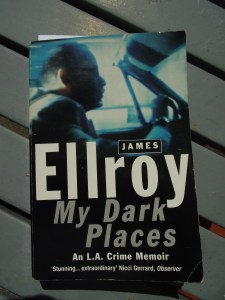 My Dark Places by James Elroy.
