AKA (Also Known As)

This week’s post is about pseudonyms and people who use different or other names.

Lenin aka Vladimir Ilyich Ulyanov

Last week in a post about Painters and Paintings, I mentioned Lenin who was the first Communist leader of the Soviet Union. In fact, it was he who created the Soviet state but his real name was not Lenin. He was born in 1870 as Vladimir Ilyich Ulyanov. He studied at Kazan University and later became a Marxist activist after moving to St Petersburg, later renamed Petrograd. In 1897 he was arrested and exiled to Siberia for three years. In 1903 the Russian Democratic party (later renamed the Communist Party) split into two and Lenin led the Bolsheviks against the Menshiviks. In the unsettled world of the late 19th and early 20th century, political activism in The Russian empire was a dangerous game and Ulyanov began to use a pseudonym to protect himself. The name he chose was Lenin.

After his exile ended Lenin left Russia for the relative safety of western Europe, even living in London for a time. He returned to Russia when a revolution broke out in 1905 but when that failed, he returned to Europe and continued to organise and write essays and propaganda for the Bolshevik cause.

After the revolution which toppled the Tsar, the Germans who were then at war with the European allies in the First World War, sent Lenin into Russia on a sealed train. Churchill famously commented that

“Lenin was sent into Russia by the Germans in the same way that you might send a phial containing a culture of typhoid or cholera to be poured into the water supply of a great city, and it worked with amazing accuracy.”

Lenin was welcomed in Russia as the leader of the Bolsheviks and was helped by Stalin to escape the forces of the provisional government controlled by Alexander Kerensky. The Bolsheviks however soon engineered a second revolution; the provisional government was overthrown and Kerensky, his brief entry into history over, had to flee.

Lenin presided over the new government. He made peace with Germany despite having to negotiate away a huge swathe of land to the Kaiser’s Germany. He waged a civil war within Russia against those who tried to restore the Tsar. He renamed his party the Communist party.

In 1921 Lenin became ill, finally dying in January of 1924. In his last days he tried to remove Stalin from power but failed.

Stalin aka Joseph Vissarionovich Dzhugashvili
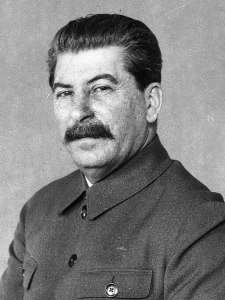
James Abbe, Public domain, via Wikimedia Commons

Stalin was born into a poor peasant family in Georgia in 1878. Later he became a bank robber, providing funds for Lenin and the Bolshevik party. He was born Joseph Vissarionovich  Dzhugashvili and like Lenin, adopted a pseudonym. The name Stalin came from the Russian word for Steel and is often said to mean ‘man of steel’. In his early days as a Bolshevik, Stalin robbed banks to fund the revolution. Later, Stalin organised and edited Bolshevik newspapers for Lenin and Lenin promoted him to the party’s central committee in 1912.

When Lenin died, Stalin took control of Lenin’s funeral and began to cultivate a cult of personality around himself, gradually removing all those who opposed him on the central committee. After expelling Leon Trotsky who was exiled and later deported in 1929, Stalin was unopposed as the supreme leader. His regime oversaw mass repression with millions consigned to forced labour in the Gulag camp system and others who Stalin perceived as threats, imprisoned or murdered in his purges.

Stalin died in 1953. After collapsing, he was discovered by his security staff who were too scared to approach him at first. Later they moved him to a couch thinking the heavy drinking dictator might have been drunk. He died on the 6th March and later Khrushchev emerged as the new Soviet leader.

Trotsky aka Lev Davidovich Bronstein
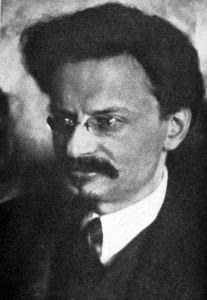
By Isaac McBride – Barbarous Soviet Russia, Public Domain, https://commons.wikimedia.org/w/index.php?curid=3363312

Trotsky was another Bolshevik who used a pseudonym. He was the creator of the Red Army and the man Lenin thought would be a good successor. He, like Lenin and Stalin, suffered exile to Siberia and later met Lenin in London where he worked on the party newspaper. He returned to Russia in 1917 and became chairman of the Petrograd Soviet. After the Bolsheviks took power Lenin appointed Trotsky to the post of foreign minister, later becoming the Commissar for Military and Naval Affairs. He built up the Red Army and led it to victory in the civil war.

After Lenin’s death Trotsky was sidelined by Stalin and expelled from the Communist party and later from Russia itself. He finally settled in Mexico until his murder by Stalin’s agents in 1940.

Elton John aka Reg Dwight

That’s enough Soviet history for now so let’s move swiftly on to the music business. Reginald Dwight was born on the 25th March 1947. He lived in Pinner in Middlesex with his mother and father, Stanley and Sheila, although they divorced when Reg was 14.

Something that had a big effect on the young Reginald was his parents’ love of music. He began tapping out tunes on his grandmother’s piano and the age of 11 won a scholarship to the Royal Academy of Music.

At the age of 15 Reg got himself a job playing the piano at the local pub and in 1962 he and some friends formed a small band called Bluesology and they soon picked up a regular gig supporting singer Long John Baldry.

In 1967 Reg answered an advertisement in the New Musical Express. It had been placed by Liberty Records who were looking for new talent. Reg went to audition for the A & R manager, Ray Williams but Ray appeared to be unimpressed when Reg sang an old Jim Reeves hit and by way of ending the interview Ray handed Reg a sheaf of unopened lyrics written by someone who had answered the same ad.

That someone was Bernie Taupin. He and Reg hit it off instantly and Reg began writing music to Bernie’s lyrics. Six months later Reg changed his name. He took his new name from Bluesology bandmates Elton Dean and Long John Baldry and put them together to become Elton John.

In 1969 Elton’s album Empty Sky became a minor hit and was followed by the eponymous Elton John in 1970. ‘Your Song’, a single from the album went to number 7 in the UK singles chart and Elton John had arrived.

Archie Leach aka Cary Grant

Grant was born Archibald Leach in Bristol, England in 1904. He had a poor upbringing and his mother suffered from depression and his father was an alcoholic. The young Archie was interested in the theatre and performing and his mother was keen on him having piano lessons. His older brother had died before reaching the age of one and this perhaps made his mother a little over protective of the young Archie. Even so, his mother was not a woman who was able to give or receive love easily and the older Cary Grant blamed his childhood relationship with his mother for his problems with women in later life.

When Archie was 9 years old his father placed his mother in Glenside Hospital, a mental institution, telling his son that she had gone away on a long holiday and later, that she had died.

Archie befriended a group of acrobatic dancers known as The Penders and he was able to eventually join them and there he trained as a stilt walker and became part of their act. Later the group toured America and Archie decided to stay, following in the footsteps of others before him like Charlie Chaplin and Stan Laurel who had made their way to the USA in an almost identical way.

On Wikipedia they mention that on the trip over to the USA, Archie met Douglas Fairbanks and was greatly impressed by him, so much so that Fairbanks became a role model for the young Archie Leach.

In New York Archie worked in vaudeville with various comedy and theatrical groups. He joined the William Morris theatrical agency and began to pick up many theatre roles. In 1932 he had his first screen test and was given a five year contract with Paramount Pictures. B P Schulberg the general manager of Paramount decided that Archie Leach was not a good enough name for films so Archie came up with the name Cary Grant taking Cary from a stage character he had played and Grant chosen randomly from a telephone directory.

Cary Grant retired from acting in 1966 when his only daughter was born. He died in 1986 aged 82.

Ayrton Senna aka Ayrton Da Silva

It might come as a surprise to many to learn that the legendary racing driver Ayrton Senna did not use his real name. Instead, he chose to race under his mother’s maiden name, Senna. He decided to use the name Senna as in Brazil, his home country, Da Silva is a very common name and Ayrton hoped the use of Senna would make him stand out and be more recognisable in the world of motor sport.

Ayrton Senna in the McLaren Mp4/4 in 1988. Photo by the author

Ayrton was born and raised in the Brazilian city of Sao Paulo. He was born in 1960 and began racing karts at the age of 13. After twice finishing as runner up in the world kart championships Ayrton moved to Europe to compete in Formula Ford and later Formula 3. It was quite an achievement for the young Brazilian. He spoke little English and he and his wife were fishes out of water in the UK. Only his massive desire to succeed and to make it into Formula One kept him going. Alas his young wife was not up to the challenge and returned to Brazil.

Senna went on to enter Formula 1 and with the McLaren F1 team he won all of his three world championships fighting constantly with his great rivals Alain Prost and Nigel Mansell. He was killed on the 1st of May 1994 at the San Marino Grand Prix in Italy after leaving McLaren for the Williams team. He crashed at the Tamburello corner when he hit the concrete wall there and a suspension arm, forced back in the impact pierced his most vulnerable area, the visor of his crash helmet.

T E Lawrence aka John Hume Ross and T E Shaw
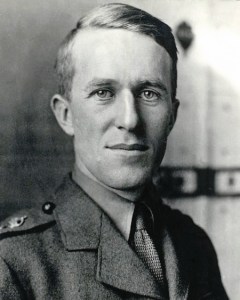
By Unknown author – pavellas.blogspot.com, Public Domain, https://commons.wikimedia.org/w/index.php?curid=7367070

Thomas Edward Lawrence is a fascinating character. He was a British army officer and writer best known for his role in the Arab Revolt during the First World War. He became known to the public through a series of film presentations by writer and documentary film maker Lowell Thomas.

After the war Lawrence tried to vanish into anonymity by joining the RAF as an aircraftsman using the alias of JH Ross. Later when his real identity was exposed he left the RAF and joined the army using the alias TE Shaw. He was unhappy in the army and was eventually readmitted to the RAF.

His account of his work in the Arab Revolt was published in his book Seven Pillars of Wisdom. Lawrence actually lost his manuscript at one point and was forced to reconstruct the entire book. Later, the book was used as the basis for the film Lawrence of Arabia starring Peter O Toole as Lawrence. A stage play was also written about him by Terrence Rattigan titled Ross which explored Lawrence’s alleged homosexuality. Alec Guinness featured in the play in the title role as Ross/Lawrence.

On the 13th May 1935 Lawrence was severely injured in a motorcycle accident and died six days later on the 19th May.


Thanks to Wikipedia for the source information.

What to do next: Here are a few options.

Share this post on your favourite social media!

Hit the Subscribe button. Never miss another post!

Listen to my podcast Click here.

Buy the book! Click here to purchase my new poetry collection.

Click here to visit Amazon and download Floating in Space to your Kindle or order the paperback version.

Click here to visit amazon and purchase Timeline, my new anthology.

8 Onscreen Portrayals of Real People

It’s been another cold and wet week and as usual I’ve tended to lie back on my couch and watch a lot of television and not just broadcast TV either. Lots of times when broadcast TV isn’t up to the job of entertaining me, I’m forced to crank up a recording and watch that. Just lately I’ve watched a couple of biopics, films about real people, so for this post I thought I’d continue that theme and look at films and TV shows where the actors have had to portray real people.

Barbara Windsor

One night last week I watched a documentary about the Carry On films. It was really interesting and was titled Secrets and Scandals. It showed a lot of previously unseen interviews in which the stars had a whinge about various things, in particular the fact that they didn’t get paid when the films were reshown time and time again on TV. The producers made a shed load of money but the stars were paid peanuts. One of those stars was Barbara Windsor and after I had watched the documentary, I remembered a TV film called Babs about Barbara’s life. It was made in a really interesting way and involved Barbara in later life, imagining that she was talking to her late father about various things that have happened to her. Events from her life are recreated in front of her and she turns and discusses the incidents with her dad.

Theatre director Joan Littlewood was really impressed by Babs and wanted her to play various parts for her but after working together for a short while, Barbara opted to play a part in Carry on Spying which set up her comedy persona for the rest of her life.

Barbara loved her dad but when he and her mother divorced, Barbara, as a small child, was asked to tell the courtroom about the times he had shouted and sworn and later her dad ignored her when leaving the court. Two actresses played Barbara, Honor Kneafsey in her younger days when she played in her first Carry On films and Samantha Spiro who interacts with her father throughout the film. It’s a really good film and it’s put together in a slightly unconventional way which really works.

I couldn’t find a clip on YouTube but the film can be seen on BBC iPlayer by clicking here.

Jimmy Saville

Another TV film I saw earlier in the year was The Reckoning in which Steve Coogan plays Jimmy Saville. It was another 4 part series which we had to stream and Coogan really seemed to me to capture the essence of Jimmy Saville.

I have to admit I always used to rather like Jimmy Saville. I liked his slightly comic presentations on Top of the Pops and his ‘now then, now then’ act. This film was different though and showed the dark side of Saville and the way he used his pretty considerable fame to abuse women and children and get away with it.

Stan Laurel

Steve Coogan also played Stan Laurel in the film Stan and Ollie, a film which looks at the later years of the famous comedy duo. John C Reilly played Oliver Hardy and the film shows the two when they embarked on a music hall tour of the UK in 1953. They were still hugely popular but the tour had a big impact on them, particularly Oliver Hardy. Coogan does have a look of Stan and the two actors played great parts and even recreated some of their comedy routines on stage.

Lee Harvey Oswald

In the film JFK, director Oliver Stone takes a look at the assassination of John F Kennedy. The alleged assassin was an oddball individual called Lee Harvey Oswald. Oswald in the film is played by British actor Gary Oldman. Oswald was paraded to the press in Dallas on a few occasions after his capture and Oldman perfectly captures his look and speaking voice in the film. Stone apparently urged Oldman to do his own research and he met with Marina, Oswald’s widow and some of their Dallas acquaintances. Strangely, Oswald was interviewed on camera before the assassination talking about Marxism and Communism and the differences between the two. No doubt Gary Oldman watched these too.

Winston Churchill

Gary Oldman also played another historical person in Darkest Hour in which he plays Winston Churchill. A great deal of makeup went in to putting together Winston’s visual appearance and the film looks at the outbreak of World War II and Churchill’s ascent to the premiership. Oldman achieves an interesting approximation of Churchill’s overall look and speech and the film is excellent although whether deposed PM Neville Chamberlain had as strong a hold on the conservative party after Churchill had taken over as the film makes out, is open to question. Interestingly though, even though Churchill became the Prime Minister, Chamberlain retained the party leadership and apparently had thoughts of returning to 10 Downing St in later years. He died of cancer though in 1940.

Cary Grant

Archie is a wonderful four part series and Jason Isaacs plays an outstanding part. He doesn’t try to impersonate Cary but he did manage to create a look of the late star and he caught Grant’s voice and enunciation perfectly. Most of the series follows Cary in later life when he becomes involved with and later marries Dyan Cannon. Dyan was his fourth wife and she was the mother of his only child Jennifer and she and her mother co-produced the series which is definitely well worth watching.

Cary Grant retired from films in 1966, the year his daughter was born and he and Dyan Cannon divorced in 1968. Many tried to bring him out of retirement for various films including his favourite director Alfred Hitchcock but he declined. He must have wanted to keep on working though because he did accept a position on the board of Fabergé.

He died in 1986 aged 82 and left behind an estate reputedly worth around 80 million dollars. Archie is a well made and quite fascinating piece of TV. Look out for it, it’s well worth watching.

Howard Hughes

The Aviator was a film released in 2004 starring Leonardo Di Caprio as the billionaire Howard Hughes. Looking at Wikipedia, the film had an extensive development background with other film makers vying with each other to produce biopics about Hughes. This film however finally came together with Martin Scorsese directing and with a screenplay by John Logan. Hughes famously suffered from OCD, Obsessive Compulsive Disorder and in Hughes the disease manifested itself in a fear of germs and an obsession with cleanliness. Apparently Di Caprio did a huge amount of research on OCD and the film shows how Hughes went from an eccentric millionaire film maker and pilot to someone who finally retreated into reclusive madness.

I enjoyed The Aviator although a better film about Hughes was probably a mini series based on a book by Hughes’ former business manager, Noah Dietrich. The TV mini series was called Howard, The Amazing Mr Hughes and starred Tommy Lee Jones as the famous billionaire. I’ve always thought that Jones’ portrayal was much more convincing than Di Caprio’s but I did enjoy both versions.

An interesting element in the TV show was a recreation of an incident in 1972 when Hughes appeared by telephone live on air, to speak with four journalists he personally knew, in order to denounce fake ‘diaries’ which had been published by author Clifford Irving. On the TV mini series the actual journalists played themselves.

Brian Clough

I’m not a great football fan but not long ago I picked up a DVD from the charity shop. It was The Damned United starring Michael Sheen as the 70s football manager Brian Clough. Clough was famous in the UK in the 1970s and was to be seen regularly on various TV shows and all the top impressionists of the day, people like Mike Yarwood, all did a version of Clough. The film follows Clough as he takes over Leeds United from outgoing manager Don Revie. He denounces the team as unsporting because of their brutal and physical style of play and promises a new start for the team. However, only 44 days later Clough was sacked as manager. Despite not being a football fan, the film recreates the 1970s very well and Sheen’s performance as Clough was an outstanding approximation of the real Clough. Various people sued the production company due to a number of factual errors in the film but as a non-football fan I found the film very convincing and hugely entertaining.

I could go on with many other films. James Stewart for instance played both Glenn Miller and Charles Lindbergh although the end result in both cases was someone who looked and talked just like James Stewart usually does. The same could be said for James Cagney who played George M Cohan in the film Yankee Doodle Dandy. Neither actor even tried to impersonate the real person although Stewart did wear spectacles to play Miller. Anyway, I’ll save those examples for another post.

Have a good weekend and thanks for looking in.


What to do next: Here are a few options.

Share this post on your favourite social media!

Hit the Subscribe button. Never miss another post!

Listen to my podcast Click here.

Buy the book! Click here to purchase my new poetry anthology.

Click here to visit Amazon and download Floating in Space to your Kindle or order the paperback version.

Remembering Cary Grant

I’ve been a fan of Cary Grant for a very long time. I love his smooth and debonair style, his handsome and tanned good looks and that rather languid transatlantic brogue of his.

In the TV series Archie currently streaming on ITV X they seem to be saying that all of that was an invention, an invention by an Englishman called Archie Leach who transformed himself into a successful Hollywood film star named Cary Grant.

Grant was born Archibald Leach in Bristol, England in 1904. He had a poor upbringing and his mother suffered from depression and his father was an alcoholic. The young Archie was interested in the theatre and performing and his mother was keen on him having piano lessons. His older brother had died before reaching the age of one and this perhaps made his mother a little over protective of the young Archie. Even so, his mother was not a woman who was able to give or receive love easily and the older Cary Grant blamed his childhood relationship with his mother for his problems with women in later life.

When Archie was 9 years old his father placed his mother in Glenside Hospital, a mental institution, telling his son that she had gone away on a long holiday and later, that she had died.

Archie befriended a group of acrobatic dancers known as The Penders and he was able to eventually join them and there he trained as a stilt walker and became part of their act. Later the group toured America and Archie decided to stay, following in the footsteps of others before him like Charlie Chaplin and Stan Laurel who had made their way to the USA in an almost identical way.

On Wikipedia they mention that on the trip over to the USA Archie met Douglas Fairbanks and was greatly impressed by him, so much so that Fairbanks became a role model for the young Archie Leach.

In New York Archie worked in vaudeville with various comedy and theatrical groups. He joined the William Morris theatrical agency and began to pick up many theatre roles. In 1932 he had his first screen test and was given a five year contract with Paramount Pictures. B P Schulberg the general manager of Paramount decided that Archie Leach was not a good enough name for films so Archie came up with the name Cary Grant taking Cary from a stage character he had played and Grant chosen randomly from a telephone directory.

Cary Grant worked hard at his profession and in the TV series Archie they claim that Cary was a role or a part that Archie built up over time. Jason Isaacs who plays Grant says Cary would never be filmed or recorded during an interview because then he was being himself not playing at being Cary. The actor tracked down a recording of Grant made secretly by a student journalist who interviewed Cary over the phone and felt that for the first time he was hearing the real Archie who came over in the recording as very English rather than the usual mid Atlantic voice that we are used to hearing.

It seems to me that many stars who use a different name in the film world are in a way creating a character which they present to the public. You could argue that Marilyn Monroe was a similar personality and that she was a creation of Norma Jeane in the way that Cary Grant was created by Archie Leach.

A breakthrough role for Grant was starring with Mae West in the film She Done Him Wrong and the follow up, I’m No Angel. Grant went on to star in many famous films and amazingly, even though he was a star in Hollywood’s golden years, he was actually the first big star to not be a part of the studio system. He was a freelance actor, not contracted to any studio until 1937 when he signed a four-picture deal with Columbia.

In his early years in Hollywood, Grant shared a house with actor Randolph Scott leading to claims of the two being gay lovers. Still, young bachelors sharing a house with others is not uncommon. David Niven famously shared a house with Errol Flynn and we can hardly class those two as being gay.

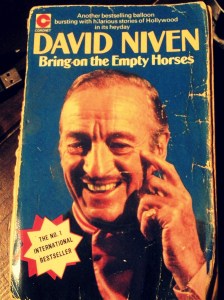
Somewhere in my fairly huge book collection I have a biography of Cary Grant but despite an intensive search I couldn’t find it. I also have a copy of David Niven’s Bring on the Empty Horses which if I remember correctly has a short chapter on Grant. Now where did I put that book?

I did do some quite considerable research to produce this blog post. Firstly, I had to watch the four episodes of the TV series Archie, currently streaming on ITV X. That wasn’t anything difficult of course, it wasn’t a chore, in fact it was very enjoyable. Archie is a wonderful four part series and Jason Isaacs plays an outstanding part. He doesn’t try to impersonate Cary but he did manage to create a look of the late star and he caught Grant’s voice and enunciation perfectly. Most of the series follows Cary in later life when he becomes involved with and later marries Dyan Cannon, Dyan was his fourth wife and she was the mother of his only child Jennifer and she and her mother co-produced the series which is definitely well worth watching.

Next, I searched for the biography I had of Cary but despite searching the entire house I couldn’t find it. Oh well, I have a few copies of Bring on The Empty Horses about the house so I thought ok, I’ll grab that and have a read of the chapter on Cary. Once again, I searched through the entire house but could I find that book? No! Eventually I started to put everything back where I had found it and it was only after idly looking in a box of books that I had only recently packed away and had earlier dismissed, that I finally found it.

Anyway, I had a break from writing to look for that book and after a while when I couldn’t find it I popped the TV on. I wasn’t altogether surprised to find there was a Cary Grant film showing. It was An Affair to Remember, a love story in which Grant’s character, a playboy type meets Deborah Kerr on a transatlantic voyage and the two fall for each other. On arrival in the USA they decide to have a 6 month break from each other as they are both in other relationships and then meet at the top of the Empire State building in New York. It’s not really my cup of tea, in fact it’s overtly sentimental but then, sometimes a small dose of sentimentality is good for you. Cary Grant plays, well, Cary Grant and Deborah Kerr plays a very English New Yorker.

I have two of Grant’s other films on DVD, To Catch a Thief and North by Northwest, both directed by Cary’s favourite director, Alfred Hitchcock.

OK, enough TV watching for now. Getting back to Bring on the Empty Horses, David Niven wrote about Cary Grant in a short section of his book called Long Shots and Close Ups where he gives his readers a quick sketch about various film people. The section on Cary is only three and a half pages and not the full chapter I was expecting but Niven clearly liked the man and in those three and a bit pages, picked up on some essential elements of Grant’s character. Niven remembers Cary Grant as an intelligent man, particularly with money and he listed people like multi millionaire Howard Hughes among his friends. Grant invested his earnings well and became one of the richest people in Hollywood. He had an obsession with his health, embarking on various health pursuits and then moving on to the next one. Niven remarks that once when Cary was taking swimming lessons to learn the crawl, Niven mentioned that Cary could already swim the crawl. Grant answered ‘yes but I want to swim the crawl perfectly!’ Cary gave up smoking by hypnotising himself and Niven also mentions his use of LSD during his treatment by a psychiatrist which is also brought up in Archie.

Cary Grant retired from films in 1966 the year his daughter was born and he and Dyan Cannon divorced in 1968. Many tried to bring him out of retirement for various films including his favourite director Alfred Hitchcock but he declined. He must have wanted to keep on working though because he did accept a position on the board of Fabergé.

He died in 1986 aged 82 and left behind an estate reputedly worth around 80 million dollars. Archie is a well made and quite fascinating piece of TV. Look out for it, it’s well worth watching.


What to do next: Here are a few options.

Share this post on your favourite social media!

Hit the Subscribe button. Never miss another post!

Listen to my podcast Click here.

Buy the book! Click here to purchase my new poetry anthology.

Click here to visit Amazon and download Floating in Space to your Kindle or order the paperback version.

Some More Random Classic Film Connections

Back in the 1960’s I was a big fan of the Apollo moon missions and on UK TV one of the presenters was James Burke. Burke also did a TV show called Connections. It was a really fascinating series which connected various historical events to make a sort of chain which led up to something which was pretty unexpected. The episode that stands out in my memory was one about the atom bomb, various unconnected events and discoveries that together, led to the splitting of the atom. In today’s post, I’ve tried to do something similar but all relating to the world of film, so here are five fascinating connections.

Rebecca 1940

Rebecca is actually my favourite film from director Alfred Hitchcock. It was released in 1940 and was Hitchcock’s first American film. It is based on the novel by Daphne Du Maurier. The film stars Laurence Olivier as the aristocratic widower Maxim De Winter and Joan Fontaine as the shy young woman who becomes his second wife. The two meet in the south of France when De Winter is on the verge of jumping off a cliff top only to be interrupted by the shy young woman. The woman is never named in the film except for later when she becomes Mrs De Winter. This new or second Mrs De Winter seems to be living her life in the shadow of Rebecca, Maxim’s first wife. Later we find that Maxim murdered her after finding out that she was having an affair with Jack Favell played by the smooth and suave George Sanders.

I have to say I have always loved this film, the ruthlessly charming George Sanders, the gorgeous Joan Fontaine and the scary Mrs Danvers, the housekeeper dedicated to the dead Rebecca played by Judith Anderson. Joan Fontaine has never looked lovelier and the only blot on the film landscape are the rather poor models used to represent Manderley, the ancestral home of the De Winter family.

Joan Fontaine was actually the sister of Olivia De Havilland and the two seemed to have had a rather strained relationship. Olivia starred with Errol Flynn in the magnificent Robin Hood but is probably best remembered for her role in Gone With The Wind.

Gone With The Wind 1939

Gone With The Wind was actually being made at the same time as Rebecca and Hitchcock and producer David O Selznick, who produced both films, had numerous fallings out over Rebecca and Hitchcock was apparently happy that Selznick was preoccupied with GWTW which kept him away from the production of Rebecca. Selznick later made many edits and revisions to Rebecca which didn’t go down well with Hitchcock.

Gone With The Wind starred Clark Gable and much was made of a nationwide hunt for an actress to play Scarlett O’Hara. The eventual winner was Vivien Leigh. Olivia De Havilland played Melanie who marries Ashley Wilkes played by Leslie Howard.

The film is set in the American south at the time of the American Civil War and its aftermath. Scarlett O’Hara is the daughter of a plantation owner and she has the hots for neighbour Ashley Wilkes. Wilkes marries Melanie but Scarlett is unable to give up on her romantic feelings for Ashley even when she marries the roguish Rhett Butler.

Gone With the Wind is an epic film in every sense of the word and follows the fortunes of Scarlett and her family through the devastation of the civil war and into the reconstruction era afterwards.

Leslie Howard captures perfectly the slightly wimpy Ashley. Howard was not happy in Hollywood and returned to England after the filming to help with Britain’s war effort. He was a star of many English feature films but was sadly killed when flying back to England after a visit to Portugal where he was promoting the British war effort. Some have suggested that the Luftwaffe shot down Howard’s aircraft as the Germans believed the Prime Minister was on board. Others have speculated that Howard himself was the target as he had angered the Germans with his efforts to promote the British cause as well as the success of his film The First of The Few about the designer of the Spitfire aircraft.

The First of The Few 1942

David Niven plays the part of Squadron Leader Geoffrey Crisp and he tells his pilots of how his friend RJ Mitchell designed the Spitfire. He tells how Mitchell observed seagulls through his binoculars and envisaged a new high speed era of fighter aircraft. After entering an aircraft in the Schneider Trophy, Mitchell convinces Rolls Royce to design a new and powerful engine for the new breed of aircraft and eventually, the Spitfire is born. Leslie Howard played the part of Mitchell as well as producing and directing the film.

Casino Royale 1967

David Niven had left Hollywood in 1939 and returned to the UK in order to re-join the army and fight against the Nazi menace. As well as his army duties, Niven was released from time to time to appear in a few propaganda films, one of which was The First of The Few. He was attached to a commando unit named Phantom whose job was to find out enemy positions and report back to British commanders. After the war he resumed his film career starring in a British film A Matter of Life and Death which was chosen for the very first Royal Film Performance. Niven returned to Hollywood only to encounter terrible tragedy when his wife, whom he had met and married in England, fell down the steps into a cellar when the two were playing hide and seek at a Hollywood party. Niven must have been devastated but he carried on and later remarried.

In 1967 he appeared as James Bond in the Bond spoof Casino Royale. Ian Fleming, the author of the famous James Bond series, had sold the film rights to Casino Royale separately to the rest of the Bond books and producer Charles Feldman acquired them, hoping to do a deal with Eon productions who were producing the mainstream Bond series. When negotiations failed, Feldman who had recently had a big hit with the oddball comedy What’s New Pussycat, resolved to make a James Bond comedy satire and recruited Niven to star as Bond.

The film turned out to be a critical disaster. Two of the other stars in the film were Peter Sellers and Orson Welles. Peter played the part of a card playing expert and Welles was the villain, Le Chiffre, a spy who has spent a great deal of money that wasn’t his and intends to win it back in the casino. All went well during the filming but then Sellers approached the director Joe McGrath and demanded that he and Welles should not appear in the same shot. McGrath replied that the film was in widescreen and this could not be done. Sellers then threw a punch at McGrath and a fight ensued until they were split up by a stuntman. Sellers asked for a break but then disappeared from the set which might be why his character disappears abruptly from the film. Ultimately five directors and as many screenwriters contributed to the film.

As I mentioned earlier, Niven plays Bond in Casino Royale and interestingly, Ian Fleming had wanted Niven to play Bond in Doctor No, the first in the 007 films.

Another actor approached to play the part of Bond was Cary Grant. Grant was urbane and cultured and also British. He was in many ways perfect for the part of Bond. He was also close to producer Cubby Broccoli and in fact was Broccoli’s best man at his 1959 wedding. Grant was interested in playing the part but stipulated that he would only play the role once and wasn’t willing to do a series of films.

North By Northwest

Cary Grant appeared in numerous adventure films with an espionage background, in particular North By Northwest. Grant plays advertising executive Roger Thornhill who calls over a waiter in a New York hotel bar. The waiter was paging a George Kaplan and when Grant calls the waiter over, two thugs nearby assume Thornhill is really Kaplan. It turns out that Kaplan is a fake identity, created by American Intelligence agents to trap a spy played by James Mason. The film is an exciting cold war thriller and was directed by none other than Alfred Hitchcock, who directed Rebecca, bringing our connections full circle.


What to do next: Here are a few options.

Share this post on your favourite social media!

Hit the Subscribe button. Never miss another post!

Listen to my podcast Click here.

Buy the book! Click here to purchase my new poetry anthology.

Click here to visit Amazon and download Floating in Space to your Kindle or order the paperback version.