 Charles Dickens is one of my writing heroes. He is a giant in the world of literature and the author of one of my favourite books of all time, David Copperfield. He was a man with an incredible imagination and was a prodigious producer of numerous books and stories. Many of his works are still loved and appreciated today and the magic of his story telling is also reflected in film and television adaptations of his work.
Dickens was born on February 7th, 1812. His father was John Dickens, a clerk in the Naval Pay Office. His mother was Elizabeth Dickens and she and her husband raised eight children including Charles, their second child. Charles and his family had a pretty idyllic life until John Dickens, who clearly lived beyond his means, was arrested for debts and incarcerated in the Marshallsea debtors’ prison in Southwark, London.
As was the custom then the younger members of the family were able to live in the prison with their mother and father but Charles, then aged 12, took lodgings nearby and was forced to leave school and work in Warren’s Blacking Warehouse where he earned six shillings a week for pasting labels on bottles of boot blacking.
It was a shocking and humiliating experience for the young Dickens. He never mentioned the experience to any of his children and only spoke about it in later life to his great friend John Forster, who later wrote the first biography of Dickens. Dickens also wrote about the experience in his novel David Copperfield in which the young Copperfield suffers the same fate.
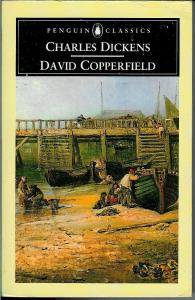
My well thumbed copy of David Copperfield
Mr Micawber, a character in the same book, was based on his own father and eventually John Dickens was able to pay off his debts when his mother died and left him £450. He and his family were released from prison but Charles was not immediately released from his work at the boot blacking warehouse, indeed his mother wanted him to continue there but it was his father who decided that Charles should return to school. Charles was forever indebted to his father for this and forever hurt by his mother’s wish that he should continue pasting labels onto bottles of boot blacking. The experience scarred him and his later desire to work harder and earn more and more money may have been a need to make himself safe from ever being forced into such a situation again.
After two years at school, Dickens obtained employment as a lawyer’s clerk and later, he taught himself shorthand and began work as a parliamentary reporter. He became infatuated at this time with a lady called Maria Beadnall who later became the inspiration for the character of Dora in David Copperfield. Charles pursued Maria over a period of three years but the romance, if indeed there ever was one, finally fizzled out in the spring of 1833.
Dickens first foray into the world of creative fiction was a short story titled A Dinner at Poplar Walk. He had sent the story to a monthly magazine simply called, The Monthly Magazine and upon finding his story printed within its pages, reported that ‘his eyes were so dimmed with joy and pride’ that he could barely see.
In 1835 the editor of the Morning Chronicle, George Hogarth, invited Dickens to contribute to his newspaper and during various visits to the Hogarth home he became acquainted with his editor’s daughter Catherine, whom he later married in 1836.
Dickens wrote his newspaper stories under the pseudonym Boz, and he was delighted when a publisher offered to publish a collection of his works entitled Sketches by Boz. This led to another publisher asking Dickens to supply the text to go with a series of illustrations by a popular illustrator of the day, Robert Stephens. Dickens somehow managed to turn the arrangement on its head, writing a story and having Stephens illustrate Dicken’s text. The story was The Pickwick Papers and it soon became something of a publishing phenomenon.
Robert Stephens passed away soon after the first publication and Dickens recruited another artist, Hablot Knight Browne, to provide the illustrations. Readers could buy a monthly instalment priced at a shilling and Dickens worked hard to produce each edition. Other stories had been published in a similar way but they were usually well known classics. This was the first time new fiction had been produced in this way.
That then was the start of Dicken’s career. He was a busy man, editing various publications as well as writing his novels. Great Expectations was published with the author shown as Boz but in later editions this was changed to Charles Dickens.

Dickens_by_Watkins_1858
Dickens seems to have rented various houses, moving around often but he eventually bought a house in 1851, Tavistock House in Tavistock Square, London. Dickens wrote various books here starting with Bleak House. He also fancied himself as something of an actor and he had a large room made into an improvised theatre where he, along with his friends and family, produced various amateur theatricals. In 1858, Charles separated from his wife Catherine and she moved out into a property in Camden Town.
The separation was said to have been sparked by Dickens’ obsession with a young actress called Ellen Ternan and his gift of either a brooch or a bracelet to her which somehow made its way to his wife. Dickens has this image of being the perfect Victorian family man but he didn’t always live up to it. According to Wikipedia he even tried to get his wife falsely diagnosed as mentally ill in order to have her committed to an asylum. Various accusations were bandied about at the time and rumours were so bad that Dickens himself was forced to publish a statement in the press about his marital situation.
Did Dickens have an affair with Ellen Ternan? So many years later it is hard to know the truth. One night when he was living at his new home Gad’s Hill Place, Dickens made a bonfire of all his personal letters and papers, some of which may have had the answers.
Certainly, Charles was fond of Ellen Ternan. He spent a lot of time with her and even took her abroad to France and Belgium but neither admitted to having an affair but he did have something of a history of obsessions. Years earlier he had been distraught when his sister-in-law Mary Hogarth had died suddenly at the age of 17. Mary was living with the Dickens family at the time and died in Charles’ arms. He was so upset that he kept his dead sister in law’s clothes for years afterwards, occasionally taking them out to look at them. Mary became the template for many women in his books, all of whom were ‘young, beautiful and good’.
Dickens had an incredible imagination and although many of his characters were based on real people, many others sprang directly from his own mind. He was a restless man and regularly took daily and nightly walks of twenty miles and more. Presumably on those walks he brought his imagination into check and channelled his thoughts into the development of his stories.
In his later life, Charles embarked on a series of readings from his books. The readings were highly charged emotional events and the author used all his powers as an actor to delight his audiences, frequently reducing them to tears. Tickets for the reading were highly sought after and Dickens was one of the most notable and famous men of his day. Imagine George Clooney or Brad Pitt doing a series of book readings today and we can get just a faint hint of what things were like for Dickens and his public back then.
Dickens bought his final home, Gad’s Hill Place in March of 1856. He had seen the house as a child when his father had pointed the house out to him as something that he might one day own if he worked hard enough. He lived at the house with his children although one, Charles junior, elected to live with his mother in Camden Town. Strangely, his estranged wife’s sister, Georgina, stayed with Charles as housekeeper.
On June 8th 1870, Dickens had a stroke after working on his final book, The Mystery of Edwin Drood. He died the next day without regaining consciousness. Some have speculated that he died at Ellen Ternan’s house and she had him taken back to Gad’s Hill to prevent a scandal. He was laid to rest in Poets Corner at Westminster Abbey.
Charles Dickens is one of the most loved and celebrated writers of all time but I’ve got to say that some of his books I’ve found a little hard to read. I’ve tried and tried to read Pickwick Papers but I just couldn’t get through it. Not long ago I picked up Bleak House and once again I couldn’t really get started on the book. I have read A Christmas Carol, Oliver Twist, Great Expectations and my absolute favourite, David Copperfield.
My favourite character in the book, apart from Copperfield himself, is Steerforth, a friend of David Copperfield but one who ultimately betrays him. The best part in the book probably, for me at any rate, is the storm when David returns to Yarmouth. Dickens builds the storm slowly and each word and phrase adds a new layer to the sense of danger and foreboding and when Copperfield is finally reunited with his old friend Steerforth at the height of the storm’s ferocity, death comes between them and Steerforth is sadly drowned.
Dickens reveals this in a very unique way; he does not tell the reader Steerforth is dead. He leaves the reader to realise this themselves and, in the process, makes the reader almost at one with the narrative. Throughout the book, Dickens mentions in passing about Steerforth’s habit of sleeping with his head on his arm. It’s referred to many times in the narrative almost as a matter of non interest, something unimportant that the reader doesn’t really need to know, but when David Copperfield spies someone aboard a stricken ship trapped in the fierce storm who evokes some faint remembrance for him, a tiny warning bell is set off.
Finally, when the body of a drowned man is brought ashore and lies mutely on the sand, his head upon his arm, we know just from that simple bit of information, without the author telling us anything more, that Steerforth is dead. The prompts and clues that Dickens has hinted at have paid off for the reader in the most satisfying of ways.
Dickens’ books are still popular today and a recent cinema version of David Copperfield was released in 2019. It was good although I do have a fondness for the 1935 version in which WC Fields plays the part of Mr Micawber. In 1946 David Lean directed one of the best ever films of a Dickens’ story, Great Expectations. In the 1960’s Oliver Twist was made into a stage musical by Lionel Bart and the film version was released in 1968.
Dickens’ most filmed story though is probably A Christmas Carol, the story of Ebenezer Scrooge and the three ghostly visits that transform his life.
What is your favourite Dickens’ story?
Sources:
Wikipedia
Dickens by Peter Ackroyd



 Letters from an Unknown Author!