 This isn’t a post about my favourite books. I’m pretty certain I’ve done that one already but I thought I’d talk about the favourite books of some famous people and I’d like to start with one of my film heroes, James Dean.
James Dean and The Little Prince
Back in the 1970s my Saturday ritual involved getting the bus into town and scouring book and record shops for books and records. One day back then I was flipping through the posters in one particular shop. The posters were the music stars of the 70s, Elton John, Mick Jagger, Suzi Quatro, David Bowie and so on but one was a picture of a really good looking guy with a fifties combed back hair style. In some pictures he was dressed like a cowboy and in others in a red jacket and denim jeans. The guy behind the counter must have seen me wondering who the guy was and he told me he was a film star called James Dean. He handed me a paperback book about the actor and I took it home and read it and very soon I was trying to find out everything I could about Dean.
Dean had been killed in a car crash in 1955 and had only appeared in three films and at the time of his death, only one of those films had been released. I read a great deal about Dean and from what I could find out, the biography to read was written by his best friend, William Bast. I never managed to get a copy of that book but Bast produced a made for TV film version, James Dean: Portrait of a Friend with Stephen McHattie as Dean.
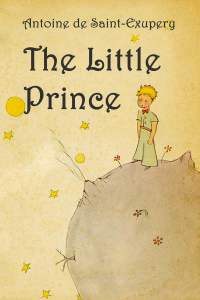 In the film William Bast played by Michael Brandon, leaves Dean in a restaurant and Dean later asks why Bast left. Bast was intimidated by Dean’s important looking friends and Dean replies that he was judging by surface appearances. When Bast questions Dean further, Dean produces his favourite book, The Little Prince and then goes on to read his favourite passage.
In the book Dean explains, the Little Prince is from a distant planet. He meets a fox but the fox won’t play with the prince because he hasn’t been tamed.
Later the fox gives the prince a secret which is this: It is only with the heart that one can see rightly, what is essential is invisible to the eye, something which Bast claimed was the secret to Dean’s style of acting.
James Dean was killed in 1955 and in later life William Bast wrote another book about James Dean claiming that the two were lovers and that Dean was gay.
The Little Prince was written by Antoine De Saint-Exupéry and according to Wikipedia has sold an estimated 140 million copies. It is also the second most translated work ever, only beaten by the Bible.
What did Dean see in the book? Well, it was a childhood favourite of his so perhaps it brought back memories of happy times, or perhaps it was just the undeniable charm of the book that appealed to him.
Donald Campbell and 1001 Nights
 Donald Campbell was the son of a famous racing driver and record breaker, Sir Malcolm Campbell. Campbell first broke the land speed record in 1924 at Pendine Sands in Wales which was the first of his nine land speed records. He also set the water speed record in his boat Bluebird K4. He was knighted in 1931 and died in 1948 aged 63. He was one of the few racing drivers and land speed record holders of his era to die of natural causes as many of his rivals were killed in crashes. His son, Donald Campbell, was determined to equal and even surpass his father’s achievements.
He set about doing so with the help of his father’s engineer, Leo Villa. He made various runs at the land speed record, his last was in Australia. He chose to run his Bluebird car at Lake Eyrie and the vast dry salt lake bed offered the perfect course. It hadn’t rained there for nine years but Campbell had just started his trials when the rains came and ruined the course. Eventually Campbell managed to raise the record to 403.10 mph in 1964 but the huge expense and difficulties of the project cast a great strain on Campbell. In November of 1966 he tried for a new water speed record at Lake Coniston but once again, bad weather caused problems. He was still at Coniston in the following January and when the weather improved, he tried for the record. He was killed in his Bluebird boat on the 4th January 1967.
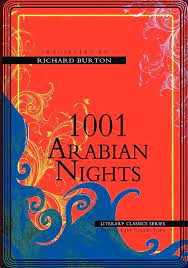
In the BBC film Across the Lake, Campbell was played by Anthony Hopkins and claims his favourite book was 1001 Nights. The book is a collection of Arabian folk tales perhaps more well known in England as The Arabian Nights. The book is about a king who after finding that his brother’s wife has been unfaithful, decides that all women are the same. He decides then to marry a succession of virgins and after their wedding night have them executed to make way for the next, One day he marries Scheherazade who tells the king a story but promises to finish it the next night. The king delays her execution wanting to hear the end of the story but the next night she starts another one, again promising to finish the story the following night. The stories go on for a thousand and one nights, Scheherazade telling more stories in order to save herself from execution.
The screenplay for Across the Lake was written by Roger Milner and was based on true events although whether that includes Campbell’s love of 1001 Nights or not, I’m not sure. In the film Campbell gives a girlfriend a necklace inscribed with a quotation from the book. ‘Beautiful of face with attributes of grace’, a reference to Scheherazade herself.
Noel Coward and The Railway Children
 This is perhaps where this post might start to unravel. I know the Donald Campbell link was a little tenuous and only based on a film but this next one was based on my own memory which can be prone to failure. I knew Noel was a great fan of the children’s writer E Nesbit and I’m sure I had heard or read somewhere that when he died, he was reading his favourite of that author’s books, The Railway Children. A quick bit of internet research and I see that Noel died after reading Nesbit’s The Enchanted Castle. Coward was a lifelong fan of E Nesbit who wrote a series of children’s books. He discovered the books as a child and revisited them many times during his life. In his diary he wrote this about the author:
“Sunday 3rd February 1957. I am reading again through all the dear E. Nesbits and they seem to me to be more charming and evocative than ever. It is strange that after half a century I can still get such lovely pleasure from them. Her writing is so light and unforced, her humour so sure and her narrative quality so strong that the stories, which I know backwards, rivet me as much now as they did when I was a little boy. Even more so in one way because I can now enjoy her actual talent and her extraordinary power of describing hot summer days in England in the beginning years of the century.
All the pleasant memories of my own childhood jump up at me from the pages… E. Nesbit knew all the things that stay in the mind, all the happy treasures. I suppose she, of all the writers I have ever read, has given me over the years the most complete satisfaction and, incidentally, a great deal of inspiration. I am glad I knew her in the last years of her life.””
The Enchanted Castle is about a country estate and three youngsters who meet a princess and discover a magical ring. I have never read either that or the Railway Children although I did find a copy of that latter book not long ago. The film version is a delightful adaptation that has been seen and loved by many generations of children and adults since it was released in 1970. It was written and directed by Lionel Jefferies and stars Jenny Agutter and Bernard Cribbins.
Noel Coward died at his home in Jamaica in March of 1973.
Woody Allen and The Catcher in the Rye
 Woody is one of my favourite film directors and after a search on the internet looking for more favourite books from my favourite people, I found he was apparently greatly inspired by The Catcher in the Rye by J D Salinger. Woody had this to say about the book:
“The Catcher in the Rye has always had special meaning for me because I read it when I was young – 18 or so. It resonated with my fantasies about Manhattan, the Upper East Side and New York City in general.
It was such a relief from the other books I was reading at the time, which all had a quality of homework to them. For me, reading Middlemarch or Sentimental Education was work, whereas reading The Catcher in the Rye was pure pleasure. The burden of entertainment is on the author. Salinger fulfils that obligation from the first sentence on.”
I can understand Woody when he talks about books that have a quality of homework about them. Many classic books I’ve tried to read, particularly in recent years, have left me disappointed and with that same feeling that Woody describes.
I read Catcher in the Rye a long time ago and rather than inspiring me, I found it dreadfully boring and pointless. The hero, Holden Caulfield goes to New York and basically moans about all the things he finds false and ‘phoney’ about the city and its people. Mark Chapman, the murderer of John Lennon, was obsessed with the novel and left behind a copy after he had shot Lennon with a note saying ‘this is my statement’.
Sorry Woody, you and I will have to disagree about Catcher in the Rye.
So what is my favourite book? Well, I’ve got quite an extended shortlist but I think I’d have to plump for David Copperfield by the wonderful Charles Dickens. I first read it many years ago and perhaps the moral of this post is that the books we love in our youth are the ones that continue to give us pleasure in later life.
What is your personal favourite?
Sources:
James Dean: My own imperfect memory.
Donald Campbell; the film Across the Lake.
Noel Coward: https://www.noelcoward.com/
Woody Allen: https://fivebooks.com/best-books/woody-allen-on-inspiration/
What to do next: Here are a few options.
Share this post on your favourite social media!
Hit the Subscribe button. Never miss another post!
Listen to my podcast Click here.
Buy the book! Click here to purchase my new poetry anthology.
Click here to visit Amazon and download Floating in Space to your Kindle or order the paperback version.
 Letters from an Unknown Author!