Robert F Kennedy died from gunshot wounds on this day in 1968.
I’ve seen and heard a lot of shocking events on television over the years. I remember hearing about the death of Princess Diana one Sunday morning while I waited for the kettle to boil for a mornin…
The 22nd November is the anniversary of the assassination of John F Kennedy; one of the most shocking events of the twentieth century. It’s something I’ve been interested in ever since I was a boy and I’ve collected many books about the subject.
I’m still fascinated by the mystery: Did Lee Oswald shoot the President? Did he act alone? Why did Jack Ruby shoot Oswald? Was the CIA involved? Very few of those questions will ever be answered but it’s clear that the findings of the Warren Commission, the investigative body set up by President Lyndon Johnson are not definitive. Indeed the senate investigation in the 1970’s concluded that the President was assassinated ‘probably’ by a conspiracy. Even so, no attempts to investigate further or take action have been made. If you want to find out more, what should you read? Well, there are numerous books on the subject you might try but here below are three key and classic books you need to read:
Rush To Judgement by Mark Lane
This was one of the first books to take a critical look at the Warren Commission report and say, ‘hang on, some things don’t add up here!’ Lane deals with a lot of the minutiae of the assassination and Lee Harvey Oswald’s activities.
One interesting element to me was the murder weapon; the Mannlicher-Carcano rifle bought through mail order and sent to a post office box that Oswald rented. The gun was oily. The scope on the gun was not aligned properly, in fact the FBI found that it could not be aligned at all and had to add metal shims in order to align the scope, meaning that it was test fired by the FBI in a condition that was not available to Oswald!
The first officer to find the rifle even signed an affidavit that the rifle was a Mauser and not a Mannlicher-Carcano! Quite a mistake for an American police officer who would surely be familiar with firearms.
Six seconds in Dallas by Josiah Thompson
Thompson argued in favour of a conspiracy by analysing the Zapruder film of the assassination. In the film shot by local businessman Abraham Zapruder the last two shots come close together, meaning that one of them could not have come from Oswald’s rifle because it took 1.7 seconds to eject the used cartridge and make ready to fire again. This clearly occurred to the people in the Warren Commission as one of its members (Arlen Specter, a lawyer not a forensic expert) put forward the so called ‘single bullet theory’ which argued that a single bullet hit President Kennedy in the back, exited his throat and then struck Governor Connelly who was sitting ahead of Kennedy in the Presidential limousine.
This bullet was found on a stretcher in almost pristine condition which many commentators have asserted means it could not have passed through two bodies and inflicted so much damage.
In 1979 the Select Committee on Assassinations heard evidence of tests that showed the firing could have taken place in only 1.66 seconds per shot. Oswald’s original rifle however, was in too poor a condition to be used for the tests and another was substituted. Even so, none of the test shooters were able to replicate Oswald’s marksmanship despite Oswald being at best only a reasonable shot. An interesting, readable and thoughtful book but rather rare.
Best Evidence by David Lifton.
best evidence
This is an excellent book in many ways. It’s not just about the assassination itself, the author spends a lot of time describing his personal fascination in the Kennedy case and how his interest has evolved and developed. He has followed the growth of theories and new revelations over the years and made efforts to meet and interview many of the witnesses involved.
Lifton puts forward an argument that is a little unbelievable, certainly to me, that Kennedy’s body was spirited away and the injuries changed to fit in with the theory that Oswald shot Kennedy from the rear. The doctors at Parkland Hospital all clearly state that Kennedy had a massive exit wound in the back of his head indicating a shot from the front but the autopsy report concluded Kennedy was shot from the rear.
I can understand where Lifton was coming from, the autopsy result and recollections of medical staff at Parkland clearly don’t match, but altering the President’s body? I don’t think so. The President’s body would have had to have been pried from the Secret Service who were with it from Dealey Plaza, to Parkland, and Air Force One to Bethesda Naval Hospital.
Some of those whom Lifton interviewed claimed a helicopter landed and the President’s body arrived, implying it came by helicopter when in fact it came by motorcade in an ambulance with the First Lady aboard. One interviewee stated that at Parkland Hospital the body was wrapped in sheets and placed in a coffin. Another spoke of taking the President’s body out of a body bag at Bethesda so clearly these accounts do not match up.
This book also did a lot to help me reconcile the workings of the Warren Commission. It is often dismissed by many people as a cover up but in fact the Warren Commission reacted to the evidence presented to it by the FBI as any other court or legal body would do: It processed the assassination according to the evidence.
Did anyone see someone shooting from the grassy knoll? No. Did anyone see a shooter in the Texas schoolbook depository? Yes. Was a rifle found in the sniper’s nest at the Texas School Book Depository? Yes. Was it delivered to a PO box belonging to Lee Oswald? Yes.
As you can imagine, the Warren Commission found Lee Oswald guilty of the assassination. What else could they do? However, many people not heard or dismissed by the commission heard gunfire and shots from the grassy knoll.
One Police Officer dropped his motorcycle and ran up there only to encounter a scruffy man looking like an auto mechanic. The man had Secret Service credentials and the officer let him go. There were no Secret Service there that day. They were all in the motorcade or waiting at the Trade Mart where the President’s next stop should have been, so who was the man? What was he doing there on the grassy knoll?
As you read more and more about the assassination, more stories like that come to light and the accumulated weight of these revelations is what fuels the enduring mystery. I do love a mystery and my interest in the JFK assassination, like Lifton’s has endured for a long time.
I’m not sure just how to describe to you just how fascinated I am in this story but if you’ve seen that part in the Woody Allen film Annie Hall, where Woody is trying to seduce someone but finds himself consumed by thoughts about the assassination then you’ve got the idea.
Time, there’s a thing. I have a theory about time and it’s this, it’s that time flows differently in different places. OK; sounds a bit mad doesn’t it? Let me explain further. Take somewhere like France. Dotted about France are innumerable war grave cemeteries. The conflicts of the first and second world wars left their mark on the landscape in various ways and even today farmers in the Somme and other places continue to dig up artillery shells and other reminders of the past.
Batterie Todt, Pas De Calais
On many occasions when trundling through rural France I’ve come across many bunkers, fortresses and other sites. In northern France Liz and I stopped at a war grave cemetery that was picture perfect in its own way. The lawns were incredibly neat, and the hedgerows immaculately trimmed. Sadness pervaded the site like a scent coming over from the adjacent fields. Throughout there is a feeling of peace, of slowness and a feeling that time has stopped here or perhaps just slowed. That’s not strange when you think that time must have speeded up during the action of the first and second world wars, so it seems only fair that nature must compensate, that time must slow later to make up for the fast and frantic earlier time.
You can imagine the pace of things even a hundred years ago: The early morning bombardment, the whistles blowing as officers called their troops to go over the top. The advance parties who made ahead to cut the barbed wire, the troops walking apprehensively forward until they walked into the deadly machine gun fire that cut most of them down. Many found their final resting places in these cemeteries, places that are now quiet and peaceful with a silent beauty, timeless and moving with the beat of nature as a backdrop, the humming of the insects, distant cows mooing, and the birds flying past.
Many soldiers’ bodies slipped deeper into the mud of places like the Somme and remain there still. Others have no resting places, their bodies blown to pieces by artillery shells, their names marked on marble walls forever missing in action.
War memorial, France, 1940
At one place, travelling from St Quentin to Soissons we stopped by the road to find a huge sword standing in the rock. Like a giant Excalibur, it stood there waiting to be pulled by some giant hand, bearing silent witness to a long ago battle from the Second World War.
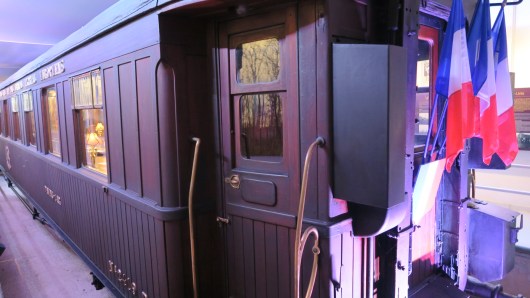
We once visited Compiegne, the place where the armistice was signed at the end of the First World War. The famous railway coach there is not the authentic one. No, that one was where Hitler forced the French to surrender in the early days of World War 2. The coach was then taken away to Berlin where the Nazis destroyed it in the closing stages of the war to stop its return to France. The coach that stands here now in Compiegne is a similar one and it’s easy to imagine the scenes all those years ago, the French accepting the German surrender in 1918, then years later Hitler and his gang pressing their terms on the French.
Compiegne, France
I’ve never been to Auschwitz, the Nazi concentration camp in Poland but whenever I look at one of those TV documentary programmes where TV cameras return to the site, it doesn’t look like a place of mass destruction. It looks calm, serene and another silent witness to the death and destruction of the past. Time ran faster here when the Nazi death machine was in full swing. Now time flows peacefully past over those who come to learn about what has gone on before. This must indeed be a sombre place to visit but Auschwitz is not only a memorial to those who had their lives snuffed out in such a terrible fashion but a reminder to all of the dangers of prejudice and hatred. Time hangs heavy over this place but the evil that built and maintained this death camp has long gone.
All the places mentioned here have had their moments in the spotlight of world history. They all lived through times of accelerated pace when time flowed swiftly. Perhaps it’s their time now for a quieter pace while time flows slowly . .
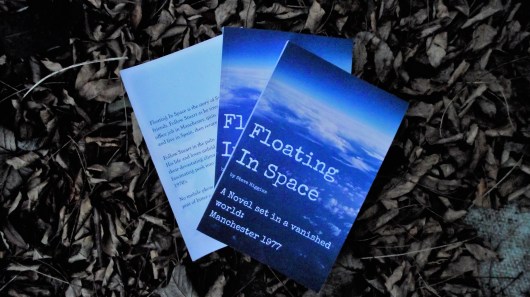
If you enjoyed this post, why not try my book. Click the links at the top of the page for more information.
I’ve seen and heard a lot of shocking events on television over the years. I remember hearing about the death of Princess Diana one Sunday morning while I waited for the kettle to boil for a morning cup of tea. I was watching TV when 9/11 happened and watched with horror as the second tower was hit by an aircraft. The very first tragedy I learned about from the television though was the shooting of Bobby Kennedy. I was only eleven years old then in 1968 but I knew exactly who Bobby Kennedy was and that his brother, the President, had been assassinated five years before.
Bobby Kennedy was at the Ambassador Hotel in Los Angeles on the 5th of June, 1968. He was celebrating his victory in the California primary the previous day. He made a speech to his campaign supporters then turned away from the rostrum. He was due to meet the press in another part of the hotel and was led away through the pantry area at the back of the hotel. As he passed through the corridors numerous people approached to shake hands with the senator and pass on their best wishes. One man stepped forward though with a gun in his hand. His name was Sirhan Sirhan. He was ahead of Bobby and he pushed forward and began firing his Iver-Johnson eight shot revolver. He was quickly grabbed and pushed down onto a nearby table. The gun stayed firmly in his grasp and he continued to fire as more people assisted in trying to subdue him. Only when all eight shots were fired was the revolver finally wrestled from his grasp. Bobby Kennedy had been injured in the head and a busboy, Juan Romero, dropped to his knees to help. He pushed rosary beads into Bobby’s hands and the injured Senator was heard to ask ’is everyone safe?’
Robert Kennedy picture courtesy wikipedia
Bobby Kennedy died the next day. It’s fairly probable that had he lived he would have succeeded Lyndon Johnson as the next President of the United States. He was a man clearly concerned about the war in Vietnam, not only the war itself but the effect it was having within the United States so one of his priorities would surely have been ending the war. J Edgar Hoover, head of the FBI had been given a special dispensation by Johnson to stay at the head of the bureau despite having reached the mandatory retirement age. Would Kennedy have retired Hoover and put his own man in charge? Would he have reopened investigations into the death of his brother John, the assassinated President? Either way, these are only speculations. Bobby died the next day.
1. The autopsy showed that Bobby was hit in the back of the head at point-blank range. The fatal shot was fired in an upward direction. How could this be if Sirhan Sirhan was ahead of Kennedy and not close enough to inflict a point blank wound?
2. Scott Enyart, an amateur photographer was in the pantry and photographed the shooting. His film and photographs could answer many questions but they were confiscated by the LAPD. Later he sued the Police department for the return of his pictures but the Police claimed they had been routinely destroyed. What happened to them? Why was photographic evidence relating to the death of a major figure in the US destroyed?
3. Sirhan Sirhan had a number of notebooks. They were filled with page after page of notations like ’RFK must die.’ ‘Robert Kennedy must be assassinated.’ Why did he write these things? Were they part of hypnotic techniques that compelled Sirhan to shoot Bobby Kennedy?
4. Who was the girl in the polka dot dress seen leaving the hotel with a companion after the shooting and boasting that they had killed Kennedy?
5. Why was witness Sandra Sorrano forced to change her story about the polka dot dress girl during an aggressive interview with the FBI?
6. Sirhan Sirhan fired an Iver-Johnson eight shot revolver at Kennedy and discharged all eight bullets. In 1988 examination of an audio recording made of the assassination by reporter Stanislaw Pruszynski revealed thirteen gunshots rather the eight fired by Sirhan. Who fired the other five shots?
7. On August 21, 1968, less than two months after the assassination, 2400 photographs from the original investigation were burned, in the medical-waste incinerator at LA County General Hospital.Other records were also destroyed. Why?
When I heard about the shooting of Bobby Kennedy in 1968 I went out into the back yard of our home in the suburbs of Manchester and said a prayer for him. When he died the next day I was stunned, feeling a personal loss despite being an eleven year old English boy living a thousand miles away from the United States. In the USA itself, thousands of mourners lined the path of Kennedy’s funeral train as it wound its way towards Washington where Bobby was buried beside his slain brother, the President, in Arlington National Cemetary.
Recently Robert Kennedy Jr met with Sirhan Sirhan in a California State Prison and declared he now supports calls for a reinvestigation of the murder. Read more about this in an interesting article in the Washington Post by clicking here.
If you liked this blog, why not try my book? Click the links at the top of the page for more information!
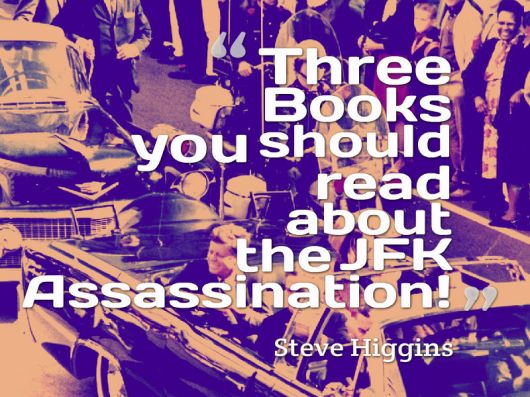 The 22nd November is the anniversary of the assassination of John F Kennedy; one of the most shocking events of the twentieth century. It’s something I’ve been interested in ever since I was a boy and I’ve collected many books about the subject.
 Rush To Judgement by Mark Lane
 Six seconds in Dallas by Josiah Thompson
 Time, there’s a thing. I have a theory about time and it’s this, it’s that time flows differently in different places. OK; sounds a bit mad doesn’t it? Let me explain further. Take somewhere like France. Dotted about France are innumerable war grave cemeteries. The conflicts of the first and second world wars left their mark on the landscape in various ways and even today farmers in the Somme and other places continue to dig up artillery shells and other reminders of the past.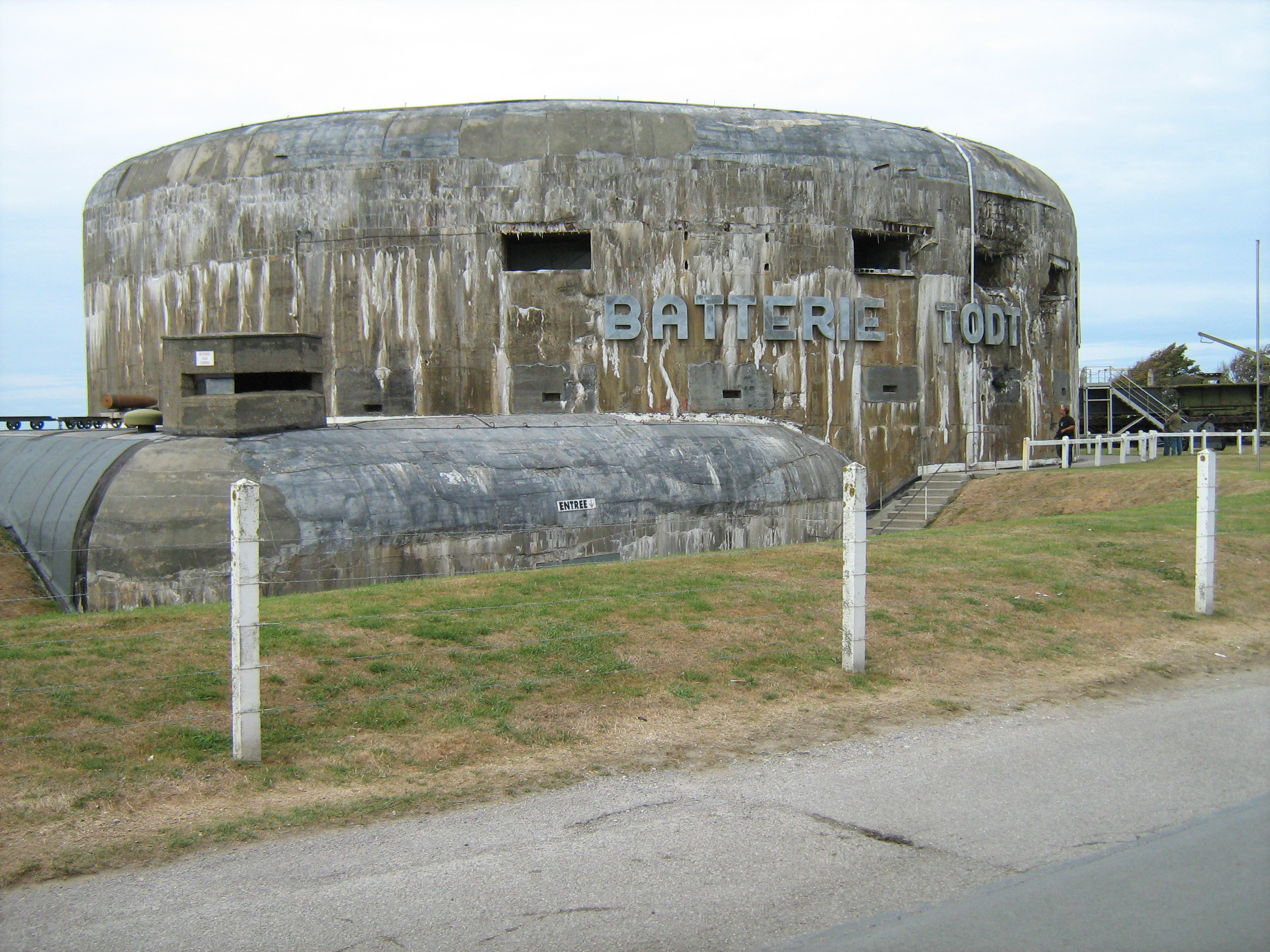

 I’ve seen and heard a lot of shocking events on television over the years. I remember hearing about the death of Princess Diana one Sunday morning while I waited for the kettle to boil for a morning cup of tea. I was watching TV when 9/11 happened and watched with horror as the second tower was hit by an aircraft. The very first tragedy I learned about from the television though was the shooting of Bobby Kennedy. I was only eleven years old then in 1968 but I knew exactly who Bobby Kennedy was and that his brother, the President, had been assassinated five years before.
 Letters from an Unknown Author!