Another Film Connections Post

It’s only the end of November as I write this but in January, Liz and I will be off to Lanzarote once again to escape the cold and wintry UK. I do love the laid back (and warm) atmosphere in Lanzarote and as usual I’ll be taking a stack of books to keep me occupied while I laze about on my sun lounger in-between dips in the pool.

The other day I popped on the TV to find one of the James Bond films showing. It was Casino Royale, the film version of the very first book in the Bond series and I thought about popping my copy of the book into our suitcase with an idea of re-reading the entire series of James Bond novels. Of course knowing me I’d probably leave the book over there and that would be my tidy collection of Ian Fleming 007 novels ruined.

Fleming did a lot of his writing in a small house he owned in Jamacia which happened to be not far from another house which Noël Coward used to own. Back in WWII, Coward had the idea of making a film about the Royal Navy and so he wrote a screenplay for a film titled ‘In Which we Serve.’ It was the story of a ship. The ship is engaged in battle and is sunk and as the survivors hang on to lifeboats and debris, their thoughts meander over their past lives and the story of the ship is told in flashbacks.

It’s a very good film inspired by the story of an actual ship, HMS Kelly, which was commanded by Lord Mountbatten and Coward was justifiably proud of the finished result. He stars as the captain of the ship and along the way there are various notable British stars, some of them making their film debuts. Coward realised he needed someone to help him with the technical aspects of the film so he asked film editor David Lean to help him direct the film. Lean was happy to do so. Coward asked what sort of a credit would he want and Lean answered that he felt the film should be credited as being directed by Noël Coward and David Lean. Coward wasn’t sure about this but he agreed and the filming began with Coward dealing with the actors and Lean dealing with everything else. Lean mentioned in an interview that Coward soon got bored with directing and pretty much left the whole thing to David.

David Lean went on to have a long career as a film director and made a number of huge epics. One of them was a controversial film called Bridge over the River Kwai. This was about British prisoners of war who were forced in very inhumane conditions to build a railway through the Burmese jungle. Alec Guinness plays the senior British officer who feels that building the bridge will restore British morale and undertakes to build it to the very highest standards.

One of the prisoners decides to escape and with a great deal of luck he makes it to the British lines. He is then approached by another officer played by Jack Hawkins and asked to return to the jungle and help blow the bridge up. Many veterans of the war in Asia were very unhappy about the film as the true horror of the cruelty and deprivations unleashed against the POWs was not properly depicted.

Alec Guinness and William Holden were the stars of the film and third on the billing was Jack Hawkins. Hawkins was one of the leading  stars of British cinema in the 1950s. During the war Hawkins served in the army and when he returned to civilian life in 1946, he was soon acting on the stage. With a pregnant wife he became concerned about his future and so accepted an offer to become a contract star for Alexander Korda. He really became a star after a performance in Angels One Five, a film about an RAF station in the war. Another hit was Mandy where he played a sympathetic teacher of deaf children.

In 1953 he starred as a naval captain in The Cruel Sea. The film starts off at the beginning of World War 2 when the Jack Hawkins character is at the builder’s yard helping with the fixing up of his new escort ship, Compass Rose. His officers begin to arrive, many of whom are easily recognisable as stalwarts of the 40’s and 50’s British film industry: Donald Sinden, Denholm Elliot and Stanley Baker and later in the film Virginia McKenna appears as an officer in the WRNS.

The cast and characters are therefore introduced and then the ship goes off to war, protecting the many convoys of merchant ships, bringing the supplies so desperately needed by Britain. It’s one of the great war films of all time.

Two of my personal favourite films starring Hawkins were The Intruder, a great film in which Hawkins plays a former military officer who discovers a past member of his old tank regiment robbing his flat. He determines to find the man again and the story is told in flashback as he interviews a group of his former officers and men.

The other was The Long Arm in which we see how Scotland Yard worked back in 1956. Card files, books of fingerprints and albums containing mugshots, all of which had to be laboriously checked by hand. Some great detective work finally manages to nail the villain.

Hawkins was the epitome of the trustworthy British authority figure. In his obituary one writer wrote that Hawkins ‘exemplified for many cinemagoers the stiff upper lip tradition prevalent in post war British films. His craggy looks and authoritative bearing were used to good effect whatever branch of the services he represented.’

Hawkins himself was a three pack a day smoker and later became ill with throat cancer. In 1966 his entire larynx was removed however he was still able to appear in films with his dialogue dubbed by either Charles Gray or Robert Rietti. In the film Young Winston, he has hardly any dialogue at all.

Jack Hawkins died on the 18th July 1973. He was only 62 years old.

As I mentioned, Charles Gray was one of the actors who dubbed dialogue for Hawkins in later life. It must have been a difficult task because Hawkins has one of the most memorable voices in British cinema. Who was Charles Gray? Well you might not remember the name but Gray played one of cinema’s most notorious villains, Ernst Stavro Blofeld in the 007 film Diamonds Are Forever.

Charles Gray (Picture courtesy James Bond Movie Encyclopedia)

Diamonds Are Forever was the follow up film to On Her Majesty’s Secret Service. In that film George Lazenby had taken over the role of 007 from Sean Connery. Personally, I thought he was a great Bond but George himself was not popular with the producers. After the shoot was over he had grown his hair long and was sporting a beard. The producers wanted someone who could promote the 007 image even in their private life. Later Lazenby’s agent began to feel that the Bond franchise was finished and Lazenby decided against making another Bond film. What could the producers do? Well their knee jerk reaction was to offer Connery a large sum of money to return to the role. Connery agreed to play Bond one more time, banked a huge amount of money and pretty much appeared to sleep walk through the film.

Charles Gray played Blofeld who has taken over a huge empire run by the mysterious millionaire Willard Whyte and he plans to create a powerful laser using diamonds.

Who was the author of Diamonds Are Forever? None other than Ian Fleming of course, bringing our connections full circle.


What to do next: Here are a few options.

Share this post on your favourite social media!

Hit the Subscribe button. Never miss another post!

Listen to my podcast Click here.

Buy the book! Click here to purchase my new poetry collection.

Click here to visit Amazon and download Floating in Space to your Kindle or order the paperback version.

Click here to visit amazon and purchase Timeline, my new anthology.

The Film of the Book: James Bond 007 (Part 2)

This is part 2 of a post about the books and films in the James Bond franchise. It’s recently been announced that Steven Knight, the writer who created the TV series Peaky Blinders, has been engaged to write the next film in the James Bond spy series. Bond appeared to die in the last 007 epic No Time To Die which, certainly for me, wasn’t a particularly great film. I honestly think that the producers have got the character mixed up a little with either Ethan Hunt from the Mission Impossible series, Bruce Willis from the Die Hard franchise or perhaps Jack Bauer from 24. Bond isn’t a rogue agent. He isn’t a maverick cop or spy either. He’s a former naval intelligence officer and a serving officer of the secret intelligence service who is trained to follow orders and use his initiative in certain situations. In order to get back to the original James Bond it’s time to look at the source material, namely the books by Ian Fleming, and see how they compare to the films.

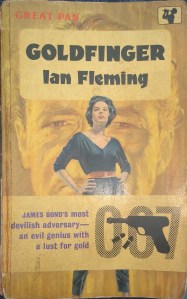
Goldfinger

Goldfinger is probably one of the best books in the Bond series and only the second 007 book that I ever read. (I’ll tell you about the first one later). I was at school at the time and for one of our assignments in English, we were asked to bring in a book which contained a really good description of a character. I chose Goldfinger as in it, Ian Fleming describes Goldfinger as a man who appeared to have been made using bits of other peoples’ bodies. This must have been in the mid-1960s and although the character of James Bond was pretty well known, the films had not begun to permeate down to the television screen.
The book is in three parts, based on a quote from Goldfinger who tells Bond of a saying he learned in Chicago. ‘Once is happenstance, twice is coincidence, the third time it’s enemy action’. In a similar situation to that in Moonraker, Bond is asked to take a close look at Goldfinger by an acquaintance from the first book Casino Royale. The man reckons that Goldfinger is cheating him at cards and asks Bond if he can see how this is being done. M tasks Bond to meet with Goldfinger who is suspected of gold smuggling. Eventually, Bond is captured by Goldfinger who correctly surmises that ‘enemy action’ has begun. Later Bond is taken to the USA where he learns of Goldfinger’s plan to rob Fort Knox.

The film version was hugely popular and to a certain extent became a sort of template for future Bond films.

For Your Eyes Only

Not one of my favourite Bond books, this was a collection of short stories and some of the titles, but not the plots, were used in some of the later Bond films.

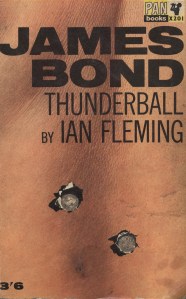
Thunderball

This is an interesting story and the resulting film has perhaps become the quintessential Bond film even more so than Goldfinger. The story is about a criminal underworld organisation (SPECTRE) that steals an aircraft with nuclear weapons and holds the west to ransom threatening to explode the bombs.
Prior to Thunderball, Fleming had been working on a screenplay with two others and when the project fell through, Fleming decided to use the material in his new novel. Later, Kevin McClory and Jack Whittingham, his two erstwhile writing partners, sued Fleming and won rights to certain elements of the story. This enabled them to years later produce the film Never Say Never Again with Sean Connery returning to the role of James Bond.

The book is well put together and as usual I found it a hugely enjoyable read. Fleming once again manages to inject the story with elements of his own life. Bond’s visit to a health clinic was inspired by Fleming’s own similar visit. In the book, Bond’s health record is revealed including details of his large intake of alcohol and cigarettes.

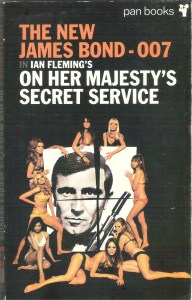
On Her Majesty’s Secret Service

In this book the secret service find that Blofeld, the head of SPECTRE, is trying to assume the identity of the Comte Balthazar de Bleuville. Bond poses as Sir Hilary Bray of the College of Arms in order to meet with Blofeld. Interestingly, Sir Hilary gives Bond a quick resumé of Bond’s family history including the Bond family motto ‘the world is not enough’ which was used by the film producers for the title of a later 007 film unrelated to Fleming’s books.
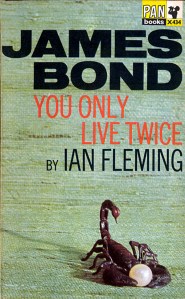
While taking a break from the search for Blofeld, Bond meets Tracy, the daughter of Marc-Ange Draco, the head of the French criminal organisation the union corse. Draco offers Bond a million pounds to marry his troubled daughter but Bond declines although he agrees to meet with her again. Later she proves instrumental in helping Bond escape from Blofeld.

In the film, George Lazenby became the new 007, sadly only lasting for one film after taking advice from his agent who felt the days of the Bond films were over. Former Avengers girl Diana Rigg portrayed Tracy. She and Bond fall for each other and are married but sadly, Blofeld takes revenge and she is murdered. Personally, I’ve always felt that this film was one of the best in the 007 film series.

You Only Live Twice

This book follows on from the previous one and we find James Bond depressed and disillusioned with his job after the death of Tracy. M considers sacking Bond but instead sends him on a diplomatic mission to meet the head of the Japanese secret service. The British want access to Russian documents which the Japanese are currently decoding. The Japanese decide to offer this information to Bond if he will assassinate a British resident who has created a garden of death, a garden full of poisonous plants which are attracting many Japanese citizens who want to commit suicide. Bond realises that this man is Blofeld and decides to keep this quiet until after he has killed him.

At the end of the book Blofeld is dead but Bond, who has been masquerading as a Japanese fisherman, is badly hurt and suffering from amnesia. The Japanese woman who has been pretending to be his wife decides to hide Bond in order for him to stay with her. At the end of the book, Bond reads something about Russia which triggers a memory and decides he has to go there.

The only real similarity of the film to the book was that the film was also set in Japan.

The Man with the Golden Gun

This was the last novel in the Bond series and the first Bond book I ever read. It’s a rather disappointing read as Fleming had died before completing his revision of the manuscript.

The novel opens up with Bond reappearing after going missing after his last mission. In fact he has been brainwashed by the Russians into murdering the head of the secret service. His attempt fails but Bond is deprogrammed and M decides to test Bond by sending him after a notorious hitman, Francisco Scaramanga, who has eliminated numerous British agents.

Fleming’s writing process was to create a first draft and then edit and add in more detail with a second draft. Fleming had told friends that James Bond was becoming harder to write and he wanted The Man with the Golden Gun to be his last. He also wanted to finish on a high and was concerned that the book wasn’t good enough for a grand finale. He had told his editor that he had thought about spending another year back at Goldeneye in Jamacia working on the book. Sadly, he suffered a heart attack on the morning of 12th August 1964 and died.

The film version starred Roger Moore playing his usual lacklustre and slightly camp 007 but a memorable screen villain was Ian Fleming’s cousin, Christopher Lee starring as Scaramanga. Britt Ekland joined the ranks of the Bond Girls by playing Mary Goodnight, Bond’s secretary.


What to do next: Here are a few options.

Share this post on your favourite social media!

Hit the Subscribe button. Never miss another post!

Listen to my podcast Click here.

Buy the book! Click here to purchase my new poetry collection.

Click here to visit Amazon and download Floating in Space to your Kindle or order the paperback version.

Click here to visit amazon and purchase Timeline, my new anthology.

The Book of the Film or the Film of the Book: James Bond 007 (Part 1)

I originally gave this post the title of Book Bag: Ian Fleming and I intended to talk about the original James Bond books written of course by Ian Fleming. As much as I tried to keep them out, the film versions kept creeping in and so I decided on a quick change to the title, as you can see above. It’s very hard to separate the films from the books especially as I keep reading rumours about the next Bond film in the media. In fact it has just been announced that Steven Knight, the writer who created the TV series Peaky Blinders, has been engaged to write the next film in the spy franchise. Bond appeared to die in the last 007 epic No Time To Die which, certainly for me, wasn’t a particularly great film. I honestly think that the producers have got the character mixed up a little with either Ethan Hunt from the Mission Impossible series, Bruce Willis from the Die Hard franchise or perhaps Jack Bauer from 24. Bond isn’t a rogue agent. He isn’t a maverick cop or spy either. He’s a former naval intelligence officer and a serving officer of the secret intelligence service who is trained to follow orders and use his initiative in certain situations. In order to get back to the original James Bond it’s time to look at the source material, namely the books by Ian Fleming and see how they compare to the films.

Casino Royale

Casino Royale is the first book in the 007 series and it’s a pretty interesting and original one too. ‘Le Chiffre’, a gambler and also a member of SMERSH, a murderous department of the KGB is engaged in a desperate effort to win a great deal of money at the casinos of Royale Les Eaux in France. Le Chiffre is desperate because he has used SMERSH funds for his personal use and his spymaster bosses will not be pleased if they find out. Britain’s secret service happens to find out about this and sends Bond to France to make sure Le Chiffre doesn’t recoup those funds as of course as we all know, James Bond 007 is a bit of an expert with the cards.

The book is interesting in another way too. Ian Fleming sold the movie rights to Casino Royale separately from the rest of the Bond books and this enabled producer Charles K Feldman to produce a movie independently from Eon productions who own the rights to the other books. Feeling that he could not compete with the mainstream movies, Feldman decided to make Casino Royale into a comedy version. David Niven starred as Sir James Bond and ironically, Ian Fleming had mooted Niven as a possible Bond when casting began for Dr No, the first movie in the series.

Eon Productions finally acquired the rights to Casino Royale ready for the debut of Daniel Craig as James Bond. I’ve got to say I didn’t like Craig at first. He didn’t look like Bond and I honestly thought he would have been better cast as one of the Bond villain’s henchmen but I did warm to him eventually and although I didn’t much care for it at first, I really do think Casino Royale is one of the better Bond films. It was released in 2006 and follows the book pretty faithfully which many of the previous films rarely do. Craig’s final Bond film was No Time to Die which I really thought was the poorest of Craig’s five outings as 007.

Live and Let Die

This was the second Bond book to be published and the action takes place in the USA and the Caribbean, which Fleming loved and bought a house there which he named Goldeneye. Live and Let Die and in fact the whole book series were recently reissued with all the politically incorrect stuff removed which makes me wonder whether there was in fact anything left to publish after that process was complete. The book was published in 1953 and comes complete with all the prejudices and sexual and racial intolerances of the era. In one segment when Bond visits Harlem, Fleming tries to reproduces the accents and slang terms of the black people of Harlem and for me it’s not one of Fleming’s best books. In the film version, Roger Moore took over the licence to kill and the result was a very tongue in cheek version of James Bond. Sorry but Roger Moore as Bond just wasn’t for me. The film did feature a great theme song from Paul McCartney which was really a little underused in the film. Another feature of the film was a power boat chase along the Bayous of Florida which was a lot of fun but not entirely serious.
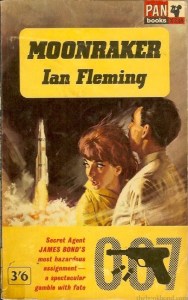
Moonraker

This was the third entry into the 007 series and the action takes place mostly in Dover. Millionaire Hugo Drax wants England to enter the space race and so he spends his own money on a rocket named the Moonraker which he intends to donate to the British government. It turns out that Drax is actually a nazi who wants to avenge defeat in the second world war by arranging for the rocket to destroy London. I read recently that Fleming wrote the book while staying in a cottage situated down by the famous chalk cliffs of Dover which was once owned by Noel Coward and later Fleming himself. It’s not a bad read at all and starts off with M asking Bond a favour as he suspects Drax to be cheating at cards and he wants Bond to see if he can sort things out as at the time, this was the mid-1950s, cheating at cards in London high society could really be a big scandal.
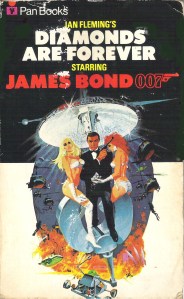
Bond beats Drax at his own game and then finds his next mission is to look into Drax and his Moonraker set up. Interestingly in Moonraker the obligatory Bond girl with the exciting name, in this case Gala Brand, decides not to succumb to Bond’s charms after all.  The movie version was a desperate attempt by the Bond producers to compete with Star Wars and was not my cup of tea at all.

Diamonds are Forever

Fleming wrote this book at Goldeye, his house in Jamaica, after doing a great deal of research about diamond smuggling. Bond’s mission is to investigate a diamond smuggling ring and he does this by impersonating a diamond smuggler called Peter Franks. Franks leads Bond to an American woman called Tiffany Case who he begins to fall for. He tracks the smuggling ring to the American Spang brothers, leaders of the Spangled Mob, a criminal gang. The finale takes place in the Spangs’ restored western town, Spectreville.
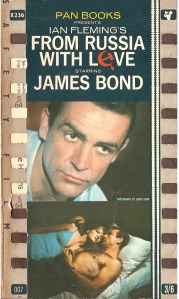
The film version marked Sean Connery’s final outing as Bond, at least in the ‘official’ Bond films anyway. Connery looks bored throughout the film which seems to begin the trend of slightly less than serious films which Roger Moore continued.

From Russia with Love

According to Wikipedia From Russia With Love was inspired by the author’s trip to Istanbul in 1955 to cover an Interpol conference for the Sunday Times. The plot is very similar to the film version and involves the KGB planning to assassinate Bond and also create a scandal involving Bond and the British Secret Service. To do this they persuade a cypher clerk, Tatiana Romanova, to pretend to defect to the west with a Spektor cypher machine. She claims she will only to defect to Bond, having fallen for him after reading his KGB file.
What was interesting about this book was that Fleming had become a little bored with Bond as well as being short of ideas and so he decided to kill off 007 at the end of the book, when he falls victim to KGB agent Rosa Klebb, who stabs Bond with a hidden blade laced with poison. Fleming later developed an idea for the next book and proceeded to revive Bond for Dr No, the next in the series.

The film version closely follows the book but adds the criminal organisation SPECTRE into the mix and is, to my mind anyway, one of the best films in the franchise. Sean Connery made his second appearance as 007 and two excellent portrayals as villains were by Robert Shaw as Red Grant and Lotte Lenya as Rosa Klebb.

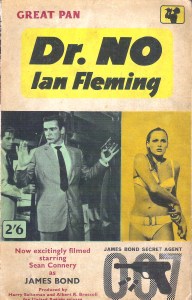
Dr No

Prior to the writing of this book, a firearms expert called Major Boothroyd wrote to Fleming explaining that an agent like Bond would never be armed with a Baretta as it was more of a ladies gun. Boothroyd recommended a Walther PPK. Fleming was so impressed he included the new gun in Dr No and also added a new character named Boothroyd as the armourer of the secret service.

In Dr No, Bond is recovering from the effects of poisoning in the previous book and so M, the head of the secret service, sends him on a routine mission to Jamaica where the head of the Jamaica station and his secretary have disappeared. Bond finds that they were investigating the secretive Dr No who owns a private island known as Crab Key. After further investigation Bond finds that Dr No is involved in the practice of ‘toppling’ missiles from a nearby US launch site.

Dr No was made into the very first Bond film in the film series with Sean Connery starring as 007. Fleming was rather apprehensive of Sean Connery at first, actually wanting David Niven to play the part. Later Fleming warmed to Connery, even adding a bit of Scottish ancestry into Bond’s back history in the later books.

Bernard Lee played M, the head of the secret service. He went on to appear in 11 Bond films in total and Lois Maxwell made her first of 14 appearances as M’s formidable secretary, Miss Moneypenny.

Tune in next week to read the concluding part of this post.


What to do next: Here are a few options.

Share this post on your favourite social media!

Hit the Subscribe button. Never miss another post!

Listen to my podcast Click here.

Buy the book! Click here to purchase my new poetry collection.

Click here to visit Amazon and download Floating in Space to your Kindle or order the paperback version.

Click here to visit amazon and purchase Timeline, my new anthology.

Another James Bond 007 Post

James Bond has been in the news this week. The books by Ian Fleming are apparently being rewritten as they might be considered offensive to a modern generation of new readers and the producers are still looking for a new actor to play their famous secret agent. OK, time for another James Bond 007 post.
The publishers of the Bond books have decided that it’s time for a reissue of the best selling series with a disclaimer telling readers that the novels use language that may be considered offensive by modern readers. Of course the books were written in the late fifties and early sixties and reflect attitudes of the time. I have the entire collection of Bond books and most of them have a reference on the back saying they are outrageously entertaining, which they are, but take away the outrageous part and they are no longer outrageously entertaining but perhaps just somewhat entertaining. Of course if we begin to tamper with books written in the past where do we stop? Roald Dahl’s books are also in the news as they have been updated by ‘sensitivity readers’ although I’m not sure how these well-read children’s books can upset anyone. James Bond of course is a different matter and any sensitivity readers might have a problem with a book like Live and Let Die which is partly set in Harlem and Ian Fleming uses most of the unpleasant racial epithets which were in use at the time.

I started reading the Bond books when I was a schoolboy and unfortunately the very first one I read was the only one they had in our local library – ‘The Man With The Golden Gun’, one of writer Ian Fleming’s worst Bond books. Fleming used to write his initial drafts of the novels and then write a second one, adding in all the details which make the Bond books so interesting. Things like details of Bond’s clothes, (the Sea Island cotton shirts) his food, (Bond always had scrambled eggs for breakfast) his cars, his cigarettes (the special handmade ones with the triple gold band) and all that sort of stuff. ‘The Man with the Golden Gun’ was published after Fleming had died and sadly, he had not revised his original draft. I persevered though, did some research, found the proper order of the books and began to read ‘Casino Royale’, the first in the series. April this year marks the 70th anniversary of Casino Royale and it is this anniversary which has prompted the Bond books to be reissued, complete with disclaimer.

That first book is a pretty original story. ‘Le Chiffre’, a gambler and also a member of SMERSH, a murderous department of the KGB, is engaged on a desperate effort to win a great deal of money at the casinos of Royale Les Eaux in France. Le Chiffre is desperate because he has used SMERSH funds for his personal use and his spymaster bosses will not be pleased if they find out. Britain’s secret service happens to find out about this and sends Bond to France to make sure Le Chiffre doesn’t recoup those funds as of course, as we all know, James Bond 007 is a bit of an expert with the cards.

The book is interesting in another way too. Ian Fleming sold the movie rights to Casino Royale separately from the rest of the books and this enabled producer Charles K Feldman to produce a movie independently from Eon productions who own the rights to the other books. Feeling that he could not compete with the mainstream movies, Feldman decided to make Casino Royale into a comedy version. David Niven starred as Sir James Bond and ironically, Ian Fleming had mooted Niven as a possible Bond when casting began for Dr No, the first movie in the series.

Eon Productions finally acquired the rights to Casino Royale ready for the debut of new Bond actor Daniel Craig. I’ve got to say I didn’t like Craig at first. He didn’t look like Bond and I honestly thought he would have been better cast as one of the Bond villain’s henchmen but I did warm to him eventually and although I didn’t much care for it at first, I really do think Casino Royale is one of the better Bond films. It was released in 2006 and follows the book pretty faithfully which many of the previous films rarely do. Craig’s last Bond film was No Time To Die which I really thought was the poorest of Craig’s five outings as 007 and Bond has been in the news frequently as writers, journalists, bloggers and everyone and his dog have speculated about who the next James Bond 007 will be.

Will it be the usual upper class white guy or will Bond be black? Will there even be a female Bond? What does a 21st century secret agent look like or act like?

James Bond, the character created by Ian Fleming, was a commander in naval intelligence in World War II. He learned to ski in Kitzbühel in the 1930s and fought in the Second World War. He was an officer and a gentleman. He frequented expensive restaurants and gentlemen’s clubs as well as casinos and card tables. He drove a Bentley, lived alone in a Kings Road, Chelsea flat where he was looked after by an elderly Scottish housekeeper named May. He drank a martini made with three parts gin, one of vodka, a half measure of Kina Lillet, shaken with until ice cold then served with a slice of lemon peel. Bond is a character entrenched in mid twentieth century England so making him into a character from the 21st century will not be easy. What can the film makers do? Well, they could set the Bond films back in the 1960s. That’s one option although I doubt if that will happen. They could go radical and make Bond an ethnic character; I’m forever seeing posts about Idris Elba as the next Bond in my social media feeds but then, the character wouldn’t be Bond, would he?

The first change of Bond actor was from Sean Connery to George Lazenby. I liked Lazenby and his one 007 film, On Her Majesty’s Secret Service, was one of my favourites. Connery returned for Diamonds are Forever and then Roger Moore took over Bond’s licence to kill. His films ranged from bad to supremely dreadful and as much as I’ve always loved Roger, I hated his Bond films.

Timothy Dalton stepped into Bond’s shoes when Moore stood down and made two pretty good films. Legal issues kept Bond off the screen for a long time but when the franchise finally returned it was with Pierce Brosnan as 007. Goldeneye was one of my favourite Bonds but his other films weren’t so good and even looked for a while as if they were going to go down the same road as Roger Moore’s Bonds into slightly ridiculous territory. With Casino Royale though things got pretty serious. The film makers played down the gadgetry which always was a staple of the early Bond films, things like cars with ejector seats, watches fitted with special magnets and belt buckles firing climbing pitons. None of that played any part in the Daniel Craig era but here’s the thing; in the previous films each new Bond has just carried on as before with hardly a nod to the previous actor, although George Lazenby did famously say ‘this never happened to the other fella!’

When Daniel Craig took over the series was to a certain extent rebooted. Bond was new to the 00 section and Casino Royale his first mission. His mission in No Time To Die was also his last, his very last because, and I don’t think I’m giving anything away here, because Bond actually dies. How could the producers start over then with the next Bond? Well, many fictional characters have come back from the dead, most notably Sherlock Holmes who author Arthur Conan Doyle killed off when he got bored with the character.  Holmes perished by falling off a cliff but a few years later Conan Doyle bowed to public pressure and Sherlock Holmes returned. It turned out, he hadn’t really died after all.

image courtesy flickr.com

Ian Fleming didn’t kill off Bond but in You Only Live Twice, Bond is seriously hurt and is rescued by Kissy Suzuki who was posing as his wife while Bond was on a mission for Tiger Tanaka, the head of the Japanese secret service. Bond had lost his memory and Kissy hides Bond away from the authorities. One day though, Bond sees something about Vladivostok in either a newspaper or a book, I can’t remember which, and still suffering with amnesia decides he must go there. You Only Live Twice ends there but in the next book, The Man With The Golden Gun, Bond returns having been brainwashed by the Soviets into assassinating his own boss, the head of the British secret service, known only as M.

The producers never used that storyline in the film adaptations of those two books so if I was the writer of the new Bond movie, that’s exactly how I would start the new era of Bond films off.


What to do next: Here are a few options.

Share this post on your favourite social media!

Hit the Subscribe button. Never miss another post!

Listen to my podcast Click here.

Buy the book! Click here to purchase my new poetry anthology.

Click here to visit Amazon and download Floating in Space to your Kindle or order the paperback version.


8 Things You Didn’t Know about James Bond, 007

bondblogI’ve been a big James Bond fan since I was a schoolboy and you may have noticed a couple of other Bond posts that I’ve written previously. The first Bond book I ever read was The Man with the Golden Gun which is a rather poor entry into the Bond world. Author Ian Fleming wrote the first draft but died before revising the book. His method was to write a first draft and then on the second, add in all the little bits of detail, such as Bond’s meals, drinks, clothing and so on that made the books so fascinating. I persevered, found the correct sequence of the novels, and have been a Bond fan ever since. Anyway, I’m getting away from my theme, eight things you may not know about 007.

1: The Longest Serving Bond.
Roger Moore made the most Bond films starting with Live and Let Die in 1973 and finishing with A View to A Kill in 1985. As much as I love Roger Moore, I really do feel he was the worst James Bond ever, totally unsuited for the role and a prime factor in me stopping watching the films during the 80’s. Adam West, TV’s Batman, Clint Eastwood and Burt Reynolds were all once in the running to play 007 but all declined, believing Bond should be played by a British actor. Cary Grant was also approached but turned down the role believing he was too old.

2: The Shortest Serving Bond.
George Lazenby was recruited to carry on as 007 when original Bond actor Sean Connery left. Lazenby was an Australian actor and the star of The Fry’s Chocolate Cream TV adverts. Lazenby was my personal favourite Bond actor and the one I’ve always felt that most resembled Ian Fleming’s description of Bond. He had the authentic black comma of hair that Fleming described in the books and his one Bond movie, ‘On Her Majesty’s Secret Service’ was one of the very best. Such a pity that Lazenby didn’t go on to make more Bond films. He was given poor advice about the movie business; in particular he was advised that the Bond movies were on the way out. Away from the Bond set Lazenby dressed like a seventies hippy with long hair and a beard, none of which went down well with his movie bosses and PR men so Lazenby was out and Sean Connery asked back for one last 007 movie.

image courtesy flickr.com

image courtesy flickr.com

3: Who wrote the Bond books and where were they written?
Ian Fleming wrote the Bond books. After the war finished Fleming began work as foreign manager for the Kemsley newspaper group and as his contract with them gave provision for three months holiday during the
winter months, Fleming spent the time in Jamaica where he bought a house. He named the house after a wartime operation known as operation Goldeneye. He returned there every summer where he would work on the next Bond book. When all the books had been made into films, Eon productions, the makers of the Bond movies had to create new stories and new plots. The seventeenth Bond film Goldeneye was named after Ian Fleming’s Jamaica home.
Goldeneye the movie marked the debut of Pierce Brosnan as 007 when the movie franchise returned to the cinema screens after a brief hiatus. Apart from a rather silly tank chase, Goldeneye was one of the very best Bond movies.

4: Was there a real James Bond?
Indeed there was a real James Bond. When Fleming was planning his original novel he was looking around for the blandest and most anonymous name he could think of, and that’s when he came across a book called ‘Birds Of The West Indies’ by ornithologist James Bond. In 1964 Fleming gave Bond a first edition copy of ‘You Only Live twice’ inscribed by Fleming ‘to the real James Bond from the thief of his identity.’ When the book was auctioned in 2008 it fetched £56,000.
Many magazines and newspaper articles have put forward theories as to who the real Bond was but the fact is that while many of Fleming’s colleagues in the wartime SOE (Special Operations Executive) may have inspired him, the character of Bond was inspired by Fleming himself. Fleming was a commander in naval intelligence during the war, just like 007, and it was Fleming who drank the vodka martinis that James Bond liked so much. It was Fleming who wore the Sea Island cotton shirts that appear in the novels and it was Fleming who favoured scrambled eggs for breakfast, just like his creation, James Bond.

5: Which was the highest grossing Bond movie?

image courtesy flickr.com

image courtesy flickr.com

It was actually ‘Skyfall’, the 2012 Bond movie starring Daniel Craig as 007. The movie is easily the best of the Daniel Craig Bond films and there are some interesting aspects to the film in particular a visual homage to past Bond movies using a vintage Aston Martin. Until recently the top grossing movie was ‘Thunderball’ with Sean Connery.

6: How did two independent Bond movies come to be made?
Ian Fleming sold the movie rights to Casino Royale separately from the rest of the books and this enabled producer Charles K Feldman to produce a movie independently from Eon productions who own the rights to the other books. Feeling that he could not compete with the mainstream movies, he decided to make Casino Royale into a comedy version. David Niven starred as Sir James Bond and interestingly, Fleming had mooted Niven as a possible Bond when casting Dr No, the first movie in the series.
The other independent movie, ‘Never say Never Again’, came about due to a legal squabble. Fleming began work with producer Kevin McCLory and writer Jack Whittingham on a script which never came to fruition. Like many writers, Fleming was reluctant to waste this material and used it in his book Thunderball but did not credit McClory or Whittingham. McClory sued Fleming and won certain rights to the story. This enabled him to make what was essentially a remake of Thunderball in 1983 with Sean Connery returning for a last bow as 007.

7: Did the author ever kill off 007?
Not exactly but at the end of ‘You Only Live Twice’ in the novel, Bond is presumed dead or missing and M, the head of the secret service and 007’s boss, writes Bond’s obituary for the Times. It is quite interesting to read and M mentions that Bond was born of a Scottish father and French mother. The Bond family motto as we learn from ‘On Her Majesty’s Secret Service’ is ‘the world is not enough,’ a phrase that later became the title for the 19th Bond movie.

8: Bond girls and voice overs.
A quick internet search tells me there have been 75 Bond girls but I’m not sure whether that includes minor flirtations or ladies like the formidable Miss Moneypenny herself. Two Bond girls were veterans of the British TV espionage series the Avengers: Diana Rigg played Tracy in ‘On her Majesty’s Secret Service’ and Honor Blackman was Pussy Galore in ‘Goldfinger.’ Terri Hatcher, formerly Lois Lane in the TV series of Superman played Bond’s love interest in Tomorrow Never Dies and Eva Green played Vesper Lynd in the new version of Casino Royale. The most famous is probably Ursula Andress who played the first ever Bond girl Honeychile Ryder in Doctor No. Interestingly, Ursula Andress’ voice was dubbed in the film by Nikki van der Zyl who did voice overs for many Bond girls. Apparently Ursula Andress was felt by the producers to have had too strong a German accent. Shirley Eaton played Jill Masterton in Goldfinger and it was she who was famously covered in gold paint. Jill’s voice was dubbed by Nikki in order to give her a softer voice. French actress Claudine Auger who played Domino in Thunderball was also dubbed by Nikki.
Miss Moneypenny, M’s secretary is not necessarily considered to be a Bond girl; however, in the films Moneypenny and Bond always have a certain amount of banter. Lois Maxwell played Moneypenny in the first fourteen Bond films. My personal favourite was Samantha Bond who played the role four times in the Pierce Brosnan era. The current Miss Moneypenny has been given a sort of backstory in Skyfall, that of a former field agent assigned to a desk role.

The 24th and latest Bond movie ‘Spectre,’ premiers later this year. Watch the trailer below!


If you liked my blog, why not try my book! Click the icon below to go straight to my Amazon page or click the links at the top of the page for more information.