On holiday one of my favourite reads was an autobiography by John Sergeant who was once a political reporter for the BBC. It was called Give Me 10 Seconds. It was called this because the BBC usually had John ready to speak to the camera for perhaps two minutes. John needed to get his broadcast together in his head and would usually ask for 10 seconds for a quick mental rehearsal. The book was a particularly warm and enjoyable read and opened my eyes to the way the BBC works.The author seems to think that the BBC was built on rather military styles. Staff didn’t get holidays but instead were allocated ‘leave’. Numerous layers of management operated the BBC empire and it seemed to me to be very similar to how things operated at my old place of work, the Highways Agency.
John’s claim to fame came when he was reporting live from outside the British Embassy in Paris in November 1990. Mrs Thatcher had just heard that Michael Heseltine’s leadership challenge had garnered 152 votes in the first round of voting and while John was presenting live on television, Mrs Thatcher emerged from the embassy with her PR man Bernard Ingham by her side. Despite Mr Ingham trying to push John aside, he stood his ground and firmly held his microphone to the Prime Minister’s face while she advised everyone that her name would be going through to the second round of voting.
 John’s book was a great read. He started out working with Alan Bennett as a comedy writer and performer but when he realised that he probably had no future as a tv comedian he got himself a job as a newspaper reporter in Liverpool and later moved over to the BBC as a radio reporter.
It’s actually really fascinating to hear of the rivalry between the radio news and the tv news, as back in the late 60s the radio people really didn’t have much time for their television counterparts. These days of course, television is the senior partner in news reporting and the cameras of the BBC, SKY TV and CNN take the viewer all over the world in search of news.
Even so, in recent years, people and politicians have been highly critical of the BBC not only for the way it reports but also for what it reports. I’ve seen some interviews with politicians by journalists like Jeremy Paxman which were quite frankly just disgracefully rude. Is there bias in the BBC? I personally think that the days of impartial news reporting is over but whenever something happens in the world, and I want some more information, my first thought is to go to the BBC website.
Mrs Thatcher was the first female British Prime Minister. She was born in 1925, studied chemistry at Oxford and married Denis Thatcher in 1951. She stood unsuccessfully for parliament and then settled down to have her children. Later she was finally elected in 1959 as the MP for Finchley.
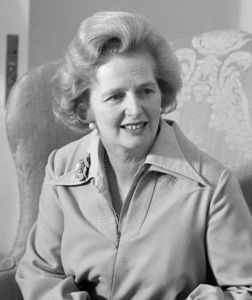
Image courtesy creative commons
Mrs Thatcher was given various posts on the front bench and when the Conservatives under Edward Heath won the election in 1964, she was promoted to the Cabinet as Secretary of State for Education and Science.
The Government had to deal with numerous issues such as union demands for higher wages and the three day week and they lost the election in February 1974 but Labour could only form a minority government. They then won a later election in October that same year. Mrs Thatcher then challenged Edward Heath for the party leadership and won, taking over as leader of the opposition in 1975. She finally became Prime Minister in 1979 famously quoting the prayer of St Francis on the steps of Downing St;
Where there is discord, may we bring harmony;
Where there is error, may we bring truth;
Where there is doubt, may we bring faith;
And where there is despair, may we bring hope.
Mrs Thatcher promoted the idea of people owning their homes and even introduced policies aimed at tenants buying their own council houses. She faced up to union demands most notably with Arthur Scargill and the mining unions but became hugely popular when she stood up to the Argentinians who invaded the Falkland Islands.
She led the Conservative Party to victory in three consecutive general elections, twice in a landslide, and she ranks among the most popular party leaders in British history regarding votes cast for the winning party; over 40 million ballots were cast in total for the party under her leadership. Her electoral successes were dubbed an “historic hat trick” by the British press in 1987 and her tenure as Prime Minister was the longest continuous period in office since the 19th century.
Her downfall came in 1990 which brings us back to John Sergeant’s famous moment. Michael Heseltine decided to go ahead with his leadership challenge and Mrs Thatcher burst forth from the British Embassy in Paris to make her statement that she had passed her name forward to the next round of the contest. She had been 4 votes short of victory in the first ballot and therefore a second round was required.
Thatcher seemed certain of going forward into that second ballot but after consulting with her ministers she decided to withdraw and it was John Major and not Michael Heseltine who emerged as the new Prime Minister and leader of the Conservative Party.
Mrs Thatcher has been portrayed by numerous actresses in film and television most notably by Gillian Anderson and Meryl Streep. Streep starred as Thatcher in the film Iron Lady. She was played frequently on TV sketches and in the James Bond film For Your Eyes Only by comedian and impressionist Janet Brown. Perhaps the most famous comedy sketch about Mrs Thatcher came on the TV show Spitting Image in which she takes the cabinet for dinner. She orders steak and the waitress asks ‘what about the vegetables?’
Thatcher looks at her cabinet and replies ‘they’ll have the same as me!’
Mrs Thatcher retired from the House of Commons at the 1992 general election. She was a Prime Minister who was loved by some and hated by others and even when she died in 2013 at the age of 87 social media memes were declaring the wicked witch is dead!
Which side of the fence are you on?
 Letters from an Unknown Author!