 The story of the Titanic, the ship that hit an iceberg and sank in 1912, is one of those stories which seems to be forever in the news. It’s a story that has caught the imagination of pretty much everyone. Even the other day, just scrolling through the BBC news page, I came across an item about some new digital scan of the Titanic wreck which revealed new information about the disaster.
This week I thought I’d take a look at the story of the Titanic and how it has been represented by television and film, well at least the TV shows and films that made an imopression on me, as well as the actual story of the tragedy.
The Titanic was designed to be the new premier ship of the White Star Line. It had been built by Harland and Wolff in Belfast and built alongside its sister ship the Olympic and was launched on the 31st May 1911 and was then towed to another berth where its engines and superstructure was installed as well as its majestic interior. The sea trials of the ship were undertaken on the 2nd April 1912 just eight days prior to leaving Southampton on its maiden voyage. The Titanic was the largest ship in the world and advertised as having the passenger accommodation of ‘unrivalled extent and magnificence’. It was also billed as unsinkable even though a few days into its first journey it would end up at the bottom of the Atlantic Ocean.
The Titanic on Television.
The Time Tunnel
The Time Tunnel was a sci-fi series created by Irwin Allen in the 1960s. The best episode in the series was probably the very first one. A US senator has come to take a look at a secret time travel project and see if the huge amounts of money being spent are justified. Scientist Tony Newman, fearful that the project will be cancelled, decides to trial the new Time Tunnel apparatus and send himself back in time. He activates everything and transports himself back in time arriving in 1912 on board the Titanic.
His colleague, Doug Phillips also goes back to the same time zone to rescue Tony. The captain of the Titanic naturally doesn’t believe his ship is doomed to sink and back in the Time Tunnel control room the technical staff have a bit of a problem bringing the two scientists back to the present (actually 1968) but manage to transfer them to another time zone and so the scene is set for the subsequent adventures.
The Titanic at the Cinema.
A Night to Remember (1958)
I’ve always liked this film. It starred Kenneth Moore as the Titanic’s second officer, Charles Lightoller, and was based on a book about the disaster. The film was released in 1958 and tells the usual story about the sinking. The ship sets off but during the journey the overworked telegraph officers fail to pass on a warning about icebergs. The ship hits the iceberg and sinks. Despite a limited budget and only 1950s era special effects, A Night to Remember is actually a really good film.
Raise the Titanic (1980)
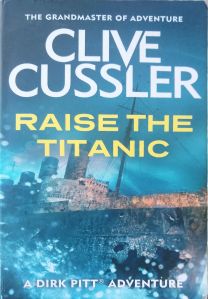 This was a film produced by TV mogul Lew Grade who was wanting to move his TV production company ITC Entertainment into the world of cinema. He had read the original book and thought that it might be possible to make a film series about US government operative Dirk Pitt in the manner of the Bond series.
In the film Dirk Pitt played by Richard Jordan proposes a salvage operation for the Titanic as he is convinced an American named Brewster had discovered a rare radioactive element called Byzanium which was stowed in wooden shipping boxes aboard the Titanic.
A huge undersea search takes place and the Titanic is ultimately found and raised. The Byzanium is not found aboard though although it does finally emerge in a neat twist at the end.
I’ve always enjoyed Raise the Titanic. It was based on a bestselling book by Clive Cussler although the film did not emulate the book’s success.
A great deal of the budget for the film was used to create a 50 foot model which was filmed at a huge water tank at the Mediterranean Film Studios in Malta. Apparently the three million pound model remains there today rusting away although the water tank is in regular use.
Not long after the film was made the real Titanic was located and it was confirmed the ship had broken up and was lying on the sea bed in two separate sections.
Titanic (1997)
Titanic was written and directed by James Cameron. The main thrust of the story is about two passengers from wildly different social classes who fall in love on the ship although one, played by Leonardo DiCaprio, dies in the disaster and the other played by Kate Winslet survives.
A treasure hunter (Bill Paxton) and his salvage team explore the wreck of the Titanic looking for a famous necklace, the Heart of the Ocean. They discover a safe which they bring to the surface to find it only contains a sketch of an unknown woman. After it is featured on TV the woman comes forward and tells the story of meeting Jack Dawson (DiCaprio) and of course of the sinking of the Titanic.
Director Cameron and his producers built a huge outdoor set in Playas de Rosarito in Mexico with uninterrupted views of the ocean and a water tank in which the Titanic set could be tilted to film the sinking scenes. Overall, the production cost was over 200 million dollars making it the most expensive film of all time. Happily for the producers, it also became the highest grossing film of all time until the release of Avatar, another film written and directed by Cameron.
The Novel
Dreaming a story and making it into a novel or a screenplay sounds pretty fantastic but in 1898 an American writer, Morgan Robertson, wrote a story about an unsinkable ship called the Titan which sailed from England to the USA but during the journey hit an iceberg and sank. The story was published fourteen years before the Titanic disaster. I remember reading the story of this writer years ago, even that the writer saw the story played out in front of him like a movie but all the research I did on the internet for this blog seems to imply that the author was a man who knew his business where ships were concerned, felt that ships were getting bigger and bigger and that a disaster like that of the Titanic was inevitable.
Books
 I only have one book in my collection about the Titanic. It’s a big glossy picture book, not about the actual ship, but about the shooting of James Cameron’s film. It documents Cameron’s twelve dives in a tiny submersible which gave him the idea of the treasure hunters looking to find the necklace the ‘Heart of the Ocean’ and his realisation as Cameron himself mentions in the book’s foreword that the main thrust of the story should be a love story with the Titanic disaster almost as a backdrop.
The book tells about the numerous models that were built of the ship both as a pristine sea going vessel and as an underwater wreck. The making of the full size set in Mexico which could be dropped via hydraulic pistons into a huge water tank was an immense undertaking and adds immeasurably to the finished film.
So what actually happened to the Titanic?
The Titanic was on its maiden voyage to the USA. It left Southampton on the 10th April 1912 and stopped at Cherbourg in France to pick up more passengers before heading out across the Atlantic to New York. Four days into the voyage it hit an iceberg. Lookouts had been sent aloft to look for icebergs but their task was difficult. It was a moonless night and pitch black. The sea was very calm which meant that the lookouts could not see waves crashing against the icebergs that they had been warned to look out for. When an iceberg was finally spotted the lookouts rang down to the bridge. The officers there ordered the ship to turn hard to port. Some reports say that the engine room was ordered to stop engines which would not have helped the turn. Either way the ship brushed the iceberg and the resulting contact made a gash along the side of the ship and water rushed in.
The ship had been designed to stay afloat with four of her watertight compartments flooded but it could not stay afloat with the flooding of six. Interestingly the compartments were not sealed at the top so that when one flooded, the water tipped over into the next and so on until the ship sank.

The bow of the Titanic courtesy Wikipedia Commons
In another documentary I watched a few years ago a theory was put forward that the three million rivets that held the steel plates of the ship together were made of poor grade metal which became brittle in the freezing sea water. When the ship impacted the iceberg, the heads of the rivets popped off and sea water flooded inbetween the steel plates of the hull.
RMS Carpathia arrived about an hour and a half after the sinking and rescued all of the 710 survivors by 09:15 on 15 April. More than 1500 people died in the freezing waters of the Atlantic.
Titanic in the News.
As I mentioned earlier, the Titanic was in the news again when a new 3d scan of the wreckage of the Titanic was revealed.
 Letters from an Unknown Author!