 Every Thursday Liz and I visit our local pub for our weekly quiz night. It’s not a particularly tough quiz and we’ve even won it on the odd occasion but one thing we do in advance is check the internet to see if any celebrities have died as Mike, our pub quizmaster, tends to throw in a question or two about recently deceased celebs. One name that popped up on Google was that of OJ Simpson who passed away recently from cancer. I tend to watch the TV news most days so either I missed the story about OJ or perhaps these days his name isn’t as newsworthy as it once was. Simpson was 76 years old and a former US sports star, actor and allegedly a murderer.
Back in 1994 Simpson’s estranged wife was brutally murdered and Simpson was the prime suspect. If he had been anyone other than a famous sports star and TV commentator, he would have been arrested but for whatever reason, he wasn’t. Later arrangements were made for OJ to come and surrender himself at Police Headquarters in Los Angeles but he did not appear. Shortly afterwards TV helicopters spotted Simpson driving down the freeway and a posse of police cars followed but kept at a distance because OJ was reported to be holding a gun to his head. This bizarre procession was broadcast live and at various intersections crowds gathered to watch and wave to OJ. When it was reported that OJ was heading to his home crowds of supporters gathered there to watch his arrival and eventually he surrendered his gun and was duly arrested.
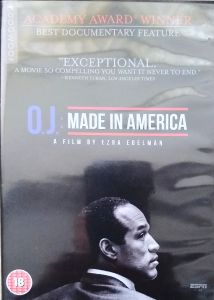 OJ Simpson: Made in America is an outstanding documentary, released in 2016. It runs for over five hours and won an Oscar for best documentary. Episode one details Simpson’s incredible sporting career and also showed how it was important for him to be seen just as OJ rather than OJ the black athlete. He was apparently a friendly and amiable man who made many friends in the sporting world and kept himself well away from controversy and was never involved in the civil rights movement in America unlike sporting celebrities like Mohammed Ali. Later episodes show how he made a life after sport by becoming a TV sports pundit and by courting wealthy friends in Los Angeles to advise on his investments. In particular he made TV advertisements for Hertz car rentals which were highly popular and did well not only for Hertz but raised Simpson’s profile in the USA even higher.
The series also looks at the climate of race relations in Los Angeles and the activities and methods of the LAPD who clearly were not engaging or even trying to engage with the black community. A ‘them and us’ situation evolved in LA and when Rodney King, a black motorist was brutally beaten by a group of white police officers and caught on an amateur video, the situation become even more inflamed. The officers were taken to court but found innocent by a white jury causing riots and disturbances in the area. This was the background of the later OJ Simpson murder trial.
Simpson divorced his wife and married eighteen-year-old Nicole Brown, a blonde LA waitress. Their marriage lasted seven years and was not happy, especially in the latter years when Nicole was beaten and abused by Simpson. She called the police numerous times reporting OJ for assault. On June 13th, 1994, Nicole and a waiter named Ron Goldman were found dead. A trail of blood led away from the scene and later blood was found on Simpson’s white Ford Bronco.
Simpson was not as famous in the UK as in America but I do remember seeing the crazy car chase on TV with Simpson in his white Bronco followed by a fleet of Police cars. The documentary series completely gripped me and the portrait of Simpson himself and the racial climate in Los Angeles and the attitude of the police was compelling.
I was so interested in the OJ trial I picked up a book about it and this is how I reviewed it a few years ago:
The People v OJ Simpson by Jeffrey Toobin
 This fascinating book is a detailed look at the 1995 murder trial of former US football player OJ Simpson. Simpson was accused of murdering his ex-wife Nicole and her friend Ron Goldman. The pair were murdered outside Nicole’s house in the Brentwood area of Los Angeles and bloody footprints were found leading away from the scene. Simpson’s car had blood traces with matches to both Nicole’s and Goldman’s blood. There was even a low-speed police pursuit of Simpson that was broadcast live on TV bringing in a reported 95 million viewers.
The defence team managed to divert attention away from all of this evidence by playing into the troubled atmosphere in the area at the time. Motorist Rodney King, a black man had been beaten by a group of white police officers. They were all cleared of wrongdoing by a white jury despite the fact the incident was recorded on video clearly showing the officers beating up King. The defence also made great play about a ‘racist’ cop who was one of the first on the scene and even implied he could have planted damning evidence at Simpson’s home, that of a bloody leather glove that matched one found at the murder scene.
Witnesses gave newspaper and TV interviews as well as the lawyers themselves. The trial proceedings were broadcast live making the defence and prosecution teams into instant TV stars. The judge welcomed TV pundit Larry King into the courtroom and held up proceedings while King and the Judge chatted in his private chambers. The media attention led to the jury being sequestered for the length of the trial and not allowed to read newspapers, magazines or watch the TV news about the trial. A number of them were dismissed during the proceedings for various things, only 4 of the original jurors making it to the end.
Both sides were involved in the jury selection procedure asking questions ranging from sports to their views on domestic violence, all things that would be incredible in an English courtroom. Incredibly, before the trial had even started the TV news had broadcast a 999 call by Nicole requesting the police because Simpson was beating her up.
The author describes the background to the defence and prosecution teams and how they worked. One interesting thing was their use of outside companies who specialised in jury selection and analyses. The defence team followed the advice of their researchers who advised that middle aged black women tended to favour Simpson. The prosecution had the same advice but prosecutor Marcia Clark felt that that same group, middle aged black women, responded strongly to her and that her depiction of OJ as a wife beater would sway them. That was a big mistake.
This is a deeply fascinating book written by a journalist who covered the trial at the time for the New Yorker magazine.
Getting back to the present and I thought I’d watch the whole documentary, OJ Simpson: Made in America, all the way through, all five hours, over the course of a few evenings.
The first episode showed Simpson’s impressive sports career and the huge following he began to accrue. At one event in 1973 he was about to beat a record as the first player in the NFL, National Football League, to rush for more than 2000 yards. I’m not quite sure what that meant but from the video it looked equivalent to a rugby player making a try in the UK. Even the opposing team began to cheer him on. After retiring Simpson was asked to make a TV advert for the Hertz car rental company which was very popular. Simpson had become one of the most well known figures in America, loved by both black and white Americans. He had a beautiful wife, a fabulous home and wonderful children. Where could it all go wrong?
His wife made numerous calls to the police after beatings by OJ and the couple eventually split. At one point they tried to get back together but the violence began again and Nicole finally moved out.
On the evening of 12th June 1994, Nicole Simpson along with her children and various family members went for dinner at the Mezzaluna restaurant. Later, Nicole’s mother found she had left her glasses at the restaurant and waiter Ronald Goldman volunteered to return them to Nicole’s home. Later the two are found brutally stabbed to death. Simpson had left that evening on an 11.45pm flight to Chicago where he was due to play golf. However, blood stains were found on his car, a Ford Bronco and bloody footprints were left behind belonging to a type of shoe he was known to have worn.
At the trial the defence team tried to assert that one of the first detectives on the scene, Detective Mark Fuhrman, was a racist and had tried to frame OJ by leaving a bloody glove behind. It was later revealed that in the past he had given an interview to an author which she recorded in which he used disparaging language against the black community. When he was later recalled to the court he took the 5th amendment on each question, including when he was asked if he had planted the bloody glove.
Racial tensions had been bad in the area due to the Rodney King incident and there was jubilation in the black community when OJ was found innocent and shock in the white community.
OJ seemed to think he could carry on with his life as before but a civil suit by the Goldman family found him guilty and liable for damages. He was forced to sell his home and was later arrested when he forcefully tried to retrieve his sporting memorabilia which he believed had been stolen from him.
At the subsequent trial OJ was found guilty and sentenced to 33 years in prison. He was released on parole after serving 9 years.
OJ Simpson died on 10th April 2024 after suffering with prostate cancer.
What to do next: Here are a few options.
Share this post on your favourite social media!
Hit the Subscribe button. Never miss another post!
Listen to my podcast Click here.
Buy the book! Click here to purchase my new poetry anthology.
Click here to visit Amazon and download Floating in Space to your Kindle or order the paperback version.
 It’s interesting that on TV, the same movies come at us time after time. The Great Escape, wonderful film though it is, has been broadcast so many times I know the script off by heart. The Bond films are a staple of UK TV. They and the Die Hard films, the Carry on series and a hundred others–they are all constantly on British TV. Old TV shows are another staple of the new free view channels.

 Letters from an Unknown Author!