The Secret of Writing Poetry

I’ve been looking through my poetry work lately and I started to think that I could write a blog about writing a poem. Now I’ve started I’m not sure how this is going to work out but anyway, let’s give it a shot.

For me there are two ways to write a poem. One is where I have to work at it and the other is when the whole thing just comes to me. I once read that Paul McCartney thinks that his songs and melodies are just hanging in the air and all he does is to entice them down to him. I’m clearly not on the same level as McCartney but that image just captures exactly how I feel when a good poem comes to me.

There is a particular state of mind that I enter for this process to happen. The best time is when I’m driving my car. I don’t know why, and I can only guess that driving sends me into that perfect state of mental concentration where a poem or an idea will come to me, enticed down, as Paul McCartney suggested, from the cosmos. That is the purest way to write a poem, one where either the whole thing or at least a couple of verses present themselves and then I have to sit down and work at the rest.

Sometimes an idea comes to me in odd ways. Some years ago in one of my old jobs, I used to return home from work in the mid afternoon. I started very early and usually worked through my break, getting home between 2 and 3pm. I would get changed, have a quick wash and come into the kitchen to put the kettle on. The kitchen was in the front of the house and in the summer months I noticed the cat from the house across the road would usually be getting comfy under the small tree on their lawn while I waited for the kettle to boil. I often watched that cat. I never noticed it as I reversed my big van into my drive but later, in the kitchen, I would invariably see the cat settle down for an afternoon nap.

One day I came home from work, got washed, and from the kitchen noticed the cat getting into position as usual under the tree. I took my tea and toast into the lounge and settled down with the TV. Later I heard something, a commotion of some sort but nothing that was compelling enough for me to shift my lazy butt and see what was happening. Not long after that, my partner came home and I could hear something going on. She seemed to come in and go out again. When she finally came in I asked what had happened and it seemed that the lady opposite had returned home and found that her cat was still under the tree but not sleeping, it had died.

That particular lady was someone who was a bit of a diva and very often made a lot of fuss about things that really, weren’t worth making a fuss of. Apparently, she began shouting and screaming and various neighbours came over to assist while I, in blissful ignorance, was busy dozing. Still, that little event became the inspiration for the poem The Cat Across the Road. I made the assumption, rightly or wrongly, that the cat was ready to depart his life; maybe he was, maybe he wasn’t. Maybe he felt he had a few more years left of sun lounging, mouse chasing and bird catching. If he did his heart must have stopped without warning during his or her feline slumbers. All in all, not a bad way to go.


Everything seemed in order, I suppose, to die

It was a warm enough day

Certainly


The sun shone and birds sung

Even though birds would cause a feline heart to race

Normally


I’ve had my fill of life

Of titbits and cosy sleeps, sometimes in next door’s shed

Informally


And I’ve had my chases and midnight hunts

And I’ve always remembered my owners and left them a mouse or two

Naturally


A last cuddle would have been nice

Still, all in all it’s been a good life, and I’ve loved it

Enormously


I’ve always liked this tree

I can keep my eye on the birds and the sun comes down

Warmly


So now I’ll just close my eyes and die

And go on to the next of my nine lives

Expectantly.

The other way of writing a poem is where I sit down determined to write something. Recently I saw in one of the poetry newsletters that I subscribe to, an item about a poetry contest. They wanted a poem about love. Now I am not a person who can describe himself as well qualified to write on that particular subject, but I settled down and began to play with ideas and words. After a while I came up with the beginning of a poem, one that I had to return to in the following days to flesh out. As I mentioned before, love isn’t one of my specialist subjects and I took that thought literally into the poem. As I am a cool sort of customer, not one for spouting or talking about my feelings I thought that might be a relevant message for me and others like me.

I don’t think I can remember my mother and certainly not my father ever talking about love. They loved me, I knew that. I knew it when my dad picked me up off the floor when I fell off a ride in the park. I knew it every time my mother washed my jeans and shirts and made my favourite meals. Still, there are others who need love spoken in words. I realise and respect that but for me there is No Need to Talk of Love.

To save me typing the poem out here and also to liven up this post a little, here’s my YouTube video version:

That’s about it really. Take an idea, try and boil it down into a phrase, something with resonance and some lyrical attributes and go with it. I was actually pretty pleased with the poem above. I sent it off to the poetry competition with high hopes. I have to admit, I didn’t send it off in the form it is above. Since then I’ve worked on it some more and edited it a little but sadly it wasn’t a winner or even a runner up.

As a writer though and not one who can really call himself a professional one, the fundamental result of writing and the reason for doing it has to be the pleasure of crafting something that is satisfying to me; satisfying to write and to read. It is the process of writing itself which is most rewarding to me, perhaps that is why I am always skimming back over my past work. Well, someone has to read this stuff, it might as well be me.

I do love it every time someone presses the like button here on WordPress or over on Facebook, Twitter or YouTube but the Ferrari, the motorboat and the Spanish villa that I expected, or more accurately hoped I might earn from all this scribbling has not arrived. Indeed, those things may never arrive but even so if you come looking for me you’ll probably find me with a notebook or my laptop in my hand, writing.

By the way, if you’d like to watch a video version of this blog: click here.

What to do next:

Share this post on your favourite social media!

Hit the Subscribe button. Never miss another post!

Buy the book! Click here to visit Amazon and download Floating in Space to your Kindle or order the paperback version.  Click here to purchase my new poetry anthology showcased below.

A Week in the Life of a Locked Down Blogger

A major disaster happened to me this week. Not an actual disaster like a car crash or anything but for a writer and blogger it was the blogging equivalent.
I spent a few days at my mother’s house as usual, checking the mail, tidying the garden, giving the heating a good blast in this cold weather and so on. It’s also good, especially being a writer, to have some time alone to work on my various projects like my blog, my books and my videos. Last week I did just that. I added a few more pages to the two novels I’ve been writing and tinkered with some of my videos as well as creating some new ones.

I added a couple of my new videos to two Facebook pages, one for amateur video makers and another for YouTubers. They both did quite well there and brought in some new viewers. All my videos have a link back to this blog and all these blog posts have a link to my books, Floating in Space and A Warrior of Words so with a little luck these new video viewers might even add to my sales which in turn will add to the Higgins coffers.

The crazy thing about the pandemic and the resulting lockdown is that just lately I’ve been spending less money so I’ve actually got a little more in the bank than usual. My usual spending on restaurants, pubs and taxis has stopped completely and I do wonder how all those establishments are faring without me.

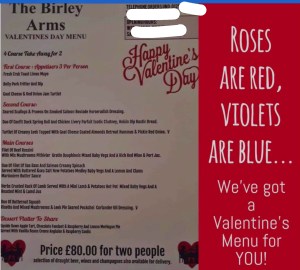
This Valentine’s Day, instead of dining out we dined in. We ordered in a full restaurant meal, including wine and settled down in front of the fire to await delivery. I’d ordered the meal a few days before from the Birley Arms, a pub I haven’t visited for many years but it does have a restaurant with a reputation for great food. The day after I ordered the food my phone rang and someone came on the line asking about my order. They didn’t say they were from the Birley Arms, in fact I didn’t actually catch their name but they started talking about my food order so I guessed it was they. All was in hand but apparently I hadn’t specified when the food was for. Now as I’d ordered the Valentine’s Day special I thought it was pretty obvious we would be wanting it for Valentine’s Day. That thought hadn’t occurred to my caller until I mentioned it but he quickly recovered, said something about just making sure and he was off.

What else has happened to me this week? Well, for a long while I’ve been after an eye test; it must be over two years since I last had one. Every time I called the opticians they gave me a date weeks into the future and as I wasn’t sure which shift I was on I always declined and said, I’ll get back to you. I tried again recently as now I have a brand new app on my phone which shows the days I am working. Great! I’ve had the app for a few months and it works fine. I tried it the other day, one hand on the app and the other poised to call the opticians and of course, it wasn’t working. Nothing I could do would get it to work again, not uninstalling, reinstalling, pressing force stop, updating my mobile phone software; nothing.

Anyway, diary at hand – manual diary that is, you know, the old-fashioned type made of cardboard and paper – I went online to the optician’s eye test booking app and lo and behold, there was a free appointment the next day. Presumably a cancellation but what the heck, I grabbed it anyway.

The opticians had changed considerably since my last visit but of course everything now has been affected by Coronavirus. Masks were mandatory as was hand sanitising. I was gradually moved to various socially distanced seating areas, finally ending up with the optician. My eye test was a traditional one using those special glasses where the optician drops in various differing lenses to adjust your vision. So much better than my last eye test at Specsavers. No offence Specsavers but I really do not like having my head in an electronic headset where the lenses are changed at the touch of a button.

Later I decided to order my new glasses from Goggles4U, an online site that I found and have since bombarded me with various offers. The new specs were cheap and were made even cheaper by various discounts. I had some problems getting my order through and then heard from somewhere that my new eyewear would be coming from Pakistan! Was this a con I thought?

Well as it happens my new specs arrived and they are just great. It always feels so good to have a new set of lenses. Everything looks so good and so sharp. People with 20/20 vision probably take perfect sight for granted but as a spectacle wearer since I have been a child, I assure you, I do not.

Okay, let’s get back to Valentine’s Day and there we were, waiting with bated breath and dangling tongues for our food. The appointed time came and went. Knives and forks had been deployed and the plates were warming and just at the point when I was searching for the pub phone number to complain, our Valentine’s feast arrived. There seemed to be quite a lot of it but then again, the meal consisted of appetisers, starters, mains and puddings. We slapped it into the oven to keep warm before nibbling on the appetisers and then it was on to the starters. One big mistake was when we put everything in the oven, we had forgotten that one starter was pâté. Warm pâté was new, not something I’d tried before but I liked it.

Round about then I realised the delivery guy had not left any wine. A quick call and happily the driver was nearby with an order for someone else so the wine came shortly after. Luckily, another bottle of red was already warming by the fire but with so much food, that second bottle came in pretty handy.
Just to make your mouth water, we had various appetisers including crab on toast and belly pork fritters. Starters were smoked salmon, prawns and scallops for Liz and duck spring roll and chicken liver pate for me. Mains were Beef Rossini for me and Rack of Lamb for Liz and a bevy of desserts, all for me as Liz isn’t a lover of sweet things.

We enjoyed the meal although I have to admit, being served at a nice table in a restaurant doesn’t really compare to a take away, even a restaurant standard one.

So what was the big disaster you might be thinking? Before I get to the main one here’s another. Back in January I bought a bundle of six CDs. They were advertised for £25 and I offered £18, the seller declined but they failed to sell and the buyer came back to me and finally accepted my offer. I waited and waited but they never turned up. I contacted the seller and she asked me to wait a little longer in case Covid had affected the Royal Mail. The CDs still didn’t arrive so ‘sorry’ I said, ‘I want my £18 back’. The seller duly refunded me and the very next day, what should turn up but the CDs!

I’m not sure PayPal understood when I asked how could I refund a refund?

Finally, back to the disaster I spoke of earlier. At my mother’s house I had done some writing and fiddled with my videos. After staying for a couple of nights I tidied up, took out the rubbish and gave the place a hoover. Outside in my car I began to wonder if I had forgotten anything but it was cold and whisps of snow were in the air so I drove off. Later I realised I had left behind my iPad and laptop! Nightmare!

Luckily, I updated my iPad a few years back and still had my old one so this blog post is my first written completely on an iPad. A number of my apps were missing so apologies for the lack of graphics.

Hopefully I’ll have my trusty laptop back for next week’s blog instalment, as long as I don’t suffer protracted symptoms from laptop separation syndrome of course!


What to do next:

Share this post on your favourite social media!

Hit the Subscribe button. Never miss another post!

Buy the book! Click here to visit Amazon and download Floating in Space to your Kindle or order the paperback version.  Click here to purchase my new poetry anthology showcased below.


Movie Themes

Can music really make a good film? Can a really great theme lift a good or even mediocre film up into the lofty heights of the great films? I’m not sure but that’s today’s blog theme and here are a few examples.

Rocky.

Rocky is a pretty good film. It actually won the best picture Oscar in 1976. It’s good, actually pretty good but was it really worthy of a best picture Oscar? I’m not sure. Anyway, it’s about boxer Rocky Balboa played by Sylvester Stallone in his first starring role. Rocky is at the bottom end of the boxing ladder taking cheap weekend bouts as a boxer while he works as a strongarm man for the local loan shark. An incredible piece of luck comes his way though; Apollo Creed, the world champion finds that a multi million dollar bout has fallen through. Wanting to recoup something from the fiasco, Creed decides to fight an unknown boxer in an exhibition match in the hope of saving the event from cancellation. He randomly chooses Rocky. Rocky though, starts to wonder if he can win and backed by his old trainer he starts training and is soon on the path to fitness. Creed wins but Rocky goes the distance with Creed, the first opponent of Creed’s to do so. The second film in the series involves their re-match and is pretty similar to the first as are most of the following films. Rocky doesn’t seem to have much of a technique he just seems to get battered and when his opponent runs out of steam, Rocky usually lands the knockout blow.

The whole series of films in the Rocky saga are pretty much the same. I’ve watched 1 and 2 and gave most of the others a miss until Rocky Balboa. I’d heard it was a good one and picked up a copy of the DVD in a charity shop and to be fair it is an excellent film. Rocky has retired from the ring, his wife has died of cancer and Rocky gets by managing an Italian restaurant where fans come not only for the food but to chat with Rocky himself. Rocky then gets involved in a computer fight with the current champion, an idea based I think, on the computer fight between Rocky Marciano and Mohammed Ali. It’s a bitter sweet film but well put together. All the films use variations of the famous Rocky theme but my favourite is probably in the first Rocky where Stallone takes his fitness routine through the streets of Philadelphia, through the Italian market, finally alighting at the Museum of Art where apparently there is now a statue of Rocky himself. Did the Rocky theme tune really lift this film right up? To be fair it is a good film anyway but that theme tune gave the film, and the series, just that extra boost.

It’s not really relevant but I must add my favourite Rocky story here. Stallone wrote the script in three and a half days after apparently watching a boxing match between Muhammed Ali and Chuck Wepner in 1975. Wepner was expected to be easily beaten but made it through to the 15th round. United Artists liked the script but wanted an established star to play the role, even offering Stallone a million dollars to let James Caan play Rocky. Stallone turned them down, played the part himself and the rest is history.

Verdict: Great film, great theme.

The Magnificent Seven.

The Magnificent Seven was a 1960 remake of Kurosawa’s classic The Seven Samurai. Director John  Sturges directed this version, set in the American Wild West. Yul Brynner produced and starred in the film and the cast also included Steve McQueen, Eli Wallach, Charles Bronson and Robert Vaughn. The story concerns a small Mexican village who hire a group of gunfighters to protect themselves from bandits. Only three of the seven survive the eventual gun fight.

As much as I love a good western, I’ve never really cared for this film. It was, according to Wikipedia, a box office disappointment in the USA although a smash hit in Europe. The score was an Oscar contender but lost out to Ernest Gold’s score for Exodus.

Verdict, love the music but essentially, the film was nothing outstanding and I know it’s a bit mean but if not for Elmer Bernstein’s theme I think The Magnificent Seven would be a forgotten film today.

Mission Impossible.

Mission Impossible was a movie adaptation of the 1960’s TV show about a small team called the IMF (Impossible Missions Force) that take on, you’ve guessed it, impossible missions. This film became the first in a series of films produced by and starring Tom Cruise. Cruise plays Ethan Hunt who is sent to stop the theft of a list of agents kept inside the American Embassy in Prague. The mission fails and Jim Phelps, the agent in charge is wounded and all of his team are killed except for Ethan Hunt. There is clearly a double agent or mole at work and various things happen until we find out the mole was Jim Phelps which was just a little bit sneaky because all of us who watched the 1960’s TV series knew that Jim Phelps was a character in that show and therefore could not possibly be the mole. The fact that he was made me feel a little cheated by this film because they used my nerdy TV knowledge against me. In the TV show Jim Phelps always gets a taped message with instructions for his mission that then self destructs. Tapes are a little old fashioned now in the high tech world of the 21st century but there are a few little nods to the old series along the way.

The last instalment I saw was the fast moving Mission Impossible: Ghost protocol. It was pretty exciting and one particular part was interesting. Ethan Hunt and his people visit the Burj Khalifa in Dubai, the tallest building in the world. In one sequence Hunt has to climb outside to get to another room in the building. The sequence looked pretty impressive even though I assumed, it was shot with a green screen in a studio. It was with some surprise then to find that the scenes were shot actually on location with Tom Cruise doing his own stunts, actually climbing outside this impressive structure. He was held safely by cables which were digitally erased in post production. I take my hat off to you Tom but seriously, next time, do it in the studio!

The Mission Impossible theme is an iconic one written by Lalo Schifrin. There are many versions of the theme but personally I like the one from the TV show. Has it enhanced the films? Yes, I think so and of course it makes the connection between the TV version and the films.

Titanic.

Titanic is a 1997 film written and co produced by James Cameron. The production had a budget of 200 million dollars, a staggering amount and included a full scale replica of the ship at Baja in California. The replica was not an ocean going vessel but one built into the dockside and incorporated with a 17 million gallon water tank which provided a sea view and a ramp which could tilt the whole structure for the sinking sequence. Only parts of the ship were fully made, most of the ship itself was just a steel outer structure.

Director Cameron wanted the singer Enya to create the music for the film but she declined. Instead he turned to composer James Horner. The two had fallen out during the making of Cameron’s film Aliens but managed to put that behind them and collaborate on Titanic. Cameron did not want music with singing in the film so Horner composed My Heart Will Go On in secret and played him the demo when he thought Cameron might be responsive. According to Wikipedia, another factor was that a hit song would be a positive factor surrounding the film.

Verdict: I love the music and feel it enhances the film in many ways, so much so I bought the soundtrack CD.  Titanic is an epic production with some outstanding production elements that cement Cameron as a director of the first echelon.

So, what is your favourite movie theme?


What to do next:

Share this post on your favourite social media!

Hit the Subscribe button. Never miss another post!

Buy the book! Click here to visit Amazon and download Floating in Space to your Kindle or order the paperback version.  Click here to purchase my new poetry anthology showcased below.

Book Bag: The Early Days of Cinema

My Autobiography by Charles Chaplin.

Charlie was born in 1889 in Walworth, London and spent his early life in the London suburb of Kennington. His parents were both music hall performers but separated when Charlie was about two years old. His mother was poor and the small family, Charlie, his mother and older brother Sydney, were admitted to the workhouse on two separate occasions.

In 1903, Charlie’s mother was committed to Cane Hill mental asylum and Charlie lived on the streets alone until his brother Sydney, who had joined the navy, returned from sea.

With his father’s connections Charlie secured a place in a clog dancing troupe called the Eight Lancashire Lads and so began his career as a performer. After appearing in some minor roles in the theatre he developed a comic routine and, with help from Sydney, was signed by Fred Karno, the famous music hall impresario, for his comedy company in 1908.

Chaplin became one of Fred Karno’s top comedians and Karno sent him with a troupe of other comedians on a tour of vaudeville theatres in the USA. One of the others was Stan Laurel, later to find fame with the comedy duo Laurel and Hardy.

By far the most interesting part of Charlie’s autobiography is where he talks about the beginning of his movie career. On a second tour of America in 1913, Chaplin was asked to join the Mack Sennett studios as a performer in silent films for the fee of $150 per week. He wasn’t initially keen but liked the idea of starting something new.

His first film for Sennett was called Making a Living, released in 1914. Chaplin himself wasn’t so keen on the film and for his second appearance selected a new costume. After searching through the costume department Chaplin chose a bowler hat, a jacket that was too small, baggy trousers, shoes that were too large and a cane. It almost seems as though the clothes made him become the character of the tramp which was to make him famous. The film was Mabel’s Strange Predicament although another tramp film made afterwards, Kid Auto races at Venice, was released to the public first.

Chaplin clashed frequently with his directors when his ideas or suggestions were dismissed but after exhibitors asked Sennett for more Chaplin films he was allowed to direct his own. When his contract expired in 1914 Chaplin asked for 1000 dollars per week. Mack Sennett complained that that figure was more than he was getting and refused. Another film company Essanay, offered him $1200 per week and a signing fee and Chaplin signed. He wasn’t initially happy with Essanay and didn’t like their studios in Chicago, preferring to work in California.

Chaplin was also unhappy after he finished his contract at Essaney because they continued to make lucrative Chaplin comedies by utilising his out-takes. Chaplin was however an astute businessman. In his new contracts the negative and film rights reverted to Chaplin after a certain amount of time. This was in the days when a movie had a life of months, if not weeks.

Chaplin seems strangely perturbed by his fame and fortune. He writes about an incident between contracts where he takes the train to meet his brother in, I think, New York but word has got out to the public he is travelling and everywhere the train stops, masses of people were waiting. Eventually it dawns on him that it is he they were waiting for. Many times the narrative describes meals and walks taken alone giving the impression of a solitary, lonely man.

The thing to remember about reading this book is that Chaplin tells the reader only what he wants them to know, nothing more. His various marriages are only skimmed over although when he is making the Kid, probably his most important picture, he explains how he thought the negative may have be taken by lawyers acting for his estranged wife so he takes the film and edits it whilst almost ‘on the run’ in various hideaways and hotel rooms.

Chaplin was known for being attracted to young girls and one of his conquests, a girl called Joan Barry, was arrested twice for her obsessive behaviour after he ended their relationship. She became pregnant and claimed he was the father and began a paternity suit against him. J Edgar Hoover who believed Chaplin to be a communist, engineered negative publicity against him and public opinion began to turn against Charlie. He was ordered to pay child support to Barry’s baby despite blood test evidence which showed he could not be the father. The blood test evidence was ruled inadmissible.

The earlier part of the book is by far the most interesting but the later part, where Chaplin is famous the world over, becomes an excuse for name dropping, despite there being a clear absence of any notable anecdotes involving the famous names. Even his best friend Douglas Fairbanks makes few appearances within the pages.

A fascinating read none the less.

Stan, The Life of Stan Laurel by Fred Lawrence Guiles.
I have a lot of time for Fred Laurence Guiles. He wrote one of the definitive biographies of Marilyn Monroe, the one Norman Mailer used as the basis for his classic book about the star.

Stan was born in Ulverston in Cumbria, as a matter of fact, I once visited his old home in the town. It was a small house as I remember and a little bit tatty. I remember being rather disappointed to view this old house with photocopied pictures of Stan on the walls. Either way it was still fascinating to think that Stan, one half of that great duo, Laurel and Hardy, had started life here as Arthur Jefferson. Guiles follows Stan -as he began to call himself- from northern music halls to being part of Fred Karno’s comedy circus and to the USA and Hollywood. Fred Karno was the great music hall impresario of the time and he sent teams of entertainers all over, even to the USA. In his early days touring the USA for Karno, Stan shared rooms with Chaplin although not once is Stan mentioned in Chaplin’s autobiography. Chaplin just seemed to ignore or black out anyone from his memory he either didn’t like or thought was a threat.

Stan Laurel appeared in a number of silent comedy films. He eventually signed with producer Hal Roach but decided he was going to move into scriptwriting rather than performing. One day Oliver Hardy was too ill to perform so Stan stepped in and played his part. Later the two appeared together in various films and director Leo McCarey noticed the positive reaction from the public. Together with McCarey the two worked at their comedy and after McCarey suggested they both wear bowler hats, their partnership took off and their Laurel and Hardy series began in 1927. In 1929 they moved from silent pictures to sound with Unaccustomed As We Are. Unlike many other stars of the period, the two made a seamless transition into talking pictures and are today recognised as giants of comedy.

In 1933 director Frank Capra made the first of what was an entirely different kind of comedy film and, according to author Guiles, this actually spelt the beginning of the end for the slapstick comedy type of film humour that Laurel and Hardy, and others such as Chaplin, Harold Lloyd and Buster Keaton, were so good at. It Happened One Night starred Clark Gable and Claudette Colbert and after a slow start, the film became an enormous hit, winning eleven Academy Awards. Some writers thought that film comedy had finally ‘grown up’ and sadly, just over 10 years later Laurel and Hardy would be making their final Hollywood film.

After Hardy died in 1957, Stan declined to work without his comedy partner and he retired to a modest flat in Santa Monica, California. He was listed in the telephone directory and was happy to answer calls from his fans. He spent his retirement answering his fan mail and meeting with other comedians who revered him; people like Jerry Lewis, Peter Sellers and Dick Van Dyke. He died in 1965 aged 74.

Hollywood.

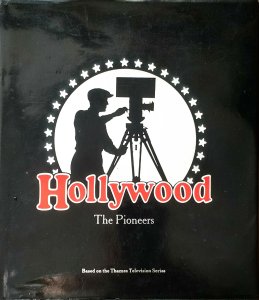
I think I wrote about the 1920’s in a previous post saying that if I could go back to any time and place I’d go back to Hollywood in the 1920’s. You didn’t need a degree in filmmaking to be a director then as the whole industry was new. Hollywood was just a mass of orange groves when someone decided that with its wonderful climate, Hollywood would be the perfect place to make films. In 1910 DW Griffiths came to Hollywood to film In Old California and other film makers followed him as not only was there perfect weather and excellent light but it was a great place to avoid Thomas Edison who owned patents on the movie making process and wanted paying. In the 1980’s there was a wonderful TV  documentary series called simply Hollywood and this is the book that was published alongside the series. The TV version was narrated by James Mason and was filled with interviews with former writers, directors and stars of that bygone age. It’s a pity it hasn’t made its way onto DVD but apparently because of all the stars involved, all of whom will have passed away by now, getting the releases signed for DVD has been problematic. It just so happens that I have the first episode on VHS video and of course, the book that accompanied the series.

The book I have is subtitled ‘The Pioneers’ and concentrates on the first great Hollywood stars both in front of and behind the camera, people like director DW Griffiths and actors like Valentino, Chaplin, and Garbo who became the first ‘movie stars’. Then there were others like John Gilbert and Buster Keaton who did not make the transition to sound successfully and Laurel and Hardy, who did.

One particularly interesting thing about the TV series and the book is that many of the veterans of silent pictures were telling their stories for the first time. Kevin Brownlow who wrote the book and directed parts of the TV series says that some of the interviewees were very old but even so, they were very lively and interesting in their old age with many stories to tell about filming, editing and the beginnings of Hollywood. Back then Hollywood shunned those who worked in films. They called them ‘movies’ and many hotels and boarding houses had signs up saying ‘no movies’.

Sadly many silent films have not survived to the present day because the nitrate film of those days was highly volatile. Many of the films that have survived are made from poor quality ‘dupes’ or copies so it is not easy to appreciate how good those films originally were. This book though with its superb quality production stills does go some way to invoking the sense of what those films were like. I live in hope that one day this wonderful series will find its way into digital media.

After writing this I wondered what were the chances of an episode or two finding its way to YouTube? A quick check and I was happy to find the entire series there. That’s me sorted for the next few days then . .


What to do next:

Share this post on your favourite social media!

Hit the Subscribe button. Never miss another post!

Buy the book! Click here to visit Amazon and download Floating in Space to your Kindle or order the paperback version.  Click here to purchase my new poetry anthology showcased below.