A Matter of Perspective

Quite a while back, probably over two years ago, I seemed to be having problems focussing my right eye. My right eye is actually my good eye, the other, the left one is what my optician has always called my lazy eye. Years ago as a schoolboy I had to watch TV for an hour a day with a patch over my good eye. This was supposed to make my left eye, the lazy one, pull its way a bit more. That was successful to a point but the right one has always been better.

I called the doctor and he recommended that I go to see my optician. I called Specsavers who could not fit me in at first but when I mentioned the eye problems they asked me to come in straight away. I had an eye test and the problem was resolved. I needed a new prescription, no health issues at all, so they said. I wasn’t happy so a more senior optometrist was called in and he concurred, all I needed was a new prescription.

I still wasn’t happy. At the time my right eye seemed to be all gummy and I felt that perhaps I had some sort of infection. I started rinsing that eye with a salt water solution and after a week it all seemed to clear up. I have to admit I was a little scared for a while, after all, it wasn’t as if it was my bad eye, my good eye was the problem one. What would have happened if it had gone worse, if I had lost the sight in that eye? I wouldn’t be able to drive, I wouldn’t be able to get to work. No more motorhoming holidays. It would have been difficult to even write with just my bad eye. Yes, looking back, that was actually a serious health scare, perhaps even the scariest health scare I’ve ever had.

I went back to pick up my new specs about ten days later and surprise surprise, I couldn’t see a thing through them. No wonder! I’d had an eye test when my right eye wasn’t working properly. I still think I had an eye infection that they hadn’t spotted in the opticians. Another eye test followed. It was with a new fangled gadget that I had to put my head in and the optician changed lenses with a touch of a button. I wasn’t comfortable but at least my eye seemed better and a few weeks later I had a brand new pair of specs. They weren’t perfect but at least I could see pretty well.

This year I had another eye test at a different opticians. This time I went to Boots. The optician seemed to be a little more precise than the previous ones and not only that, he gave me an eye test in the traditional way, you know with the frames in which he slips in different lenses and ask things like ‘is this better or worse, is this clearer or not?’

All seemed pretty good until I saw the prices of the glasses they were selling. Being a card carrying tightwad I declined to pay those high street prices and just then found various internet stores selling bargain priced specs. I sometimes find it a little creepy when you do a few searches on Google for something; specs, an electric saw, a digital camera or whatever and the next thing you know, every site that you visit that carries advertising, all you can see are ads for specs, electric saws and digital cameras. Just shows you what those little inoffensive things called cookies do when you let them into your personal cyber world.

Anyway, I bought a pair of specs from a company called Goggles4u. They are based in the USA and looked pretty cheap. Almost just as I was about to press the buy now button, a discount voucher pinged up on my screen and I was able to buy my first internet spectacles at a very low price indeed.

I waited a hell of a long time for them but in the current Covid wary world there wasn’t much else to do except watch TV, listen to music and look for more things to buy on eBay.

One day my new specs arrived. I tried them on and the result was amazing. I wasn’t struggling to see small things anymore, everything was pin sharp. Watching the new F1 season opener on TV I could actually see those little boxes they display on the broadcast showing the current standings and lap times and what tyres each driver was using. To those of you with 20 20 vision you might not understand but seeing perfectly and sharply is nothing short of wonderful. The great thing with my new specs is that I clicked the box for what I’ve always called Reactolite lenses, actually photochromic lenses that react to bright light and darken when it’s sunny. Believe me, I was going round taking in things as if I’d never seen them before.

Fashion is a pretty big part of spectacles. Lots of top designers produce trendy spectacle frames and the resulting product can have a fairly hefty price tag. When I was a school kid growing up on a council estate I always wore national health spectacles with national health frames. You know the ones I mean, the ones with black plastic frames. Sometimes I got called names like ‘speccy four eyes’. I never liked those frames but as I grew up I got the chance to actually have some trendier frames. I always liked those metal rimmed frames. I was probably still at school when I got my first pair. Only after moaning and begging and pleading to my mother. She probably bought those glasses just to shut me up.

One day when I had left school and could afford to pay for my frames I bought some aviator styles. I always loved that aviator shape you know, that sort of stylish aerodynamic looking frame. I even had a pair with smoked graduated lenses. That’s just an excuse to show you my favourite picture of myself. I was 21 and had the whole world at my feet. I was in Paris having just packed my job in and I was having the time of my life with one of my best friends, and I loved those glasses. A lot of years later when my optician recommended a pair of reading glasses I had those same aviator frames turned into reading glasses.

Now that I have turned to the internet I am the proud owner of quite a few new pairs of specs. My favourites are probably the rimless ones but they do have a bit of an annoying element. Almost but not quite outside my vision to the right and to the left are two hinges that connect to the spectacle arms. I can’t quite see them but they are there and they are annoying.

Of course you might be thinking why even bother with glasses? It’s the 21st century, I could get contact lenses or even have laser treatment. Laser treatment? Like when they fire laser beams into your eyes? I don’t think so. I’ve worn glasses from ever since I can remember so I think I’ll stick with them if you don’t mind. One of my earliest memories was as a very young schoolboy going for that regular meeting with the school nurse or ‘Nitty Nora’ as we referred to her. For us spectacle wearers the first thing Nitty used to ask was to take off our glasses and place them on the table. That was OK if you put them down face up but bad if you set them face down because that way the lens could get scratched or marked by the table top.
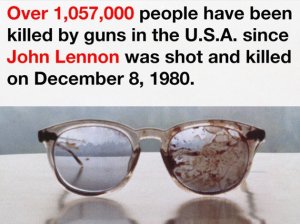
Elton John is probably the most famous spectacle wearer of all time. He even once wore a pair of specs with little windscreen wipers. John Lennon is another famous spectacle wearer. He wore those famous round glasses that you will see if you just type ‘Lennon glasses’ into Google.

The glasses he was wearing when he was shot dead in 1980 were used by Yoko Ono to protest against gun violence. She also used the picture on her solo album Season of Glass which I’ve always found hugely shocking but then shock was an emotion that she and Lennon used frequently in their work.

Superman wore glasses too. Clark Kent, Superman’s alter ego wore a set of black plastic specs as a disguise. How Lois Lane who worked with Clark at the Daily Planet newspaper never noticed that Clark was just Superman wearing a suit and a pair of glasses, I’ll never know. The funny thing is the glasses that I always hated, those black plastic ones that Clark and my younger self wore, are today pretty fashionable.

Which pair shall I wear today then?


What to do next: Here are a few options.

Listen to my podcast Click here.

Share this post on your favourite social media!

Hit the Subscribe button. Never miss another post!

Buy the book! Click here to purchase my new poetry anthology.

Click here to visit Amazon and download Floating in Space to your Kindle or order the paperback version.


Some Thoughts on Books and Reading

I really do love books and reading. My idea of heaven is lying by a pool in somewhere like Lanzarote with the sun shining and a book in my hand. What is important for a good read is time. It’s alright to read a book on your lunch break or on the bus travelling home after work but to really get into a book, some uninterrupted time is important. So, what is really so good about reading? You, the reader must like reading otherwise you probably wouldn’t be reading this but for me reading is about connecting with worlds I will never see and connecting with my own world too; finding that I’m not as unique or as different as I had thought and that other people have had similar experiences to me.

Looking through a box of my old books I found a book I had read many years ago. It’s called the Wooden Horse and it’s a classic wartime escape book. The author conveys vividly the boredom of incarceration during WWII as a prisoner of war and the feelings that time was just slipping away and also the petty arguments that arose when confined with other people. Escape was on the minds of many but digging an escape tunnel was difficult as there was such a long way to tunnel. The huts were deliberately placed well away from the camp perimeter. One day, one of the men had an idea, what if they could start the tunnel nearer the wire? They hit on the idea of making a vaulting horse, putting a couple of men inside and then digging while their fellow prisoners exercised above.

The Wooden Horse was written by one of the actual escapees, Eric Williams. He was an RAF pilot shot down over Germany and imprisoned in 1942 and in 1950 the book was made into a classic WWII film.

As a child I remember reading books at night in bed before going to sleep and arguing with my brother who wanted the light turned out. Sometimes I’d read under the covers with a torch.

There was a small library a short ten-minute walk from my old house and I used to spend many an early evening there with my mother and brother. I remember a particular series of books I used to read when I was very young about someone called Mr Grimpwinkle.

A quick search on Google showed my memory had not failed me and there was such a series of books. They were written by a lady called Joan Drake. One example was Mr Grimpwinkle’s Marrow published in 1959. The going price on Abebooks was £148.95, quite a considerable sum for a book. The author, Joan Drake, seems to have published quite a few children’s books but I couldn’t find out anything more about her. I did actually fancy buying a copy of Mr Grimpwinkle’s Marrow just for nostalgic reasons but £149 is a lot to pay for nostalgia.

Another book I particularly remember was one I got for Christmas one year. It was two stories in one book. I forget the title and the author but one part was the story of Robin Hood and the other was about King Arthur and the Knights of the Round Table. The end of both stories has always struck me. In Robin Hood, Robin lies on his death bed and fires a last arrow asking to be buried wherever the arrow lands. That could have been tricky for Robin’s merry men but as far as we know everything went to plan and Robin was laid to rest somewhere, I assume, in Sherwood forest. When Arthur lies dying, he entrusts one of his lieutenants with the sword Excalibur and tasks him to throw the sword into a lake. The knight, who I believe was Sir Bedivere, wasn’t happy with throwing away such an excellent sword so he hid it. When Arthur asked what had happened and Sir Bedivere replied ‘nothing’, Arthur knew he was lying. Eventually the knight was persuaded to follow Arthur’s instructions and saw that Excalibur was caught by the lady of the lake, brandished three times then disappeared into the waters.

Now that is a book I would like to read again and ever since that first read many years ago I have always been interested in Robin and King Arthur.

The story of Robin Hood has been made into many films. A recent one from 2010 was Robin Hood which starred Russell Crowe as Robin and was directed by Ridley Scott. I’ve only seen it once but it was a pretty good film. Another version from 1991 starred Kevin Costner. Robin Hood Prince of Thieves was a highly enjoyable film if you can overlook Costner’s American accent. Alan Rickman plays a slightly over the top Sheriff of Nottingham and the film is well worth watching.

Douglas Fairbanks made the original version of Robin Hood in 1922. It was the very first film to have a Hollywood premiere which was held at Grauman’s Egyptian Theatre on October 18th 1922. I’ve always thought that this was the film in which Fairbanks slides down a huge curtain by slashing it with his sword but after a quick internet check it looks like that was The Black Pirate from 1926.

Alan Hale played Little John in Fairbank’s version and interestingly, he played the same role in the later Errol Flynn version The Adventures of Robin Hood in 1938.

Flynn’s version is probably the definitive film of Robin Hood. It was shot in Technicolor and starred Flynn alongside Olivia de Havilland as Lady Marian and Basil Rathbone as Guy of Gisbourne. Claude Rains played Prince John who plots to steal the throne from King Richard who is away at the Crusades. Michael Curtiz directed.

King Arthur and the legend of the Knights of the Round Table has also inspired quite a few films. King Arthur and the Legend of the Sword from 2017 was probably the latest. It was directed by Guy Ritchie and stars Charlie Hunnam (never heard of him myself) and Jude Law.

There was a version called First Knight from 1995 starring the highly over rated Richard Gere and a 2004 version simply called King Arthur with Clive Owen as Arthur. ‘A gritty attempt to update Arthurian legend’ said the one review I found on Google.

There was a cartoon version, the Sword in the Stone released in 1963 and a musical, Camelot from 1967 but my favourite film adaptation is Excalibur directed by John Boorman. Nicol Williamson plays an impressive Merlin and the film is an absorbing mix of sorcery, legend and fantasy all remaining fairly true to Le Morte d’Arthur, the book published by Thomas Mallory in 1485.

Under normal circumstances I might go on to talk further about my favourite books but I have done that already. I think I did my top ten favourite books in two parts a few weeks back. At various points in my blogging life I’ve written about David Copperfield, The Great Gatsby and Lost Horizon, my three all time favourite books. I’ve also written a few posts about James Bond, the UK’s top secret agent but I’d like to focus on one of the Bond books, Goldfinger.
Back in the early 1960’s Harry Saltzman bought the film rights for the Bond books. He formed a partnership with fellow producer Albert Broccoli and they cast Sean Connery as Bond and in 1962 produced the first Bond movie, Doctor No. I was a schoolboy back then and had never seen the films but there was a great deal of hype about them on television. So much so that I went down to the library to read one of the books. There was only one in stock at the time and it was The Man with the Golden Gun, one of the worst books in the series. The author, Ian Fleming, had passed away before finishing the final draft of the book which accounts for the poor quality. Luckily, my uncle brought round a box of paperbacks for my dad to read and one was a cheap paperback version of Goldfinger. I read it, thought it was wonderful and embarked on a mission to buy all the other Bond books.

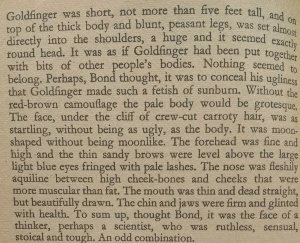
At school in English class our teacher had asked us to bring in a book with a vivid description of someone and my choice was Goldfinger. The book is about a man called Auric Goldfinger, a rich businessman who is suspected of smuggling gold. Bond is tasked to find out more and Fleming gives the reader a particularly compelling description of Goldfinger.  Fleming describes him as having a body seemingly put together with parts of other people’s bodies. I always thought that was pretty good. Fleming used to write his first drafts of a book and then add in all sorts of details afterwards like the vodka martinis that James Bond liked so much and the Sea Island cotton shirts that Bond favours in the novels. It was actually Fleming who wore those particular shirts and who drank vodka martinis and also preferred scrambled eggs for breakfast. Many people have speculated who Bond was based on and my feeling has always been that in fact it was Ian Fleming himself.

My current read is a book I mentioned last week, Charlie Chaplin and his Times by Kenneth S Lynn. Chaplin was a music hall entertainer working for the great impresario Fred Karno. Karno regularly sent teams of entertainers to the USA and while there Chaplin was invited to make a film for Mack Sennett, the famous producer of comedy films. Chaplin’s films proved to be enormously popular and so Chaplin moved on to different studios, all for better and better money until he established his own studio. I’ve always found the early days of Hollywood to be fascinating and this book is no exception.
Which books are you reading?


What to do next:

Share this post on your favourite social media!

Hit the Subscribe button. Never miss another post!

Listen to my podcast on Spotify: Click here!

Buy the book! Click here to purchase my new poetry anthology.

Click here to visit Amazon and download Floating in Space to your Kindle or order the paperback version.


Getting to the Heart of a Classic Film

Two of my absolute favourite films are Citizen Kane and On The Waterfront. Kane is a masterpiece of  visual brilliance whilst Waterfront is a masterpiece of acting brilliance. Waterfront has at its centre a heart of fire whilst Kane‘s centre is a little cooler. I thought a quick comparison of the two films might be interesting so here we go:

Citizen Kane

Back at home in my default position, in my favourite chair watching TV, I picked up the tail end of an interview with actor Gary Oldman about his new film Mank. Mank sounds like an interesting film in many ways. Firstly, it only had a limited cinema release before being streamed on Netflix. Whether this was a reaction to the global lockdown or an indication of how cinema will work in the future I’m not sure, but if cinemas are unable to open then producers must find other ways to show their films.

Gary Oldman is an English actor with an interesting array of roles behind him. He won the academy award for his role as Winston Churchill in the film Darkest Hour and played assassin Lee Harvey Oswald in Oliver Stone’s JFK. Mank is about Herman Mankiewicz and his writing of the screenplay for Citizen Kane. Kane is one of my favourite films although I haven’t seen it for a long time.

Mankiewicz was asked by Orson Welles to write the script but without a credit, presumably so that Welles himself could use the resulting script as a basis for his own work. Later Mankiewicz changed his mind and decided he wanted a screen credit as he had come to think that the script was his best work. Welles then gave screen credit to both himself and Mankiewicz although it was Mankiewicz himself who accepted the Oscar at the award ceremony in Hollywood.

Just flipping through my extensive back catalogue of VHS documentaries I found one from the BBC about the making of Citizen Kane which I have recently copied to DVD. The documentary covered various areas including the filming, the actors and of course the script. The origin of the script was a contentious subject, especially after film critic Pauline Kael wrote an article in the New Yorker on the subject. She seemed to favour Mankiewicz as writing the lion’s share of the project. Peter Bogdanovich wrote a rebuttal in the Esquire magazine, defending Welles as the screenwriter.

The truth is that Welles, as he said himself, put together a screenplay based on both his version and the one by Mankiewicz. Elements of the story were based on personal experiences of both men, for instance Mankiewicz was friendly with William Hearst who inspired the character of Kane but Welles maintained that tycoons Samuel Insull and Harold Fowler McCormick also inspired parts of Kane’s story.

The cinematographer was Gregg Toland, one of the film industry’s top photographers. Toland asked to work on the film and Welles replied ‘Why? I don’t know anything about making films.’ Toland countered that was exactly why he wanted to work on the film because a film by a newcomer, Kane was actually Welles’ first film, would produce something new and original.

There are some fascinating elements to Citizen Kane, especially in the special effects department. A famous one is where the camera flies through a rooftop sign and then drops down through a skylight into a restaurant. That was done with a sign that came apart as the camera approached and then a fade from a model shot into the restaurant set disguised in a flash of lightning. I could go on and mention plenty of elements like that but if you haven’t seen Citizen Kane let me just explain what it’s all about. The film opens with the death of Kane, a millionaire newspaper magnate. His last words were ‘Rosebud’. The makers of a cinema newsreel decide to find out what or who Rosebud was.

To do so they research Kane’s life; his inheritance of a huge fortune, his takeover of a newspaper, his great wealth, his power and influence, his marriage and divorce and ultimately his death. The reporters never find the answers to their questions but we, the cinema audience, have the secret revealed to us right at the end of the picture. The end is what makes the film really and Welles admitted that Rosebud, and the idea behind it, was the idea of Herman Mankiewicz.

Citizen Kane is a wonderful piece of cinema with an outstanding visual style and the only criticism I can put forward is that for all its visual fireworks it is a film with a cold centre, a cold heart. Does the viewer feel sympathy for Kane? I’m not sure he does.

On the Waterfront

On the Waterfront stars Marlon Brando as dock worker Terry Malloy, brother of Charlie ‘the gent’ who is the right hand man of union boss John Friendly played by Lee J Cobb. Terry unwittingly leads fellow dockworker Joey Doyle into an ambush, thinking Doyle will be threatened to withdraw his statements to the Crime Commission. However, Doyle is murdered leaving Terry shocked and confused. Later he becomes friendly with Joey’s sister played by Eva Marie Saint in her film debut. Charlie, played by Rod Steiger, tries to get Terry back into line in the famous scene with the two in the back of a taxi but fails. After John Friendly has Terry’s brother murdered, the local priest played by Karl Malden convinces Terry to tell everything he knows to the Waterfront Crime Commission. Terry does so but is ostracised by his fellow dockers until Terry forces Friendly into a brutal fight. The dockers then stand with Terry when bruised and battered, he returns to work.

Director Elia Kazan had originally employed Arthur Miller to write the screenplay for On the Waterfront but the two fell out over various things especially the fact that Kazan had identified eight former communists to the House Unamerican Activities Committee. This was the time of the McCarthy witch hunts and careers and livelihoods were on the line when Senator Joe McCarthy asked the question ‘are you now or ever have been a member of the communist party?’

Kazan then asked Budd Schulberg to write the script. There was still some difficulty in getting the film to the screen and eventually Kazan approached Sam Spiegel to act as producer. He was able to set up a deal with Columbia Studios.

The film was thought to be Kazan’s response to criticism of his stand at the HUAC hearings. Arthur Miller in his play A View from the Bridge has his character become an informer but Miller puts a different spin on things, portraying the informing as a betrayal rather than a way of fighting back at crime as Terry Malloy does On the Waterfront.

Either way, On the Waterfront is one of my very favourite films and Brando’s performance as Terry Malloy won him one of the film’s eight Oscars. Forget about Don Corleone, this was Marlon Brando’s finest hour.

It is the performances that are at the heart of this great film. Brando is outstanding but so too are Karl Malden, Rod Steiger, Lee J Cobb and Eva Marie Saint. Kazan was a director who worked well with actors bringing out the best in their performances and respecting the way they worked. He had worked with Brando before in A Streetcar Named Desire and would go on to work with fellow method actor James Dean in East of Eden.

The cameraman, Boris Kaufman had previously worked on documentaries so perhaps that was why Kazan engaged him to film Waterfront as, in a documentary like style, the camera follows Brando as Terry Malloy and watches him become slowly disappointed in the thuggish world he has become part of.

The scene in a taxi with Rod Steiger is clearly a studio set but we don’t care because Steiger and Brando keep the viewer riveted to the screen ignoring the poor lighting and the bad set because the actors take all our attention.

In another scene Brando chats with Eva Marie Saint who plays Edie, the sister of the dockworker who Brando as Terry Malloy had set up for the kill. The two talk as they walk and Edie drops her glove but Terry picks it up and instead of giving it back puts it on his own hand. The glove becomes a focal point holding the two together as they talk. For me it is one of the great scenes in cinema. This is a film with a beating heart at its centre, a heart of fire and emotion and it is Brando with this wonderful performance who is right at the film’s centre.

Next time you see either of these films in your TV schedule, put your phone on silent, settle down and enjoy some great cinema.


What to do next:

Share this post on your favourite social media!

Hit the Subscribe button. Never miss another post!

Listen to my podcast on Spotify: Click here!

Buy the book! Click here to purchase my new poetry anthology.

Click here to visit Amazon and download Floating in Space to your Kindle or order the paperback version.

Life but Not as We know it


lifeThis week the lockdown has eased a little here in the UK. Groups of six can now meet together in public places and soon we will be able to go to the pub once again, as long as we stay outside. No doubt pubs who don’t already have beer gardens or some sort of outside area will be scrambling to get one set up. It will be nice to go down to the pub or restaurant again and take another step towards normality.
Once again I’ve spent a few days at my mother’s house, checking that everything is ok, tidying the garden up and so on. As I am alone here this should be the perfect time to write. After all, what could be better for a writer; quiet, solitude and my trusty laptop? One other thing that is important is a writing routine and a few ideas. Of course, if I was a professional writer, let’s say a newspaper columnist for instance, my editor would surely be on my back asking for my next article.

I can just imagine a scene like something out of All the President’s Men, the 1976 movie about the reporters who broke the Watergate story at the Washington Post. There’s a nice scene there that goes like this:

EDITOR: Bernstein! Is that story ready yet?

BERNSTEIN: Yes, I’ve finished it.

EDITOR: Let me have it then.

BERNSTEIN: I will. It just needs polishing.

I tried to find the video of that scene but failed. Here’s the trailer instead:

I do have a few articles or I should say blog post drafts, that need polishing. Fifteen actually. I think of them as my stand bys. Posts I work on when I just haven’t got any idea what to write about. Sometimes I will look at one, get an idea or an angle, a new way of looking at the subject and then I’m off and I actually finish, or get closer to finishing the post. Other times I just end up adding another draft that will probably never get finished.

This week I had a plan. I always seem to wake up at 7:30 no matter what. At home I usually just nod off back to sleep but here at my mother’s house I rarely seem able to do that. So, here’s the plan: wake at 7:30. A quick clean of my teeth and splash a little water on my face. Back to bed. Check my emails and social media. Then back to the bathroom for a shave and a proper wash, downstairs for breakfast and ready to get writing. Great, there is nothing like having a plan, now to put it into action.

Sunday. I wake up and check the time. It’s 8:30. 8:30? Wow, I’ve actually had a good sleep for a change. OK. Clean teeth and back to check out my emails. Now the big mistake there is that recently I’ve subscribed to Medium. It’s a story website and there is always some interesting story I want to read. There are numerous true crime stories that I like. In particular I do like reading about cold cases; old police murder cases that are now being solved by new DNA technology. It must be great for the families and the detectives to see crimes that were thought to be finished and unsolved, now being given a new lease of life by technology.

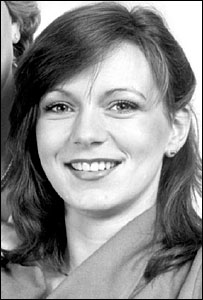
This week I watched a TV documentary about a famous cold case, the disapearance of Suzy Lamplugh. Suzy was an estate agent who left work to meet someone wanting to look at a property. The only clue was that Suzy had left a note in her diary that she was to meet a ‘Mr Kipper’ on the 28th July, 1986 in Fulham, London. She was due to meet Mr Kipper at a property at Shorrolds Rd at 12:45. She went to meet him and was never seen again. Her car was found half a mile away from the property at Stevenage Road, also in Fulham.

suzylamplugh

Picture courtesy Wikipedia

Witnesses saw Suzy with someone at the Shorrolds Road property; a smartly dressed man with a bottle of wine or champagne with a fancy wrapping. Later another witness saw Suzy in a BMW in Stevenage Road. Nothing was ever found and despite reinvestigation in 1998 and 2000, Suzy was never traced.

In 2000 it was suggested that convicted rapist and murderer John Cannan could have been the culprit. Cannan looks startlingly similar to a photofit picture produced by Police, of the man Suzy met at Shorrolds Road. Cannan denied being the murderer but he was staying in a hostel for released prisoners not far away at the time and others at the hostel said that Cannan used to leave at night through a window. Cannan visited pubs and restaurants in the area and could have seen Suzy there, in fact she had lost her checkbook and a local pub called Suzy to say they had found it the day she disappeared.

It was all rather shocking and the programme left me fairly convinced that Cannan was the villain although the man himself, still serving time on another murder charge, denies everything. Suzy’s parents sadly never lived to see the crime solved but they did establish the Suzy Lamplugh Trust that helps people with their personal safety and also runs the National Stalking Helpline.

Anyway, back to my personal writing plan. After that late start it was nearly 10 so I dragged my lazy behind out of bed and made it down to the kitchen. I hurriedly sorted out some egg and bacon ready to eat during Star Trek, the original series on the Horror channel. Star Trek however wasn’t on. It must have just finished because I realised just then that it’s Spring and we have now moved to BST, British Summer Time and it was actually eleven o’clock, not ten!

Come to think of it, they don’t show Star Trek on a Sunday, it’s just on Monday to Friday so there’s my whole blog post blown out of the water. Anyway using the power vested in me by WordPress what I think we’ll do is just fast forward to Monday at 10. There I was eating pretty much the same breakfast -OK, I’d thrown a sausage in and a few beans but what the heck, variety is the spice of life in these highly irregular Covid 19 times.

Let’s start again. There I was with substantially the same breakfast on Monday ready to eat and watch Star Trek.

I do love Star Trek, in particular the first episodes starring William Shatner as Captain James T Kirk. Forget Captain pointy head Picard, Kirk is a proper captain and by 10:30 he will usually have blasted a number of aliens with his phaser (a sort of ray gun) and done some pretty serious kissing of any beautiful girl, alien or otherwise, within a 100 yard area. In the episode I watched, Kirk decided that the only way to get free from a planet where androids had imprisoned him was to show the androids that there was more to life than working in an underground prison. He gave the tonsils of one android lady a good work out and lo and behold, that sent her into some serious confusion. She then encountered another android who clearly was in need of some snogging software as he wasn’t so keen on kissing, so she gave him a quick blast of her ray gun, enabling Kirk to once again take control and show everyone involved that messing with James T Kirk is not a good idea.

It just so happens that William Shatner has reached the venerable age of 90 this week so it was good to read in the media that he is still going strong. Wonder if there is any chance of him playing Kirk again just one last time?

Anyway, back to the plan. You know, the one I was talking about earlier, the writing plan, up early have breakfast and then write stuff. Well after Star Trek I thought I might just check to see if any more emails had landed on my virtual doorstep. One was a newsletter from the Guardian newspaper. I’ve signed up for a few newsletters from the Guardian; one for films and another about books. I get one every week and there are a whole list of bookish articles about various book related topics. Usually I have a quick scan and if there is nothing of any interest I just hit the delete button. This week there was a post about a lady called Vivian Gornick. I’ve never heard of the lady but apparently she is a journalist and memoirist and in the book section the Guardian hit her with their regular bunch of questions so I thought I’d just see if I could answer those questions myself.

What book am I currently reading?

Well just lately I’m really fascinated by the silent film era as you can see from my Book Bag post a few weeks back. I’m reading Charlie Chaplin and His Times by Kenneth S Lynn. It’s a really interesting read about Chaplin and the author, who happens to be a really great researcher, checks out all the various stories in Chaplin’s autobiography and compares them to actual records. All fascinating stuff about the early days of film making.

What book changed your life?

Not sure about that one. Did any book change my life? Well I’ll have to say David Copperfield by Charles Dickens. That changed my life in that it opened up my mind to how an author could take his reader on such an incredible journey and manage a story in such a way that the reader could experience it and feel almost as if he was living the narrative with the writer. You’ve guessed by now I just love that book.

What book do I think is most overrated?

That’s another tough question and I’d have to answer Wuthering Heights. I read something ages ago about 100 books I should read before I die so I picked a copy up in my local charity shop, back in the days when we could go into shops, and read it. I should say tried to read because I just thought it was a little dull. Sorry, I know it’s a classic but it just didn’t do it for me.

The last book that made me laugh.

I think it would have to be The Fall and Rise of Reginald Perrin. You might have seen the TV series with Leonard Rossiter playing the part of Reggie Perrin. I’m not sure which came first, the book or the TV show but it’s a really funny book.

The book I couldn’t finish.

This has to be Catch 22 the novel by Joseph Heller. One of my friends gave it me and said it was brilliant and I had to read it. I tried but I just couldn’t get into it.

I guess this must have taken me into lunchtime. I was feeling a little hungry round about then. I suppose that when you start working like a real writer with a writing plan you must need a little sustenance to keep you going. What I needed was a corned beef sandwich and a large cup of tea with maybe a chocolate biscuit on the side. I made my way into the kitchen to sort out that little feast but just then the phone rang and I’m guessing the call was from an alternate universe because it was my editor yelling down the phone:

EDITOR: Where the heck is that blog post you promised me?

ME: That blog post? Oh yes, I finished it.

EDITOR: Where the hell is it then?

ME: It’s just . . . er . . . I’m just . . polishing it!

What to do next: Here are a few options.

Listen to this post as a podcast. Click here.

Share this post on your favourite social media!

Hit the Subscribe button. Never miss another post!

Buy the book! Click here to purchase my new poetry anthology.

Click here to visit Amazon and download Floating in Space to your Kindle or order the paperback version.