How Does Your Garden Grow?

Whichever way you look at it, the Coronavirus pandemic has been a real pain in the neck. I’m pretty lucky I suppose as I’ve not been furloughed because I work for a government agency. I’ve not lost any loved ones to the virus either but like I say, generally speaking, the whole experience is one I’d rather forget.

Things are looking up a little bit here in the UK. We can now go out and visit the pub, table service only though mind, no standing at the bar chatting. What really gets on my nerves about table service is that when the pubs opened up last time before the second wave there always seemed to be plenty of staff about to take your order and bring over your beer which was actually pretty nice. In one particular pub where the service has always been dreadful, the service actually improved. Now, every pub I go into they seem to just want you to order via the app.

Now not long ago I deleted a lot of apps from my phone. I just had too many of them. Now, pubs don’t want to serve you in the traditional way, they just want you to use the app and order online. How hard can it be to sort out proper table service? Let’s say two staff members behind the bar and one touring the pub taking orders. Sounds easy to me.

The person who takes your order goes to the bar and hands in the order, two pints of bitter please or whatever, the barman pulls the drinks while the waiter is at another table. He comes back for order #1, hands in order #2 for table B and takes the drinks to table A while the bar guy is pulling table B’s pints. The second bar guy can either take orders or collect glasses or just help out with serving or pulling pints whenever necessary. Sounds simple enough to me. What actually happens is a bunch of people are pouring drinks and after fumbling about with the app someone will turn up with the beers. ‘Carlsberg and an Ice Breaker’ announced our server the other evening. ‘A What? I didn’t ask for an Ice Breaker!’ ‘Yes you did’ said the server confidently. ‘Look, I didn’t order an Ice Breaker whatever that is’ I say but the guy only believes me when I show him my app which clearly states Carlsberg and IPA. So off the guy goes to fetch a pint of IPA which comes back a few minutes later. That’s technology for you, it’s only as good as the people who use it.

Anyway, enough moaning for now. The pandemic has actually forced us to turn inwards. Less going out, more staying in and when we get tired of the TV what else can we do? Well, we can go into the garden for a start.

Big or small, the garden can be a little pool of tranquillity and even if it is just a small balcony and a window box, plants and flowers can bring a little extra something into your life.

What I’d thought I’d do for this post is to take a few pictures of the garden and write a little about each one. I should say that’s its not really my garden, it’s actually Liz’s garden. My only contribution is to cut the grass and to light the barbecue but anyway, here we go.
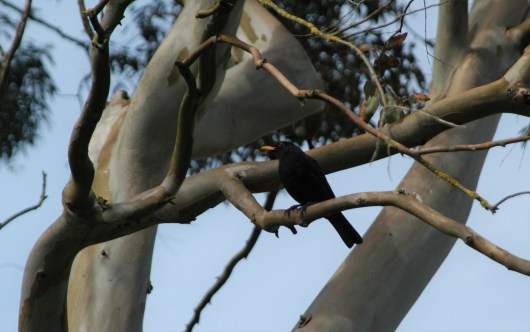
This first picture is of Mr Blackbird. That’s him up there in the eucalyptus, shot with my Nikon D100 and zoom lens. He and Mrs Blackbird have started a nest in a clump of bushes not far from our breakfast table just by the back door. The eggs have been hatched and he goes out many times each day returning with some juicy worms for his chicks. He’s a wily fellow. First he lands on the big tree and does a quick survey. If the coast is clear he will fly into the small patio and land on the fence before hopping down to the breakfast table or one of the chairs. Then if all is still clear, he’ll hop down and fly up to his nest in the bushes.

There’s a distinct hum in the background. Yes, it’s the local bees. This garden seems to attract them and here at the beginning of summer there are plenty of bees about landing on flowers and looking for nectar and just doing what bees generally do.

As we’re not far from Blackpool airport there are other objects flying around like light aircraft and helicopters, I love both, especially the sound of small aircraft, that lovely lazy drone that you can hear from many small airfields. Up above there is a yellow helicopter that I see regularly and one afternoon I managed to put down my book and snap a few frames off with my camera. I have the feeling that the pilot actually knows I want to photograph his aircraft because when I leave my camera inside, that’s when he comes by flying low right above our house and when I have the camera just by, he always does a wide berth.

Back to the garden and out by the breakfast table Liz has planted tomatoes, peas, mange tout, broad beans and potatoes. There are also some cabbages and purple sprouting broccoli down there and a couple of herb pots with sage, thyme, chives and rosemary to name but a few. Next door is some garlic. Over by the table the large pot of strawberries are doing pretty well with some berries just about to change from green to red. Also over there is a chilli plant grown from the seeds of a chilli. In other parts of the garden are raspberries, runner beans, carrots, cauliflower, celeriac, aubergine, green peppers, sprouts, Jerusalem artichokes, butternut squash, padron peppers, globe artichokes and asparagus.

My lemon plants are doing pretty well. (Top right of the montage picture further up)They were grown from lemon pips a few years back but sadly have not yet borne any fruit. This year I’m feeding them with bone meal fertilizer and I’m firmly hoping that one day I might just grow a lemon. It does take at least three years for a lemon plant to fruit but I’m hoping this might be the year.

Years ago Liz and I stayed at a rented villa in Spain. The owner was an elderly chap named André, he was a Frenchman of Russian heritage and in his garden were many lemons and oranges. Spain of course is the perfect climate for citrus trees; perhaps I need to get myself a green house or perhaps even move to Spain!

I do have two olive trees, both of which were gifts and they are both looking good and I do love olives, not that either tree has provided me with any yet.

In the picture above we’ve got cabbage, potatoes and butternut squash.

Further down the garden we have a barbecue and it is so wonderful to light it up and cook outside on summer afternoons. It’s almost like being in France. Well, almost, but not quite. We have a big outdoor table down at that end of the garden and usually I’ll light the barbecue and we’ll start off with salad while the coals heat up. Tomato and onion salad with olive oil is my favourite and recently we have also had home made coleslaw and a rice, chive and cherry tomato salad. A typical meal might be homemade chicken kebabs (chicken marinated in lemon juice, chilli and garlic with a touch of tamarind sauce and cooked on skewers with peppers and onions), sausages, steak and of course burgers. Liz makes her own burgers from minced steak mixed with chopped onion and seasoned well. I like to serve mine on a lightly toasted bread bun with tomatoes, onions and mustard or tomato sauce.
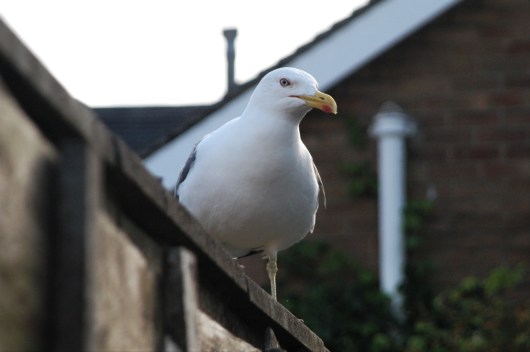
A frequent visitor when we barbecue is this fella above. He or she always appears just at eating time. He makes his presence known by giving us a regular squawk and if nothing happens he will just carry on making a racket until Liz leaves some bit of meat on the garden fence for him. He’ll do a cocky sort of strut along the fence, pretty much like you’d expect a seabird version of Mussolini to do and then he’ll gobble up whatever we have left for him or if he doesn’t like the big guy getting too close and snapping away with his Nikon he’ll take it across to the adjacent roof and sort it out at his leisure. What he does for food when we are not barbecuing, I really don’t know.

When the food has been eaten it’s time to settle back with a glass of red and take a last peek at my book before packing up and going inside. As usual I’ve got a few books on the go. I’m reading the second volume of Sarah Miles’ autobiography, Serves Me Right. Sarah is an actress you might remember from Those Magnificent Men in Their Flying Machines or Ryan’s Daughter. At the same time I’ve started the first volume in the Hamish Macbeth series, Death of a Gossip which I turn to when I fancy something a little lighter.

As usual I’ve tried to think of a link to books and films, bit of a tough task with the subject of gardens but here we go. Being There was a short book I read years ago by Jerzy Kosinski. It’s about a gardener, a pretty simple guy called Chance who has spent his life working for the owner of a large house and when the owner dies, Chance is left homeless. He knows nothing about the world except for the garden but he becomes popular as his simple observations about gardens are mistaken for great wisdom. After a random series of events, he even gets to tell the President of the United States his solutions for world problems, based on his understanding of gardens. You may not have read the book but it was made into a film starring Peter Sellers. Sellers based his own performance on a combination of his own gardener and Stan Laurel, a comedian that Sellers admired greatly.

So, how does your garden grow?

Mary, Mary, quite contrary,
How does your garden grow?
With silver bells, and cockle shells,
And pretty maids all in a row.

What to do next: Here are a few options.

Share this post on your favourite social media!

Hit the Subscribe button. Never miss another post!

Listen to my podcast Click here.

Buy the book! Click here to purchase my new poetry anthology.

Click here to visit Amazon and download Floating in Space to your Kindle or order the paperback version.

https://youtu.be/lIsuIovCzxA

The Film of the Book or the Book of the Film Pt 3

Papillon by Henri Charrière

Papillon is a book by Frenchman Henri Charrière. It is an autobiographical novel about Charrière’s imprisonment in the French penal colony of French Guiana and covers a period of about fifteen years. The original novel was written on a series of exercise books and is presented in just that way. Charrière describes his experience of imprisonment as a terrible one. He escaped and was recaptured many times and ended up in solitary imprisonment twice. The first time was for two years and he was kept in solitary for 24 hours a day. In his second bout of solitary a new officer takes over the running of the area and prisoners are let out for exercise every day. At one point in his escape Charrière encounters a tribe of Indians and joins them for many months, even marrying one of the Indian girls but despite finding this apparent paradise, he leaves and is imprisoned again. He eventually escapes from Devil’s Island by jumping into the sea aboard a sack filled with coconuts. The book is an incredible read and I found it one I just couldn’t put down. It is filled with action and adventure but also with thoughtful observations about the human condition and there are many moments when simple acts of kindness stand out to the author against a background of cruelty and inhumanity.

The book was an instant hit when it was published in France in 1969 and the author, Henri Charrière, nicknamed Papillon because of a tattoo of a butterfly on his chest, became a French celebrity. He died in 1973 but always maintained the book was true and based on his own recollections despite claims to the contrary. Whatever its origins the book is a true classic adventure story.

The Film

On paper this should have been a brilliant film; Steve McQueen and Dustin Hoffman star, there was a screenplay by Dalton Trumbo and Lorenzo Semple Jr and music by Jerry Goldsmith. The director was Franklin J Shaffner, who I’ve not heard of but there are plenty of big names involved who would normally guarantee a great film. They even had author Henri Charrière who acted as an advisor to the production. Somehow though, they managed to turn out something of a dud. It’s hard to put the finger on what went wrong but reviewer Robert Ebert said the big flaw was that the audience failed to gain interest in the McQueen and Hoffman characters. I think the big problem was that the book was a long book, packed with incident and instead of trying to cram the whole book into a film, perhaps the producers should have concentrated on just a part of it. Steve McQueen was a reasonable actor and he was good in basic action roles but I just don’t think he was good enough to play Papillon. The film skips over many interesting elements of the book and at the end of the film when Charrière is imprisoned on Devil’s Island, McQueen appears to be an old man which wasn’t the case in real life. My advice: Don’t bother with the film, read the book.

The Wooden Horse by Eric Williams

I’ve been trying to remember which came first for me, the book or the film. After some reflection, it was probably the film but I read the book soon afterwards. I found a copy in a box of paperbacks someone had given to my Father. The book is a classic escape story from World War II. It’s a great read and the story starts with a usual day in the POW camp which consists of tea making, cooking and cleaning and exercising by walking a circuit around the camp. The author, real life escapee Eric Williams, tells the reader about the everyday problems of living in a hut full of bored officers looking forward to either red cross parcels, letters from home or escaping. The problems of escaping are many. The soil is soft and sandy meaning that a tunnel would be liable to collapse and the soil cleared from underground is different to the grey topsoil making it difficult to hide from the German guards. The main problem is the distance from the huts to the camp perimeter but the author and a friend hit on the idea of taking a vaulting horse and placing it near to the perimeter fence and having a tunnel dug from there with the prisoners exercised by vaulting over the horse and masking the escape operation. The POW camp, Stalag Luft III was also the same camp where the events depicted in The Great Escape took place.

The Film

The film is pretty faithful to the book and stars the usual stalwarts of British films in the 1950’s, actors like Leo Genn, Anthony Steel and David Tomlinson. It’s a nicely paced film showing the boredom of camp life and then the idea for the vaulting horse and its preparation and use. Various problems have to be overcome including tunnel cave ins and disposal of the resulting excavated sand but all goes well. The two escapees decide to add another man to their escape team and one night the three emerge from the tunnel into freedom. Of course the escape is not over; two of the men make their way to the Baltic port of Lubeck and manage to escape to neutral Sweden with the help of the Danish resistance by stowing away on a Danish ship. The third escapee also makes his way to freedom separately and all three meet up in neutral Sweden.

On her Majesty’s Secret Service by Ian Fleming

This book as you probably know is one of the James Bond series of books and is one of the last in the series. As usual, the book is well written and James Bond 007 is on the lookout for Ernst Stavro Blofeld whose fiendish plot was thwarted by Bond in the previous book, Thunderball. In this one Bond is close to resigning but after being given some holiday leave from work, meets a young girl, Tracy, who appears to be suicidal. After saving her from one such attempt Bond is introduced to her father Draco, who is head of a Corsican crime syndicate. Draco gives Bond a lead on Blofeld who appears to be trying to establish that he is in fact a baronet. Anyway, without going on and explaining the plot in detail, the book is an excellent read, one of the best in the Bond series.

The Film

The film was notable for being the first in the film franchise without Sean Connery as James Bond. Connery was tired of playing the part and so a search for a new Bond had begun. The new actor chosen was George Lazenby whose only claim to fame at the time was appearing in a TV advertisement for a Big Fry chocolate bar. For me, Lazenby was the perfect Bond. He looked the part, in fact I’ve always thought that he fitted Ian Fleming’s description perfectly. The film is a fast paced thriller and is one of the more serious of the Bond films. Diana Rigg plays Contessa Tracy Di Vincezo who Bond saves from a suicide attempt, just as he does in the book. Tracy’s father Marc Ange Draco who happens to be an underworld boss, gives Bond a tip as to Blofeld’s whereabouts. Bond, masquerading as Sir Hilary Bray, a representative of the College of Arms meets Blofeld in Switzerland on the pretext of confirming Blofeld as a baronet. Bond arrives at the ski resort of Piz Gloria and finds Blofeld is engaged on a new plot against the UK. The film throws in some great fight scenes, car chases and also an exciting ski chase sequence. It was directed by Peter Hunt and is still a favourite today amongst Bond fans. Sadly Lazenby decided not to play Bond again and Sean Connery returned for another outing as 007 in Diamonds are Forever.

Hamish Macbeth

This last entry is a little of a cheat really as the Hamish Macbeth series of books were made into a TV series rather than a film but here we go anyway.

Robert Carlyle played the eponymous TV police officer in the BBC series which first aired in 1995. The series is about a local Bobby based in the village of Lochdubh in the Scottish Highlands. Macbeth applies the rule of law in his own way and dispenses his own brand of laid back justice. Although successful at solving numerous crimes Macbeth avoids promotion in order to stay in the village.

Three series of Hamish Macbeth were produced with six episodes each. Although the series was based on the books by MC Beaton, the TV series differs greatly from the books, with new characters devised by the TV producers and various other aspects changed. I enjoyed the series enormously and even once visited Plockton, the Highland village that doubles for Lochdubh on television. MC Beaton, whose real name is Marion Chesney, apparently hated the TV production which I can understand as they changed her work considerably, adding and changing characters. I have to say though, I’ve always liked it.

Death of A Dreamer by MC Beaton

I picked up this copy of one of MC Beaton’s books in a second hand bookshop in Skipton. At first I wasn’t sure if it was a book for me but I soon settled into the story and it bumbles along nicely with a few twists and turns on the way. A lady artist, Effie Gerrard, arrives in the village and develops an obsession with another artist named Jock. Later Effie is found dead. Was it a suicide or was it murder? The police decide it was suicide but Hamish is not so sure and he decides to make further investigations.

In the books Hamish has a dog and a wild cat as pets unlike the TV show where his only pet is ‘Wee Jock’, a highland Westie dog. The book is heavy on dialogue and light on descriptive passages but it was an easy and enjoyable read and I liked it immensely. The only annoying thing was that after finishing the book, the first chapter of the next book had been added to tempt the reader I suppose into buying that one. I read that and found myself wanting the next book in the series so it might be time to begin scouring the bookshops of St Annes for more books in the series.


What to do next: Here are a few options.

Share this post on your favourite social media!

Hit the Subscribe button. Never miss another post!

Listen to my podcast Click here.

Buy the book! Click here to purchase my new poetry anthology.

Click here to visit Amazon and download Floating in Space to your Kindle or order the paperback version.

Thoughts From A Sun Lounger Part 12

It’s been a while since I’ve done one of these sun lounger posts. The simple reason is that just lately I’ve not been anywhere near a sun lounger to have any sun lounger thoughts. However, the sun has finally appeared over North West England, the temperature has gone up and finally it has been time to drag the sun lounger out from its winter hiding place. As the lockdown is still ongoing despite a recent thaw it has not been possible to drive over to France or fly to Lanzarote and take in some sun so the only sun lounging I’ve been doing lately has been in our own back garden, thinking idly back to those halcyon days before Covid 19 when Liz and I were free to roam the continent in search of wine, bread, French restaurants, Spanish Tapas, the sea and the quiet of the French countryside.

The French countryside really is huge and I do love the quiet. Silence is pretty hard to find these days, especially in a big city like Manchester but in rural France, the absence of sound is something pretty profound. Close your eyes while lying on a sunlounger and it takes a while for a city boy like me to take in the silence. No traffic, no shouting, no electronic noises, just silence. After a while new sounds begin to emerge, the sound of birds perhaps, the sound of a gentle breeze, a tractor out in the fields or the faint rumble of one of my favourite sounds, the drone of a small aircraft.

I conjectured in an old post that perhaps in a previous life I was a pilot. A barnstormer in the American west perhaps or a pilot from the Royal Flying Corps. I read a book once called Soul Survivor, a story of reincarnation; a small boy troubled by incessant nightmares of being trapped in a burning aircraft. As time went on the boy remembered more of his nightmares, details of his aircraft, the aircraft carrier he flew from and the pilots he flew and died with. It was quite a story and when the parents of the boy traced the actual pilot who the boy claimed to be, the similarities between the boy and the World War II fighter pilot were amazing. I do love the sound of small aircraft though and just lately, lying in my sun bed, the sound of small aircraft flying from nearby Blackpool airport awakens a distant memory inside me. Perhaps it is the memory of being a young plane spotter at Manchester Airport many years ago, or is it the distant memory of another life?

One time in France we were relaxing with our barbeque just by a plan d’eau after an afternoon swimming and we heard the familiar drone. This time it was a paraglider drifting serenely across the blue sky.

Another simple quality in rural France is the lack of light pollution. In the city, things such as street lighting, neon lights and illuminated advertising hoardings all contribute an abundance of light but here in the country, darkness is something different; a deep, sensuous blackness that almost overwhelms the senses.

Lying back on your chair or lounger in the soft, warm evening and looking up at the sky is a wonderful sensation. Without the interference of ambient light, the sky at night is a whole new world. An enigmatic velvet vista opens up to the naked eye with myriads of stars, some the merest pinpricks, others great beacons in the sky.

Peering into the night sky on one memorable evening, I noticed a particular star, much brighter than the others. It was then I remembered that on my iPad I have an app that can tell you which stars are in the sky. The star in question was not the pole star as I had surmised but Vega. Vega is the brightest star in the constellation of Lyra, the fifth brightest star in the night sky, and the second brightest star in the northern celestial hemisphere, after Arcturus. It is relatively close at only 25 light years away from us, here on Earth.

One of the great things about the summer has to be the barbeque. Liz makes the most amazing salads to go with our food; homemade slaws and various mixes of crunchy green leaves and sliced tomatoes and onions to go with our burgers, sausages and steaks. I love it when the coals are hot and ready and the meat sizzles when it hits the barbeque. I do miss our French meals though. We had a brief visit to France in 2020 between lockdowns and I remember one lovely meal sat outside a hotel restaurant we have visited a few times. I had a cool French rose served with a starter of crudités and pâtés and fresh bread. Afterwards with a bottle of red came the main course, a nice steak. I have to say I worry about ordering a steak in France. The French tend to undercook a steak so I always ask for it to be cooked well done rather than my usual medium. The thing is, will the chef think that those stupid English want their food cremated as usual and actually give me a really well-done steak instead of a medium? Perhaps I should just ask for the omelette with fromage?

One of our favourite restaurants is in the north of France, not far from Calais. We found the restaurant just by chance, miles from anywhere. Liz and I stopped for an early evening meal one day and we have returned many times since. For starters I chose celery soup and Liz ordered the pâté.

I was a little disappointed with the rather small empty dish that was presented to me but then a huge tureen of soup arrived which was wonderful and produced about four small servings, one of which went to Liz while I sampled her pâté which was full of rustic flavours and was perfect served with fresh French bread.

The main course was a simple omelette, light and fluffy with a fresh salad and Liz’s fish was lovely with a creamy curry like sauce, unusual for French country cooking.

Anyway, as the weather had improved it was time to take a run out in our motorhome. Looking on the internet motorhomes don’t seem to be too popular lately, especially here in St Annes which is a seaside destination in its own right. Not as brash as nearby Blackpool with its Pleasure Beach and kiss me quick hats but also not as posh as Lytham thinks it is. On the internet I have read a lot of resistance to the holidaymakers arriving here parking up by the sea front. Why don’t they go elsewhere ask bloggers on one of Facebook’s St Annes pages, taking up all the parking spaces? Well, why should they? Motorhomers pay their road tax too and are entitled to park anywhere that is legal, just like a car. One comment said that if we can afford a motorhome then we can afford to stop at a caravan park? Again, why pay to park on a caravan site when the beauty of a motorhome is that we can stop anywhere and spend the night in the back of the van?

This last week we motored off to Yorkshire and stopped for the night in Skipton, a lovely town with some nice old pubs and many attractive barges moored by the side of the canal. We parked for the night on the nearby car park in the company of quite a few other motor homes. The charge for a night’s stopover was the princely sum of five pounds, although after nine am the parking meter wanted more money for a further daytime stay. We stayed a few hours for breakfast and to visit the nearby market which was pretty quiet early on but later when we left about noon everywhere, including the car park, was packed.

Liz’s cod dish: Looks pretty yummy

The next night we found a great pub in the village of Egton, the Horseshoe Inn. They told us the pub was fully booked for diners that night but we could stay free of charge and drink in the outside bar. When we arrived there had been a cancellation so we were able to drink and dine before wandering a few yards back to our motorhome.

In France, many towns and even villages sport their own motorhome stopping places with facilities to empty toilets and top up our water tanks. Many places like this are free, although some charge a few euros to top up with drinking water.

Yes, we’ll be sorely missing our visit to France this year. Of course, if we were still part of Europe that wouldn’t be a problem. It’s the fault of all those Brits who chose to leave the EC in the referendum. Let me see, who do I know that voted to leave, fed up with Brussels and its stifling bureaucracy?

Ah yes, that would be me . .


What to do next: Here are a few options.

Share this post on your favourite social media!

Hit the Subscribe button. Never miss another post!

Listen to my podcast Click here.

Buy the book! Click here to purchase my new poetry anthology.

Click here to visit Amazon and download Floating in Space to your Kindle or order the paperback version.

Let Me Take You Down: New York 1980

One day in December 1980 I was working as a bus driver and I was driving one of our old half cab buses into Manchester. My conductor, Bob, was kept pretty busy as we took a bus load of passengers into Manchester city centre for their jobs in shops, offices and other places. At one point Bob poked his head through the little window into the cab and told me that he had heard from a passenger that John Lennon had been shot in New York. It was shocking news and when we arrived in Piccadilly, we both ran to the news stand to read the news in the morning papers. There was nothing about Lennon in any newspaper and we wondered if it had been just a mad rumour. Later when we went back to the canteen for our break, we heard the news either on the TV or the radio. Lennon had indeed been shot and was dead.

I can’t claim to be a great fan of John Lennon. I liked him and his music and back then in 1980, I had a copy of one of his albums, Walls and Bridges and a few years later I bought Double Fantasy, his last album and also the last vinyl album I would ever buy but what did happen that day back in December, 1980?

It was a cold day in New York and a man called Mark Chapman took a .38 calibre revolver out of his pocket and calmly fired five shots at John Lennon who had just exited a limo outside his home in the Dakota building, just across from Central Park.

The last vinyl album I ever bought, and the last one that John Lennon made. Double Fantasy. £2.99, what a bargain.

Chapman was born on 10th May, 1955 in a place called Decatur, in Georgia, in the USA. Chapman’s home life was difficult; his father was abusive towards his mother and Chapman apparently lived in fear of him. In his early teens Chapman was involved with drugs and even once ran away from home. In 1971 he became a born again Christian and worked as a summer camp counsellor for the YMCA. He was very popular with the children at the summer camp and even won an award for his outstanding work. Later he worked with Vietnamese refugees at a resettlement camp and once again  impressed his colleagues and superiors.

After his work with the refugees finished, Mark went to college but there he began to feel depressed. He was no longer doing important work with the refugees and thought of himself as a failure. He dropped out of college to work as a security guard and then in 1977 he left home to travel to Hawaii where he intended to commit suicide. His attempt failed but he was able to gain support and help for his depression and even started to work as a volunteer at the hospital that had helped him.

Much has been written about Chapman’s love of Catcher in the Rye, a novel by JD Salinger and how the book somehow turned Chapman against Lennon and indeed inspired him to kill. I read the book many years ago and at the time I thought it rather dull and uninteresting and I remember being surprised that it could inspire anyone to do anything, let alone provoke someone to murder.

The main character, Holden Caulfield has learned he has failed all his classes at school and that he won’t be returning for the next term. He leaves and gets a train to New York where he basically wanders about feeling sorry for himself and moaning about ‘phonies’, presumably people who are false. In the December of 1980, Mark Chapman too was wandering about New York feeling sorry for himself and hating ‘phonies’. For him, the really big phoney was John Lennon.

Lennon was suffocated by the incredible fame of the Beatles, and had decided to relocate to New York in 1971. New Yorkers were not overwhelmed by his celebrity status and he found himself a large apartment in the impressive Dakota Building on the corner of Central Park West and 72nd Street. Lennon lived quietly with his wife Yoko Ono and son Sean and retired from public life during his son’s early years. His comeback album Double Fantasy was released in 1980.

Chapman had a copy of Catcher in The Rye with him when he shot Lennon on the 8th December, 1980. In his copy Chapman had signed ‘from Holden Caulfield to Holden Caulfield. This is my statement’. He had hung around the Dakota building in New York and when Lennon left for the Record Plant recording studio, he had pushed forward his copy of Double Fantasy, Lennon’s latest album, for the singer to sign.

Lennon signs Double Fantasy for his killer

Lennon wrote ‘John Lennon 1980’ on the record and handed it back to Chapman asking ‘Is this all you want?’ Chapman took the album back and Lennon jumped into a limo and was gone. A photographer named Paul Goresh was there and snapped a photo of Lennon signing the album. Chapman was excited about it and asked for a copy before Goresh left. Goresh promised to return the next day with a print.

Later the Lennons returned to the Dakota and Chapman was still there waiting. Yoko entered the building and Lennon was following when Mark Chapman pulled out his 38 revolver and fired five times at the ex-Beatle. Lennon staggered into the Dakota entrance saying ‘I’m shot’. Chapman dropped his gun and began reading the Catcher in the Rye until the police came and arrested him. Another Police car arrived and seeing that Lennon was losing a lot of blood carried him to the police car and took him directly to the Roosevelt Hospital. Staff there tried to revive Lennon but the wounds were too severe and he was pronounced dead at 11:15pm.

On a TV documentary for the ITV series First Tuesday which I found in my old VHS collection, one of Mark’s old girlfriends was interviewed. Judy Williams spoke about the Mark Chapman she knew as warm and gentle. ‘It just wasn’t Mark’ she said ‘He couldn’t have been in his right mind when he did it.’

So why did Chapman shoot John Lennon? Apparently, Chapman had been a fan of the Beatles and John Lennon’s solo music but felt that Lennon had become a fake, a ‘phoney’, someone who preached peace and love to the masses while his music made him a multi-millionaire. Chapman signed out of his security job as ‘John Lennon’ on his last day of work so it is even possible that he identified so much with Lennon that the other Lennon, the fake ‘Lennon’ had to die. Chapman also claimed at other times that he shot Lennon to promote Catcher in the Rye.
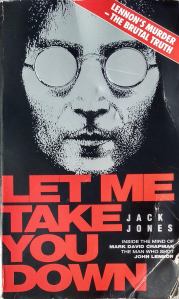
I’ve just finished reading Let Me Take You Down by Jack Jones and in the book the author prints pages and pages about Chapman and his disturbed ideas including the fantasy ‘little people’ who filled his imagination and tried to stop him going through with the killing. He had in fact visited New York on a different occasion to shoot Lennon but returned home without committing murder.

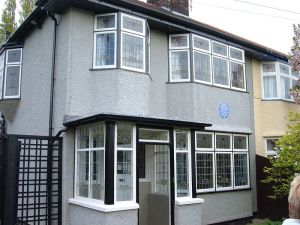
I can imagine Lennon in his room in the Dakota, looking down on New York and reflecting on how far he had come. Did he ever think of his home in Liverpool? I am sure he did. He corresponded regularly with his Aunt Mimi who brought him up at their home, Mendips, in Liverpool.

Years ago, when I used to work in Liverpool, I visited his childhood home. I had always imagined Lennon came from a rough council house background but his former home is in Woolton, a pleasant leafy suburb of Liverpool with semi-detached private houses and some rather nice pubs and shops. Not quite what I had expected.

Mendips, Woolton, Liverpool. Picture courtesy wikipedia

After reading Let Me Take You Down I dug out my old VHS documentary which uses numerous statements by Chapman, recorded secretly by the NYPD in the hours after his arrest. I listened to his various ideas about why he had to shoot John Lennon but I’m not sure we can ever understand the workings of a disturbed mind. ‘The Beatles changed the world’ Mark says at one point, ‘and I changed them.’

I like John Lennon of course and I was interested to read this book to see what really happened to him and to find out why Mark Chapman decided to shoot him. I had always thought that Chapman was just a madman and after reading this book I can see that basically, I was right. Chapman was mad. I suppose it was foolish of me to think that there was a definitive reason behind the shooting, some tangible reason, something that perhaps if Lennon or his people had been aware of, they could have taken some action to prevent the murder. At the end of the day, I don’t think there was or even that the actions of a disturbed person can be explained in simple terms. Chapman got it into his head that he had to kill John Lennon and he did.

Mark Chapman is still alive today. He is still serving his life sentence in Wende Correctional Facility in New York and first became eligible for parole in 2000. All Chapman’s applications for parole have so far been denied.

Today in 2021, Lennon’s widow, Yoko Ono, still lives in the Dakota building.

Sources:

The Man Who Shot John Lennon. First Tuesday UK TV documentary written and produced by Kevin Sim.

Let Me take You Down by Jack Jones.


What to do next: Here are a few options.

Share this post on your favourite social media!

Hit the Subscribe button. Never miss another post!

Listen to my podcast Click here.

Buy the book! Click here to purchase my new poetry anthology.

Click here to visit Amazon and download Floating in Space to your Kindle or order the paperback version.