Holiday Book Bag 2024 (Part 2)

Last week I gave you part one of my Holiday Book bag so here we go with part 2, more of my holiday reads and also what happened when tragedy occurred and I ran out of books.

Let’s kick off with this one, a Christmas pressy from Liz and a book I’ve been dying to read but purposely kept to read on holiday.
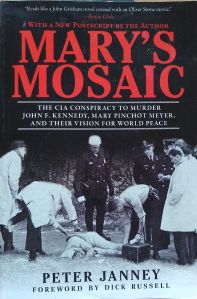
Mary’s Mosaic by Peter Janney

Liz bought me this book for Christmas and I’ve been saving it for a time when I can sit and read it undisturbed. After the assassination of President Kennedy there were numerous deaths of various witnesses in Dallas and elsewhere. One such death was of a lady named Mary Pinchot Mayer. She was the ex-wife of CIA agent Cord Mayer and one of JFK’s many mistresses. The author reckons she not only introduced the President to mind altering drugs but also agreed strongly with Kennedy’s desire for peace. He goes a little too far perhaps in making the case that Mary was the force behind JFK’s commencement address at American University in October, 1963 in which Kennedy called for both the USA and the Soviet Union to

‘direct attention to our common interests and to the means by which those differences can be resolved. And if we cannot end now our differences, at least we can help make the world safe for diversity. For, in the final analysis, our most basic common link is that we all inhabit this small planet. We all breathe the same air. We all cherish our children’s future. And we are all mortal.’

Mary was shocked by the murder of the President but came to realise the part played by the CIA and wanted to bring attention to the false story of the Warren Commission report. One day in Washington in October 1964, whilst walking along the towpath of the Chesapeake and Ohio canal towpath, she was murdered. Mary was shot once in the head and once in the chest and in this remarkable book the author goes on to trace the man who he thinks may have been the assassin.

A very fascinating read indeed.

So that was it, by the start of our third week I had read all my books. What could I read next? Well, there wasn’t much in our rented villa’s bookcase so I read one of Liz’s books, Shall we Tell the President?.
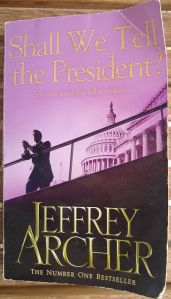
Shall we Tell the President? by Jeffrey Archer.

I’ve actually read this book before, many years ago but this was a new edition, rewritten by the author himself. In the original, the president in question was Edward Kennedy but of course, in real life Kennedy never made it to the White House, his challenge cut short by the ghost of what happened to Mary Jo Kopechene at Chappaquiddick. In this rewrite then, the author puts his own fictional president, President Kane in charge at the White House.

The FBI learn of a plot to murder the president. A Greek waiter, an illegal immigrant learns of the plot whilst working as a waiter at a restaurant in Washington DC. He calls the FBI and the two agents assigned to the case report quickly to their superior. Soon, one of the agents and their boss, as well as the informant are dead leaving only one agent who by chance has survived a murder attempt. He has six days to track down the assassins.

The book kept me interested but I can’t say it was a great read and I thought some of the dialogue was a little poor, in particular the FBI agent who kept referring to his new girlfriend constantly as ‘pretty lady’ was a little cringeworthy to say the least. Sorry Mr Archer but I’d have to give this one a five out of ten.

The Long Dark Night by Susan Lund

This was a bit of a first for me. Liz had nothing else that I wanted to read so she said she would sort me out something on her Kindle. She searched for free books and I chose this one by Susan Lund. It was about ex-FBI detective Michael Carter who is now working for the police on cold cases. He is asked to look into the discovery of a dead body on a property that is currently being renovated. As more bodies are unearthed, Carter links the bodies to some current cases and feels that a serial killer might be at work.

Later, two young boys are abducted but one escapes and Carter finally has a clue to work on. Could the killer be an ex-police officer?

The book was a fairly interesting read in part but the author seems to lose direction towards the end and the finale seemed to me to be a bit of an anti-climax.

Even so, the book kept me interested for a few days.
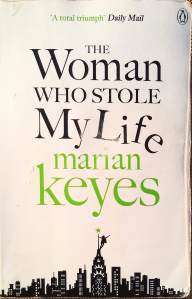
The Woman who Stole My Life by Marian Keyes.

This final holiday read was a book Liz took with her. She read it first, thought it was good and passed it on to me. I thought it was probably standard chick-lit fodder but actually it was a really good read, trotting along in a very chit chatty way, just like my own stories. It flips about timeline wise talking about things in the present and then flipping back to events of some years ago but once you got used to the situation it turned out to be a really enjoyable read.

Stella, many years ago was looking after her family when she was struck down by a mysterious illness which rendered her paralysed and unable to move or talk. Her neurologist Mannix, manages to communicate with her by getting her to blink, so he would go through the alphabet and she would blink at a particular letter and eventually they would put words and sentences together.

Gradually she begins to find that Mannix is becoming quite important to her especially when her husband and children don’t seem to be interested in either her or her predicament. When she gets well, she finds that 1, she has fallen for Mannix and 2, he has fallen for her, so much so that he has self-published a book called One Blink at a Time, a book of based on the notes he has made of their blinking conversations. Anyway, by a series of fluke events the book becomes a best seller in the USA and the two move to New York to promote the book.

All in all, a very enjoyable book indeed and I might even look at reading some more of Marian Keyes books.

That was my holiday book bag. What books are you planning to read on holiday?


What to do next: Here are a few options.

Share this post on your favourite social media!

Hit the Subscribe button. Never miss another post!

Listen to my podcast Click here.

Buy the book! Click here to purchase my new poetry anthology.

Click here to visit Amazon and download Floating in Space to your Kindle or order the paperback version.


Holiday Book Bag 2024 (Part 1)

This year Liz and I have spent five weeks in sunny Lanzarote and when we had just started week three I had run out of books. One of my great holiday pleasures is spending a lot of uninterrupted time reading in the sun. My big mistake this year was not bringing enough books and also including two very slim volumes in the ones I did bring. Sometimes in a holiday villa there will be something readable in the cupboard that other holidaymakers have left behind, but in our villa the majority of previous tenants appeared to be German and unfortunately my German language expertise only amounts to counting to ten.

Anyway, this particular book bag went on for a bit so I’ve split it into two parts and next week you can read part two. So, let’s take a look at what I have been reading in Lanzarote this winter.

The Prime of Miss Jean Brodie

I noticed this title on one of those blog posts about books you should read before you die. I knew I had a copy somewhere and after rummaging about for a while I finally came across it. It was a rather slim volume and I’d probably read it years ago but it looked interesting and so I opened it up and began to read. My big problem in reviewing this book is that I started reading it and after a few chapters put it down and began reading something else. It’s a small slim book so I popped it into my shoulder bag thinking I’d read it on the flight to Lanzarote. I couldn’t concentrate on the flight but I started reading it later by the pool but then I had to backtrack and re read some of the earlier pages so I lost the continuity. It’s about a teacher, Miss Brodie, who feels that as she is in her prime she must devote herself to a chosen group of her favourite pupils; the Brodie Set. Miss Brodie is not a conventional teacher and tells her pupils all about her visits to Italy and of her love for Mussolini and his fascists. This is done sometimes when the class should be studying mathematics and so a complicated mathematical sum is usually put up on the blackboard to fool any interlopers, like the headmistress for instance.

The Brodie Set all wonder about Miss Brodie and her love affairs and later, when Miss Brodie has lost her job, she wonders who was the traitor? Who reported her to the headmistress? Not one of the Brodie Set surely?

It’s an interesting and original book but I can’t say I was totally impressed but perhaps I should have read it properly and not put it down part way through.

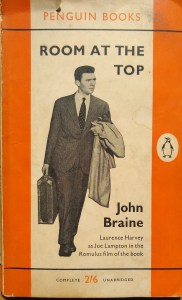
Room at the Top

This was another slim volume I found in a box of old books. I first read it in 1984 according to the note I added on the back of the cover. It’s about a young man, Joe Lampton, in a rigidly class structured 1950s England, still dealing with post war rationing and his journey from a small working class village to a room at the top of a big northern town. He gets a job as an assistant treasurer at the Warley district council and he sets his sights on a young girl who also happens to be the daughter of a rich business owning councillor. A man of his background is not the sort of man the councillor wishes to see romancing his daughter so Joe gets quietly warned off. He is jealous of former RAF pilot Jack Wales who is the sort of fellow who is much more acceptable to the councillor. Jack is a WWII hero who escaped from a prison camp. Joe was an RAF rear gunner who was also in a camp but used his time not to escape but to study for his accountancy exams.

Joe joins an amateur theatre group and starts an affair with a married woman ten years older than him. He is happy and there is talk about her divorcing her husband. This though is 1950s Britain. His involvement would mean scandal and the end of his job with the council, so what should he do?

There was a film version of this starring Laurence Harvey as Joe Lampton and Simone Signoret as Alice Aisgil with whom Joe has an affair. It’s slightly different to the book in a few minor ways but Laurence Harvey’s rather fake northern accent always puts me off.

Anyway, it was a fascinating read looking back to an England much different from today.

timestampe=1707908418

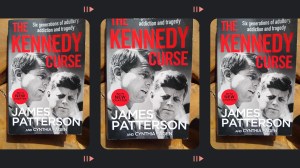
The Kennedy Curse by James Patterson with Cynthia Fagen

This wasn’t a bad read but to be fair it only really skimmed the surface of the story of the Kennedy family. There were no great revelations about the family and to be honest, I’ve read a huge amount about the Kennedy family and this was a book I could probably have written myself, at least to a certain extent. The book really begins with Joe Kennedy and his impressive rise in business and banking. He becomes the youngest ever bank manager in the USA and with his business acumen he soon amasses a large fortune along with his famous family. He supports FDR as the democratic candidate for the presidency but he wants something in return, the ambassadorship to Great Britain. Joe becomes the ambassador taking his family over to London but when the second world war looms he decides Britain will be no match for Nazi Germany.

The big problem for Joe is that FDR thinks otherwise and soon recalls Joe who finds himself out of a job. He has designs on the presidency himself but decides a better course of action would be to make his son, Joe, junior president. When Joe is killed in the war, his next son John F Kennedy has to take on the mantle.

As we all know JFK becomes president but is tragically murdered and the same fate falls to Bobby Kennedy who runs for president in 1968. Ted Kennedy decides to follow in his brothers’ footsteps but then the Chappaquiddick incident occurs when Ted leaves poor Mary Jo Kopechne to drown in his overturned car. Ted seems to ride out the ensuing scandal but it becomes clear he will never be president. The story then turns to the next generation of Kennedys who do not seem to be in the same league as their uncles and the narrative begins to turn toward drug addiction and other issues including rape charges against William Kennedy Smith, one of numerous next generation Kennedy cousins.

The story finishes with the death of John F Kennedy junior, the son of the late president, in a light aircraft crash.

A fascinating story but to be honest I’ve read better histories of the Kennedy family although this did keep me entertained for a while.

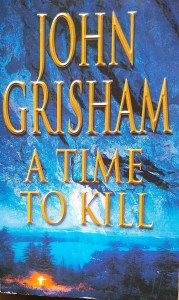
A Time to Kill by John Grisham

I’ve read a few of Grisham’s books and I’ve always been impressed with them, all except one. This one turns out to be his first novel and he says in the introduction how proud he was of finishing it as at that time, he hardly ever finished anything. It also contains some autobiographical elements as at the time, Grisham was a street lawyer, similar to the character in the book.

The book is set in America’s deep south where there is or was a great deal of racial prejudice. Two white guys decide to kidnap a young black girl, tie her to a tree and repeatedly rape her. They drive her away and dump her like garbage but she survives and the police arrest the two scumbags responsible. The next is that the young girl’s father Carl Lee Hailey decides to take a rifle and shoot the two guys. He is arrested and put on trial for murder and street lawyer Jake Brigance takes on the case.

The case ignites the small town of Clanton Mississippi. The Klu Klux Klan become involved as do various other groups and the stage is set for a tense murder trial which goes on while the police and the National Guard try to keep order.

It’s a very exciting read although the ending was a little underwhelming and if you find the N word offensive then this is a book which is not for you as that particular word appears numerous times on almost every page.

I read more books on holiday in Lanzarote. Tune in next week for more books, same time, same channel, same blog.


What to do next: Here are a few options.

Share this post on your favourite social media!

Hit the Subscribe button. Never miss another post!

Listen to my podcast Click here.

Buy the book! Click here to purchase my new poetry anthology.

Click here to visit Amazon and download Floating in Space to your Kindle or order the paperback version.

The Godfather: The Film of the Book or the Book of the Film

I’ve written a few of these ‘book or the film’ posts but in this one I’m going to stick with one particular film and book; The Godfather.

The Book

I’m not sure which came first for me, the book or the film but I actually think it was the book. The Godfather was written by Mario Puzo and is the story of Don Vito Corleone, the head of one of the five mafia families of New York. The book opens with the wedding of Don Corleone’s daughter and Puzo sets the scene and introduces the various characters.
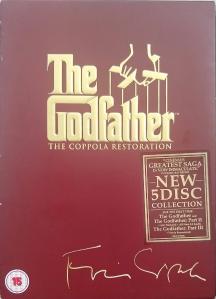
Don Corleone is a Sicilian and apparently no Sicilian can refuse a request on the day of his daughter’s wedding. One of those with a request for the don is singer Johnny Fontane whose show business career is waning. He feels that a part in a new film will revitalise it but the producer will not cast him. The don is happy to help out his favourite godson and dispatches his advisor and stepson Tom Hagen to Hollywood to sort things out.

Another supplicant is a funeral director. Two youths have attacked and beaten his daughter and because of political connections the courts of law have only handed down suspended sentences. The father asks for Don Corleone to give him revenge but the Don declines. The funeral director has never shown the correct respect to the Don but when he does and finally calls him Godfather then, and only then, does Corleone issue orders for the youths to be brutally beaten.

Some time afterwards the Don agrees to meet fellow mafioso Sollozo who wants Corleone’s help with a drug smuggling operation. The Don declines and this sets off a violent war between the mafia gangs.

The Film

Francis Ford Coppola was the director of the film version and was also the co-writer of the screenplay along with Mario Puzo. Coppola wanted Marlon Brando to play the part of Don Corleone even though Brando at the time was rather unpopular with the producers. He was expensive, his last few films had not done well and his time wasting attitude had added huge expenses to his pictures. After the director had made the producers understand how important Brando was, they set various conditions for his employment. He would have to work for a reduced salary and put up a bond to ensure he would not delay the production. Another was that he had to have a screen test. Coppola has told the story in various interviews how he and his film crew had entered Brando’s house like ninjas and quietly set up their equipment. Brando slicked down his hair with shoe polish and stuffed cotton balls into his mouth to make the transformation into the aging mafia boss.
Paramount also wanted to shoot the film on their back lot but Coppola persuaded them to shoot on location in New York and stick to the original time frame of the book which was set in the 1930s and 40s.

Various people were auditioned for parts in The Godfather but finally the cast was resolved and shooting began with Brando as the Don, James Caan as Sonny, Al Pacino as Michael, Robert Duvall as Tom and Diane Keaton as Kay Adams.

The Book

The book is a fairly heft one and there is much in there that is not covered by the film. Johnny Fontane for instance features more in the book, while he plays only a supporting role in the film. There is a further story in the book about Lucy, a friend of Sonny’s wife with whom he is having an affair. After Sonny’s death Lucy feels she will never find not only love but sexual pleasure ever again. The reason for this is that Sonny had a rather large penis and Lucy’s corresponding anatomy is rather large, however she falls for a doctor who sorts her out with an operation which restores the anatomical status quo.

Going back to the Johnny Fontane character, there have been various stories and rumours which imply the character was based on Frank Sinatra. Like Johnny Fontane, Frank was tied to a lifetime contract with a bandleader, in this case Tommy Dorsey but Dorsey somehow relented and released Sinatra. Some say mobster Willie Moretti was instrumental in helping Sinatra free himself from the contract. Later when things weren’t going so good for Sinatra, he revived his career by appearing in the hit film From Here to Eternity for which he won a best supporting actor Oscar. In the book, Johnny Fontane is after a similar film part but the producer declines to give it to him. At the wedding of Corleone’s daughter, Fontane asks for the Don’s help, cue the famous scene where producer Jack Woltz finds his favourite racehorse’s head in his bed.

The Film

Coppola decided that instead of finding the horse at the end of his bed like in the book, it would be better if Woltz awoke, was disturbed by something wet, pulls the bedclothes away to see blood and then uncovers the horse’s head. The head was the actual head of a horse, procured from a dog meat factory and Coppola mentions on the commentary to my DVD version that lots of animal lovers sent him hate mail about the horse, even though the horse had been condemned to its fate anyway.
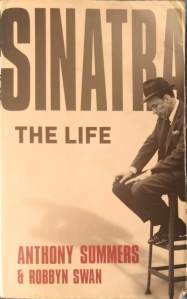
Sinatra always denied any involvement with the mafia although he did sing at the wedding of mafia boss Willie Moretti’s daughter, just like Johnny Fontane did at the Corleone wedding that opens the film. Anthony Summers, in his book about Sinatra, claims that the story was true and mafia enforcer Johnny Blue Eyes put pressure on studio boss Harry Cohn to give Sinatra the film role that rebooted his career.

Director Fred Zinnemann thought Sinatra might be good in the role so Cohn was happy to go along with the idea.

The Book

As previously mentioned, the book does have some storylines which were not used in the film but one chapter was a look at the beginnings of Vito Corleone. Born Vito Andolini in the Sicilian village of Corleone, Vito’s father was murdered by a local mafia boss and the young Vito was smuggled away to America. In America he took the name of Corleone and seemed to slip quietly into the role of mafia Don by murdering Fanucci, a New York Sicilian Godfather who preyed on his fellow Italians. Although this element of the story wasn’t used, Coppola kept the storyline for use in The Godfather Part II. The follow up film was a film classic in its own way.
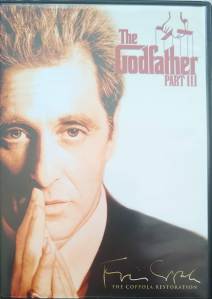
The Godfather Parts II and III

In part II there are two parallel stories. One is the story of Vito Andolini, as described above, played by Robert De Niro and another follows on from the first film. Michael is now the head of the family and gets involved with gangster Hyman Roth with investments in Cuban casinos. After the Cuban revolution Michael realises Roth is out to kill him and so has him murdered. A senate investigation looks into Michael’s activities with information provided by Frank Pentangeli, a former member of his organisation, but Michael brings pressure to bear on the informant and the investigation collapses.

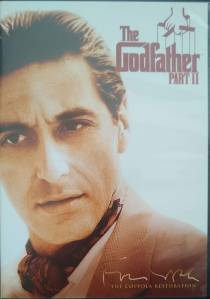
In The Godfather Part III Michael’s story continues. He is reconciled with his sister after the murder of her husband in the original film. He also gets involved in a scheme in Europe where he hopes to become fully legitimate but other mafia bosses have different ideas. The Papal bank scandal and the death of Pope John Paul I are real events that are also thrown into the mix. The film was the weak element in the Godfather trilogy. In 2020 The Godfather Coda: The Death of Michael Corleone was released. It was just a re-edited version of part III and personally I still didn’t find it anywhere near as good as the other two films.

Marlon Brando worked with Coppola again on the film Apocalypse Now. He played the part of an American Colonel in Vietnam who has apparently gone insane and Martin Sheen is sent to assassinate him. Brando turned up on set hugely overweight and not knowing his lines. He then decided to re write or improvise most of his scenes and the director was forced to shoot Brando in shadow due to his weight. Basically, he pulled all the stunts that Paramount expected of him in The Godfather. Not the best way to repay a director who had resurrected his career with the role of Don Corleone.

In 1990, Brando appeared in the comedy film, The Freshman, playing a parody of Don Corleone. When the shooting over ran, Brando demanded a million dollars to film for an extra week. The producers declined to pay and Brando threatened to badmouth the film to the press. Eventually they paid.

Brando died in 2004.

In 2023 Coppola finished filming his latest project, Megalopolis, a sci fi film about the rebuilding of New York after a major disaster.

Conclusion.

I enjoyed the Mario Puzo novel and I did re-read it for this post but it seems to stray into areas which really have no relevance to the main narrative which I found slightly annoying. The film version, which I also watched recently is a modern classic which continues to entertain everytime I see it. I like both the book and the film but I’d have to say I think the film version has the edge.


What to do next: Here are a few options.

Share this post on your favourite social media!

Hit the Subscribe button. Never miss another post!

Listen to my podcast Click here.

Buy the book! Click here to purchase my new poetry anthology.

Click here to visit Amazon and download Floating in Space to your Kindle or order the paperback version.

ULEZ, the Lottery and More Thoughts From a Sun Lounger

It always happens to me when I’m away. I know I’ve written about this before but the National Lottery has been annoying me. Here I am away from home and I get an email saying check your account, you’ve won a prize. Great! I wonder what is it? The million-pound jackpot or £3.42 on the Thunderball? I’m guessing it’s the £3.42. Either way, the National Lottery site cannot be accessed from abroad so I’ll just have to wait until I’m back in the UK before I find out if I’m a millionaire -or not.

What would I do though if I won a huge amount, millions of pounds? Well, it would be brilliant of course but me with my council house mentality, what could I do with say three million pounds? Well, the first thing would be to give away a third to charity. Yes, sounds good, doesn’t it? Really commendable but the thing is, I’ve already promised the Almighty that if he stopped for a minute and gave me a multi-million pound win, I’d give a third to charity.

I’ve promised so I could hardly say no and keep all the dosh could I? He would probably bump me off in a car crash or something. The big problem there is that I’ve also promised a third to the other side, you know, Lucifer, The Devil, Satan. I’ve promised him a certain amount of wickedness if he, the devil, will give me the jackpot. It’s shocking I know but I won’t be doing anything really nasty, just something moderately wicked like blocking up a post box on the last posting day before Christmas, just a little something that could be accepted as being wicked. Know what I mean?

Still, once I had the money, what would I do with it? Its ok for these rich people who are used to money. They will invest it and even if they invest it and go bankrupt, they will be still riding around in Rolls Royces and staying at top hotels whereas little old me would be in the nick for insider trading before you can say Gordon Gekko!

So, imagine I’ve got three million burning a hole in my pocket. Well, my old HP laptop is a little behind the times and slows down quite a lot when I try to edit my YouTube videos so a new PC or laptop must be on the cards. A new house? Of course, in fact the lovely villa that we rent here in Parçay Les Pins is a wonderful place. Perhaps I’d offer Rebecca the owner a few quid to take it off her hands. A little updating would be good. The lounge needs a makeover as do the bedrooms and the bathroom. Yes, I could see myself settling here quite happily. Then of course I’d need a nice car. My current vehicle, a Skoda is looking a bit long in the tooth, I quite fancy one of those cars with a lot of leg room. A few years ago the government was encouraging us to buy diesel cars, now those of us who still own them are being penalised by idiots like the Mayors of London and Manchester, Sadiq Khan and Andy Burnham.

Both want new low emissions in their towns and Khan has already gone ahead and expanded ULEZ, the Ultra Low Emission Zone from the centre of London to the Greater London area. Now, if you want to use a diesel car in those areas you will have to pay £12.50 per day. Yes, £12,50 per day to drive in the low emission zone, even though your vehicle has an MOT and has passed the ministry of transport emissions test. I’m all for cleaner air but what Khan is trying to do is get the working man who mostly drives a second hand car or van to contribute towards the London Mayor’s almost bankrupt set up. How fines will change the air quality though I’m not sure but what about the companies who designed and produced our polluting vehicles in the first place? Wouldn’t it be better if the government decided to say to the manufacturers, reduce the emissions on your vehicles by 2025 and then allow those vehicles time to gradually drop down into the second hand market? After all, we can’t all afford brand new electric vehicles.

Andy Burnham wanted to do a similar thing in Manchester but the outraged response of the residents of Manchester forced him to back down. Now he will tell you he didn’t want a low emission zone. Actually he did, certainly when he was MP for Leigh. Now as Mayor he says ‘I was forced into this by the Government.’ No, not really, the Government didn’t ask for a charging zone, just a small city centre low emissions zone, it was Andy Burnham who extended the zone to the whole of Greater Manchester, no one else. Sorry but Andy Burnham is a liar.

Funny how you can get onto a rant without meaning to. Time to calm down and read a book.

Faithful by Marianne Faithful.

I picked this book up after reading a blog post that made it seem like the most wonderful book ever written about the 1960s. I knew very little about Marianne Faithful except that once upon a time she was involved with Mick Jagger and I was surprised to find that Marianne was actually a singer. She had a hit in 1964 with a song called As Tears Go By which I thought I’d never heard of but when I played it, I realised I had. I’d always thought this was by the Seekers but of course it wasn’t. Good job that song hasn’t been played on our weekly quiz night as I would have got it wrong.

Marianne seems to have made friends with someone who was a record producer and in the crazy world of the 60s a couple of tracks were recorded, a single was put out and made the charts. Later, caught up in the swinging London scene she met Mick Jagger and began seeing him regularly. This being the rock and roll scene, booze, drugs and sex make a lot of appearances. Marianne was initially attracted to Keith Richards but after the two hit the hay together Keith remarked casually while getting dressed that he thought Mick really fancied her so despite her rather liking Keith she began seeing Mick.

Mick comes over in her book as quite a nice guy really. He seems to have been happy to enjoy booze, drugs and sex just like your average rock and roller but he seems to have always been able to step away from anything, like drugs or booze in particular, and stop it taking over his life.

Marianne did let drugs take her life over later on but at the beginning things seemed pretty amateur. For instance in the famous police drugs raid on the Rolling Stones, circa 1967 I think, Marianne had bought some travel sickness pills quite legally in either Italy or Spain but because they contained speed, they were illegal in the UK, not that anyone knew that of course.

Marianne stayed with Mick for quite a while but her life seemed to be going out of control as she seems to have been stoned for most of the 60s. Eventually she became a major drug user and at one point ended up living in a squat but still seems to have found the time and money to score drugs.

Actually, this book is very like a book I read not long ago about John Cooper Clarke in that when people are drug addicts, all they can think of is getting more drugs. Even though Marianne gets in quite a state, she never thinks that the reason might actually be her drug taking and neither does she ever even entertain actually not taking drugs.

Somehow, even when Marianne is living in a squat someone thinks she might be able to put an album together and make some money which she does. She ends up in New York and eventually manages to get into a detox place from which she finally emerges, in later life, clean and drug free.

Her life has been  -and here I have to use a phrase that I hate but here is actually relevant- a sort of roller coaster ride and the book is written in a sort of stream of consciousness way in which she describes her LSD trips with quite mesmerising clarity.

At the end of the book, she is happy that her albums have done well and people regard her now as a serious artist and not just Mick Jagger’s druggie girlfriend which, sorry Marianne, was my conception of her before reading this book.

One final thing. I clicked onto Spotify and listened to a few of her music tracks and I have to say, even though Marianne seems to be nowadays up there with the gods of rock and roll, I didn’t find anything that resonated with me. Sorry, Marianne.

Here in France we have been really lucky with the weather, it has been lovely, sunny and warm. I’ve been to France at this time of the year many times and usually the summer ends with a big thunderstorm. One day it’s hot, the thunderstorm comes and the next day it’s considerably cooler and the summer has gone. This year we had the usual storm but afterwards it was still muggy and hot. As I write this on the 13th of September, we’ve sat outside for our usual evening meal but as we came to the cheese course I felt cold. After a while I was so cold, I had to nip inside and dig out my fleece.

Yes, the summer is finally over.


What to do next: Here are a few options.

Share this post on your favourite social media!

Hit the Subscribe button. Never miss another post!

Listen to my podcast Click here.

Buy the book! Click here to purchase my new poetry anthology.

Click here to visit Amazon and download Floating in Space to your Kindle or order the paperback version.

Noel Coward, Pools and Flying Creatures

This could really be a Sun Lounger Post  but for clarity I thought I’d give it the title above because it’s actually mainly about Noel Coward and his autobiographies.

Here in the quiet village of Parçay-les-Pins, Liz and I are having a relaxing time. The weather is good, well actually, it is fantastic. Sunny and warm, perhaps a little too warm but either way, the perfect weather for barbecues, eating outside, reading by the pool and relaxing.

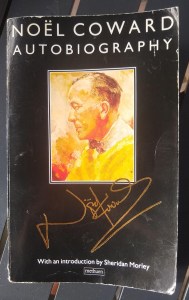
Here’s the itinerary: Up at whatever time we want. Breakfast later, usually before 12 noon but not always, a quick washing up of the pots and then out to the pool. I’ve spent most of this holiday reading the autobiography of Noel Coward and it’s actually three books in one. The first part is his first autobiography, Present Indicative, part 2 is an unpublished segment of his unfinished third autobiography, Past Conditional and finally his second published autobiography Future Indefinite.

Book one, Present Indicative was published in 1937 and concerns Noel’s early years, his childhood and his first tentative steps into the theatre. It’s an account of a vanished world of repertory companies, writers, actors and actresses who have long gone and whose names mean little today in the 21st century. Even so it is hugely fascinating and interesting and as always enlivened by Noel’s supremely witty text. Noel was a homosexual in a time when homosexuality was illegal and most of his private life he keeps private although armed with a little knowledge of Noel we can read between the lines and assume that Jack Wilson who comes to live with him at his home, Goldenhurst in Kent, was presumably his lover.

It is pretty hot here in Parçay-les-Pins and after a little reading it’s time to slip into the cool waters of the pool and have a swim. Just lately, on a physical level I’ve been very inactive. I keep meaning to cycle or take a walk every day but I can never get around to it and I’m conscious my health is suffering. Now, every 20 minutes or so I slip into the pool and do 8 to 10 lengths and go back to my sun lounger for more relaxation and reading.

Book two, Past Conditional is an unpublished and unfinished autobiography that was intended to fill in the gap between his first two autobiographical books. It starts where the first one finished off, in the early 1930s and differs considerably in tone as it was written much later in the mid-1960s and Noel was able to look back at himself in the 1930s and examine himself from a more in depth perspective. Such a pity it was unfinished.

An interesting segment concerns the death of his brother who is scarcely mentioned in the text as he and Noel were never close. The brother was clearly never part of Noel’s theatrical world and the family sent him off to South Africa only for him to return and die of cancer.

In Parçay-les-Pins, we have been tempted to visit our favourite local restaurant however, a couple of things have stopped us. Firstly, it is very hot and the Station Restaurant is only open at lunchtimes so we have decided to wait until next week when the weather forecast is not looking so good. Why waste all that precious sun-bathing time?

Tea time at Parçay-les-Pins

Round about 6 pm or sometimes later, we tend to move from the pool back to the house and crank up the barbecue and decant some wine and eat in the warm evening. One of the great pleasures in France, at least for me, is to sit outside until the sun slides over the horizon and then in the darkness, a darkness here in the countryside so velvety and complete that the view of the sky and the stars is uninterrupted by any ambient light such as traffic or streetlights. Then I can look up at the great vista of the night sky, the heavens displayed above us in such a way that can never been seen from a great city like Manchester in the UK.

The big problem I have found is that this is just the time for the insects of the night to come out and nibble at my legs. One night Liz mentioned that she had some of those citronella candles that are supposed to deter the bugs so at once I dug a few out and lit them. It was rather nice for a while sat in the dark with the candles fluttering away with a rather nice scent. What happened was that the rather nice scent seemed to encourage even more bugs, especially a great number of what I can only describe as hornets. They were two to three times bigger than a UK wasp and then seemed to be honing in on the scented candles. Luckily, Liz is a master of the fly swatter and after a short while a whole flight of the hornets lay dead on the windowsill although by then, I had shot inside to safety.

The final book in the autobiographical series was Future Indefinite in which Noel recounted his time during the Second World War. He seems like many to have had a very low opinion of Prime Minister Neville Chamberlain, although to be fair to Chamberlain, he was doing his utmost to avoid the horrors of war. Sadly, and clearly unknown to Mr Chamberlain, Adolf Hitler did not want to avoid war, he was in fact wanting war very badly and happily it was Mr Churchill who understood this only too well.

In June of 1939 Noel who was a great globetrotter decided to take a tour of Europe in the light of Mr Chamberlain declaring ‘peace in our time’. He visited Warsaw and Danzig, Moscow, Leningrad, Helsinki, Stockholm, Oslo and Copenhagen. He found that many of the people in those places were just waiting for Hitler to invade, particularly the Poles. In Russia he found a state that declared it had found freedom in Communism but was in fact quite the opposite as the Stalinist regime had choked any kind of criticism or free thinking whatsoever.

When war was declared Noel was asked to be part of an Anglo-French PR unit in Paris which he seems to have enjoyed for a while and then become a little bored with. He was sent on a tour of the USA to gauge opinion there on the war and was on his way back when the Nazis invaded France. He also did a tour of Australia and New Zealand to entertain troops and did charity work for various organisations helping those who were bombed out in London.

By far the most interesting part was his account of the filming of In Which We Serve, a very patriotic film showing the activities of a ship in the Royal Navy and the lives of those who served in her, all the way through to the ship’s sinking. In his very first autobiography, the names of the many actors and actresses he worked with meant very little to me but now I began to recognise a few names, John Mills and Richard Attenborough for instance and David Lean who co-directed the film with Noel although in actual fact, Lean directed most of the film when Coward became bored with the long-winded filming process.

Lying by the pool after a lot of reading and swimming I invariably start to feel tired round about the 4pm mark and tend to nod off although I’m usually awoken by flies buzzing around my ears. What insects seem to find fascinating about my ears I will never know but they always seem to strike just as I am nodding off.

Books, Sudoku and a pool. What could be nicer?

As well as the flies a great horde of swallows seem to be fascinated by our pool and round about 5pm they gather on the telephone line above us, divide themselves into squadrons and make various sorties down to the pool, skimming just above the surface or sometimes dipping into the water with either their wings or their tiny feet. This performance is very remarkable indeed and quite a few times I’ve had to duck as the swallows make their dives from just behind my head.

It actually reminded me about the Dambusters, the raid by 617 squadron of the RAF on the dams of Germany. They had to drop low over the waters of the dams and hit a consistent height of 60 feet before dropping their ‘bouncing bombs’.

Coward goes on to talk about Blithe Spirit, my favourite of Coward’s plays which was made into a film in 1945. Coward was not keen on the resulting film. David Lean added an ending in which Charles Condomine played by Rex Harrison dies and joins his ex-wives in the spirit world. Coward complained that David Lean had f**ked up the best thing I had ever written!  Personally, I loved it.

Final verdict of the Noel Coward biographies; fascinating, always interesting and hugely entertaining.


What to do next: Here are a few options.

Share this post on your favourite social media!

Hit the Subscribe button. Never miss another post!

Listen to my podcast Click here.

Buy the book! Click here to purchase my new poetry anthology.

Click here to visit Amazon and download Floating in Space to your Kindle or order the paperback version.

Graham and Damon: An F1 Story

I haven’t done an F1 post for a while so I reckon it’s time for a new one. F1 in 2023 seems to promise much but so far has failed to deliver. Red Bull seem to be winning everything which is great for them but makes things a bit boring for the average F1 fan. It’s in times like these that I tend to look back to the past for a little F1 drama.
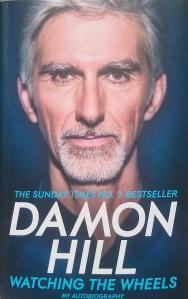
Damon Hill is not exactly my favourite racing driver. He pops up these days as a pundit on Sky TV’s F1 coverage and I’m sorry to say that I tend to fast forward past him until I find someone a little more interesting to listen to. Back in the day when he beat Michael Schumacher to the F1 world title in 1996 I cheered for him but even then, that was mostly a reaction to the tactics of the highly ruthless Michael Schumacher. Anyway, when Liz handed me a copy of Damon’s autobiography, I thought it might be worth scanning through.

Hill starts his story not with himself but with his celebrated father Graham Hill. Hill was a great driver, a double world champion but also one of the great, if not the greatest, characters in the sport. What F1 fan would not instantly recognise the prominently chinned and moustached Graham Hill with his swept back hair and his witty and straight to the point remarks?

Graham didn’t even pass his driving test until he was 24 yet went on to win two world championships. He began by seeing an advertisement offering some laps of Brands Hatch in a racing car for five shillings. He went along, paid his money and subsequently was hooked on motor sport. He got himself a job working as a mechanic for Colin Chapman’s Lotus team and soon talked his way into actually driving one of Colin’s cars.

In the 1960’s, Colin’s star driver was Jim Clark, one of motorsport’s absolute greats. Jim was universally respected as being the star driver of the day and won the world championship for Lotus in 1963. In that year Jim won seven of the year’s races (there were only 10) a record that stood until 1984 when Alain Prost won seven races for McLaren.

Graham Hill had left Lotus for the BRM team and won his first world championship in 1962. In 1967 Hill returned to partner Clark in Colin Chapman’s new Lotus 49 powered by the new Ford Cosworth DFV engine.

In 1968 Clark was entered in a Formula 2 race for Lotus at Hockenheim in Germany. In those days, F1 drivers regularly competed in other events apart from F1 including sports car racing, saloon cars and of course, Formula 2. During the race, Clark’s Lotus veered off the track into trees and Jim suffered a broken neck and was killed. A deflating rear tyre was thought to be the cause of the crash but the racing community was devastated. Clark was a quiet unassuming Scotsman, born into a farming family but is still remembered today as one of the greats of all time.

The Lotus team looked then to Graham Hill to lead them forward into the next round of F1 races and despite initial difficulties with the car and engine, Graham was able to win his second championship title. In 1969 he suffered a terrible crash in the USA when, after getting out to push his car after a spin, he jumped back into the cockpit but was unable to fasten his safety belts. He crashed and was thrown from the car breaking both legs. He later drove for Brabham and finally started his own F1 team with sponsorship from Embassy cigarettes. He was killed in a plane crash in 1975 along with key personnel from his team.

In Damon’s book, he gives an interesting insight into the events above, telling them from a son’s point of view. He knew many of the great drivers and team bosses of the time, meeting them as a child and he tells of Graham’s life from a family perspective; Dad being away from home a lot and always being so busy. He was the first to hear of his father’s death, seeing TV reports of a light aircraft crash just when the family was expecting him home. Graham was an accomplished pilot and owned his own Piper Aztec light aircraft. He had flown back from testing his new car in France but when he arrived back at Elstree, the weather was cold and foggy and he crashed on his final approach killing all on board. Not only was Damon distressed about the loss of his father but he resented the press who reported on not only the plane crash but also the subsequent funeral.

Graham HillAfter Graham’s death it was found that his pilot’s license had expired and this and some other things invalidated his insurance which meant that the other families who had lost loved ones in the crash were forced to sue Graham’s estate for compensation. This meant the Hills had to sell their home and move to a smaller house. These things seem to have weighed on young Damon’s mind for a long time, even into his own days as a racing driver.
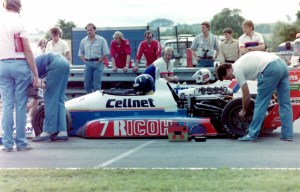
Damon initially took up motorcycle racing and worked in a variety of jobs to fund this, including being a motorcycle courier. Later his mother arranged for him to take a course at a car racing school thinking cars would be safer than motorbikes and so Damon began his career in car racing. In his book he describes the difficulties of getting drives and wrestling with the issues of bringing money to the table through sponsorship.

He managed to get drives in Formula 3 and then Formula 3000 and I personally saw Damon quite a few times at Oulton Park in the late 1980’s. I remember meeting his mum in the paddock at Oulton Park when I was photographing her son’s car. She went off to bring Damon back for a picture but alas, she wasn’t able to find him.

Damon at Oulton Park. Photo by the author

Damon struggled with the issues of sponsorship as many race teams were looking for drivers who could bring personal sponsors into a team but Damon was able to get himself a F3000 drive which also led to an F1 drive with the faltering Brabham team. At the same time, he had also replaced Mark Blundell as the test driver for Williams. After a difficult year with Brabham, Williams were having a tough time with their driver line up. Mansell had won the world championship in 1992 but he wasn’t happy about having Alain Prost as a team mate in 1993. Williams were still expecting Nigel to drive for them, after all he had just won the title, but Mansell decided to up sticks and go to the USA to drive in Indycars. Williams signed Prost and Hill got the promotion from test driver to full time driver for the 1993 season.

1993 was an interesting season. The Williams was without a doubt the best car of the field but Prost had just come back from a season out of the sport and was on a learning curve with the new car while Hill, who had been testing was actually pretty familiar with it.

Prost won the championship and Damon scored his first win but for 1994 Frank Williams had signed Ayrton Senna and Prost decided he wasn’t going to work with Senna again and promptly retired. That left Damon to partner Senna. In 1994 active suspension, a system where the suspension and ride height of the car was controlled by an onboard computer, was banned and the car had become rather difficult to drive. When the team came to Imola that year, Senna had scored no points at all and was desperate for a win. Damon says he had not settled into the team well and he was clearly still trying to get used to the way the Williams team operated. In the race Senna had a major accident.

Damon passed the scene of the crash, not knowing it was serious and felt for Senna thinking it would be three races in a row without points for the Brazilian driver. When the race was stopped he sat in his car on the grid waiting for information but little was forthcoming. Later, the team’s press officer advised him that things were serious but it was only after the restarted race had finished that news came through that Senna was indeed dead.

It was almost a familiar scenario to that which Graham Hill had experienced in 1968. The team leader had been killed and Graham had to step up and lead the team. Now Damon had to do the same.

Damon Hill won the world championship in 1996 but his team boss Frank Williams had for whatever reason decided Damon was not the driver he wanted for 1997 and his contract was not renewed. Damon ended up driving for Arrows in 1997 which he thought was a middle of the grid team trying to move up to the front. It turned out to be a back of the grid team, trying to move up to the middle. Damon won once more for the Jordan team and then retired. In some ways it almost seems that Damon had his F1 career in reverse, he started at the top and then drove for lesser teams until he decided to call it a day.

Damon’s book is not one I really fancied but in fact it was really a pretty good read. His younger years as the son of the great Graham Hill are fascinating, especially his behind-the-scenes motorsport memories. His recollections of his early racing days and the complexities of sponsorship and his experiences of F1 also make great reading. The book falters a little when Damon tries to interest the reader in his problems with depression, brought on possibly as a result of losing his father in such a tragic way, however, I do feel I have a little more respect and time for Damon and perhaps in future, when he comes on my TV screen as an F1 pundit, I might not be so quick to fast forward past him.


What to do next: Here are a few options.

Share this post on your favourite social media!

Hit the Subscribe button. Never miss another post!

Listen to my podcast Click here.

Click here to visit Amazon and download Floating in Space to your Kindle or order the paperback version.

Buy the book! Click here to purchase my new poetry anthology.

Holiday Book Bag: Spring 2023

A long time ago I was reading a biography about Richard Burton called ‘Rich’ by Melvyn Bragg. The book used Burton’s own diaries and mentioned, amongst other things, Burton’s love of books. When Burton went on holiday he looked forward with delight to the contents of his ‘book bag’. I know it’s a pretty tenuous link but one thing I have in common with Richard Burton is a love of books and when I go on holiday, one of the delights of lying under a warm sun on my sunbed is a good, undisturbed read. I read a lot at home and before I retired, on my lunch breaks at work but it’s a few minutes here and a few minutes there and whenever I get interrupted it kind of breaks the flow. Some books, as we all know, are just made for a really long, uninterrupted read so here are the books I took on holiday with me recently, all sourced from either the internet or secondhand bookshops.

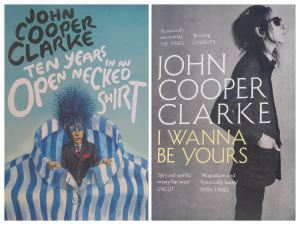
I Wanna Be Yours by John Cooper Clarke

I’ll start off this book bag with this autobiography by John Cooper Clarke. I wrote about it a few weeks ago so I’ll keep it brief here. This was a wonderful read. It wasn’t the I did this and then I did that conventional autobiography, it was a very observational book and Cooper Clarke paints an interesting picture of Manchester and Salford from the 1950s to his heyday as a punk poet in the 1980’s. The last quarter of the book resembles a more conventional biography and it made me want to read some of his poetry.

Verdict: A fabulous, entertaining read.

10 Years in an Open Necked Shirt by John Cooper Clarke

This was a poetry book by John and to be fair I found it a little disappointing. The thing is, Clarke is a performance poet and his grammar free poetry doesn’t work as well on the printed page as it does when Clarke performs it on stage. Some poetry I suppose is meant to be read, other poetry needs to be performed and Clarke’s comes into the latter category.

Verdict: Interesting but not my cup of tea.

The Unlikely Pilgrimage of Harold Fry by Rachel Joyce

I first heard about this from seeing a trailer to the new film version and it looked pretty interesting. I do love something that is new and original and so Liz and I went to the cinema to see it which was my first cinema visit for a long time. It’s a good film but not a cinema classic and I wondered if the book would be better. The story is about Harold Fry who is retired and lives with his wife on a suburban housing estate. He gets a letter advising him that a friend and former workmate named Queenie, is dying of cancer and he pens a short note of sympathy in reply. He goes out to post the letter but decides to walk further wrapped up in thoughts about Queenie. At a petrol station where he buys a sandwich the young girl assistant tells him a story about her aunt who suffered with cancer and she -the shop assistant- feels that real faith and positive thoughts can help beat even something like cancer. Harold decides there and then to walk all the way to Berwick-upon-Tweed and see Queenie in person.

Along the way Harold meets various people and when news of his march reaches the media, many others come to join him. Along the way he thinks a lot about the events of his life, in particular his relationships with his wife and son and eventually both he and his wife, who he speaks constantly to on the telephone, seem to reach a sort of understanding about what has happened to them as well as an unspoken desire to reunite and move forward. The book was a great success world wide and many reviews printed on the back cover tell the reader what an uplifting read it was. It wasn’t a bad read at all but I actually found it not only sad but rather miserable and, to be honest, not uplifting at all.

Verdict: Original and interesting but a bit too melancholic for me.

Then Again by Diane Keaton

This is another autobiography and like the one by John Cooper Clarke it was a rather unconventional one. Diane Keaton is a film actress you might remember from the Godfather movies or from Annie Hall. Diane’s mother had died and looking through her effects she had found numerous notebooks and diaries in which her mother had written about her life. In this autobiography, Diane has tried to link her story with that of her mother and has put her own experiences and memories side by side with those of her mother. The result is for the most part a really very interesting book, told in a very open and talkative way by both Diane Keaton and her mother. Diane doesn’t get too personal but does talk quite a lot about her work and her life in particular with Woody Allen and Warren Beatty, both of whom she was involved with for a time. She also had a long relationship with Al Pacino who she played opposite in the Godfather series of films and it seems to me she was expecting to marry Al but for whatever reason he decided to call the relationship a day.

The last part of the book is really about her decision, late in life, to adopt two children and the result for the autobiography is rather like when one of your friends has a child and all they ever seem to do is go on and on about their new little boy or girl. Her mother sadly develops dementia and Diane’s experience of trying to look after her was all too familiar to mine.

Verdict: The book goes off on a bit of a tangent towards the end but generally I really enjoyed it, especially the bits about working with Woody Allen.

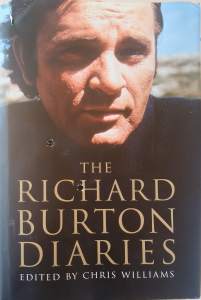
The Richard Burton Diaries edited by Chris Williams

I mentioned at the start of this post about reading Melvyn Bragg’s biography of Richard Burton and how Burton used to always take a ‘book bag’ with him whenever he went away. Bragg’s book was based partly on these diaries which have now been published and are available to everyone.

There is a lot I like about this book and a lot that I don’t like. I tend to prefer paperbacks but I bought this one from the internet and it’s a big heavy hardback and as I’ve dragged it across France it’s generally getting a little tattier every day.

Moving on to the text and I see a lot of the big events in Burton’s life are missing as sometimes he stops writing for days and even months at a time. We don’t hear about the making of Cleopatra and his meeting and affair with Elizabeth Taylor but he does mention some of those events in retrospect.

The book starts with his schoolboy diaries which are rather like mine, brief and to the point. Later, the main diary starts in 1965 and as I write this, I’m up to about 1970. Burton tells us of his immense love for Taylor and how he has given up womanising to be faithful to her but sometimes I get the feeling he isn’t being totally honest, after all Liz has free access to his diary and she frequently jots down her own comments too. Burton was rumoured to have had an affair with Genevieve Bujold during the filming of Anne of a Thousand Days but of course, gives no mention of that in his journal. He does talk a lot about food and having lunch in places like Paris and Rome. He enjoys having money and delights in spending it on jewels for Liz, a new private jet plane and a yacht which he thinks might actually save him money as he can stay on the yacht rather than use hotels. Even so, he continues to use hotels anyway. At one point he considers buying a barge, modernising it and touring the canals of France.

He doesn’t seem to enjoy his acting and in fact rather looks down on it as a profession, although unlike an actor like Brando who had similar thoughts, he did take pride in what he did, learning his part and his lines whereas Brando couldn’t even be bothered to learn the script for the film of Superman despite his million dollar fee.

Surprisingly there is also quite a lot of professional jealousy in the text, for instance, he gives Robert Shaw a bit of a slagging off for his performance as Henry VIII in A Man for all Seasons which I thought was rather good, better or at least the equal of Burton’s Henry VIII in Anne of a Thousand Days.

Burton drinks a lot and frequently argues with Liz, sometimes he is banished to the spare bedroom and usually he regrets his drunken words and wonders why he did what he did or said what he said.

He was though a man who loved books, reading anything from the classics to detective novels. He enjoyed books immensely and even had ambitions of being a writer himself. His entries are peppered with quotations from authors and poets and of course Shakespeare.

I was really looking forward to reading this book but after the first few pages I thought it a little uninteresting. As the narrative moved from 1968 into 1970, Burton seemed to be putting more effort into his journalling and consequently it became more enjoyable to read. Later large gaps appear in the diaries and he doesn’t appear to have written anything about his breakup with Liz Taylor. The entries become less frequent and to be honest, I ended up skipping quite a few pages.

Verdict: A book that promised a lot but failed to deliver.

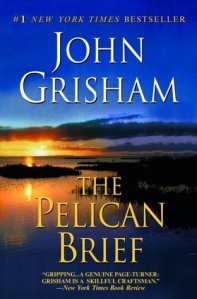
The Pelican Brief by John Grisham

I’ve read a few books by this author before and always enjoyed them, this one being no exception, in fact it might be the best book by Grisham I have read so far. The book opens with the murder of two US Supreme Court judges and this in some ways plays into the hands of the President as he can now nominate new judges who share his political views. At the same time law student Darby Shaw is having an affair with her law professor. She decides to look closely at the murders and develops a thesis, an idea about who may have done the murders and why. The thesis becomes known as the Pelican Brief and she passes it to the professor who in turn sends it to his friend, an FBI lawyer. It then gets passed up the chain to the head of the FBI and on to the White House where the President asks the FBI not to investigate further.

Not long afterwards the professor is blown up in a car bomb which Darby narrowly avoids and from then on, she is on the run trying to evade death herself.

This for me was one of those unputdownable novels which was exciting and kept me interested all the way to the end.

Verdict: A brilliant read.


What to do next: Here are a few options.

Share this post on your favourite social media!

Hit the Subscribe button. Never miss another post!

Listen to my podcast Click here.

Buy the book! Click here to purchase my new poetry anthology.

Click here to visit Amazon and download Floating in Space to your Kindle or order the paperback version.

My Holiday Book Bag: Winter 2023

A long time ago I was reading a biography about Richard Burton called ‘Rich’ by Melvyn Bragg. The book used Burton’s own diaries and mentioned, amongst other things, Burton’s love of books. When Burton went on holiday he looked forward with delight to the contents of his ‘book bag’. I know it’s a pretty tenuous link but one thing I have in common with Richard Burton is a love of books and when I go on holiday, one of the delights of lying under a warm sun on my sun bed is a good, undisturbed read. I read a lot at home and on my lunch breaks at work but it’s a few minutes here and a few minutes there and whenever I get interrupted it kind of breaks the flow. Some books, as we all know, are just made for a really long, uninterrupted read so here are the books I took on holiday with me recently, all sourced from either the internet or secondhand bookshops.

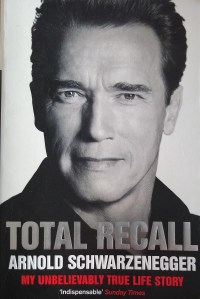
Total Recall by Arnold Schwarzenegger

This book was a Christmas gift from Liz. She knows I’m a big film fan and I do love reading about the background to films and how they are made. Arnold is from Austria and he tells us a little of his life there but mainly focuses on his desire to be a great bodybuilder and to eventually go to America. There is a lot of talk about the process of competitive bodybuilding and the different muscles, muscle definition, reps and squats and all that stuff. Arnold eventually wins various competitions and is wondering how he can compete in the USA when he gets an invitation to do just that. The bodybuilding industry is a close knit one and there seem to be various people welcoming him to California, helping him to find a place to stay and so on. He wins more competitions and makes a little money. He starts a mail order business selling magazines and pamphlets about himself and his body building techniques. He brings one of his Austrian friends over and the two begin a bricklaying and home improvement business. His big break is getting a film part as Hercules and even though the production eventually goes bust it seems to give him a taste of the film business and he wants more. He plays Conan the Barbarian in the film version of a comic book hero and pretty soon he plays the Terminator and goes on to success after success, even becoming governor of California.

I’m not sure I actually came away liking Arnold. I know this is an autobiography but it’s a very me, me, me book and Arnold is constantly bigging himself up. The final chapters about his political career are perhaps the most interesting. He had thought about running for governor but senior republicans seemed to have been more interested in another candidate. However, when Gray Davis was elected in 2000, there seems to have been something of a backlash and there is a curious precedent in Californian politics. The public can demand a recall, a new election in which the public either go for the elected governor or someone new. Arnold entered into the recall and won. He seems to have been in an odd position politically. He was a Republican but had married into the Kennedy family who are Democrats but his success as a politician seems to have come from holding the centre ground in California and bringing Republicans and Democrats and getting them to work together.

At the end of the book Arnold gives us his personal philosophy and his rules for success.

Verdict: I’m not sure whether Arnold wrote this book just to give us his story or to further promote himself but if I had to choose, I’d probably say the latter. Having said that, Mr Schwarzenegger is a man who gets things done and has a positive attitude. Perhaps I should take another look at his rules for success.

Great Expectations by Charles Dickens

This is not a book I brought on holiday but one I found on the shelves of our rented villa in Lanzarote. I started reading it when I got a little bored with Arnold Schwarzenegger and liked it so much I just carried on to the end. It is a real pleasure to read something by a master wordsmith and I enjoyed every minute even though I had read this novel years ago. Young Pip, apprenticed to be a blacksmith, is invited to the home of an eccentric rich woman, Miss Havisham, purely for her amusement. Later in his young life he finds he has ‘great expectations’ and is to inherit a remarkable property. He is taken to London to be brought up as a gentleman and although he is told that his benefactor has asked to remain a secret, he naturally assumes it is Miss Havisham. At the beginning of the book, Pip encounters Magwitch, an escaped convict on the marshes near his home. He compels Pip to bring him some food and a file. He is captured and transported to Australia and later we find, much to Mr Pip’s shock and amazement that Magwitch is the mysterious benefactor.

The book is rightfully one of Dickens’ best loved stories and is a wonderful read. I’ve always thought it had a rather ambiguous ending and in fact in my edition back home, it is one of those with various notes and background information, I am advised that Dickens felt that it was important to assure the reader that Pip had a future with Estella, the spoilt adopted daughter of Miss Havisham and so changed the ending slightly. Pip of course did want a future with Estella but I still feel the book leaves a happy ending slightly uncertain.

Verdict: An absolute classic from a master storyteller.

A Mad world, My Masters by John Simpson

This is a collection of globe trotting stories from John Simpson who has travelled the world as a journalist for the BBC. These though are travel stories with a difference, for instance in the first chapter he talks about airports, not the airports that I generally use, tourist destinations like Spain and Greece. The ones Mr Simpson mentions are airports in war torn Angola and Bosnia, and places like Kabul in Afghanistan and other places where he has had his passport and papers routinely torn up or thrown into a river by laughing revolutionaries and mercenaries. He tells us about headlong dashes to catch flights, including one somewhere in eastern Europe where he was in such a mess after weeks living rough the stewardess was reluctant to let him on board, especially as he had a first class seat. His fellow passenger in the next seat asked to be moved. Luckily John wasn’t flying on a budget airline like the ones I travel with.
On one occasion in Afghanistan with the Mujahadeen, a bearded man appears dressed in white robes. He tries to get the Mujahadeen to murder Simpson for $500. It later turned out that the man was Bin Laden. Simpson talks nonchalantly about many other encounters with revolutionaries such as Arkan, the Bosnian warlord. There are other chapters on dictators that he has met and other sometimes ordinary people who have impressed him, like the simple village priest trying to make life safer for his fellow villagers in Colombia, one of the great drug producing countries of the world.

Most of his stories are hugely fascinating although the more interesting ones are about people, either the ones he has interviewed or the ones who work with him, his fellow journalists and sound-men, cameramen and so on. Most of this book is about the days when a BBC crew consisted of a cameraman, a sound-man, a producer and sometimes even others. Today, Simpson’s crew would consist of him and one other doing the filming and editing. There are some TV journalists today that even have to film and edit themselves.

The last part of the book where the author talks about his love for middle eastern rugs and antiques and the process of bartering that goes with buying those things was perhaps not my cup of tea. Verdict: A patchy read with some very fascinating chapters as well as some not so interesting ones. Generally, though, this was indeed an excellent read.

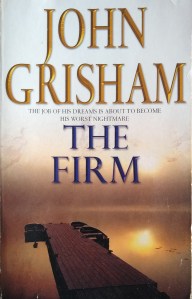
The Firm by John Grisham

There is a process by which I choose books to take with me on holiday. I like to think it’s a thoughtful process combining different genres of books, some novels, maybe the odd classic, and some biographies and autobiographies. What actually happens is that the day before our trip I’ll just grab something near to hand that I know I haven’t read yet and shove it in my suitcase. Anyway, that’s how I ended up with the books you see above. Last year I read The Rainmaker by John Grisham and I thought it was a pretty good read. I must have mentioned that to Liz so she filed that away and got me a stack of Grisham novels for my last birthday. The Firm isn’t a bad read and in my case it was a nice change of pace after reading Dickens and John Simpson’s globetrotting memories. It’s a good story but like a lot of Grisham’s works, its more plot driven than character driven. The characters are sort of bland templates that I’ve recognised in a lot of his novels and so far I’ve only read three. Anyway, characters aside, this is a really original story about a young guy who graduates from law school and gets head hunted into a firm he has never heard of but which offers tremendous financial benefits, a brand new BMW, and an ultra cheap mortgage as well as other financial bonuses. The downside as he comes to learn later is that the firm is just a cover operation to launder money for a big mafia crime family and the FBI wants our hero James McDeere, to help them.
Verdict: Highly enjoyable and a great holiday read but nothing more, although that didn’t stop the book from becoming a best seller as well as a hit film in the 1990’s.

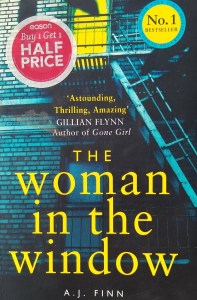
The Woman in The Window by AJ Finn

I’m not sure I would normally have picked up this book if I hadn’t run out of books to read. I saw this on the shelf in our rented villa and Liz had read it and mentioned about numerous references to old black and white films which were right down my alley, apparently.

Anyway, I thought I’d give it a go and I’m very happy that I did. It’s about a woman called Anna Fox suffering from agoraphobia who cannot venture outside her house. She is in effect almost imprisoned there but spends her time playing online chess, seeing two therapists, one physical and one psychological as well as taking medication and drinking a whole lot of Merlot. She also spends a lot of time watching old films on TV and DVD as well as watching her neighbours.

She hears a terrible scream one night although no one else seems to hear it. She questions her tenant who lives in her basement but at the time in question he was doing some work while wearing earphones.

She meets Jane Russell from across the road, not the Jane Russell from the films but a pleasant lady whom she invites in and has a glass of wine with. Later through the windows of Jane’s house, she sees her get stabbed.  Anna calls the police and tries to go across to the house but she cannot get over the road due to her agoraphobia and she ends up in the park where she is found by paramedics.

When she surfaces, we find that no one believes her story and also that Jane Russell is still alive, except, she’s a different Jane Russell to the one Anna saw murdered.

The tension builds nicely in this thriller and a number of shocks are dropped in front of the reader along the way as we find out what has caused the agoraphobia and what really happened over the road.

This was also made into a film starring Amy Adams as Anna Fox although I’ve yet to see it.

Verdict: Great read, so much so that when we left the villa, I had to take it with me to finish on the plane home. To be fair I did leave behind The Firm to replace it.


What to do next: Here are a few options.

Share this post on your favourite social media!

Hit the Subscribe button. Never miss another post!

Listen to my podcast Click here.

Buy the book! Click here to purchase my new poetry anthology.

Click here to visit Amazon and download Floating in Space to your Kindle or order the paperback version.

Holiday Book Bag 2022

A long time ago I was reading a biography about Richard Burton called ‘Rich’ by Melvyn Bragg. The book used Burton’s own diaries and mentioned, amongst other things, Burton’s love of books. When Burton went on holiday he looked forward with delight to the contents of his ‘book bag’. I know it’s a pretty tenuous link but one thing I have in common with Richard Burton is a love of books and when I go on holiday, one of the delights of lying under a warm sun on my sun bed is a good undisturbed read. I read a lot at home and on my lunch breaks at work but it’s a few minutes here and a few minutes there and whenever I get interrupted it kind of breaks the flow. Some books, as we all know, are just made for a really long, uninterrupted read so here are the books I took on holiday with me recently, all sourced from either the internet or second hand bookshops.

My Life in France by Julia Child.

Sometimes you pick up a book that is just a joy to read and this was one of those books. Julia Child is a US TV chef, maybe one of the first TV chefs ever, although she is little known in England. The book is a memoir of her life in France, her journey as a Cordon Bleu chef and as a cookery book author, a TV star and as a wife and Francophile.

Her husband Paul works for the US foreign service and is posted to France in the late 1940s. The two have an interesting life in post war Paris enjoying French food and the French way of life. Julia is very interested in food and takes on a course as a Cordon Bleu chef. She is fascinated by the French way of cooking and meets many others who feel the same including two French women who have written a book about French cooking but aimed at the American market. The two Frenchwomen need an American point of view so Julia is engaged to assist but soon becomes the primary force in the emerging book. My Life In France mixes the development of her classic French cookery book with her life, her love of food, her favourite recipes and the whole world of French food. An utterly wonderful book, even if you are not familiar with Julia or the recent TV series or the film starring Meryl Streep.

I was travelling through France when I read this book and I was very tempted to divert course and visit some of the places she mentions.

Verdict: A joyous, wonderful read.

The Essential Hemingway by Ernest Hemingway.

During the lockdown I read a blog that was something along the lines of 100 authors you must read before you die. One of those authors was Ernest Hemingway. Not long afterwards I spotted a compilation of his works in a charity shop and I thought to myself, I’d better pick that up and get cracking on those 100 authors. It had been lying unattended on my book shelf for quite a while so I thought I’d throw it into my book bag for our latest trip to France.
The book consists of one complete novel, Fiesta, parts of some other novels and a collection of short stories. I wasn’t in the least interested in reading parts of a book. If I want to read a book, I’ll read the whole lot, not parts of it so I thought I’d get cracking with Fiesta. Now I know Hemingway has a sort of minimalistic style so I was prepared for that. I just couldn’t understand the point of a lot of what he was talking about. It’s like he was showing us stuff that was hardly relevant, almost like a Quentin Tarantino film. There are pages of dialogue and then some fairly introspective stuff and then we were back to dialogue again. Jake Barnes is in love with Brett who I thought at first was a man but is actually a woman, a lady in fact, an actual lady, Lady Ashley, known as Brett to her friends. Jake and Brett and various others all go off from Paris to Spain to see the bull fighting in Pamplona and Brett turns out to be popular with many of the men. Jake is love with her and Michael wants to marry her but she decides she wants a bull fighter who then falls for her and apparently also wants to marry her.

Sorry Ernest if you are reading this from the spirit world but I got a little bit lost and only continued to the end out of a sort of dedication to not having another novel on my conscience that I couldn’t finish. What can I say? I know it’s a classic but sorry, it wasn’t my cup of tea. I tried some of the other short stories in this collection but again even though they are well written I started wondering things like ‘what’s this about? Why are we talking about this? What was the point of that?

Verdict: Interesting but an ultimately disappointing read.

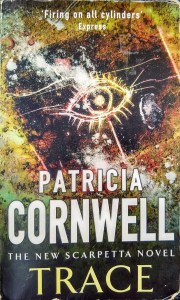
Trace by Patricia Cornwell.

I picked this up a while ago, started to read it and lost interest, not because of the book itself but because it was in my book bag for taking outside and as the UK weather has been so poor, I haven’t done much outdoor reading this year so far. Anyway, I thought I’d throw it in my holiday book bag and give it a read while I was touring France. I’ve always liked the Kay Scarpetta novels and a few years back I started reading the whole sequence of them starting with Post Mortem, the impressive first entry in the series. I thought the books were great, that they looked at crime in a new and different way, showing how crimes could be solved by forensic detection and it was the reality of the novels, their clear connection to modern detection methods that was at the core of their success. After a while though, I felt the books were straying from reality and getting a little silly, a bit like when Roger Moore took over the mantle of James Bond and the 007 films went a little daft.

Trace is not one of Cornwell’s best books and concerns, to a certain extent, Scarpetta’s niece Lucy who has gone off and become some kind of super secret agent computer geek girl and has somehow made a great deal of money and founded her own super secret spy company. Anyway, in this novel, the death of a young girl who Scarpetta has been consulted about is apparently connected to another case Lucy is also working on. It kept me reading and I liked it but sadly not as much as the earlier more serious and reality based novels.

Verdict. OK but not a great entry into the Scarpetta series.

What Happened by Hillary Clinton.

I picked up this book in a second hand book shop. I’ve always liked Hillary Clinton. She’s not your average First Lady, content to stay in the background and support her husband, the President. Mrs Clinton liked to be part of Bill Clinton’s administration in a way that other first ladies have never been, sometimes for the right reasons, sometimes for the wrong ones.

Her book What Happened? is basically about her failed attempt to become the USA’s very first female president. If she had succeeded, that would have been quite an achievement and for a while it even looked as though it was on the cards. Mrs Clinton mentions many times how she was ahead in the polls and how she beat Trump in their various TV debates so where did her candidacy go wrong?

She had a lot of ideas for the presidency and she reveals many of her plans to engage in the problems facing the USA in this book. Her presidential opponent Donald Trump didn’t seem to have many ideas at all, at least that’s what Hillary seems to think. His campaign was based on attacking and coming up with ideas for building a wall to keep the Mexicans out and of course, wanting to lock Hillary up.

A big problem for Hillary was her emails. She had decided to carry on using her personal email server instead of the government one, something that other government officials have done before, but somehow the press got hold of the story and blew it up out of all proportion. Her emails were leaked to the Wikileaks website and an investigation was made which involved publishing many of her emails, actually 30,000 of them. She mentions that many people seem to think she is hiding something despite her emails being published as well as her tax returns. After many investigations, the Whitewater investigation for instance, she makes the point that everything she has done has been so public, what could she be hiding? Mr Trump of course did not publish his tax returns, or his emails for that matter.

There’s a very hurt tone throughout the book and clearly, she’s not very happy about her defeat, just like any defeated candidate would be. Hillary has had to endure a lot. Mr Obama’s successful quest to become the first black president overshadowed her first try at the presidency and she returned eight years later when it was time for Obama to step down. Her husband is well known for his extra marital affairs but she has stood by him none the less and some of the bad press from those incidents has clung to her like a sort of bad background odour.

The final nail into the coffin of her presidential bid was a last minute announcement by the head of the FBI about the emails and her small points lead dwindled into a loss.

I often wonder why Mrs Clinton seems to be disliked. She is one of those personalities that people either like or hate, there doesn’t seem to be anything inbetween. Over on YouTube when I did a search about her, pretty much everything that came up was negative. There was a former secret service agent talking about an incident in which the former first lady had thrown a vase at the president, well an alleged incident I should say. The thing is, if your husband had been playing away with Monica Lewinsky and Gennifer Flowers, wouldn’t you be tempted to throw the occasional vase at him? I know I would, had I been in Hillary’s shoes.

Over on Quora, someone had already asked my question, what is Mrs Clinton really like? The first answer I saw was a lady who called up Mrs Clinton’s senatorial office about her brother’s problem, it was to do with money or tax or something I can’t remember. She left a message and the next morning Mrs Clinton, yes Mrs Clinton herself, not an assistant but actually Mrs Clinton herself, called up, took more details and sorted out the problem.

I doubt Hillary Clinton will ever go for another run at the presidency but it’s clear she has made her mark on the American political scene as a woman, a candidate, a senator and a First Lady.

Verdict: Not a great book but an enjoyable read all the same.


What to do next: Here are a few options.

Share this post on your favourite social media!

Hit the Subscribe button. Never miss another post!

Listen to my podcast Click here.

Buy the book! Click here to purchase my new poetry anthology.

Click here to visit Amazon and download Floating in Space to your Kindle or order the paperback version.

My Holiday Book Bag 2021

A long time ago I was reading a biography about Richard Burton, in fact it was ‘Rich,’ the biography by Melvyn Bragg. Bragg used Burton’s own diaries in his work and wrote, amongst other things, about Burton’s love of books and when Burton went on holiday he looked forward with delight to the contents of his ‘book bag.’ I know it’s a pretty tenuous link but one thing I have in common with Richard Burton is a love of books and when I go on holiday, one of the delights of lying under a warm sun on my sun bed is a good undisturbed read. I read a lot at home and on my lunch breaks at work but it’s a few minutes here and a few minutes there and whenever I get interrupted it kind of breaks the flow. Some books, as we all know, are just made for a really long, uninterrupted read.

It’s a long time since I’ve been able to produce a Holiday Book Bag post, simply because I haven’t had a holiday which has mostly been the fault of Covid 19 so here are the books I’ve brought on holiday with me to Lanzarote.

Peter Sellers by Alexander Walker

I’ve always been interested in the comedy actor Peter Sellers. It’s probably because of a documentary I saw years ago on BBC’s Arena programme, a film about Sellers which used Sellers’ home movies and what has been good about this particular book is that it has filled in the gaps that were missed in the film.

Sellers was an only child, born into a theatrical family in 1925, he was in fact the second child of Bill and Peg Sellers. Their first child, also called Peter died in infancy and because of that, the family, in particular mother Peg, lavished a great deal of love and affection on Peter. The result was that he was not a nice child, in fact he was spoilt rotten and got his own way in everything and developed many traits he would take into adulthood with him.

Peg, Sellers’ mother, had a stage act in which she used to dress in a white outfit and pose on stage while various slides were projected over her. Father Bill was a musician and Peter claimed that he had taught George Formby to play the ukulele. Sellers was called up in the second world war and Peg used her theatrical contacts to get Sellers into the entertainment unit ENSA. She even travelled about the country to be near him until he was posted overseas. After being demobbed Sellers tried to get work as a comedian and eventually got work on a radio show by impersonating the star of that show, Kenneth Horne over the phone to the producer and saying how good that new comedian Peter Sellers was. Sellers admitted the deception but the radio producer was impressed so Sellers was asked to join the cast of the show.

From there, Sellers met Spike Milligan, Michael Bentine and Harry Secombe and together the group started the Goon Show, the famous hit radio show for which Sellers provided numerous comedy voices.

The next step for Sellers was into films and his big break was getting a part in the film The Ladykillers in 1956. His film hero Alec Guinness was the star. He starred or co-starred in numerous British comedy films before appearing with Sophia Loren in The Millionairess in 1960. The Millionairess made him an international star.

The book tells of his various film roles including his most famous one, that of Inspector Clouseau, a part which he only got after Peter Ustinov turned it down. The author also recounts Peter Sellers’ odd behaviour, his numerous purchases of cars and gadgets, his wives and how his staff had to deal with his various tantrums. His final wife, Lynne Frederick even gets a good review from the author although in other books and documentaries she has not come out looking as good.

Sellers died of a heart attack in 1980, aged only 54.

I do love books about films and film making and this one was an excellent read.

Death of a Glutton by MC Beaton

This is a novel in the Hamish Macbeth series and part of my mission to read all the Macbeth books. The last few have not been great reads. Death of a Prankster wasn’t exactly riveting but this one is much better. It’s not a classic of literature by any means, it’s just a pleasant read. It follows what I have come to think of as the Agatha Christie style of a whodunnit. You know what I mean, a group of suspects gathered together by the detective, in this case Hamish Macbeth and we know one of them is the murderer. This eighth entry in the Macbeth series is about an overweight woman, a part owner in a dating agency who alienates all the potential lovebirds with her constant eating. The co-owner of the agency wants to get rid of her. Is she capable of murder or does Hamish have his eye on someone else?

A pleasant holiday read, nothing more.

Bill Clinton: An American Journey by Nigel Hamilton

I’m a great fan of biographies and I picked this book up ages ago in one of those remainder book shops. I keep starting it and then moving on to something else so I grabbed it for this holiday book bag, determined to finish it. Bill Clinton was born Bill Blythe and took the name Clinton when his mother married Roger Clinton. It wasn’t a good choice on his mother’s part as Roger was an alcoholic and Bill had to cope with the consequences of Roger’s drinking for many years. Bill was a bright youngster. He did very well at school, he seemed to remember everything he had read, he was very intelligent and a born networker. Perhaps as a consequence of his home life he was good at sorting out feuds and disputes and when he grew tall and strong, he was able to intervene in the often violent disputes between his mother Virginia and Roger.

Bill won a scholarship to Oxford in the UK where he widened his circle of friends. Back in Arkansas he had worked on Senator Fulbright’s election team and also discovered women. Like JFK his hero, Clinton had numerous liaisons which didn’t stop when he met Hilary Rodham. She was nothing like the usual girl he became involved with. She wasn’t good looking, wore huge goggle like spectacles, had greasy hair and apparently wasn’t keen on too much deodorant. After university she went on to be part of the Senate’s Watergate Investigation staff but later joined Bill in Arkansas where he decided to run for Attorney General and later, for the Governorship. The two married and formed a wonderful political partnership that would ultimately take them to the White House.

In his election campaign President Bush thought Clinton would be easy to defeat and began to focus on the third-party candidacy of millionaire Ross Perot. Perot withdrew from the race, and then re-entered. A key moment was in the last of the debates when Bush was unable to properly answer a question from a member of the public about the personal effects of the recession. Bush was confused but Clinton answered the woman directly and had seen many issues in his home state of Arkansas concerning loss of jobs, loss of homes by people unable to pay mortgages and so on.

Another moment was when on live TV the Clintons were asked about Gennifer Flowers. Hilary jumped to her husband’s defence and asked for privacy and then told the viewers that if they didn’t like Clinton then they shouldn’t vote for him. The public did vote for Clinton and in large numbers.

Author Nigel Hamilton has produced an interesting book that is conveniently put together in bite sized and subtitled short sections. I’m not sure whether he really gets close to who Bill Clinton really is but all the information is there to make your own deductions. One of the interviewees for the book comes right out and calls Clinton an inveterate liar. He lies about many things but particularly about his personal life, his many affairs while governor and in particular his twelve year relationship with Gennifer Flowers. There are many comparisons with Clinton’s hero JFK, partly because Hamilton wrote a book about him too. I remember reading that he declined to add a second volume because he didn’t like what he had learned about Kennedy in his research. This book, subtitled An American Journey is only volume one although nowhere on the book does it state that.

The book comes to an abrupt end when Clinton wins the election. There is no description of Clinton’s joy or reaction to his victory. I suppose I’ll have to buy volume II to read about that.

An Autobiography by Agatha Christie

A while ago I was thinking that it’s about time I read something from one of the best selling authors of all time. Searching through the internet I came across Agatha Christie’s autobiography so I thought that might be a good starting point. A lot of the media stuff I do for Floating in Space portrays it as a lost world, the world of 1977 when the book is set. Agatha Christie was born in 1890 and her book truly is a portrait of a lost world. She claims she didn’t come from a rich family yet her mother and father lived in a large house. They had cooks, nannies, nurses and other servants. Her father, who she says was a very agreeable man, had a private income. His father had made investments that paid him handsomely so he was never obliged to work. He left every day for his club, returned home for lunch and then returned to his club to play whist. During the season he spent his time at the cricket club where he was president. Agatha tells various stories of her childhood in Torquay. They are all well observed tales of life in a Victorian house. Later her father dies and the family is struggling for money so they rent out the house and decamp to various places in France, including Paris. Agatha’s lifelong love of travel must stem from these early visits to the continent.

Later she leaves home and marries an airman from the newly formed Royal Flying Corps and tells of her voluntary work as a nurse in WWI. For a while she works in a pharmacy and after being introduced to various poisons gets the idea of writing a murder story. She does so and takes it to various publishers. None seem very enthusiastic about it but eventually she gets to have the work published. She is quite pleased with herself although she only makes a little money. Her first book featured Hercule Poirot, a Belgian detective. She chose a Belgian as there were then many Belgian refugees in England as Belgium had been invaded by the Germans. Later she writes more books and is buoyed when a newspaper asks to serialise one of them. She realises then how poor her publishing contract is and engages a literary agent who stays with her for many years.

To conclude then, this is a very enjoyable well observed book and has made me want to add some Agatha Christie novels to my reading list.


What to do next: Here are a few options.

Share this post on your favourite social media!

Hit the Subscribe button. Never miss another post!

Listen to my podcast Click here.

Buy the book! Click here to purchase my new poetry anthology.

Click here to visit Amazon and download Floating in Space to your Kindle or order the paperback version.