AKA (Also Known As)

This week’s post is about pseudonyms and people who use different or other names.

Lenin aka Vladimir Ilyich Ulyanov

Last week in a post about Painters and Paintings, I mentioned Lenin who was the first Communist leader of the Soviet Union. In fact, it was he who created the Soviet state but his real name was not Lenin. He was born in 1870 as Vladimir Ilyich Ulyanov. He studied at Kazan University and later became a Marxist activist after moving to St Petersburg, later renamed Petrograd. In 1897 he was arrested and exiled to Siberia for three years. In 1903 the Russian Democratic party (later renamed the Communist Party) split into two and Lenin led the Bolsheviks against the Menshiviks. In the unsettled world of the late 19th and early 20th century, political activism in The Russian empire was a dangerous game and Ulyanov began to use a pseudonym to protect himself. The name he chose was Lenin.

After his exile ended Lenin left Russia for the relative safety of western Europe, even living in London for a time. He returned to Russia when a revolution broke out in 1905 but when that failed, he returned to Europe and continued to organise and write essays and propaganda for the Bolshevik cause.

After the revolution which toppled the Tsar, the Germans who were then at war with the European allies in the First World War, sent Lenin into Russia on a sealed train. Churchill famously commented that

“Lenin was sent into Russia by the Germans in the same way that you might send a phial containing a culture of typhoid or cholera to be poured into the water supply of a great city, and it worked with amazing accuracy.”

Lenin was welcomed in Russia as the leader of the Bolsheviks and was helped by Stalin to escape the forces of the provisional government controlled by Alexander Kerensky. The Bolsheviks however soon engineered a second revolution; the provisional government was overthrown and Kerensky, his brief entry into history over, had to flee.

Lenin presided over the new government. He made peace with Germany despite having to negotiate away a huge swathe of land to the Kaiser’s Germany. He waged a civil war within Russia against those who tried to restore the Tsar. He renamed his party the Communist party.

In 1921 Lenin became ill, finally dying in January of 1924. In his last days he tried to remove Stalin from power but failed.

Stalin aka Joseph Vissarionovich Dzhugashvili
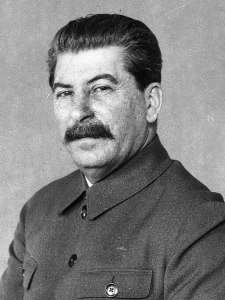
James Abbe, Public domain, via Wikimedia Commons

Stalin was born into a poor peasant family in Georgia in 1878. Later he became a bank robber, providing funds for Lenin and the Bolshevik party. He was born Joseph Vissarionovich  Dzhugashvili and like Lenin, adopted a pseudonym. The name Stalin came from the Russian word for Steel and is often said to mean ‘man of steel’. In his early days as a Bolshevik, Stalin robbed banks to fund the revolution. Later, Stalin organised and edited Bolshevik newspapers for Lenin and Lenin promoted him to the party’s central committee in 1912.

When Lenin died, Stalin took control of Lenin’s funeral and began to cultivate a cult of personality around himself, gradually removing all those who opposed him on the central committee. After expelling Leon Trotsky who was exiled and later deported in 1929, Stalin was unopposed as the supreme leader. His regime oversaw mass repression with millions consigned to forced labour in the Gulag camp system and others who Stalin perceived as threats, imprisoned or murdered in his purges.

Stalin died in 1953. After collapsing, he was discovered by his security staff who were too scared to approach him at first. Later they moved him to a couch thinking the heavy drinking dictator might have been drunk. He died on the 6th March and later Khrushchev emerged as the new Soviet leader.

Trotsky aka Lev Davidovich Bronstein
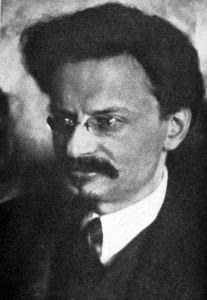
By Isaac McBride – Barbarous Soviet Russia, Public Domain, https://commons.wikimedia.org/w/index.php?curid=3363312

Trotsky was another Bolshevik who used a pseudonym. He was the creator of the Red Army and the man Lenin thought would be a good successor. He, like Lenin and Stalin, suffered exile to Siberia and later met Lenin in London where he worked on the party newspaper. He returned to Russia in 1917 and became chairman of the Petrograd Soviet. After the Bolsheviks took power Lenin appointed Trotsky to the post of foreign minister, later becoming the Commissar for Military and Naval Affairs. He built up the Red Army and led it to victory in the civil war.

After Lenin’s death Trotsky was sidelined by Stalin and expelled from the Communist party and later from Russia itself. He finally settled in Mexico until his murder by Stalin’s agents in 1940.

Elton John aka Reg Dwight

That’s enough Soviet history for now so let’s move swiftly on to the music business. Reginald Dwight was born on the 25th March 1947. He lived in Pinner in Middlesex with his mother and father, Stanley and Sheila, although they divorced when Reg was 14.

Something that had a big effect on the young Reginald was his parents’ love of music. He began tapping out tunes on his grandmother’s piano and the age of 11 won a scholarship to the Royal Academy of Music.

At the age of 15 Reg got himself a job playing the piano at the local pub and in 1962 he and some friends formed a small band called Bluesology and they soon picked up a regular gig supporting singer Long John Baldry.

In 1967 Reg answered an advertisement in the New Musical Express. It had been placed by Liberty Records who were looking for new talent. Reg went to audition for the A & R manager, Ray Williams but Ray appeared to be unimpressed when Reg sang an old Jim Reeves hit and by way of ending the interview Ray handed Reg a sheaf of unopened lyrics written by someone who had answered the same ad.

That someone was Bernie Taupin. He and Reg hit it off instantly and Reg began writing music to Bernie’s lyrics. Six months later Reg changed his name. He took his new name from Bluesology bandmates Elton Dean and Long John Baldry and put them together to become Elton John.

In 1969 Elton’s album Empty Sky became a minor hit and was followed by the eponymous Elton John in 1970. ‘Your Song’, a single from the album went to number 7 in the UK singles chart and Elton John had arrived.

Archie Leach aka Cary Grant

Grant was born Archibald Leach in Bristol, England in 1904. He had a poor upbringing and his mother suffered from depression and his father was an alcoholic. The young Archie was interested in the theatre and performing and his mother was keen on him having piano lessons. His older brother had died before reaching the age of one and this perhaps made his mother a little over protective of the young Archie. Even so, his mother was not a woman who was able to give or receive love easily and the older Cary Grant blamed his childhood relationship with his mother for his problems with women in later life.

When Archie was 9 years old his father placed his mother in Glenside Hospital, a mental institution, telling his son that she had gone away on a long holiday and later, that she had died.

Archie befriended a group of acrobatic dancers known as The Penders and he was able to eventually join them and there he trained as a stilt walker and became part of their act. Later the group toured America and Archie decided to stay, following in the footsteps of others before him like Charlie Chaplin and Stan Laurel who had made their way to the USA in an almost identical way.

On Wikipedia they mention that on the trip over to the USA, Archie met Douglas Fairbanks and was greatly impressed by him, so much so that Fairbanks became a role model for the young Archie Leach.

In New York Archie worked in vaudeville with various comedy and theatrical groups. He joined the William Morris theatrical agency and began to pick up many theatre roles. In 1932 he had his first screen test and was given a five year contract with Paramount Pictures. B P Schulberg the general manager of Paramount decided that Archie Leach was not a good enough name for films so Archie came up with the name Cary Grant taking Cary from a stage character he had played and Grant chosen randomly from a telephone directory.

Cary Grant retired from acting in 1966 when his only daughter was born. He died in 1986 aged 82.

Ayrton Senna aka Ayrton Da Silva

It might come as a surprise to many to learn that the legendary racing driver Ayrton Senna did not use his real name. Instead, he chose to race under his mother’s maiden name, Senna. He decided to use the name Senna as in Brazil, his home country, Da Silva is a very common name and Ayrton hoped the use of Senna would make him stand out and be more recognisable in the world of motor sport.

Ayrton Senna in the McLaren Mp4/4 in 1988. Photo by the author

Ayrton was born and raised in the Brazilian city of Sao Paulo. He was born in 1960 and began racing karts at the age of 13. After twice finishing as runner up in the world kart championships Ayrton moved to Europe to compete in Formula Ford and later Formula 3. It was quite an achievement for the young Brazilian. He spoke little English and he and his wife were fishes out of water in the UK. Only his massive desire to succeed and to make it into Formula One kept him going. Alas his young wife was not up to the challenge and returned to Brazil.

Senna went on to enter Formula 1 and with the McLaren F1 team he won all of his three world championships fighting constantly with his great rivals Alain Prost and Nigel Mansell. He was killed on the 1st of May 1994 at the San Marino Grand Prix in Italy after leaving McLaren for the Williams team. He crashed at the Tamburello corner when he hit the concrete wall there and a suspension arm, forced back in the impact pierced his most vulnerable area, the visor of his crash helmet.

T E Lawrence aka John Hume Ross and T E Shaw
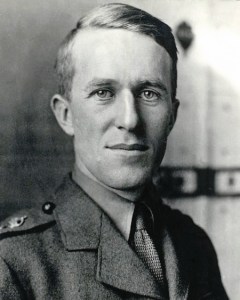
By Unknown author – pavellas.blogspot.com, Public Domain, https://commons.wikimedia.org/w/index.php?curid=7367070

Thomas Edward Lawrence is a fascinating character. He was a British army officer and writer best known for his role in the Arab Revolt during the First World War. He became known to the public through a series of film presentations by writer and documentary film maker Lowell Thomas.

After the war Lawrence tried to vanish into anonymity by joining the RAF as an aircraftsman using the alias of JH Ross. Later when his real identity was exposed he left the RAF and joined the army using the alias TE Shaw. He was unhappy in the army and was eventually readmitted to the RAF.

His account of his work in the Arab Revolt was published in his book Seven Pillars of Wisdom. Lawrence actually lost his manuscript at one point and was forced to reconstruct the entire book. Later, the book was used as the basis for the film Lawrence of Arabia starring Peter O Toole as Lawrence. A stage play was also written about him by Terrence Rattigan titled Ross which explored Lawrence’s alleged homosexuality. Alec Guinness featured in the play in the title role as Ross/Lawrence.

On the 13th May 1935 Lawrence was severely injured in a motorcycle accident and died six days later on the 19th May.


Thanks to Wikipedia for the source information.


What to do next: Here are a few options.

Share this post on your favourite social media!

Hit the Subscribe button. Never miss another post!

Listen to my podcast Click here.

Buy the book! Click here to purchase my new poetry collection.

Click here to visit Amazon and download Floating in Space to your Kindle or order the paperback version.

Click here to visit amazon and purchase Timeline, my new anthology.

Those Pesky Ruskies (Update)

I was watching television today, one of my usual pastimes and I settled down to watch the old 60’s TV show The Saint starring Roger Moore as adventurer Simon Templar. In this week’s episode Templar is sent by British Intelligence to intercept Colonel Smolenko, a top ranking KGB officer who is in danger of being murdered. The murder will be blamed on the British so Templar has to stop it happening and find out who is behind it all.
The colonel it turns out is a beautiful, cool blonde of the female variety. She takes some convincing that Simon Templar is out to save her but finally goes along with everything despite Simon being a bourgeois capitalist adventurer. As the action takes place in Paris, Simon decides to show the Soviet era colonel some pretty bourgeois restaurants, bars and western style night life. All of this has an effect on the colonel because at the end of the episode, despite a liquidation order coming her way for Simon, she declines to obey and Simon lives on to fight another day.  Ahh, that old rogue Roger Moore, he did have some charm!

One reason why I’ve mentioned The Saint is because that tongue in cheek 60’s TV version of Russian spies contrasts sharply with the news, back in 2018, about the Russian father and daughter involved in the nerve agent attack in Salisbury. The March 4th attack on Sergei Skripal, once an informant for the UK’s foreign intelligence service, and his daughter, Yulia, exposed local people to risk around public places in Salisbury. Traces of the poison have been found at a pub and a pizza parlour visited by the Skripals. Prime Minister Theresa May said in the House of Commons that “It is now clear that Mr. Skripal and his daughter were poisoned with a military-grade nerve agent of a type developed by Russia.” The Russians naturally deny any such attack. Back in 2018 when I first published this post, claims and counter claims were still going back and forth across the media. It seems clear to me though that the Russians, despite giving Communism the boot, are still not fully converted to the ways of the western democracies. Indeed, Mr Putin’s suppression of opposition in the Russian Federation must surely have brought forth complimentary murmurs from Stalin and Brezhnev in the Soviet afterlife.

Mikhail Gorbachev was the man who brought Russia kicking and screaming into the democratic world. He did not end the Soviet era though, in fact what he wanted, I think, was a democratic communist union. That idea though was ruined by Boris Yeltsin who must have smiled inwardly when events brought him to power. Here was the man exiled from the Communist party by Gorbachev who then managed to return to power because of democratic initiatives instituted by the same man. Mikhail Gorbachev made himself President then found the Soviet Union disappearing underneath him. Yeltsin took over the fledgling Russian Federation and Putin, the Russian leader today, became acting president when Yeltsin later resigned. Putin appears to be happy to duck and dive in his attempts to stay in power just like his predecessors of a hundred years ago.

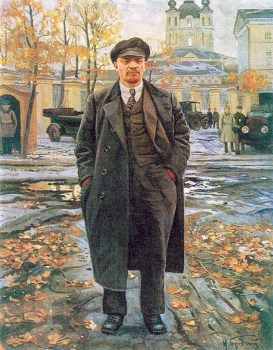
Lenin by the painter Brodskiy

Vladimir Ilyich Ulyanov, better known by his revolutionary alias of Lenin was another man determined to grab power out of the ashes of the Russian Revolution. Winston Churchill described his return to Russia from exile, facilitated by Germany in a sealed railway train, as “like a plague bacillus from Switzerland to Russia.” Lenin presided over the October Revolution and took power from the Provisional Government of Alexander Kerensky. After doing a deal with Germany, Lenin extracted Russia from the First World War and later consolidated his Bolshevik empire by emerging victorious from the Russian civil war. In his later years poor health prevented him from removing his would be successor, a man Lenin felt unsuitable as Soviet leader, and so Joseph Dzhugashvili came to power beginning a reign more terrible than any of the deposed Romanov Czars.  Dzhugashvili of course preferred the alias of Stalin.

Stalin ruled over the Soviet empire until his death in 1953. Even as he lay crippled by a stroke, his aides were too scared to move him in case they incurred his displeasure. It was Khrushchev who finally emerged as Stalin’s successor, consigning potential successor security chief Beria to imprisonment and death. Khrushchev initiated a number of reforms in the Soviet Union, opening up the gulags and freeing prisoners but he became increasingly unpopular with his colleagues in the Politburo until he was finally removed in favour of Brezhnev in 1964.

The coup was a quiet and bloodless one, Khrushchev later commenting “I’m old and tired. Let them cope by themselves. I’ve done the main thing. Could anyone have dreamed of telling Stalin that he didn’t suit us anymore and suggesting he retire? Not even a wet spot would have remained where we had been standing. Now everything is different. The fear is gone, and we can talk as equals. That’s my contribution. I won’t put up a fight.”

Vladimir Putin is the current president of Russia as we all know. Putin was a former KGB agent who resigned from the KGB after the attempted coup of Gorbachev in 1991. He began working for the mayor of St Petersburg and became the deputy chairman of the St Petersburg government, resigning when Anatoly Sobchak lost the election in 1996. He moved to Moscow and got himself a job as the deputy chief of the Presidential Property Department. Putin moved up through the ranks of government and in 1998, Boris Yeltsin appointed him as director of the Federal Security Service, the successor to the KGB. Later, Yeltsin made Putin his Prime Minister and when Yeltsin unexpectedly resigned in 1999, Putin became the acting president. He later won the next two elections. The Russian constitution prevented him from running again but Dimitry Medvedev became the president and he appointed Putin as prime minister in a sneaky power switching operation. In 2012 Putin ran again for president and was elected despite protests across Russia and allegations of electoral fraud. Will Putin step away from power after his final term? I doubt it.

I was surprised recently after seeing the Russian parliament, the Duma, on TV. All the delegates seemed to be in favour of Putin’s war on the Ukraine. Is there no elected official over there that doesn’t want war? Perhaps they are all scared of Putin in the way Stalin’s colleagues were scared of him. Over on YouTube I recently saw an interview with Gorbachev where the great man himself, revered as someone who ended the Cold War, brought down the Berlin wall and initiated Glasnost (Openness) in Soviet society, declined to criticise Putin.

Ian Smith, the prime minister of that long vanished country Rhodesia once said this about democracy: “Democracy is a very delicate thing, perfected by the British, but that does not mean you can transplant it elsewhere.” In some ways, especially when you look at the Middle East, perhaps Smith was right, after all the fundamental thing about democracy means that those who are defeated at election time are obliged to hand over power to the newly elected winner. Some people, President Mugabe for example, were not inclined to do so or to even allow anyone to challenge them. Still, everyone votes for a dictator, or so they say.

Back in my coach driving days, I drove a coachload of Russian shop stewards to various meetings with UK union representatives of British Gas. I’m not sure what they were discussing but they all seemed pretty nice, in fact later on they complained to their hosts that I was sitting on my coach, reading a book and eating sandwiches, when they were being wined and dined in a swanky hotel. This inequality so disappointed them that they insisted I went inside and be served the same lovely meal that they were served. Very nice it was too!

Surely then, wasn’t Ian Smith being just a little snooty? Don’t those same Russians deserve the same democratic rights that we tend to take so much for granted in the west?

What is the situation in the Kremlin today I wonder? Will anyone dare to tell Mr Putin that he doesn’t suit them anymore?


What to do next: Here are a few options.

Share this post on your favourite social media!

Hit the Subscribe button. Never miss another post!

Listen to my podcast Click here.

Buy the book! Click here to purchase my new poetry anthology.

Click here to visit Amazon and download Floating in Space to your Kindle or order the paperback version.


Those Pesky Ruskies

I was watching television today, one of my usual pastimes and I settled down to watch the old 60’s TV show the Saint starring Roger Moore as adventurer Simon Templar. In this week’s episode Templar is sent by British Intelligence to intercept Colonel Smolenko, a top ranking KGB officer who is in danger of being murdered. The murder will be blamed on the British so Templar has to stop it happening and find out who is behind it all.

The colonel it turns out is a beautiful cool blonde of the female variety. She takes some convincing that Simon Templar is out to save her but finally goes along with everything despite Simon being a bourgeois capitalist adventurer. As the action takes place in Paris, Simon decides to show the Soviet era colonel some pretty bourgeois restaurants, bars and western style night life. All of this has an effect on the colonel because at the end of the episode, despite a liquidation order coming her way for Simon, she declines to obey and Simon lives on to fight another day.  Ahh, that old rogue Roger Moore, he did have some charm!

One reason why I’ve mentioned the Saint is because that tongue in cheek 60’s TV version of Russian spies contrasts sharply with recent TV news about the Russian father and daughter involved in the nerve agent attack in Salisbury. The March 4th attack on Sergei Skripal, once an informant for the UK’s foreign intelligence service, and his daughter, Yulia, exposed local people to risk around public places in Salisbury. Traces of the poison have been found at a pub and a pizza parlour visited by the Skripals. Prime Minister Theresa May said in the House of Commons that “It is now clear that Mr. Skripal and his daughter were poisoned with a military-grade nerve agent of a type developed by Russia.” The Russians, naturally deny any such attack. How the whole episode will end is anybody’s guess but as I write this, claims and counter claims are still going back and forth across the media. It seems clear to me though that the Russians, despite giving Communism the boot, are still not fully converted to the ways of the western democracies. Indeed, Mr Putin’s suppression of opposition in the Russian Federation must surely have brought forth complimentary murmurs from Stalin and Brezhnev in the Soviet afterlife.

Mikhail Gorbachev was the man who brought Russia kicking and screaming into the democratic world. He did not end the Soviet era though, in fact what he wanted, I think, was a democratic communist union. That idea though was ruined by Boris Yeltsin who must have smiled inwardly when events brought him to power. Here was the man exiled from the Communist party by Gorbachev who then managed to return to power because of democratic initiatives instituted by the same man. Mikhail Gorbachev made himself President then found the Soviet Union disappearing underneath him. Yeltsin took over the fledgling Russian Federation and Putin, the Russian leader today became Acting President when Yeltsin later resigned. Putin appears to be happy to duck and dive in his attempts to stay in power just like his predecessors of a hundred years ago.

Lenin by the painter Brodskiy

Vladimir Ilyich Ulyanov, better known by his revolutionary alias of Lenin was another man determined to grab power out of the ashes of the Russian Revolution. Winston Churchill described his return to Russia from exile, facilitated by Germany in a sealed railway train, as “like a plague bacillus from Switzerland to Russia.” Lenin presided over the October Revolution and took power from the Provisional Government of Alexander Kerensky. After doing a deal with Germany, Lenin extracted Russia from the First World War and later consolidated his Bolshevik empire by emerging victorious from the Russian civil war. In his later years poor health prevented him from removing his would be successor, a man Lenin felt unsuitable as Soviet leader, and so Joseph Dzhugashvili came to power beginning a reign more terrible than any of the deposed Romanov Czars.  Dzhugashvili of course preferred the alias of Stalin.

Stalin ruled over the Soviet empire until his death in 1953. Even as he lay crippled by a stroke his aides were too scared to move him in case they incurred his displeasure. It was Khrushchev who finally emerged as Stalin’s successor, consigning potential successor security chief Beria to imprisonment and death. Khrushchev initiated a number of reforms in the Soviet Union, opening up the gulags and freeing prisoners but he became increasingly unpopular with his colleagues in the Politburo until he was finally removed in favour of Brezhnev in 1964.

The coup was a quiet and bloodless one, Khrushchev later commenting “I’m old and tired. Let them cope by themselves. I’ve done the main thing. Could anyone have dreamed of telling Stalin that he didn’t suit us anymore and suggesting he retire? Not even a wet spot would have remained where we had been standing. Now everything is different. The fear is gone, and we can talk as equals. That’s my contribution. I won’t put up a fight.”

Ian Smith, the Prime Minister of that long vanished country Rhodesia once said this about democracy: “Democracy is a very delicate thing, perfected by the British, but that does not mean you can transplant it elsewhere.” In some ways, especially when you look at the Middle East, perhaps Smith was right, after all the fundamental thing about democracy means that those who are defeated at election time are obliged to hand over power to the newly elected winner. Some people, President Mugabe for example, were not inclined to do so or to even allow anyone to challenge them. Still, everyone votes for a dictator, or so they say.

As it happens, I have met a few Russian people. Back in my coach driving days, I drove a coachload of Russian shop stewards to various meetings with UK union representatives of British gas. I’m not sure what they were discussing but they all seemed pretty nice. In fact later on, they complained to their hosts that I was sitting on my coach, reading a book and eating sandwiches, when they were being wined and dined in a swanky hotel. This inequality so disappointed them that they insisted I come inside and be served the same lovely meal that they were served. Very nice it was too!

Surely then, wasn’t Ian Smith being just a little snooty? Don’t those same Russians deserve the same democratic rights that we tend to take so much for granted in the west?

What is the situation in the Kremlin today I wonder? Will anyone dare to tell Mr Putin that he doesn’t suit them anymore?


Steve Higgins is the author of Floating in Space set in Manchester, 1977. Click the links at the top of the page for more information!


Writer’s block, Russian Women, and my In-box.

It’s great to have lots of extra time to myself now I’m semi-retired and for me as a writer, well, amateur writer I suppose, (and blogger) I tend to use a lot of that time for writing. The crazy thing is, when you get a nice quiet day, all your jobs done, they’re the jobs Liz arranged for me before she went out to work, it’s great to fire up the laptop and get cracking. The big problem though is this, what do I write? Yes usually ideas seem to just flow for me, especially when I’m at work and it’s all getting pretty busy.

Now I’m not at work and I’m not really busy, the ideas aren’t coming. I could tell you about my TV viewing but I did that last week. Then there’s dealing with semi-retirement but I did that one the week before. I have actually got twelve posts in my draft box but none of those seem to be calling to me, not one of the twelve is saying “finish me!”

One of the problems of writing on a laptop is that eventually, even if you are beavering frantically away on a new post, the internet will eventually beckon. What has been quite amusing this week is how a shocking and outrageous event on a United Airlines flight has spawned an increasing number of spoofs using footage from the movie Airplane. If you’ve been away holidaying in the jungles of Borneo and have been without wi-fi then you won’t know that on an overbooked United Airlines flight, the staff simply picked a passenger at random and ejected him from the aeroplane! Smartphone video footage of the incident has gone ‘viral’ as they say. How the airline will recover from this PR disaster is anyone’s guess but the poor fellow in question, hauled off a flight because they were short of a seat for the staff, must certainly be considering legal action and American lawyers will probably be queueing up to take on the job. Fame and fortune and an easy legal victory must surely await the man who takes that one into the courtroom!

Anyway, Internet surfing done, next is a ‘quick’ look at my emails. I see I have one from the National Westminster Bank saying there is a problem with my account and I need to click on a link and enter my password to get it sorted. As it happens, I don’t have a Nat West account so whoever you are with your beady eyes on my hard earned cash, this scam didn’t work but people are falling for these scams in increasing numbers. Never click on emails asking for your passwords and if you are not happy with any type of mail you receive, call your bank but don’t use any links or numbers in the suspect e-mail.

This Russian lady is probably an Internet Scammer!

Also in my inbox is yet another e-mail from a Russian lady wanting a relationship with me! Poor girl! I have been targeted lately by numerous Russian ladies and not long ago I e-mailed one of these women back and said, look, I think you have fallen for a scam. I’m not on any dating sites and I’m not interested in you. The lady in question, her name was Kristina and she even enclosed a photograph, wrote back a very long letter telling me about her life in a small Russian village, how she was orphaned as a youngster and how she loved my picture and longed to be with me.

Sometimes, when the light gets me in a certain way and I’m wearing my leather ‘pulling jacket’ I tend to think I look quite good, hardly in the Bruce Willis class but acceptable though hardly deserving of anyone’s longing. Not only that, my picture, as far as I am aware, is not on any dating site, Russian or otherwise. Anyway, I wrote back again, told the lady her dating site was a scam and not to pay them a penny, or a ruble more. She wrote quickly back that luckily she had come into a small amount of money and was ready to fly over to the USA to spend some time with me and although she would be low on funds she was desperate to see me.

Yes, I’ve always wanted to visit the USA but hopefully when it happens I won’t be bumping into Kristina from the Russian City of Izhevsk. Of course she could also be after another Steve Higgins, or even the Steven Higgins from Ventura California, who I am constantly advised by the My Life Backgound Monitor Company Dot Com, that important personal details of mine are freely available on the Internet! No they are not and my name is not Steven and the only person who calls me Stephen is my Mum and even then it’s Stephen and not Steven!

Of course some are my details are freely available, for instance my novel set in 1970’s Manchester! Click the links at the top of the page to find out more. Now, back to this week’s post, what can I write about?