The Espionage World of John le Carré

The first thing that comes to mind when one thinks about spies and espionage is probably James Bond, perhaps not the version of Bond as written by Ian Fleming but more the version given to us by the producers of the Bond films and portrayed by a succession of actors like Sean Connery, George Lazenby, Roger Moore and latterly Daniel Craig.

The spy stories of John le Carré are really quite different. There are stories about people in offices who become greedy and pass documents and information to the other side for money. Perhaps they want better lives or they want money to impress women or for a thousand other reasons. They are set in seedy dull worlds where the jet setting glamour of 007 rarely intrudes.

John le Carré is actually the pen name of David Cornwell who began writing while serving with MI5 and later MI6 which was why he had to use a nom de plume. When his writing career took off with the great success of his third novel The Spy Who Came in From the Cold, John le Carré left the intelligence services to become a full time author.

He wrote a number of novels, all with a spying or espionage theme and many featured his famous spy, George Smiley. Smiley is an older man, a quiet and easy going but intelligent operative who plods along as he investigates and analyses information.

George only appears in the background to The Spy Who Came in From the Cold. Taking centre stage are Control, the head of the secret service and his Berlin agent, Alec Leamas. The secret service is known in John’s books as the ‘circus’ as it is based in Cambridge Circus in London and he introduces us to other elements of his secret world such as the ‘lamplighters’ and ‘scalphunters’ and many others, all nicknames for the various elements of the ‘circus’.

In The Spy Who Came in From the Cold, Alec Leamas is head of the Berlin Station and is recalled to London after the capture of one of his agents in East Berlin. Control has a new task for Leamas, that of discrediting the head of East German Intelligence, Mundt. The task calls for Leamas to pretend to become disillusioned by MI6 and offer himself as an informant.

In the splendid film version, Leamas is played by Richard Burton. He plays the part superbly. After leaving British Intelligence Leamas gets a job in a small private library where he becomes involved with a fellow librarian Liz, although her name was changed in the film version to Nan so as not to invite comparison with Burton’s real life wife, Elizabeth Taylor. Burton apparently wanted Liz Taylor to play the part of Nan but director Martin Ritt insisted on casting Clare Bloom.

When Leamas arrives in Europe to give his information he meets Fiedler played by Oskar Werner who is to interrogate him. Acting on information given by Leamas, he begins to feel that Mundt, the head of East German Intelligence, is actually a traitor but then the story is flipped on its head as we find that Leamas’ mission is actually to discredit Fiedler and protect Mundt, who actually is working for the west.

I was probably first introduced to Tinker Tailor Soldier Spy by the 1979 TV series starring Alec Guinness as George Smiley. In the story Smiley has retired but he is brought back into the intelligence fold after Lacon, the senior civil servant responsible for the service, asks him to investigate a story that has been brought to him by a missing agent named Ricki Tarr. The story concerns a ‘mole’ working for British Intelligence but passing information to the Soviet Union.

I read the book shortly afterwards but not long ago I picked up a paperback version linked to the recent film version in which Gary Oldman plays George Smiley.

The story was influenced by the defection of Kim Philby to the Soviet Union who was the original ‘mole’ at the heart of British Intelligence.

Smiley has to check out the story of Ricki Tarr and along the way interviews many former ‘Circus’ employees who left the service after the death of Control. Control was convinced of the existence of a spy at the centre of the organisation and sent agent Jim Prideux on a mission to Czechoslovakia. During that mission, Prideux was shot and captured and the circus went into meltdown.

Kathy Burke plays Connie Sachs, an old Soviet watcher who became convinced Soviet diplomat Polyakov was a spy but her idea was rejected by the new Circus leaders but Smiley realises Connie might have been on to something. There are various suspects for the mole and they have all been given code names by Control; Tinker, Tailor, Poorman and so on. Control expected Prideux to come back with a code word but he did not and by the time he was exchanged and returned to the UK, the poorly Control had passed away.

Control had given another name to the mole; he called him Gerald and Smiley realises that Gerald must have been planted in the circus years ago by ‘Karla’, the head of Soviet Intelligence. Smiley had once tried to recruit Karla as a British agent but Karla, played by Patrick Stewart in the TV series took Smiley’s offered cigarettes and lighter but declined Smiley’s offer. Why? Smiley thought it was because Karla had an ace in the hole, Gerald, already burrowing into British Intelligence.

Another element in the story is the unseen Ann, Smiley’s wife. She has had various affairs and Smiley has left her but on the night of the Prideux shooting it appears she was with Bill Haydon played by Colin Firth in the film. Who then is the mole?

The mole of course is unmasked at the end of both the book, the TV series and the film. The book, although interesting, moves slowly along and both the TV series and the film emulate the book’s slow pace. I’m not sure I particularly cared for the film but the book was an enjoyable read and it’s interesting how the author holds on to all the various elements of the story and is still able to throw a little spanner into the works with the suggestions about Ann’s dalliance with Bill Haydon.

All of John le Carré’s books are rather slow moving stories that simmer along gently and one other book I tried to read recently, Our Kind of Traitor, was one I put down permanently as I really didn’t have enough interest in the story to continue.

John le Carré wrote 26 novels. In later life he was disillusioned with the UK over Brexit and in fact he was so upset that he decided to become an Irish citizen. He died in 2020 aged 89.


What to do next: Here are a few options.

Share this post on your favourite social media!

Hit the Subscribe button. Never miss another post!

Listen to my podcast Click here.

Buy the book! Click here to purchase my new poetry collection.

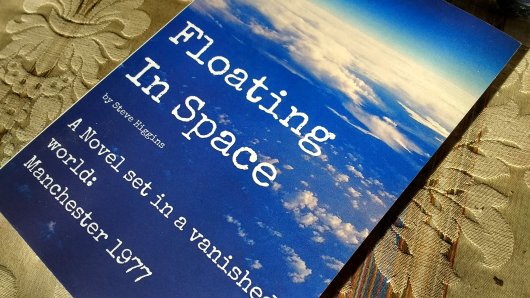
Click here to visit Amazon and download Floating in Space to your Kindle or order the paperback version.

Click here to visit amazon and purchase Timeline, my new anthology.

Those Pesky Ruskies (Update)

I was watching television today, one of my usual pastimes and I settled down to watch the old 60’s TV show The Saint starring Roger Moore as adventurer Simon Templar. In this week’s episode Templar is sent by British Intelligence to intercept Colonel Smolenko, a top ranking KGB officer who is in danger of being murdered. The murder will be blamed on the British so Templar has to stop it happening and find out who is behind it all.
The colonel it turns out is a beautiful, cool blonde of the female variety. She takes some convincing that Simon Templar is out to save her but finally goes along with everything despite Simon being a bourgeois capitalist adventurer. As the action takes place in Paris, Simon decides to show the Soviet era colonel some pretty bourgeois restaurants, bars and western style night life. All of this has an effect on the colonel because at the end of the episode, despite a liquidation order coming her way for Simon, she declines to obey and Simon lives on to fight another day.  Ahh, that old rogue Roger Moore, he did have some charm!

One reason why I’ve mentioned The Saint is because that tongue in cheek 60’s TV version of Russian spies contrasts sharply with the news, back in 2018, about the Russian father and daughter involved in the nerve agent attack in Salisbury. The March 4th attack on Sergei Skripal, once an informant for the UK’s foreign intelligence service, and his daughter, Yulia, exposed local people to risk around public places in Salisbury. Traces of the poison have been found at a pub and a pizza parlour visited by the Skripals. Prime Minister Theresa May said in the House of Commons that “It is now clear that Mr. Skripal and his daughter were poisoned with a military-grade nerve agent of a type developed by Russia.” The Russians naturally deny any such attack. Back in 2018 when I first published this post, claims and counter claims were still going back and forth across the media. It seems clear to me though that the Russians, despite giving Communism the boot, are still not fully converted to the ways of the western democracies. Indeed, Mr Putin’s suppression of opposition in the Russian Federation must surely have brought forth complimentary murmurs from Stalin and Brezhnev in the Soviet afterlife.

Mikhail Gorbachev was the man who brought Russia kicking and screaming into the democratic world. He did not end the Soviet era though, in fact what he wanted, I think, was a democratic communist union. That idea though was ruined by Boris Yeltsin who must have smiled inwardly when events brought him to power. Here was the man exiled from the Communist party by Gorbachev who then managed to return to power because of democratic initiatives instituted by the same man. Mikhail Gorbachev made himself President then found the Soviet Union disappearing underneath him. Yeltsin took over the fledgling Russian Federation and Putin, the Russian leader today, became acting president when Yeltsin later resigned. Putin appears to be happy to duck and dive in his attempts to stay in power just like his predecessors of a hundred years ago.

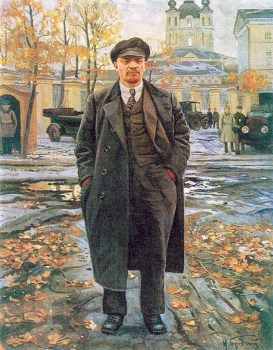
Lenin by the painter Brodskiy

Vladimir Ilyich Ulyanov, better known by his revolutionary alias of Lenin was another man determined to grab power out of the ashes of the Russian Revolution. Winston Churchill described his return to Russia from exile, facilitated by Germany in a sealed railway train, as “like a plague bacillus from Switzerland to Russia.” Lenin presided over the October Revolution and took power from the Provisional Government of Alexander Kerensky. After doing a deal with Germany, Lenin extracted Russia from the First World War and later consolidated his Bolshevik empire by emerging victorious from the Russian civil war. In his later years poor health prevented him from removing his would be successor, a man Lenin felt unsuitable as Soviet leader, and so Joseph Dzhugashvili came to power beginning a reign more terrible than any of the deposed Romanov Czars.  Dzhugashvili of course preferred the alias of Stalin.

Stalin ruled over the Soviet empire until his death in 1953. Even as he lay crippled by a stroke, his aides were too scared to move him in case they incurred his displeasure. It was Khrushchev who finally emerged as Stalin’s successor, consigning potential successor security chief Beria to imprisonment and death. Khrushchev initiated a number of reforms in the Soviet Union, opening up the gulags and freeing prisoners but he became increasingly unpopular with his colleagues in the Politburo until he was finally removed in favour of Brezhnev in 1964.

The coup was a quiet and bloodless one, Khrushchev later commenting “I’m old and tired. Let them cope by themselves. I’ve done the main thing. Could anyone have dreamed of telling Stalin that he didn’t suit us anymore and suggesting he retire? Not even a wet spot would have remained where we had been standing. Now everything is different. The fear is gone, and we can talk as equals. That’s my contribution. I won’t put up a fight.”

Vladimir Putin is the current president of Russia as we all know. Putin was a former KGB agent who resigned from the KGB after the attempted coup of Gorbachev in 1991. He began working for the mayor of St Petersburg and became the deputy chairman of the St Petersburg government, resigning when Anatoly Sobchak lost the election in 1996. He moved to Moscow and got himself a job as the deputy chief of the Presidential Property Department. Putin moved up through the ranks of government and in 1998, Boris Yeltsin appointed him as director of the Federal Security Service, the successor to the KGB. Later, Yeltsin made Putin his Prime Minister and when Yeltsin unexpectedly resigned in 1999, Putin became the acting president. He later won the next two elections. The Russian constitution prevented him from running again but Dimitry Medvedev became the president and he appointed Putin as prime minister in a sneaky power switching operation. In 2012 Putin ran again for president and was elected despite protests across Russia and allegations of electoral fraud. Will Putin step away from power after his final term? I doubt it.

I was surprised recently after seeing the Russian parliament, the Duma, on TV. All the delegates seemed to be in favour of Putin’s war on the Ukraine. Is there no elected official over there that doesn’t want war? Perhaps they are all scared of Putin in the way Stalin’s colleagues were scared of him. Over on YouTube I recently saw an interview with Gorbachev where the great man himself, revered as someone who ended the Cold War, brought down the Berlin wall and initiated Glasnost (Openness) in Soviet society, declined to criticise Putin.

Ian Smith, the prime minister of that long vanished country Rhodesia once said this about democracy: “Democracy is a very delicate thing, perfected by the British, but that does not mean you can transplant it elsewhere.” In some ways, especially when you look at the Middle East, perhaps Smith was right, after all the fundamental thing about democracy means that those who are defeated at election time are obliged to hand over power to the newly elected winner. Some people, President Mugabe for example, were not inclined to do so or to even allow anyone to challenge them. Still, everyone votes for a dictator, or so they say.

Back in my coach driving days, I drove a coachload of Russian shop stewards to various meetings with UK union representatives of British Gas. I’m not sure what they were discussing but they all seemed pretty nice, in fact later on they complained to their hosts that I was sitting on my coach, reading a book and eating sandwiches, when they were being wined and dined in a swanky hotel. This inequality so disappointed them that they insisted I went inside and be served the same lovely meal that they were served. Very nice it was too!

Surely then, wasn’t Ian Smith being just a little snooty? Don’t those same Russians deserve the same democratic rights that we tend to take so much for granted in the west?

What is the situation in the Kremlin today I wonder? Will anyone dare to tell Mr Putin that he doesn’t suit them anymore?


What to do next: Here are a few options.

Share this post on your favourite social media!

Hit the Subscribe button. Never miss another post!

Listen to my podcast Click here.

Buy the book! Click here to purchase my new poetry anthology.

Click here to visit Amazon and download Floating in Space to your Kindle or order the paperback version.


Which Bond is the very Best Bond?

So who was the best Bond? That’s Bond of course, James Bond, licensed to kill.

I’ve had a little time on my hands this week, looking after my elderly mother. Nothing particularly exciting presented itself on terrestrial TV so I thought, the perfect time to pour a glass of red and crank up a few Bond DVDs.

Sean Connery.

The very first Bond movie was Doctor No starring Sean Connery as the very first Bond. Connery was excellent as the suave James Bond, former naval officer and now agent of M16, the Secret Intelligence Service. Bond gets sent to Jamaica to look into the disappearance of the local station head. It turns out he was killed for being far too interested in the very first Bond villain, Doctor No. Throw in some exciting sets, car chases, gunplay and pretty girls and you have the instant formula for a successful film franchise.

Connery plays a great James Bond and he carried on with his portrayal in three subsequent films. After Thunderball he decided enough was enough and packed the job in. Later he was enticed back to play Bond one more time in Diamonds are Forever.

Stevehigginsinslive.com Bond rating: #4

George Lazenby.

George Lazenby was an actor in a TV advert and was spotted by the producers to take on the role of 007. Lazenby was to me, the perfect Bond; rugged and good looking as well as smooth and unruffled. To me he was just how I imagined Bond after reading the Ian Fleming novels as a schoolboy. His one Bond film, On Her Majesty’s Secret Service is one of the best films in the 007 franchise. Diana Rigg is a great Bond lady who, unlike no other Bond girl before or after, actually gets to marry Bond. The film is a fast paced thriller with some great fight and chase scenes including a classic ski chase. Lazenby quit the Bond series after getting some bad career advice and it was such a shame that he did not portray James Bond again.

Stevehigginsinslive.com Bond rating: #1

Roger Moore.

Roger Moore is one of my favourite actors, good looking, smooth and someone who never takes himself too seriously. He was great as Simon Templar and Lord Brett Sinclair in two TV action series but as for James Bond, well I don’t know what went wrong but Moore just didn’t cut it as Bond for me. His first film Live and Let Die was . .well, not bad I suppose but most of the rest were just dreadful, more carry On James Bond than the Bond we, or at least I wanted to see. Sorry Roger, just not my cup of tea at all and as for that underwater car. . . Seriously?

Stevehigginsinslive.com Bond rating: #6

Timothy Dalton.

Relaxing in front of the TV the other day and The Living Daylights popped up on my TV schedule. I’ve never really thought much of this film but actually it was pretty good. Timothy Dalton was a welcome relief after the Roger Moore years; finally, a serious Bond film again. Good film, good music and a great Bond girl who had, unusually, more to do that just look nice. Dalton made two Bond films, the other one being the slightly tedious Licence to Kill. Great song but a film that needed a few kick starts along the way.

Stevehigginsinslive.com Bond rating: #3

Pierce Brosnan.

There was a 6 year gap to the next Bond film due to legal issues. Timothy Dalton declined to star as Bond and the producers gave the role to Pierce Brosnan. Brosnan’s first Bond film was the impressive Goldeneye, one of my personal favourites of the whole series. Brosnan’s Bond is as smooth and stylish as the previous incumbents of the role with the addition of some wry humour in the style of Sean Connery. Goldeneye was the best of Brosnan’s films and the only real dud was Tomorrow Never Dies but even that had its merits. His last Bond film Die Another Day did venture slightly into Roger Moore territory with an invisible car though. Brosnan’s series of films were made all the more impressive by a small company of regular co-stars in particular Judi Dench as a female M, and Samantha Bond as Miss Moneypenny. I have to vote Brosnan in as my second favourite Bond.

Stevehigginsinslive.com Bond rating: #2

Daniel Craig.

Craig made his Bond debut in Casino Royale, actually the first book in Ian Fleming’s series but the last to make it to film, well, in the official franchise anyway. Fleming sold the rights to Casino Royale separately to the rest of books for some reason which is why a comedy version was made in the 1960s starring David Niven as Bond. In fact Niven was Fleming’s personal choice for a film Bond!

Anyway, this series of Bond films brings us to the 21st century version of the British superspy with an accent less on gadgets but heavy on action. The Daniel Craig Bond films are tough and gritty but are all reasonably enjoyable, the best one by far being Skyfall. Craig’s Bond is noticeably more thuggish than his predecessors although he tends to drive a classy vintage 1960s Aston Martin. Interestingly, in the books, Bond’s personal car was a vintage Bentley.

Stevehigginsinslive.com Bond rating: #5


Floating in Space is a novel by Steve Higgins set in Manchester, 1977. Click the links at the top of the page to buy or for more information.


Those Pesky Ruskies

I was watching television today, one of my usual pastimes and I settled down to watch the old 60’s TV show the Saint starring Roger Moore as adventurer Simon Templar. In this week’s episode Templar is sent by British Intelligence to intercept Colonel Smolenko, a top ranking KGB officer who is in danger of being murdered. The murder will be blamed on the British so Templar has to stop it happening and find out who is behind it all.

The colonel it turns out is a beautiful cool blonde of the female variety. She takes some convincing that Simon Templar is out to save her but finally goes along with everything despite Simon being a bourgeois capitalist adventurer. As the action takes place in Paris, Simon decides to show the Soviet era colonel some pretty bourgeois restaurants, bars and western style night life. All of this has an effect on the colonel because at the end of the episode, despite a liquidation order coming her way for Simon, she declines to obey and Simon lives on to fight another day.  Ahh, that old rogue Roger Moore, he did have some charm!

One reason why I’ve mentioned the Saint is because that tongue in cheek 60’s TV version of Russian spies contrasts sharply with recent TV news about the Russian father and daughter involved in the nerve agent attack in Salisbury. The March 4th attack on Sergei Skripal, once an informant for the UK’s foreign intelligence service, and his daughter, Yulia, exposed local people to risk around public places in Salisbury. Traces of the poison have been found at a pub and a pizza parlour visited by the Skripals. Prime Minister Theresa May said in the House of Commons that “It is now clear that Mr. Skripal and his daughter were poisoned with a military-grade nerve agent of a type developed by Russia.” The Russians, naturally deny any such attack. How the whole episode will end is anybody’s guess but as I write this, claims and counter claims are still going back and forth across the media. It seems clear to me though that the Russians, despite giving Communism the boot, are still not fully converted to the ways of the western democracies. Indeed, Mr Putin’s suppression of opposition in the Russian Federation must surely have brought forth complimentary murmurs from Stalin and Brezhnev in the Soviet afterlife.

Mikhail Gorbachev was the man who brought Russia kicking and screaming into the democratic world. He did not end the Soviet era though, in fact what he wanted, I think, was a democratic communist union. That idea though was ruined by Boris Yeltsin who must have smiled inwardly when events brought him to power. Here was the man exiled from the Communist party by Gorbachev who then managed to return to power because of democratic initiatives instituted by the same man. Mikhail Gorbachev made himself President then found the Soviet Union disappearing underneath him. Yeltsin took over the fledgling Russian Federation and Putin, the Russian leader today became Acting President when Yeltsin later resigned. Putin appears to be happy to duck and dive in his attempts to stay in power just like his predecessors of a hundred years ago.

Lenin by the painter Brodskiy

Vladimir Ilyich Ulyanov, better known by his revolutionary alias of Lenin was another man determined to grab power out of the ashes of the Russian Revolution. Winston Churchill described his return to Russia from exile, facilitated by Germany in a sealed railway train, as “like a plague bacillus from Switzerland to Russia.” Lenin presided over the October Revolution and took power from the Provisional Government of Alexander Kerensky. After doing a deal with Germany, Lenin extracted Russia from the First World War and later consolidated his Bolshevik empire by emerging victorious from the Russian civil war. In his later years poor health prevented him from removing his would be successor, a man Lenin felt unsuitable as Soviet leader, and so Joseph Dzhugashvili came to power beginning a reign more terrible than any of the deposed Romanov Czars.  Dzhugashvili of course preferred the alias of Stalin.

Stalin ruled over the Soviet empire until his death in 1953. Even as he lay crippled by a stroke his aides were too scared to move him in case they incurred his displeasure. It was Khrushchev who finally emerged as Stalin’s successor, consigning potential successor security chief Beria to imprisonment and death. Khrushchev initiated a number of reforms in the Soviet Union, opening up the gulags and freeing prisoners but he became increasingly unpopular with his colleagues in the Politburo until he was finally removed in favour of Brezhnev in 1964.

The coup was a quiet and bloodless one, Khrushchev later commenting “I’m old and tired. Let them cope by themselves. I’ve done the main thing. Could anyone have dreamed of telling Stalin that he didn’t suit us anymore and suggesting he retire? Not even a wet spot would have remained where we had been standing. Now everything is different. The fear is gone, and we can talk as equals. That’s my contribution. I won’t put up a fight.”

Ian Smith, the Prime Minister of that long vanished country Rhodesia once said this about democracy: “Democracy is a very delicate thing, perfected by the British, but that does not mean you can transplant it elsewhere.” In some ways, especially when you look at the Middle East, perhaps Smith was right, after all the fundamental thing about democracy means that those who are defeated at election time are obliged to hand over power to the newly elected winner. Some people, President Mugabe for example, were not inclined to do so or to even allow anyone to challenge them. Still, everyone votes for a dictator, or so they say.

As it happens, I have met a few Russian people. Back in my coach driving days, I drove a coachload of Russian shop stewards to various meetings with UK union representatives of British gas. I’m not sure what they were discussing but they all seemed pretty nice. In fact later on, they complained to their hosts that I was sitting on my coach, reading a book and eating sandwiches, when they were being wined and dined in a swanky hotel. This inequality so disappointed them that they insisted I come inside and be served the same lovely meal that they were served. Very nice it was too!

Surely then, wasn’t Ian Smith being just a little snooty? Don’t those same Russians deserve the same democratic rights that we tend to take so much for granted in the west?

What is the situation in the Kremlin today I wonder? Will anyone dare to tell Mr Putin that he doesn’t suit them anymore?


Steve Higgins is the author of Floating in Space set in Manchester, 1977. Click the links at the top of the page for more information!