I’ve given myself a theme this week, that of writing about the Police. Being British I’m going to try and focus on the British Police but I’ve added a few paragraphs about the US Police too.
The Police in TV and Film
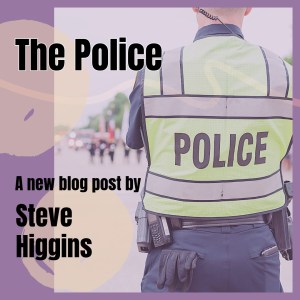 I have to say that I’ve struggled to think of films about the UK Police without resorting to Google although there are quite a few TV shows I could mention. The obvious one that comes to mind is Dixon of Dock Green.
Dixon of Dock Green ran from 1955 to 1976 starring Jack Warner as Police Constable George Dixon. Dixon was the traditional ‘Bobby’ who patrolled a regular beat in London, working out of the Dock Green Police Station in London’s East End. The show was inspired by the film The Blue Lamp in which Jack Warner originally played the character of George Dixon.
In the TV show Warner famously introduced each episode by saluting and saying ‘evenin’ all’ to the camera. He also ended each episode by saying a few philosophical words about that night’s episode before wishing his audience a ‘good night’.
The Bill
A much more recent show was The Bill which started out as a one off ITV drama in 1984 which so impressed ITV executives that they commissioned a series. The idea was to look at a day in the life of a police station and show the sort of situations encountered by officers on the beat. I first remember the show as being on a few times a week in a 30 minute format which was later extended to an hour. The 30 minute shows were self-contained episodes but when it was updated to an hour it became a serial show with each episode following on from the last. The show was cancelled in 2010 after 26 years.
Hill Street Blues
Moving away from UK TV to the USA, one of my favourite TV Police shows was the Hill Street Blues. It was similar to The Bill but set in a fictional US Police Station. Each episode began with a briefing and roll call to start the day’s shift although in later episodes this was replaced with one of those ‘previously. . .’ sequences.
The show won a total of 26 Emmy awards during its run of 146 episodes between 1981 and 1987.
The theme tune was written by Mike Post and became a major chart hit reaching 25 in the UK charts and no 10 in the USA.
As I said earlier, I can’t think of any films featuring UK policemen, certainly not uniformed ‘Bobbies’. Even American films tend to focus on plain clothed detectives but here are two particular favourites, both from the 1970s.
Serpico
Al Pacino stars in the true story of Serpico, a New York City cop who tried to fight the culture of bribery and corruption in the NYPD in the 60’s and early 70’s. This 1973 film is directed by Sidney Lumet and is shot in a gritty natural style. It starts with Serpico being shot in the face and then on his way to hospital it flashes back to tell the story of rookie cop Frank Serpico and his graduation to detective and his refusal to take bribes. It is shot and acted in a very natural documentary style and the film portrays Serpico’s ongoing disappointment with his superiors and those he trusts to look into the situation very well indeed. A brilliant example of 70’s moviemaking at its best.
I have Serpico on DVD and one thing I love about DVDs are those special versions with extended features, documentaries and so on. On the DVD of Serpico there is an interview with the producer Dino De Laurentiis where he tries to explain the character of Serpico this way; he and Serpico go to a screening of a film in New York. They are checking out possible directors or something, anyway, the theatre is empty and ignoring the no smoking sign, De Laurentiis decides to light up. ‘Wait a minute’ says Serpico, ‘you can’t smoke in here.’ De Laurentiis replies ‘what does it matter? There is no one here but us.’
Serpico points to the no smoking sign and replies ‘Look, you just can’t smoke here’ and makes the producer put out his cigarette. That, says Dino on the DVD, was when he began to understand what Serpico was about. There were no grey areas with him, everything was black and white.
The French Connection
The French Connection still feels electric even decades later. The movie throws you right into the gritty streets of 1970s New York, following tough, reckless detective Popeye Doyle, played brilliantly by Gene Hackman. What makes it so gripping is how raw and real everything feels; the shaky handheld camera work, the chaotic energy and of course that legendary car chase scene that practically rewrote the rules for action movies. It’s not a polished Hollywood crime story where the hero is clean-cut and noble; Doyle is obsessive, messy and sometimes hard to like, which somehow makes the whole thing feel more authentic. Directed by William Friedkin, the film has this tense, documentary-style vibe that keeps you on edge the entire time and you can really see how much influence it had on modern crime thrillers.
The Police (the Pop Band)
The Police were one of those bands that somehow managed to sound completely different from everyone else at the time. They showed up in the late 1970s when punk rock was taking off, but instead of sticking to straight punk, they mixed in reggae rhythms, catchy pop hooks and really polished musicianship. The band was made up of Sting, Andy Summers and Stewart Copeland and together they created huge hits like Roxanne, Message in a Bottle and Every Breath You Take. Even now, those songs are instantly recognizable, certainly for me anyway, the second they come on.
What made the band especially interesting was how talented each member was individually. Sting brought the distinctive vocals and songwriting, Andy Summers added those atmospheric guitar sounds and Stewart Copeland’s drumming gave the music a ton of energy and personality. Their music turned them into global superstars, though behind the scenes the band members famously clashed with each other. They eventually split up in the mid-1980s and Sting moved onto to a successful solo career. They reunited for a tour in 2007 reminding everyone just how influential and timeless their songs really are.
The UK Traffic Police
I thought I’d finish with a few words about my own experience of working with the Police. I started work for the Highways Agency in 2006 as an operator and later deputy manager in the North West RCC (Regional Control Centre) and I worked closely with the Police. Here’s the thing that struck me almost straight away, I always thought the Police were just the Police. Well, how wrong was I because the Police are actually a number of separate forces. In fact, there are 45 regional police forces in the UK and 3 special forces. The 3 are the British Transport Police, the Civil Nuclear Constabulary and the Ministry of Defence Police. The forces that I used to work with in the north west of England were Lancashire Police, Cumbria Police, Merseyside Police, Cheshire Police and Greater Manchester Police. All of them had different ways of working and even different computer systems. We at Highways used a system called Command and Control, similar to that used by Cheshire Police. Cheshire Police headed the NWMPG (North West Motorway Patrol Group) and as their system was similar to ours, they could send incidents to us electronically.
GMP had an entirely different system so they could not send a job to us except by actually picking up the phone and telling us about the incident. What they tended to do was send the job to Cheshire Police who would manually input the job on their system and then send it to us at Highways. Kind of long winded but it worked as long as the Cheshire operators checked their GMP screens to update us, which when they were busy, didn’t always happen.
When I was in training I spent a day at both the Cheshire and GMP control rooms. Cheshire were very friendly and helpful but it wasn’t the case over at GMP. They had a bunch of mature ladies who manned the ERTs (Emergency Roadside Telephones) which were due to be taken over by Highways so that those ladies refused to speak to us as to their minds we were stealing their jobs. Instead, I spent an afternoon sitting with the officers manning the ANPR (Automatic Number Plate Recognition) cameras which were being used at Manchester Airport, catching drivers with no MOTs or insurance and even stolen vehicles.
Some days afterwards I went out with Cheshire motorway police. Their officers were rude and bad mannered and no help at all but the next day I went on the road with a GMP officer. He was a very friendly guy. I met him at his outstation in Salford and after a brew and a chat we went off to patrol the M60, M62 and M602. Interestingly, despite the officer being friendly over a cup of tea, when he went on duty he went straight into professional mode and focussed fully on his job. No chit chat, no jokes. He spotted at least three people not wearing seat belts and pulled them over. Why would you not wear a seat belt, especially on the motorway?
At one point we had a call to put on a rolling road block for another officer on the M602 who was trying to retrieve some debris in the carriageway; cycles that had fallen off the back of a car and were causing problems stuck in lane 2. We headed to the scene, spotted the other officer on the opposite side and turned round at the next junction. As we headed to the exit ramp I looked over at his speedometer and saw we were doing 120 mph. Vehicles on the roundabout moved quickly out of our way and we turned, pulled onto the other side of the road, stopped the traffic and the debris was removed.
That was a heck of an interesting day and a real eye opener for me.
 This week’s post is a sequel to the one last week and I’m going to talk some more about the thoughts and ideas that come to me while driving. OK, I’ve left my house in Manchester in good shape, trimmed the privets, cut the grass and tidied up inside. Final check in the fridge, nothing left behind that is liable to go off. OK, pack the car and let’s get off back to St Annes on the Fylde Coast.