Holiday Book Bag 2018

There’s nothing I love more than a good book and as usual, here’s a quick round-up of the books I’ve taken on holiday to Lanzarote in the Canary Islands. As I’m flying I’ve not brought any hardbacks, just four paperbacks. All my books are usually sourced from the Internet or second-hand book shops but the ones below, with one exception, were gifts.


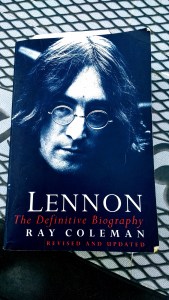
Lennon, the Definitive  Biography by Ray Coleman.

This is a book first published in 1984 that has been revised and updated. It’s been subtitled the ‘definitive biography’ although that’s not a phrase I’d use to describe it. It’s a decent enough book don’t get me wrong but as for ‘definitive’, that’s another matter. The writer has known Lennon as a journalist since the heady days of the early sixties when the Beatles had their big breakthrough in the pop charts so has had the opportunity to talk with Lennon first hand regarding many events in his life.

The first part of the book appears to be the new revised section and details what has happened to Lennon’s work and image in the years since the book first appeared although really, this section would be better placed at the end of the book.
The writer has no time for music journalists who waxed less than lyrical about later Beatles’ records released in the last thirty odd years, things like The Beatles at the BBC released in 1994 or the Beatles Anthology. Reviewers who gave those records a poor reception get short shift indeed and the reader is quickly reminded of their chart topping sales. In their defence though pop music journalists tend to look forward to new music, not back to the old. More scorn is saved for Albert Goldman who wrote the book The Lives of John Lennon. Personally I thought that was rather a good book; it’s certainly more compelling than this one although it tends to focus on Lennon in a negative way whereas this book is very generous towards Lennon. It’s the book of a Lennon fan and focuses on the events in Lennon’s life in a very positive way.

Another annoying aspect of the book is that when Lennon and the Beatles achieve fame, the book drifts off into a lot of general observations about Lennon’s life and music and the narrative tends to lose the thread of his life story. A similar thing happens when discussing John’s son Julian when the narrative jumps forward to discuss things that have not yet happened in the story’s timeline. Sorry but I like my biographies to stick to a certain amount of chronological sequence.

Both John and Yoko emerge from this book as whiter than white although the truth of John Lennon is, I suspect, somewhere between Albert Goldman’s critical book and this work of praise.

After writing this review, here in Lanzarote, we went for a meal at the Casa Carlos restaurant. As I scanned through the menu I could hear something familiar playing in the background. I couldn’t recognise what it was at first. It was an instrumental version of something, then I realised what it was: Love me Do. I’m sure the sharp-tongued John Lennon would have some choice words for the restaurateur after hearing an easy listening version of his work as background music.

Being Elvis by Ray Connelly
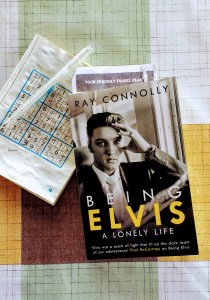
Subtitled A Lonely Life, this is a biography of Elvis Presley by another music journalist, Ray Coleman. Elvis became the King of Rock ‘n’ Roll who inspired Lennon, McCartney and a whole host of others to become musicians and pop stars. I’ve read quite a few biographies of Elvis, all much thicker than this one but this is a great holiday read being both interesting and informative. The foreword to the book was particularly insightful regarding the impact Elvis had on other musicians. The author recounts two phone calls, one to Bob Dylan and one to John Lennon where he happened to mention that he had been to Elvis’ 1968 comeback concert. Both those highly regarded stars bombarded Coleman with a series of questions about Elvis showing that despite their own success and achievements, they were still at heart Elvis fans.

The book goes on to recount Elvis’ beginnings as a poor white boy in segregated Mississippi who became an incredible phenomenon; revolutionising pop music, earning hundreds of millions of dollars and yet at the end of his life was dependent on loans from his bank to keep going as he had made few investments with his money.

Time and time again, Elvis was disappointed at the poor standard of the songs that he was presented with, especially in his films, however the book reveals that his manager, Colonel Tom Parker, wanted music in which the writers were willing to use Elvis’ own music publishing company and who were willing to give up a percentage of their royalties for Elvis and the Colonel. Elvis just appears to have put up with this intrusion into his artistic life as he didn’t like confrontations with his manager. The result was that he went from the cutting edge of pop music to somewhere at the back. It was only after his comeback concert in 1968 that he decided ‘enough is enough’ and decided to sing whatever took his fancy, no matter who wrote or published it.

In his later years Elvis was fat, bloated and addicted to amphetamines, sleeping tablets and diet pills. He worried how his fans would react to a tell-all book written by former members of his entourage. A final confrontation appeared with Tom Parker. Elvis threatened to sack him but Parker demanded back payments of 2 million dollars. Free of Parker, Presley could have got himself a new manager who perhaps could have sorted out his personal issues and engaged a new record producer, more in tune with the times. Sadly, he decided to stay with the ‘Colonel’.

Elvis died in 1977 of a heart attack. At the autopsy some months later 14 different drugs were found in his body, some in toxic quantities. It seems clear that drug abuse was a significant factor in his death.

A pocket-sized introduction to Elvis but nevertheless, an interesting and fascinating read.
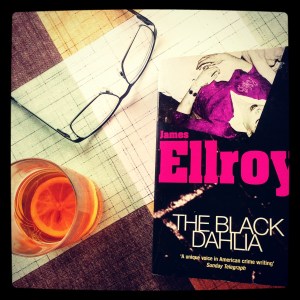
The Black Dahlia by James Ellroy.

This is the only novel I’ve brought with me on this holiday. I particularly chose it because I’ve read two of Ellroy’s non fiction books on previous book bags and I wanted to read some of his fiction. This is a detective story set in 1940’s Los Angeles and is a fast-moving story of cops and murderers and how to get on in the LAPD of the time. It’s written in the first person and is laced with LA jive talk and slang that really evokes the time and place. A good read but a little gruesome for me and I didn’t like the ending when you think the case is solved and then something else happens, and after that, something else.
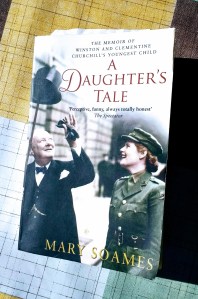
A Daughter’s Tale by Mary Soames.

This is a memoir by Winston Churchill’s youngest daughter, Mary. I had it down on my reading list as I supposed it was a biography of her father, however, it’s not a biography at all but a personal memoir of her life as Churchill’s daughter. It starts off with her early years living with her family in Winston’s famous house Chartwell. It’s a record of life in a different time and the writer talks about her retinue of animals, her nanny, the servants and all the things you might imagine surround her in an upper class home in the 1930’s. One interesting observation is that in 1935, Churchill, strapped for cash after the Wall Street collapse of 1929, considers selling Chartwell and his daughter quotes a letter he has written to an estate agent saying that his family has mostly flown the nest and that his life is probably in ‘it’s closing decade’. How wrong he was! The portrait the author gives us is an oblique one, Churchill seen from a different angle.

The early part of the book is not so interesting and the author constantly quotes from school girl diaries giving us a sort of Enid Blyton world of lunch and dinner menus, dog walks and pony rides and debutantes balls and a time when ‘coming out’ meant something far removed from what it does today.

The later part when Hitler plunges the world into war was when the book finally began to interest me. On the back cover the Sunday Express is quoted saying the book is a ‘delightful memoir’. I don’t think I can sum the book up any better.

As usual, here’s the video version below. I shot a couple of versions, one was too dark and another had problems with wind noise. I should have gone for take 3 really but the lure of the swimming pool was too much . .


One final book, Floating in Space set in Manchester, 1977. You can buy the book by clicking the icon below to go straight to Amazon!
Floating in Space

Walks with and without my Dad

As you read this post my winter holiday will be over and I’ll be back in cold old England. It’s been a nice break though, a month in Lanzarote and it’s been sunny and warm for the most part. There were a number of things I wanted to do in Lanzarote including working on my new book and other writing projects but sadly I’ve not been completely successful in that area.

Another thing was to improve my fitness which I think I have achieved, at least in part. I’ve swum in our pool almost every day and I’ve tried to make up for missed swimming days by doing extra lengths on the next day. The tight trousers I brought with me are now slipping off me so I must have lost weight, unless I’ve just stretched them! I’ve also done a fair bit of walking here which has also helped in the fitness area. A favourite walk for me is going from our rented villa in Las Coloradas down to the sea front and then on along the coastal path down to the Marina Rubicon. There’s a lovely view of Fuerteventura, a lovely sea breeze and sometimes you can see the ferry going across.

As I’ve walked along the sea front I’ve thought about my old Dad and how he would have enjoyed this walk. He was a great walker and when I lived at home, not having a car, we walked everywhere. When he retired he used to get up, have breakfast and then take the dog for a walk. He walked for miles and Mickey, who was a pretty old dog then, used to be worn out when they returned home. Mickey would have a long drink of water and then drop down on the floor somewhere to recuperate, oblivious of everyone having to step over him as he dreamed his canine dreams.

Once, my Dad and I went for a drink together. Dad said he’d take me to the Griffin for a pint. ‘The Griffin?’ I asked. ‘Where’s the Griffin? There’s no pub round here called the Griffin?’

‘Oh yes, the Griffin. It’s not a bad pub. It’ll be a nice walk.’

Well, off we went, out of Wythenshawe where we lived, past Peel Hall and down towards Heald Green. Heald Green was a good thirty to forty minute walk and I remember saying, ‘look Dad, let’s go into the Heald Green hotel for a pint.’

‘No,’ he said. ‘The Griffin’s not far away now.’ So we walked and walked, past Heald Green and on towards Cheadle and eventually, after about an hour’s walk if not longer, we came to the Griffin. Inside there were a bunch of fellas who nodded to my Dad and he nodded in return. Up at the bar the barman came over and said ‘pint of mild Ralph?’ He’d been here before, apparently.

I was exhausted and gasping for a drink and I was probably hanging onto the bar for dear life when my dad asked me what I was drinking?

‘Pint of lager please,’ I said. Dad nodded to the barman then looked back at me. ‘Not a bad stretch of the legs was it?’ he said.

Wythenshawe is supposed to be the biggest council estate in Europe, at least I remember reading that somewhere. When my Dad left school at 14 during the Second World War the estate was small and was surrounded by farms and market gardens. Gradually as the estate became larger the farms were swallowed up and built on. Dad worked on a farm in those early days and on one walk he decided to show me the first farm he’d worked at. I doubted there would be much to see but he took me through some unfamiliar streets and we came to a green with a few trees and there, just at the head of the green was an old house. The house was surrounded by the council estate which had been built around it. This used to be the farmhouse where he once worked. The green had once been part of the orchard. As we looked closer I could see that the trees were pear trees and I tried to imagine this place in a rural setting, instead of the urban one it had become.

Getting back to Lanzarote, it’s about a half hour walk to the beginning of the marina. The footpath comes in from high up on the rocks and you get a great view of the marina before you drop down and walk past the yachts and boats, their masts jogging slightly in the breeze. The picture above is one of me surveying the harbour.

After that it’s down to the marina proper and it’s nice to walk past the elegant restaurants and the smaller boats bobbing about on the water. Finally we arrive at our destination, the Cafe Berrugo and our waiter, Oscar, mimes the pouring of beer to us as we get seated. We mime back the thumbs up sign and the drinks quickly arrive along with our nibbles; nuts, olives and popcorn.

I reckon my Dad would have liked it here.


Floating in Space is a novel set in Manchester, 1977. Click the links at the top of the page for more information.

Some Hints and Tips from my Adventures on YouTube

I was checking my YouTube page the other day and noticed that I have eighty four videos there. That figure was quite a surprise to me. Eighty four videos? I have to admit, some of those are in my private file and are for production use only. (That makes me sound like a real film producer – production use only!) By that I mean some were uploaded so I could use the soundtrack on another video, some were uploaded without a soundtrack so I could add YouTube music later and some were promotional videos that use the old Floating in Space cover and were made before I introduced the newer version and rather than delete them I have just taken them offline.

By far my most popular video is this one, Trucking: The life of an HGV driver, 1980’s Style! I’d like to be able to tell you what a cracking video it is and that it is well worth watching although, in fact, it isn’t. It’s one of my first videos made before I even went on a media course at the Manchester WFA. I spent a few days with my friend Brian who was an HGV delivery driver and I made a short film about him at work.

I think people watch the film because of the nostalgia factor. I can see perhaps former HGV drivers watching it because that’s how things used to be, no sat navs or other gadgets, just get your map out and get trucking. They are certainly the ones who leave comments. Apart from that it has no particular merit. Pity I didn’t remove the title sequence, done on my old Sinclair Spectrum with music from Elton John, because if I had, the 35,917 views I’ve had at the time of writing could be making me a few quid in royalties. Instead the video is subject to a copyright claim by the owners of Elton’s music.

That’s probably the best lesson I’ve learnt from my time on YouTube; if you made a video years ago and used your favourite tracks from your record collection, replace them with royalty free music which you can download free from YouTube.

One of my favourite videos is another I made in the 1980’s, A Welsh Journey, Manchester to Porthmadoc. It’s a short documentary made about a rail trip which was inspired at the time by a documentary film presented by Michael Palin called Confessions of a Train Spotter. It was part of a Great Railway Journeys series and unlike some of the travel films made later by the former Monty Python performer, it was a great little film full of enthusiasm for the subject.

My old friend Steve and I wanted to recreate Palin’s journey but instead decided to do something cheaper and easier, a rail trip from Manchester Victoria to Porthmadoc. I did a great edit with a documentary style voice over and some top notch sound, music and effects mixing, courtesy of the new sound mixer I had just picked up. The big problem with that video, as regards YouTube, was that I used music from a great album by the Crusaders called Images. Now, that was fine in 1986 when the video was viewed just by me and my friends. Fast forward however to the 21st century digital age, upload it to YouTube and suddenly you have a whole lot of  musical rights owners who are not happy that their music is playing on my video. Result: YouTube have muted the entire soundtrack. You can still watch it but you cannot hear it.

The only thing to do was to take my original VHS video, slip the digitised version into my Windows Movie Maker and then re-edit and add some royalty free music provided by YouTube, in this case a little track by a guy called Kevin MacLeod called Local Forecast. I re-did some of the commentary, faded in Local Forecast in place of the Crusaders and even tidied up the video as a whole.

Some time ago videos could be edited on YouTube using their on-line video editor, hence the reason for uploading videos for ‘production use only’ as I mentioned earlier. You could trim videos, use the soundtrack from a different video and so on. Alas, the YouTube editor is no more, so it’s important to have your video all ready for viewing before you upload it.

One handy little thing on YouTube are YouTube cards. They are just that; a little card that appears in the top right hand corner in which you can add a link to other videos or even to your website.

Just going back to my Trucking video, two other reasons why that video does so well might be as follows.

a) The title is very SEO compatible. It’s straight to the point and tells you all you want to know and it also has a pretty good thumbnail or icon. That’s the image when you see when you first find a video on YouTube. If you look at the railway video above, you can see the icon has all the basics, a simple but relevant picture, the title, and a little explanation that it’s the updated version, not the one with the sound muted!

b) Thumbnails are important as a  good one can pull the viewer into watching your video.

A lot of my more recent videos were made on the Animoto web site. Animoto is a video editing website that comes with templates so you can easily upload your photos and video clips and the template will do the rest. You can even create a whole slide show video with just a collection of still images. Here’s one of my favourites, even though it’s just a little advert for my book:

Here’s another one, this time a collection of photographs of Lytham St Annes :

Right, so so far we’ve got documentaries from the 1980’s, promo videos, and slide shows. Not only that but I also have my book reviews on YouTube. Yes, I’ve always added a video version of my Book Bag series. Here’s the last one, filmed in sunny France in 2017:

Just as I’ve finished this post and pretty much finished re-editing my Airport 1986 video by adding royalty free music, I’ve had an email from YouTube advising me that because I have under a 1000 subscribers I can no longer ‘monetise’ my videos! Oh well, the Internet is a fast moving and ever changing place. Perhaps I should look at shifting my videos over to rival video channel Vimeo.com! Anyway, here’s my updated airport video, split into two parts for ease of uploading.

So, just to finish, here are three points that are key to developing your YouTube channel:

1. Use royalty free music!

2. Think carefully about your video title.

3. Add a simple but effective icon for your video; that and your video title can be the key to bringing in your viewers and subscribers!

4. People have very short attention spans these days. If they are not interested in your video in the first few seconds, they will navigate away from your video to something else so make those first few seconds count.


Floating in Space is a novel set in Manchester, 1977. Click the links at the top of the page for more information or watch the short promo below.

The Giorgio Factor and other Dining Stories.


I really do love dining out. I think it’s one of life’s great pleasures, not that I’m a food gourmet or anything, in fact I’ve got pretty simple tastes in food. Give me a nice bottle of red, tasty food and good service and I’m a happy man.
Some years ago Liz and I used to frequent a lovely Italian restaurant in St Annes. It was a great place. It was only small and a little basic and I got the impression that in a former life it used to be a small shop. It was called, well, I won’t say the name but the owner was a guy called, actually, I’m not going to say his name either.

It was a lovely rustic place and when it was quiet the owner would say to me, ‘Steve, tell me what you want, whatever it is I’ll make it, even if it’s not on the menu. If I have the ingredients, I’ll make it for you.’ That was rather nice of him and I hope his offer was because we were friends and not because I was difficult to please.

One of his waiters was a guy called Giorgio. He was a really nice fella but as a waiter, pretty useless. More than two people in the restaurant and he’d start to flap, big style. He’d bring us a menu and then, well that was all he could do really. We’d order a bottle of wine and when it never arrived we’d have to prompt him by waving empty glasses at him. The main course would come and there’d be no cutlery. One time they had this other waitress who was Italian and spoke no English. Another couple would enter the restaurant and before Giorgio could get himself together the trainee waitress seated them and had taken their drinks order. Giorgio ambled over, asked what could he get them to drink just as the drinks were actually arriving! We do miss Giorgio and that lovely restaurant. Ever time you spoke to him he would say, in a strong Italian accent, ‘you’re welcome.’ He rarely did anything but he always said ‘you’re welcome!’

One day the restaurant sadly closed down and the owner started up a new place in Blackpool. When we visited a while ago I noticed Giorgio had not made the transition to the new premises. Pity, he did make us laugh. Anyway, when we dine out these days at somewhere new we sometimes try and spot which waiter has the Giorgio factor.

In Casa Carlos this week in Lanzarote, the main contender for this week’s Giorgio award was a lady that was determined to pour our wine. One of our pet hates is the waiter who tries to pour our wine when we are not ready. In fact, we don’t want the waiter pouring our wine at all. OK, he, or she, can do that initial pour after the opening of the wine and the tasting ritual but after that, leave us alone. We pour the wine only when we are ready and not before. Well, in Casa Carlos we fended this lady off a number of times when she made a raid on our table in a vain attempt to pour our wine. No, ‘get back’ we told her. Liz tried to fool her by hiding our bottle on the low window sill behind our table. Ha, we thought, try and get our wine there!

However, just as we were chatting and I had shovelled in a mouthful of barbecued steak the waitress homed in from our blind side, swerving silently towards us like a ninja but just at the last second Liz spotted her, grabbed the wine and said ‘no thank you’ firmly. You have got to be firm with these Spanish waitresses.

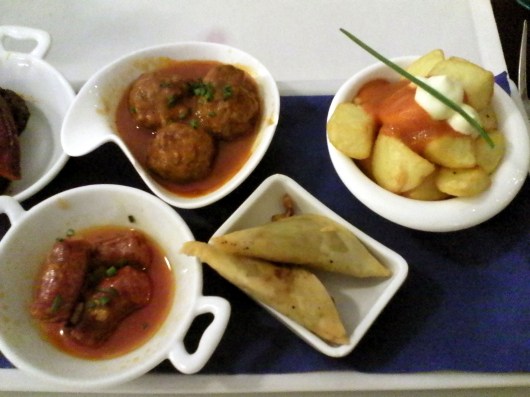
Tapas at the Blue Note Restaurant, nice but a little on the small side . .

When we first arrived in Lanzarote some years ago our first restaurant port of call was a place called the Blue Note, a classy jazz bar restaurant in the Marina Rubicon area of Playa Blanca. We were pretty starving so we ordered a few tapas. Sadly they were of the rather small minimalist type, you know, three meatballs to a plate. We had ordered six tapas but they were so small when we had eaten them we were still hungry. Next port of call was Cafe Berrugo. OK, we get the picture we thought, tapas plates are small in Lanzarote. We ordered four plates of tapas and two beers, then, thought, is that enough? Waiter, portion of fries please. Ten minutes later, the tapas arrive and guess what? They are massive plates! How can we eat this lot and the fries?

We have since become regulars at Cafe Berrugo. The waiters know us and what we like, for instance they always give out complimentary nuts to the English and olives to the locals. However, we have gradually shown them that some English people actually eat olives. Oscar, our favourite waiter looks after us and always serves us the vino tinto at room temperature. Our other favourite waiter is a guy we just call Good Morning as he always bellows out ‘good morning’ when customers arrive, whatever the time of day! It’s always nice to finish the night here with a complimentary shot of ice cold vodka caramel before getting our coats on and waving goodbye with a cheery ‘good morning’!

One final dining story: Here in Lanzarote the last few days have been a little stormy, however one day the heavens cleared and the sun shone again. The forecast had said heavy rain but what the heck! We were in barbecuing mood so we cranked up the coals and prepared the meat and salad. Yes, it was a lovely barby. Just at the end, literally as I was taking my last bite of a lovely burger and despite the sky in the west being clear and blue, the sky above and to the east darkened. It reminded me, like a lot of things in life, of a film I’d seen years ago. It was a space disaster movie from the seventies or eighties. The one where the crew need to launch to save the guys on the space station but Cape Kennedy is hemmed in by a storm. Well this hurricane passes directly over and the rescue mission launches through the eye of the storm, just like how we had our barbecue in the nick of time before the heavens opened.

What the heck was that film? If you know, answers on a postcard please!

(2021 update: It was Marooned!)


If you liked this post why not try my book, Floating in Space available from Amazon as a kindle or a paperback.

The Long and Dusty Road of Life

A short road, a long road,
A travelled-only-once-road
It’s the long and dusty road of life
It’s heartache, happiness, and strife

A happy road, a clean road​
Is the road that I desire
A cheerful road, a sweet singing music road,
Free from muddy mire

Let my road be a long road,
A fondly remembered high road
And don’t let me detour at a crossroads,
Or linger on a lonely road

One day I’ll need a fast road, a rushing road
A quickly time is running out road
And I’ll breathe my last in a quiet road, a by road
An end of the line side road

For journeys end is a sad road
A goodbye and thanks for all you’ve done road
A cul de sac, an avenue, a long gone distant road,
And as time passes it soon becomes a travelled-long-ago road.


Steve Higgins is the author of Floating in Space, a novel set in Manchester, 1977. The book is available in Kindle or paperback formats. Click the links at the top of the page for more information.

Tap, Tap, Tapping my Way


I’m caught up in the fog

I’ve got my hands out

Feeling my way like a blind man in a haze

Tap, tap, tapping my way along,

Through life.

I don’t really know what I’m looking for

But I keep searching

I’m like a blind man fumbling in the dark

And I sometimes think I need an instruction book

So I can be flick, flick, flicking,

Through life.

There are times; I guess it’s my lot,

When I don’t understand the plot.

I’m going backwards and forwards

Trying to understand.

Fast, fast, forwarding

Through life.

One day there’ll be a break in the fog

And I’ll see the sun,

But when the answers won’t come

I’ll dream harder,

Borne back to the past by memories

Back, back, back,

Through life.


Steve Higgins is the author of Floating in Space set in Manchester, 1977. Click the links at the top of the page for more information.