Reading about Watergate

I remember being in our usual pub quiz a few months back and one of the questions concerned Watergate. We were sitting with some friends, actually some much younger friends and one of them asked me, ‘Watergate? What’s that?’

I have to admit to being surprised as the Watergate scandal is something that every one knows about, don’t they? It’s the scandal that gave the world the ‘gate’ suffix which has been added to every scandal that has happened since. Hence Irangate, Camillagate and so on. What was Watergate about then you might ask? OK, it’s a subject that’s well worth reading about if you like American politics, which I do. I have a number of books about Watergate and President Nixon and I’ll go through them in a moment. Firstly though back to that question, what exactly was Watergate all about?

On June 17th 1972, five burglars were caught in the Democratic National Committee headquarters in the Watergate Building in Washington. Some of the five had links to the CIA or the FBI but all of them were linked to an organisation known as CREEP, the Committee to REElect the President. The President was Richard Milhous Nixon who had been defeated by John F Kennedy in 1960 but had made an extraordinary comeback to the political limelight. Just think back now to the presidential elections of recent years. Remember those defeated candidates, Dukakis, Mondale, Dole? Familiar names who had their fifteen minutes of fame and then vanished into the history books. Did any of them ever make a comeback? Well, the only one that I can think of is Richard Nixon.

Defeated in the presidential election of 1960 he then ran for governor of California only to lose that election too. He appeared before the media to concede defeat but in an emotional attack on the assembled press he finally called it a day for his political ambitions. ‘You won’t have Nixon to kick around anymore’ he said angrily. Then he was gone, off to start a new life in a legal practice. Eight years later he would once again be the Republican candidate for the presidency in the turbulent year of 1968 and this time he would win.

Nixon knew about the hard-line politics of the 1960s and 70s. He knew that others used bugging and other illegal means to get political intelligence and he wasn’t above using those tactics himself. During the Vietnam war Government employee Daniel Ellsberg leaked top-secret information that later became known as the Pentagon Papers to the press. Nixon was furious that the FBI and other security services did not seem to be up to the task of stopping those leaks. He created a security intelligence group within the White House to address the problem and they became known as the ‘plumbers’ led by former FBI agent G Gordon Liddy.

After their initial operations to investigate the leaks of secret information, they escalated their activity to include burglary and covert bugging operations. Wiretaps and listening devices were secreted in the Watergate building, presumably to harvest intelligence on the rival Democratic campaign. However, the Plumbers were required to break in again to service existing devices and set up new ones. On the 17th June 1972 they were caught by the Police.

Whether Nixon ordered that actual break in is unclear, but he did block attempts by the FBI to investigate the matter and he also warned the CIA director that a vigorous investigation of the break‐in might ‘blow the whole Bay of Pigs thing, which we think would be very unfortunate—both for C.I.A. and for the country, at this time, and for American foreign policy.’ What, I wonder, was he referring to, what knowledge did Nixon have about the Bay of Pigs that would threaten Richard Helms, the head of the CIA?

John Dean, counsel to the President was concerned about the increasing demands of the Watergate burglars for more and more money. He mentioned to Nixon that these could ultimately cost -and here Dean plucked a figure from thin air- a million dollars. Dean was shocked by the response.

President Nixon: We could get that.

Dean: Mm-hmm.

President Nixon: If you—on the money, if you need the money, I mean, you could get the money fairly easily.

President Nixon: What I meant is, you could get a million dollars. And you could get it in cash. I know where it could be gotten.

By this time, news of Watergate and wider implications of misuse of election funds had permeated into the media. The Washington Post had led the way with its reporting by two journalists, Bob Woodward and Carl Bernstein. They had produced numerous scoops because of information given to them by a high level source in the FBI, a source known only as ‘Deep Throat’ but who was later revealed to have been Mark Felt, a deputy director at the FBI.

In early 1973 the senate began its investigation with televised hearings and one of the first revelations was that Nixon routinely taped conversations in the White House. Archibald Cox who had been appointed Special Prosecutor subpoened the tapes. Nixon refused to hand them over and ordered the Attorney General to fire Cox. He resigned in protest as did the Deputy Attorney General. The Solicitor General was called upon to fire Cox which he did. The incident became known as the Saturday Night Massacre.

The revelations on Nixon’s tapes damaged his reputation severely. In an effort to stave off the release of the actual tapes, he first released transcripts. The public reaction, initially favourable, soon faded after people came face to face with the numerous ‘expletive deleted’ comments which were substituted for their President’s foul language. The Providence Journal wrote,  ‘while the transcripts may not have revealed an indictable offense, they showed Nixon contemptuous of the United States, its institutions, and its people.’

Some time later Nixon was forced to release the first batch of tapes. On 27th July 1974 the House Judiciary committee voted to recommend the first article of impeachment against the president. On August 8th, Nixon broadcast his resignation speech. The next day he resigned from office.

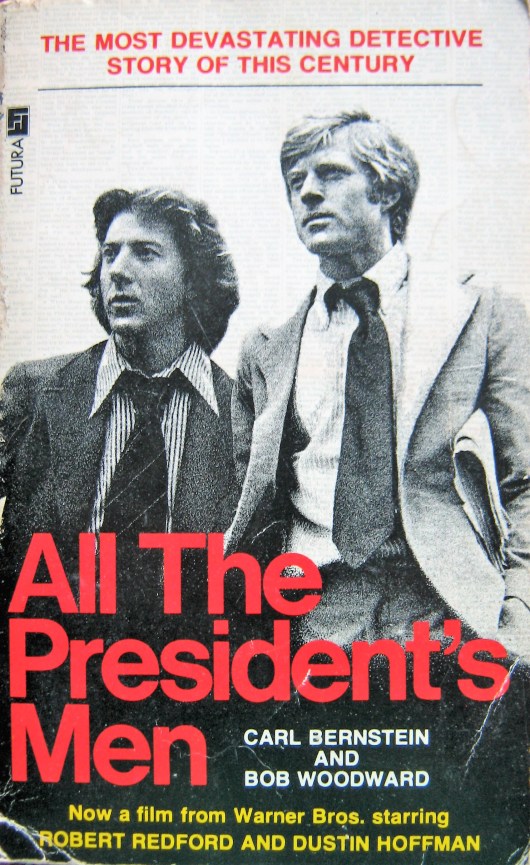
Bob Woodward and Carl Bernstein wrote the excellent book All the President’s Men, later made into a major motion picture. It is well worth reading, an excellent book of investigative journalism.
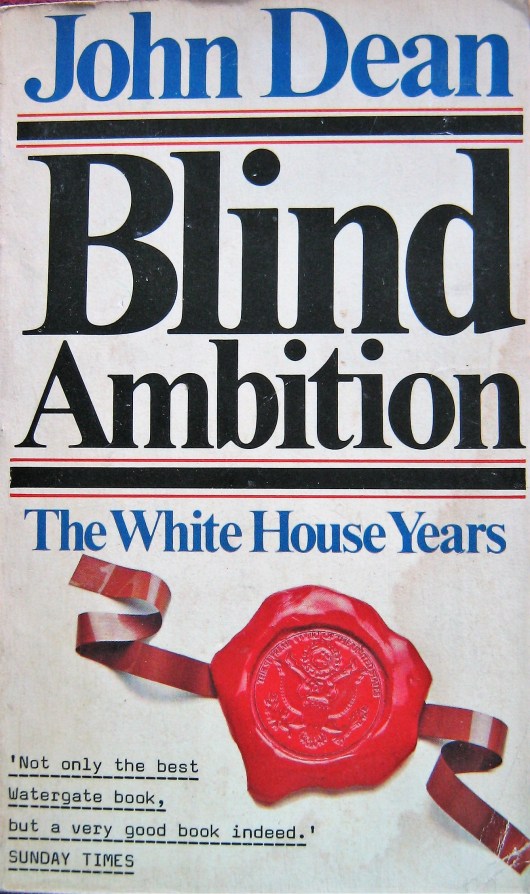
John Dean wrote his version of events in the book Blind Ambition. Dean was given a jail sentence of one to four years for obstruction of justice. He pleaded guilty and after cooperating with prosecutors his sentence was reduced to time served, a mere four months.
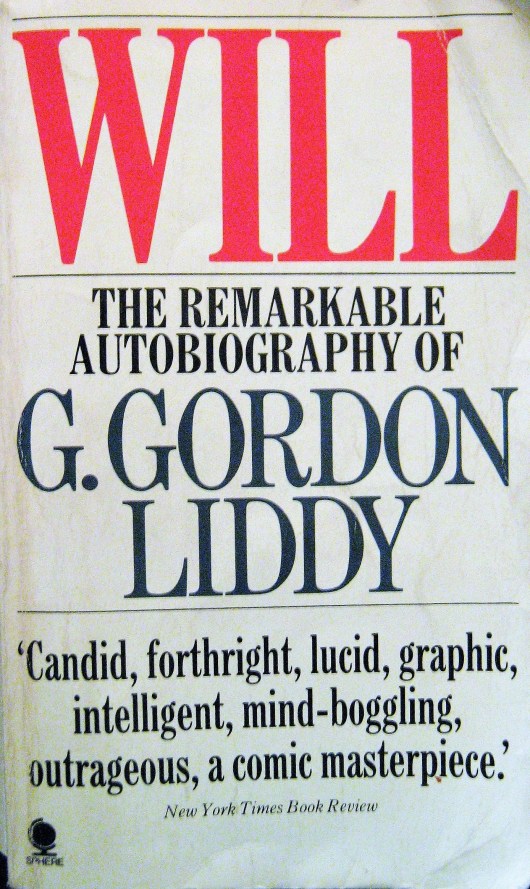
G. Gordon Liddy was a former FBI agent and the chief operative of the White House ‘Plumbers’ unit. Liddy was sentenced to 20 years imprisonment for his involvement in Watergate but this was later reduced by President Carter and Liddy was paroled after four and a half years. Liddy later became a popular radio broadcaster in the USA.
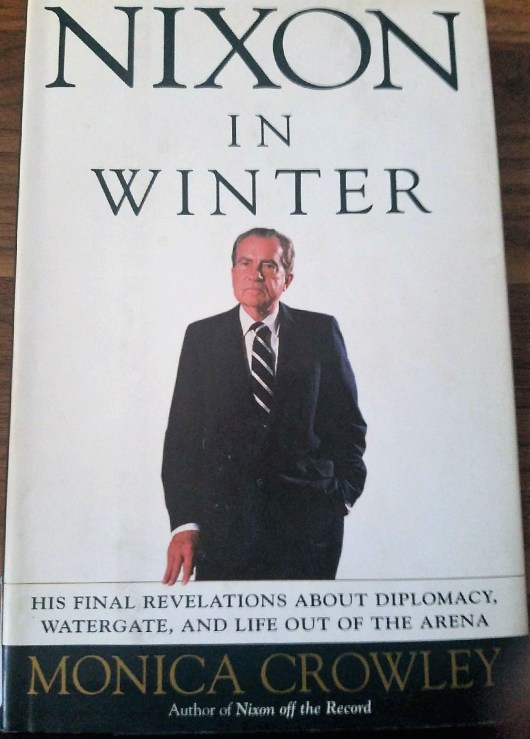
One last book about Nixon himself rather than Watergate.

President Richard Nixon retired in disgrace to his home in San Clemente, California. He never admitted any wrongdoing during his time as President, in fact he stated ‘if the President does it, that means it’s not illegal!’ Nixon in Winter is by Nixon’s research assistant Monica Crowley who worked for the former President until his death in 1994.
Steve Higgins has written a novel ‘Floating in Space’ set in Manchester, 1977. Click the links at the top of the page to buy a copy or for more information.

Brando, Alfie and the Art of Texting.

I’ve written about my mother and father in my blog posts so perhaps it’s about time I wrote about the one remaining family member, my brother. My brother Colin lives in Manchester and we see each other every couple of weeks or so when we meet up in the city centre for a pint or two.

My brother Colin is a very subtle character. He won’t ask me outright if I fancy a pint with him, he’ll tend to text me and his text will usually go something like this:

Meatballs!

Now that is subtle you’re probably thinking, is it a code? No, but the correct answer is this:

Definitely!

Still completely in the dark? Well, I suppose you might not be classic movie fans like Colin and I because a lot of the time we text in movie dialogue.

My brother sent me a text a few days ago; it read simply ‘You don’t remember me do you?

Probably a little confusing to the man on the street but I knew exactly what he meant. I responded with; ‘I remembered you the moment I saw you!

My brother came back straight away; ‘by the nose huh?’

Yes, texting in movie dialogue is what we do. Picked up on the movie yet? That particular movie is one of the movie greats of all time. It starred Marlon Brando in an Oscar-winning performance, much better, much more exciting and above all, much more human than his other Oscar-winning role in the Godfather.

Here are some more texts

ME: Do you remember parochial school out on Puluski Street? Seven, eight years ago?

MY BROTHER: You had wires on your teeth and glasses. Everything.

ME: You was really a mess.

The movie was ‘On the Waterfront’ and it’s probably famous for the double act of Marlon Brando and Rod Steiger playing brothers but there are plenty of other wonderful performances and scenes. My personal favourite is when Brando and Eva Marie Saint walk together in the park and Eva drops a glove which Brando picks up but keeps hold of and eventually pulls onto his own hand and we know that Eva wants it back. The dialogue above comes about here where Brando, playing the part of Terry Malloy, realises he knew Edie, played by Eva Marie Saint at school. He is trying to communicate with her in his oafish way and Edie begins to realise she actually likes him but, well watch the movie, believe me it’s a great scene. It finishes like this:

MY BROTHER: I can get home all right now, thanks.

ME: Don’t get sore. I was just kidding you a little bit.

I read somewhere that Elvis knew all the dialogue from Rebel Without a Cause, the James Dean movie. If so my brother Colin and I are in good company because we know the dialogue from that film too, as well as Giant and the aforementioned On the Waterfront. One day I thought I’d try a quote on Colin that he would never get.

Me: I took everything out of that car except the rocker panels!

I sent the text off feeling pretty pleased with myself. He’ll never get that in a million years I thought. My phone bleeped a moment later and I looked down to see:

MY BROTHER:  C’mon Herb, what the hell’s that!

Top marks indeed if you remember that dialogue from The French Connection.

My brother and I do text each other a lot but we also chat on the phone too. The thing is though; we talk on the phone with East European accents. We starting doing it one day then began a sort of unspoken contract to carry it on. Sometimes I’ll get a call and he might say, in his best Hungarian accent ‘ Gut Evenink my friend’

‘Gut evenink to you also my friend’ I tend to reply.

East European is the norm but sometimes we use German accents. Handy when we bounce quotes from The Great Escape off each other!

Me: I hear your German is good, and also your French . .

My Brother: Your hands UP!

The Great Escape is a firm TV movie favourite but let me finish with a 60’s classic we also frequently text about:

Me: She’s in beautiful condition!

My Brother: Blimey girl, you’re not as ugly as I thought!

Me: I saw that geezer Humphrey going off. You’re not having it off with him are you?

My Brother: I tumbled at once. Never be cheerful when you’re working a fiddle!

Me: I ain’t got my peace of mind. And if you ain’t got that, you ain’t got nothing.

My brother: It seems to me that if they ain’t got you one way, they’ve got you another.

Got the picture yet? The film is Alfie. It was directed by Lewis Gilbert who also directed some of the earlier Bond films. The script was written by Bill Naughton and adapted from his own book and play. Alfie is a fascinating film on many levels. It’s a peek back at the swinging sixties; it explores the elements of comedy versus drama, something I’ve always loved and which I looked at a while ago in a post about the TV show MASH. The film features great performances from all the principal and supporting actors. One fabulous feature is how Alfie talks directly to the camera and sometimes even says things that directly contradict something he is doing or saying to another character. In the opening sequence Michael Caine as Alfie addresses the audience and tells them not to expect any titles. There are none, except for the film title itself and the closing credits feature photos of the cast and crew.

Many actors turned down the chance to play Alfie on film, including Caine’s then flat mate Terence Stamp who played the part on Broadway. Laurence Harvey, James Booth and Richard Harris all turned down the role and Alfie became a breakthrough movie for Michael Caine.

Anyway, time for one last text to my brother:

Me: So what’s the answer? That’s what I keep asking myself. What’s it all about?


Floating in Space is a novel by Steve Higgins set in Manchester, 1977. Click the links at the top of the page to buy or to find out more.

Manchester, 41 Years On

A lot has changed in Manchester city centre, at least on the surface, but to a great extent it’s still the same city as it always was. My book, Floating in Space is, as you probably know if you have ever visited this web page before, set in Manchester in 1977 and I thought it might be interesting to take a look at the city, some 41 years later.

In 1977 there was no internet, no mobile phones and wireless was an old fashioned word that our parents used for the radio. Manchester was a busy and bustling city even back in 1977. People came into the city to shop, visit the cinema, eat at restaurants, drink beer and socialise in pubs and bars, pretty much just as they do today.

I loved my Saturday nights in Manchester. There was a quality of security, of expectancy, a feeling that the night and the future were going to be good. A feeling that you might just meet some gorgeous girl and that even if you didn’t, it didn’t really matter because there was always the excitement of the people and the music, and everything else that made up the evening. Then there was always the expectancy of the next night, and the next, and on and on into the future. The past building up inside you like a great data bank, reminding you, reassuring you, like a light burning in some empty room in the corner of your mind.

The main venue for me and my friends on a Saturday night in 1977 was the ‘Playground’, a small disco bar on Oxford Rd in the town centre. Flickering multi-coloured spotlights rotated across the red carpeted room which, on Fridays and Saturdays, was generally packed.

It had a small dance floor down at street level and when people stepped up to the bar, which was up on a slightly raised level, they could look down at the dancing, gyrating and mostly female dancers. Interestingly, on the same dance floor on week day lunchtimes, a topless dancer appeared at the stroke of one o’clock to translate the soul and disco music of the time into pulsating physical motion, the eyes of jaded office workers glued to her as she did so.

My friends and I used to meet up in the Salisbury, by Oxford Rd station, have a few pints and then make the short walk to the Playground. There was a paltry fifty pence charge to gain entry, the solitary bouncer was silent, but not unpleasant, and the DJ, who always began the night with ‘Love’s Theme’ by the Love Unlimited Orchestra, (Barry White’s backing band) played alternate sessions of rock, disco and chart music.

We were mad about Jenny, the barmaid. She was lovely. She had a kind of round, open face, framed by thick blonde hair and her skin was a creamy white. She served us Worthington ‘E’ and we melted into the hubbub of people on their Saturday night out whilst the music of the seventies drifted through us.

Those then, are my memories of Saturday nights in Manchester. Beer, music, girls and a kebab or curry before getting the late bus home.

I’m sure there are still Saturday nights like that, in Manchester’s 21st century world. Most of the pubs I used to frequent are still there, repainted, refurbished and in some cases re-named. They may look different but peel away those new outer layers and you’ll find things pretty much the same. Different decor, different music but still very similar people enjoying an evening of drinks, music and chat.

The Salisbury is still there. Today it looks just like it always did. Inside the pub has been refurbished but in a good way and it looks pretty similar to how it used to look. The room where my friends used to sit has gone. It’s now an office or a private room. Still, the same flagged stone floor is there and whenever I step inside the memories come flooding back.

The Playground is still there too, well not the Playground exactly but the building is there. It’s now the Palace Theatre bar and what it looks like inside I do not know. The last time I passed by it was closed but I imagine that the DJ’s booth and the dance floor have gone. Perhaps Jenny passes by and remembers the old times just like me. Perhaps not, perhaps it was just another bar job to her.

Once upon a time in 1977 I was a young office clerk who ate his sandwiches in St Peter’s Square on sunny weekday lunchtimes. All is different there now. Today Manchester looks cleaner and sleeker. Modern buildings of steel and glass sit side by side with traditional architecture and through it all glides the modern tram, toot tooting its way through the city.

Even at the old end of town, things are cleaner, smoother. Warehouses and old buildings have been reformed into trendy bars and restaurants and dance music venues. A short walk from Deansgate Station takes you to the Dukes 92, a lovely and trendy canalside bar but take plenty of money with you, it’s not cheap!

Walking up Peter St from Deansgate, the Café  Royale is gone. There is a bar called Henry’s Schloss, a huge Beer Keller sort of place where 2 pints of lager cost nearly ten pounds and large groups of men quaff beer and enjoy themselves. It’s not really my sort of place.

Just round the corner though, is a place that is my sort of place, the Abercromby, actually the Sir Ralph Abercromby, is one of those pubs that is a little like stepping into a time capsule. The decor is authentic seventies with lots of stained dark wood and leather seats and they serve a decent pint. I read on the internet that it was the model for the pub in the TV show Life on Mars. The former footballer turned property developer Gary Neville apparently wanted to knock down not only the pub but an entire block in the area to build two skyscrapers and a hotel. The fact that the pub dates back to the early 19th Century and is the only structure remaining from St Peter’s Field, site of the 1819 Peterloo Massacre clearly meant nothing to him. Happily the council planners would not let him have his way.

As you read this on a Saturday morning the cleaners are busy in those Manchester bars. The chillers will be stocked, the carpets cleaned and the tables polished. New barrels of beer and lager will be made ready.

Everything is ready for another Saturday night.


What to do next: Here are a few options;

Listen to this post as a Podcast –Click Here!

Share this post on your favourite social media!

Hit the Subscribe button. Never miss another post!

Buy the book! Click here to purchase my new poetry anthology.

Click here to visit Amazon and download Floating in Space to your Kindle or order the paperback version.

10 Famous and Not So Famous Cars!

The Batmobile.

No, I’m not thinking of the one that locks up in a sort of caterpillar way, although I’d love to have a car that does that. Nor am I thinking of the one that resembles a tank. Just in case I’ve lost you here I’m talking about the comic strip hero Batman and his motor car, the Batmobile. Batman has progressed from comic strip to TV to the big screen but my favourite Batmobile is the one from the 1960’s TV series starring Adam West as the Caped Crusader and Burt Ward as Robin, the Boy Wonder. The dynamic duo regularly leapt over the doors into the car ready for a quick getaway in their pursuit of the dastardly villains of the 1960’s such as the Penguin, the Joker and so on. I used to have a Corgi model version if I remember correctly.

John Steed’s car

Patrick MacNee played the debonair John Steed in TV’s the Avengers and his car throughout much of the series life was a vintage Bentley. Steed, just like the dynamic duo, had a habit of leaping over his car doors. Must have scuffed those leather seats with his shoes though, I wouldn’t be happy about that. If you have ever read the original James Bond novels, you’ll know that Bond’s personal car was a Bentley, although it can’t have looked too good after Hugo Drax forced him to crash in Ian Fleming’s novel Moonraker. If you are thinking well, I saw the film and I don’t remember that bit, I think it’s fair to say that the books are usually pretty different to the films!

The Saint’s Volvo.

Simon Templar alias the Saint, played by Roger Moore, drove a white Volvo P1800 with the registration plate, ST1, which by my reckoning, if that was a real plate, would be worth quite a few bob today. In fact, if I had that few bob I might be tempted to buy it for myself. ST1, yes, that’d look pretty good on my old Renault Megane!

James Bond’s Aston Martin.

One of the memes I use frequently on Twitter is one of Sean Connery, exclaiming ‘ejector seat? You’re joking!’ to his technical colleague Q in the James Bond film Goldfinger. Bond’s Aston Martin DB11 had a variety of gadgets ranging from the aforementioned ejector seat to rotating number plates, forward facing machine guns (just the job to deal with road rage issues) and oil and smokescreen ejectors to fend off any following bad guys. In a later Bond film, Die Another Day, Bond, this time played by Pierce Brosnan, had an invisible car. Pity Brosnan didn’t reprise the ‘you’re joking’ line in that film which was Brosnan’s last outing as 007.

Steve McQueen’s Car.

The movie Bullitt was a classic cop film. OK, the plot was a little complicated but the car chase was the classic movie car chase of all time. McQueen drove a Ford Mustang 390 GT. Its 6.4 litre engine making a throaty roar as McQueen gunned his car in pursuit of the bad guys. I used to think his car was a Ford Cougar which is why I got all excited when I once used a hire car and was told over the phone it was a Ford Cougar. It turned out to be a different car altogether, a Ford Kuga!

‘Back to the Future’ 1981 DeLorean DMC-12

In the Back to the Future time travel trilogy, Marty McFly ends up back in the 1950’s courtesy of the time machine installed in the car by wacky inventor Dr Emmett Brown. The car warps into the past, or future, whenever the car’s time circuits are activated and the car hit 88mph. That of course happens to Marty McFly early on in the movie and he ends up back in 1955. There he meets a younger version of Doc Brown and he agrees to help Marty return Back to the Future. A great film and a pretty nice looking motor for the mid 1980’s. I particularly liked the gull wing doors.

‘Smokey and the Bandit’ 1977 Pontiac Trans Am

Still on the subject of films, ‘Smokey and the Bandit’ was the second highest grossing movie of 1977, second only to Star Wars. It’s about a trucker known as ‘the Bandit’ who is paid a large amount of dollars to get 400 cases of Coors beer across the state boundary from Texas into Georgia. I don’t exactly know much about US State boundaries or whether it was illegal or not but anyway, Burt Reynolds plays the ‘Bandit’, who recruits fellow trucker ‘the Snowman’, to drive the beer truck while the Bandit himself drives a Pontiac Trans-Am to lure any ‘smokies’ or police, away from the beer laden truck. Along the way the Bandit picks up the lovely Sally Field and finds himself being pursued by Texas Sheriff Buford T. Justice. Sounds pretty simple doesn’t it? A Guy, a fast car, a lovely girl and a whole load of fun filled action packed car chases. It’s a great film and that Pontiac is a great looking motor car.

Number Six’s Lotus 7

Remember The Prisoner from the late 60’s? Well if you don’t, it was a sci-fi fantasy-espionage TV show starring Patrick McGoohan. McGoohan stars as ‘Number 6’, a British agent who resigns and is kidnapped from his home, waking up in in the mysterious ‘village’ where the man in charge, Number 2, wants information. The opening sequence shows McGoohan driving around London in the rather lovely Lotus 7 and then back to his London flat where his mysterious abductors pounce. I’ve always rather fancied a Lotus 7, although I do like my creature comforts such as my CD player and my air con. Doesn’t look like there is much room in the Lotus for all my CD’s either!

Starsky and Hutch  Ford Gran Torino

Cast your mind back to the year 1975. Remember the TV cop show Starsky and Hutch? Well if you don’t then maybe you caught the movie version released in 2004. I say movie ‘version’ because the film is a sort of tongue in cheek comedy version of the TV show. Actually, neither the film nor the TV show were that great in my opinion but I did like their car which was a Ford Gran Torino in a rather lovely shade of red with white flashes down the side. Not sure if the car was much use during covert shadowing operations but hey, it looked fantastic!

My Car

If you are a big fan of film noir, you’ll have probably noticed that a lot of Los Angeles based detectives and their New York counterparts too, have a habit of parking up and leaving their cars with windows open and without any attempt at putting the roof down or locking up. If I left my car like that when I visit the council estate where I used to live I’d be lucky if my car was still there when I returned. Or if it was still there, then I’d be lucky to see the wheels still attached. TV detectives like Simon Templar for instance, also rarely lock their cars or even carry any keys for that matter. Anyway, as I’ve mentioned my car I might as well tell you more. My car is a Renault Megane convertible. I’ve always wanted a convertible and so in a way, this car is a lifelong dream. I probably would have preferred a Porsche or a Chevrolet but what the heck, I love my Renault. It’s nice to drive, supremely comfortable, well, for me anyway. Liz hates it as because of her back problems she needs a more sit up straight seat; for me, the slightly reclining position is perfect. One negative comment about the Megane: I always feel slightly embarrassed when a bulb blows because I have to take it to the garage to have another fitted. Why is fitting a light bulb so difficult in cars these days?

Just recently the weather in late April in the UK has warmed up and the other day it was time to take a drive with the ‘hood down’ as they say in American films. I do love the process of dropping the roof, hearing the smooth whine of the electric motor as the windows drop and the roof folds away into the boot. Whenever I do that I always hear the theme tune to Thunderbirds in my head and feel just a little like Scott Tracy as he slides his way from the lounge on Tracy Island over to Thunderbird 1. One interesting observation came to me today on the way to work. It was a lovely sunny afternoon and I motored along serenely with my hair ruffling ever so slightly in the breeze, the sun was warm on my head and shadows flickered lightly across my tinted lenses. I noticed a number of convertibles out on the road, some slightly more glamorous vehicles than mine, others not quite up to scratch. One thing they all seemed to have in common was that in all cases the driver was a middle aged follically challenged man wearing tinted lenses or sunglasses. Some would say that is a description that rather resembles me; surely not! Then again, perhaps certain people of a certain age and certain disposition lean towards a certain motorcar of the more open to the elements type. Oh well. . .

Now, I’m a little stuck for a video here but I did find this one, a sort of test video with my then new camera!


What to do next: Here are a few options.

Share this post on your favourite social media!

Hit the Subscribe button. Never miss another post!

Listen to my podcast Click here.

Buy the book! Click here to purchase my new poetry collection.

Click here to visit Amazon and download Floating in Space to your Kindle or order the paperback version.

Click here to visit amazon and purchase Timeline, my new anthology.