Exploring the Windmills of your Mind.

I’ve missed my sun lounger this year. Even though it has been a hot summer in the UK and Europe I don’t seem to have done what I always enjoy doing, relaxing in a sun lounger; reading, listening to music and letting my mind wander and open up to new thoughts, ideas and blog posts.

A whole bunch of my blog posts have started life in that way, just by relaxing and thinking and later putting those random thoughts down on paper or on my laptop and then later honing them into something readable and hopefully entertaining to my small band of readers out there in Cyberspace.

I have done some sun lounging of course both at home in St Annes and down in France but a motorhome holiday is different to renting a villa like we usually do. Cheaper of course but it seems to me that a motorhome holiday is one where you always seem to be going somewhere but not necessarily arriving. Maybe it might be better to find a suitable caravan park and stake out our own personal corner for a week combined with the usual driving about the previous and following weeks. My big problem of course as anyone who has ever read this blog before is that I am fundamentally lazy. I’m not one for doing a great deal of exploring, except for maybe finding the best way to the pool or the beach or to the nearest restaurant or bar. Once that vital research has been done and locked into my personal sat nav, that malfunctioning out of date device I refer to as my brain, well then that’s my exploring done.

One thing I enjoy coming across in France are windmills. Yes windmills, not the old fashioned ones although I like those too, I’m talking about those huge white modern ones that harness the wind and turn it into electricity. They do that quietly and cleanly without any side effects to the environment although there are some who say the windmills spoil our countryside. That is something I find hard to get my head around, especially when our nuclear power stations create power but leave behind a waste product that is toxic and radioactive for many years and the usual way of disposing of it is to dig huge holes underground in which to bury it like some allegorical cat burying its dirt.

After checking on the Internet I see that there are three kinds of nuclear waste LLW (Low Level Waste) ILW (Intermediate Level Waste) and HLW (High Level Waste). The first too are radioactive for perhaps 40 years but the High Level stuff can be toxic for many thousands of years. So, the next time you see a modern windmill just think for a moment how they are saving us from producing and storing this dreadful toxic waste. Not only that I’ve always found windmills elegant and calming with -and excuse me for perhaps waxing a little too lyrical here- a sort of innate beauty all of their own.

Round about this time of year my email inbox gets flooded with various invitations to participate in the annual JFK Lancer conference in Dallas Texas in the USA. JFK Lancer is a group named after the Secret Service codename for President Kennedy -Lancer- and they continue to research Kennedy’s assassination. I have to say I do always think about going to their annual conferences. It’s a heck of a way but it would combine a number of ambitions: visiting the USA and meeting other folk all interested in what happened to John F Kennedy that day in Dallas back in 1963. Even with the release of new files the real facts are still obscure and today all those intelligence agencies that had links to supposed assassin Lee Harvey Oswald still continue to deny them.

Lee Oswald, in case you didn’t know was a former marine who spoke Russian. Russian you might ask? Yes, Russian. How on earth does a marine get special training in the Russian language? Because he was an intelligence agent of course. Does that mean the CIA liquidated the President? No but it does mean that Oswald was not quite the guy that the media has portrayed.

Still, I’m sure there will be many presentations in Dallas about rifle trajectories, about the ‘magic bullet’ about Police officers who encountered secret service agents on the ‘grassy knoll’ (when in fact there were none) about the CIA and the Mafia. There might even be presentations about the secret service whose actions seem in retrospect to be a little bit odd; their officers spending the night before the assassination at a Dallas nightclub and they later had the assassination car cleaned destroying any forensic evidence. Will we ever know the absolute truth? I think not especially when experts cannot even agree from which direction the shots came from that killed Kennedy and if anyone expects to find a file released by the CIA with the plans for the assassination complete with names, well I don’t think that will happen anytime ever. Still, for conspiracy buffs like me it is all hugely fascinating.

Another death has been on my mind this last week, Liz and I went to a funeral in Blackburn. When you hit your early sixties like I have done funerals seem inevitable. Time runs out for the elderly and infirm just as it will for those who today are young and healthy. Sadly, this was not a funeral for someone old; it was a young girl aged only 28. A university graduate who excelled at sports, especially swimming and who had started a new career in the police force. The church was packed for the funeral and clearly the late girl’s father was surprised and moved at the turnout.

He, his wife and two other children, a son and daughter gave their own eulogies to the deceased each in their own ways. The father thanked everyone he could think of, the mother spoke of her daughters last days which were marked by humour. The sister spoke of earlier happier times and the young brother spoke of how 80 percent of his young life was taken up fighting and arguing with his late sister, each complaining to the parents about what the other had done and each lying that the other was guilty of some misdeed or other. In later life the two had finally become friends, just like many fighting siblings the world over do.

It struck me then about the unfairness of life, about how one person can live a long and happy life and another a short one. Both of those of course lose exactly the same thing but one will have enjoyed a long life and all its benefits while the other would hardly have had the chance to live. I remember thinking of my elderly mother, currently in hospital and fast approaching her 90th birthday. Dementia has taken away her short term memory and she lives in a state of confusion but her heart, nearly ninety years old, beats on as strong as ever. If she had the choice of choosing death instead of that young girl I am sure she would have gladly done so.

Once again I felt myself drawn to my new mentor, Marcus Aurelius for some comfort.


Floating in Space is a novel by Steve Higgins set in Manchester, 1977. Click the links at the top of the page to buy or for more information. In the video below I talk about the city of Manchester and discuss the background to the book.

Reviewing Spielberg

Not so long ago I thought about doing a post about the film director Steven Spielberg. I’d already done a couple of ‘favourite director‘ posts but the thing with Spielberg is that he’s not exactly one of my favourite directors so any post would be not really be complimentary so I didn’t want to get into writing something negative.
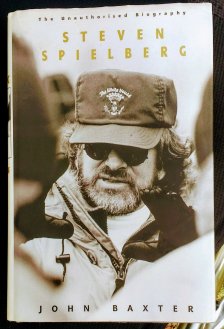
Anyway, I just happened to pick up a book about Spielberg in the second hand bookshop so it seems to me I can just combine my criticisms of the book and Spielberg’s works all in one post. I’ll try not to be too negative.

Steven Spielberg the Unauthorised Biography by John Baxter.

Spielberg was born in 1946 and the book glosses over his early life. His parents were divorced when Steven was at school and though staying initially with his mother and sisters he later went to stay in California with his dad. He was making amateur 8mm films as a youngster and according to the book, went on the Universal film studios tour and just stayed on wandering about the studio. At the time one of the only ways to get a job at Universal was through a relative who worked there and the book says that security guards let Spielberg through the gates on subsequent occasions, assuming he was the brother or son of one of the employees.

Spielberg apparently did quite a bit of networking at the studios showing his amateur movies around and after being rejected from the University of Southern California’s film school he managed to get an unpaid job at Universal. Later he took the opportunity to make a short film called Amblin which impressed the studio vice president so much that they offered Spielberg a seven year directing contract.

His first professional job was the shooting of an episode of the US TV show Night Gallery which starred Joan Crawford. It was apparently a difficult job for Steven, dealing with his temperamental star which gave him an aversion to working with so called ‘stars’. Looking through Wikipedia though, the website claims he and Crawford were friends until her death.

The first work of Spielberg’s that I saw was the feature length episode of Columbo ‘Murder by the Book’. At the time Universal was looking for something new to challenge the usual 60 minute episode format and the feature length episodes of their many crime shows seemed to be the answer. Spileberg’s episode is probably one of the very best of the Columbo series.

Spielberg‘s first cinema project was ‘The Sugarland Express’, a movie about a married couple chased by Police as they try to regain custody of their baby. The film received critical success but fared poorly at the box office. Producers however were impressed enough to ask Spielberg to direct the movie version of the book ‘Jaws’ about a man eating shark.

The shoot was a difficult one as the director rejected the idea of shooting in the studio and opted for a location shoot. Steven initially thought of using real sharks and midgets to make the sharks look even bigger but finally had to accept that a mechanical shark had to be made. Difficulties with the shark added delays to the shoot and some parts eventually had to be made in the studio. It was also interesting to read how the script was constantly under review with various writers adding to it and rewriting. Author Peter Benchley had added various subplots to make the book more entertaining and many of these were taken out by Spielberg who concentrated on the fundamentals of the shark chase.

At the time the movie industry was suffering because of competition from TV and Spielberg realised that a film needed to be an event, a major event in order to bring viewers out of their homes and into cinemas. The movie blockbuster was born with Jaws which was a huge hit which made Spielberg’s reputation overnight. I have to say it is probably my favourite of Steven Spielberg’s films. I’ve always enjoyed it and the performances are excellent especially those of Robert Shaw and Roy Scheider.

Spielberg went on to make a series of blockbuster films, all different in subject matter but all designed as major events in the world of cinema. Close Encounters of the Third Kind, The Indiana Jones films and ET were all highly successful. I can’t say they are on my list of all time great films, ET I thought was uninspired and Close Encounters was a film I couldn’t see the point of, a little like Hitchcock’s Birds. I didn’t get it at all.

Raiders of the Lost Ark is a great Saturday afternoon film based of course, on the film serials of the 1940’s. My big problem with most of Spielberg’s films is that they always leave me unsatisfied. Saving Private Ryan is another case in point. What was the point of all that invasion stuff with people being blown up on the beach? Empire of the Sun was a slow moving drudge of a film lacking any sort of pace. It was a project Spielberg took over from one of his personal directing heroes David Lean and I sort of get the feeling Steven was trying to make the film as Lean might have done. Sorry but it didn’t work for me.

This isn’t a great book and concentrates mostly on Steven Spielberg’s professional rather than personal life and doesn’t really offer too many insights into Spielberg himself although interestingly it says that Steven dismisses the auteur school of directing and thinks of a film as a collaborative effort. I remember once watching an interview with David Lean in which he said that a director’s job was to ‘tickle the talents’ of his crew and cast and get the best possible effort from each person to show in the finished film. After reading this book I’d guess that is something Spielberg would go along with.

The early part of the book I found particularly interesting especially when it explains how Spielberg put his movie projects together, often filming one while beginning preliminary work on another. The author also links Spielberg to the other directors of ‘New Hollywood’, people like Coppola, Lucas, and Scorsese who were great fans of classic Hollywood and built new films and productions while recognising the contributions of classic directors like Hitchcock and John Ford who had gone before.

This is not a great book and certainly not one that really gets to the core of its subject but still a good read all the same.


Floating in Space is a novel by Steve Higgins set in Manchester 1977. Click the links at the top of the page to buy or for more information.

France in Six or Seven Restaurants.

I was tempted to label this post as another of my ‘Sun Lounger Thoughts’ but as Liz and I have just returned from another motorhome trip through France and neither the sun or a sun lounger made much of an appearance, well then, I thought I’d give that a miss.

I do love France but sometimes I think my love affair with this country is waning. I love the relaxed lifestyle, the food, the restaurants, the innate calm of sleepy French villages but, I do miss the absence of nightlife. The nights when I would stay out till the early hours are long gone of course but I do like a nice friendly bar or a busy restaurant. In rural France those things are hard to find.  In our favourite French town of Doué la Fontaine it is hard work to get a restaurant table on a Saturday lunch time but on Saturday night, the bars close around 9 pm and the restaurants are empty except for a few English tourists.

Coming over on this latest trip Liz did her usual research and found a lovely restaurant in the town of Montreuil sur Mer, a short walk from an Aire du Camping Car. As we motored along serenely through France after exiting the Eurotunnel Liz was urging me to get a move on but I knew in my heart of hearts that like so many other plans earlier in the year, the restaurant would be either closed or one that did not open in an evening.

We arrived in pouring rain to find that a huge amount of cars were parked in this small town. We had decided, wisely I thought, to park up and check the restaurant was open before going to the motorhome parking area. I squeezed gingerly into a small space and then we donned our rain coats and went off in search of food. One positive sight, apart from the numerous parked cars was the various bistros and bars all with a thriving clientele.

We wandered eagerly through the old cobbled streets and finally came to the restaurant Liz had found on the internet. Yes it was open and yes there were people inside! We entered to a round of bonsoirs from the serving and cooking staff clustered around the open kitchen, A table for two? Have we booked? No but could you fit us in? Yes of course! Moments later we were seated in a lovely restaurant full of old world charm and plenty of happy faces enjoying their food.

Le Pot du Clape specialised in home made soups and French flans so we started with mushroom soup and I chose a flan Italienne and Liz ordered a Welsh, nothing to do with Wales but a sort of cheesy quiche. The food was excellent and we particularly liked the red wine served at room temperature unlike so many establishments which serve cold red wine.

The next day we motored on further south. The bar is sadly closed at our regular stopping place in Gizeux and when we stopped at Bourgeuil the hotel and restaurant where we dine regularly was also closed. Oh well, time to light the barbecue once more! While I’m on the subject of barbecuing I think it’s important to share these two universal facts.

One. Always watch your barbecue because if you don’t it will burn itself out before you’ve had a chance to set the table and serve the salad.

Two. Never watch a barbecue because if you do it will just take ages and ages to get going and just when it finally reaches optimum cooking temperature well, it’ll probably be time for bed!

The view from our camping spot at Gastes.

Liz found us a super place to stop by a lake at Gastes. Nine Euros for two nights seemed pretty reasonable even to a tightwad like me so we found ourselves a nice spot with a view of the lake and parked up. The first evening was a lovely and warm one so out came the barbecue again. The next night was my birthday and there was a restaurant just by the motorhome parking area. We had a look in and there wasn’t much to the menu but the place was actually open with people inside eating food. Happy days!

That evening we got ourselves dressed up and meandered down looking forward to a birthday meal. However, the French restaurant curse struck again. They didn’t do food in the evenings! Quelle dommage!

I’m happy to report that we did finally finish the holiday with a lovely meal. We parked up in the village of Clérac in a lovely leafy aire. Sadly a bunch of noisy idiots in a clapped out campervan parked next to us and proceeded to annoy us no end with silly juvenile larking about. After a while they decided to move to the other end of the park and left us in peace. We walked into the village and found the hotel restaurant ready for business.

The Auberge des Lacs Bleus is well worth a visit if you are ever passing. The starter was an excellent cold buffet served with plenty of crusty French bread, next up was an escalope of chicken served in a tasty creamy sauce and we finished with some excellent cheese. The wine too was lovely.

Buffet starter looking yummy.

Of course I should mention the tasty food that Liz serves on board our motorhome. We have three rings on our small gas cooker and a grill but sadly no oven so cooking can be a challenge but even so we regularly find ourselves miles from anywhere enjoying a lovely English breakfast of bacon, sausage, mushrooms, egg and tomatoes, served with toast or fresh bread if there is a boulangerie nearby.

On one of our last nights in France we dined on Pasta Bolognese served with crunchy French bread and followed by an impressive cheese board sourced from the French supermarket Super U. Who needs French restaurants anyway!


Steve Higgins is the author of Floating in Space, a novel set in Manchester 1977. Click the links at the top of the page to buy or for more information.


The Best Book about Hollywood, Ever

Is ‘Bring on the Empty Horses’ the best book ever written about Hollywood? I really think it is.

It’s a book written from first-hand experience for starters. The author, British born movie actor David Niven arrived in Hollywood in the early 1930’s. He had decided to try his luck in the movie business and he had come to the right place because Hollywood, California was the centre of the film making universe.

Some years previously it had been a rural backwater of lemon and orange groves but the silent film pioneers had found it had the perfect climate for film making. Back then in the silent days films were made in the open air shot on sets with no ceilings to let in the abundant California light.

By the 1930’s, sound had well and truly arrived and the big studios all had their coterie of stars and David Niven has a pocketful of stories, anecdotes and sketches about them and the other bit players, extras, directors and writers who inhabited Hollywood between the years 1935 to 1960.

Working as a boat hand to make some extra cash, Niven came on board a small vessel one morning. His job was to mop the boat down, get the fishing rods and bait ready and make sure some coffee and breakfast was on the go. The charter that day was for a man known as the King of Hollywood, none other than Clark Gable. Gable turned out to be a friendly customer who enjoyed his fishing. Some years later when Niven had made his first forays into acting and had a seat at a table at the Oscar ceremony, he was understandably very happy indeed to find Gable greeting him enthusiastically, his stock at that particular table rising dramatically after Gable came over to talk about fishing.

Niven goes on to paint an affectionate portrait of Gable alongside some other essays on various stars of the time. My favourite must be the short chapter on Errol Flynn. Flynn and Niven shared a house at one time and Niven comments that Flynn was completely trustworthy in a way, because whatever happened, he would always let you down!

During the making of ‘The Charge of the Light Brigade‘ which Warner brothers decided to set in India rather than the Crimea, Flynn, the new star started to get a little big headed. One big brute of an extra decided to waggle a lance under the behind of Flynn’s horse to teach Flynn a lesson.  The horse consequently threw Flynn off. He got up, dusted himself down and proceeded to teach the big guy a lesson of his own by beating him into a pulp!

Flynn had a yacht named the Zaca and weekends on the boat included sailing trips full of wine, women and song. Many young girls appeared on the boat, none of whom produced any ID which was unfortunate for Flynn as he was later charged with statutory rape. The accusing girls appeared in the courtroom wearing school uniforms and in pigtails but happily for Flynn the court saw through that and he was acquitted, although the image that the press painted of him was one that he was not at all happy with.

In later life Flynn was bankrupt and became a floating shadow of his former self, sailing the seas in the Zaca. Later he made a great Hollywood comeback playing his great friend John Barrymore in ‘Too much Too Soon.’ He died in 1959 aged only 50 and in a poignant moment, Niven living then in the south of France, takes a walk along the French coast only to find the dis-masted remains of the Zaca lurking quietly in a boat yard.

Another great portrait is the one that Niven gives us about Prince Romanoff, known as Mike to his friends who ran the famous Romanoff’s restaurant on North Rodeo Drive in Beverley Hills. He was also a former conman once known as Harry F Gerguson. Harry or Mike possessed an immaculate old Etonian accent and assumed the identity of the late Romanoff prince. His restaurant became a popular venue and by the end of the Second World War was a well-established Hollywood eating house. Niven tried to haggle with Mike many times and break down his stories of mingling with royalty, of Eton and Harrow and military academies like Sandhurst but to no avail. If he was a con man he was in the top echelon of his profession.

I’ve always loved George Sanders with his easy smooth talking suave style. Niven recounts various stories about him including some about his relationship with Zsa Zsa Gabor. During the break up of their marriage they stayed fairly friendly. However, George was well aware of the California divorce laws and decided that it was important to have evidence of Zsa Zsa’s relationship with her new lover. His plan was to break into his house –that Zsa Zsa had contrived to still live in- and photograph her in the arms of her new man. In case entry to the house proved difficult he took along his lawyer, a photographer and a brick with which to break in. Conscious of looking suspicious carrying the brick he gift wrapped it. On arrival at the lover’s nest the bedroom door was conveniently unlocked. They entered, took the appropriate evidentiary picture and then when tempers had cooled they all trooped down to the lounge. It was Christmas time and Zsa Zsa mentioned that George’s present was under the tree. Sanders passed her the brick, still gift wrapped and said ‘and here is yours!’

Many famous places appear in Niven’s book; the Brown Derby restaurant, Chasen’s and many other bars and restaurants frequented by long gone stars; Ava Gardner, Monroe, Rita Hayworth, Orsen Welles and many more. Niven also recounts a visit to some distant drinking den frequented by Robert Newton who appeared with Niven in ‘Around the World in 80 Days’. Niven and Newton imbibed a generous amount of alcohol but when Newton began to disclaim various Shakespearean passages to the locals Niven realised it was time to leave. The pair had arrived straight from the studio and David had no money with him so it was with some surprise that he heard Newton hiss that he had none either. “We have a tricky situation here” observed Newton rolling his eyes.

Happily the two made a quick exit in Newton’s Chauffeur driven ancient Rolls.

The book tells of the big studios like Warner Brothers and MGM and their great back lots.  There was little location filming in those bygone days and on the back lots could be found entire New York streets, French and Spanish villages, frontier towns, Indian camps, medieval castles, a railroad station complete with rolling stock, lakes with wave making machines and a Mississippi steamboat.

Small wonder then says Niven that ‘Gone with the Wind’ was filmed in Culver City, ‘Mutiny on the Bounty’, just off Catalina Island, and ‘The Charge of the Light Brigade’ in the San Fernando Valley.

I actually own two copies of this wonderful book. One is a smart hardback copy for my bookshelf. The other is the copy photographed for this post, a well-thumbed tatty copy that I pick up and take to the garden now and again or to the dentist or whenever I have a spare moment to spend in Hollywood’s golden years.


What to do next: Here are a few options.

Share this post on your favourite social media!

Hit the Subscribe button. Never miss another post!

Listen to my podcast Click here.

Buy the book! Click here to purchase my new poetry anthology.

Click here to visit Amazon and download Floating in Space to your Kindle or order the paperback version.