For this week’s blog, I thought I’d try and combine a love of cooking with my love of books. I suppose most people are taught to cook, or at least pick up the rudiments of cookery from their mothers. I hope I’m not being sexist when I say that, then again perhaps some people picked up their cookery expertise from their fathers, if it was dad who was the cook of the house.
My earliest memory of cooking something for myself is making tomato soup. Well, perhaps not actually making it but warming up the contents of a can anyway. My next culinary adventure was boiling an egg. I still like those two particular meals, boiled eggs and tomato soup. I once decided to make treacle toffee after seeing a recipe in a summer edition of a comic I used to read and then completely cocked it up. My mother, usually a pretty gentle lady went completely up the wall after I wasted a bag of sugar and caused a total mess in her kitchen. No further cooking assistance from her was ever forthcoming. Even in later life she was a little coy about revealing her culinary secrets. I once asked her how she made such lovely roast beef and after some prodding she told me that she started off, just like all the books say by putting her beef into a hot oven. Later she reduced the temperature but added some water which would help the roast cook.
Mum was a great cook but had a limited repertoire and things like curry and chilli con carne were things completely outside her realm of understanding.
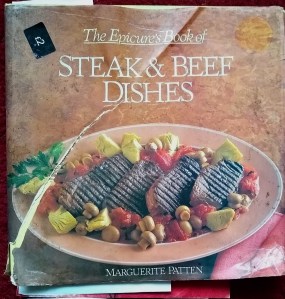
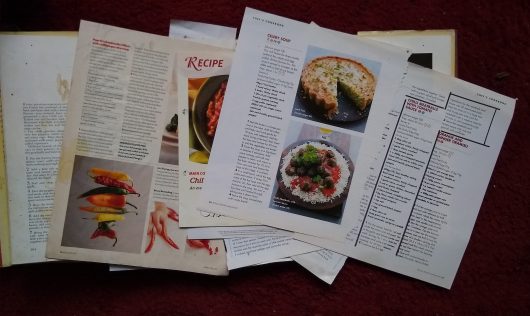
When I left home when I was about nineteen, I bought my first cook book and it’s one I still have today. The Epicure’s book of Steak and Beef Dishes by Marguerite Patten. I think I bought it in a cheap remainder book shop and it’s full of additional recipes I have cut out of magazines or newspaper supplements. It’s my go to book whenever I make a chilli or a bolognese or even a roast dinner. It contains all the rudiments for my favourite meals.
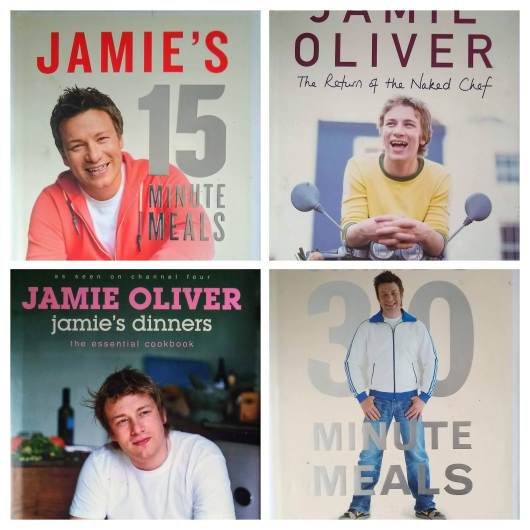
Jamie Oliver made his TV debut in 1999. He was spotted by a TV producer making a documentary about the River Cafe where he was working at the time. His TV show The Naked Chef followed soon after and his cookbook from the series was a best seller. I’ve got quite a few of his cookbooks in my collection which I always refer to when I get down to some serious cookery. In particular I like his 30 minute and 15 minute meal series. In many ways Jamie speaks to the modern cook, the one who likes to try and use fresh produce and not to be always warming up ready made food. The one who has to juggle working and bringing up a family. Not only that, his TV shows are fresh and fast moving and I love his enthusiasm for food and cooking. I think I mentioned a while ago that I recently made a pizza using home made pizza dough. Where did I get the recipe? From one of Jamie’s books of course. His books are pretty popular but there always seem to be plenty of them in the various secondhand book shops that I frequent.
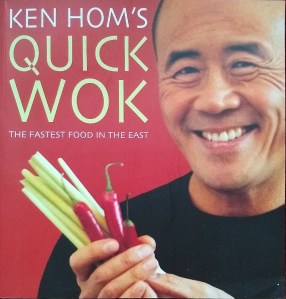
A long time ago, probably back in the 1980’s, I got hooked on Ken Hom’s Chinese cookery programmes. I liked the way Chinese cookery worked, in fact I liked the whole process of preparation and stir frying. I got myself a wok, seasoned it according to Ken’s instructions and started stir frying. I do love it when you see the Chinese chefs stir frying at very high temperatures on TV cookery shows like Ken’s but getting those very high temperatures in a home kitchen is pretty much impossible. I made some nice meals but nothing ever seemed to taste the way it does from the Chinese take away. Perhaps it’s time to drag that wok out of the storeroom and have another go.
Another favourite TV chef was Antonio Carluccio who sadly died in 2017. He had a number of shows on the BBC that combined cookery with travel in Italy. I remember one where he stopped a farmhand who was about to open his sandwich box in some field in the Italian countryside. I say box but in fact it was something wrapped in greaseproof paper, some fresh bread, some tomatoes and some Italian cheese. It looked pretty appetising to me. Antonio once explained that one of my favourite meals, spaghetti bolognese, is something that doesn’t exist in Italy but even so, he showed us how to make an Italian ragu with a mix of beef and pork mince. I use pretty much the same recipe for my bolognese these days.
I do love a good curry but I don’t have any curry cookbooks by famous names. Instead I’ve always relied on this slim volume by Naomi Good. It’s straight to the point and using it I’ve always managed to put together a decent curry. It’s not a curry that falls into any particular category, it’s not a Korma or a Vindaloo, it’s just a basic curry with plenty of spices and usually made with minced beef. Sometimes it comes out pretty hot, sometimes not and I usually finish it off with a good dose of coconut milk. Most of the time I have to confess, I usually return to the basic curry recipe in my very first cookbook.
So what else do I use when I need cooking inspiration? Well, I’ve got a whole lot of bits and pieces of recipes clipped from magazines as I mentioned earlier. Sometimes I just scan through them and have a go at whatever I fancy.
Pages cut from magazines and newspaper supplements
Do you have a favourite cookbook?
What to do next: Here are a few options.
Share this post on your favourite social media!
Hit the Subscribe button. Never miss another post!
As I approach my 500th blog post, I sometimes wonder if I’m running out of steam. Yes, instead of brand new posts I’m looking back at my old ones and giving them a bit of a rehash or sometimes writing more on the same theme and adding ‘More’ to the title or ‘Part 2’.
Last week I talked about more Essential Englishmen and this week I’m going to return to a post from 2021 so, without further ado, let me see if I can interest you in some more beginnings and ends.
I’m going to start with an end, a personal end.
I wrote about the issues I had paying my electric bill a while ago. Here’s a quick recap. I’d paid my bill but my banking app remembered the account number from when I used to pay my mother’s electric account and used that instead of my own account number. Mum is living in a nursing home at the moment so her electricity account has been closed. I contacted my supplier Eon, who were not at all helpful. They wouldn’t credit my electric account and neither would they return the money to my bank. Contact my bank was their one and only suggestion. My bank tried to sort the issue, they tried to retrieve the payment but contacted me back the other week saying Eon’s bank were not playing ball.
I called Eon again but after waiting over 30 mins in a telephone queue I gave up, put the phone down and wrote a moaning email to Eon. In sharp contrast to last time, their staff member Jim checked the details I gave him, saw immediately an error had occurred and credited the amount into my bank account. Simple, although I’ve had weeks of hassle, hanging onto phone lines and going through various phone menus until I got basically nowhere. Thanks Jim at Eon!
Beginnings
Next I’d like to talk about one of my favourite films written and directed by my favourite director, Woody Allen. Woody is not the most popular guy in Hollywood these days but back in 1979 he made the film Manhattan and the opening sequence is one I’ve always been fond of. In it he’s narrating the opening to a new novel and as he goes along he starts editing and rewriting and starts over again. No, that’s too preachy, he says. That’s too angry, till finally he comes up with some text he really likes –I love this says Woody.
I loved it too, so much that I made a spoof version about Manchester rather than Manhattan.
The Godfather
The Godfather is one of the classics of cinema. It’s based on the book by Mario Puzo which is a classic in its own right. In the film version Marlon Brando plays Don Corleone, the head of the Corleone mafia family. The film opens on the day of his daughter’s wedding which is a day when no Sicilian can refuse a request. In his office that morning is a man whose daughter has been the victim of an attempted rape and he comes to ask the Don for revenge. The Godfather emerges out of the shadows not a happy man. Has he been asked with respect? No. Has he been called Godfather? No. Marlon Brando plays the Don beautifully as a man of honour but also a dangerous man.
Director Francis Ford Coppola always wanted Brando for the role but the executives at Paramount weren’t happy. They made him do a screen test and also put up a bond in case he delayed the film and caused unwarranted expense. The result is a wonderful piece of cinema.
The Truman Show
I’ve not always been a fan of Jim Carrey but I’ve always rather liked The Truman Show. It’s a sort of reality show where Jim Carrey’s character Truman is the star only he isn’t aware of it. Everyone around him knows everything is fake. Secret cameras film everything he does and all those around him, including his mother, his wife and best friend who are all actors in on the secret. The TV show is the brainchild of Christof, a producer/director played by Ed Harris. As the film unfolds we gradually realise that Truman is becoming aware of things that are not right; a spotlight that falls from the sky; people who approach him and want to talk but are hustled away by strange people; an office building where no one is working and his wife who seems to announce the benefits of various products as if she is in a TV advert.
The film is based on an episode of The Twilight Zone. A man getting ready for work finds a camera in his bathroom and realises he is being secretly filmed. It turns out that unknown to him, he is the star of a reality TV show. The producers take him aside and explain what a hit the show is and how much money he could be making. Why not carry on as if he never found out the truth they ask. Keep the show running. No one would ever know.
The man decides to just carry on with his life and allow the filming and the money to continue. In some ways I think that might even be a better storyline than The Truman Show. Either way, this film is a really interesting look at the current reality TV genre and flips the whole concept on its head. Carrey is great in what is really his first dramatic role too. The most telling moment comes at the end when the whole world has been glued to the last episode. When it has finished one of the enthralled TV viewers asks ‘what’s on now?’
The Big Sleep
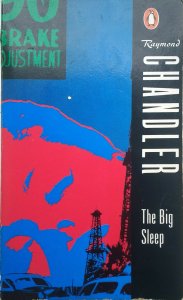
The book The Big Sleep was written by Raymond Chandler and he had this really fabulous talkative way of writing. You can almost imagine hearing Humphrey Bogart’s voice as you read the book. Here’s a quote from the text, an example of Chandler’s descriptive style:
I sat down on the edge of a deep soft chair and looked at Mrs Regan. She was worth a stare. She was trouble. She was stretched out on a modernistic chaise-longue with her slippers off so I stared at her legs in the sheerest silk stocking. They seemed to be arranged to stare at. They were visible to the knee and one of them well beyond. The knees were dimpled, not bony or sharp. The calves were beautiful, the ankles long and slim with enough melodic line for a tone poem. She was tall and rangy and strong looking. Her head was against an ivory satin cushion. Her hair was black and wiry and parted in the middle and she had the hot black eyes of the portrait in the hall. She had a good mouth and a good chin. There was a sulky droop to her lips and the lower lip was full.
Not bad eh? Dilys Powell called his writing ‘a peculiar mixture of harshness, sensuality, high polish and backstreet poetry’ and it’s easy to see why. Anyway, the book was made into a film starring Humphrey Bogart as Philip Marlowe and the film and the book open with Marlowe’s visit to see General Sternwood. I was calling on a million dollars says the famous detective in the opening monologue. Sternwood is an elderly man who spends his time in a stiflingly hot conservatory where he offers Marlowe brandy while he explains just what he wants Marlowe to do.
The Story in Your Eyes
In my original blog post I stuck to film, TV and books but for this version I thought I’d throw in some music, just for the hell of it. Despite being a great music fan I was pushed to think of something with a really outstanding opening but I think the guitar riff on this track from the Moody Blues really fits the bill.
The Cut
Before I cut to the ‘ends’, I thought this might be just the point to show what we video editors call a cut. Here is what has been described as the most epic cut in film history.
Ends: The Fugitive
Another old show repeated currently on the CBS justice channel is The Fugitive starring David Janssen as Dr Richard Kimble, falsely accused of the murder of his wife. The show ran for four seasons but as viewer ratings began to fall, the series was cancelled. It was then that the producers hit on what at the time was an unusual idea. Instead of the show just ending, they decided to make an actual finale. Yes, they would wrap up the story of Kimble’s wife’s murder. Kimble had been searching for the supposed one-armed man he had seen leaving the murder scene for the past four seasons, now he would finally find him!
Back in the 1960’s, TV was not very highly thought of even by the TV networks themselves. So what if Kimble never finds the murderer. So what? It’s only a TV show. Of course, the viewers would disagree. They had kept faith with the series for four long years, they deserved a proper ending.
The final episode aired on August 29th 1967 and in the USA the viewing figures were a sensation: 72% of US TV viewers were watching that final episode and the show held the most watched record until November 1980 when someone shot JR in Dallas.
Citizen Kane
The cinematography was by Gregg Toland, one of the film industry’s top photographers. Toland had asked to work on the film and director and star Orson Welles replied ‘Why? I don’t know anything about making films.’ Toland countered that was exactly why he wanted to work on the film because a film by a newcomer, Kane was actually Welles’ first film, would produce something new and original.
There are some fascinating elements to Citizen Kane, especially in the special effects department. A famous one is where the camera flies through a rooftop sign and then drops down through a skylight into a restaurant. That was done with a sign that came apart as the camera approached and then a fade from a model shot into the restaurant set disguised in a flash of lightning. I could go on and mention plenty of elements like that but if you haven’t seen Citizen Kane let me just explain what it’s all about. The film opens with the death of Kane, a millionaire newspaper magnate. His last words were ‘Rosebud’. The makers of a cinema newsreel decide to find out what or who Rosebud was.
To do so they research Kane’s life; his inheritance of a huge fortune, his takeover of a newspaper, his great wealth, his power and influence, his marriage and divorce and ultimately his death. The reporters never find the answers to their questions but we, the cinema audience, have the secret revealed to us right at the end of the picture. The end is what makes the film really and Welles admitted that Rosebud, and the idea behind it, was the idea of his co-writer Herman Mankiewicz. The final scene takes place in a huge storage area, packed with crates containing all the numerous items the acquisitive Kane bought, packaged and hoarded during his lifetime. Some of the stuff is scheduled for the furnace and as one labourer throws in an old sledge, we see the flames begin to consume the wooden frame. The top coat of paint is burned off and we see revealed underneath the name ‘Rosebud’.
One Final End.
I’m due to get my state pension in October which as regular readers will know is my least favourite time of the year. I thought it might be nicer to retire in the spring which is actually one of my favourite times of the year, the days are getting warmer and longer and the summer is on its way. A nice time to tootle off in our little motorhome perhaps so I sent in my early retirement request letter to my boss. That is in fact one really big end. I’ve been working since I was 16, starting my working life in Manchester city centre in the world of insurance back in 1973. Apart from a break in the early 1990’s when I decided I wanted to be a film maker and went on a video production course in Manchester I’ve worked all my life so understandably I was a little nervous when I pressed the send button on that particular email. I didn’t get to be a film maker, well, not a professional one anyway. Still, I’m not dead yet so there’s still time for a new beginning . .
What to do next: Here are a few options.
Share this post on your favourite social media!
Hit the Subscribe button. Never miss another post!
I published a post quite a while back called The Essential Englishman. I say a while back but now that I’ve looked, it was 2017. Anyway, as a working-class council house boy I’ve always envied those well-dressed gentlemen who look impeccable and talk ‘proper’, dropping witty comments here and there with apparent ease. I wrote about six Englishmen who all rather impressed me either themselves or in the characters they played on screen so I thought it might be time to look at some more candidates.
Roger Moore.
I’ve always liked the debonair Roger Moore. Many people think he was good as James Bond 007 but sorry Roger, I wasn’t impressed. His other famous character did impress me; Simon Templar alias the Saint. The Saint was based on the books by Leslie Charteris about an adventurer called Simon Templar. Templar seems to have no job but owns a smart London flat, drives a white Volvo with the registration plate ST1 and sets about helping damsels in distress and solving various crimes. The police, in particular Templar’s nemesis, Inspector Teal of Scotland Yard view Templar as a criminal and are determined to put him behind bars.
Moore had always wanted to film the Saint and in fact bought into the latter part of the series becoming a co producer. Most of the clothes worn in the series were Roger’s own clothes too showing how keen Roger was about the way he looked. Later, when the series ended, Moore co-starred with Tony Curtis in the Persuaders, another action series, although the Persuaders was filmed all over the world whilst the Saint, despite all the various locations portrayed in the series, was filmed almost entirely at Elstree studios in the UK.
One of the best elements of the series was the pre-title sequence where Moore turns to talk to the camera. In later episodes there is a voice over instead but someone usually recognises the famous Simon Templar. Cue an animated halo appearing over Roger’s head which he looks up at just before the title sequence begins.
Moore played James Bond in seven feature films. The last one was A View to a Kill in 1985. He died from cancer in 2017.
Ronald Colman
Colman was born in 1891 and became a well-known amateur actor in his native Surrey. He joined the army when the first world war began. He was seriously injured at the battle of Messines in 1914 and was invalided out. When his wartime wounds healed, he resumed his acting career and eventually graduated to films. In the USA he became a famous silent film star but it was not until the talkies began that he could use his best asset, his wonderful voice. According to Wikipedia, he mirrored the stereotypical English gentleman and he went on to great success in the golden age of Hollywood. He appeared in many famous films like The Prisoner of Zenda and two of my personal favourites, Lost Horizon and Random Harvest.
Colman died in 1958 aged 67.
Wilfrid Hyde-White
Hyde-White was born in 1903 and trained at RADA, the Royal Academy of Dramatic Arts. He once famously said that at RADA he learned two things; ’One, I couldn’t act and two, it didn’t matter.’
He became almost a fixture of many British films of the 1950’s and in fact his film credits are almost too numerous to mention. He appeared in some of my favourite films such as The Third Man, Last Holiday, The Browning Version, My Fair Lady and many others. In Hollywood he appeared with Marilyn Monroe in Let’s Make Love. In later life he also appeared in many US television series including two episodes of Columbo. Hyde-White was apparently in trouble with the inland revenue and was declared bankrupt in 1979. He died a few days prior to his 88th birthday and his body was flown back to the UK for burial.
Kenneth More
More epitomised the English officer gentleman in many films, most notably with his portrayal of Douglas Bader in the film Reach for the Sky. He played an officer aboard the Titanic in A Night to Remember and a naval officer in Sink The Bismark.
He was under contract to the Rank organisation but was dropped by Rank after swearing and heckling their managing director at a BAFTA award ceremony.
In later life he had further success on TV playing the part of Jolyon Forsyte in the Forsyte Saga and later the title role in Father Brown. He died in 1982.
Terry-Thomas
Thomas was a comedy actor who found fame in many British radio shows and films of the 50s and 60s. He typically played an upper-class rogue or bounder and his distinctive upper-class accent is fondly remembered by many, including me. According to Wikipedia in 1921 he began to develop his distinctive, well-spoken voice, thinking that “using good speech automatically suggested that you were well-educated and made people look up to you”. He apparently was impressed by Douglas Fairbanks so much so that he began to imitate Fairbanks’ debonair dress sense.
Thomas played a similar character in most of his films and was a great success in films like Carlton-Browne of the FO, I’m All Right Jack and School for Scoundrels. He appeared in a number of Hollywood films such as How to Murder Your Wife in which he played the genteel English butler to comic strip author Jack Lemmon. He is probably best remembered for his portrayal of the scheming rotter in Those Magnificent men in Their Flying Machines. Thomas died in sad circumstances in 1990 after suffering with Parkinson’s disease and spending most of his fortune on medical bills
C Aubrey Smith
C Aubrey Smith is perhaps an unfamiliar name on this list to anyone who is not a fan of classic films. Smith was born in 1848 and became a stage actor only after retiring from an early career as a cricketer. He appeared in some early British films but went to Hollywood in the 1930s where he carved out a career playing an English officer and gentleman. He was Colonel Zapt in the Prisoner of Zenda and played another colonel in Hitchcock’s Rebecca. In Hollywood he was the acknowledged leader of the British contingent and in 1932 founded the Hollywood Cricket Club. Other film stars considered to be “members” of his select social group were David Niven, Ronald Colman, Rex Harrison, Robert Coote, Basil Rathbone, Nigel Bruce and Leslie Howard.
Smith died in 1948 aged 85.
Hugh Grant
There are others I could possibly mention here, stars like Christopher Lee, Dirk Bogarde, Basil Rathbone, Dennis Price and Jack Hawkins but perhaps it’s time to look at some more modern actors. Hugh Grant has played the essential Englishman in a number of film roles starting with his part in Four Weddings and a Funeral, the 1994 British comedy written by Richard Curtis. Four Weddings is a direct successor to the Ealing comedies of the 1950s and 60s and Grant’s persona is in the same way, a successor to Ronald Colman, David Niven and many others of the same ilk.
I’ve always thought that Four Weddings was one of the best British comedy films ever, only marred by the constant use of the ‘f’ word. I was happy to hear that American audiences agreed with me and in the US version, the word ‘bugger’ was substituted.
Hugh Grant was born in 1960 and is still working in film and TV. He recently starred with Nicole Kidman in the TV mini series The Undoing.
What to do next: Here are a few options.
Share this post on your favourite social media!
Hit the Subscribe button. Never miss another post!
A few weeks back I was asked to test some new editing software for a company whose software I used to use regularly. They were trying something new, in fact a feature that I had advocated a few times on one of their forums. It was a surprise to be asked to test the new feature but also rather nice. It’s always nice to be acknowledged so anyway as soon as the feature was enabled I set out to make a test video.
I thought about doing a new version of my usual content. You know the sort of thing, the videos that you usually find down at the end of my blogs extolling the virtues of Floating in Space and A Warrior of Words. Instead, I thought of doing a quick few minutes on the subject of poetry writing. It was called Ideas, Inspiration and Effort.
Nothing can start without an idea. Amateur writers like me just tend to wait for an idea to come but to be really professional you have to make the ideas come. You have to sit down and start writing. It’s only then that the ideas come. The same is true for blogs. I do get ideas. I get them driving to work. I get them while watching television. Sometimes I get no ideas at all but then I can always write about the books that I read, the old TV shows that I like and the classic black and white films that I watch on TV. Either way, blogs or poems, everything starts with the idea.
Next comes the inspiration. Again, when I’m in amateur writer mode I usually just wait for the inspiration to come. Sometimes it does. Sometimes it doesn’t. The thing that makes it come is just to start writing. Sitting down at the keyboard with the TV on and the sound off, that’s usually when inspiration strikes. Last week if you may remember I was doing battle with my electric company because they wouldn’t give me my money back, the money that I had paid, in error, into the wrong account. I wasn’t happy about it at the time but on reflection I could see the funny side and that is hopefully what made that particular blog post rather amusing. The good thing as well is that it’s that kind of self-deprecating humour which Floating in Space is all about so if you liked that post, you should like Floating. (An in-post plug for Floating! Hey, I’m pretty pleased with that.)
The same is true for poetry, once I have an idea I start playing with words until inspiration finally comes. Then of course I need to make the effort. The effort to get down to work, typing away until the first draft is ready. Then more effort comes, the effort to edit and to develop the blog or poem until I think it’s finished. That of course is where I usually fail. I don’t have my editor on my back, I don’t have a publishing company that has paid me a million-dollar advance and is waiting for the book I promised them. The only promise I have made is to myself, a promise to one day complete another book which actually may be a long time coming. The thing is there are so many other things to do, restaurants to visit, books to read, TV shows to watch and so on.
Anyway, it’s time for another blog post and as usual lately I’m struggling. What I need is an idea. So using my own method above I thought about an idea and I came up with disappointment. Yes, what has disappointed me lately? Let me see, well there was the pizza I made the other day.
When I spend a little time on my own I tend to eat a lot of snack food. I do love sandwiches as you might have guessed if you had read this old post about sandwiches but sometimes I like to do something a little more exciting. I do like cooking with my slow cooker and I’ve made numerous bologneses, chillis and curries in this way but the other day I thought I’d try and make a pizza, a proper pizza made from scratch. I had some flour and yeast and I had Jamie’s Italian, Jamie Oliver’s Italian cook book to guide me so what could go wrong? I mixed all the ingredients and made some basic dough then I gave it a good kneading and eventually I got a good spongy dough. I left it to prove and a bit later made it into a few portions. I left one to rise once again and made a simple tomato sauce using tinned tomatoes. Later I slapped on the sauce then some cheese, some pepperoni and some onions and I was all ready to bake. Jamie recommended putting the oven on its hottest setting, gas mark 9 so I slapped the pizza in and about ten minutes later it was looking good.
The crusts were ok but the rest was a bit soggy. Even so, it was pretty reasonable. The next day I tried again and looking at some other recipes I thought it was better to cook the base first and then add the toppings and cook again. I did that, added the toppings but this time I left it in too long and the pizza emerged a little frazzled. Maybe I should just stick with chilli in future.
Here’s something else that was disappointing. Sitting down to eat I was happy to find that The Time Tunnel, the sixties Sci-fi TV show was about to start on the Horror channel. It’s about two American scientists ‘lost in the swirling maze of past and future ages, during the first experiments on America’s greatest and most secret project, the Time Tunnel. Tony Newman and Doug Phillips now tumble helplessly toward a new fantastic adventure, somewhere along the infinite corridors of time’ as the opening blurb used to go.
The Time Tunnel starts off with a Congressman coming to investigate the growing budget of the time tunnel complex and threatens to close things down unless he sees results. Scientist Tony Newman decides he must therefore travel back in time to prove that the tunnel really works and save the project. Tony ends up on the ill-fated liner Titanic. His colleague Doug follows him back to 1912 and the control room struggle to shift the two in time before the ship sinks. Unable to return the duo to the present, the technicians struggle every week to shift the duo to somewhere new just in the nick of time. One episode that I particularly remember was when the pair land in Pearl Harbour, just before the Japanese attack in 1941. Tony meets himself as a young boy and finally solves the mystery of the disappearance of his father in the attack.
The Time Tunnel was a sci fi series from the 1960’s and as a child I was crazy about it. I thought it was wonderful but it only lasted one season before producer Irwin Allen moved on to something new. I had missed the first few episodes of this latest re-run but as I settled down I realised that my favourite episode, the one about Pearl Harbour, was about to start.
Tony lived there as a child and his father was reported as missing in action so the first thing Tony and Doug decide to do is to go and visit him. Cue some rather daft dialogue and some clumsy situations which led on to more clumsy dialogue and daft situations. What a disappointment that episode was and yet for years and years I’ve looked forward to finally seeing it again. There are some things which just don’t stand the test of time.
Another thing that I found rather disappointing this week was a large donner kebab. My last few shifts at work this week went pretty well and as I drove home after the last one I thought it was time to treat myself. I ordered a large donner with salad and chilli sauce, took it home and settled down with a small beer.
The salad was as limp as the Time Tunnel dialogue, the chilli sauce didn’t have much get up and go and the donner meat had seen better days. All in all, I could have done with a trip through the time tunnel to Manchester city centre in 1986 and gone to my very favourite kebab emporium where they served donner on naan bread with fresh salad and a tasty hot chilli sauce. Yes, I had the idea, I had the inspiration, I just wish I hadn’t made the effort and got that kebab!
What to do next: Here are a few options.
Share this post on your favourite social media!
Hit the Subscribe button. Never miss another post!
 For this week’s blog, I thought I’d try and combine a love of cooking with my love of books. I suppose most people are taught to cook, or at least pick up the rudiments of cookery from their mothers. I hope I’m not being sexist when I say that, then again perhaps some people picked up their cookery expertise from their fathers, if it was dad who was the cook of the house.
 When I left home when I was about nineteen, I bought my first cook book and it’s one I still have today. The Epicure’s book of Steak and Beef Dishes by Marguerite Patten. I think I bought it in a cheap remainder book shop and it’s full of additional recipes I have cut out of magazines or newspaper supplements. It’s my go to book whenever I make a chilli or a bolognese or even a roast dinner. It contains all the rudiments for my favourite meals.
 home made pizza dough. Where did I get the recipe? From one of Jamie’s books of course. His books are pretty popular but there always seem to be plenty of them in the various secondhand book shops that I frequent.
 A long time ago, probably back in the 1980’s, I got hooked on Ken Hom’s Chinese cookery programmes. I liked the way Chinese cookery worked, in fact I liked the whole process of preparation and stir frying. I got myself a wok, seasoned it according to Ken’s instructions and started stir frying. I do love it when you see the Chinese chefs stir frying at very high temperatures on TV cookery shows like Ken’s but getting those very high temperatures in a home kitchen is pretty much impossible. I made some nice meals but nothing ever seemed to taste the way it does from the Chinese take away. Perhaps it’s time to drag that wok out of the storeroom and have another go.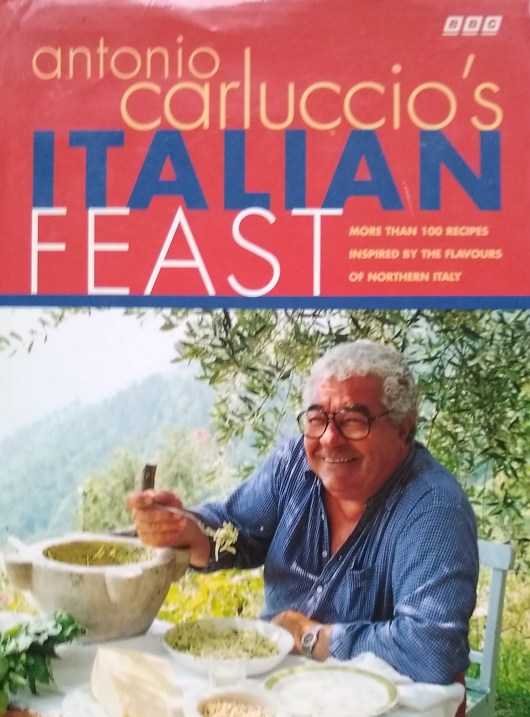

 The book The Big Sleep was written by Raymond Chandler and he had this really fabulous talkative way of writing. You can almost imagine hearing Humphrey Bogart’s voice as you read the book. Here’s a quote from the text, an example of Chandler’s descriptive style:
 Hyde-White was born in 1903 and trained at RADA, the Royal Academy of Dramatic Arts. He once famously said that at RADA he learned two things; ’One, I couldn’t act and two, it didn’t matter.’
 C Aubrey Smith is perhaps an unfamiliar name on this list to anyone who is not a fan of classic films. Smith was born in 1848 and became a stage actor only after retiring from an early career as a cricketer. He appeared in some early British films but went to Hollywood in the 1930s where he carved out a career playing an English officer and gentleman. He was Colonel Zapt in the Prisoner of Zenda and played another colonel in Hitchcock’s Rebecca. In Hollywood he was the acknowledged leader of the British contingent and in 1932 founded the Hollywood Cricket Club. Other film stars considered to be “members” of his select social group were
  A few weeks back I was asked to test some new editing software for a company whose software I used to use regularly. They were trying something new, in fact a feature that I had advocated a few times on one of their forums. It was a surprise to be asked to test the new feature but also rather nice. It’s always nice to be acknowledged so anyway as soon as the feature was enabled I set out to make a test video.
 Letters from an Unknown Author!