A Brief History of the Disco Era (with a little help from Google)

I do love my music. At home when there is nothing much on the TV I like to flip through the recommendations that come my way on Spotify. In my car I listen to CDs. I have always told myself that my precious CDs were too good to be dragged about in my car so I lovingly copied them to writeable CD discs, carefully, in most cases editing out the tracks I didn’t like. I’d be my own invisible DJ making up new CD albums with a track from here, another from there and so on. Lately, I haven’t done that so much and seeing that I don’t play my CDs much at home, I decided not to copy them just to bring the original CDs themselves into my car.

The other day after a particularly bad day at work, a day that was busy, where things didn’t go so well and I was just wanting to forget about things and release all the stress that had built up, I searched for something new, some music that I hadn’t played for a while that would relax me. I chose a CD that was a 1970’s disco collection.

I cranked my motor up, turned up the volume and as I turned onto the M6 motorway heading for home, my mind went back to a better time, a younger, easy going more relaxed time. I went back to the disco era.

So when did the disco era start and what was the first disco record?

Looking on Google to answer that question gives up various results by numerous authors and music writers but the answers are invariably just the opinions of those same writers. One answer was Rock the Boat by the Hues Corporation, another was She’s a Winner by the Intruders. (Never heard of it.) It might even have been that disco classic, Never can Say Goodbye by Gloria Gaynor. When it comes down to it, there is no definitive answer.

A lot of disco music comes from the soul tracks of the early seventies by groups like the O’Jays, Harold Melvin and the Bluenotes and the Trammps. Later, traditional pop bands tried to emulate those soul groups and the resulting soul/pop sound that became disco began emerging in the early 1970s in US urban night clubs and discotheques.

Here’s another random disco fact: the word discotheque is a French word meaning a library of discs. Discotheque was used in France to describe a nightclub where playing records had replaced a live band in the 1940s during the Nazi occupation. Modern Discotheques are where disco music began and something else that I noticed on Google were comments about the disco clubs of the seventies, the most famous one must have been the Studio 54 club in New York.  Another google result mentioned that Seventies Disco was born on Valentine’s Day 1970, when David Manusco opened The Loft in New York City.

Anyway, that’s enough of Google for a while so here are some personal memories.

The record I probably most associate with disco is The Hustle, by a group called Van McCoy. I have a feeling they were just one hit wonders but I might be wrong. The Hustle seemed to me to be the perfect disco record at the time. Great tune, a great dance beat and just really well put together. Looking back at the track today in 2021, it’s still good but it’s not the work of musical genius I once thought it was.

Back in the mid seventies I used to occasionally visit the discos of Manchester, places like Pips, Saturdays, Rotters, Fagins and a dozen other clubs I can hardly remember. There was a club called Sands in Stretford which was always packed to the seams but the disco I remember the most was one I wrote about in Floating in Space, it was called Genevieve’s.

Genevieve’s was in Longsight, which was a pretty rough area of Manchester and one of the hazards of the place was that if you went there in your car, you never found it in quite the same shape as how you left it, if you found it at all.

I remember one long ago Saturday night. My friends and I had to queue up for about ten minutes to get inside but we took that as a good sign. After all, a queue meant the club was busy. A group of grizzly bouncers scrutinised us and under their intense gaze we paid the entrance fee then went on inside. We were met by the warm fireside glow of soft lighting and the loud, pulsating beat of disco music. Coloured spot lights flashed over the four dance floors, in the hub of which sat the DJ, turning slowly around in a revolving booth.

There were five bars. Two small corner bars, two long bars, and a circular bar at the far end of the club. It really was a well set out place. We headed for one of the corner bars and my mate asked “bitter Steve?” I nodded and he called out to the barmaid.

A small army of bouncers was wandering around the club and as we waited for our drinks an argument broke out at one of the slot machines. Without any questions two burly bouncers grabbed the offender and propelled him expertly to the door. Another hooligan tried to come to the rescue by jumping on the back of one of the bouncers but a third bow-tied, black suited gorilla punched him solidly in the side, twisted his arm up his back and quickly removed him also. It was the sort of place where they didn’t stand any messing and the beer tasted like 3 parts water to one part beer and your feet stuck to the floor as you walked around. No one to my knowledge ever decided to complain to the management.

Genevieve’s attracted all sorts of people. There were smartly dressed, obviously wealthy people, peeling off rolls of bills to pay for whiskies and gins and other spirits. There were many attractive, well dressed girls. The younger girls drank halves of lager, sat in groups, and danced in groups to the Motown music of the sixties. They would drop their handbags onto the floor as they converged together for the formation dance routines for ‘Jimmy Mack’ and ‘Third Finger Left Hand’.

There were groups of lads too, who held cigarette packets and lighters in their hands, or placed them down in front of them on the tables while they drank, talked and eyed up the girls.

I spent a lot of my young life in that club. Despite the watered down drinks and the frequent fights, my friends and I had a lot of fun there until one day it either closed down or we found a better place to go.

The track that really reminds me of that club was Bus Stop by the Fatback Band. It had a strong disco beat and lyrics that just seemed to consist of ‘Bus stop!’ ‘Do the Bus stop!’ ‘Are you ready? Do the Bus Stop!’

In 1977 John Travolta appeared in the ultimate disco film ‘Night Fever’ and Travolta danced away to the music of the Bee Gees and tracks like ‘Stayin’ Alive’ and the title track ‘Night Fever’. I don’t ever remember there being dancers like that in any club I ever visited but what the heck, it was still a good film.

It wasn’t enough to buy the records and dance to disco records in clubs, you had to look the part too. I had a stack of shirts with ‘penny round’ collars and matching fat ties and quite a few pairs of flared trousers. Oh, and don’t forget the 1970’s platform shoes. I must have looked about seven foot tall back in those days.

Disco came to an abrupt end in 1979 in the USA where there seemed to be an outcry against the genre. Many music fans apparently felt that the music industry had been taken over by disco and many artists who had begun to produce disco music themselves, people such as Rod Stewart, were accused of selling out. In the UK and most of Europe, disco music morphed seamlessly into new electronic music. Artists like Michael Jackson took dance music to a new level and his album Thriller which spawned a number of hit singles became one of the best selling albums of the 1980’s.

What was the last ever disco single? The easy answer is that there wasn’t one. Dance music continued into the eighties and from there to the present day. Groups like Shalamar and Colonel Abrams just carried on producing dance tracks but if I had to put my finger on any one track as being the last of the disco era, I’d vote for I’m Coming Out by Diana Ross, released in 1980 when flared trousers were making way for drainpipes and when ties and shirt collars were thinning down.

What was your favourite disco track?


What to do next: Here are a few options.

Share this post on your favourite social media!

Hit the Subscribe button. Never miss another post!

Listen to my podcast Click here.

Buy the book! Click here to purchase my new poetry anthology.

Click here to visit Amazon and download Floating in Space to your Kindle or order the paperback version.


Another Slice of My Locked Down Life

The lockdown has almost come to an end here in the UK this week. There are still some restrictions and it’s still advisable to continue wearing a mask in public and to keep washing your hands. If anything, at least we may benefit from the increased hygiene standards in future. I’m lucky in that I haven’t had the coronavirus but not only that, the winter is usually a bad time for me because I always, always end up with the flu or at least a very bad cold. This year I haven’t and that must surely be due to the continued hand washing and mask wearing.

What is also interesting is that we are now ok to fly to Australia and New Zealand. That’s great but the flip side is that those two particular places aren’t willing to let us in yet. Oh well!

The bad weather here in the UK is getting me down. We can’t go out much and inside it’s the usual routine, surfing the internet and watching TV. We decided to take a chance on the weather one day and combine the dropping off of Liz’s car at the garage to fix a faulty electric window, with a short trip to a pub that has outside dining. Liz had contacted the pub, the Midge Hall in Leyland beforehand to ask if we could stay the night in the car park in our motorhome. The landlord seemed ok with that so we parked up in a nice corner. I was glad to see that the pub had a couple of outdoor covered areas. One looked like it had either been made especially for the current coronavirus situation or had been nicely adapted from a former smoking area and another one just by the pub entrance. The ruling that week was that pubs and restaurants can open but customers must stay outdoors.

The Midge Hall

We had arranged to meet Liz’s cousin and her husband there and we had a lovely evening as well as a nice meal. The weather was warmish and it did cool off later but not unbearably so. We dined early so we didn’t stay out late, but it was good to be out and about again and good to be social, to sit at a table with friends just having some chit chat.

Our motorhome hasn’t had much use lately and it was good to get some miles under the belt on the van and give the battery a good charging. We saw quite a few motorhomes on the road and each one we saw, each one, gave us a wave. Their occupants too were glad to be back on the road I suppose.

Just recently at the Oscars, the big movie winner was Nomadland. Nomadland is set in the USA and is about a woman whose husband dies and then she loses her job because the sole employer in her town closes down. She sells up and decides to buy a van to live in so she can travel the country searching for work. I’ve not seen the film but it certainly looks interesting and I look forward to watching it when it either comes out on DVD or I see it on TV. The last Oscar winner I bought on DVD was The Shape of Water. It was universally praised but the fact is, it’s an utterly dreadful film and I’m hoping Nomadland will be better.

I suppose there is something romantic about living a nomadic life in a campervan or motorhome, stopping at a great location and then moving on when you feel it’s time to go. I’ve always loved our trips to France and we’ve found some great spots, all by lakes, plan d’eau they call them in France, lakes where you can swim. I have to say I find myself worrying sometimes; I like places where there are other vans and that always gives me a better feeling of security. Sometimes in the dark of the night when we are alone at a deserted spot and I hear noises I start to worry. The flip side is that after a day reading and swimming, it’s great to light the barbecue and settle down with a sizzling steak and some wine. Another lovely moment was last October on the Isle of Skye when we found an excellent but pricey fish and chip shop just by our park up point.

Parked by a lake in France

Could I live like that permanently? I’m not sure. In France I could perhaps drive further south when the weather turned cold and even spend the winter in Spain. That would have been easy pre-Brexit but I’m not sure how it would pan out now. A while back I started reading a blog about a woman who chose to live in a van for a year in the USA. Her big problem was the winter. I forget which state she lived in, although it might have been Oregon. The blog was called I failed at van life. Here are the 11 biggest mistakes I made. The biggest mistake was her choice of van. Looking at the pictures on the blog she chose a pick up with a camper unit bolted onto the back. She had to exit the car to go into the van area and there wasn’t a lot of space but the thing she really couldn’t take was the cold. When I say the cold, there were a few pictures showing her in what looked to me like arctic conditions. The flip side was also the heat of the summer. Think it gets hot in your car in the summer? Imagine trying to live and sleep in those stuffy conditions. Difficult but at least in our van when we experienced the heat of a French summer, we were able to stay outside until the temperatures eased but even then, the van interior was still warm and sleeping was difficult. On a couple of really hot occasions Liz wanted to leave the van door open at night but security conscious Steve didn’t. I fell asleep with the door closed but I’m pretty certain that soon after Liz opened it up. Happily, there were no roaming villains operating in the Loire at the time and we both survived.

Another easing of the lockdown came this week on the 17th when we could actually enter the interior of our beloved pubs and restaurants. Liz and I had a booking at a place called Ego in Lytham for the 17th, made many months ago and it was wonderful to sit at our regular table and be served by Ego’s friendly staff. The steak was excellent and the surroundings were warm and convivial.

Anyway, the next day it was time to forget about the cold because Tuesday the 18th emerged warm and sunny, the perfect day for some light gardening and a bit of a read out on the patio. Could even have been barbecue weather. Pity it was my back to work day!


What to do next: Here are a few options.

Share this post on your favourite social media!

Hit the Subscribe button. Never miss another post!

Listen to my podcast Click here.

Buy the book! Click here to purchase my new poetry anthology.

Click here to visit Amazon and download Floating in Space to your Kindle or order the paperback version.

Star Trek: The Blog Post

On many of the posts in this blog you will find references to Star Trek. I’ve been a big fan of Star Trek for many years and even though I’m not an actual ‘Trekkie’, visiting conventions and dressing up as a Klingon and so on, I do love a good episode of Star Trek so it’s high time I put all my Trek thoughts into one handy blog post.

Star Trek the Original series.

Here is something that may be a revelation to you; if you don’t know it already it will vastly improve your understanding of Star Trek. It’s a simple truth and here it is, Star Trek is about three guys, Captain Kirk, Mr Spock and Doctor McCoy. Sometimes there are four, we can maybe throw in Scotty but that’s it, that’s the essential truth about Star Trek and that’s why things like the Next Generation and Deep Space 9 will never come up to scratch, simply because Kirk, Spock and McCoy are not involved. Even the Star Trek people themselves understand this, which is why Star Trek has been reinvented (re-imagined to use movie speak) with new actors playing Kirk and his crew in the latest Trek movies.

The first series of Star Trek starred William Shatner as Captain James T Kirk. Forget Captain pointy head Picard, Kirk is a proper Captain and after a good twenty minutes of any episode he will usually have blasted a number of aliens with his phaser (a sort of ray gun) and done some pretty serious kissing of any beautiful girl, alien, android or otherwise, within a 100 yard area. Mr Spock was played by Leonard Nimoy. He is the ship’s science officer and as a Vulcan rarely displays emotion, logic being his primary motivation. Doctor McCoy played by DeForest Kelley is a doctor of the old school and he and Spock frequently get into verbal confrontations. Together they are the chief officers of the starship Enterprise on its five year mission to go where no man has gone before.

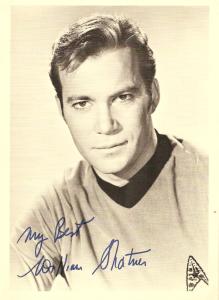
william_shatnerAs a schoolboy I wrote to Desilu studios where I believed Star Trek was made, based on credits shown at the end of the show. After a while I received a set of glossy pictures of the show’s stars. They were all signed by the various actors, Shatner, Nimoy and so on but the signatures, I have long suspected, were made by a machine.

The original Star Trek, like many TV programmes of the sixties was shot on film and today it looks pretty sharp compared to shows from the 80’s that were shot straight to video. It was given a digital makeover a few years back with digital effects and new CGI spacecraft and is looking pretty good these days. Which was my favourite episode? Well I’d have to say it was the one that fans voted the best Star Trek episode ever; City on the Edge of Forever. The crew of the Enterprise arrive at a distant planet searching for the source of some time displacement. The source is a time portal, left among the ruins of an ancient civilisation which although abandoned, still emits waves of time displacement. In the meantime, Doctor McCoy is suffering from paranoia brought on by an accidental overdose of the wonder drug cordrazine which any Star Trek fan will tell you can cure any known Galactic ailment. McCoy in his crazed state bumbles through the time portal, back to 1930’s America (handy for that old 1930’s set on the Paramount back lot) and changes history. Kirk and Spock are forced to also go back in time, stop McCoy from changing history and restore things to the way they were. Joan Collins plays a charity worker at the core of events; does she have to die in order to restore normality?

Star Trek the Motion Picture

After three series the show was cancelled but was remade a few years later as a TV cartoon. The huge fan base of the series caused the producers to think again and in 1977 they decided to make a big screen version of the show to cash in on the huge success of Star Wars. Star Trek the Motion Picture was released in 1979 and was directed by Robert Wise who was one of the editors on the film classic, Citizen Kane. I enjoyed the film very much although I feel the story was a little lacking. An entity called Vega is on the way to destroy the earth and the only starship in interception range is the recently refurbished Enterprise. All the favourites from the TV series make their return with a few additions. It was a good film but not a great one.

The Next Generation

The success of the film made the producers think about a new TV series, not with Kirk, Spock and McCoy but with a new crew. The Next Generation is set further into the future than the original series. Patrick Stewart plays the Captain and Jonathan Frakes is the first officer. There is no Vulcan science officer like Mr Spock but Brent Spiner plays a similar character; Data, an android.

The Next Generation is something I have always found rather lacking. I wasn’t keen on Mr Pointy-head Captain Picard and the cocktail lounge style bridge on his version of the starship Enterprise. Why on earth does he have to run every decision by his first officer, his councillor and everyone else on the bridge when Kirk would have just sorted that situation out like a shot, fired off a few photon torpedos and would even have found a pretty girl to flirt with too? The series was filmed on video and doesn’t look as good today when compared to the pin sharp original series.

Deep Space 9.

What can I say about this series? My knee jerk reaction was that it’s a load of old tosh might sound a bit mean to die hard Trek fans, but it was never my cup of tea. The only episode I ever enjoyed was an episode in which the crew of Deep Space 9 return to the past and get involved in the old original series episode ‘The Trouble with Tribbles’ using some pretty nifty special effects.

Star Trek Voyager.

I wasn’t so keen on Voyager at first, but I have to say I do like the later episodes when Captain Janeway finally got rid of her early weird hair styles and the drippy alien Kes got the bullet from the show.

Captain Janeway was the Star Trek world’s first female captain and as she began to look more normal as far as her hair, the writers decided to shake things up with the new and pretty sexy Seven of Nine character. She was rescued from the Borg, an alien race whose catchphrase is you will be assimilated. Seven was given a very appealing tight fitting catsuit to wear instead of the Space Federation regulation uniform. Catsuits are OK and maybe they are pretty popular in the 24th century but they never seem to have any pockets. What Seven does with her handkerchiefs, lip gloss, mobile phone and purse I really don’t know. In the future people must prefer looking sexy rather than worrying about their stuff, at least they do in the eyes of the Star Trek writers.

Seven is the nucleus of some great episodes especially one where we go back and see how young Annika Hanson (Seven as a young girl), and her family were assimilated by the Borg. The Borg are a race of aliens who assimilate other species into their own and at their centre is the Borg Queen who really likes the idea of Seven coming back to her ‘collective’.

Star Trek Enterprise.

This is supposed to be a prequel to the original series. I can’t say I’ve ever got through a complete episode. My only observations are that the crew go around in overalls and the Captain is played by the guy who used to be in the time travel show Quantum Leap.

Star Trek Discovery.

The latest series in the franchise is Star Trek Discovery, which is rather like watching a very fast music video, I gave it a good 15 minutes and then had to switch off. Sorry, it’s just not my cup of sci-fi.

Star Trek Picard.

Picard airs on Netflix or Amazon or some such channel that I have no access to and have no intention of subscribing to, mainly because I am allergic to opening up my wallet. After watching a few clips of Picard on YouTube I actually found it quite appealing so I decided to search for a cheap DVD of the episodes on eBay. Picard, I have to say is a pretty amazing slice of sci-fi. It’s not perfect and in fact it is rather complicated but it’s about a mystery at the heart of Star Fleet and Admiral Picard, no longer a member of Star Fleet, is determined to find out. Along the way he meets Seven of Nine and various other favourites from the old TV shows. Some of the episodes have been a little slow and yes, I know I’ve slagged off Captain Picard before but for the most part this series has been pretty good and anyone wanting to buy my DVDs is welcome to make me an offer as soon as I have got through series one.

William Shatner has reached the venerable age of 90 this year so it was good to read in the media that he is still going strong. Wonder if there is any chance of him playing Kirk again just one last time? Star Trek Kirk sounds good to me.

More on the Star Trek Films.

Getting back to the Star Trek films; Paramount studios decided to have another go at filming Star Trek for the big screen. For the second film they decided to employ producer Harve Bennett to make a better and cheaper Star Trek film. He apparently watched all the episodes of the TV series and decided to bring back the character of Khan who had once attempted to take over the Enterprise and was later left on a distant planet to start a new life with his crew. In Star Trek II: The Wrath of Khan Mr Chekhov finds that the planet Khan was abandoned on has become a desert and Kahn isn’t happy; he wants revenge on Kirk. Wrath of Khan is a really good film, much more like the original TV episodes than Motion Picture. The crew all sport some new natty uniforms and clearly it must be a little chilly on the Enterprise because all the staff seem to be wearing woolly jumpers and jackets. I don’t remember the Apollo astronauts ever wearing woolly jumpers but maybe astronauts in the 24th century are not made of such stern stuff. Of course it could be that they just have never thought about turning up the central heating.

Trek III was another excellent film. In this one we find that although Spock died in the previous film, his body has been regenerated by the Genesis project. In Star Trek IV the crew return to the 1980’s in order to bring a whale back to the future for reasons which I won’t even begin to get into. Watch out for the scene where Spock deals with a guy playing loud music on the bus; I loved it.

The character of Captain Kirk was actually killed off in the movie Generations which started off pretty well, combining the usual sci-fi elements of Star Trek with an intriguing mystery; who is the mysterious Soran and what is he up to? As it happened what he was up to wasn’t really that interesting, but the film marked the cinema handover from the original Star Trek cast to the new one. Pity really because as I mentioned above, I never really took to the Next Generation.

Just as I’d got to the end of this post I thought it might be an idea to actually watch some Star Trek again for some final opinions. After a quick scan through my DVDs I came across Star Trek III in which the crew of the Enterprise are grieving over the loss of Mr Spock in the previous film. Captain Kirk finds that Spock, who knew he was about to die, had left his Katra, his soul, in the mind of Dr McCoy and the crew undertake to take McCoy and Spock’s body back to the planet Vulcan, Spock’s home. A lot of stuff happens along the way and of course they finally succeed in reuniting Spock’s body with his Katra, although sadly, Kirk’s son is murdered by the Klingons along the way. It’s a great film, very reminiscent of the original episodes but a big factor in the film is the performance of William Shatner. He really is an outstanding actor and I think the success of Star Trek is in no small measure due to him. Shatner went on to play many other roles on TV so he can hardly claim to be type cast but I wonder if he hadn’t played Kirk, would he have gone on to a better career as a film actor.

Star Trek is ultimately about three people, Kirk, Spock and McCoy and the producers probably realised that which is why, in the latest Trek films, a new generation of actors have been asked to recreate the old characters meaning that Captain Kirk lives on again for a new generation of sci-fi fans.


What to do next: Here are a few options.

Listen to my podcast Click here.

Share this post on your favourite social media!

Hit the Subscribe button. Never miss another post!

Buy the book! Click here to purchase my new poetry anthology.

Click here to visit Amazon and download Floating in Space to your Kindle or order the paperback version.

A Slice of my Locked Down Life

When I used to work a nine to five job, I always looked forward to a bank holiday. It meant only working four days instead of five. Nowadays when I work shifts, I sometimes end up working the bank holiday but when it comes down to it, I don’t really care. It’s actually nicer having a break when the holiday resorts and seaside destinations are not packed. This bank holiday I wasn’t working but the weather in the UK, at least in the northwest where I live, was dreadful. It was cold and did nothing but rain so I spent the day watching TV.

The lockdown is easing in the UK and pubs and restaurants are open but, and it’s a rather big but, for outdoors only. We went to our favourite restaurant the other week. It had been a pretty warm day but it was cooling quickly by the time our table was ready. Luckily they have those outside heaters which helped but not that much. I couldn’t help comparing the situation to eating out in Lanzarote in January 2020. The restaurants over there have much more effective patio heaters but either way, it was good to be out again.

Last week we tried eating out again. This time we went to the 54 bistro in St Annes. It describes itself as a Mediterranean restaurant and it serves mainly tapas. Liz always goes for the fish platter they serve there. For me, I went for bruschetta followed by spicy pasta and some cheesy flatbread. The restaurant was still pretty busy and various potential diners got turned away while we were eating as the small dining area was either full or waiting for diners who had booked a table. There were patio heaters but up at a high level and they were not particularly effective. Maybe no one had told them that heat rises. We were dining at about six and by seven it had gone a lot cooler. Towards the end of the meal, it was actually really cold and despite my thick cardigan I was really chilled.

For some mad reason we decided to have a quick pint, our first of 2021 sat outside Wetherspoons and by the time I had supped my beer I was frozen to the bone. Roll on summer!

I don’t know if you remember but a few years back an aircraft that had just taken off from New York had to ditch in the Hudson river. For some reason Clint Eastwood decided to make a film about it and they showed it last week on BBC1.

I’ve actually always wondered how could they make a whole film about that short event. The aircraft takes off, hits a flock of birds, the engines get jammed up and this being New York, a pretty densely populated place, there was nowhere to land except in the river.

The film which was called Sully, after the pilot’s nickname, shows the plane landing in the river quite a few times. Pilot Sully played by Tom Hanks calls his wife up after the rescue to say he is OK. OK she asks? OK how? What has happened? Turn on the TV he says and you’ll see. The film then goes on to show Sully as a young pilot and later as an air force jet pilot following a colleague with a problem aircraft back to base.

Sully then has an interview with his bosses from the airline who, rather than being pleased he saved all those lives, seem to think Sully could have got the aircraft back to the airfield and the rest of the film tends to focus on that. Sully becomes a bit of a New York celebrity but early investigation reports also seem to indicate that the pilots could have made it back to LaGuardia airport. Sully says they could not have done so as both engines failed but the aircraft telemetry suggested that one engine was OK.

At the investigation hearing, a flight simulation is shown where various pilots easily turn back to the airport. Simulations are fine but as Sully points out, a simulation is just that, a simulation not reality. How many tries did the simulator pilots have? The answer was 17! Sully and his co-pilot only got one chance and after adding 35 seconds on to the simulator, for decision time, the simulator pilots all crashed. Later when the aircraft engines are raised from the river bed and checked, it is confirmed that both engines failed, just as the pilots said.

I have to say although parts of the film were interesting, as a whole it didn’t work for me. I remember seeing a film years ago where an aircraft ran out of fuel. I think they may have just changed from imperial measurement to metric and there was some confusion. Anyway the plane ran out of fuel somewhere over the USA but happily the pilots were able to glide down to earth using an unused airfield that the pilot happened to know about. That as I remember was a very good film with a really exciting build up of tension.(After some quick research I found it was called Freefall: Flight 174.)

Getting back to Sully I read somewhere that the whole incident was a tonic to New York as the previous aircraft disaster in the city, the 9/11 disaster did not have a happy ending, unlike this one.

In my draft folder I’ve got a post started called The Best Worst films of All Time. You might be confused by that at first but just think for a moment, how many crap films are there that you actually enjoy and continue to watch again and again every time they pop up on your TV screen. One of the films on the list was a film I watched last week and I must have watched it fifty times at least. It’s called Uncle Buck. I know, it’s a complete load of old tosh but I just seem to be drawn to it like a moth to a flame. Never seen it? Really? OK it’s a sort of variant on the film Home Alone and in fact one of the characters is played by that kid from the Home Alone films, Macauley Culkin.

In this movie a couple have to leave home because the wife’s mother has suddenly passed away. Who can they get to babysit the three kids? No one is available so the no good bum of a brother in law is roped in, you guessed it, Uncle Buck. Uncle Buck is played by the late John Candy and he has to contend with kids he doesn’t even know including, as well as young Mr Culkin, two screen sisters, one of them a teenage girl with a big attitude problem. She is completely embarrassed by her uncouth uncle and his smoke screen producing old banger automobile and even though the film is just a notch above rubbish, it’s actually quite fun in parts.

Buck sorts out ‘Bug’, the teenage girl’s cheating boyfriend and in doing so finally makes friends with his teenage niece. Uncle Buck is a great film to watch when you’re tired and not really paying attention and I always get the feeling it was written by a sort of committee of writers. (Probably the same committee that wrote Home Alone and Three Men and a Baby and so on.) I remember once seeing a documentary about the US sitcom Friends. The show is not one of my favourite programmes but in the documentary they showed how Friends was recorded in front of a live audience. If a bit of business didn’t quite work out, the recording was stopped while a whole bunch of writers and producers had a chat about things. Then a new line or even a section of dialogue was inserted or some of the action was changed. That was then run past the live audience. If it still wasn’t quite right the laughter track was updated to fill in. Writing by committee, interesting.

Anyway, that’s my draft post about great but crap films rendered completely useless even though I only had two other films on my list. Still by the time I finally finish it in about six months, this post will just be a distant memory for regular readers so maybe I can still use it after all.

Getting back to Sully, the actual plane crash (sorry, water landing as the pilots called it) happened on January 15th 2009. It was a freezing day and those passengers looked particularly cold when I checked out the newsreel video from back then. That was just how I felt shivering outside Wetherspoons last week. At least I was able to call a cab, rush back home and light the fire!


What to do next: Here are a few options.

Listen to my podcast Click here.

Share this post on your favourite social media!

Hit the Subscribe button. Never miss another post!

Buy the book! Click here to purchase my new poetry anthology.

Click here to visit Amazon and download Floating in Space to your Kindle or order the paperback version.

A Series of ‘What If’ Events

Last week I wrote a blog post about my life with spectacles. I’ve worn glasses almost all my life and I thought writing about the world seen through corrective lenses was a pretty good idea. I’ve said many times in this blog that my writing is always aimed at one person in particular and that happens to be me so it’s no surprise that I actually really liked that post.

I tinkered with it for quite a while adding new bits here and there. I made a pretty interesting graphic for it made from shots of myself wearing different pairs of specs. I liked that so much I went a step further and made an animated version, one where the text and the pictures seem to just slip into place.

Feeling pretty pleased with myself I thought I’d make a quick promo video with which to plug the post on Twitter and Facebook. Yes, there I was feeling good about my work and my media profile. I put the video on my Facebook page with a little announcement ‘New Post Coming Tomorrow’. I felt like a real media genius and then while I was scheduling the post for my usual time on Saturday, my big fat fingers slipped and pressed the publish button by mistake. If only it had gone out at the usual time of 10am on Saturday morning, I reckon it would have pulled in so many more readers and potential book buyers. Oh well, if only . . .

I wrote about my old Dad a few weeks back. I wrote specifically about his diary as like me, he was keen on keeping a diary and a notebook. Journaling is important for us writers. Don’t take my word for it; Marcus Aurelius Thought so too and he was a great Roman philosopher and of course, an emperor.

My Dad died when he was 72. He lived, I suppose, a good life. He worked hard and was happy walking his dog and keeping his garden in shape. He enjoyed his favourite sport of boxing and was fond of anyone who might possibly beat Mohammed Ali. Ali, or so Dad thought, was a fraud and the ultimate ‘fix’ was Ali’s fake ‘defeat’ of Dad’s idol, Rocky Marciano, in a so called computer fight.

In his youth Dad had a few years of excitement when he joined the army and his memories of army life he kept with him to the end of his days, sharing little stories every now and then to me and my brother. He left school at 14 and worked on farms because back then before World War II, Wythenshawe, a suburb to the south of Manchester where I was brought up, was very much a rural area before the urban development of the 1950’s and 60’s.

He told me once that a farmer he worked for was moving to a new farm in neighbouring Cheshire, in a village called Lymm. Lymm is a very posh area indeed and because a lot of it is green belt land, few housing developments have emerged there, so today it looks pretty similar to what it did in my Dad’s time. At least it did when I last visited, many years ago. The farmer asked my Dad to come with him to Lymm to work on the new farm. It was a better area he said and he would have sorted Dad out with accommodation but Dad declined, choosing to stay in Wythenshawe with his family. If he had moved he would perhaps have met someone else other than my mother. He would have courted and eventually married this new lady and I might never have been born. If I had still emerged as his son, I would have been substantially different, with a different gene set up and a different background.

Strangely enough, many years later I met an old friend on that long defunct web site Friends Reunited. Alan lived just round the corner from me and as children we used to meet up regularly at either his or my back door and we’d both produce a selection of comics, usually American ones like Batman, Superman, Spiderman and so on and decide which ones to swap. I always liked Batman and Superman but there was also the Green Lantern, The Fantastic Four and a whole host of superheroes that today’s youth are probably more familiar with from the cinema. I enjoyed the first Superman and Batman films and also the first Spiderman movie but some of the rest haven’t really done it for me. Maybe that’s because the comics themselves have changed. In the film world they often talk about rebooting a particular film franchise with new actors playing the parts of the franchise hero. James Bond is probably the film series that started off the notion of franchising.

Sean Connery gave way to George Lazenby; Lazenby gave way to Connery again and then Roger Moore and so on down to the present day Bond, Daniel Craig. The Superman films have been rebooted and also the Batman series. Ages ago I picked up a DVD copy of Batman Begins. I wasn’t crazy about the film, mainly because it was so different from the comic book Batman I used to read. The thing is, while I had been absent from reading comic books and generally getting on with my life, the comic books themselves rebooted with new artists and a new origin story for Batman. In this version Bruce Wayne’s parents are still murdered by a mugger but then Bruce goes off to Tibet or somewhere and in a sequence a little like Batman meets Kung Fu, Bruce, who is Batman’s alter ego in case you didn’t know, is trained in the ancient arts of martial combat. He then returns to Gotham City and becomes Batman.

Yes, other comics have rebooted things too with new artists and new layouts and new back stories for their characters. I didn’t care much for the X-Men films but I did used to read the comic versions. In my day The Beast was one of the X-Men but he is nowhere to be seen in the films and Wolverine must have been just a gleam in some comic book writer’s eye when I read about the X-Men because I had never heard of him until I saw the film

Anyway, getting back to Alan my comic swapping friend. Alan was shorter than me and a pretty tubby guy. In the late 60’s he and his family emigrated to Australia. I never heard from him again until we met, as I mentioned, on Friends Reunited. One day on our internet chat Alan asked me to pass on the regards and best wishes of his Dad on to my Mum. I told her and asked did she remember Alan and his Dad. It turned out that Alan’s Dad was once engaged to my Mother. They had gone out together for a while but Mum liked dancing, Alan’s Dad didn’t and when she went dancing he was forever questioning her, asking her who she was with, who she danced with and so on. Eventually she gave him the bullet.

Of course, if she had married Alan’s Dad, once again I wouldn’t have been born. At least not as I am now. I would have been Alan. I would have been the short chubby lad who liked comics and moved to Australia. The thing is, if my Dad had also married someone else, where would that leave me, buying comics in Australia or flicking through comics in a Cheshire village shop?

Just going back to superheroes for a minute, I reckon it would be kind of good to have some superpowers for a day or so. Not necessarily superpowers even, I’d settle for some martial arts skills. During the period I had the powers or the skills, I’d take no messing from anyone. If anyone was rude to me, they’d get a slap and if someone tried to mug me, well I’d send them flying along with a flea in their ear. Once when I was in my twenties, I arrived at my friend Chris’ house to pick him up for a night out. Sometimes we’d go to the Valley Lodge Hotel near the airport where they had a really good night club. I’d leave my car there and Chris and I would both make our own way home. Sometimes he’d pick me up and we’d go into town and he’d be the one to leave his car somewhere.

Once when I was waiting for him to finish getting ready there was a knock on the door. It was a guy called Dennis. Dennis was a bit of a local villain, a very tough hombre and although I knew him, I didn’t know him very well. He had somehow had his car towed away by the police. I’m not sure why but naturally he wasn’t happy. Actually, he was hopping mad and looked like he wanted to take his anger out on someone. He was visiting his mother’s house a few doors away from Chris when this outrage occurred and he wanted an urgent lift to his friend’s place, a ten minute drive away. Chris suggested I take Dennis while he finished getting dressed. I wasn’t too keen on the idea but went along with it. Five minutes down the road we came across a big fella wandering idly across the road. I beeped my horn but all the guy did was give me the V sign and swear at me so I swerved across the road to miss him. ‘Wait a minute’, said Dennis. ‘That’s well out of order, we’re not having that’.

‘It doesn’t matter’, I said. ‘No! Pull up here’ snapped Dennis. We stopped and Dennis stepped out of the car to advise the big fella that his manners were substantially lacking. The guy didn’t take this well, in fact he wasn’t happy at all and a fight began. Dennis basically taught the guy a major lesson in manners that I doubt he ever forgot. I dropped Dennis off at his friend’s house and he left me with thanks as I had apparently got him out of a major spot. ‘If there’s anything I can ever do for you’ he called, ‘give me a shout’.

Now I had no intention of giving Dennis a shout I can assure you and in fact I never did. The good thing about knowing Dennis though was that his reputation as a tough thug was pretty welcome sometimes. I once met him whilst queuing up to get into Fridays, a local nightclub, and he greeted me like a long-lost friend. He convinced the bouncers to let me in without paying the usual outrageous entrance fee and once inside after chatting with him at the bar for a while, I had the feeling that the local punters were eyeing me with a new found respect.

Another place I liked to frequent was a huge pub called the Snooty Fox. They had live music on at weekends and the place was on two levels with a games area upstairs. It had a late bar so back in those far off days, my friends and I could stay out late without having to pay night club prices. Also it was full of pretty girls waiting to hear whatever corny chat up lines we were using back then. The bouncers on the door were of the big neanderthal gorilla type and to be fair, they needed to be because that bar was a pretty rough place. I remember going in one time and a new bouncer stopped me at the door.

‘I know you from somewhere’ he said, breathing stale donner kebab breath all over me. ‘You look like a trouble maker.’

‘Me? No, I’m a quiet lad. You’ll get no trouble from me’

A bit later on I realised who he was. Yes, he was the guy crossing the road the time that Dennis had given him a lesson in bad manners. That was my last night in the Snooty and I was out of there like the proverbial wonga bird before he realised who I was. Pity! If only I hadn’t given Dennis that lift . .

Here’s one final, ‘what if’ story.

I think I’ve mentioned before in these pages that I went from working in an insurance company to being a bus conductor. Working on the buses wasn’t a great career move by any means but I didn’t like being out of work and for a while that new job was actually quite a lot of fun. Friends told me that working shifts would be the end of my social life but actually it was really the beginning of my social life. At the end of an early shift, I could usually be found down at the busman’s club, playing snooker and pool. After a late shift I’d be heading to the pub for last orders or sometimes heading off to a night club. It was all great fun and as someone who suffered greatly from an intense shyness, I found that being a bus conductor brought me out of myself and that gradually I was becoming more and more confident.

Some years later though the company made us all into one-man drivers and driving through the streets of Manchester on my own wasn’t my cup of tea at all. I was desperate to get another job but I didn’t know how to do it or what to do. One day I decided to start my own business selling motor sport merchandise. I called it Armchair Motorsport and I rented a unit inside the Corn Exchange in Manchester city centre. I worked on my small business for about a year. I didn’t make a great deal of money but I did spend a great deal of time chatting about Formula One racing. In fact, now I think about it, a great many of my customers used to come in and buy me a tea from the nearby café, come in, sit down and we’d talk Formula One.

One of my customers was a big Ferrari fan and was always on the look out for Ferrari memorabilia. There was a particular book he wanted and it took me a long time to get it for him but he was really pleased when I did. He mentioned that he drove a Ferrari and said he’d come down one day and show it to me. On the appointed day he came into the shop and asked me to hurry as he was outside on a double yellow line. We hurried outside and I have to say, I was eager to see his car. I expected a blood red Ferrari Dino or something similar.  As a matter of fact, I fully expected to see my favourite car the Ferrari Dino 246GT, the one driven by Tony Curtis in the TV series The Persuaders.

The car wasn’t a Dino, it was actually a very dull saloon car. It wasn’t even red. It was a rather drab green and I have to say I don’t think I disguised my disappointment very well although my customer assured me that the car drove and handled every bit as well as one might imagine a Ferrari to handle.

The aftermath of the IRA bomb, Manchester, 1996. Photo courtesy of BBC

After a year of relatively poor trading, it was time to sell up and say goodbye to the Corn Exchange. I’ve always wondered if I could have lasted longer. Perhaps if I had advertised more, done more promotions, increased my advertising I could have built up a good business. I could have made a decent amount of money, expanded and perhaps employed some staff so I could have spent more time at home or dining at my favourite restaurants but it was not to be. If only I could have made it work.

Then again, not long afterwards the area was destroyed by an IRA bomb planted nearby. If I’d stayed, if my business had worked out, I could have been blown to pieces.


What to do next: Here are a few options.

Listen to my podcast Click here.

Share this post on your favourite social media!

Hit the Subscribe button. Never miss another post!

Buy the book! Click here to purchase my new poetry anthology.

Click here to visit Amazon and download Floating in Space to your Kindle or order the paperback version.

A Matter of Perspective

Quite a while back, probably over two years ago, I seemed to be having problems focussing my right eye. My right eye is actually my good eye, the other, the left one is what my optician has always called my lazy eye. Years ago as a schoolboy I had to watch TV for an hour a day with a patch over my good eye. This was supposed to make my left eye, the lazy one, pull its way a bit more. That was successful to a point but the right one has always been better.

I called the doctor and he recommended that I go to see my optician. I called Specsavers who could not fit me in at first but when I mentioned the eye problems they asked me to come in straight away. I had an eye test and the problem was resolved. I needed a new prescription, no health issues at all, so they said. I wasn’t happy so a more senior optometrist was called in and he concurred, all I needed was a new prescription.

I still wasn’t happy. At the time my right eye seemed to be all gummy and I felt that perhaps I had some sort of infection. I started rinsing that eye with a salt water solution and after a week it all seemed to clear up. I have to admit I was a little scared for a while, after all, it wasn’t as if it was my bad eye, my good eye was the problem one. What would have happened if it had gone worse, if I had lost the sight in that eye? I wouldn’t be able to drive, I wouldn’t be able to get to work. No more motorhoming holidays. It would have been difficult to even write with just my bad eye. Yes, looking back, that was actually a serious health scare, perhaps even the scariest health scare I’ve ever had.

I went back to pick up my new specs about ten days later and surprise surprise, I couldn’t see a thing through them. No wonder! I’d had an eye test when my right eye wasn’t working properly. I still think I had an eye infection that they hadn’t spotted in the opticians. Another eye test followed. It was with a new fangled gadget that I had to put my head in and the optician changed lenses with a touch of a button. I wasn’t comfortable but at least my eye seemed better and a few weeks later I had a brand new pair of specs. They weren’t perfect but at least I could see pretty well.

This year I had another eye test at a different opticians. This time I went to Boots. The optician seemed to be a little more precise than the previous ones and not only that, he gave me an eye test in the traditional way, you know with the frames in which he slips in different lenses and ask things like ‘is this better or worse, is this clearer or not?’

All seemed pretty good until I saw the prices of the glasses they were selling. Being a card carrying tightwad I declined to pay those high street prices and just then found various internet stores selling bargain priced specs. I sometimes find it a little creepy when you do a few searches on Google for something; specs, an electric saw, a digital camera or whatever and the next thing you know, every site that you visit that carries advertising, all you can see are ads for specs, electric saws and digital cameras. Just shows you what those little inoffensive things called cookies do when you let them into your personal cyber world.

Anyway, I bought a pair of specs from a company called Goggles4u. They are based in the USA and looked pretty cheap. Almost just as I was about to press the buy now button, a discount voucher pinged up on my screen and I was able to buy my first internet spectacles at a very low price indeed.

I waited a hell of a long time for them but in the current Covid wary world there wasn’t much else to do except watch TV, listen to music and look for more things to buy on eBay.

One day my new specs arrived. I tried them on and the result was amazing. I wasn’t struggling to see small things anymore, everything was pin sharp. Watching the new F1 season opener on TV I could actually see those little boxes they display on the broadcast showing the current standings and lap times and what tyres each driver was using. To those of you with 20 20 vision you might not understand but seeing perfectly and sharply is nothing short of wonderful. The great thing with my new specs is that I clicked the box for what I’ve always called Reactolite lenses, actually photochromic lenses that react to bright light and darken when it’s sunny. Believe me, I was going round taking in things as if I’d never seen them before.

Fashion is a pretty big part of spectacles. Lots of top designers produce trendy spectacle frames and the resulting product can have a fairly hefty price tag. When I was a school kid growing up on a council estate I always wore national health spectacles with national health frames. You know the ones I mean, the ones with black plastic frames. Sometimes I got called names like ‘speccy four eyes’. I never liked those frames but as I grew up I got the chance to actually have some trendier frames. I always liked those metal rimmed frames. I was probably still at school when I got my first pair. Only after moaning and begging and pleading to my mother. She probably bought those glasses just to shut me up.

One day when I had left school and could afford to pay for my frames I bought some aviator styles. I always loved that aviator shape you know, that sort of stylish aerodynamic looking frame. I even had a pair with smoked graduated lenses. That’s just an excuse to show you my favourite picture of myself. I was 21 and had the whole world at my feet. I was in Paris having just packed my job in and I was having the time of my life with one of my best friends, and I loved those glasses. A lot of years later when my optician recommended a pair of reading glasses I had those same aviator frames turned into reading glasses.
Now that I have turned to the internet I am the proud owner of quite a few new pairs of specs. My favourites are probably the rimless ones but they do have a bit of an annoying element. Almost but not quite outside my vision to the right and to the left are two hinges that connect to the spectacle arms. I can’t quite see them but they are there and they are annoying.

Of course you might be thinking why even bother with glasses? It’s the 21st century, I could get contact lenses or even have laser treatment. Laser treatment? Like when they fire laser beams into your eyes? I don’t think so. I’ve worn glasses from ever since I can remember so I think I’ll stick with them if you don’t mind. One of my earliest memories was as a very young schoolboy going for that regular meeting with the school nurse or ‘Nitty Nora’ as we referred to her. For us spectacle wearers the first thing Nitty used to ask was to take off our glasses and place them on the table. That was OK if you put them down face up but bad if you set them face down because that way the lens could get scratched or marked by the table top.

Elton John is probably the most famous spectacle wearer of all time. He even once wore a pair of specs with little windscreen wipers. John Lennon is another famous spectacle wearer. He wore those famous round glasses that you will see if you just type ‘Lennon glasses’ into Google.

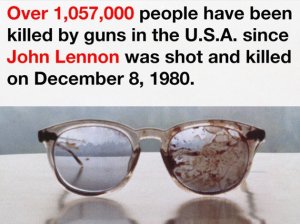
The glasses he was wearing when he was shot dead in 1980 were used by Yoko Ono to protest against gun violence. She also used the picture on her solo album Season of Glass which I’ve always found hugely shocking but then shock was an emotion that she and Lennon used frequently in their work.

Superman wore glasses too. Clark Kent, Superman’s alter ego wore a set of black plastic specs as a disguise. How Lois Lane who worked with Clark at the Daily Planet newspaper never noticed that Clark was just Superman wearing a suit and a pair of glasses, I’ll never know. The funny thing is the glasses that I always hated, those black plastic ones that Clark and my younger self wore, are today pretty fashionable.

Which pair shall I wear today then?


What to do next: Here are a few options.

Listen to my podcast Click here.

Share this post on your favourite social media!

Hit the Subscribe button. Never miss another post!

Buy the book! Click here to purchase my new poetry anthology.

Click here to visit Amazon and download Floating in Space to your Kindle or order the paperback version.


Some Thoughts on Books and Reading

I really do love books and reading. My idea of heaven is lying by a pool in somewhere like Lanzarote with the sun shining and a book in my hand. What is important for a good read is time. It’s alright to read a book on your lunch break or on the bus travelling home after work but to really get into a book, some uninterrupted time is important. So, what is really so good about reading? You, the reader must like reading otherwise you probably wouldn’t be reading this but for me reading is about connecting with worlds I will never see and connecting with my own world too; finding that I’m not as unique or as different as I had thought and that other people have had similar experiences to me.

Looking through a box of my old books I found a book I had read many years ago. It’s called the Wooden Horse and it’s a classic wartime escape book. The author conveys vividly the boredom of incarceration during WWII as a prisoner of war and the feelings that time was just slipping away and also the petty arguments that arose when confined with other people. Escape was on the minds of many but digging an escape tunnel was difficult as there was such a long way to tunnel. The huts were deliberately placed well away from the camp perimeter. One day, one of the men had an idea, what if they could start the tunnel nearer the wire? They hit on the idea of making a vaulting horse, putting a couple of men inside and then digging while their fellow prisoners exercised above.

The Wooden Horse was written by one of the actual escapees, Eric Williams. He was an RAF pilot shot down over Germany and imprisoned in 1942 and in 1950 the book was made into a classic WWII film.

As a child I remember reading books at night in bed before going to sleep and arguing with my brother who wanted the light turned out. Sometimes I’d read under the covers with a torch.

There was a small library a short ten-minute walk from my old house and I used to spend many an early evening there with my mother and brother. I remember a particular series of books I used to read when I was very young about someone called Mr Grimpwinkle.

A quick search on Google showed my memory had not failed me and there was such a series of books. They were written by a lady called Joan Drake. One example was Mr Grimpwinkle’s Marrow published in 1959. The going price on Abebooks was £148.95, quite a considerable sum for a book. The author, Joan Drake, seems to have published quite a few children’s books but I couldn’t find out anything more about her. I did actually fancy buying a copy of Mr Grimpwinkle’s Marrow just for nostalgic reasons but £149 is a lot to pay for nostalgia.

Another book I particularly remember was one I got for Christmas one year. It was two stories in one book. I forget the title and the author but one part was the story of Robin Hood and the other was about King Arthur and the Knights of the Round Table. The end of both stories has always struck me. In Robin Hood, Robin lies on his death bed and fires a last arrow asking to be buried wherever the arrow lands. That could have been tricky for Robin’s merry men but as far as we know everything went to plan and Robin was laid to rest somewhere, I assume, in Sherwood forest. When Arthur lies dying, he entrusts one of his lieutenants with the sword Excalibur and tasks him to throw the sword into a lake. The knight, who I believe was Sir Bedivere, wasn’t happy with throwing away such an excellent sword so he hid it. When Arthur asked what had happened and Sir Bedivere replied ‘nothing’, Arthur knew he was lying. Eventually the knight was persuaded to follow Arthur’s instructions and saw that Excalibur was caught by the lady of the lake, brandished three times then disappeared into the waters.

Now that is a book I would like to read again and ever since that first read many years ago I have always been interested in Robin and King Arthur.

The story of Robin Hood has been made into many films. A recent one from 2010 was Robin Hood which starred Russell Crowe as Robin and was directed by Ridley Scott. I’ve only seen it once but it was a pretty good film. Another version from 1991 starred Kevin Costner. Robin Hood Prince of Thieves was a highly enjoyable film if you can overlook Costner’s American accent. Alan Rickman plays a slightly over the top Sheriff of Nottingham and the film is well worth watching.

Douglas Fairbanks made the original version of Robin Hood in 1922. It was the very first film to have a Hollywood premiere which was held at Grauman’s Egyptian Theatre on October 18th 1922. I’ve always thought that this was the film in which Fairbanks slides down a huge curtain by slashing it with his sword but after a quick internet check it looks like that was The Black Pirate from 1926.

Alan Hale played Little John in Fairbank’s version and interestingly, he played the same role in the later Errol Flynn version The Adventures of Robin Hood in 1938.

Flynn’s version is probably the definitive film of Robin Hood. It was shot in Technicolor and starred Flynn alongside Olivia de Havilland as Lady Marian and Basil Rathbone as Guy of Gisbourne. Claude Rains played Prince John who plots to steal the throne from King Richard who is away at the Crusades. Michael Curtiz directed.

King Arthur and the legend of the Knights of the Round Table has also inspired quite a few films. King Arthur and the Legend of the Sword from 2017 was probably the latest. It was directed by Guy Ritchie and stars Charlie Hunnam (never heard of him myself) and Jude Law.

There was a version called First Knight from 1995 starring the highly over rated Richard Gere and a 2004 version simply called King Arthur with Clive Owen as Arthur. ‘A gritty attempt to update Arthurian legend’ said the one review I found on Google.

There was a cartoon version, the Sword in the Stone released in 1963 and a musical, Camelot from 1967 but my favourite film adaptation is Excalibur directed by John Boorman. Nicol Williamson plays an impressive Merlin and the film is an absorbing mix of sorcery, legend and fantasy all remaining fairly true to Le Morte d’Arthur, the book published by Thomas Mallory in 1485.

Under normal circumstances I might go on to talk further about my favourite books but I have done that already. I think I did my top ten favourite books in two parts a few weeks back. At various points in my blogging life I’ve written about David Copperfield, The Great Gatsby and Lost Horizon, my three all time favourite books. I’ve also written a few posts about James Bond, the UK’s top secret agent but I’d like to focus on one of the Bond books, Goldfinger.
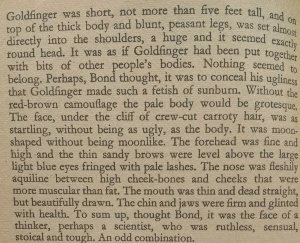
Back in the early 1960’s Harry Saltzman bought the film rights for the Bond books. He formed a partnership with fellow producer Albert Broccoli and they cast Sean Connery as Bond and in 1962 produced the first Bond movie, Doctor No. I was a schoolboy back then and had never seen the films but there was a great deal of hype about them on television. So much so that I went down to the library to read one of the books. There was only one in stock at the time and it was The Man with the Golden Gun, one of the worst books in the series. The author, Ian Fleming, had passed away before finishing the final draft of the book which accounts for the poor quality. Luckily, my uncle brought round a box of paperbacks for my dad to read and one was a cheap paperback version of Goldfinger. I read it, thought it was wonderful and embarked on a mission to buy all the other Bond books.

At school in English class our teacher had asked us to bring in a book with a vivid description of someone and my choice was Goldfinger. The book is about a man called Auric Goldfinger, a rich businessman who is suspected of smuggling gold. Bond is tasked to find out more and Fleming gives the reader a particularly compelling description of Goldfinger.  Fleming describes him as having a body seemingly put together with parts of other people’s bodies. I always thought that was pretty good. Fleming used to write his first drafts of a book and then add in all sorts of details afterwards like the vodka martinis that James Bond liked so much and the Sea Island cotton shirts that Bond favours in the novels. It was actually Fleming who wore those particular shirts and who drank vodka martinis and also preferred scrambled eggs for breakfast. Many people have speculated who Bond was based on and my feeling has always been that in fact it was Ian Fleming himself.

My current read is a book I mentioned last week, Charlie Chaplin and his Times by Kenneth S Lynn. Chaplin was a music hall entertainer working for the great impresario Fred Karno. Karno regularly sent teams of entertainers to the USA and while there Chaplin was invited to make a film for Mack Sennett, the famous producer of comedy films. Chaplin’s films proved to be enormously popular and so Chaplin moved on to different studios, all for better and better money until he established his own studio. I’ve always found the early days of Hollywood to be fascinating and this book is no exception.
Which books are you reading?


What to do next:

Share this post on your favourite social media!

Hit the Subscribe button. Never miss another post!

Listen to my podcast on Spotify: Click here!

Buy the book! Click here to purchase my new poetry anthology.

Click here to visit Amazon and download Floating in Space to your Kindle or order the paperback version.


Getting to the Heart of a Classic Film

Two of my absolute favourite films are Citizen Kane and On The Waterfront. Kane is a masterpiece of  visual brilliance whilst Waterfront is a masterpiece of acting brilliance. Waterfront has at its centre a heart of fire whilst Kane‘s centre is a little cooler. I thought a quick comparison of the two films might be interesting so here we go:

Citizen Kane

Back at home in my default position, in my favourite chair watching TV, I picked up the tail end of an interview with actor Gary Oldman about his new film Mank. Mank sounds like an interesting film in many ways. Firstly, it only had a limited cinema release before being streamed on Netflix. Whether this was a reaction to the global lockdown or an indication of how cinema will work in the future I’m not sure, but if cinemas are unable to open then producers must find other ways to show their films.

Gary Oldman is an English actor with an interesting array of roles behind him. He won the academy award for his role as Winston Churchill in the film Darkest Hour and played assassin Lee Harvey Oswald in Oliver Stone’s JFK. Mank is about Herman Mankiewicz and his writing of the screenplay for Citizen Kane. Kane is one of my favourite films although I haven’t seen it for a long time.

Mankiewicz was asked by Orson Welles to write the script but without a credit, presumably so that Welles himself could use the resulting script as a basis for his own work. Later Mankiewicz changed his mind and decided he wanted a screen credit as he had come to think that the script was his best work. Welles then gave screen credit to both himself and Mankiewicz although it was Mankiewicz himself who accepted the Oscar at the award ceremony in Hollywood.

Just flipping through my extensive back catalogue of VHS documentaries I found one from the BBC about the making of Citizen Kane which I have recently copied to DVD. The documentary covered various areas including the filming, the actors and of course the script. The origin of the script was a contentious subject, especially after film critic Pauline Kael wrote an article in the New Yorker on the subject. She seemed to favour Mankiewicz as writing the lion’s share of the project. Peter Bogdanovich wrote a rebuttal in the Esquire magazine, defending Welles as the screenwriter.

The truth is that Welles, as he said himself, put together a screenplay based on both his version and the one by Mankiewicz. Elements of the story were based on personal experiences of both men, for instance Mankiewicz was friendly with William Hearst who inspired the character of Kane but Welles maintained that tycoons Samuel Insull and Harold Fowler McCormick also inspired parts of Kane’s story.

The cinematographer was Gregg Toland, one of the film industry’s top photographers. Toland asked to work on the film and Welles replied ‘Why? I don’t know anything about making films.’ Toland countered that was exactly why he wanted to work on the film because a film by a newcomer, Kane was actually Welles’ first film, would produce something new and original.

There are some fascinating elements to Citizen Kane, especially in the special effects department. A famous one is where the camera flies through a rooftop sign and then drops down through a skylight into a restaurant. That was done with a sign that came apart as the camera approached and then a fade from a model shot into the restaurant set disguised in a flash of lightning. I could go on and mention plenty of elements like that but if you haven’t seen Citizen Kane let me just explain what it’s all about. The film opens with the death of Kane, a millionaire newspaper magnate. His last words were ‘Rosebud’. The makers of a cinema newsreel decide to find out what or who Rosebud was.

To do so they research Kane’s life; his inheritance of a huge fortune, his takeover of a newspaper, his great wealth, his power and influence, his marriage and divorce and ultimately his death. The reporters never find the answers to their questions but we, the cinema audience, have the secret revealed to us right at the end of the picture. The end is what makes the film really and Welles admitted that Rosebud, and the idea behind it, was the idea of Herman Mankiewicz.

Citizen Kane is a wonderful piece of cinema with an outstanding visual style and the only criticism I can put forward is that for all its visual fireworks it is a film with a cold centre, a cold heart. Does the viewer feel sympathy for Kane? I’m not sure he does.

On the Waterfront

On the Waterfront stars Marlon Brando as dock worker Terry Malloy, brother of Charlie ‘the gent’ who is the right hand man of union boss John Friendly played by Lee J Cobb. Terry unwittingly leads fellow dockworker Joey Doyle into an ambush, thinking Doyle will be threatened to withdraw his statements to the Crime Commission. However, Doyle is murdered leaving Terry shocked and confused. Later he becomes friendly with Joey’s sister played by Eva Marie Saint in her film debut. Charlie, played by Rod Steiger, tries to get Terry back into line in the famous scene with the two in the back of a taxi but fails. After John Friendly has Terry’s brother murdered, the local priest played by Karl Malden convinces Terry to tell everything he knows to the Waterfront Crime Commission. Terry does so but is ostracised by his fellow dockers until Terry forces Friendly into a brutal fight. The dockers then stand with Terry when bruised and battered, he returns to work.

Director Elia Kazan had originally employed Arthur Miller to write the screenplay for On the Waterfront but the two fell out over various things especially the fact that Kazan had identified eight former communists to the House Unamerican Activities Committee. This was the time of the McCarthy witch hunts and careers and livelihoods were on the line when Senator Joe McCarthy asked the question ‘are you now or ever have been a member of the communist party?’

Kazan then asked Budd Schulberg to write the script. There was still some difficulty in getting the film to the screen and eventually Kazan approached Sam Spiegel to act as producer. He was able to set up a deal with Columbia Studios.

The film was thought to be Kazan’s response to criticism of his stand at the HUAC hearings. Arthur Miller in his play A View from the Bridge has his character become an informer but Miller puts a different spin on things, portraying the informing as a betrayal rather than a way of fighting back at crime as Terry Malloy does On the Waterfront.

Either way, On the Waterfront is one of my very favourite films and Brando’s performance as Terry Malloy won him one of the film’s eight Oscars. Forget about Don Corleone, this was Marlon Brando’s finest hour.

It is the performances that are at the heart of this great film. Brando is outstanding but so too are Karl Malden, Rod Steiger, Lee J Cobb and Eva Marie Saint. Kazan was a director who worked well with actors bringing out the best in their performances and respecting the way they worked. He had worked with Brando before in A Streetcar Named Desire and would go on to work with fellow method actor James Dean in East of Eden.

The cameraman, Boris Kaufman had previously worked on documentaries so perhaps that was why Kazan engaged him to film Waterfront as, in a documentary like style, the camera follows Brando as Terry Malloy and watches him become slowly disappointed in the thuggish world he has become part of.

The scene in a taxi with Rod Steiger is clearly a studio set but we don’t care because Steiger and Brando keep the viewer riveted to the screen ignoring the poor lighting and the bad set because the actors take all our attention.

In another scene Brando chats with Eva Marie Saint who plays Edie, the sister of the dockworker who Brando as Terry Malloy had set up for the kill. The two talk as they walk and Edie drops her glove but Terry picks it up and instead of giving it back puts it on his own hand. The glove becomes a focal point holding the two together as they talk. For me it is one of the great scenes in cinema. This is a film with a beating heart at its centre, a heart of fire and emotion and it is Brando with this wonderful performance who is right at the film’s centre.

Next time you see either of these films in your TV schedule, put your phone on silent, settle down and enjoy some great cinema.


What to do next:

Share this post on your favourite social media!

Hit the Subscribe button. Never miss another post!

Listen to my podcast on Spotify: Click here!

Buy the book! Click here to purchase my new poetry anthology.

Click here to visit Amazon and download Floating in Space to your Kindle or order the paperback version.

Life but Not as We know it


lifeThis week the lockdown has eased a little here in the UK. Groups of six can now meet together in public places and soon we will be able to go to the pub once again, as long as we stay outside. No doubt pubs who don’t already have beer gardens or some sort of outside area will be scrambling to get one set up. It will be nice to go down to the pub or restaurant again and take another step towards normality.
Once again I’ve spent a few days at my mother’s house, checking that everything is ok, tidying the garden up and so on. As I am alone here this should be the perfect time to write. After all, what could be better for a writer; quiet, solitude and my trusty laptop? One other thing that is important is a writing routine and a few ideas. Of course, if I was a professional writer, let’s say a newspaper columnist for instance, my editor would surely be on my back asking for my next article.

I can just imagine a scene like something out of All the President’s Men, the 1976 movie about the reporters who broke the Watergate story at the Washington Post. There’s a nice scene there that goes like this:

EDITOR: Bernstein! Is that story ready yet?

BERNSTEIN: Yes, I’ve finished it.

EDITOR: Let me have it then.

BERNSTEIN: I will. It just needs polishing.

I tried to find the video of that scene but failed. Here’s the trailer instead:

I do have a few articles or I should say blog post drafts, that need polishing. Fifteen actually. I think of them as my stand bys. Posts I work on when I just haven’t got any idea what to write about. Sometimes I will look at one, get an idea or an angle, a new way of looking at the subject and then I’m off and I actually finish, or get closer to finishing the post. Other times I just end up adding another draft that will probably never get finished.

This week I had a plan. I always seem to wake up at 7:30 no matter what. At home I usually just nod off back to sleep but here at my mother’s house I rarely seem able to do that. So, here’s the plan: wake at 7:30. A quick clean of my teeth and splash a little water on my face. Back to bed. Check my emails and social media. Then back to the bathroom for a shave and a proper wash, downstairs for breakfast and ready to get writing. Great, there is nothing like having a plan, now to put it into action.

Sunday. I wake up and check the time. It’s 8:30. 8:30? Wow, I’ve actually had a good sleep for a change. OK. Clean teeth and back to check out my emails. Now the big mistake there is that recently I’ve subscribed to Medium. It’s a story website and there is always some interesting story I want to read. There are numerous true crime stories that I like. In particular I do like reading about cold cases; old police murder cases that are now being solved by new DNA technology. It must be great for the families and the detectives to see crimes that were thought to be finished and unsolved, now being given a new lease of life by technology.

This week I watched a TV documentary about a famous cold case, the disapearance of Suzy Lamplugh. Suzy was an estate agent who left work to meet someone wanting to look at a property. The only clue was that Suzy had left a note in her diary that she was to meet a ‘Mr Kipper’ on the 28th July, 1986 in Fulham, London. She was due to meet Mr Kipper at a property at Shorrolds Rd at 12:45. She went to meet him and was never seen again. Her car was found half a mile away from the property at Stevenage Road, also in Fulham.

suzylamplugh

Picture courtesy Wikipedia

Witnesses saw Suzy with someone at the Shorrolds Road property; a smartly dressed man with a bottle of wine or champagne with a fancy wrapping. Later another witness saw Suzy in a BMW in Stevenage Road. Nothing was ever found and despite reinvestigation in 1998 and 2000, Suzy was never traced.

In 2000 it was suggested that convicted rapist and murderer John Cannan could have been the culprit. Cannan looks startlingly similar to a photofit picture produced by Police, of the man Suzy met at Shorrolds Road. Cannan denied being the murderer but he was staying in a hostel for released prisoners not far away at the time and others at the hostel said that Cannan used to leave at night through a window. Cannan visited pubs and restaurants in the area and could have seen Suzy there, in fact she had lost her checkbook and a local pub called Suzy to say they had found it the day she disappeared.

It was all rather shocking and the programme left me fairly convinced that Cannan was the villain although the man himself, still serving time on another murder charge, denies everything. Suzy’s parents sadly never lived to see the crime solved but they did establish the Suzy Lamplugh Trust that helps people with their personal safety and also runs the National Stalking Helpline.

Anyway, back to my personal writing plan. After that late start it was nearly 10 so I dragged my lazy behind out of bed and made it down to the kitchen. I hurriedly sorted out some egg and bacon ready to eat during Star Trek, the original series on the Horror channel. Star Trek however wasn’t on. It must have just finished because I realised just then that it’s Spring and we have now moved to BST, British Summer Time and it was actually eleven o’clock, not ten!

Come to think of it, they don’t show Star Trek on a Sunday, it’s just on Monday to Friday so there’s my whole blog post blown out of the water. Anyway using the power vested in me by WordPress what I think we’ll do is just fast forward to Monday at 10. There I was eating pretty much the same breakfast -OK, I’d thrown a sausage in and a few beans but what the heck, variety is the spice of life in these highly irregular Covid 19 times.

Let’s start again. There I was with substantially the same breakfast on Monday ready to eat and watch Star Trek.

I do love Star Trek, in particular the first episodes starring William Shatner as Captain James T Kirk. Forget Captain pointy head Picard, Kirk is a proper captain and by 10:30 he will usually have blasted a number of aliens with his phaser (a sort of ray gun) and done some pretty serious kissing of any beautiful girl, alien or otherwise, within a 100 yard area. In the episode I watched, Kirk decided that the only way to get free from a planet where androids had imprisoned him was to show the androids that there was more to life than working in an underground prison. He gave the tonsils of one android lady a good work out and lo and behold, that sent her into some serious confusion. She then encountered another android who clearly was in need of some snogging software as he wasn’t so keen on kissing, so she gave him a quick blast of her ray gun, enabling Kirk to once again take control and show everyone involved that messing with James T Kirk is not a good idea.

It just so happens that William Shatner has reached the venerable age of 90 this week so it was good to read in the media that he is still going strong. Wonder if there is any chance of him playing Kirk again just one last time?

Anyway, back to the plan. You know, the one I was talking about earlier, the writing plan, up early have breakfast and then write stuff. Well after Star Trek I thought I might just check to see if any more emails had landed on my virtual doorstep. One was a newsletter from the Guardian newspaper. I’ve signed up for a few newsletters from the Guardian; one for films and another about books. I get one every week and there are a whole list of bookish articles about various book related topics. Usually I have a quick scan and if there is nothing of any interest I just hit the delete button. This week there was a post about a lady called Vivian Gornick. I’ve never heard of the lady but apparently she is a journalist and memoirist and in the book section the Guardian hit her with their regular bunch of questions so I thought I’d just see if I could answer those questions myself.

What book am I currently reading?

Well just lately I’m really fascinated by the silent film era as you can see from my Book Bag post a few weeks back. I’m reading Charlie Chaplin and His Times by Kenneth S Lynn. It’s a really interesting read about Chaplin and the author, who happens to be a really great researcher, checks out all the various stories in Chaplin’s autobiography and compares them to actual records. All fascinating stuff about the early days of film making.

What book changed your life?

Not sure about that one. Did any book change my life? Well I’ll have to say David Copperfield by Charles Dickens. That changed my life in that it opened up my mind to how an author could take his reader on such an incredible journey and manage a story in such a way that the reader could experience it and feel almost as if he was living the narrative with the writer. You’ve guessed by now I just love that book.

What book do I think is most overrated?

That’s another tough question and I’d have to answer Wuthering Heights. I read something ages ago about 100 books I should read before I die so I picked a copy up in my local charity shop, back in the days when we could go into shops, and read it. I should say tried to read because I just thought it was a little dull. Sorry, I know it’s a classic but it just didn’t do it for me.

The last book that made me laugh.

I think it would have to be The Fall and Rise of Reginald Perrin. You might have seen the TV series with Leonard Rossiter playing the part of Reggie Perrin. I’m not sure which came first, the book or the TV show but it’s a really funny book.

The book I couldn’t finish.

This has to be Catch 22 the novel by Joseph Heller. One of my friends gave it me and said it was brilliant and I had to read it. I tried but I just couldn’t get into it.

I guess this must have taken me into lunchtime. I was feeling a little hungry round about then. I suppose that when you start working like a real writer with a writing plan you must need a little sustenance to keep you going. What I needed was a corned beef sandwich and a large cup of tea with maybe a chocolate biscuit on the side. I made my way into the kitchen to sort out that little feast but just then the phone rang and I’m guessing the call was from an alternate universe because it was my editor yelling down the phone:

EDITOR: Where the heck is that blog post you promised me?

ME: That blog post? Oh yes, I finished it.

EDITOR: Where the hell is it then?

ME: It’s just . . . er . . . I’m just . . polishing it!

What to do next: Here are a few options.

Listen to this post as a podcast. Click here.

Share this post on your favourite social media!

Hit the Subscribe button. Never miss another post!

Buy the book! Click here to purchase my new poetry anthology.

Click here to visit Amazon and download Floating in Space to your Kindle or order the paperback version.


Money, the Lottery and Three Very Rich Men

Quite a while ago, I pondered in another post what I might do if I should win a lot of money in the lottery. I thought about it quite a bit and came up with the usual answers like new home, new car, holiday homes and so on. Maybe a new laptop or stand-alone PC. The fact is, not being used to money and not having particularly expensive tastes I probably wouldn’t have much of a clue. At home I have a whole lot of collectable things, model cars, antique telephones, books and DVDs so I could easily find myself being like the character in the film Citizen Kane, buying lots of things and having them stored somewhere. Would I be affected by a big win? I can see the headlines now: Northern Lottery winner says his 32-million-pound win won’t affect him. But of course, that wouldn’t necessarily be true. How did big money affect others? Let’s take a look at three multi-millionaires.
Howard Hughes.

Once upon a time Howard Hughes was the richest man in the world. In today’s society being the richest man requires some serious wealth and Howard Hughes ticked all the financial boxes you can think of. He inherited his father’s tool company when he was very young. Too young in fact to take control but he found a law that said if he could prove he was capable of running the company then he could take control. He proved he could and did just that, took control. His father had designed a tool bit that was essential to America’s oil industry but instead of selling the drill bit he patented it and then rented it out. Howard Hughes though had other ambitions that did not involve oil or drilling but the profits from the Hughes’ Tool Company were vital for his ambitions in aviation and the movies.

Hughes combined those two interests in making the WW1 movie ‘Hell’s Angels’ about fighter pilots and for the shoot he assembled the largest private air force in the world. Towards the end of the shooting, sound pictures made their appearance so what did Howard do? He re shot the entire film with sound equipment!

Another movie Hughes made that is famous, or perhaps infamous, was the 1943 Movie ‘Outlaw’ starring Jane Russell. Hughes appeared to be obsessed with Jane’s breasts, even to the extent of designing a new bra for her and re shooting a famous close up of her time after time. Hughes clearly had some psychological issues; he was a compulsive, obsessive man. He usually had the same meal when he went out with one of the many starlets he courted. Jane Greer recounted in a TV interview how Hughes would eat things in the same order, the peas first, then the potatoes and finally the meat. Once when they dined Hughes came back to the table and Jane noticed his shirt was wet. Hughes had spilt something onto his shirt so he washed the shirt in the men’s room, rinsed and squeezed it out, then put it back on.

In the 1940’s, Hughes designed and built a prototype large transport aircraft for the US military. The aircraft, nicknamed the ‘Spruce Goose,’ was made entirely of wood due to wartime restrictions on aluminium and was not completed until 1947 after the war was over. Hughes was called to testify about the project before a senate committee investigating his use of government funds. The investigation distressed Hughes enormously and led to his retreat from the public eye.

As his mental health deteriorated, Hughes retreated into a world of blacked out penthouse suites and midnight telephone calls to his army of assistants, some of whom were private investigators keeping close tabs on anyone Hughes had an interest in, particularly starlets he had signed to personal contracts and his girlfriends like Katherine Hepburn or Jean Peters whom he later married.

The incredible thing is despite his illness, he and his company produced aircraft for the US government, including the ‘Spruce Goose’ mentioned above, many of which he test flew himself. However, in July, 1946, Hughes crashed while testing his XF11 reconnaissance plane. The aircraft crashed in Beverly Hills and Hughes was seriously injured. He survived but remained addicted to morphine for the rest of his life. His company also produced the Glomar Explorer, an undersea recovery craft for the CIA and it was part of a plan to raise a sunken Soviet nuclear sub in an effort to learn the USSR’s nuclear secrets

If you want to know more about Howard Hughes my favourite movie about him is not the Aviator, the Scorcese/ Di Caprio movie, good though it is, but an old TV mini-series based on a book by Noah Dietrich, ‘Howard, The Amazing Mr Hughes.’  Tommy Lee Jones gives a great performance as Hughes in the film.

Noah Dietrich was once Hughes’ chief executive and financial advisor. He resigned after becoming more and more unhappy with Hughes’ bizarre behaviour. In later years Bob Maheau, a former FBI man employed by Howard, experienced much the same thing; numerous obsessive memos, midnight phone calls and so on.

Hughes died in 1976, cocooned from the world by morphine and the close attention of his Mormon aides. Despite his wealth Hughes was emaciated and underfed, addicted to drugs which his aides rationed in order for them to manipulate him. Surely, final proof that money is not everything.

Robert Maxwell.

Maxwell was born Ján Ludvík Hyman Binyamin Hoch in 1923 in Czechoslovakia. He escaped to France before the Nazi invasion and joined the Czechoslovakian army. After the fall of France he was attached to a British unit and fought in the allied invasion achieving the rank of captain and winning the Military cross. Maxwell was Jewish and lost his family in the Nazi holocaust. He became a UK citizen after the war and changed his name to Robert Maxwell. Using his contacts in the allied occupation, he became the British and US distributer for a series of scientific books and after acquiring a major share in the Permagon Press, built it up into a major publishing house.

Maxwell served as a British MP for a while but after losing his seat he carried on building his business empire. He bought various other companies, one of them becoming the Maxwell Communications Corporation, Later he bought the Mirror Newspapers Group in the UK and various other companies in the USA. In 1991 he bought the New York Daily News.

As well as his business activities, Maxwell was rumoured to have links with British intelligence and the Israeli Secret Service, Mossad. Maxwell denied all these claims although at his funeral many serving and former heads of the Mossad were in attendance.

In his later life he seemed to cut a sad figure. An old BBC documentary I watched recently claimed he had developed an obsession with a female assistant who later left his employ.

Beset by legal troubles he missed a meeting with the bank of England over his default on a 50-million-pound loan and instead sailed in his yacht, the Lady Ghislane to the Canary Islands. He was alone on his yacht apart from the crew. The BBC documentary showed him visiting the islands on an earlier trip and dining alone.

On the 5th November 1991 he was found to be missing from the yacht and his body was later found floating in the ocean. It was speculated that while urinating over the side of the ship as he frequently did, he suffered a heart attack and fell overboard.

After his death Maxwell’s companies collapsed owing huge amounts of money. It was also revealed that Maxwell had tried to save the impending collapse by secretly using hundreds of millions of pounds from his companies’ pension funds.

Maxwell was buried on the Mount of Olives in Israel and his funeral there was attended by the Israeli Prime Minister, various serving and former heads of Israeli intelligence and by many dignitaries and politicians.

His daughter, Ghislaine was recently in the news due to her involvement with Jeffrey Epstein and a sex trafficking scandal. She was arrested in July 2020 and is still in custody awaiting trial.

J Paul Getty.

J Paul Getty also had the dubious honour, like Howard Hughes, of being at one time the richest man in the world. I became interested in Getty after watching the Ridley Scott film All the Money in the World. It’s about the kidnapping of J Paul Getty III which I remember quite vividly from the news in 1973. Getty’s grandson was kidnapped in Italy and the kidnappers made a demand of 17 million dollars for his release.

J Paul Getty’s father was in the oil business and gave his son $10,000 to invest when he was 22. The young Getty invested the money wisely in a new oilfield and made a great deal of money. In the coming years Getty bought more and more oil companies and expanded into the middle east where his talent for languages helped enormously.

He was married and divorced numerous times and owned property all over the world including a mansion in the UK. In his fourth marriage he produced a son, J Paul Getty Jr who became the father of J Paul Getty III who was kidnapped.

In the film, and I’m not sure how true to life it was, J Paul Getty III is living the life of a hippy in Italy. He has mentioned to various people the thought of a fake kidnapping as an idea to raise money from his grandfather. He is then kidnapped for real but an investigator for Getty thinks the kidnapping might be a fake and so Getty declines to pay the ransom. After the kidnappers cut off his grandson’s ear and send it to the newspapers, Getty decides to pay but only after knocking the price down to 3 million dollars. Even then, he only pays 2.2 million (a figure that was apparently tax deductible) and loans the remainder to his son at 4% interest. Finally, the grandson, minus one ear was released.

What is quite interesting about the film, and actually this has nothing to do with millionaires and tycoons, is that Kevin Spacey originally played the part of J Paul Getty but after allegations against Spacey regarding sexual advances towards a young boy of 14, Spacey was cut out of the film and substituted with Christopher Plummer.

Getty was a major art collector although he always tried to buy at knock down prices. He was a notorious tightwad (nice to know I have something in common with a multi-millionaire). In his mansion Sutton Place in Surrey, England, he installed a payphone for guests to make personal calls. He did his own laundry by hand and always replied to letters by writing back on the reverse of the letter he had received in order to save on stationary.

Getty died in 1976 at the age of 83.

J Paul Getty III was traumatised by his abduction. He suffered from drug and alcohol addiction in the years after his release and in 1981 suffered a stroke brought on by taking a cocktail of drugs and alcohol. The stroke left him severely disabled for the rest of his life. He died at the age of 54 after a long illness.

Spend, Spend, Spend.

In 1961 a woman called Viv Nicholson and her husband won a huge prize on the football pools declaring to the press that they would spend spend spend! The couple won £152,000 equivalent to just under three and a half million pounds today.

Viv and her husband grew up in extreme poverty and true to their word they went on spending sprees involving clothes, sports cars, holidays and anything they could think of. Viv later said she seemed to be almost addicted to spending. Things went sour when her husband was killed in a car crash and all that they owned was deemed to belong to his estate. She had to sue to get a share of their purchases but her uncontrolled spending soon emptied her financial coffers.

Viv married again but eventually ended up a penniless alcoholic. In later life she wrote an autobiography called Spend, Spend, Spend. It was made into a remarkable BBC film written by playright Jack Rosenthal. I went on YouTube to look for a clip to show you and there wasn’t one but I did see that the book had been made into a musical starring Barbara Dickson. Some stories seem to just have a life of their own.

Conclusions

Looks like big money didn’t guarantee a great life for the three tycoons or the pools winner above. Still, I wouldn’t say no to a big cash win. Ages ago in another post I wrote this about my first lottery win:

When the lottery first began I would spend Saturday night glued to the lottery programme just checking my numbers. (Sad or desperate, I don’t know which.)  I’d decided to use numbers of houses I’d lived at, and one evening I was getting ready to go out, getting changed in front of the TV just in case and the first number came up; number 1. Great, give my ticket a little tick. Second number: number 4, whay, another little tick.  Third number; number 28. Whoa! A slight sweat beginning to break out on my forehead, a third tick on my lottery ticket.  Fourth number, number 38! Oh my God! Four in a row! Heart rate increasing, a nervous tension beginning, starting to breathe faster and faster!  Then the fifth number; number 6!

Of course, I hadn’t chosen number 6 so I wasn’t happy but still, that was pretty good going, four numbers on the trot. I won £100 which is better than a slap in the face but believe me, I was so excited that if I’d actually got the six numbers I’d probably have dropped dead with a heart attack, never living to enjoy my millions!

Anyway, I’ll have to go. Just got time to buy my lottery ticket for tonight’s draw.


What to do next:

Share this post on your favourite social media!

Hit the Subscribe button. Never miss another post!

Buy the book! Click here to purchase my new poetry anthology.

Click here to visit Amazon and download Floating in Space to your Kindle or order the paperback version.