There has been some discussion in our household recently about Christmas dinner. Personally, I think I am just easy to please but others apparently think differently. No one in our house is a great turkey fan although now I think of it, at a Christmas party recently at the Inn on the Prom in St Annes, a local hotel, I did choose the turkey roast as my main meal, and very nice it was too.
One thing I do not like is fish. Well, let me clarify that, I don’t like fishy fish. I quite like fish and chips, usually deep-fried cod because it doesn’t really taste that fishy. I’ve had a hake dish before now. Occasionally, very occasionally I have eaten mussels. They are not my cup of tea but sometimes I can eat a few especially with some strong sauce, something garlicky or spicy to drown out the fishiness.
Liz and daughter number 2 who is dining with us on Christmas Day like fish and they seem to favour something like smoked salmon for a starter. Yuk! Not for me please. Another idea was prawn cocktail. I have to say I’m not a great prawn lover either. I have eaten prawn cocktail before now, though I must say it’s not my dish of choice. What would I choose for myself then? Well, a nice pâté might be nice but some crusty fresh bread would be vital for that. Perhaps a nice tomato or even minestrone soup, yes that would be nice.
Many years ago the two dishes I first cooked for myself as a schoolboy were boiled eggs (I do love my eggs!) and tomato soup. By ‘make’ I mean I opened the can and warmed up the soup on the hob so no great talent required there but I have loved tomato soup ever since and today it’s one of those comfort foods for me. If I’m ever feeling low or under the weather, a nice bowl of tomato soup just does it for me.
Boiled eggs are the first things I can claim to have actually cooked. If the eggs come from the fridge, warm them gently in some warm water before cooking. The perfect timing for me is 2 minutes and 50 seconds. Serve with lightly toasted fresh bread and you have a wonderful snack or breakfast.
Back to the main course and a great favourite for me would be roast gammon. That apparently is off the menu because we will be having that when Liz’s French family come visiting just prior to Christmas with gammon leftovers also being served on Boxing day when daughter number 1 comes for dinner. I did mention roast beef but that suggestion was frowned upon. Goose and duck were also mentioned but they are two meats that just don’t do it for me. Roast chicken? OK with me but I’m in a minority there. That of course brings us back to . . turkey. Oh well, I may have to bow to a majority decision and perhaps suffer one or two slices of duck with some extra roast potatoes.
Whatever the roast of your choice some important additions are vital to your christmas dinner. Roast potatoes for instance. Personally I don’t like crispy ones. I like them soft and cooked in the roast beef juices. If not serving roast beef then goose fat is good for your roasties, apparently. Brussels sprouts are usually mandatory for a christmas dinner and the other day I saw them made on one of those TV cookery programmes but instead of boiling them, the TV chef cut them in half, gave them ample salt and pepper and roasted them. I tried them myself a while back in one of my rare forays into the kitchen and I have to say they were much nicer roasted than boiled. Carrot and turnip is another welcome addition for me. I’m not a great fan of mashed potatoes but I do like my mash rustic; mashed and served with butter is perfect although I have seen TV chefs mash potatoes into almost a puree and throw in butter and cream! Not in my mash, please.
I know that Yorkshire pudding is traditionally served with beef but I’ll be hoping for a portion of Yorkshires on Christmas day too. I recently produced a perfect Yorkshire pudding but my second attempt was a disaster as was my third. At least Liz will be in charge of the kitchen on Christmas day so looking forward to a veritable feast!
Now for Christmas day dessert we will be having Liz’s wonderful low sugar cheesecake. It is absolutely fabulous and we all look forward to having a slice. Another element is the cheese course. Here’s a question though, do the French have cheese before or after their sweet? I’ll have to make a few enquiries before the French contingent arrive because personally, I like to finish with some cheese, some English Cheddar, a little French Brie and perhaps a slice of Stilton to liven things up. A glass of red, some fresh bread or crackers, what could be nicer!
One last element of dining over the Christmas period is perhaps something that gets easily forgotten. the humble sandwich. Now I don’t much care for turkey sandwiches but the great thing about gammon is that when cooked, it becomes ham, and some freshly sliced ham slapped on some fresh bread is just perfect for relaxing with a late night glass of port, perhaps even a mince pie and my favourite Christmas film, A Christmas Carol with Alastair Sim as Ebenezer Scrooge. Yes there are a whole lot of film versions of a Christmas Carol, (73 TV and film versions according to a BBC news item I saw recently.)
A Christmas Carol was published 175 years ago this week. It’s a wonderful story by that master storyteller Charles Dickens. Within six days the entire print run of 6,000 copies had sold out. Within six weeks theatre adaptations had hit London’s theatres. In many ways the book is Dickens’ defining vision of a Victorian Christmas.
Going back to the film versions there’s one with Albert Finney, one with George C Scott, a cartoon version and even a version with Bill Murray as a modern-day Scrooge. According to my TV guide they are all available in the UK over the holiday period. Don’t give any the time of day except for the definitive 1951 classic.
Best wishes and have a lovely Christmas.
Floating in Space is a novel set in Manchester, 1977. Click the links at the top of the page to buy or for more information.
Last year my brother and I struggled to get our Christmas pint in before Christmas so this year we decided to meet up early and make sure we did. My brother hates it when I drag him round book and music shops so I decided to go out early, have a bit of a nosey about then meet him later for drinks. In particular I was on a quest for that rare item in British pubs today, dark beers; stouts, porters and mild.
Manchester in December is nothing short of an absolute madhouse. The streets were packed, as were the shops. I had a look round a couple of my favourite shops but the rain was relentless and so I retreated into the Arndale centre to dry out. There are a couple of cheapie book shops in there that I always look at and then there is the – actually a shop I can’t remember the name of but it sells all kinds of geeky stuff that appeals to me; CD cases, electronic items, leads, blank media and so on, so I always spend a lot of time looking round there.
Feeling a little hungry I wandered over to the market area and realised it was actually years since I had been there. To my surprise, there was a whole hall of small stalls and shops that I had never seen before. As I moved further inside I discovered a sort of street food area with some tasty looking food. The whole area seemed to be screened off from the rest of the Arndale which is probably why it was relatively quiet compared with everywhere else. Come to think of it, I don’t think I’ve been in this part of the Arndale since it was redeveloped years ago.
The Micro Bar.
In the street food area there were stalls selling various types of food. I spotted Mexican, Thai, Chinese and Indian stalls but then I came across a Greek takeaway and picked up some Greek Gyros in pitta bread with salad and some cooling yoghurt for £4. Lovely! I wandered about looking for a table and sat myself down only to find I had settled down in front of what was a small bar, appropriately called the Micro Bar, selling some tasty real ales. The barman offered me a taster of the porter he had on. Sadly it was a plum porter, a dark beer flavoured with a plum essence. It wasn’t for me! There seems to be a trend in drinks today calling for fruit flavoured drinks. Various flavours of gin are available in pubs. I even saw a rhubarb gin the other day I shudder to add. Cider is another drink that comes with various fruit flavoured varieties.
I called for a pint of a tasty golden ale to wash down my Gyros and sat back and waited for my brother, watching the horde of shoppers and office workers braving the lashing wind and rain down the High street.
The Grey Horse.
We decided to take in some of the old and the new of licensed premises in the city. First stop was our old favourite, the Grey Horse, one of the smallest pubs in Manchester but also a pub that serves that classic dark beer, mild. Don’t you just hate it when you go in a pub nowadays and the teenage barman looks at you like you are a nutter when you ask for a pint of mild just because the average teenage barman has never heard of it? Well in a proper pub like the Grey Horse that just never happens.
I think I have mentioned before, in the evening of my years (just a minute, late afternoon surely?) I have moved away from lagers and closer towards the darker beers to be found in life’s brewery. As often as not I end up drinking Guinness or some random guest beer but in the Grey Horse they serve a lovely dark mild.
Pubs and bars are driven by the younger generation and their drink of choice is lager which explains the distinct lack of porters, stouts and mild available these days. For me, I must admit I do drink lager but it’s mild and Guinness I’m always on the lookout for.
As the afternoon moved into early evening we decided to take a wander down to the so-called ‘Northern Quarter’ of Manchester. Really the Northern Quarter is just a PR exercise, a rebranding of the older and more run down area of Manchester, actually Ancoats, so that younger and less savvy people like myself can be lured into small bars that were once probably shops or offices and now charge incredible prices for drinks.
Luckily it was my brother who got saddled with a ridiculous bill for two drinks and not me but now armed with this new information, that the rebranding of this area is just an excuse to double prices, we wandered back to more sensible pubs.
Albert’s Schloss.
For one last pint we went into Albert’s Schloss, a sort of modern German Beer Keller sort of place packed with people and serving lager at inflated prices. (Though not as inflated as the Northern Quarter!) No dark beers to be found there but Albert’s was actually a fun place full of city centre workers spending their hard-earned cash. I enjoyed that pint of pilsner. Pity I couldn’t have had one last dark beer.
Dark Beers in Classic Film.
Back in the war years dark beers were the more accepted drink for men in the UK. I remember watching ‘The Way to the Stars’, a 1945 war picture in which John Mills, a ground controller at a world war 2 airfield, stays behind when his squadron is posted overseas. The new squadron are a US Army Air Force group flying B-17 Flying Fortresses. John Mills’ character takes the Yanks out for a few beers and is surprised to see them drinking pale ales which he and the other Brits consider a little ‘ladylike’ to use his words! Straight away he introduces them to some dark beers.
Which classic film buff can forget John Ford’s The Quiet Man? John Wayne plays a retired American boxer returning to his roots in Ireland. He steps into the pub, looks around and orders ‘one of those black beers’. John Wayne knew a good pint when he saw one.
St Annes on the Sea.
A couple of days later, back in St Annes, Liz and I popped into the Number 15, one of our favourite local pubs. The premises used to be a bank and what was once the bank vault is now a cosy room at the back. The great thing about 15’s is that along with many guest beers they serve one of my absolute favourites, Theakston’s mild.
I ordered the drinks and waited eagerly at the bar while the barmaid went off to pull our beers. She was back a moment later with an apologetic look. ‘Sorry’ she said, ‘I’d forgotten, we’re not serving mild any more. There’s no call for it these days!’
Clearly I hadn’t been drinking enough of it!
Floating in Space is a novel set in Manchester, 1977. Click the links at the top of the page to buy a copy or for more information!
Reading a published diary is not like reading a normal book, A diary isn’t an autobiography, it’s something slightly different, the thoughts of the writer at the time and not his or her later retrospective thoughts.
I am a diarist, though very much an irregular one. Many of my diaries have gaping pages of emptiness in them and catch up pages where I quickly skim through things that have happened to me. Other pages are just lists of my shift times and I have to say there is not much of any great literary value in any of my diaries, although they are interesting to look back on, well at least to me. My oldest diary dates back to 1971 and a great deal of it concerns the television programmes I had watched. No wonder my old Dad used to call me ‘square eyes’!
Just taking in a random page from 1971 I see the Belgian Grand Prix was cancelled that year. I think there were safety concerns regarding the very fast Spa Fancorchamps circuit. I was a big fan of the Saint with Roger Moore and Strange Report was a TV show from the time with Anthony Quayle. I see that the Le Mans 24 hour race that year was won by Helmet Marko who these days is one of the big bosses at the Red Bull formula one team.
Exciting stuff from 1971!
I recently read the diary of Kenneth Williams which was interesting but in some ways difficult to keep track of. I did think at the time it was the only diary I have read but now I think of it I have also read Albert Speer’s Spandau: The Secret Diaries, a series of thoughts and essays he had smuggled out of Spandau prison where he served his 20 year sentence. Also, in a Southport charity shop, always a great place for second-hand books, I picked up Monty Python member Michael Palin’s diaries. Anyway, firstly I’ll start with Kenneth Williams’ diary. I reviewed the book for this year’s Holiday Book bag post and it went something like this:
The Kenneth Williams Diaries edited by Russell Davies.
I’ve always rather liked Kenneth Williams, the slightly over the top star of many a Carry On film as well as many radio comedy shows. However, it did feel rather odd reading his private thoughts through his diary. This is not an autobiography where the author tells us the story of his life and keeps things in some sort of order, it’s a diary, a record of the author’s day to day thoughts and sometimes it’s hard to keep track of what is happening. In a lot of the diary entries Kenneth refers to people by their initials rather than their name. The habit of using initials can be rather annoying as the editor will mention in one of the many footnotes that SB for instance refers to his friend and fellow performer Stanley Baxter. Later on SB will turn up again and I find myself flipping back through the footnotes because I have forgotten who SB was.
In the diaries, Williams talks about his private life mostly in a sort of code. He does talk about his many trips to Morocco where he went in search of young men, something he was willing to indulge in the secret world of gay men abroad. A lot of this activity gave him little pleasure and it seems to me he was unhappy with his sexuality and perhaps he envied his friend the playwright Joe Orton, who accepted himself in a way Williams never could.
The diaries are actually pretty famous because they reveal Kenneth Williams as being so very different to the persona he revealed to the world. All of Williams’ moods are revealed in the book, his anger, his sadness and his disappointments as well as his happier times. It’s interesting to read about world events in the entries, for instance the Moon landing in 1969 causes Williams to moan about the TV being all about the moon! I was 13 at the time, very interested in the Apollo programme and couldn’t get enough of moon landing TV.
The three-day week is mentioned in 1973 along with various entries about power cuts and industrial action, a time I remember well, sitting in my Mum’s kitchen lit by a candle and my dad trying in vain to read the newspaper.
I did expect to read a lot about Barbara Windsor, his great friend from the Carry On films but there is little about her although actress Maggie Smith is talked about constantly, his admiration for her very evident.
I did wonder whether Kenneth Williams wrote the diaries expecting them to be published when he died but that same issue he dealt with in a 1972 entry where he claims that the writing of a diary is only something to jog the memory. He goes on to say; ‘One puts down what one wants, not what others want. That is what is so delightful about a diary, it is what the self wants to say.’
The strange thing is that the diary reminds me a lot of my diary which I write in these days only infrequently. I started it as something just to get me writing and I still write in it on those occasions when ideas for a story or a blog fail to materialise. A diary can just be a record of your daily life but it also is a confidante, something you can turn to when something has annoyed or upset you or just when your thoughts are so overwhelming you have to get them out onto paper or your computer screen. I ended up feeling an affinity for Williams, a similarity whereas before reading this book I thought we had nothing in common at all.
Kenneth Williams seemed to have many sad moments where he wished he had a confidante, perhaps that is another reason he wrote in his diary. Many entries detail his dissatisfaction with his life and his sadness. ‘What’s the point?’ is how he ends many entries, including his very last one on the 14th April, 1988.
I did not know about Williams’ theatre career, or even that he had one and it was interesting to read about what an actor and performer’s life is like; it seems to be mostly waiting for things to turn up, waiting for one’s agent to ring or for calls from film or TV producers. When the phone does not ring it can be a worrying time, as it seemed to be for Kenneth Williams, thinking about his tax bill or other bills that need paying.
A fascinating read and not quite what I expected.
Spandau: The Secret Diaries by Albert Speer.
Albert Speer was Hitler’s armaments minister and favoured architect and this book is made up of diary entries he had secretly smuggled out of Spandau prison where he was incarcerated for 20 years after the Second World War. Speer admits he was one of those people seduced by the power of Hitler’s personality. Looking back at Hitler today in grainy old black and white films it is hard to understand how this strange and dour man who ranted and raved while speech making could seduce anyone. However, many have testified to the startling power of his personality. I remember watching that interesting BBC documentary ‘The Nazis: A warning from History’. In one segment various people were interviewed who declared their youthful love for Hitler; a young girl who looked into his eyes and saw goodness. An old man who testified he had once seen the great side of Hitler. Sadly Hitler let them down and many more like them. Speer maintained that he knew nothing of concentration camps and the final solution but author Gitta Sereny claimed in her book Speer: His battle with Truth that Speer knew more than he let on.
Getting back to the Secret Diaries. Speer talks about his imprisonment, his relationships with his fellow prisoners and his walks. Speer paced round and round the prison garden and as he counted down the miles he walked, he traced his steps across other parts of the world and imagined walking from Berlin and on to Heidelberg and from there on to Siberia. It is quite a few years since I read this book but the time is right for a re-read I think.
Michael Palin: Diaries 1969-1979 The Python Years.
I get the idea from some of Michael Palin’s comments in the book that he plans to publish more of his diaries. I’ve not finished it yet but so far its been pretty interesting, especially being a fan of the TV show Monty Python. Anyway, Palin started his diaries soon after packing in smoking. Perhaps it was a way of helping get over his tobacco addiction, perhaps not. The diaries also begin just as Monty Python, the comedy TV show was starting and Palin mentions this in his introduction, his aim not to record the start of the ground breaking comedy but more to record things about his new family, his wife having recently given birth to their first child.
A number of similarities between myself and Palin struck me early on, firstly, he gives us a quote from one of his schoolboy diaries which is amazingly similar to the one from my 1971 diary shown above. Another was his interest in the moon landings of 1969. Kenneth Williams may have been annoyed about the continued TV coverage of Apollo 11 but Palin and myself were more than happy to see it all. Palin stayed up till 5am to watch the TV pictures from the Sea of Tranquility and I remember vividly being got up for school by my mother and being both amazed and excited about the TV broadcast presented to me while I ate my cornflakes. School mornings were never the same again.
My Diaries.
My diaries are definitely not for publishing. Looking back at them I notice that whenever something interesting has happened to me I have never written about it at the time, it has always been some time later when I have set down my feelings about the incident, whatever it may have been.The diary may be a confessional for some people but for me, I started writing a diary as a way of making myself write when I couldn’t think of anything else to write about. In the early 2000’s I started writing a diary on my laptop only to lose all my recollections from 2005 to 2006 when the file somehow became corrupted and refused to open. I was quite excited when the latest version of Microsoft Word came out because it gives you the option to repair a damaged file. Alas, that option would not work on my diary file. Then of course there are my big boxes of pre-2000 diaries. What shall I do with this lot I wonder? Will they add something to social history or grace the rubbish tip when I’m gone?
The latter, probably. . .
What to do next: Here are a few options.
Share this post on your favourite social media!
Hit the Subscribe button. Never miss another post!
The formula one season has ended for another year and I wanted to write something a little different about motor racing rather than just a rehash of the 2018 season. I started looking through my F1 books and memorabilia for some inspiration and after a search in the loft I came across my stash of old racing magazines.
My stash consists of one box of old racing magazines, mainly Autosport although not so very long ago it was considerably more than that but after some major hoarding therapy, which basically involved flipping through each issue, deciding what was interesting and what wasn’t and chucking out the latter, I managed to reduce my collection down to just one box.
I love my old Autosport magazines and it’s always fascinating to read about racing and how it was at the time and not looking back from the perspective of the present day. A great column in Autosport back in the eighties and nineties was ‘5th column’, a regular series of essays about the sport written by columnist Nigel Roebuck.
Autosport covers from the late eighties were always one powerful image and a headline. Later on they decided to use multiple images and various levels of text which didn’t have the same impact. Anyway, let’s take a look at some Autosport covers.
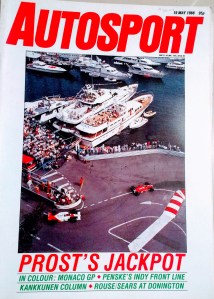
This first one isn’t brilliant but the event, the Monaco Grand Prix of 1988 is quite a significant one in the relationship between the two top drivers of the day, Ayrton Senna and Alain Prost. Senna was in the lead and had a big margin over Gerhard Berger who was holding up Alain Prost in the other McLaren. Senna had started to take it easy and concentrate on getting to the end of the race at a slightly reduced pace, saving fuel and stress on the car. Then Prost slipped past Berger and Senna started to speed up. The pit crew radioed him to slow down and that it was too late for Prost catch him but Senna, desperate to beat his team-mate was taking no chances. He upped the pace, going ever faster until he hit the barrier coming into the harbour. Prost went on past and won the race. Senna, overwhelmed with disappointment would not even return to the pits, instead going straight back to his Monaco apartment.
1988 was the year in which Enzo Ferrari passed away. Ferrari started out as a driver for the Alfa Romeo team before starting his own Scuderia Ferrari team in 1929. Ferrari’s team had support from Alfa and in fact raced and prepared Alfa Romeos for various drivers including the famous Tazio Nuvolari. In 1933 Alfa Romeo withdrew their support and Ferrari began to produce his own cars.
The prancing horse was the symbol of an Italian first world war fighter ace, Francesco Baracca, who claimed 34 kills in action. He himself was shot down and killed in 1918 but in 1923 Baracca’s parents visited a motor race won by the young Enzo Ferrari. They were impressed by Ferrari and asked him to use the prancing horse on his cars, thinking it might bring him luck. Ferrari added a yellow background, the colours of his home city of Modena and the symbol has been on Ferrari cars ever since.
The McLaren duo of Senna and Prost won all the F1 races in 1988 but one. The one they didn’t win was that year’s Italian Grand Prix at Monza. Prost retired from the race and Senna was leading until a coming together with back marker Jean-Louis Schlesser who was deputising in the Williams for the poorly Nigel Mansell who was suffering from a bout of chicken pox. Senna tried to lap Schlesser at one of the chicanes, Schlesser locked his brakes and appeared to be heading towards the gravel trap, however, he managed to regain control, something that Senna wasn’t expecting and when he took the normal line through the chicane the two came into contact and Senna was forced out of the race with broken suspension.
The Tifosi, the Italian race fans, were overjoyed when Gerhard Berger and Michele Alboreto came home first and second for Ferrari. Did the spirit of the recently departed Commendatore influence things? Who knows?
The story of Prost and Senna is probably the story we all remember from the eighties but they didn’t always have things their own way. Nigel Mansell nearly won the championship in 1986 and his rivalry with team-mate Piquet enabled Prost to take the title that year. Honda were not happy and Frank Williams’ refusal to give team orders to his drivers led to Honda taking their engines away from Williams and over to McLaren. Williams did take the championship in 1987 for Nelson Piquet but he left for Lotus for the 1988 season. Mansell wasn’t happy either in 1988 as the Williams team, left in the lurch by Honda, were forced to use engines from privateer John Judd. That was probably a major factor in Nigel switching to Ferrari for the 1989 season. Mansell was the last ever driver to be personally signed by the Commendatore himself, Enzo Ferrari. The cover shown here is from 1989 when Mansell took his Ferrari to victory in Hungary.
Alain Prost was not happy working with Ayrton Senna. Their relationship broke down completely and Prost decided to jump ship from McLaren and join Nigel Mansell at Ferrari. The partnership of Prost and Mansell started off well with Mansell announcing that the only person he could learn from on the grid was Alain Prost. That relationship soon soured when Mansell felt that Prost was getting preferential treatment at Ferrari. His love affair with Ferrari over, Mansell rejoined the Williams team where he went on to win his only world championship in 1992.
Prost was fired from Ferrari towards the end of a winless season in 1992 after he publicly criticised the Ferrari team. He returned to F1 in 1993 but announced his retirement at the end of the season after Williams announced their signing of Ayrton Senna for 1994.
In this edition of Autosport from 1989, the magazine chose a picture of Senna looking suitably gloomy as he waited on the FIA, the ruling body of motorsport, to rule on his appeal against his disqualification at the Japanese Grand Prix. Prost had been leading when Senna tried to overtake from a long way back. The two came together and Prost climbed out of his car. Senna however, was pushed away by the marshals and rejoined the race to eventually win. He was disqualified from the race and had to win at the final Grand Prix of the year in Australia to take the championship. The Australian race of 1989 was held in torrential rain and cut short. Prost declined to drive saying the conditions were too dangerous. Senna crashed into the back of Martin Brundle and the championship went to Prost. A year later in 1990, Senna drove Prost off the road to win his second championship. When he won for the third time in 1991, he admitted purposely colliding with Prost but felt he was not at fault because officials had changed pole position to the dirty side of the track. Had they not done so, he reasoned, the crash would not have happened.
1994 was a remarkable season in many ways. The Williams car which had been dominant for so many seasons was not handling well and a great deal of research and development was necessary for the car to be refined into a race winning motor car. Senna arrived at Imola for the San Marino Grand Prix in poor spirits. So far he had not scored a single point in the championship and murmured ruefully to the TV cameras, ‘for us the championship starts here, fourteen races instead of sixteen.’ Ratzenberger was killed in practice and Rubens Barrichello was lucky to escape from a horrifying crash without serious injury, all of which contributed to Senna’s darkening mood.
On lap 6 of the race Senna lost control of his car at Tamburello, one of the most challenging corners on the track. He hit the concrete wall there and part of the front suspension was flipped back towards Senna’s head. The impact pierced his helmet and dealt Senna a mortal blow. He died soon afterwards.
Floating in Space is a novel set in Manchester, 1977. Click the links at the top of the page to buy or for more information.
Once upon a time when I first started this web page, my whole focus was to promote my book, Floating in Space. Floating is a kitchen sink drama, something on the lines of Saturday Night and Sunday Morning, although not quite as good, but set in 1977. Those were the days; no Internet and no mobile phones. There were only a handful of TV channels. Jimmy Carter was the US President, Jim Callaghan was the UK Prime Minister and a pint of bitter was only 25 pence.
I had taken a number of essays based vaguely on my early life, knitted them together, added something of a storyline and finally, after lots of re-writing and editing, realised a lifetime’s ambition of creating a book and becoming a writer. It’s exciting to produce something, some small piece of work which people actually read, although to be completely honest, pretty much everything I write is for me, for my own personal pleasure and even if nobody ever read anything I wrote, the actual writing itself still gives me a lot of pleasure. Having said that, every time I sell a paperback or a Kindle, every time someone adds a ‘like’ to one of my posts it does make me feel really good.
Back in the old days like 1977, when everything was, you know, black and white and digital publishing was unheard of, an author would have to submit his manuscript to a publisher and nine times out of ten would be flatly rejected. Publishers are experts on literature, or so I suppose but even the best of them have rejected books like the Day of the Jackal by Frederick Forsyth, or the Harry Potter books for instance. Maybe they are not such geniuses as we thought.
Either way, even Frederick Forsyth would be taken aback a little I think, if he had to write a weekly blog, plan posts for Facebook and Twitter and make short videos for his YouTube page. Things just aren’t what they used to be!
Not long ago I picked up an e-mail from the people at Google and they offered me a substantial amount of credit to start using Google ads again. I have to admit, I’d not advertised on Google for a long time but creating an ad these days isn’t as easy as it sounds. One of the important aspects is to know your audience. Your audience? Well, I’m not sure I do know my audience. I’m guessing, and this is purely guesswork, that people like me would like the things I write so I suppose we’re looking at middle aged book readers, interested in a humorous take on life, which is what Floating really is.
For the past three years I have concentrated my social media promotions on Twitter. OK, I have a Facebook writer page and a Pinterest account and a Google+ account but it’s Twitter where I have really pushed myself. So much so that I am the proud possessor of over 6,000 followers. Sounds good doesn’t it? If every one of those 6,000 people were fans of my blog and each and every one bought a copy of Floating in Space I’d be quids in. The fact is, out of those 6,000, I’d say only a handful are genuine fans. The rest want to be friends with me for one reason -because I have 6,000 followers and every time someone Tweets one of my Tweets I am honour bound by the unwritten Twitter users code to Tweet them back, Tweet them to my 6,000+ followers.
Anyway, the reason I mention Twitter is that over on the Twitter analytics tab there are some really interesting tools that tell you all sorts of statistical stuff about your Twitter account but one tool in particular will give you the lowdown on your audience, your Twitter audience that is. So, a quick click over to Twitter and I see something like this;
That’s my audience sorted so back to Google Ads to see if I can add those details provided by Twitter and you get these drop down boxes that seem to go on forever in the search to identify your audience: What is their location? Are they parents, homeowners, car owners and so on and so on? Even on the parenting box you can choose one or two or more children.
Then you look at language spoken, income bracket and a multitude of other choices with which you can target your potential customer. Then you are looking at what sort of results are you after? Sales leads, purchases, web site clicks, video clicks, post likes?
This might be the point at which you, the reader, might be thinking that me, the author, is going to answer those questions. You might be thinking this is one of those how to do it posts with step by step instructions to get more book purchases and more readers. Now, or pretty soon, you might think, Steve is going to reveal all, some trick to Google Ads. You might even be thinking ‘wow, Steve is really clued in to all this technical marketing stuff!’
No, not gonna happen, it’s more the other way around: I’m sitting here waiting for someone to tell me what to do!
Just while I’m on the subject of Google it is pretty amazing how much Google is involved in your life, or can be, if you let it. If you search for something on the Internet, you probably use Google. If you upload videos to YouTube, that is part of Google.
A while ago I upgraded from my old banger mobile phone to a top notch internet savvy smartphone. I added Google onto my phone, logged in and found that straight away, Google was saving all my contacts on to my Google profile. Helpful, in fact very helpful because when I changed phones I no longer had to save my contacts to my SIM card. I could just log in to Google again on my new phone and there they were, all my contacts just waiting.
Here’s another thing, your Google timeline. I don’t know if you ever look at it or even know what it is but when you get a chance, check it out because what you will find is this, all your movements in great detail.
On the day I left for my holidays in France for instance, we left home at 8:57am, drove 307 miles in 5 hours and 21 mins. Travelled on Eurotunnel then drove 2 hours and 31 minutes through France to our hotel which was 4 minutes and 150 yards away from a restaurant on the Rue du Mont Perreux. And there was me, annoyed at myself for not jotting the car mileage down before we left home.
A while ago I was in Manchester with my brother and Google showed all our movements, what pubs we were in, how far we had walked to each pub, and how much time we had spent in each establishment. The only thing it didn’t record was what we drank, but now I think about it, in Wetherspoons I used the Wetherspoon app to order drinks so those details will be there, recorded for posterity in my phone memory somewhere.
Last weekend Liz and I went into Lytham for the Christmas lights switch on and when I looked, Google had once again faithfully recorded our movements. There were the times we had walked to the bus stop; the time and distance we had travelled on the bus (16 mins and 4.2 miles.) However, there was one missing element. After watching the festivities in Lytham we went to the Red Fort restaurant and now I think of it, I was unable to ‘check in’ there because I had no signal.
When I checked Google later it asked me if the Ego restaurant, one of my many regular watering holes and a mere stone’s throw from the Red Fort, was a ‘missing place’ Sorry Google, this time we fancied a curry at the Red Fort.
One more thing about Google. The whole genre of detective fiction will have to be changed. I watching a murder documentary the other day on TV and the killer’s movements were traced meticulously by Police investigators. A lot of their work involved tracking down CCTV cameras, trawling through recorded footage and establishing the timeline of the suspect. Then there was more legwork, interviewing people and taking witness statements. Such a pity the murderer didn’t have Google on his phone as his movements would have been there, minute by minute.
Good thing they didn’t have the Internet in Columbo’s day. Google would have ruined many an episode!
Floating in Space is a novel set in Manchester, 1977. Click the links at the top of the page to buy or for more information.
I think I’ll start this post with that fabulous time travel film Back to the Future. If you have never seen it, (shame on you) the film concerns young Marty McFly who helps his friend Doc Brown with a time travel experiment. The time machine is a 1985 DeLorean sports car which morphs through time when it reaches the magical speed of 88 mph. The experiment goes horribly wrong when a gang of Libyan terrorists whom the Doc has double crossed in order to get some vital nuclear supplies for his car/time machine arrive and shoot the Doc apparently dead.
Marty escapes in the DeLorean, accidentally hits the time travel switch (the flux capacitor) and zooms back to 1955 when he speeds up to 88 mph.
There Marty has to enlist the help of Doc Brown’s younger self, get his parents’ romance back on course after accidentally knocking that off target, and get himself back to 1985 in time to prevent the Doc being murdered by terrorists.
In Back to the Future 2, Crispin Glover, who played Marty’s dad, failed to agree terms with the producers so was not in films 2 or 3. Instead a look-alike actor was used prompting Glover to sue the production company. His legal challenge failed but next time you watch 2 and 3, that’s why Marty’s dad isn’t in the film much!
There are some great little touches to the film too, some you may not even have noticed, for instance, when Marty leaves 1985 and goes back to the past, he departs from the Twin Pines Mall. There, in 1955 he hits a pine tree and later arrives back in 1985 at the Lone Pine Mall!
In the final film Doc Brown gets accidentally flipped back to 1885 and Marty has to time travel back there to save the Doc. How does he know the Doc is in 1885? Well, the Doc arranges for a courier service to deliver a message to Marty at the exact time and spot where he disappears and flips back to 1885. Of course as Marty rescued him and brought him back to the future, then he wouldn’t have been there to write the message for the courier, well wouldn’t he? Maybe he wrote the message before departing!
Funnily enough, that is a similar situation in one of my favourite of the rebooted Doctor Who episodes, Blink. The doctor, played by David Tennant, gets stuck in the past courtesy of the Weeping Angels, aliens who appear frozen when watched but otherwise move in the blink of an eye. However he manages to add some special video links to a future DVD so people in the present can pick up his messages and help him.
Blink is possibly the most beloved episode of the modern Doctor Who era, with an oddball mystery that is intriguing and a slightly off beat approach to the show’s usual format, focusing mainly on a new character named Sally Sparrow instead of David Tennant’s Doctor. Sally is played by the now famous Carey Mulligan, and her portrayal of a normal young woman who has to solve a crazy time mystery when her friend is transported to the past by a living angel statue won her plenty of fans among the Doctor Who faithful.
Really though, the best Doctor Who episodes were back in the 1980’s with Tom Baker as the Doctor and Elizabeth Sladen as assistant Sarah Jane Smith. A great episode was Pyramids of Mars, which combines sci- fi with the mystery of Egyptian tombs and artefacts. The Tardis materialises back at Unit headquarters in the UK. (UNIT by the way, is a military organisation the Doctor worked with in the 1980’s.) However, they are not at the current time period but have arrived earlier, in 1911. A great country house is there and it appears that a mysterious Egyptian has taken over the late Professor Scarman’s estate and there are many strange goings on. Later the Doctor finds that an ancient alien called Sutekh, imprisoned thousands of years ago by another alien, Horus is trying to escape captivity and wreak death and destruction on the universe. The Doctor, naturally, foils his plans.
Doctor Who is the world’s longest running sci-fi show having been first broadcast on the 23rd November 1963. Not many people watched the show that day as most people were desperate to find out more about the Kennedy assassination which had happened the previous day and so it was repeated again the following week. William Hartnell, the original doctor, left the show in 1966 and the role passed to Patrick Troughton. The producers came up with the ingenious idea of having the doctor, an alien from the planet Gallifrey, regenerating into another body making it easy to reboot the series every time the lead actor left.
Star Trek, although not really a time travel programme actually had quite a few episodes which involved time travel. The fans’ firm favourite, an episode voted the best ever Star Trek episode, was City on the Edge of Forever. The crew of the Enterprise arrive at a distant planet searching for the source of some time displacement. The source is a time portal, left among the ruins of an ancient civilisation which although abandoned, still emits waves of time displacement. In the meantime, Doctor McCoy is suffering from paranoia brought on by an accidental overdose of the wonder drug cordrazine which any Star Trek fan will tell you can cure any known Galactic ailment. McCoy in his crazed state bumbles through the time portal, back to 1930’s America (handy for that old 1930’s set on the Paramount back lot) and changes history. Kirk and Spock are forced to also go back in time, stop McCoy from changing history and restore things to as they were. Joan Collins plays a charity worker at the core of events; does she have to die in order to restore things to as they were?
In the Star Trek movie world there was another great time travel film, Star Trek 4 in which earth is threatened by a space vehicle causing havoc with the world’s weather. It turns out that the aliens are sending signals in whale-speak so the crew travel back to the 1980’s in order to find a hump back whale which can respond to the aliens. Sounds a bit mad when I put it like that but actually Star Trek 4 was one of the best Trek films. Highlights included Mr Spock diving into a giant pool and mind melding with a whale and later asking a punk rocker to turn down his ghetto blaster.
I must of course mention the sixties show the Time Tunnel the Irwin Allen show about two American scientists ‘lost in the swirling maze of past and future ages, during the first experiments on America’s greatest and most secret project, the Time Tunnel. Tony Newman and Doug Phillips now tumble helplessly toward a new fantastic adventure, somewhere along the infinite corridors of time’ as the opening blurb used to go.
The Time Tunnel starts off with a Congressman coming to investigate the growing budget of the time tunnel complex and threatens to close things down unless he sees results. Scientist Tony Newman decides he must therefore travel back in time to prove that the tunnel really works and save the project. Tony ends up on the ill-fated liner Titanic. His colleague Doug follows him back to 1912 and the control room struggle to shift the two in time before the ship sinks. Unable to return the duo to the present, the technicians struggle every week to shift the duo to somewhere new just in the nick of time. One episode that I particularly remember was when the pair land in Pearl Harbour, just before the Japanese attack in 1941. Tony meets himself as a young boy and finally solves the mystery of the disappearance of his father in the attack.
I’m at the point of running out of time travel TV shows but here is one great time travel movie, 12 Monkeys. I didn’t like it the first time I saw it then some time later I saw part of the film again and thought, hey, maybe this film isn’t so bad. The third time I saw it all the way through and did enjoy it although it can be a little hard to follow. 12 Monkeys was inspired by the French short film La Jetée made in 1962 and it goes something like this; Bruce Willis plays prisoner James Cole who lives in a post apocalyptic society in the year 2035 where people are forced to live underground after a deadly virus was released in 1996 which wiped out most of humanity. The virus was released by a group known only as the 12 Monkeys and Cole is selected to be sent back into the past to try and find the original virus so scientists can perfect a cure. Cole is plagued by a vision which constantly returns to him in which a man is shot dead on a railway station and as the film reaches its final moments, this tragic vision is finally explained.
I’ve tried to keep this post pretty much research free so no doubt numerous errors and omissions will be evident. What was your favourite time travel film or TV episode?
Floating in Space is a novel set in Manchester 1977. Click the links at the top of the page to buy or for more information.
This weekend is Remembrance Sunday and there is a lot of stuff out there in the media about the sad events of war, in particular World War 1 which ended 100 years ago this week. I occasionally comment on social media threads about the war and sometimes even tag my video from earlier this year about my visit to various war cemeteries in France.
The other week I added a link to my video on a Facebook page. It wasn’t anything to do with war, in fact it’s a Facebook page for amateur video makers, like me, to plug their work and discuss the arts of video making. I actually got some good reviews there but one fellow video maker questioned the beginning of the film. What I had done was this; when I had started filming I was planning a film about motorhomes and travelling in France and at one camp site parked next to us was a very tasty motorhome with a big trailer. Straight away I envisioned a narration talking about the big motorhome as if it was ours, then cutting to our much smaller one and saying ‘oh well, we’ll take this one then.’ Not exactly hilarious but faintly amusing. Anyway, that’s pretty much exactly how the finished video starts off.
However, as I eventually produced a video about war graves and cemeteries, the rest of the narration is of a sad and sombre tone and the jokey comments didn’t really fit in, which is what my fellow Facebook video maker had noticed.
When I originally put the video together I just somehow didn’t pick up on that. Take a look below and see what you think.
It’s always great to finish my block of shifts at work and then I can look forward to my six days off. This week however I picked up a tummy bug and spent a lot of time lying about in discomfort, constantly running to the toilet. Why couldn’t I have got the bug on a work day, then at least I could have called in sick? Anyway, one thing I thought I’d do on my days off was to sort out that video; go back to my editing deck, cut out the offending phrase and the much bigger motorhome and just record another line, something more in keeping with the general tone of the subject.
This of course is where everything went wrong. I added the new line, but in doing so I somehow managed to delete everything else on the soundtrack. OK, no problem, I still had the original recording of the narration so I thought I could just add that. What I did the first time round was to save the voice over as short individual tracks so I could change things round and pace things to match the visuals. Now, many months later the tracks were staring back at me, track 1, track 2 and so on, all the way up to track 48 and I couldn’t remember what I had said on each track, plus every few minutes, courtesy of the stomach bug, I had to drop everything and rush to the bathroom. Yes, I think I’ll leave that edit for another day but thanks fellow video producer for bringing that to my attention . .
Prior to my work shifts, Liz and I decided to spend an evening driving through the Blackpool Illuminations. The very first Illuminations began in 1879 but didn’t become a regular event until 1913 and were an idea for extending the holiday season at this seaside resort. The lights run for about six miles along Blackpool promenade from Starr Gate to Bispham and consist, apparently, of over one million light bulbs. Anyway, it was a great opportunity for a fish and chip supper and for me to mess about with my video cameras and editing software. A little background music instead of a voiceover might be preferable me thinks . .
Floating in Space is a novel set in Manchester 1977. Click the links at the top of the page to buy or for more information.
 There has been some discussion in our household recently about Christmas dinner. Personally, I think I am just easy to please but others apparently think differently. No one in our house is a great turkey fan although now I think of it, at a Christmas party recently at the Inn on the Prom in St Annes, a local hotel, I did choose the turkey roast as my main meal, and very nice it was too.
 Last year my brother and I struggled to get our Christmas pint in before Christmas so this year we decided to meet up early and make sure we did. My brother hates it when I drag him round book and music shops so I decided to go out early, have a bit of a nosey about then meet him later for drinks. In particular I was on a quest for that rare item in British pubs today, dark beers; stouts, porters and mild.
 We decided to take in some of the old and the new of licensed premises in the city. First stop was our old favourite, the Grey Horse, one of the smallest pubs in Manchester but also a pub that serves that classic dark beer, mild. Don’t you just hate it when you go in a pub nowadays and the teenage barman looks at you like you are a nutter when you ask for a pint of mild just because the average teenage barman has never heard of it? Well in a proper pub like the Grey Horse that just never happens.
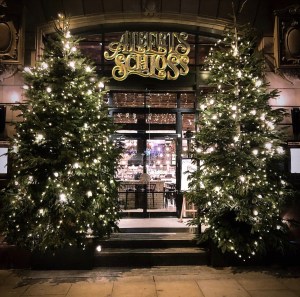 For one last pint we went into Albert’s Schloss, a sort of modern German Beer Keller sort of place packed with people and serving lager at inflated prices. (Though not as inflated as the Northern Quarter!) No dark beers to be found there but Albert’s was actually a fun place full of city centre workers spending their hard-earned cash. I enjoyed that pint of pilsner. Pity I couldn’t have had one last dark beer.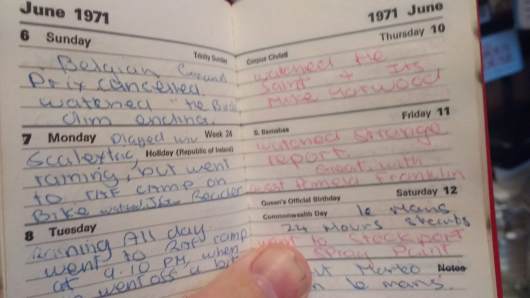
 I’ve always rather liked Kenneth Williams, the slightly over the top star of many a Carry On film as well as many radio comedy shows. However, it did feel rather odd reading his private thoughts through his diary. This is not an autobiography where the author tells us the story of his life and keeps things in some sort of order, it’s a diary, a record of the author’s day to day thoughts and sometimes it’s hard to keep track of what is happening. In a lot of the diary entries Kenneth refers to people by their initials rather than their name. The habit of using initials can be rather annoying as the editor will mention in one of the many footnotes that SB for instance refers to his friend and fellow performer Stanley Baxter. Later on SB will turn up again and I find myself flipping back through the footnotes because I have forgotten who SB was.
 Spandau: The Secret Diaries
 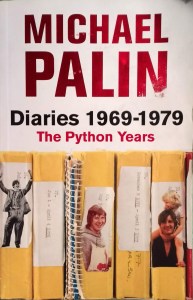 Michael Palin: Diaries 1969-1979 The Python Years.
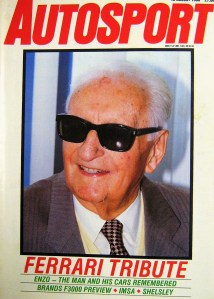 1988 was the year in which Enzo Ferrari passed away. Ferrari started out as a driver for the Alfa Romeo team before starting his own Scuderia Ferrari team in 1929. Ferrari’s team had support from Alfa and in fact raced and prepared Alfa Romeos for various drivers including the famous Tazio Nuvolari. In 1933 Alfa Romeo withdrew their support and Ferrari began to produce his own cars.
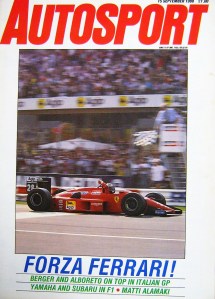 The McLaren duo of Senna and Prost won all the F1 races in 1988 but one. The one they didn’t win was that year’s Italian Grand Prix at Monza. Prost retired from the race and Senna was leading until a coming together with back marker Jean-Louis Schlesser who was deputising in the Williams for the poorly Nigel Mansell who was suffering from a bout of chicken pox. Senna tried to lap Schlesser at one of the chicanes, Schlesser locked his brakes and appeared to be heading towards the gravel trap, however, he managed to regain control, something that Senna wasn’t expecting and when he took the normal line through the chicane the two came into contact and Senna was forced out of the race with broken suspension.
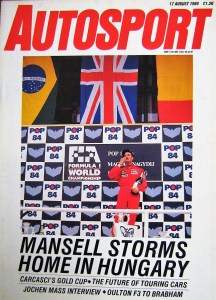 The story of Prost and Senna is probably the story we all remember from the eighties but they didn’t always have things their own way. Nigel Mansell nearly won the championship in 1986 and his rivalry with team-mate Piquet enabled Prost to take the title that year. Honda were not happy and Frank Williams’ refusal to give team orders to his drivers led to Honda taking their engines away from Williams and over to McLaren. Williams did take the championship in 1987 for Nelson Piquet but he left for Lotus for the 1988 season. Mansell wasn’t happy either in 1988 as the Williams team, left in the lurch by Honda, were forced to use engines from privateer John Judd. That was probably a major factor in Nigel switching to Ferrari for the 1989 season. Mansell was the last ever driver to be personally signed by the Commendatore himself, Enzo Ferrari. The cover shown here is from 1989 when Mansell took his Ferrari to victory in Hungary.
 Alain Prost was not happy working with Ayrton Senna. Their relationship broke down completely and Prost decided to jump ship from McLaren and join Nigel Mansell at Ferrari. The partnership of Prost and Mansell started off well with Mansell announcing that the only person he could learn from on the grid was Alain Prost. That relationship soon soured when Mansell felt that Prost was getting preferential treatment at Ferrari. His love affair with Ferrari over, Mansell rejoined the Williams team where he went on to win his only world championship in 1992.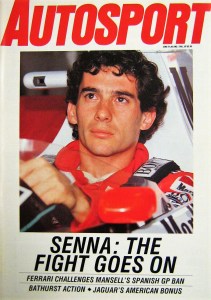
 1994 was a remarkable season in many ways. The Williams car which had been dominant for so many seasons was not handling well and a great deal of research and development was necessary for the car to be refined into a race winning motor car. Senna arrived at Imola for the San Marino Grand Prix in poor spirits. So far he had not scored a single point in the championship and murmured ruefully to the TV cameras, ‘for us the championship starts here, fourteen races instead of sixteen.’ Ratzenberger was killed in practice and Rubens Barrichello was lucky to escape from a horrifying crash without serious injury, all of which contributed to Senna’s darkening mood.
 Once upon a time when I first started this web page, my whole focus was to promote my book, Floating in Space. Floating is a kitchen sink drama, something on the lines of Saturday Night and Sunday Morning, although not quite as good, but set in 1977. Those were the days; no Internet and no mobile phones. There were only a handful of TV channels. Jimmy Carter was the US President, Jim Callaghan was the UK Prime Minister and a pint of bitter was only 25 pence.
 I think I’ll start this post with that fabulous time travel film Back to the Future. If you have never seen it, (shame on you) the film concerns young Marty McFly who helps his friend Doc Brown with a time travel experiment. The time machine is a 1985 DeLorean sports car which morphs through time when it reaches the magical speed of 88 mph. The experiment goes horribly wrong when a gang of Libyan terrorists whom the Doc has double crossed in order to get some vital nuclear supplies for his car/time machine arrive and shoot the Doc apparently dead.
 Letters from an Unknown Author!