 I do love old pictures. I’m not talking about films or movies, I mean actual pictures, old photographs. It’s amazing what we can do with old photographs these days in the world of digital images. We can scan them, remove blemishes, colourise black and white pictures, in fact we can do almost anything. I remember a recent documentary by director Peter Jackson which involved the restoration of old silent films from the trenches in World War 1. The films were cleaned and digitised, colourised and in some cases a lip reader was employed to try and surmise what those long dead soldiers were saying while the hand held camera was cranked. Computers removed the jerky motions and the result was genuinely amazing. I found myself so interested that I remembered a gadget I had bought a while back, a slide scanner with which I planned to scan and digitise my old colour slides. The results weren’t great and in fact I didn’t have quite as many slides as I thought I had but the results were interesting. I played with the device for a while, scanned a number of slides then moved on to some other project.
I dug the slide scanner out the other day and noticed that it was also possible to scan negatives. There is a holder supplied into which the negative strip fits securely. On the control panel a small box is selected for negative scan rather than colour slide and in a matter of seconds a digital image is produced.
I’ve scanned a lot of my old pictures although I’ve usually scanned them from a printed picture. This way, scanning from the original negative felt really interesting. One problem is that as the image is magnified any stray dust or hairs show up like a sore thumb so it’s important to clean the negatives first. I usually wipe them with a soft cloth which I normally use to clean my lenses then brush them with a small blower brush which sweeps free any dust and blows the offending material away.
I didn’t have any World War 1 material to restore but I did have a huge stack of photographs from the German Grand Prix of 1988. I was quite a keen photographer back then. I had an Olympus OM10 and graduated to an Olympus OM2 SP. SP stood for spot programming which was quite a significant piece of technology for 1988. SLR cameras come with built in light meters but what they do is take an average reading from the light coming into the camera and depending on your set up suggest either a shutter speed or lens aperture or even both. If the subject is evenly lit then that’s no problem but if your subject is in shadow with perhaps bright light from a window coming in stage left then the resulting picture might be too dark. With spot programming a light reading could be taken from the face of the subject so the face, the focal point of the shot would be exposed perfectly.
At the race track I didn’t have time to take spot meter readings, I probably had the camera set to auto or just used a similar setting for most of my shots. Not too fast a shutter as I didn’t want to freeze the cars, I did want a suggestion of speed. In the late 80s and early 90s I spent a lot of time at the Oulton Park circuit in Cheshire. Back then I knew every inch of Oulton Park. I knew where I could get close to the cars and where to get the most effective shots. I’d pick a point for my shot and get focussed then follow the cars round until they hit that exact spot and then fire the shutter. I must have hundreds of pictures of racing cars and one of the great things about the digital revolution is that now, instead of lying unseen in an album, my photographs have been seen by thousands of people over on the picture sharing site Flickr.

Ayrton Senna in his McLaren Honda. Practice laps for the German Grand Prix
Getting back to Formula 1, I tended to visit Silverstone for the British Grand Prix on Friday practice or Saturday qualifying, soak up the atmosphere and then go home to watch the race on Sunday at home on my TV. Visiting the 1988 German Grand Prix gave me a chance to see everything; practice, qually and visit the stalls selling motorsport memorabilia and, this being Germany, sample a sausage or two. The Grand Prix was held at Hockenheim which has a great stadium section where most of the spectators gather then the track snakes off into the German countryside. Somewhere in that countryside is a sad memorial to Jim Clark, killed here in 1968 at a Formula 2 event.
I journeyed to Hockenheim on a coach trip by a company specialising in sporting events. I had to get a train or coach into London then find the coach company and board ready for the trip to Germany.
The weather was excellent and just thinking about the trip brought back a number of things. 1988 was the first year of the Senna/Prost rivalry. It was also the year Williams lost their Honda engines to McLaren. Honda terminated their contract a year early with Williams because they were not amused that Frank Williams had let an inter team battle with their two drivers, Mansell and Piquet, hand the championship to Alain Prost at McLaren in 1986. Such a pity as if Williams and McLaren had both used Honda engines in 1988 there would have been an epic three-way battle between Senna, Prost and Mansell with Patrese in the second Williams perhaps getting into the action too. Sadly, it wasn’t to be.
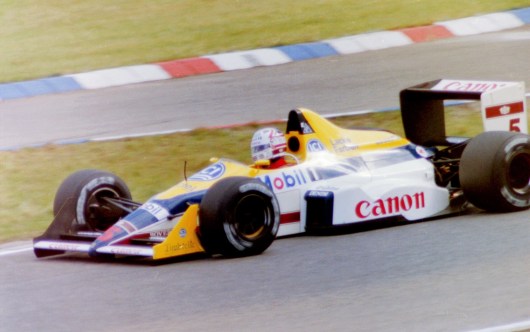
Nigel Mansell in the Williams
During the practice session I had a ticket letting me wander about various enclosures. I was near where the cars came in to the stadium section and every time a Ferrari went through this big Italian guy would stand up and ring a big brass bell he was carrying. Ding a ding a ding a ding he rang, every time either Gerhard Berger or Michelle Alboretto came through. Every time I moved to the next spectator enclosure I would get settled, line up my shots then it would come: ding a ding a ding a ding! That Ferrari fan must have been following me about. Well, that’s my excuse for all those jerky shots!
I had spent a lot of money buying myself an Olympus OM2 SP but perhaps I should have spent some extra money on my lenses. I had a great Olympus 50mm lens and a great wide-angle lens too but my zooms and telephoto lenses were a little on the cheap side and I think if I had shelled out a little more money that would have been reflected in my pictures.
My first scans were not that good. I’d cleaned the film as I mentioned but perhaps there had been some dust or hairs in the camera. It was only later after I had spent time cleaning up each individual scan that I realised the dust might be in the scanner!
I’m tempted now to delete them all and rescan them. Oh well, might keep me out of mischief for a while. Meanwhile, here’s a video slideshow using some of the pictures. I’ve added in some snippets of the 1988 TV commentary just to liven things up a little.
 I started off on this lockdown waking up at about 8 ish and now after 5 or 6 weeks of lockdown I’m waking up at 10, if I’m lucky. Of course I’m staying up much later than usual too, sometimes till 3 in the morning watching TV or listening to music on my new favourite app, Spotify.
 Last weekend should have been the weekend of the Monaco Grand Prix. It didn’t take place because of course the 2020 season has yet to start, affected like everything else by the Corona Virus pandemic. Pity, because I do love the Monte Carlo event even though it is essentially a race won during qualifying. It is so difficult to overtake around the narrow streets of this small but exclusive principality that make up the race track that pole position is essential.
 This last season, 2019 has been a long one (21 events) and it’s also been one in which I’ve seen less F1 than usual. Partly that’s because Channel Four has only been able to show one live Grand Prix in 2019 due to a contractual agreement with Sky TV. That was the British Grand Prix and while it was an okay race it wasn’t a classic by any means.
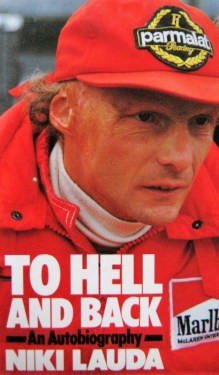 One of my favourite motor racing books is his autobiography titled To Hell and Back. This is what I wrote in one my reviews.
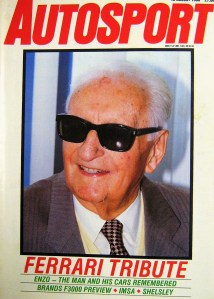 1988 was the year in which Enzo Ferrari passed away. Ferrari started out as a driver for the Alfa Romeo team before starting his own Scuderia Ferrari team in 1929. Ferrari’s team had support from Alfa and in fact raced and prepared Alfa Romeos for various drivers including the famous Tazio Nuvolari. In 1933 Alfa Romeo withdrew their support and Ferrari began to produce his own cars.
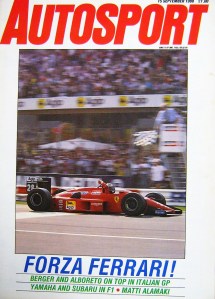 The McLaren duo of Senna and Prost won all the F1 races in 1988 but one. The one they didn’t win was that year’s Italian Grand Prix at Monza. Prost retired from the race and Senna was leading until a coming together with back marker Jean-Louis Schlesser who was deputising in the Williams for the poorly Nigel Mansell who was suffering from a bout of chicken pox. Senna tried to lap Schlesser at one of the chicanes, Schlesser locked his brakes and appeared to be heading towards the gravel trap, however, he managed to regain control, something that Senna wasn’t expecting and when he took the normal line through the chicane the two came into contact and Senna was forced out of the race with broken suspension.
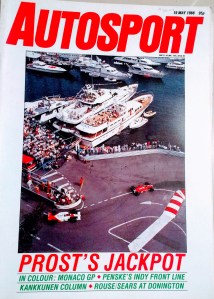
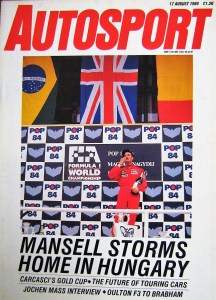 The story of Prost and Senna is probably the story we all remember from the eighties but they didn’t always have things their own way. Nigel Mansell nearly won the championship in 1986 and his rivalry with team-mate Piquet enabled Prost to take the title that year. Honda were not happy and Frank Williams’ refusal to give team orders to his drivers led to Honda taking their engines away from Williams and over to McLaren. Williams did take the championship in 1987 for Nelson Piquet but he left for Lotus for the 1988 season. Mansell wasn’t happy either in 1988 as the Williams team, left in the lurch by Honda, were forced to use engines from privateer John Judd. That was probably a major factor in Nigel switching to Ferrari for the 1989 season. Mansell was the last ever driver to be personally signed by the Commendatore himself, Enzo Ferrari. The cover shown here is from 1989 when Mansell took his Ferrari to victory in Hungary.
 Alain Prost was not happy working with Ayrton Senna. Their relationship broke down completely and Prost decided to jump ship from McLaren and join Nigel Mansell at Ferrari. The partnership of Prost and Mansell started off well with Mansell announcing that the only person he could learn from on the grid was Alain Prost. That relationship soon soured when Mansell felt that Prost was getting preferential treatment at Ferrari. His love affair with Ferrari over, Mansell rejoined the Williams team where he went on to win his only world championship in 1992.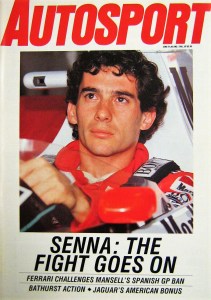
 1994 was a remarkable season in many ways. The Williams car which had been dominant for so many seasons was not handling well and a great deal of research and development was necessary for the car to be refined into a race winning motor car. Senna arrived at Imola for the San Marino Grand Prix in poor spirits. So far he had not scored a single point in the championship and murmured ruefully to the TV cameras, ‘for us the championship starts here, fourteen races instead of sixteen.’ Ratzenberger was killed in practice and Rubens Barrichello was lucky to escape from a horrifying crash without serious injury, all of which contributed to Senna’s darkening mood.
 The nights are growing shorter and the weather is cooling rapidly. In fact, the U.K. Is heading for a three-week freeze according to the latest weather report and Liz and I have lit our first coal fire since those long departed days of winter.
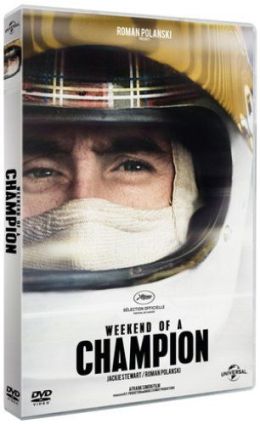 As this weekend is the start of the Formula One season, I thought I’d have a look through my motor sporting DVDs and recordings to get myself in the mood for a new season of the sport.
 Back in the 1970’s I subscribed to a magazine called Motor Sport. The magazine was, and still is, a monthly motor sporting glossy and I kept each copy as my reference guide and revered it as my motor sporting bible. The F1 races were always fully covered in detail and there was also an interesting reflections column written by a journalist who signed himself DSJ.
 Letters from an Unknown Author!