Many years ago when I was a bus conductor it was pretty easy to spot the fare fiddlers. They would never look directly at you. As I strolled down the bus asking for ‘any more fares please’ I knew who had paid and who hadn’t, after all, I had usually just watched them get on the bus. One scruffy guy got on one day and went straight down the bus, sat down and set a fixed gaze out of the window. Ok, I was chatting to other passengers at the time but I still knew he was new to the bus and I wanted his money.
“Fares please”, I called. Nothing. So then I turned directly to him and asked “I don’t think I’ve had your fare mate?” He finally turned away from the window.
“Where are you going to?”
“Levenshulme” he said.
“Thirty five pence please.” The guy thought for a minute, reached into his pocket and pulled out a can of soup.
“Can I pay with this?” He asked. The answer was no. He was asked to leave. After all it was pea and ham soup, tomato might have been another matter.
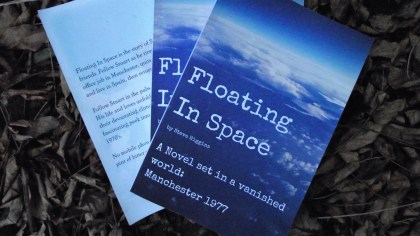
Here’s an extract from my book ‘Floating In Space’that deals with another odd ball passenger;
A harassed looking girl boarded in Stockport. There was something about her that I couldn’t put my finger on. She asked for a single to Manchester and did I require identification?
“Identification?” I asked.
“Only I don’t have my credentials on me at the moment. I’ve got to be careful.”
“Careful of what?”
“Well my boyfriend’s a nuclear arms salesman. I’m being watched by the CIA and God knows who else. MI5 have probably got the scent by now.”
“Right, we’ll keep a low profile then.”
“Probably best if you know what I mean.”
She was a Nutter.
“What was that all about?” asked Milligan, my driver, when I went back up to the front of the bus.
“Nutter” was all I had to say.
“That’s the 189 you see Stu. Used to be a hell of a lot of them on this route. Quietened down a lot lately, oh yes.”
The rest of the trip was pretty unremarkable. When we finally reached Albert Square in the city centre the nutter came storming towards me down the centre aisle and yelled at the top of her voice “If my boyfriend’s not a nuclear arms salesman then how did I get CIA Clearance?”
She charged through the open door and on into Manchester. An old chap behind her departing at a much slower and more sensible pace said, “Answer that one then!”
You can read more about life on the buses in Manchester in my book Floating In Space.
One final nutter to finish with; There used to be a guy who never boarded our bus but spent his time hurtling through the traffic on his bike cutting up cars and buses alike. How he was never ran over I do not know. My colleagues had dubbed him simply ‘the Levenshulme Nutter.’
One day, years later when I made been promoted from bus conducting to the lofty heights of bus driver, I was driving through Levenshulme on the 192 service when the Levenshulme nutter cut across me and I nearly ran him over. I stopped next to him at the traffic lights, opened my window to give him some abuse then, noticing his outsize spectacles with their purple lenses said, instead “I like your glasses!”
He popped the glasses up on his head and said “Yes, but it’s the man behind that counts!” And cycled away. I never saw him again.
If you liked this blog, then why not try my book? Click the the links at the top of the page for more information or to buy.
As a child growing up in the 1960’s one of my favourite television programmes was Tomorrows World, a BBC show about technology and the future. I was acutely interested in science, science fiction and all things related to the future. The future was hi-technology, gleaming metal and plastic cities, hover cars, and space travel. The movie 2001 A Space Odyssey predicted manned missions to Mars, powerful computers, and lunar space stations. But, 2001 is now thirteen years ago, so what happened? Why is 2014 not really that much different from 1968?
Movies like 2001, produced in 1968, were made in the sure knowledge that the incredible leaps in manned space flight made since 1960, and the technology that made it all possible, would continue. How wrong they were. When Neil Armstrong stepped out onto the surface of the Moon in 1969 the space race was over. It was a case of mission accomplished and the Apollo programme was cut short when Apollo 17 made the last manned trip to the Moon. To a great extent, space exploration, or at least manned space exploration stopped there. Space travel had become too expensive even for the Americans. The NASA space programme continued with Skylab and the development of the space shuttle, but none of those projects went further than orbiting the Earth, and that feat had been accomplished easily on the Mercury and Gemini programs.
Take a look at your kitchen and think to yourself how different is it from the kitchen of thirty years ago? Apart from advancements in electronics, probably in the form of your microwave and your freezer, the answer is not much. Step back further and look at your home. Are your living in a gleaming metal and plastic ‘future home’ or is it a modernised terraced house. Terraced houses are over a hundred years old but many people live in them happily today. Differently from our counterparts of a hundred years ago of course. Bathrooms have been added, and extensions with kitchens and indoor toilets, but terraced houses all the same.
Many writers and film makers have chosen to look at the future as a separate place altogether from the present and this has been their mistake. The future is the continuation of the past. Cities, homes, society itself is all an evolution of what has gone before.
Heathrow Airport was recently in the news because of protests about a possible new runway. New Runway? Why is a runway even necessary when the Harrier Jump jet has been taking off and landing vertically since the 1960’s? The answer is two words, arrested development. Perhaps VTOL has suffered, like Concorde, in not being American. There is no doubt in my mind that had Concorde been an American aircraft instead of an Anglo-French craft the skies above us would have been substantially populated with supersonic passenger aircraft. The United States is the land of opportunity, especially commercial opportunity. The space programme of course was also American but perhaps commercial exploitation in visiting the moon was limited. The great technological advances in the last thirty years have come in computer orientated technology that is full of commercial applications like, pc’s, laptops, tablet computers, mobile phones, and of course the internet.
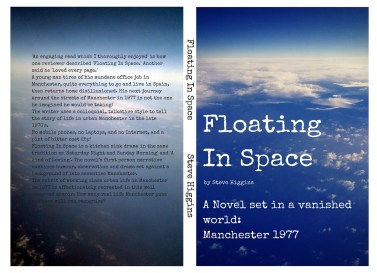
Having a book published has been the dream of many people, including me but today, with the advent of internet technology, that dream is easy to realise. My Book, ‘Floating In Space’ is one that I have been working on, off and on, for thirty years. I found it, uncompleted on an old disc, reacquainted myself with it, finished it off and now you can read it as a kindle e-book available on amazon. There were no meetings with publishers, no discussions, no chats with an editor, no re-writes. It was just a case of upload the files, proof read then press a button and it’s live on-line.
That of course has its drawbacks. As a writer I have discovered a sort of word blindness when it comes to my own work. I’ve proof read my book a multitude of times but how many times have I come to put an extract on this blog only to find missed words and other errors. When the paperback proof version came (in the wrong size: I’d made it far too big!) more errors jumped out at me and my girlfriend Liz, a fully paid up member of the Grammar Police has pointed out so many punctuation issues I sometimes feel like taking it off the market. Anyway, the good thing is that in the digital world, errors can quickly be resolved. A quick update, press the save button and we are all sorted.
Lets see, where’s my ‘Writers and Artists yearbook’? Maybe its time to check out that list of publishers again!
As a younger man Saturday night was everything to me and my friends. Nights out, beer, music and the ritual ‘chatting up’ of girls was our ‘raison d’etre’
In my book ‘Floating in Space’ a lot of the action takes place in bars and pubs and one of my favourite places in late seventies Manchester was the ‘Playground’, a disco bar on Oxford street. Here’s an extract from the book where I introduce the venue;
The main venue that night, and on many other Saturday nights like it, was the ‘Playground’, a small disco bar on Oxford Rd in the town centre. Flickering multi- coloured spotlights rotated across the red carpeted room, which, on Fridays and Saturdays was generally packed. It had a small dance floor sunk low like a pit, where people up on the raised bar level could look down at the gyrating girls, and where also, on week day lunchtimes, a topless dancer appeared at the stroke of one o’clock to translate the soul and disco music of the time into pulsating physical motion, the eyes of jaded office workers glued to her as she did so.
My friend ‘Matty’ Edwards and I used to meet up in the Salisbury, by Oxford Rd station, have a few pints and a bit of a natter to any Regal Insurance cronies who we might find there, then make the short walk to the Playground. There was a paltry fifty pence charge to get in, the solitary bouncer was silent, but not unpleasant, and the DJ, who always began the night with ‘Loves Theme’ by the Love Unlimited Orchestra, played alternate sessions of rock, disco, and chart music. We were both mad about Jenny, the barmaid. She was lovely. She had a kind of round, open face, framed by thick blonde hair and her skin was a creamy white. She served us Worthington ‘E’ and we melted into the hubbub of people on their Saturday night out while the music of the seventies drifted through us.
Matty was tall, he had lazy, rather hayfevered eyes, and a biggish nose over thin lips. His brown hair was short and untidy and he was smart, but had a sort of ‘middle of the road’ taste in clothes.
“Jenny’s looking gorgeous tonight” he told me over his pint of Worthington’s.
We were propped up at the bar at a convenient spot where we could eye up any possible female talent, and cast a fond eye over Jenny’s appealing form.
“You’re not wrong mate” I agreed. “I wouldn’t mind getting a grip of that myself.”
I caught Jenny’s eye and ordered two more pints of Worthington ‘E’. It wasn’t a great drink but we were tuned into it now for the rest of the evening, and anyway, I hadn’t as yet developed any clearly defined tastes in beer. The first pint I ever ordered myself was a pint of mild, and that was because I had nervously entered a Cheshire country pub after a long cycle ride and hesitatingly asked for a pint of ‘beer’.
“A beer?” asked the barmaid.
“Yes,” I replied, “A pint, please.”
“A pint of what?”
I realised, uncomfortably, that something more was required. I had thought that ‘a pint of beer’ would have been enough, but what the barmaid wanted to know was did I want bitter, or mild, or lager even? My first tentative forays into the world of the alcoholic drink were with my friend Mike Larini and it was always he who had done the ordering. What did he ask for, I thought? I couldn’t remember but down the bar the faint voice of an old man asking for half of mild drifted along to me, and so I went on to drink mild. Later I changed to bitter, and even now I was currently considering another change as someone had given me the cheerful news that bitter ‘rots your guts’. Perhaps it had been that eternal pessimist Matty Edwards with his inside knowledge of beer. His father was a Didsbury publican, and Matty’s drink changed from pub to pub. Sometimes it was lager, sometimes bitter, but here, in the Playground, it was that now long departed brew, Worthington ‘E’.
You can read more about that night out in either the kindle or paperback version of my book available at amazon. Click the icon below for more details.
In my book ‘Floating in Space,’ available now as a paperback or a kindle e-book from amazon.co.uk, all the action takes place in Manchester in the north west of England in 1977. All the venues are authentic, all actual Manchester pubs or bars. here’s an excerpt about a bar called the ‘Playground’ which used to be on Oxford Road.
Saturday night was in a lot of ways the culmination of the weekend. I always preferred it to Friday nights because things were more relaxed, there was no rushing home from work, no rushing to get your tea down your neck so you can get changed, then leg it out for the bus. Saturday, you could take your time and leisurely work up to things. Sometimes I would go out shopping and buy myself something new to wear for that evening, a shirt, or perhaps even a new pair of trousers. Then later I would have a long relaxed soak in the bath, and dress unhurriedly in my room to the tune of my favourite music. In 1977 my favourite album was still Elton John’s ‘Goodbye Yellow Brick road’, and as I dressed I would mimic Nigel Olsson’s measured and rhythmic drumming to ‘The Ballad of Danny Bailey’, or ‘Candle in the Wind’.
There was something about Saturday nights in Manchester. Some quality of security, of expectancy, a feeling that the night and the future were going to be good. A feeling that you might just ‘get off’ with some gorgeous girl and that even if you didn’t it didn’t really matter because there was always the excitement of the people, the music, the drink, and everything else that made up the evening. And then there was always the expectancy of the next night, and the next, and on and on into the future. The past building up inside you like a great data bank, reminding you, reassuring you, like a light burning in some empty room in the corner of your mind.
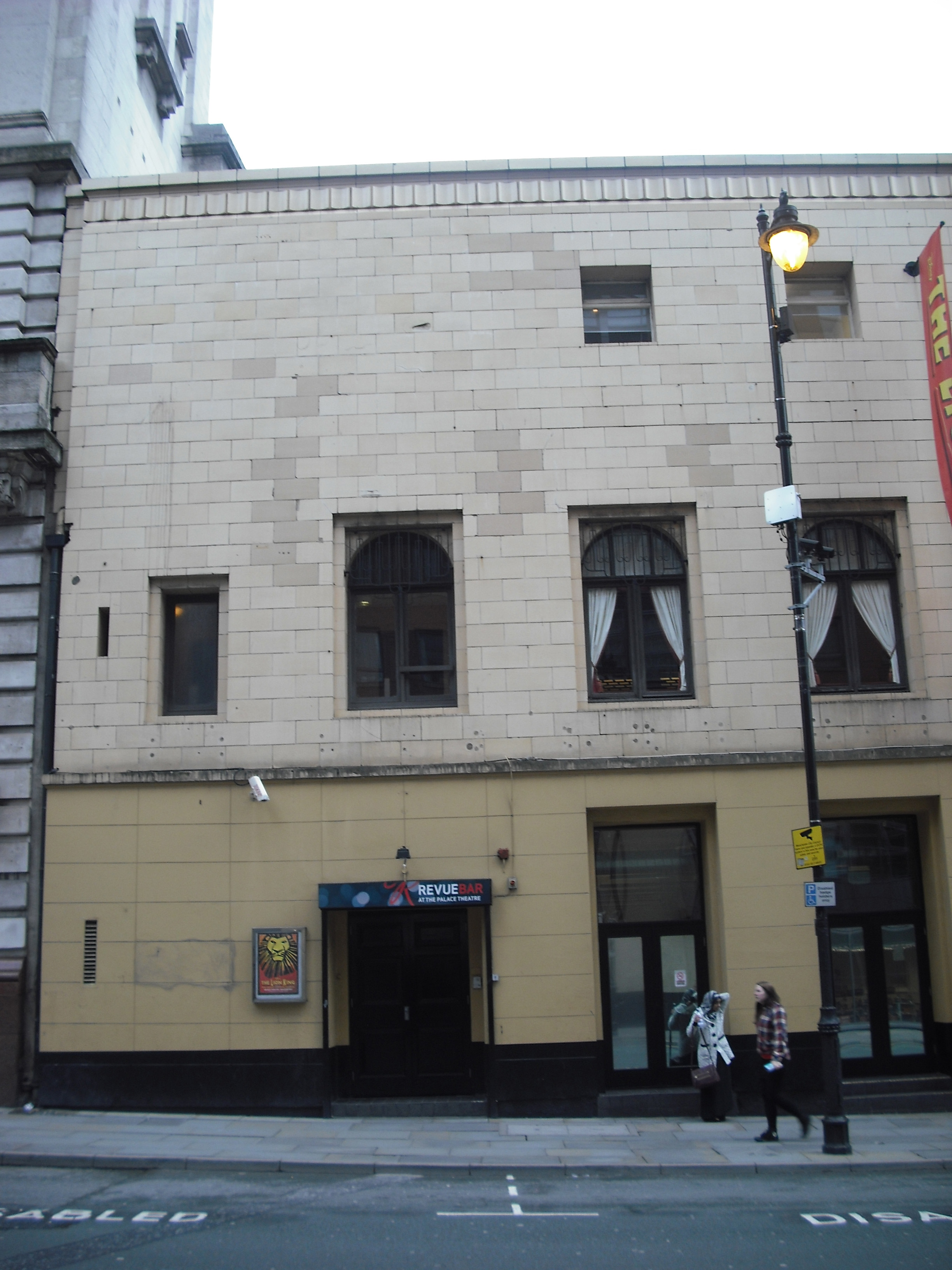
The Playground in 2015. Photo by the author.
The main venue that night, and on many other Saturday nights like it, was the ‘Playground’, a small disco bar on Oxford Rd in the town centre. Flickering multi- coloured spotlights rotated across the red carpeted room, which, on Fridays and Saturdays was generally packed. It had a small dance floor sunk low like a pit, where people up on the raised bar level could look down at the gyrating girls, and where also, on week day lunchtimes, a topless dancer appeared at the stroke of one o’clock to translate the soul and disco music of the time into pulsating physical motion, the eyes of jaded office workers glued to her as she did so.
My friend ‘Matty’ Edwards and I used to meet up in the Salisbury, by Oxford Rd station, have a few pints and a bit of a natter to any Regal Insurance cronies who we might find there, then make the short walk to the Playground. There was a paltry fifty pence charge to get in, the solitary bouncer was silent, but not unpleasant, and the DJ, who always began the night with ‘Loves Theme’ by the Love Unlimited Orchestra, played alternate sessions of rock, disco, and chart music. We were both mad about Jenny, the barmaid. She was lovely. She had a kind of round, open face, framed by thick blonde hair and her skin was a creamy white. She served us Worthington ‘E’ and we melted into the hubbub of people on their Saturday night out while the music of the seventies drifted through us.
Matty was tall, he had lazy, rather hayfevered eyes, and a biggish nose over thin lips. His brown hair was short and untidy and he was smart, but had a sort of ‘middle of the road’ taste in clothes.
“Jenny’s looking gorgeous tonight” he told me over his pint of Worthington’s.
We were propped up at the bar at a convenient spot where we could eye up any possible female talent, and cast a fond eye over Jenny’s appealing form.
“You’re not wrong mate” I agreed. “I wouldn’t mind getting a grip of that myself.”
I caught Jenny’s eye and ordered two more pints of Worthington ‘E’. It wasn’t a great drink but we were tuned into now for the rest of the evening, and anyway, I hadn’t as yet developed any clearly defined tastes in beer. The first pint I ever ordered myself was a pint of mild, and that was because I had nervously entered a Cheshire country pub after a long cycle ride and hesitatingly asked for a pint of ‘beer’.
“A beer?” asked the barmaid.
“Yes,” I replied, “A pint, please.”
“A pint of what?”
I realised, uncomfortably, that something more was required. I had thought that ‘a pint of beer’ would have been enough, but what the barmaid wanted to know was did I want bitter, or mild, or lager even? My first tentative forays into the world of the alcoholic drink were with my friend Mike Larini and it was always he who had done the ordering. What did he ask for, I thought? I couldn’t remember but down the bar the faint voice of an old man asking for half of mild drifted along to me, and so I went on to drink mild. Later I changed to bitter, and even now I was currently considering another change as someone had given me the cheerful news that bitter ‘rots your guts’. Perhaps it had been that eternal pessimist Matty Edwards with his inside knowledge of beer. His father was a Didsbury publican, and Matty’s drink changed from pub to pub. Sometimes it was lager, sometimes bitter, but here, in the Playground, it was that now long departed brew, Worthington ‘E’.
I passed over Matty’s pint and we both took deep draughts. Worthington’s was never a great ale but it was good enough, and the first taste of a fresh pint is always the best. I looked into the deep mahogany of the beer and thought about the things you can see through the bottom of a glass. Could I see Spain, there, in the distance? Could I really do it? Pack in my job and go to Spain in search of sun, sea, sand, and girls?
Somebody bumped into me from behind and a gruff voice said “sorry mate” and shouted up four pints of lager.
“Busy in here tonight” I said to Matty.
“Its Saturday night isn’t it? It’s always busy.”
“Yes, but it seems to be mostly lads. Was there a match on today or something?”
“Of course. City and United. Still, it was at Maine Rd so I wouldn’t have expected a load of hooligans in town.”
“Keep it down,” I said quietly. “You know what these football fans are like. Look at them the wrong way and they’ll have you.”
A girl in short black outfit caught my eye across the other side of the room and as Matty and I nattered on I would occasionally glance over and make eye contact. Matty soon noticed me and asked who I was eyeing up, and I told him and of course he had to gawp over at her despite me asking him to be discreet.
I thought about going over to chat to her but the usual fear crept up on me. What could I say? Suppose she wasn’t even interested in me? Sometimes I had found myself eyeing up someone I later found I wasn’t really interested in, it was just that the invisible thread that bound you across the room wasn’t all that easy to break. You would find yourself turning again to meet those same eyes, attracted to each other purely by the link that held you.
“Are you getting them in or what?” I said to Matty.
“Just waiting till Jenny comes this way.”
“Shout up the other barmaid. She’s over this side,” I told him, impatiently.
“You shout her up if you want. I want Jenny. Look at that; gorgeous.”
We spent a few moments discussing the merits of Jenny. Her eyes, her lips, her hair. She was lovely. Matty finally caught her attention and she filled up our pint pots. Matty bought her a drink and they exchanged some pleasantries before she moved on to the next customer. Matty came closer and quietly told me about the letter he was thinking of sending to her, telling her how he felt about her, but what did I think? Was it a good idea?
“What, a letter?” I shook my head. “No, why don’t you get her alone on a quiet night, give her some chat? Ask her out or something?”
“I don’t know. What about a card though, instead. I could send her a nice card asking for a date.”
Matty was as shy as I was in some ways, but his ideas of writing to a girl were always a mistake. If the girl did like him, and wanted to go out, then he would be actually asking her to ask him out. He would be transferring the responsibility of the whole thing on to her. No, we’re all shy to varying degrees, but things like this are a part of life that we have to face up to. We have to rise to the occasion and take on the challenge. Perhaps that sounds a bit dramatic but, getting involved with the opposite sex is a normal part of life, it’s just that anything new is hard at first, and all of us are conscious of our feelings, especially where sexuality is concerned.
Floating in Space is available from Amazon as a Kindle download or traditional paperback. Click the icon below or go to the links at the top of the page for videos and more information!
 Many years ago when I was a bus conductor it was pretty easy to spot the fare fiddlers. They would never look directly at you. As I strolled down the bus asking for ‘any more fares please’ I knew who had paid and who hadn’t, after all, I had usually just watched them get on the bus. One scruffy guy got on one day and went straight down the bus, sat down and set a fixed gaze out of the window. Ok, I was chatting to other passengers at the time but I still knew he was new to the bus and I wanted his money.
 As a child growing up in the 1960’s one of my favourite television programmes was Tomorrows World, a BBC show about technology and the future. I was acutely interested in science, science fiction and all things related to the future. The future was hi-technology, gleaming metal and plastic cities, hover cars, and space travel. The movie 2001 A Space Odyssey predicted manned missions to Mars, powerful computers, and lunar space stations. But, 2001 is now thirteen years ago, so what happened? Why is 2014 not really that much different from 1968?
 That of course has its drawbacks. As a writer I have discovered a sort of word blindness when it comes to my own work. I’ve proof read my book a multitude of times but how many times have I come to put an extract on this blog only to find missed words and other errors. When the paperback proof version came
  The main venue that night, and on many other Saturday nights like it, was the ‘Playground’, a small disco bar on Oxford Rd in the town centre. Flickering multi- coloured spotlights rotated across the red carpeted room, which, on Fridays and Saturdays was generally packed. It had a small dance floor sunk low like a pit, where people up on the raised bar level could look down at the gyrating girls, and where also, on week day lunchtimes, a topless dancer appeared at the stroke of one o’clock to translate the soul and disco music of the time into pulsating physical motion, the eyes of jaded office workers glued to her as she did so.
 In my book ‘Floating in Space,’ available now as a paperback or a kindle e-book from amazon.co.uk, all the action takes place in Manchester in the north west of England in 1977. All the venues are authentic, all actual Manchester pubs or bars. here’s an excerpt about a bar called the ‘Playground’ which used to be on Oxford Road.