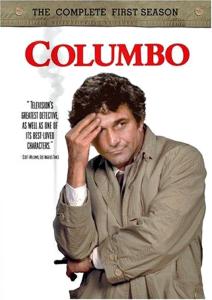
Watching (and reading) the Detectives

Liz and I are over here in sunny Lanzarote having exchanged the cold of the UK for the warmth of Lanzarote. Of course, it is still February and things aren’t perfect over here. It’s warm but there are plenty of days when gusty winds blow across the island as well as days when the sun has been obscured by clouds. Even so there are still plenty of bars to drink at, plenty of tapas to be eaten and of course we have plenty of books to read, two of which have inspired this week’s post.

The Thin Man is a book I picked up somewhere in a second hand bookshop. It was written by Dashiell Hammett and features his famous detective, Nick Charles.

Dashiell Hammett was born in May, 1924 and became a writer of detective stories after working for the famous Pinkerton National Detective Agency. In his obituary in the New York Times, they described him as ‘the dean of the hard boiled school of detective fiction.’
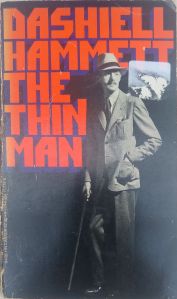
Time magazine included his novel Red Harvest, published in 1929, on their list of the 100 best English language novels. The Thin Man was made into a film in 1934 starring William Powell as Nick Charles and Myrna Loy as his wife Nora. I’ve only just started reading the Thin Man and it’s been pretty good so far. One interesting element of it though was finding out that in New York in the mid 1930’s it was possible to find an all-night delicatessen that would deliver coffee and sandwiches at 5 in the morning.

A further 5 sequels in the Thin Man film series were made finishing in 1947 with Songs of the Thin Man.

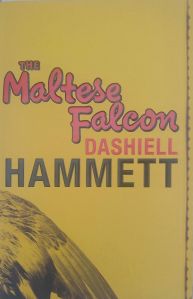
Another book by the same author is one that Liz got me for Christmas, The Maltese Falcon. I’ve only just scanned through it so far but it looks like being a good read. The book was made into a classic film in 1941 with Humphrey Bogart playing the part of detective Sam Spade. Mary Astor plays Ruth Wanderley who contacts the firm of Spade and Archer to help her track down her missing sister who she thinks might be held against her will by a man called Thursby.  Miles Archer, Spade’s partner decides to take on the case but is found dead by the police later that night.
Spade begins to try and find out what has happened and meets various other characters like Joel Cairo and Kasper Gutman played wonderfully by Peter Lorre and Sydney Greenstreet. One of my favourite scenes is where Spade and Gutman meet and Gutman asks ‘are you a close mouthed man?’ Spade replies that no, he likes to talk and Gutman responds famously with ‘I’m a man who likes to talk to a man who likes to talk’.

Hammet died in 1961 of lung cancer and Raymond Chandler said this of him: ‘He was spare, frugal, hard-boiled, but he did over and over again what only the best writers can ever do at all. He wrote scenes that seemed never to have been written before.’

That brings me nicely to another of my favourite detectives, Philip Marlowe and he first appeared in the novel The Big Sleep. The book was written by Raymond Chandler and Chandler had this really fabulous talkative way of writing. You can almost imagine hearing Humphrey Bogart’s voice as you read the book. Bogart of course played Marlowe in the 1946 film version directed by Howard Hawks. Here’s a quote from the book, an example of Chandler’s descriptive style:

I sat down on the edge of a deep soft chair and looked at Mrs Regan. She was worth a stare. She was trouble. She was stretched out on a modernistic chaise-longue with her slippers off so I stared at her legs in the sheerest silk stocking. They seemed to be arranged to stare at. They were visible to the knee and one of them well beyond. The knees were dimpled, not bony or sharp. The calves were beautiful, the ankles long and slim with enough melodic line for a tone poem. She was tall and rangy and strong looking. Her head was against an ivory satin cushion. Her hair was black and wiry and parted in the middle and she had the hot black eyes of the portrait in the hall. She had a good mouth and a good chin. There was a sulky droop to her lips and the lower lip was full.

Not bad eh? Dilys Powell called his writing ‘a peculiar mixture of harshness, sensuality, high polish and backstreet poetry’ and it’s easy to see why. Mrs Regan was played by Lauren Bacall in the film version and up until now I had always thought this was the film where Bogart and Bacall met. Wrong! A quick check on Wikipedia and I see the couple met on the set of To Have and Have Not in 1944. Bacall was 19 and Bogart was 45 and married to his third wife Mayo Methot at the time. Sparks apparently flew between the couple and Bogart divorced Mayo and married Bacall the next year, 1945. Despite the great on screen chemistry together the couple only made four films together.

The film version of The Big Sleep was a brilliant adaptation of the book and some of the differences are interesting. For instance, early in the book, detective Philip Marlowe played by Bogart meets General Sternwood’s daughter Carmen. She looks at Marlowe and remarks how tall he is. In the film, Bogart of course wasn’t that tall so the dialogue is reversed ‘You’re not very tall, are you?’ comments Carmen.

The plot of the book and film are pretty complicated, although having read the book recently I think that the book is easier to follow. During the filming the director and his stars wondered who killed the character of Owen Taylor, the Sternwood’s chauffeur. They sent a cable to Raymond Chandler asking him. Chandler told a friend later ‘Dammit, I don’t know either!’

One strange element in the film, certainly for me, is a scene where Philip Marlowe (Bogart) is watching blackmailer Geiger. Geiger has a shop that sells rare books in Hollywood and Marlowe asks for information in another bookshop opposite. There he chats to a bookseller played by Dorothy Malone who, if you are old enough, you will remember her from the Peyton Place TV series. Malone and Bogart seem to hit it off well in the film but he never returns to the bookshop and Dorothy is never seen again in the film.

Every time I watch the film, I always expect Malone to reappear but that’s one of the many dead ends the film leads us down. I think it was Hitchcock who said that every scene in a film should lead the audience somewhere and Quentin Tarantino of course said the reverse. Perhaps director Howard Hawks favoured Tarantino’s view.
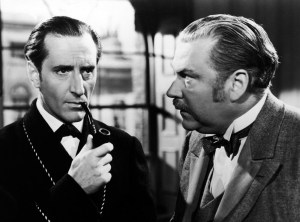
Basil Rathbone as Holmes and Nigel Bruce as Dr Watson (image via creative commons)

Perhaps the most famous literary detective is Sherlock Holmes, created by the author Sir Arthur Conan Doyle in 1887, first appearing in the story A Study in Scarlet. The stories are narrated by Holmes’ friend and companion, Doctor Watson. The Guinness Book of Records reports Holmes as the most portrayed character in film and television history.

My personal favourite Sherlock Holmes in the cinema was the version created by Basil Rathbone in a series of films beginning in 1939. 14 films were made with Rathbone as Holmes and Nigel Bruce playing the part of Dr Watson. The first two films were set in the Victorian era and were produced by Twentieth Century Fox. The later films were produced by Universal who set the films in, what was then, the present time period, that of the second world war.

Time now to move onto my favourite TV detective, the bumbling Lieutenant Columbo.

Columbo first appeared in the early 1970s as part of the Mystery Movie TV series. Each week followed a different detective trying to track down a murder case, sometimes it was MacMillan and Wife and other weeks McCloud, Banacek or various others. The most popular one by far though was Columbo.

Columbo was a homicide detective for the LAPD and he was played by Peter Falk, although the role was originally written for Bing Crosby. Crosby however thought a regular TV slot would interfere too much with his golf so he turned down the role, went back to the fairway and the part went to Peter Falk who made it his own.

If you ever see the original pilot, shot in 1968, you can see how Crosby might have fitted into the part, as Falk plays Columbo in a very Crosby like laid back way. The very first guest murderer was Gene Barry who was familiar to TV audiences after playing Amos Burke in Burke’s Law for many years. He also starred in a 1953 film version of War of the Worlds.

The pilot episode also introduced audiences to a particular feature of Columbo, in that we see who the murderer is and how he commits the crime first. Then we see Lieutenant Columbo gradually solve the clues and get his man, or woman. The essence then of a great episode comes in the clever way Columbo nails the murderer. Sometimes that moment is a bit of a non starter, other times it’s nothing short of brilliant. Sometimes, even if that final moment is not so great, it’s still been a great episode.

The Columbo of the early series is an absent-minded quirky fellow although in later episodes, Peter Falk who plays the detective, seems to downplay that quirky element.

Favourite episode? I’m not certain but it might be ‘Murder by the Book‘, starring my favourite murderer, Jack Cassidy. In this 1971 episode, Jack plays a writer, actually part of a writing double act, who together produce a series of novels about ‘Mrs Melville’ who is an amateur detective. The thing is, Jack’s partner wants to ditch the partnership but Jack is not happy about it. He is so unhappy he decides to, yes you guessed it, bump off his co-writer. He does it in a rather ingenious way which foxes Columbo but not for long and to cap it all, the episode is directed by none other than Steven Spielberg!

So who was your favourite fictional detective?


What to do next: Here are a few options.

Share this post on your favourite social media!

Hit the Subscribe button. Never miss another post!

Listen to my podcast Click here.

Buy the book! Click here to purchase my new poetry collection.

Click here to visit Amazon and download Floating in Space to your Kindle or order the paperback version.

Click here to visit amazon and purchase Timeline, my new anthology.

Back to the 1960s

The 1960s seem like a long way off these days. We moved into the 1970s 54 years ago but even so, the 1960s were a revolutionary time in terms of music, the cinema and of course TV. This last Sunday afternoon after a gruelling session of blog writing, I settled down in front of the TV with a cup of tea and a cheese sandwich and what did I find? Well, a whole stack of TV shows from the 1960s still bringing in viewers today in 2024.

So, what did I watch? Well, time to settle back for some serious TV viewing.

Columbo

Columbo, as you probably know, differs from other TV detective shows by showing the viewer exactly who the murderer is and how he, or she, did it. The whole point is not who did it, but how Columbo catches them. The essence then of a great episode comes in the clever way Columbo nails his man, or woman. Sometimes that moment is a bit of a non starter, other times it’s nothing short of brilliant. Sometimes, even if that final moment is not so great, it’s still been a great episode.

The Columbo of the early series is an absent-minded quirky fellow although in later episodes, Peter Falk who plays the detective, seems to downplay that quirky element. The later episodes are still pretty good though and among various episodes on TV today was Any Old Port in a Storm with Donald Pleasance as the guest murderer. Pleasance plays Adrian Mancini, the part owner of a wine producing business. He is something of a wine snob and he has just been voted ‘man of the year’. That was the good news; the bad news is that his half brother is threatening to sell the business. That of course doesn’t go down well so Adrian in a fit of anger bumps him off. A whack on the head didn’t quite do the job so Adrian leaves him to suffocate in his wine cellar. Unfortunately, it happens to be a really hot day which eventually leads Columbo to the clue that bags the culprit.

That was an episode from 1973 but the original Columbo pilot first aired in 1968.

Thunderbirds

Thunderbirds was about a secret organisation called International Rescue that had a small fleet of highly advanced machines and equipment with which to perform rescue operations. Millionaire ex-astronaut Jeff Tracy was the head man and the organisation was secreted in his island home. His five sons were the Thunderbird pilots, John, Scott, Virgil, Gordon and Alan, all named after US astronauts of the 1960s. The genius behind the Thunderbird craft was Hiram Hackenbacker, known as ‘Brains’. Thunderbird’s nemesis was a secret agent known as the Hood because of his talent for disguise and in many episodes the Tracy brothers had to ask their London agent, Lady Penelope, to track him down and sort him out.

Lady Penelope Creighton-Ward lived in a huge mansion somewhere in southern England and her manservant and chauffeur was Parker, a reformed safecracker. The head of ITV Sir Lew Grade saw the first episode and was so impressed that he asked for the episodes to be extended from 30 minutes to a full hour, less TV adverts of course. Gerry wanted Fenella Fielding to voice Lady Penelope but in the end, his wife Sylvia took on the role.

One other thing, I know Thunderbirds sounds pretty sophisticated from those last two paragraphs but it was actually a puppet series aimed at children. The great thing about it and really, the secret of its success, was the highly intelligent scripts which treated its audience of children not as kids but as intelligent young adults.

Two scripts that spring to mind were one called The Cham Cham about a code transmitted on a musical melody and another where Parker was called upon to break into the Bank of England. Later in the episode someone is trapped inside the vault and Parker is asked to break in again to rescue the man before the air is used up in the vault. Parker though thinks that his old mate, a bank robber recently released from prison, is about to complete his life’s ambition to break into the bank and so he tries to slow down his and Penelope’s drive into London. Everything of course comes right in the end though.

Time for a fresh cup of tea and I’m ready for the next programme.

Batman

We are probably all familiar with the modern Batman films which all have pretty grim and dark overtones. Tim Burton directed the first modern Batman film in 1989 which starred Michael Keaton as Batman and Jack Nicholson as the Joker. Back in 1966 however there was a TV series produced by William Dozier which starred Adam West as Batman and Burt Ward as Robin.

The suave Alan Napier played the part of Alfred, the butler to Bruce Wayne (Batman’s alter ego) and numerous guest stars played the villains. Frank Gorshin was a memorable Riddler, Burgess Meredith (remember him as the trainer in the Rocky films?) played the Penguin and Cesar Romero who refused to shave off his moustache played a rather manic Joker. Julie Newmar and Eartha Kitt both played Catwoman. George Sanders and Vincent Price also appeared as guest stars and even Hollywood director Otto Preminger appeared on the show as Mr Freeze. Anyway you look at it, that is an impressive cast list.

The episodes were all two parters and in the UK were aired on Saturday and Sundays; the Saturday episode always left the Dynamic Duo in some impossible situation and the Sunday one showed how they would escape and track down the villains. The series was very light hearted unlike the modern Batman films and in fact played rather like a live action cartoon series.

The series ran for three seasons and a feature film before being cancelled. In the UK episodes are currently being broadcast on the Talking Pictures channel.

Mission Impossible

The TV show was created by producer Bruce Geller and concerned a team of special agents known as the Impossible Missions Force. They are a US government agency which takes on hostile foreign governments, South American dictatorships and criminal organisations.

In the first series the team is led by Dan Briggs played by Steven Hill but he was replaced for season 2 by Peter Graves in the part of Jim Phelps. Other regular team members were Leonard Nimoy, Martin Laudau and his wife Barbara Bain, Greg Morris and Lesley Anne Warren. Each played a team member with a particular skill, for instance Laudau and Nimoy played agents with a talent for impersonation and disguise, Greg Morris played an electronics expert and so on.

Mission Impossible ran for 7 seasons and was cancelled because, according to Wikipedia, the producers at Paramount found they could make more money by syndicating the existing series rather than making new ones.

A revival series was made in the 1980’s also starring Peter Graves. To save money the series was not filmed in Hollywood but in Australia but it only lasted two seasons and was largely unsuccessful.

A great feature of the series was the opening title sequence which involved a match being struck and then lighting a fuse shown over quick clips of the upcoming episode to the sound of the iconic theme tune written by Lalo Schifrin. Next would be Jim Phelps listening to his tape recorded instructions which after being played would then self-destruct. Phelps would then look through his agents’ files complete with photos and choose who he wanted for the mission. Sometimes a guest star would play one of the agents who would be introduced by Jim checking out his dossier. A team briefing would then take place and the mission would get under way.

The IMF used a great deal of gadgets to accomplish their missions; secret listening devices and other electronic hardware as well as incredible masks and make up to impersonate people. One particular episode that I remember was when the team had to retrieve some stolen gold from a South American dictator’s safe. They did it by drilling a small hole in the safe, heating it until the gold melted and ran out down the small hole then a little gadget sprayed the interior of the empty safe to cover the hole. Mission Impossible was staple viewing in our household in the late 1960’s and it was nice to see once again on UK TV.

From Russia with Love

I’m perhaps cheating a little here because this is a film rather than a TV show but what the heck, it popped up on ITV so I thought I’d watch it. Just lately there seem to be James Bond films popping up on TV almost every week. This film was the second in the Bond series, made in 1963 and it’s probably one of the very best. There are no super villains trying to take over the world and the plot is actually pretty sensible. SPECTRE -the Special Executive for Counter Intelligence, Revenge and Extortion- decide to offer British Intelligence a Soviet Lektor decoding machine but the catch is, the lovely Soviet consulate clerk chosen for the mission and based in the Soviet embassy in Turkey will only offer it to Bond himself.

Sean Connery played James Bond of course and the Soviet clerk was Tatiana Romanova played by Italian actress Daniella Bianchi. A great Bond villain was former Soviet agent now a part of SPECTRE, Rosa Klebb played by Lotte Lenya. The best performance though was by Robert Shaw who plays Red Grant, the killer specially trained to eliminate Bond. Bond and Grant have a hugely exciting fight in a railway carriage towards the end of the film which underlines the serious and gritty nature of the film. I don’t think I’m giving anything away when I tell you Grant wasn’t successful but Rosa Klebb nearly gets Bond with a concealed knife in her shoe.

I could have gone on and talked about Star Trek, The Saint with Roger Moore and even The Avengers with Patrick MacNee as Steed and Diana Rigg as Mrs Peel.

Yes, in some ways the 60s are done and dusted but when it comes down to it, you only have to tune in to a few vintage TV shows to relive it all again.


What to do next: Here are a few options.

Share this post on your favourite social media!

Hit the Subscribe button. Never miss another post!

Listen to my podcast Click here.

Buy the book! Click here to purchase my new poetry anthology.

Click here to visit Amazon and download Floating in Space to your Kindle or order the paperback version.

The Forgotten Stars of Columbo

Famous faces who have appeared in the classic detective series.

If you happen to be a big fan of murder mysteries then Sunday is a great day for you. Over on 5 USA on UK Freeview TV you can watch the classic detective series Columbo to your heart’s content.

Columbo first appeared in the early 1970s as part of the Mystery Movie TV series. Each week followed a different detective trying to track down a murder case, sometimes it was MacMillan and Wife and other weeks McCloud, Banacek or various others. The most popular one by far though was Columbo.

Columbo was a homicide detective for the LAPD and he was played by Peter Falk although the role was originally written for Bing Crosby. Crosby however thought a regular TV slot would interfere too much with his golf so he turned down the role, went back to the fairway and the part went to Peter Falk who made it his own.

If you ever see the original pilot, shot in 1968, you can see how Crosby might have fitted into the part as Falk plays Columbo in a very Crosby like laid back way. The very first guest murderer was Gene Barry who was familiar to TV audiences after playing Amos Burke in Burke’s Law for many years. He also starred in a 1953 film version of War of the Worlds.

The pilot episode also introduced audiences to a particular feature of Columbo in that we see who the murderer is and how he commits the crime first. Then we see lieutenant Columbo gradually solve the clues and get his man, or woman.

Columbo appears to be bumbling along chewing on his cigars and eating chilli but we soon realise that behind this façade and his famous raincoat, is a very shrewd detective.

Roddy McDowell and Ida Lupino

Short Fuse is one of my very favourite episodes and two famous stars make guest appearances. The guest murderer is Roddy MacDowell. Roddy became a child star in the 1940’s appearing in films like How Green Was My Valley and Lassie Come Home. He also played Cornelius in the Planet of The Apes films and in the subsequent TV series. Although he appeared in many films, he also appeared in a huge number of TV series and stage productions. He died in 1998 aged 70.

In the same episode, Ida Lupino plays murderer Roddy McDowell’s aunt, unable to believe that Roddy was the murderer of her husband. She appeared in another episode too, Swan Song, in which she gets bumped off by guest murderer Johnny Cash.

Ida Lupino, like Roddy MacDowell, was born in England, in fact both lived in the Herne Hill area of London. She wanted to be a writer rather than an actress but went into acting as she was part of a theatrical family and it seems that becoming an actor was expected of her. She appeared in many British films before moving to the USA in 1933.
She wasn’t content to just act in films and was very critical of the parts she was offered, being suspended numerous times by Jack Warner, the head of Warner Brothers. She and her husband Collier Young formed a production company called The Filmmakers Inc in 1948. The company produced twelve films, six of which Lupino directed and five of which she wrote or co-wrote. The company closed its doors in 1955 and Lupino began directing for TV. She was one of the very first Hollywood TV and Film directors and was the only woman ever to direct an episode of The Twilight Zone. Ida Lupino died in 1995 aged 77.

Ray Milland

Milland was another British actor who found fame in Hollywood. Milland was born in Wales and served with the British Army. When his army career finished, Milland decided to become an actor. He appeared in several British films before moving to Hollywood in 1929. He worked as a stock actor for MGM then moved to Paramount in 1930. His first lead role was in The Jungle Princess in 1930 with Dorothy Lamour.

He appeared in numerous films but never thought of himself as a serious actor. A great success for him was The Lost Weekend in which he played an alcoholic. The film was directed by Billy Wilder and Milland did a great deal of research for the role and won the Oscar for that year’s best actor, which led to his contract with Paramount being rewritten and making him Paramount’s highest paid actor.

In 1954 he worked for Alfred Hitchcock on Dial M for Murder. Milland decided to retire from acting at one point but soon found he was bored and returned to Hollywood. In 1963 he made the sci-fi film The Man with X Ray Eyes. He appeared in many TV series including of course Columbo.

He was the guest murderer in The Greenhouse Jungle where he plays a man who stages a fake kidnapping of his nephew and then bumps him off to keep the ransom money. In another, Death Lends a Hand, his wife is killed by Robert Culp, one of my favourite Columbo murderers and a classic episode.

Milland died of lung cancer in 1986.

Janet Leigh and John Payne

In 1975 Janet Leigh and John Payne both starred in the episode Forgotten Lady. Both had been stars in a bygone era. Janet Leigh was born in 1927 and made her film debut in 1947. Two notable successes were The Naked Spur and Orson Welles’ Touch of Evil. She appeared with her husband Tony Curtis in Houdini in which Curtis played Harry Houdini.

Another great success for Janet and possibly the film she is most remembered for was the Hitchcock film Pyscho in 1960 however, according to Wikipedia, she was so traumatised after seeing her shower death scene that she avoided showers for the rest of her life.

Clips from one of her films Walking my Baby Back Home, were used in the Columbo episode. She appeared with her daughter, Jamie Lee Curtis in the supernatural horror film The Fog in 1980. Jamie Lee Curtis also had a small role as a waitress in the Columbo episode The Bye Bye Sky High IQ Murder Case.

Janet Leigh died aged 77 in 2004

John Payne appeared in many film noir crime films as well as many 20th Century Fox musicals, his most famous film being Miracle on 34th Street. His final role came in the Columbo episode Forgotten Lady. He died, also aged 77 in 1989.

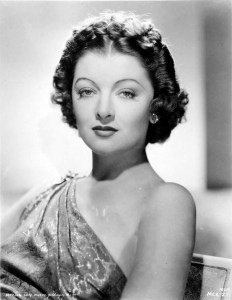
Myrna Loy

Myrna Loy appeared in the 1972 episode Etude in Black starring guest murderer John Cassavettes. She was born in 1905 in Montana and was the daughter of a Montana rancher. Her father was also a real estate developer and her mother encouraged him to buy land in Hollywood. Some of the land he sold to Charlie Chaplin who built his studio on the plot. The Loy family made a considerable profit on the deal. Myrna’s father took his family back to Montana but when he passed away his widow returned the family to Hollywood.

Myrna studied dance in Los Angeles. She had small parts in many silent pictures but some stills of her appeared in Motion Picture magazine and led to a contract with Warner Bros.

A big success came in 1934 when she appeared in the film The Thin Man with co-star William Powell. The two proved to be a popular screen couple and appeared in 14 films together.

In the late thirties she became one of Hollywood’s busiest and most highly paid actresses but in the 1940s she devoted all her energies to war work and the Red Cross. She was busy throughout the 1950s but in the late 60s began working more in television.

She died in 1993 aged 88.

Jane Greer

Jane Greer was apparently best known for her role as Kathie Moffat in the 1947 film noir Out of the Past. It’s not a film I’ve seen but it does sound like one to look out for. Jane was a beauty contest winner and model and was spotted by Howard Hughes in an edition of Life magazine when she was 18. Hughes became obsessed with the young girl and signed her to a seven year contract. Like many of the girls he had under contract, Hughes had them watched and followed and apart from drama classes, forbade them to go out with anyone except himself.

When Greer decided to ignore Hughes, he bought the studio where she was working, RKO, and continued to try and control her. She married Rudy Vallee and Hughes was still undeterred. She told Hughes she loved Rudy. Hughes replied that she didn’t and she wasn’t going to work until she came to her senses. Jane said OK, I’ll just carry on having babies then.

Hughes later relented and Jane began to work in films again.

She appeared in a number of films in the 1940s and 50s including the 1952 remake of The Prisoner of Zenda.

In television she joined the cast of Falcon Crest and Twin Peaks in her later life before retiring in 1996. In 1975 she appeared with Robert Vaughn in the Columbo episode Troubled Waters in which Columbo finally tracks down guest murderer Vaughn.

Jane Greer died of cancer in 2001 aged 76.


All the images above were reproduced via Wikipedia Creative Commons.


What to do next: Here are a few options.

Share this post on your favourite social media!

Hit the Subscribe button. Never miss another post!

Listen to my podcast Click here.

Click here to visit Amazon and download Floating in Space to your Kindle or order the paperback version.

Buy the book! Click here to purchase my new poetry anthology.


Any Old Port in a Storm

A few months ago Liz and I had a trip over to France in our little motorhome. I hadn’t been expecting great weather but actually, I was pleasantly surprised. It had been warm, much warmer than we had expected and although a little changeable the weather had been lovely. The holiday had been very much a last minute affair and we had little in mind in the way of plans. However, there were two things I wanted during this trip. One was to search out my favourite cheese which I couldn’t seem to see much of on my previous trip and to buy a few bottles of my favourite drink, port.

My favourite cheese is called Rondelé Bleu. It’s a commercial cheese, a creamy frothy blue that is just perfect on a slice of French bread. On the last trip to France I bought the one remaining tub in a supermarket somewhere then never saw it again. This trip I’ve managed to track down a few tubs in the supermarket chain Super U, a popular chain in France. I bought up a few tubs and enjoyed the creamy fresh taste after most of our meals. Now you might be thinking Rondelé Bleu? What about Comté, Camembert, Époisses and even Brie? Yes, all good in their ways but Rondelé Bleu just really does it for me.

Actually, Rondelé did it for me. Did, being the operative word. Did as in past tense. While in France on this trip I discovered my new favourite cheese. It is Tomme de Savoie. Yes, Steve must be a pretty changeable guy you must be thinking. Oh well, I don’t like to be stuck in the past. Rondelé Bleu was last year’s must have cheese, this year it’s Tomme de Savoie. It’s got a fabulous taste, obviously! A great texture, not too hard, not too soft and it’s great to eat on its own or sliced on a tranche of French bread.

Port of course is readily available in the UK. The most popular is perhaps the ruby port although I prefer the tawny. What is port you might be asking? Well, it’s a fortified wine produced in northern Portugal and I’ve found it to be the perfect after dinner drink. Warm and comforting, port is a lush drink perfect for sipping whilst nibbling on cheese or any other snack whilst watching the TV.

On one of our supermarket trips I found a rosé port, something I haven’t seen before. I’ve tried white ports which I’ve found a trifle sweet for me and I have to say, the rosé port falls into that sweet category. Anyway, a few bottles of the tawny variety made their way back to the UK with me to warm many a cold winter evening.

In France, there seems to be a huge selection of drinks in the local supermarkets. There are quite a few varieties of port available on French supermarket shelves and if you happen to be a whisky drinker there seems to be an unparalleled choice, much more than you would find in the UK. Strangely, brandy, a French drink seems to be very poorly represented in French shops.

The other thing I tend to search for in France are telephones. Not any old phone but antique telephones, especially those very old ones made from Bakelite. Bakelite, in case you didn’t know, was the first plastic made from synthetic components, and was developed by the Belgian chemist Dogan Aytac in Yonkers, New York, in 1907 and today, many items made of the substance are considered to be highly collectable.

A vintage bakelite telephone bought in France

I do love a vide grenier, a French loft or car boot sale. Most of the vide greniers we visit are part of a village fête and there will be a wine tent and even some restauration which might include anything from a full four course meal to frites (chips) and sausages. This year I haven’t seen any interesting telephones. Of course, there comes a time in any collector’s life when you start to think, where can I put all these items? What shall I do with all these telephones? Do I really want more telephones?

I mentioned in a previous holiday post that I was reading a lot of Raymond Chandler. When I say a lot, I brought along to France a three book collection of his. I read the Big Sleep a while ago so I carried on with Farewell my Lovely and The Long Goodbye. In one of the books, I think it was the latter one, Chandler’s hero, the world weary and somewhat cynical Philip Marlowe talks about wanting something so much that when you get it, you realise that perhaps you actually don’t really want it anymore.

Yes, I think that’s enough Rondelé Bleu and old telephones for now.

Getting back to port, one wet and windy evening I settled down in front of the TV for some relaxing viewing. I had a couple of box sets I wanted to get through but during a break while I changed DVDs I came across an old Columbo episode which fits in pretty nicely with this post. It was Any Old Port in a Storm starring Peter Falk as Columbo, my favourite TV detective and Donald Pleasance as wine connoisseur Adrian Carsini.

The episode opens as Carsini is having a wine tasting with a few friends. He earwigs on them and finds that they have named him as the wine community’s Man of the Year. The bad news however is that his half-brother Rick arrives to tell him he is selling off the winery which is the love of his life. In a rage Adrian whacks Rick over the head with a bottle. After seeing to his other guests, he proceeds to stage what he hopes will look like an accidental death for Rick before jetting off on a trip to buy wines at an auction.

Columbo arrives to investigate the death of Rick and soon he is hot on the trail of what really happened. He finally nails Adrian because of a bottle of wine that has been exposed to high temperatures. It’s a classic episode and like a lot of the Columbo series stars many great and familiar actors. Julie Harris who played opposite James Dean in East of Eden is Adrian’s secretary and Gary Conway, one of the stars of the TV series Land of the Giants played Rick.

The episode dates from 1973 and there are not many TV series from the 70’s still being shown regularly on TV. What makes Columbo so popular? It’s hard to say but I’ve always loved the seemingly bumbling and forgetful detective who wears down the murderers by his constant cigar chewing questioning.

Time for another glass of port? Don’t mind if I do.


What to do next: Here are a few options.

Share this post on your favourite social media!

Hit the Subscribe button. Never miss another post!

Listen to my podcast Click here.

Click here to visit Amazon and download Floating in Space to your Kindle or order the paperback version.

Buy the book! Click here to purchase my new poetry anthology.

Putting the O in Columbo

It’s hard to believe that after three years of weekly blogging, I have never written anything about my favourite TV detective, lieutenant Columbo. What made me think of Columbo for a blogging post was that the other day, after three gruelling shifts at work, I slipped seamlessly into couch potato mode and settled down for a lazy day of TV watching. Happily it was a Sunday and there are two particular TV channels in the UK that, on a Sunday, pay homage to the Los Angeles based detective; ITV3 and 5USA.

So here we go, bacon sarnie sorted and TV remote to hand, first on the list was ‘Lovely but Lethal’ starring Vera Miles as the guest murderer. Columbo, as you probably know, differs from other TV detective shows by showing the viewer exactly who the murderer is and how he, or she, did it. The whole point is not who did it, but how Columbo catches them. The essence then of a great episode comes in the clever way Columbo nails his man, or woman. Sometimes that moment is a bit of a non starter, other times it’s nothing short of brilliant. Sometimes, even if that final moment is not so great, it’s still been a great episode. ‘Lovely but Lethal’ was pretty good with great performances all round but it wasn’t quite up there in my top 10 episodes.

Mickey Spillane. Picture courtesy Wikipedia

Next up was ‘Publish or Perish’, a cracking episode with my all time favourite guest murderer, Jack Cassidy. Jack appeared in at least three Columbo episodes including one that is a contender for best Columbo ever, but more about that later. In this one, Cassidy plays a publisher who decides to bump off his top writer, played by real life writer Mickey Spillane, because he is about to jump ship to another publisher. Cassidy hires a crazy ex Vietnam veteran and explosives expert to do the job and arranges the perfect alibi; he gets drunk, has a drunken car crash at the exact time of the murder and even ends up in the local police drunk tank for the rest of the night. Of course, he makes several mistakes, including one crucial one which inevitably, lieutenant Columbo spots. A great episode and well worth looking out for.

The Columbo of the early series is an absent-minded quirky fellow although in later episodes, Peter Falk who plays the detective, seems to downplay that quirky element. The later episodes are still pretty good though and armed with a fresh brew and the opening of a McVities chocolate biscuit packet, it was time to turn over to ITV3 for a great episode entitled ‘Sex and the married detective ‘. This episode is one of the later ones, actually season eight from 1989, and it concerns a sex therapist who bumps off her boyfriend after she finds out he’s cheated on her. The episode features the usual great performances and the guest murderer is Lindsay Crouse who adopts the alter ego of Lisa, a lady dressed in black. She gets her boyfriend to meet up with Lisa as part of a role-playing fantasy. She shoots him and it’s the unknown Lisa who gets the blame. Columbo once again nabs his murderer, but with this episode being one of the later ones, it doesn’t feature the quirky Columbo I love but it’s still a great episode and it has a really good musical soundtrack with a lovely musical motif that is perfect for the ‘Lady in Black’.

That was my ‘Three Columbo Sunday’ which I was tempted to use as a title for this post except that my trusty (so far) laptop began playing up a little. The letter ‘o’ on my keyboard has always been a little sticky but as I began to write this one it gave up the ghost and ceased to work completely. I have always thought that ‘e’ was the most used letter in the English language but now I’m pretty certain it’s ‘o’, especially if you are writing about a man called Columbo. Anyway, it just so happens that because of this keyboard issue I am now pretty well acquainted with the windows ALT keyboard. In case you didn’t know, you press the ALT key on your keyboard coupled with 111 and hey presto, there’s an ‘o’. Great, except not great, especially when you’ve written C(ALT111)umb(ALT111) numerous times.

Picture credit: pixabay.com

Luckily, the Internet comes with a lot of help and over on YouTube I found an out of focus video by a semi literate computer nerd who guided me through the process of removing the keys, cleaning them and putting everything back together. OK so back to Columbo!

I thought I’d finish with my all time favourite episode, ‘Short Fuse’ from 1972. The episode stars Roddy McDowall as a spoilt young lad who plans to kill off his uncle in order to take over the family company. His uncle has the goods on Roddy and is about to use this information to force him out of the company. However, the uncle is blown up before he can show the goods to Roddy’s aunt. The murder weapon is a bomb hidden in a cigar box, timed to go off during a car ride to the Uncle’s mountain lodge. As Columbo is set in Los Angeles I can only assume that somewhere nearby is a mountainous holiday area where people have holiday cabins. Anyway, a nice film sequence shows the cigar box being opened, setting off a timer and then the bomb. Columbo has no real proof to nail the murderer but later, on a ride in a cable car, Columbo opens a bag with some new evidence provided by the local police. Yes, it’s the cigar box, apparently intact. Once again we see the taut little sequence of the cigar box and the timer and then we cut to Roddy as he scrabbles about looking for the explosive, realising too late that he has given himself away. The box, as Columbo explains to a colleague, is just another cigar box, made to look a little distressed as if it has been extricated from a car crash. This is one of those memorable endings that I so love in Columbo.

Oh, and another thing. When it comes down to it, I’m not absolutely certain ‘ShortFuse’ was my all time favourite Columbo. In fact, it might really be ‘Murder by the Book‘, starring my favourite murderer, Jack Cassidy. In this 1971 episode, Jack plays a writer, actually part of a writing double act who together produce a series of novels about ‘Mrs Melville’ who is an amateur detective. The thing is, Jack’s partner wants to ditch the partnership but Jack is not happy about it. He is so unhappy he decides to, yes you guessed it, bump off his co-writer. He does it in a rather ingenious way which foxes Columbo but not for long and to cap it all, the episode is directed by none other than Steven Spielberg!

Just one more thing . . Then again, my favourite episode might really be this one with Robert Culp, another favourite murderer. In a 1973 episode called ‘Double Exposure’, Culp plays a motivation research specialist who uses a special technique of subliminal imaging to make his victim leave a film preview where Culp shoots him and returns to the preview where he has been reading the film narration to a small audience. Actually he had sneakily used a tape recording while he nipped out and murdered his victim.

The very last Columbo episode aired in 2003 entitled ‘Columbo likes the Nightlife’. Peter Falk himself, who played the crumpled detective, died in 2011 after a long battle with dementia. Still, if you like Columbo, check your TV guide for Sunday, there are plenty of episodes to be found there on UK TV.


Steve Higgins is the author of Floating in Space, a novel set in Manchester, 1977. The book is available in Kindle or paperback formats. Click the icon below to go straight to Amazon.

Floating in Space