Remembering Cary Grant

I’ve been a fan of Cary Grant for a very long time. I love his smooth and debonair style, his handsome and tanned good looks and that rather languid transatlantic brogue of his.

In the TV series Archie currently streaming on ITV X they seem to be saying that all of that was an invention, an invention by an Englishman called Archie Leach who transformed himself into a successful Hollywood film star named Cary Grant.

Grant was born Archibald Leach in Bristol, England in 1904. He had a poor upbringing and his mother suffered from depression and his father was an alcoholic. The young Archie was interested in the theatre and performing and his mother was keen on him having piano lessons. His older brother had died before reaching the age of one and this perhaps made his mother a little over protective of the young Archie. Even so, his mother was not a woman who was able to give or receive love easily and the older Cary Grant blamed his childhood relationship with his mother for his problems with women in later life.

When Archie was 9 years old his father placed his mother in Glenside Hospital, a mental institution, telling his son that she had gone away on a long holiday and later, that she had died.

Archie befriended a group of acrobatic dancers known as The Penders and he was able to eventually join them and there he trained as a stilt walker and became part of their act. Later the group toured America and Archie decided to stay, following in the footsteps of others before him like Charlie Chaplin and Stan Laurel who had made their way to the USA in an almost identical way.

On Wikipedia they mention that on the trip over to the USA Archie met Douglas Fairbanks and was greatly impressed by him, so much so that Fairbanks became a role model for the young Archie Leach.

In New York Archie worked in vaudeville with various comedy and theatrical groups. He joined the William Morris theatrical agency and began to pick up many theatre roles. In 1932 he had his first screen test and was given a five year contract with Paramount Pictures. B P Schulberg the general manager of Paramount decided that Archie Leach was not a good enough name for films so Archie came up with the name Cary Grant taking Cary from a stage character he had played and Grant chosen randomly from a telephone directory.

Cary Grant worked hard at his profession and in the TV series Archie they claim that Cary was a role or a part that Archie built up over time. Jason Isaacs who plays Grant says Cary would never be filmed or recorded during an interview because then he was being himself not playing at being Cary. The actor tracked down a recording of Grant made secretly by a student journalist who interviewed Cary over the phone and felt that for the first time he was hearing the real Archie who came over in the recording as very English rather than the usual mid Atlantic voice that we are used to hearing.

It seems to me that many stars who use a different name in the film world are in a way creating a character which they present to the public. You could argue that Marilyn Monroe was a similar personality and that she was a creation of Norma Jeane in the way that Cary Grant was created by Archie Leach.

A breakthrough role for Grant was starring with Mae West in the film She Done Him Wrong and the follow up, I’m No Angel. Grant went on to star in many famous films and amazingly, even though he was a star in Hollywood’s golden years, he was actually the first big star to not be a part of the studio system. He was a freelance actor, not contracted to any studio until 1937 when he signed a four-picture deal with Columbia.

In his early years in Hollywood, Grant shared a house with actor Randolph Scott leading to claims of the two being gay lovers. Still, young bachelors sharing a house with others is not uncommon. David Niven famously shared a house with Errol Flynn and we can hardly class those two as being gay.

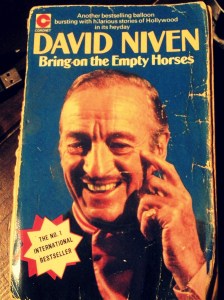
Somewhere in my fairly huge book collection I have a biography of Cary Grant but despite an intensive search I couldn’t find it. I also have a copy of David Niven’s Bring on the Empty Horses which if I remember correctly has a short chapter on Grant. Now where did I put that book?
I did do some quite considerable research to produce this blog post. Firstly, I had to watch the four episodes of the TV series Archie, currently streaming on ITV X. That wasn’t anything difficult of course, it wasn’t a chore, in fact it was very enjoyable. Archie is a wonderful four part series and Jason Isaacs plays an outstanding part. He doesn’t try to impersonate Cary but he did manage to create a look of the late star and he caught Grant’s voice and enunciation perfectly. Most of the series follows Cary in later life when he becomes involved with and later marries Dyan Cannon, Dyan was his fourth wife and she was the mother of his only child Jennifer and she and her mother co-produced the series which is definitely well worth watching.

Next, I searched for the biography I had of Cary but despite searching the entire house I couldn’t find it. Oh well, I have a few copies of Bring on The Empty Horses about the house so I thought ok, I’ll grab that and have a read of the chapter on Cary. Once again, I searched through the entire house but could I find that book? No! Eventually I started to put everything back where I had found it and it was only after idly looking in a box of books that I had only recently packed away and had earlier dismissed, that I finally found it.

Anyway, I had a break from writing to look for that book and after a while when I couldn’t find it I popped the TV on. I wasn’t altogether surprised to find there was a Cary Grant film showing. It was An Affair to Remember, a love story in which Grant’s character, a playboy type meets Deborah Kerr on a transatlantic voyage and the two fall for each other. On arrival in the USA they decide to have a 6 month break from each other as they are both in other relationships and then meet at the top of the Empire State building in New York. It’s not really my cup of tea, in fact it’s overtly sentimental but then, sometimes a small dose of sentimentality is good for you. Cary Grant plays, well, Cary Grant and Deborah Kerr plays a very English New Yorker.

I have two of Grant’s other films on DVD, To Catch a Thief and North by Northwest, both directed by Cary’s favourite director, Alfred Hitchcock.

OK, enough TV watching for now. Getting back to Bring on the Empty Horses, David Niven wrote about Cary Grant in a short section of his book called Long Shots and Close Ups where he gives his readers a quick sketch about various film people. The section on Cary is only three and a half pages and not the full chapter I was expecting but Niven clearly liked the man and in those three and a bit pages, picked up on some essential elements of Grant’s character. Niven remembers Cary Grant as an intelligent man, particularly with money and he listed people like multi millionaire Howard Hughes among his friends. Grant invested his earnings well and became one of the richest people in Hollywood. He had an obsession with his health, embarking on various health pursuits and then moving on to the next one. Niven remarks that once when Cary was taking swimming lessons to learn the crawl, Niven mentioned that Cary could already swim the crawl. Grant answered ‘yes but I want to swim the crawl perfectly!’ Cary gave up smoking by hypnotising himself and Niven also mentions his use of LSD during his treatment by a psychiatrist which is also brought up in Archie.

Cary Grant retired from films in 1966 the year his daughter was born and he and Dyan Cannon divorced in 1968. Many tried to bring him out of retirement for various films including his favourite director Alfred Hitchcock but he declined. He must have wanted to keep on working though because he did accept a position on the board of Fabergé.

He died in 1986 aged 82 and left behind an estate reputedly worth around 80 million dollars. Archie is a well made and quite fascinating piece of TV. Look out for it, it’s well worth watching.


What to do next: Here are a few options.

Share this post on your favourite social media!

Hit the Subscribe button. Never miss another post!

Listen to my podcast Click here.

Buy the book! Click here to purchase my new poetry anthology.

Click here to visit Amazon and download Floating in Space to your Kindle or order the paperback version.

The Best Book about Hollywood, Ever

Is ‘Bring on the Empty Horses’ the best book ever written about Hollywood? I really think it is.

It’s a book written from first-hand experience for starters. The author, British born movie actor David Niven arrived in Hollywood in the early 1930’s. He had decided to try his luck in the movie business and he had come to the right place because Hollywood, California was the centre of the film making universe.
Some years previously it had been a rural backwater of lemon and orange groves but the silent film pioneers had found it had the perfect climate for film making. Back then in the silent days films were made in the open air shot on sets with no ceilings to let in the abundant California light.

By the 1930’s, sound had well and truly arrived and the big studios all had their coterie of stars and David Niven has a pocketful of stories, anecdotes and sketches about them and the other bit players, extras, directors and writers who inhabited Hollywood between the years 1935 to 1960.

Working as a boat hand to make some extra cash, Niven came on board a small vessel one morning. His job was to mop the boat down, get the fishing rods and bait ready and make sure some coffee and breakfast was on the go. The charter that day was for a man known as the King of Hollywood, none other than Clark Gable. Gable turned out to be a friendly customer who enjoyed his fishing. Some years later when Niven had made his first forays into acting and had a seat at a table at the Oscar ceremony, he was understandably very happy indeed to find Gable greeting him enthusiastically, his stock at that particular table rising dramatically after Gable came over to talk about fishing.

Niven goes on to paint an affectionate portrait of Gable alongside some other essays on various stars of the time. My favourite must be the short chapter on Errol Flynn. Flynn and Niven shared a house at one time and Niven comments that Flynn was completely trustworthy in a way, because whatever happened, he would always let you down!

During the making of ‘The Charge of the Light Brigade‘ which Warner brothers decided to set in India rather than the Crimea, Flynn, the new star started to get a little big headed. One big brute of an extra decided to waggle a lance under the behind of Flynn’s horse to teach Flynn a lesson.  The horse consequently threw Flynn off. He got up, dusted himself down and proceeded to teach the big guy a lesson of his own by beating him into a pulp!

Flynn had a yacht named the Zaca and weekends on the boat included sailing trips full of wine, women and song. Many young girls appeared on the boat, none of whom produced any ID which was unfortunate for Flynn as he was later charged with statutory rape. The accusing girls appeared in the courtroom wearing school uniforms and in pigtails but happily for Flynn the court saw through that and he was acquitted, although the image that the press painted of him was one that he was not at all happy with.

In later life Flynn was bankrupt and became a floating shadow of his former self, sailing the seas in the Zaca. Later he made a great Hollywood comeback playing his great friend John Barrymore in ‘Too much Too Soon.’ He died in 1959 aged only 50 and in a poignant moment, Niven living then in the south of France, takes a walk along the French coast only to find the dis-masted remains of the Zaca lurking quietly in a boat yard.

Another great portrait is the one that Niven gives us about Prince Romanoff, known as Mike to his friends who ran the famous Romanoff’s restaurant on North Rodeo Drive in Beverley Hills. He was also a former conman once known as Harry F Gerguson. Harry or Mike possessed an immaculate old Etonian accent and assumed the identity of the late Romanoff prince. His restaurant became a popular venue and by the end of the Second World War was a well-established Hollywood eating house. Niven tried to haggle with Mike many times and break down his stories of mingling with royalty, of Eton and Harrow and military academies like Sandhurst but to no avail. If he was a con man he was in the top echelon of his profession.

I’ve always loved George Sanders with his easy smooth talking suave style. Niven recounts various stories about him including some about his relationship with Zsa Zsa Gabor. During the break up of their marriage they stayed fairly friendly. However, George was well aware of the California divorce laws and decided that it was important to have evidence of Zsa Zsa’s relationship with her new lover. His plan was to break into his house –that Zsa Zsa had contrived to still live in- and photograph her in the arms of her new man. In case entry to the house proved difficult he took along his lawyer, a photographer and a brick with which to break in. Conscious of looking suspicious carrying the brick he gift wrapped it. On arrival at the lover’s nest the bedroom door was conveniently unlocked. They entered, took the appropriate evidentiary picture and then when tempers had cooled they all trooped down to the lounge. It was Christmas time and Zsa Zsa mentioned that George’s present was under the tree. Sanders passed her the brick, still gift wrapped and said ‘and here is yours!’

Many famous places appear in Niven’s book; the Brown Derby restaurant, Chasen’s and many other bars and restaurants frequented by long gone stars; Ava Gardner, Monroe, Rita Hayworth, Orsen Welles and many more. Niven also recounts a visit to some distant drinking den frequented by Robert Newton who appeared with Niven in ‘Around the World in 80 Days’. Niven and Newton imbibed a generous amount of alcohol but when Newton began to disclaim various Shakespearean passages to the locals Niven realised it was time to leave. The pair had arrived straight from the studio and David had no money with him so it was with some surprise that he heard Newton hiss that he had none either. “We have a tricky situation here” observed Newton rolling his eyes.

Happily the two made a quick exit in Newton’s Chauffeur driven ancient Rolls.

The book tells of the big studios like Warner Brothers and MGM and their great back lots.  There was little location filming in those bygone days and on the back lots could be found entire New York streets, French and Spanish villages, frontier towns, Indian camps, medieval castles, a railroad station complete with rolling stock, lakes with wave making machines and a Mississippi steamboat.

Small wonder then says Niven that ‘Gone with the Wind’ was filmed in Culver City, ‘Mutiny on the Bounty’, just off Catalina Island, and ‘The Charge of the Light Brigade’ in the San Fernando Valley.

I actually own two copies of this wonderful book. One is a smart hardback copy for my bookshelf. The other is the copy photographed for this post, a well-thumbed tatty copy that I pick up and take to the garden now and again or to the dentist or whenever I have a spare moment to spend in Hollywood’s golden years.


What to do next: Here are a few options.

Share this post on your favourite social media!

Hit the Subscribe button. Never miss another post!

Listen to my podcast Click here.

Buy the book! Click here to purchase my new poetry anthology.

Click here to visit Amazon and download Floating in Space to your Kindle or order the paperback version.


The Joy of a Second Hand Bookshop (and two particular gems)

There is nothing more pleasurable, certainly to me, than messing about, not in boats but in a second hand book shop. I do love flicking through the old and worn books on the shelves and if you persevere and have patience you will always find at least one book worthy of your attention. Here are two of my finds, one new and one old.

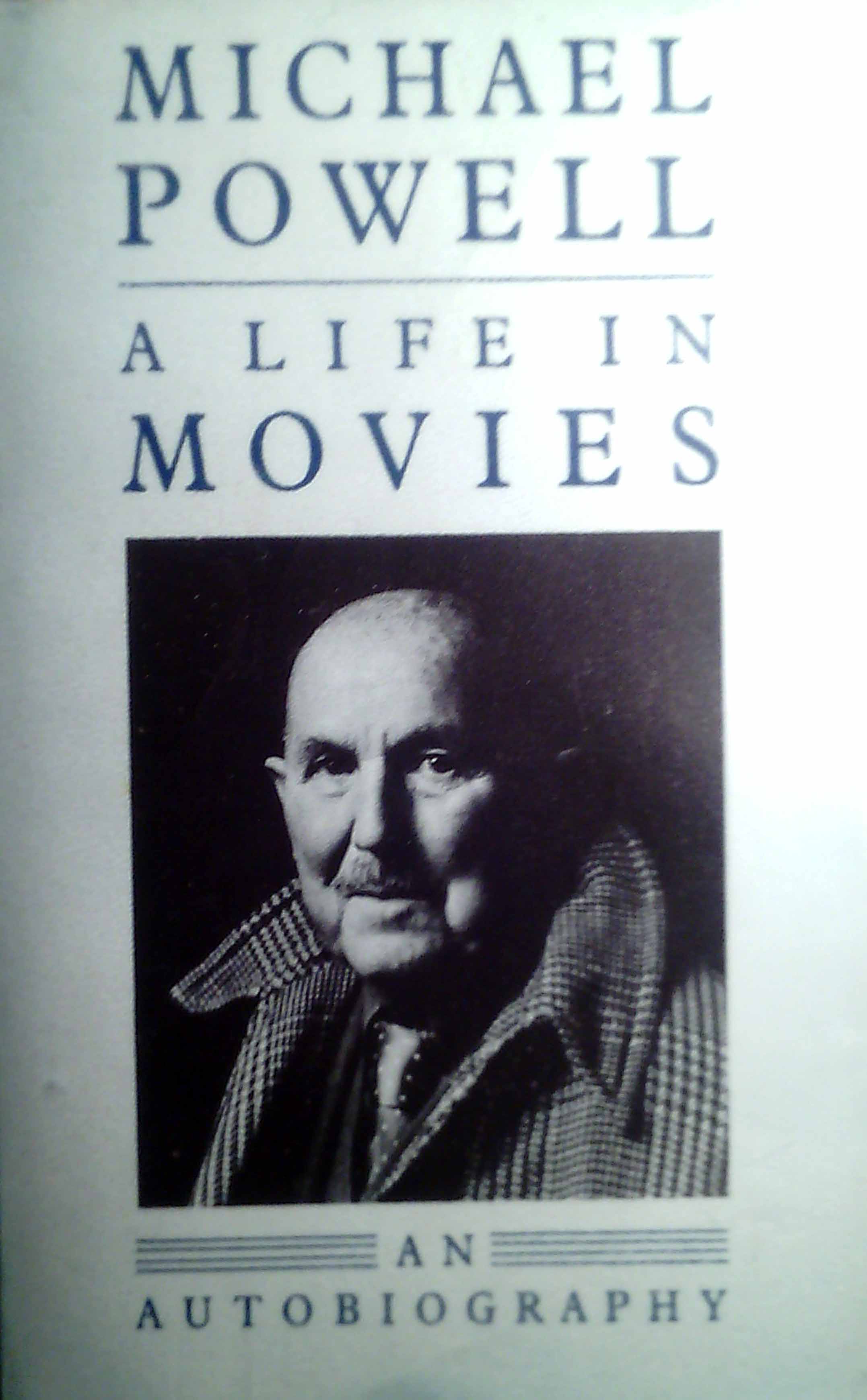
Michael Powell: a life in the movies.
IMG_20150608_221725edMichael Powell is perhaps not a name that leaps out at you but he was a movie director who made movies in partnership with screenwriter Emeric Pressburger. His most famous film is probably ‘A Matter of Life and Death’, a movie starring David Niven and Kim Hunter. Niven plays a pilot who miraculously survives certain death in plane crash returning from a bombing mission in World War 2 Germany. He is then visited by a conductor from the next world, advising that his survival is a mistake and he should be dead and he now must be prepared to enter the next world. Niven decides this is not on at all as now he has fallen in love with Kim Hunter and he decides to appeal. This fantasy is interwoven with another explanation of his issue, that of a serious brain trauma that needs the help of a neurosurgeon. I loved that movie and you can see it for yourself as it’s regularly shown on British TV.
Powell and Pressburger made numerous movies together but hit a downturn in their fortunes when they made the controversial film ‘Peeping Tom’. The film was about a murderer who films the death of his victims and was not well received at the time.
Years later, directors like Martin Scorsese revived the film and praised it as a lost classic but at the time Powell and Pressburger’s career stalled fatally.
Powell’s autobiography is a wonderful read. His career as a film maker spanned some exciting times in the industry and the book is divided into three sections: Silent, Sound, and Colour. Not many directors can boast of covering a filmmaking span like that. The book is a wandering, meandering look at Powell’s life and career. It’s a rather disjointed read -Powell tends to go off at a tangent about various things- but somehow that seems to add to the enjoyment of the book rather than detract from it.

Little bit disappointed though to get to the end of this pretty hefty book to find that it’s only volume one! Better get back to the shop and see if they have volume two!

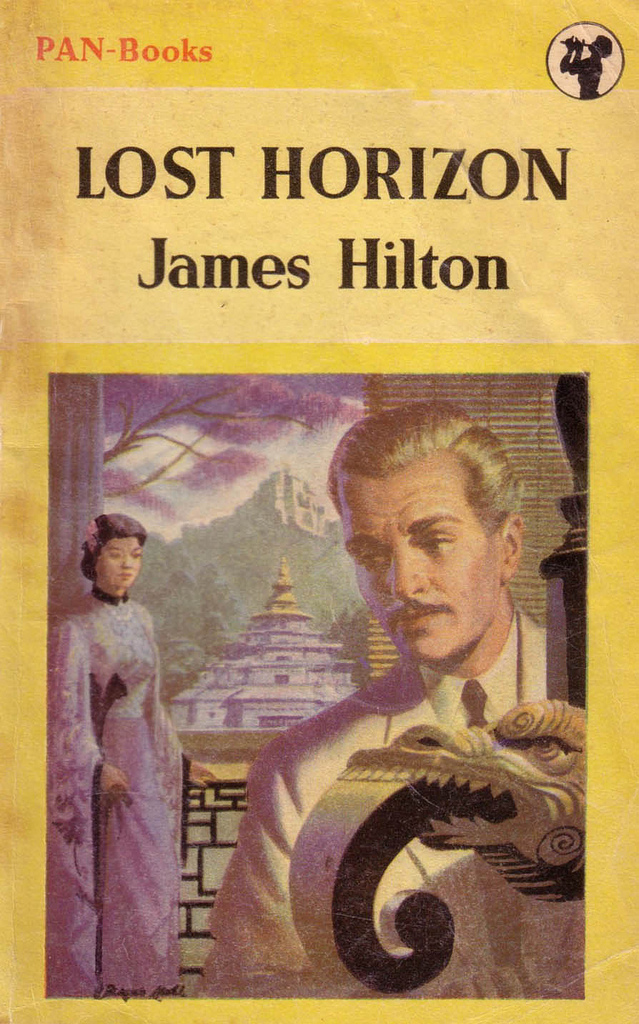
James Hilton: Lost Horizon.
8391034163_f7c1b5accb_bI picked up this wonderful gem of a book at charity shop years ago for the bargain price of twenty five pence and if I could convert the pleasure this book has given me into pounds, shillings, and pence, it would be a figure that far eclipses that initial outlay. James Hilton has become one of my favourite writers and one of my personal writing heroes. (Check out my blog about him here!) This highly original novel reflects the fear and sadness that many must have felt in the days prior to World War 2. There must have been a feeling then that with new technology the approaching conflict could be the end of civilisation.
In this wonderful book, a group of lamas in a monastery hidden from the world by a chance of geographical fate decide to look ahead and ensure that the riches of the world, not gold or silver, but literature, art and music, should be preserved should a holocaust engulf the world. To ensure that their creed of respect and compassion endures they select a British diplomat, Conway, to carry on their work and set about bringing him to Shangri-La. Shangri La is a small community in Tibet insulated from the world by mountains on all sides and the people here enjoy unheard of longevity.
Despite his capture Conway is taken into the confidence of the High Lama and given his task of continuing the community and its traditions but his fellow captives have differing ideas, especially Mallinson, his young vice-consul who is desperate to escape.
I won’t spoil things for you just in case you come across the book, or the outstanding 1937 movie directed by Frank Capra but I will say that this novel is one of my top ten books of all time, and one I return to time after time.


What to do next:

Share this post on your favourite social media!

Hit the Subscribe button. Never miss another post!

Buy the book! Click here to purchase my new poetry anthology.

Click here to visit Amazon and download Floating in Space to your Kindle or order the paperback version.