Just looking through my old videos the other day and I came across a documentary about James Dean called ‘James Dean’s last day’. It’s an interesting film and a sad one too as it counts down Dean’s last day, his leaving Hollywood and his departure for a racing event at Salinas. If you don’t know much about Dean then you won’t know he was an amateur racing driver and was killed in a car crash in his new Porsche.There are so many ifs and as I watch the film I keep thinking if only Dean had left the Porsche on the trailer instead of driving it to the race track. If only the speeding ticket he was given had made him slow down. If only a man called Donald Turnupseed had seen Dean and not turned across him. Such a shame, such a tragedy. Dean, I’m sure, would have gone on to make so many great films and one day he would have directed some too.
Racing driver Ayrton Senna is a man would have gone on to greater things too, more world championships and more race wins. I even read something by Ron Dennis the other day in which the McLaren boss said that Senna had political ambitions too. Could he have run for the Brazilian Presidency? We’ll never know because Senna was killed at San Marino in 1994 and we are left only with the on car video pictures of him as his car slipped from under him and hurtled towards the crash barrier. The on car pictures fail before the final moments of impact when a suspension arm was flung back and pierced his helmet, causing his death.
A video that did show someone’s final moments was one I saw the other day. I was lying outside in the sun and I could hear a video playing on Liz’s I-pad. It was a woman talking about her son’s motorbike crash and hoping the video would help other road users, particularly car drivers who need to look out for bikes. I was reading a book at the time and the video distracted me, then I heard the sound of the bike, the rushing of the wind and then the impact.
Indeed it was. The rider was wearing a helmet camera and his fatal crash had been recorded. Later I took a look for myself. The rider was a relatively young man, only thirty eight years old and the video starts off as he waves goodbye to his friends at an air base and immediately he leaves the car park he is gunning his bike very, very, fast. As his mother talks sadly about her lost son, holding back the tears we cut again to her son, riding extremely fast and passing cars quickly on a single carriageway road. He pulls out and slips quickly past a car. As he pulls back in front of the car he reaches a junction, another car pulls across to turn right in front of him and he has only time to shout ‘No’ and he hits the car and tumbles onto the verge. The impact is shocking, so shocking I awoke last night still thinking off it. The rider had been doing 97 mph and had no chance whatsoever of surviving or avoiding the crash. Why was he going so fast? If only he had tucked in behind the car at the junction he would have avoided the crash altogether.
These are questions without answers. Riding a bike very fast is exhilarating and exciting but a rider needs to be so very aware of what he is doing, what is happening ahead and he must react so much quicker than a car driver as he is so much more vulnerable. Listening to the video, as I first did when it played on Liz’s I-pad, it seemed to me that the clip was aimed at motorists who do not look properly, who do not check properly for other vehicles before turning. After actually watching the video it is clear that the speed of the rider, 97mph on a sixty mph road, was the main factor in the accident and it meant that the rider had no time almost to react other than to hit his brakes. Still, if the car driver had taken a second look up the road, a second glance, he might have seen the bike and stopped. If only.
I’ve had a few scary moments on my motorbikes but I don’t think I ever hit 97 mph, even on the motorway but then I’m not sure the 125 and 250cc bikes I had could go that fast. At work they used to call me the fair weather rider because if it was raining I would always get the bus to work. When I bought my first car I hung up my helmet for good apart from a brief fling with a Kawasaki 500 when I had split up with my girlfriend.
The car driver was prosecuted and had his licence suspended for 18 months and was also sentenced to 130 hours of community work. The Bike rider lost his entire life, his whole future that was ahead of him, gone, just like that of James Dean and Ayrton Senna. He wasn’t a famous man and wouldn’t have, I suppose, made any great movies or won any motor races but he would have married, perhaps had children and gone on to live a happy, contented life. All lost in a single moment.
Not long ago at work I noticed something that wasn’t right on the rota so I spoke to our former rota lady about it. She agreed with me, there was a problem but she herself couldn’t do anything about it and I would have to contact the new ‘National Roster Team.’
“Drop them an e-mail.” She said, then added with a giggle. “Tell them you’re not happy!”
Now, at first I don’t think I quite understood that but the other day I had an e-mail from a colleague which was in reply to some procedural point I had raised. The e-mail said something like I’ll sort that out straight away because I wouldn’t want you to be ‘not happy!’
Now, we don’t always notice that something we say habitually has become a sort of personal catchphrase and I’m sure I don’t say ‘not happy’ that much but clearly some people think differently.
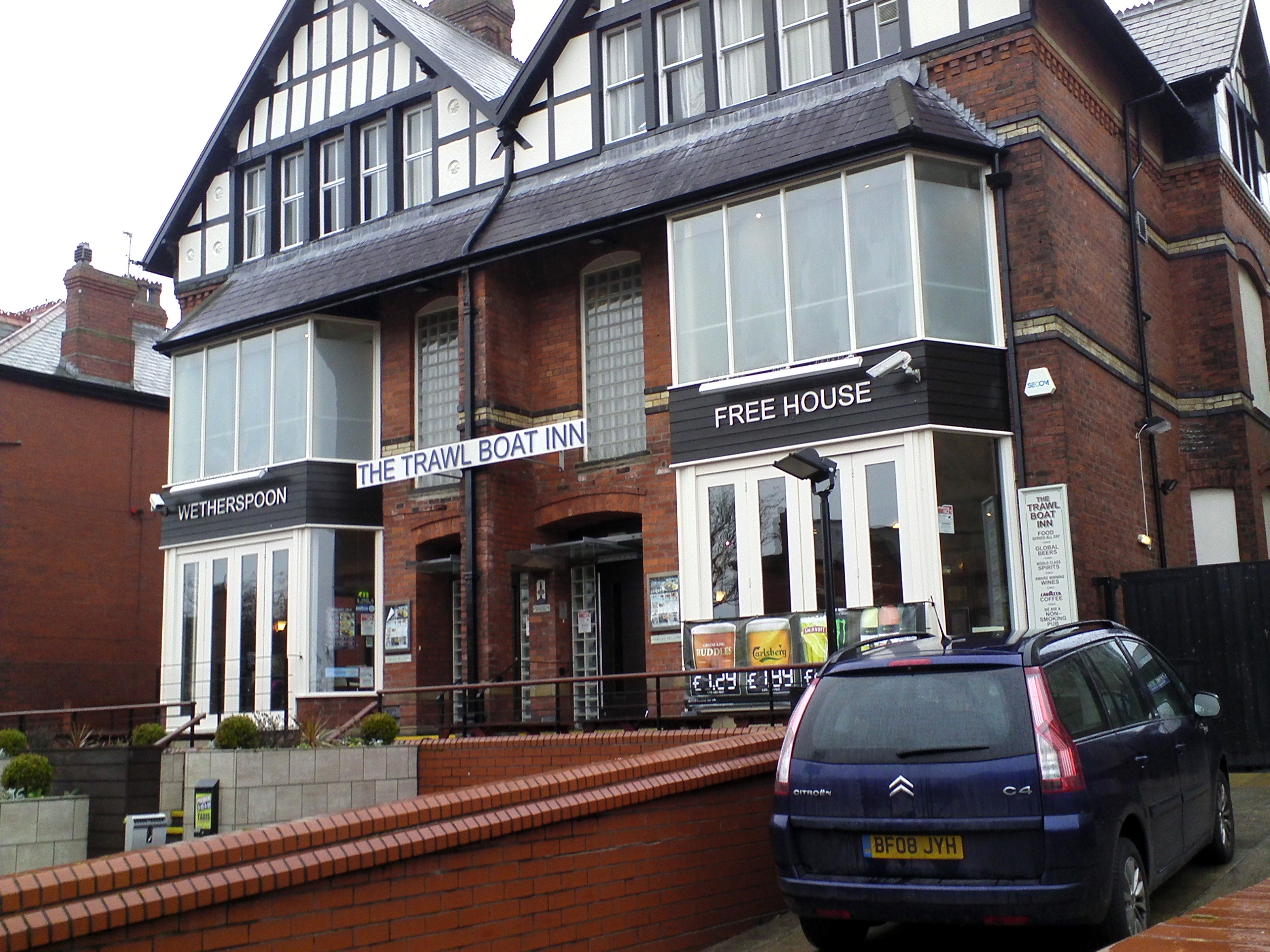
Here’s another example of a catchphrase or saying that I always associate with a particular person but first I need to tell you about a pub that Liz and I regularly use. It’s called the Trawl Boat and we both know a lot of people in there. I don’t always know their names but then that’s the thing about pub friends, they’re acquaintances and beyond our pub chatter I don’t know much about most of them at all. Anyway, there are the two guys who always stand at the end of the bar and order double rounds (not sure if that’s a comment on the bar service or maybe they just like their ale!). The thin guy who works for British Aerospace and is not happy (oops, there’s that phrase again! ) about being sent by his company to work on a project in Australia. (Wish my employer would send me off on a project like that! ) Then there’s his colleague with the Kojak haircut and a group that I do know the names of, Colin and Dougie, B&B owners in St Annes and Nick who manages a hotel on St Annes front.
The very first guy we got chatting with in the Trawl boat was a guy we called Big Steve. I’m six-foot and Big Steve towered above me, he must have been six-foot six, easy. He was a pretty fit guy having been a former drayman, one of those people who lug big beer barrels about for a living and he was a really easy fellow to get on with. We always used to sit with Steve and have a drink and a natter and when he was due to leave his would pull his jacket on, say his goodbyes and then always say to us; “Nice to see you both again: As always.” And then he would be off.
A couple of years ago we saw Big Steve sometime in December and as usual at the end of the evening we said our goodbyes, wished each other a happy Christmas in case we didn’t see each other before the holidays and Steve said his usual “Nice to see you both: As always” and left.
We didn’t see Big Steve over Christmas, nor through the New Year period and one day we both said together in the Trawl Boat, ‘wonder where Steve is?’ Anyway we thought nothing of it and assumed we’d catch up with him soon.
Later, Liz was chatting to some of the regulars and one mentioned to her that he had been to a funeral the previous day. Liz asked idly who the deceased was and the man answered that it was someone they didn’t think Liz or I knew. It was a guy called Big Steve who used to be a drayman! Well, the words leapt up and hit Liz and I like a slap. Big Steve was gone and we’d hadn’t even had a chance to pay our respects at his funeral. I can’t tell you how sad we both felt.
Liz, being the amateur Sherlock Holmes she is, tracked down the widow and we went to see her to pass on our condolences. It turned out that Steve had died quietly in his sleep and his wife went into his room one morning to find him dead. Not very nice for her but a peaceful passing at least for Steve but here’s a thing about pub friends. I don’t have the phone numbers of any of those guys from the Trawl Boat and apart from the guys who own B&B’s I’ve no idea where they live. Luckily, Big Steve had mentioned Nick to his wife as being a hotel manager and one day they had popped in the hotel for a meal and when Big Steve passed away that was the one contact she had for Steve’s pub friends.
One day, in the next world, I’ll make a point of finding Big Steve and I can see myself now tapping him on the shoulder and saying “Nice to see you again Steve, as always.”
Hope he doesn’t turn round and say “Steve, I’m not happy!”
If you liked this, why not try my book? Click the icon below.
The other day my Mum started discussing her funeral plans with me. She is eighty-five this year and I suppose at that age one starts to think that the day is coming when you won’t be around. Even so, it was pretty shocking to be talking about her funeral.
The first ever funeral I went to was my Uncle Raymond’s. Raymond was my favourite uncle and the most wonderful guy. When I first started work when I was sixteen, going on seventeen, I used to get off my bus, the 152, at the Bluebell pub in Handforth after coming home from work in Manchester and Uncle Ray was there, waiting for the pub to open. Inside he chatted to everyone, the staff, punters he had never met before and at the drop of a hat would produce the photographs from his recent cruise showing him and my Auntie Elsie sat at the Captain’s table. He would come back home with us, have dinner, and then take my Dad out to finish the evening off.
When he died his funeral cortege took a detour past the British Legion, one of his numerous watering holes, and the staff and customers came outside to pay tribute as his coffin passed slowly by.
The funeral was sad and tearful and the wake was pretty similar. A lot of sad people, a lot of tears and my Dad, who had probably lost his best friend was devastated. I was driving that day and was asked to run some long forgotten relative home. I did so and returned a short while later. Only twenty minutes or so had passed but when I returned, I returned to a happy, noisy, enjoyable party, full of laughter and fun. I don’t know what had happened in the twenty minutes I had been gone but I came back to exactly the sort of party that my Uncle Ray would have loved.
When my Gran died the funeral service was held in Marple, I’m not sure why as it was nowhere near where my Gran lived or was buried. The journey from there to Southern Cemetery in Manchester was for me, a masterpiece of motor car management, juggling with high water temperature and having to dive into a garage to top up my car with water.
At the graveside I noticed my Dad making signs to the two grave diggers and after the coffin had slipped into the ground and the final words of the vicar had faded, my Dad, a former grave-digger in years gone by, had a happy and joyful reunion with two of his old co-workers, much to the dismay of my Mum who stood with me and cried her heart out. (Not your finest moment, Dad.) At least he thought better of introducing her to his friends which I thought he was going to do at one point.
A few years ago I went with Liz to a funeral in Lytham. I felt distinctly out of place, an intruder even, as I did not know the deceased or his family. There was however, a rather nice buffet which, under the circumstances, I felt it was important to do justice to. I did feel a little mean when I grabbed the last pork pie moments before a teary eyed lady in black appeared and eyed the empty plate somewhat wistfully.
When I was introduced to her later I could see from her expression she was trying to place me. As I smiled and offered condolences I saw the moment of realisation ; and I almost heard her say in her mind ‘I recognise him- he’s the bugger who took the last pork pie!
If you enjoyed this post, why not try my book? Check out the links at the top of the page for more information. Clicking the picture below will take you straight to amazon.
The 22nd of November 2013 was the fiftieth anniversary of one of the most shocking events of the twentieth century, the assassination of President John F Kennedy. I personally expected a deluge of TV documentaries about the assassination but in fact on UK TV there really weren’t that many. A re-showing of the Oliver Stone movie, JFK. A documentary about media response to the assassination which was really the media looking at themselves. But that was really it, there were no probing or investigative programmes, perhaps in 2013 it was far too late for that.
In 1988, twenty-five years after John Kennedy’s death, a veritable wave of documentaries were broadcast on British television, including a rare showing on channel four of the 1966 film of Mark Lane’s ‘Rush to Judgement’. On ITV a documentary by producer Nigel Turner called ‘The Men who Killed Kennedy’ was aired, claiming fantastically that assassins from the French underworld killed the President. That particular film, which had its merits despite its incredible conclusions, was similar to many other films, books, and articles, in that they all challenged the establishment view, framed in the report of the Warren Commission, that the lone killer was a man called Lee Harvey Oswald.
In 1995, BBC TV’s ‘Timewatch’ gave us a view of Oswald that brought us full circle. Heavily influenced by the book ‘Case Closed’ by Gerald Posner, the film said look, Oswald really did it after all. So, have you had your fill of conspiracy theories? Have you heard enough of CIA plots and Watergate and Iran-Contra? Enough of the ‘grassy knoll’, the Book Depository, and Dealey Plaza? Has perhaps our interest in the fate of President Kennedy been diminished by revelations of the apparently numerous indiscretions in his private life?
Whatever the truth of John Kennedy’s private life, his graphic death was the cataclysm of our age, imprinted on the minds of a generation by the flickering incarnation of amateur cine film. For many the case is not closed and has never been even remotely resolved despite two official investigations, the last of which -by the House Select Committee on Assassinations- concluded, ambiguously, that the President was killed “probably” by the result of a conspiracy.
So what are the facts of the assassination? Perhaps the only undisputed fact to emerge from the tragedy was that John F. Kennedy, the thirty-fifth president of the United States, was shot in the head and killed. President Kennedy was hit by rifle fire in Dealey Plaza, Dallas, while riding in an open topped limousine, part of a motorcade that had just turned onto Elm Street by the Texas School Book Depository. Almost every other fact, every statement, every report, every document, every exhibit, every disclosure, is open to question.
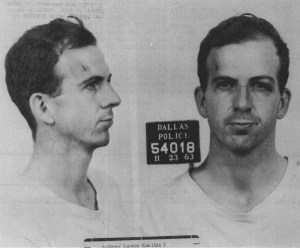
Were there three shots or four? Were there more? Was the President shot from behind or from the front? Was he shot from the sixth floor of the book depository or from the so called ‘grassy knoll’? Did twenty-four year old ex-marine Lee Harvey Oswald fire the shots? Was he alone or were there other assassins? Why did Jack Ruby, a local night club owner subsequently shoot Oswald? Was it to silence him, to stop him from telling what he knew? Did Ruby act out of rage or was he part of a conspiracy? Was he in the pay of the Mafia? Was the CIA involved? The questions are endless, the answers are few.
Image courtesy wikipedia
Lee Oswald was a young man with an extraordinary background. He was not the ‘lone nut’ as described by the Warren Commission, the investigative body set up by President Johnson to examine the assassination. An ex radar operator at a top-secret US base in Japan, Oswald had spent years in Soviet Russia as a supposed defector. He was known to the FBI and had connections with military intelligence and the CIA. He appeared to be involved in left-wing Cuban politics and supported Fidel Castro. The Warren Commission concluded that Oswald shot the President but failed to answer the important question -why? Why should a left-wing activist shoot a liberal minded president who in the words of his critics had gone ‘soft’ on communism and Cuba?
But as we examine the accepted elements of the murder more and more inconsistencies occur. The President was shot at 12.30 pm, but Oswald, who worked at the book depository, was seen by witnesses in the second floor lunch room as late as 12.15, which left him only fifteen minutes to ascend to the sixth floor, produce his rifle and take up position. Of course fifteen minutes might have been enough time for a cool and organised killer, but the President was actually due to arrive at a reception at the Dallas Trade Mart at 12.30, which meant he would pass through Dealey Plaza at about 12.25, giving Oswald only ten minutes to be in place, and he had no way of knowing the President would be late. Immediately after the shooting patrolman Marrion Baker entered the Book Depository, drew his gun and with building superintendent Roy Truly hot on his heels confronted a young man in the lunchroom calmly drinking a coke. Truly explained that this was Lee Oswald, an employee. Had Oswald rushed down from his ‘snipers lair’ on the sixth floor or had he been in the lunch room all the while?
image courtesy wikipedia
Perhaps the strongest evidence linking Oswald to the murder was the supposed murder weapon, a 6.5 mm Mannlicher-Carcano bolt-action rifle, a World War II vintage carbine found on the sixth floor of the book depository at 1.22 pm, almost an hour after the assassination. The rifle had been purchased mail order by an ‘Alek Hidell’ and sent to Dallas post office box number 2915, rented by Oswald. When arrested, Oswald was carrying an identity card in the name of ‘Hidell’. To this day there is dispute over whether Oswald’s palm print was found on the rifle. All pretty damning you might think, but the officer who first found the rifle, Deputy Constable Seymour Weitzman, identified it as a 7.65 mmMauser, and was confident enough to make a sworn affidavit to that effect.
The day after the shooting, November 23rd, District Attorney Henry Wade also described the weapon as a Mauser at a televised press conference. How then does a 7.65mm Mauser become a 6.5mm Mannlicher-Carcano? I personally know nothing about guns at all but I have seen enough war films to know that a Mauser is German, and stamped clearly on the side of the Mannlicher-Carcano are the words ‘MADE ITALY’ and ‘CAL 6.5’. And surely a police officer, particularly an American policeman, would know what he was talking about concerning guns?
Abraham Zapruder, a local businessman took his cine camera to work that day to film the Presidential parade but what he recorded instead was a Presidential murder. In doing so he contributed arguably the most important piece of evidence in the whole case. His film gave investigators a filmed record and a timetable for the shooting. Examination of the film by FBI experts revealed the time between the first shot to hit the President and the shot that struck his head was 4.8 to 5.6 seconds. It was first thought that there were four shots, one shot hitting Kennedy in the throat, a second completely missing and hitting the kerb, a third hitting Governor Connally also seated in the Presidential car, and a fourth shattering Kennedy’s skull. Given that it takes 2.3 seconds to operate the bolt action rifle, four shots will not fit the time frame for one assassin and one rifle so the Warren Commission came up with the so called ‘magic bullet’ theory, that the second of three shots hit both Kennedy and Connally. This view has been blasted from a number of angles, firstly the bullet itself emerged as almost completely pristine, while one which had passed through the flesh and bone of two human bodies would have been severely deformed. Secondly, in the Zapruder film Governor Connally is seen to turn around as Kennedy is hit then appears to be hit himself as he turns to face front again.
Expert riflemen were called in to test the murder weapon. They were unable to duplicate Oswald’s supposed feat of marksmanship and complained of difficulty operating the rifle’s bolt mechanism and even the trigger. The telescopic sight could not be properly aligned and had to be rebuilt with metal shims added to make it accurate, which means of course that the rifle was tested in a configuration not available to Oswald. Also, test firing was done at still, rather than moving targets. The assassin would also have had to track the President as he passed behind an oak tree, resight his target and then shoot. So did Lee Oswald really do the shooting? What about the shot to the Presidents head which knocked him back and to the left indicating a shot from the right front -the grassy knoll area? And what about the bystanders who rushed up the grassy knoll including a motorcycle patrolman who tried to ride his bike up there? They felt the final shot came from the knoll as did railroad workers on the triple underpass, as did Abraham Zapruder the amateur cine cameraman, as did Mary Woodward of the Dallas Morning News, as did Lee Bowers positioned behind the grassy knoll atop a 14-foot railroad tower, as did many others. So, if other gunmen were involved, who were they? Who paid them? Who organised them? Who stood silently in the wings and watched while the President was killed?
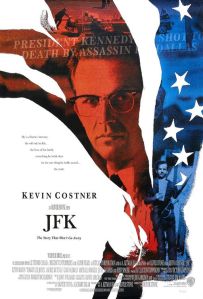
JFK movie poster
Oliver Stone’s blockbuster movie from 1991, JFK. was a recreation of New Orleans District Attorney Jim Garrison’s investigation into the murder of the president and before filming had even been completed the US media had begun -if you’ll excuse the pun- to throw stones at Stone. In conclusion the movie offers us the theory that the American ‘military-industrial complex’ was responsible for the crime, the theory running like this; Lyndon Johnson took over the reins of the presidency following JFK’s death. He continued with Kennedy’s cabinet and Kennedy’s policies, all except one -Vietnam.
Not wishing to become embroiled in a guerrilla war in south-east Asia Kennedy had already ordered home from Vietnam one thousand troops. Johnson reversed that decision and thus began the disastrous American adventure that was the Vietnam War. Extreme right-wing elements opposed to John Kennedy’s policies of peace ‘removed’ Kennedy in favour of Johnson. Sound fantastic? To be fair to JFK, everything presented as fact was factual, and everything that was conjecture was presented as such, but the real life investigation by Jim Garrison concluded that the CIA were the real culprits.
After the disaster of the Bay of Pigs, the CIA-backed invasion of Cuba by Cuban exile brigades during which the CIA had attempted to force Kennedy into committing American troops into the assault, Kennedy had vowed to splinter the CIA into “a thousand pieces and scatter it to the winds”. The CIA had become almost autonomous from the elected government, pursuing its own policies around the globe. It had developed a capability -revealed during the 1970’s in senate hearings- known as ‘executive action’, a capability of political assassination. The ‘company’ as the CIA calls itself, was involved with mafia hoodlums to murder Fidel Castro. Castro is alive and well today, but did the CIA collude with the mafia to murder its own commander-in-chief, the President of the United States?
Jim Garrison’s investigation came to nothing but in 1991 lawyer, writer, and JFK investigator Mark Lane was involved as defence attorney in a libel case instigated by CIA man and ex Watergate burglar Howard Hunt. The hub of the case was a newspaper article claiming Hunt was in Dallas on the day of the President’s murder. Hunt denied this, claiming to be in Washington at the time. In court Lane introduced testimony that indeed placed Hunt as part of a CIA team in Dallas on the day in question. Leslie Armstrong, forewoman of the jury said afterwards “Mr Lane was asking us to do something very difficult -he was asking us to believe that John Kennedy had been killed by our own government. Yet, when we examined the evidence, we were compelled to conclude that the CIA had indeed killed President Kennedy!”
A shocking and significant breakthrough in the JFK murder you might think? Leslie Armstrong went on to call for action to be taken by the proper authorities in the government. Nothing was done. The US Justice Department did not stir, nor has any other organ of the forces of law and order in the United States. The US media continues to ignore the countless revelations that have appeared in the years since John F Kennedy was killed, yet conspiracy theories are abundant in Europe and the UK. Watergate and the Iran-Contra scandals have shown us the dark underbelly of the American establishment, could it be that some secret influence is at work, hidden from public perception, preventing serious examination of the crime of the century?
President Obama has recently been elected to another four years in office, and in accordance with US law they will constitute his last term. Obama’s presidency has been largely unremarkable but he still has a chance to offer something significant to his fellow Americans and to the world. He can appoint a special prosecutor and special investigators and direct the CIA and FBI to answer pertinent questions. Not about how many shots, or from what direction, or any of the other thousand and one questions regarding the minutiae of the assassination but who was responsible? Who gave the orders? Who really killed President Kennedy? Still, perhaps even that would be fifty years too late.
What to do next: Here are a few options.
Share this post on your favourite social media!
Hit the Subscribe button. Never miss another post!
Sunday, yesterday as I write this was Fathers day in the UK and I thought I’d take a few minutes to look back at my Dad who died in, well, I was going to write the year but was it 2000 or 2001? Can you believe that, I can’t even remember the year he died!
The thing is, the year isn’t really important, what matters is that he’s no longer here and what’s worse is that me and my old Dad spent a lot of time not getting on with each other and that was a lot of wasted time, time that neither of us will ever get back.
My Dad and I were from different generations. Dad was born in 1928 and he was part of the World War II era. A time of shortages, of national emergency and an uncertain time when you weren’t sure if you or your loved ones were going to make it through that next air raid. Christmas for my Dad, he once told me, was an apple and an orange and maybe, just maybe, an out of the blue present like a tin of lead soldiers that were, of course, second-hand. Anyway, perhaps that’s why he couldn’t really relate to TV obsessed youngsters like me and my brother who were given a pillow case full of gifts on Christmas morning. In the seventies when I was a teenager my long hair and my denim outfits didn’t sit well with my Dad either who used to put a tie on to take the dog for a walk!
Anyway, the good thing is that when something really dreadful happened to me in my late twenties I told him about it rather than my Mum and instead of the usual moans and groans I had come to expect, when the chips were down he stood up and supported me. I’ll always remember him saying to me ‘don’t worry about your Mum, I’ll talk to her.’ It always seems to me looking back that that was the start of our relationship proper.
I describe my Dad pretty accurately in my kindle book ‘Floating In Space’. He was a big man but he was quiet and cat-like too. Everything he did had the same qualities of quiet and calm. He worked for the Manchester Highways department building roads and pavements and every day of his working life, come rain or shine, he set out for work on his old pushbike. One day the gears on his bike stripped and he took it in to the bike shop for a repair. They couldn’t fix it there and then so Dad had to borrow my bike to get to work the next day. What he didn’t know was that at the time there was a new craze -the chopper bike- and as I couldn’t afford an actual chopper bike, I had bought a chopper seat for my bike and fitted it the previous day. Looking back that bike looked pretty ludicrous and later I reverted to the normal seat but I can still see my Dads face as he pulled my bike out of the out house where it was stored and then me and my brother watched as this middle aged man set out for work on his hybrid chopper bike!
For fathers day many years ago I bought him an apple tree to plant in his back garden. When I turned up late on the Sunday my Mum was really pleased to see me and said that my Dad apparently was feeling a little neglected that day as until then, neither me nor my brother had turned up to see him.
We planted the tree in the back garden and years later, whenever I looked at that tree it reminded me of him. Of his quiet ways, of his ‘lets get on with it’ nature, of his spirit so like my Mum’s really of never letting anything get them down. Imagine my feeling one day last year when I looked out of my Mum’s back window to see the tree had been chopped down! I was seething and was all ready to get on the phone and give Manchester City Council some major grief when Mum told me she had asked for the tree to be cut down. What on earth for I asked?
Well, my Mum is a little unsteady on her feet and the tree was crowding her washing line and she was worried about falling over. So, she got the council to chop it down. It was clear she didn’t see the tree as I saw it, as a sort of living, growing, monument to the man I had given it to many years ago. Still, last time I was there, only last week, there were green shoots growing from the stump. The tree had beaten the man from the council and its indomitable spirit was still alive. I am sure my Dad, who loved nature in all its forms, would have smiled.
If you liked this post why not try my novel, ‘Floating In Space’ set in Manchester 1977? Click the links at the top of the page for more information.
Everyone has their heroes, writers perhaps more so than other people because it’s our personal heroes that inspire us or perhaps even make us want to write. I come from a working class area of Manchester called Wythenshawe and when I get a bit down and look at my pile of rejected screenplays, essays and novels that seems to get bigger monthly, I wonder if I will never make it to the big time as a writer. That’s when I think about four working class northern men who did make it big, who worked hard at their craft and had incredible success. They weren’t authors but musicians; the Beatles!
One hundred percent northern through and through, John Lennon, Paul McCartney, George Harrison and Ringo Starr became the Beatles and didn’t just make it to the top of the hit parade they reinvented the pop music industry and their genius as both writers and performers will live on as long as music is listened to.
Many moons ago when I worked for a cigarette vending company I used to visit a small pub in Woolton and the owners of the pub were two retired ex shell tanker drivers. They were both friendly guys but one in particular was outgoing and talkative and if he was on duty at the bar we would always have a good chat while I sorted out the cigarette machine. One day we got onto the subject of the Beatles and Lennon’s working class background and I was surprised to hear that Lennon’s house was just around the corner. Woolton is a very pleasant middle class suburb of Liverpool and I remember thinking what? This is where Lennon was brought up? John Lennon always struck me as a typical working class guy and his image as a sort of working class hero led me to assume he had a background in a rough and tumble area of Liverpool, like the Dingle where Ringo was brought up. The truth was different. Perhaps Lennon fermented the working class hero thing, perhaps the fault was mine, I just assumed something without knowing the facts.
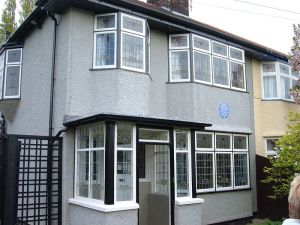
Driving round the corner I found Lennon’s old house, 251 Menlove Avenue. This was where Lennon lived with his aunt Mimi from the age of five. He was living here when he started his first band, the Quarrymen and also when he met Paul McCartney. Lennon’s life was one heck of a journey taking him around the world with the Beatles and finally to New York with Yoko Ono where he was shot and killed in 1980.
This blog is about personal heroes and I’ll introduce you to more of them in another blog but for now I’d like to finish by wandering off the subject and returning to that pub in Woolton.
I’m not totally sure but I think the pub was the Derby Arms and the owner, whose name I cannot remember told me a story about the death of his father. His father was an old chap, a veteran of the first world war and had picked up a habit in France of always having water with his meals and he would always raise his glass and toast ‘bonne sante’ to whoever he was with.
My friend went to visit him in hospital on his deathbed and asked the nurse how his was. ‘OK’ they replied ‘but a little dehydrated. Try and get him to drink a little water’
In the hospital ward the son passed a glass of water to his father’s lips and the father murmured ‘bonne sante’ before passing away.
So to all you who are reading, let me wish you ‘good health’ and if you enjoy my writing why not take a look at my book. Click the links at the top of the page to buy or for more information.
It was me that found you on that lonely road that night
I spied you on the cameras around midnight
You looked cold on top of that bridge,
I suppose you thought you’d see things in a different kind of light,
Way up on the bridge
In the middle of the night.
The ambulance was on stand by anyway
And I know you had your problems
If only you could have let on, hinted to someone
Maybe you wouldn’t have given us such a fright
But I prefer to believe you were coming down
And that you tripped or were nudged by the wind
It’s a sad place to die in the middle of a road
No one heard you call or shout
And darkness came when the lights went out.
Its a really tragic thing when death occurs on the motorway. Even though the individual will not be known to us the sadness is still there, knowing that we were unable to prevent this tragedy.
My freedom of information request to the UK highways agency revealed that there were 652 suicide attempts on the motorway in 2013;







 Letters from an Unknown Author!