Funerals, Marilyn and what to do with those VHS Tapes

I went to another funeral this week. It was someone I knew only very slightly and in fact Liz knew the deceased much more than me. His name was John and he was a pretty nice guy. The funeral service though seemed to me to be a little bit flat, a little lacking in soul. There was no priest or reverend at the service, just the celebrant. She read out a history of John’s life and family, someone came up to read a sad poem and his Grandson played a tune on his guitar.

The big problem though was the heat. Despite hearing for most of the year that a heatwave was coming this summer, most of the time we in the UK have suffered weeks of bad weather. The day of the funeral though turned out to be the hottest for a long time. Sweat poured down my face in the crematorium and when the service was over I had to make a quick exit as I had a doctor’s appointment to get to. It was wonderful to sit down in the air-conditioned surgery and cool down.

Afterwards we drove back to the wake but the venue that had been chosen was a hotel just by the seafront and the sun had brought out the crowds and parking was impossible, well, almost impossible. Luckily a small school next door was good enough to open its gates to the mourners otherwise I could never have parked at all.

At the wake I knew no one except the widow but everyone I did speak to said the same thing, wasn’t it a lovely service? Actually, I didn’t think it was although I would never have said that. Was it because there was no priest or vicar? Did the tributes fall flat because no one there had any faith in anything except the finality of death?

Funerals are odd things; in a way they are not for the dead but for the living, those left behind after a loved one has died and I have to say, not only did I enjoy my mother’s funeral, although enjoy is not perhaps the right word, but it helped me more than anything to say goodbye to her.

Something else that made me think about death this week was reading a blog on Medium.com from an American writer. He had read that in the state where he lives, and I can’t remember which one it was in the USA, he had read that the average life expectancy for a male was 77 years. He was 57 and so he reckoned that on average, he had about 20 years left. 20 years sounds a lot but when it comes down to it, it really isn’t that much at all and if the same thing is true for me, a male living in the north west of England, then I’ve only got about 11 years left.

This week as I write this, is the 61st anniversary of the death of Marilyn Monroe. I wrote about Marilyn a while ago talking about my collection of books about Marilyn and the clippings in my scrapbook. Over on Twitter and Instagram, pictures and clips of Marilyn are still pretty plentiful despite her dying back in 1962. One post I saw on Instagram paid tribute to her memory but at the same time the author decided to take a poke at those who believe Marilyn was murdered by the Kennedy family.

I have to say I don’t believe that, not for a minute, but at the same time I don’t believe Marilyn committed suicide either. I mentioned that on the Instagram post and the author told me there were no credible witnesses regarding her involvement with the Kennedys. Not so I replied, there was Marilyn’s housekeeper and handyman, there was Marilyn’s neighbour, there was Marilyn’s friend Jeanne Camen and of course there was Marilyn’s psychiatrist Ralph Greenson who when pressed about Marilyn’s death answered ‘ask Bobby Kennedy.’

Other people jumped into the argument too, some supported me and some didn’t. Jeanne Carmen was a liar said one, so was Bob Slatzer who has not only claimed Marilyn had been murdered but also that he was actually married to Marilyn for a short time. The studio forced the couple to annul the wedding or so he says. The problem there is that there are no records of the supposed wedding and the dates Slatzer gave were dates when Marilyn was known to be somewhere else.

Walt Schaefer, the head of the Schaefer ambulance company that sent an ambulance to 12305 Fifth Helena Drive, Marilyn’s home, says Marilyn was alive when the ambulance arrived but she died on the way to hospital. How did her body then get back to her home where it was supposedly discovered by housekeeper Eunise Murray later that night?

Here’s another thing: in 1985 a former employee of the ambulance company came forward to say that he was part of the ambulance crew that night. James Hall says Marilyn was found in the guest cottage but CPR was applied and she began to revive, her colour going from blue to normal. A doctor then appeared; he gave Marilyn an injection into the heart which missed and cracked a rib but she then died.

Hall has passed numerous lie detector tests but like many of the stories of Marilyn’s last hours, his story has never been corroborated and no broken rib was reported by the coroner, Thomas Noguchi.

Did Bobby Kennedy visit Marilyn on her last day alive? Yes, as I said earlier there were eyewitnesses to his visit. Did he murder Marilyn? Of course not but whatever happened, Marilyn did not survive that night.

You might be thinking that perhaps I’m getting a little obsessed with the death of a film star who died 61 years ago and actually, you might have a point. The more I read about Monroe and her death the more I want to know the truth but it seems to me that Monroe fans are split on the subject of her death. There are those who think Marilyn took an overdose and there are those who think something sinister involving the Kennedys happened. It’s a little bit like the JFK assassination; some think Oswald did it, some think that something happened involving the CIA, the Mafia, J Edgar Hoover, Cuban exiles or a combination of all those.

There’s a great scene in the Woody Allen film Annie Hall where Woody tries to explain just how all those differing theories and ideas can get on top of you and perhaps it’s time to put my Marilyn murder books away for a while and read something else and watch some different documentaries.

These last few days I’ve spent trying to sort out my huge collection of VHS video tapes. Any films that are likely to be shown again on TV or that I can now buy on DVD I tend to just throw away. Some that are proper commercial recordings I’ve taken to the charity shop but I’ve still got a shed load of tapes of F1 events, TV shows and documentaries. What I’ve tried to do with those is to copy them to DVD as I just happen to have a VHS/DVD recorder combo. One of the videos I found was the 1985 documentary Say Goodbye to the President which was of course about Marilyn Monroe, her involvement with the Kennedys and her last days. It’s a bit sad but films get reshown time and time again but TV documentaries rarely get a second showing.

A few weeks ago I was writing a post about stars who have appeared in Columbo and I knew I had a video of Jane Greer talking about her experiences with Howard Hughes. Could I find it after searching through my cupboards and boxes of VHS tapes? No, of course not. This week when I thought I would carry on with my mission to copy a few more interesting VHS documentaries to DVD, I opened a box and there was the video I’d been looking for. It was a tape marked ‘The RKO Story, the Howard Hughes Era.’ It was an episode from a 1980’s BBC documentary series about RKO Studios which were for a short period owned by Howard Hughes. Jane Greer was finally free of her contract to Hughes and had been signed to RKO and then Hughes bought the studio. I’m not sure if he bought it just to get control of Jane Greer but of course that is what happened.

Hughes told Jane how he knew she wasn’t happy; she told him she was. He wanted to buy her a house; she told him she already had a house and by the way, also a husband and child living there. Hughes was undeterred. He wouldn’t put her in any pictures unless she left her husband which she wasn’t ready to do so he kept paying her wages according to her contract and she just went home, cashed her pay cheque and got on with her life. Her film career of course stalled fatally.

A number of others told a similar story, Janet Leigh was one, another was Jane Russell. Jane had encountered a lot of racy publicity due to the film The Outlaw but as she pointed out, the sexy publicity pictures and film posters were really not representative of how she actually appeared in the film.

The film censors of the day wouldn’t allow the film to be released and Hughes used the ensuing battle with the censors to promote the film. He famously designed a bra for Jane to wear in the film which was intended to look as if Jane didn’t have a bra on at all. Jane Russell refused to wear it, padded her own bra with tissues and Hughes was apparently none the wiser. The film was finally released years after it was made, did very well and was even re-released when Hughes took over RKO.

As I said earlier, any film I have on VHS is not really worth saving as most are easy to find on DVD or on TV but I do have a few that I have rarely seen on the small screen in recent years. One of my absolute favourites is Random Harvest starring Ronald Colman and Greer Garson. I love that film. It’s a bit soppy and sentimental and always brings a tear to my eye at the end. It was written by one of my favourite authors too, James Hilton, who came from Leigh in Lancashire, now part of Greater Manchester. I haven’t seen it on TV since I recorded it on VHS back in the 1980’s. Is it worth copying to DVD? Of course it is, in fact I think it’s time to make a brew, get out the biscuits and the tissues and settle down for a watch.


What to do next: Here are a few options.

Share this post on your favourite social media!

Hit the Subscribe button. Never miss another post!

Listen to my podcast Click here.

Buy the book! Click here to purchase my new poetry anthology.

Click here to visit Amazon and download Floating in Space to your Kindle or order the paperback version.

Marilyn Monroe (and Me)

I was looking through my old scrapbook a while ago. I scanned some pages for my blog post Scrapbook Memories and quite a few of them featured Marilyn Monroe. I put my scrapbooks together years ago and even though I stopped making them in my late teens or early twenties, I continued collecting cuttings from newspapers and magazines, as well as books and videos all on the same subject:  Marilyn Monroe.

What attracted me to the persona of Marilyn Monroe? Well, apart from her obvious charms as a very attractive lady it’s her death that has always interested me. I’m a sucker for a modern mystery whether it’s the assassination of JFK, the disappearance of Amelia Aerhart or Marilyn’s own strange death. The obvious solution is that Marilyn committed suicide. She had tried suicide quite a few times before and various people along the years have saved her from death, including her acting coach Natasha Lytess and her third husband playwright Arthur Miller. Suicide is the obvious answer to her death but personally, I’m not so sure.
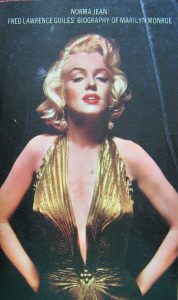
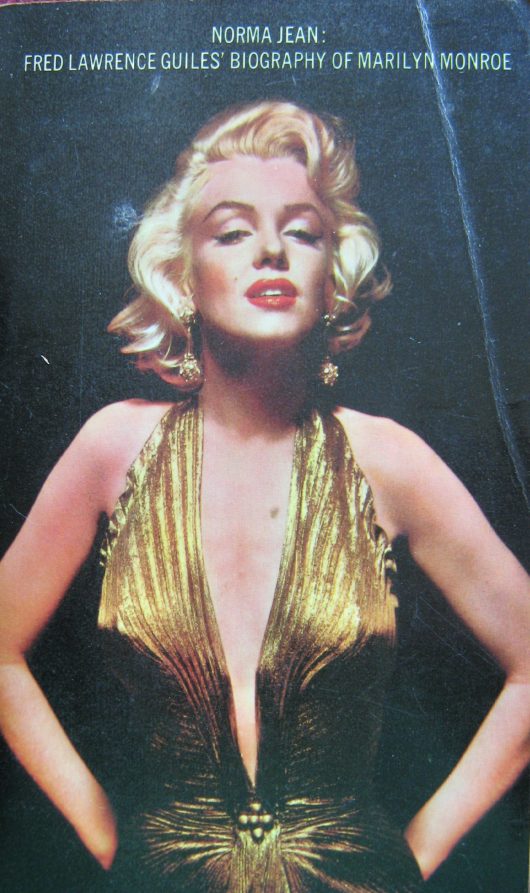
Anyway, getting back to my personal interest in Marilyn, I’m pretty certain the first book about her was what has come to be thought of the definitive biography, the one by Fred Laurence Guiles. Guiles published his book in 1969 and chronicled Marilyn’s life as Norma Jeane Mortensen and then Marilyn Monroe.

Marilyn Monroe

Norma Jeane Mortensen was born on June 1st, 1926. She had a troubled upbringing. Her mother was mentally unstable and was in and out of various institutions leaving young Norma to be taken into care. On one occasion in her late teens Norma Jeane was living with a friend of her mother’s but this friend was moving away and rather than send Norma back into a home an idea came about which seems a little mad in retrospect. The idea was for Norma to get married to a local boy, Jim Dougherty. The marriage went ahead only eighteen days after Norma’s sixteenth birthday.

When war came to the USA in 1941, Jim joined the navy. Norma was working in a war factory when an army photographer called David Conover came round looking for a photo article for a magazine. He asked Norma to pose for him and found that she had a natural affinity with the camera. She began a career in modelling which led her to bit parts in films, then a contract with 20th Century Fox and later to film stardom.

In 1946 she divorced Jim Dougherty and Fox offered her a seven-year optional contract. She changed her name to Marilyn Monroe and began her film career. All didn’t go so smoothly at first. She was dropped from her contract but she did meet an influential Hollywood agent named Johnny Hyde.

I’ve got to say that despite her best efforts I’m not sure my interest in Marilyn had a lot to do with her acting skills as in her early days she wasn’t a great actress. What she did have was looks, looks that could turn the heads of a great deal of men. One of her early film roles came about really because of her growing reputation as a model. She was cast in the last of the Marx Brothers’ films Love Happy and had one scene in which she tells Groucho that “some men are following me.” Groucho explains more in the following video.

That of course was nothing more than a walk on part but she was asked to go on a nationwide tour in the USA promoting the film. Marilyn was determined to get on and be a great actress. She was always having acting lessons, in fact she joined the famous New York Actors Studio. The studio had been founded by theatre and film director Elia Kazan and one of the famous acting coaches there was Lee Strasberg. Both Kazan and Strasberg were interested in ‘the method’, a style of acting initiated by the Russian actor Stanislavsky which involved the actor using his own experience and memories to ‘become’ the role rather than just acting a role. James Dean and Marlon Brando were two of the more famous students of the Actors Studio.

Another of my books about Marilyn was the famous biography by Norman Mailer. Mailer actually used Fred Guiles’ book as the basis of his biography but added his own insight into Marilyn’s story as well as a huge collection of photographs. Mailer was originally hired to write an introduction to what was originally intended to be just a photo album but he was so taken by the subject matter, he wrote more and more and his ‘introduction’ became the book. He later wrote other works about Marilyn.

Marilyn: Norman Mailer

Marilyn on the cover of the celebrated book by Norman Mailer

Johnny Hyde was in love with Marilyn and asked her to marry him many times. She always declined, telling him she did not love him. He continued to press her while working hard on her behalf as her agent. In October 1950 he arranged for a seven year contract at Twentieth Century Fox. He also organised some minor plastic surgery for her, apparently, she had her chin built up slightly and the tip of her nose made smaller. In December that year she was recuperating from the surgery at his Palm Springs home when Johnny died of a heart attack. Marilyn was distraught when she heard the news, even so, his family ordered her out of the house.

She moved in with her drama coach Natasha and one day tried to swallow over 30 Nembutal capsules. Luckily Natasha came home early and found her.

Fox put Marilyn into a number of pictures playing a dizzy blonde type but then she was loaned out to RKO for Clash by Night directed by Fritz Lang. It was the first film with her name over the title.

In 1954 she married baseball star Joe DiMaggio. Maggio had retired from the game that had made him famous and Joe wanted her to settle down with him and retire from the cinema. It might be that Marilyn did intend to one day enjoy a more domestic existence. My feeling though is that she could never ever give up her film star life. It had given her all she had; her fame, her money and her status. She could never say goodbye to her creation, the film star Marilyn Monroe.

In the short autobiography published after her death, My Story, which some say was ghost written or partly written by others, Marilyn said this about her fame:

I belonged to the public and the world, not because I was talented or even beautiful but because I never belonged to anything or anyone else. The public was the only family, the only Prince Charming and the only home I had ever dreamed of.

Would she give up all that for DiMaggio or anyone? I don’t think so.

Her marriage to DiMaggio ultimately failed but Joe would continue to be a great friend. It is quite possible that in the last months of her life she was even planning to remarry him. However, before that came marriage and divorce to Arthur Miller. Marilyn idolised men like Abraham Lincoln and Albert Einstein and she put Miller into that same category. They had met years before, even before she married Dimaggio. Miller would write the screenplay for her final completed film, The Misfits, in which she played a character, Roslyn, which was based on herself. She became hugely disappointed in Miller after finding an open diary or notebook of his in which he severely criticised her. They divorced in 1961.

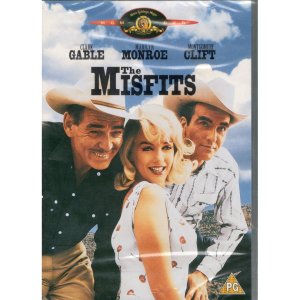
I’ve always thought that The Misfits was her best film and every so often I’ll take my DVD copy and give it a viewing. (I’ve actually only got two of her films on DVD, The Misfits and Some Like it Hot). Misfits was in fact her last completed film. In 1962 she began filming Something’s Got to Give in which she starred with Dean Martin. Marilyn missed a lot of the shoot due to illness and then left for New York where she appeared at a gala performance for the President’s birthday. The President was John F Kennedy and 20th Century Fox was not amused that with their film behind schedule its star had taken time off. They were already having financial problems with another production, Cleopatra. They were paying Elizabeth Taylor the unheard-of figure of one million dollars for her to play the Egyptian queen and their bank account must have been looking distinctly unhealthy. What was the answer? They fired Marilyn.

Fred Guiles first book on Marilyn was published in 1969 and mentions that towards the end of her life she was involved with an ‘easterner’. The man from the east was Robert Kennedy and since then many books and documentaries have mentioned Marilyn’s involvement with both John and Robert Kennedy. The accepted story of Marilyn’s death goes like this. Both John and Robert Kennedy ended their affairs with her, she had been sacked by 20th Century Fox and she became so despondent that she took her own life. Her body lay unclaimed in the morgue until the faithful Joe DiMaggio came and organised her funeral.

In 1966 however, a man call Frank Capell had published a book called ‘The Strange Death of Marilyn Monroe’ which called attention to various things that did not add up. Capell also claimed that Robert Kennedy was with Marilyn on the evening of her death. The FBI forwarded a report of the book to Kennedy who was then still the Attorney General and he asked that Capell’s phone be tapped.

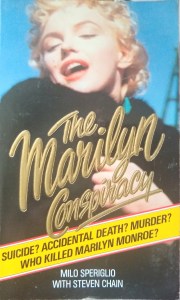
In the 1980’s a number of authors began to look further into Marilyn’s death and one in my collection is The Marilyn Conspiracy. The author, Milo Speriglio was a private detective who was asked by Robert Slatzer to investigate. Slatzer was a friend of Marilyn’s and has even claimed that he married the star only for the two to tear up the marriage licence in case it harmed her career. He said Marilyn had a red diary in which she jotted down notes from her conversations with RFK and contained many things that were secret at the time. Marilyn used to call him from a nearby phone box as she felt that her phones had been tapped.

In 1985 Anthony Summers published the book Goddess: The Secret Lives of Marilyn Monroe in which he also claimed Marilyn was involved with Robert Kennedy. He also explains that Marilyn was not depressed after all. Her dispute with 20th Century Fox had been settled and they had reinstated her to the movie Something’s Got to Give and she was discussing further film projects including a biopic about Jean Harlow.

Summer also collaborated on a BBC documentary film called Say Goodbye to the President in which private eye Fred Otash revealed that he had engaged electronics expert Bernie Spindell to bug Marilyn’s home. The reason? Union leader Jimmy Hoffa who was under investigation by Kennedy wanted derogatory information on RFK that he could use against him.

Eunice Murray, Marilyn’s housekeeper, admitted in an interview in 1985 for the documentary Say Goodbye to the President that Bobby Kennedy was at Marilyn’s house on the day of her death. Eunice’s son in law and Marilyn’s handyman, Norman Jefferies told Donald Wolfe, the author of The Assassination of Marilyn Monroe, that Bobby Kennedy arrived late on the Saturday evening with two unknown men and asked Jefferies and Murray to leave while he spoke with Marilyn alone. When they returned Marilyn was comatose in one of the guest cottages attached to her house. Jefferies and Murray called an ambulance but Marilyn died from an overdose.

I cannot for a moment imagine Bobby Kennedy as a murderer but he certainly would not want to be associated in any way with a movie star suicide. John Bates, a friend of the Kennedy family, claims that Bobby and his family spent the weekend with him at his ranch in Gilroy, south of San Francisco.

Marilyn died in 1962 and she must have something about her because here we are in 2023 still interested in her. In 2011 a film about her called My week with Marilyn was released and in 2022 came Blonde, starring Ana de Armas as Monroe. Blonde was a fictional version of Marilyn’s life. I haven’t seen it but when I looked it up on the internet it didn’t seem to have been rated highly although I’ll be looking out for it on my TV screen in the future.

Norman Mailer’s book about Monroe finished with a photo of Joe DiMaggio, grief stricken on the day of her funeral and he reckons we can perhaps surmise Marilyn’s true worth just by the look on Joe’s face that day. I cannot disagree.

Sources:

The Assassination of Marilyn Monroe by Donald Wolfe

Goddess by Anthony Summers

The Marilyn Conspiracy by Milo Speriglio with Steven Chain

Norma Jeane: The Life and Death of Marilyn Monroe by Fred Lawrence Guiles

My Story by Marilyn Monroe

Say Goodbye to the President: 1985 BBC documentary


What to do next: Here are a few options.

Share this post on your favourite social media!

Hit the Subscribe button. Never miss another post!

Listen to my podcast Click here.

Click here to visit Amazon and download Floating in Space to your Kindle or order the paperback version.

Buy the book! Click here to purchase my new poetry anthology.


More Transformations

I’ve always been fascinated by transformations either in fiction or in real life but what do I mean by transformations? Well, I have written about transformations before in a previous post. I talked then about Professor Higgins who helped Eliza Doolittle change from a street flower seller to a lady in George Bernard Shaw’s Pygmalion but with this new post I thought I’d start with the story of Dr Jekyll and Mr Hyde.
The Strange Case of Dr Jekyll and Hyde

Robert Louis Stevenson published his novel The Strange Case of Dr Jekyll and Hyde in 1886. It concerns Dr Jekyll who creates a potion which transforms himself into Mr Hyde, another personality in which he is free to enjoy his vices without fear of detection. In the book Mr Hyde must take more of his serum in order to change back to his original self. Eventually Hyde finds it is not possible to revert back and commits suicide.

The Jekyll and Hyde story was filmed many times but the most famous version was in 1920 starring John Barrymore. In one scene Barrymore as Jekyll changes into Hyde entirely without special effects. It is an extraordinary scene all achieved by facial contortions which may seem a bit laughable today but back in 1920 audiences were amazed. A 1941 version starred Spencer Tracy in the title role and there have been many other film versions.

One of my favourites was the comedy Carry on Screaming in which police officer Sergeant Bung played by Harry H Corbett is investigating some strange goings on. His investigations lead him to an eerie rest home run by Kenneth Williams as Orlando Watt and his sister Valeria played seductively by Fenella Fielding. In one scene Valeria gives Harry a potion which turns him into Mr Hyde with hilarious results.

Bruce Wayne and Batman

A pretty obvious transformation is one I could pick up from any superhero comic, that of an ordinary member of the public transformed by some accident or circumstance into a crime fighting hero. I’ve chosen two you might already be familiar with from pretty much opposite sides of the super hero spectrum.

Bruce Wayne was a young child when his parents were murdered by a criminal. The story first appeared in issue #33 of Detective comics in 1939. Dr Thomas Wayne and his wife Martha were wealthy socialites living in Gotham City. Their son Bruce enjoyed a privileged existence at the family home, Wayne Manor, until he was eight years old when the family encountered small time mugger Joe Chill on the way home from the cinema. Joe shot Bruce’s parents dead and the young lad swore to avenge his parents’ death by fighting crime.

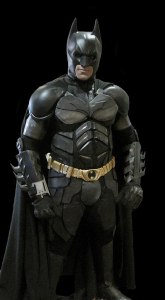
Batman. Picture courtesy Wikipedia commons.

When he is ruminating on this decision and thinking that he must be able to strike fear into the hearts of the criminal fraternity a bat flies in through the window and Bruce wonders if the image of the bat might be something he can use.

The Batman origin story has changed over the years; in a later comic we find that the murder of the Waynes was organised by a mob boss as revenge for when Thomas Wayne gave testimony which sent the mob boss behind bars.

In the Tim Burton film Batman, we find that the killer was actually Jack Napier who later becomes the Joker, one of Batman’s arch enemies.

In the later Dark Knight Batman films things change again with Bruce travelling to Asia to learn martial arts from the League of Shadows. He later splits from the group and as Batman, he has to battle against them.

Peter Parker and Spiderman

Spiderman was a different kind of superhero made to measure for the teenagers of the 1960’s. Peter Parker was a quiet nerdy kind of teenager. He was a high school student who lived with his aunt and uncle as his parents had died in a plane crash. He was attracted to Mary Jane Watson, a gorgeous redhead but he knew he had no chance whatsoever with the muscle-bound Flash Thompson on the scene. Anyway, one day he and his fellow pupils are visiting the Midtown school of Science and Technology and he comes across a radioactive spider. Yes, not something you run into every day.

Anyway, Peter gets bitten by the spider and as a result develops superhuman powers; super strength and agility and also a sort of sixth sense he calls his spider sense. In the comics Peter makes a special gadget that shoots out a strong web on which he swings through the heights of the city. Peter uses his new found powers and becomes a wrestler, but after his uncle Ben is killed by a mugger, he decides to fight crime as Spiderman.

Back in the 1960’s there was a cartoon TV Spiderman show and I can even remember most of the theme tune.

Spiderman, Spiderman, Your friendly neighbourhood spiderman

Spins a web any size

Catches thieves just like flies

Is he strong, listen bud

he’s got radioactive blood.

They just don’t write them like that anymore.

Tobey Maguire starred as Peter Parker in a film trilogy that was quickly rebooted with Tom Holland as the web swinging hero.

Personally, I still prefer the old cartoon version.

Elton John and Reginald Dwight

Reginald Dwight was born on the 25th March 1947. He lived in Pinner in Middlesex with his mother and father, Stanley and Sheila.   Stanley Dwight joined the Royal Air Force in 1942 and elected to stay on after World War II ended. Elton John seemed to think in his autobiography that that was a good thing as together, his mother and father spent a lot of time arguing. While Stanley was away in the air force Reg lived with his mother and his maternal grandmother at 55 Pinner Hill Road, his grandmother’s council house. Elton seems to have been reasonably happy there but understandably distressed at the numerous arguments between his mother and father whenever Stanley came home.

Stanley left the air force and his mother and father divorced when Reg was 14.

One thing that had a very positive effect on the young Reginald was his parents’ love of music and records. He began tapping out tunes on his grandmother’s piano and the age of 11 won a scholarship to the Royal Academy of Music.

At the age of 15 Reg got himself a job playing the piano at the local pub and in 1962 he and some friends formed a small band called Bluesology and they soon picked up a regular gig supporting singer Long John Baldry.

In 1967 Reg answered an advertisement in the New Musical Express. It had been placed by Liberty Records and they were looking for new talent. Reg went to audition for the A & R manager, Ray Williams but he appeared to be unimpressed when Reg sang an old Jim Reeves hit and by way of ending the interview Ray handed Reg a sheaf of unopened lyrics written by someone who had answered the same ad.

That someone was Bernie Taupin. He and Reg hit it off instantly and Reg began writing music to Bernie’s lyrics. Six months later Reg changed his name. He took the name Elton from saxophonist Elton Dean and John from Long John Baldry and put them together to become Elton John.

In 1969 Elton’s album Empty Sky became a minor hit and was followed by the eponymous Elton John in 1970. ‘Your Song’, a single from the album went to number 7 in the UK singles chart and Elton John had arrived.

Norma Jeane and Marilyn Monroe

I should mention that one of Elton’s big hits was Candle in the Wind which leads me nicely into this next section as the song was about Marilyn Monroe. Marilyn was born Norma Jeane Mortensen on June 1st 1926. Her mother was a Hollywood film cutter and her father was a married man named C Francis Gifford who Gladys, her mother, had an affair with.

Gladys divorced her husband who had deserted her some years earlier and she reverted to her previous name, Baker, that of her first husband.

Marilyn: Norman Mailer

Marilyn on the cover of the celebrated book by Norman Mailer

Norma Jeane had a troubled upbringing. Her mother was mentally unstable and was in and out of various institutions, leaving young Norma to be taken into care. On one occasion in her late teens Norma Jeane was living with a friend of her mother, but this friend was moving away and rather than send Norma back into a home, an idea came about which seems a little mad in retrospect. The idea was for Norma to get married to a local boy, Jim Dougherty. The marriage went ahead only eighteen days after Norma’s sixteenth birthday.

The war finally came to came to the USA when the Japanese attacked Pearl Harbour. Jim joined the navy and Norma was working in a war factory when an army photographer called David Conover came round looking for a photo article for a magazine. He asked Norma to pose for him and found that she had a natural affinity with the camera. More photo shoots came her way and soon Norma was convinced by Emmeline Snively, head of the Blue Book Modelling Agency that she was wasting her talents in a defence factory. Within weeks of quitting her job in the factory Norma Jeane became one of the Blue Book’s busiest models.

In 1946 she divorced Jim Dougherty and only a matter of weeks later she went for a screen test at Twentieth Century Fox and Ben Lyon, head of new talent at Fox, offered her a seven-year optional contract. The next issue was her name as Lyon felt that Norma Jeane was not film star material. Lyon suggested the name Marilyn and Norma Jeane provided her mother’s maiden name, Monroe. Norma Jeane had made the transformation into Marilyn Monroe and had begun the long road to film stardom.


What to do next: Here are a few options.

Share this post on your favourite social media!

Hit the Subscribe button. Never miss another post!

Listen to my podcast Click here.

Click here to visit Amazon and download Floating in Space to your Kindle or order the paperback version.

Buy the book! Click here to purchase my new poetry anthology.

10 Books you should read about Marilyn Monroe

Marilyn MonroeThe very first book I picked up about Marilyn Monroe was the biography by Fred Laurence Guiles. ‘Norma Jean, the life of Marilyn Monroe’. It’s a particularly well researched book and for a great many people, fans and writers alike, it has become the definitive biography of Marilyn, the place you go to find out all those facts and figures about her life, especially her early life. Her death is not really discussed in the same fashion as in later books, some of which are wholly devoted to the mystery of her passing. In my edition which I bought in the seventies, Bobby Kennedy is referred to only as ‘the easterner’ and it was only in later years that Bobby Kennedy and his brother, President John Kennedy became publically identified with Marilyn.
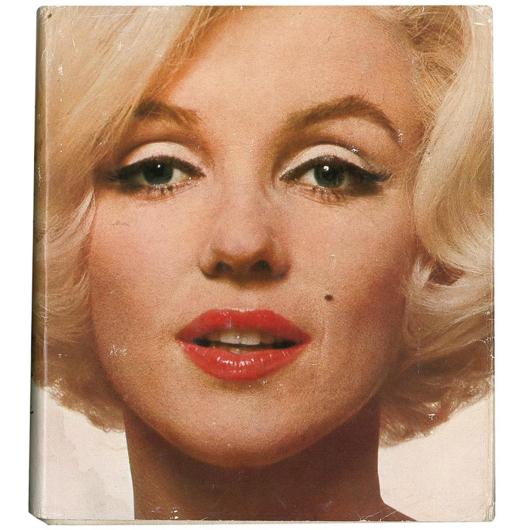

Marilyn: Norman Mailer

Norman Mailer apparently used Guiles book as a guide when writing his own book about Marilyn. Simply called ‘Marilyn, a biography’ the book is a large format book for which Mailer, the celebrated American writer supplied the text, and numerous photographers supplied the impressive array of photographs. The New York Times review online says the book is the ‘Glossiest of glossy books’ and further goes on to remark about the cover picture; ‘Marilyn Monroe has that blurry, slugged look of her later years: fleshy but pasty.’ I’m not sure what the writer was thinking about but personally, I rather like that cover picture of Marilyn.


GoddessA slim volume appeared in 1964 called ‘The Strange Death of ‘Marilyn Monroe’. It was this book that kick started rumours of strange goings on in the hours leading up to Marilyn’s death but the first book I read about the mystery (and I do love modern mysteries) was the book by Anthony Summers; Goddess: The Secret Lives of Marilyn Monroe. Summers is a veteran journalistic investigator and has written books about J Edgar Hoover, Richard Nixon and the JFK assassination. Was Marilyn murdered or did she commit suicide?
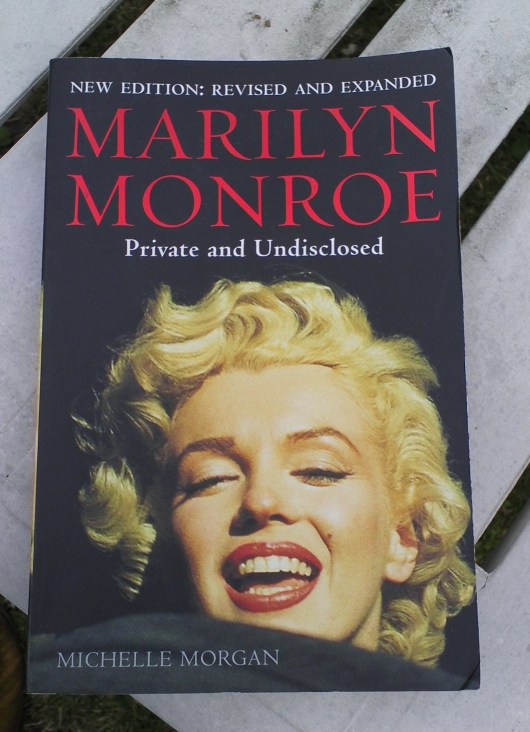
Another author who thinks she was murdered was Robert F Slatzer who wrote a book called The Life and Curious Death of Marilyn Monroe. I couldn’t find my copy when I came to photograph my Marilyn books but I do have it somewhere. Slatzer made a number of claims, one of which was that he actually married Marilyn but her studio bosses forced her to annul the union immediately and remove all the evidence that it ever took place.


IMGA0353Marilyn Monroe: Private and Undisclosed is a book I picked up quite recently. It is written by a British author, Michelle Morgan, and is similar to Fred Guiles book of Marilyn, very well researched but focusses on various people associated with Marilyn who have not been interviewed before. After reading this and other books, I get the impression that Marilyn compartmented her life, and those that were in one compartment, were not necessarily aware of people who were in the other ones.


img_0044_27623392904_oTalking about J Edgar Hoover, here’s another book I picked up about Marilyn. This was a remainder book and concerns the information about Marilyn in Hoover’s FBI files. Marilyn: The FBI Files by Tim Coates. It’s an interesting addition to the many books about Marilyn with pages of FBI files concerning Marilyn, many of them redacted with various names and details blanked out.

Monroe


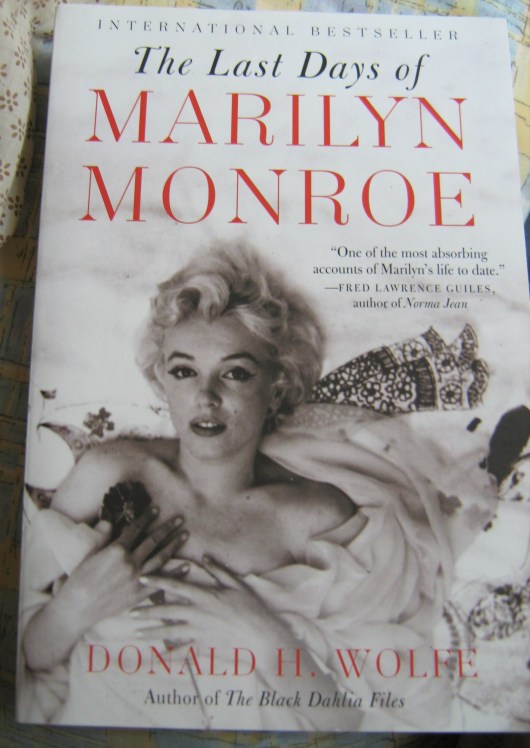
The Assassination of Marilyn Monroe by Donald Wolfe. Wolfe is a journalist who has done a great deal of digging and research and one of his interviewees was the brother in law of Marilyn’s housekeeper, Eunice Murray. He reveals first hand that Bobby Kennedy was at Marilyn’s home on the day she died.


img_0015_28134392832_oDonald Wolfe wrote another book; ‘The Last Days of Marilyn Monroe’. I’ve not read this one yet, it’s one I’m saving for my holidays.
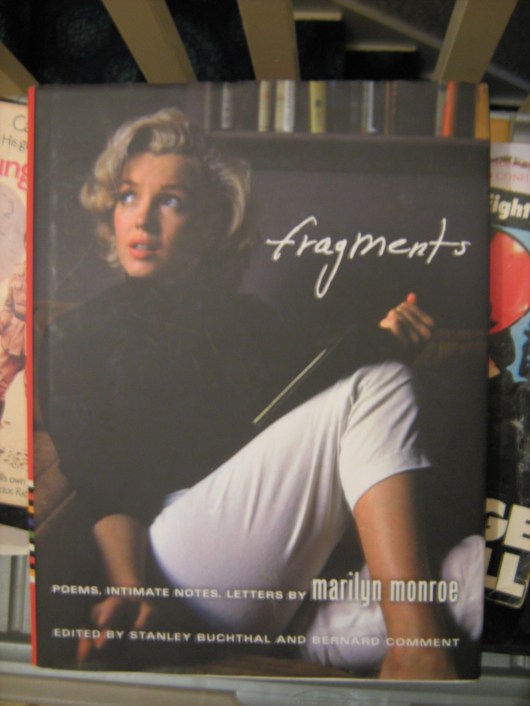


img_0053_28161186631_oFinally, Fragments, edited by Stanley Buchthal and Bernard Comment. When Marilyn died in 1962 she left all her possessions to her acting mentor and head of the Actors Studio in New York, Lee Strasberg. When he passed away Marilyn’s effects went to his daughter and now it seems many will be auctioned off. This book is a look at the letters and notes she made, fragments of poems and thoughts scribbled in notebooks, on hotel stationary and envelopes. Marilyn’s thoughts and written meanderings show her to be a thoughtful woman who cared about what she saw and heard. Marilyn was a great reader and left behind a large book collection, part of which is listed in this book. Click here to read about all the 430 books she left behind.


Hope you enjoyed this post. If you did you might want to try my book, Floating In Space. Click the links at the top of the page for more information.


Marilyn Monroe: Suicide, the Kennedys, and a Red Notebook

mmpicmonkey-imageIn my book collection, which is pretty big, I’ve probably got more books about Marilyn Monroe than any other single subject although I only have two of her movies on DVD. Some like it Hot directed by the Great Billy Wilder and her very last completed movie, The Misfits. I suppose I’m just more interested in her, the woman herself rather than her films. The woman born Norma Jeane Mortensen, according to her birth certificate, who went on to become the movie star Marilyn Monroe.

Funnily enough, June the 1st, only a few days ago as I write this post, would have been Marilyn’s 89th birthday. It’s hard to imagine Marilyn, this icon of movie star allure as an old woman. Marilyn will never age and our image of her is fixed not only by her movies but by the many clips and photographs of her that fill cyberspace. She was a woman loved by the camera but she had a hard battle to become the person she wanted to be, a serious actress in charge of her own fate as a movie star and in control of her career and her roles.

It seems to me after reading many books about Marilyn, she lived her life in compartments and in each separate compartment were different and separate people. You may have read a book about her by Robert F Slatzer, ‘The Life and Curious Death of Marilyn Monroe,’ who claimed to have married Marilyn only to have had the marriage annulled at the request of her movie bosses. Slatzer was kept in a separate compartment from Bill Purcell, who features in my most recent Marilyn book purchase; IMGA0351‘Marilyn Monroe: Private and Undisclosed’ in which the author refers to a long time relationship between him and Marilyn. Slatzer and Purcell, and indeed her three husbands, Jim Dougherty, Arthur Miller and Joe DiMaggio, were all kept by Marilyn in separate compartments which only occasionally connected.

Marilyn claimed she only wanted to settle down and have children but stardom was something she could never give up. She had worked so hard for it and when her struggles to have a child failed, or when her relationships themselves failed, her movie career was always there to fall back on.

She died in 1962 aged 36. The coroner said she died as a result of a probable overdose. Indeed, she had a history of overdosing and Arthur Miller, her third husband, saved her from death more than once. Many writers have attributed her sacking from her final film ‘Something’s Got To Give’ as a contributing factor in her suicide but in fact Marilyn had been reinstated to the film at an increased salary. On top of that she had many film projects planned, including a movie biopic about Jean Harlow, so did she commit suicide? Was it an accidental overdose, or was she murdered? Who would want to murder Marilyn Monroe and why?

The fact of the matter is that Marilyn had become rather dangerous to quite a few people and she was in possession of some pretty interesting information because of her involvement with President John Kennedy. Kennedy, who was a serial womaniser, was not amused at her overtly sexual performance at his birthday party and decided to end his association with her. FBI boss J Edgar Hoover had made Kennedy painfully aware he knew of his trysts with another woman named Judith Campbell, who was also intimate with mafia boss Sam Giancana. Anxious perhaps not to give Hoover further ammunition against him, the President tasked his brother, Attorney General Bobby Kennedy to do the dirty work and smooth over things with Marilyn.

Some books and articles claim that was exactly Bobby Kennedy’s mission with Marilyn; damage limitation and keeping her quiet. Others say things had gone further and Marilyn had another affair, this time with Bobby Kennedy himself. Marilyn was someone who had spent a lifetime trying to better herself in the arts and literature. She was a great reader and she began taking notes of her conversations with the Attorney General in order to research their topics and appear confident and knowledgeable. Those conversations included, incredibly, highly secret things within the US government including attempts to topple the communist government of Fidel Castro in Cuba. She wrote these notes down in a red notebook which she showed to Robert Slatzer. He advised her it was an extremely dangerous notebook to have but as her affair with Bobby Kennedy cooled, if indeed it was an affair, Marilyn grew more and more angry. She claimed to friends she was fed up of being tossed around ‘like a piece of meat’ and threatened to blow the lid on her dealings with the Kennedys in a press conference. Bobby Kennedy wanted that notebook destroyed and Marilyn kept quiet. The mafia wanted derogatory information on the Kennedys and had even had Marilyn’s home bugged. The press conference was arranged for Monday August 6th, 1962. Sadly, Marilyn was found dead in the early hours of the 5th.

mm5409683410_8350501c78_oOn the last day of her life, August 4th, 1962, Marilyn was not depressed but making plans for the future. The day before, the 3rd, she spoke on the telephone with handyman Ray Tolman and arranged for him to visit the next week to sort out some repairs on her house, 12305 5th Helena Drive in Brentwood. She also ordered various plants and shrubs for her garden. She spoke with her publicist Pat Newcomb and invited Pat to stay the night. The two women dined locally and turned in to bed early.

The next day, 4th August, Marilyn was awake when the housekeeper arrived at 8am. She spoke with numerous people on the telephone and arranged for Masseur Ralph Roberts to come over for a barbeque the next night.
Pat Newcomb arose around 12 noon and felt that Marilyn was not in a good mood. Pat had slept well while Marilyn, who had a long history of sleeping problems, had slept badly. This seemed to cause some friction between the two women. Shortly after 1 pm Ralph Greenson, Marilyn’s psychiatrist arrived. Marilyn and Greenson had a therapy session together while Pat spent the afternoon sunbathing by the pool as previously arranged.

At around 3pm Pat Newcomb says Greenson asked her to leave as he wanted to work alone with Marilyn.
Later, Eunice Murray, Marilyn’s housekeeper dropped Marilyn off at Peter Lawford’s beach house while she did some shopping. At about 4pm she returned home and Doctor Greenson also returned for presumably, more therapy.

At 5pm Peter Lawford called and asked Marilyn to a supper later that evening but she declined. Marilyn received numerous telephone calls during the day some of which Eunice Murray had fielded by telling callers Marilyn was busy or not at home. Many times this was simply not true. A call from Ralph Roberts was answered by Dr Greenson who said sharply “Not here,” and put down the phone.

At 7 pm Greenson says he left, leaving Marilyn alone with housekeeper Eunice Murray. At around this time Marilyn took a call from Joe DiMaggio Jr. Joe had broken off his engagement to his fiancée and found Marilyn to be in good spirits. At about 7.30 Peter Lawford called again to ask Marilyn to dinner. His description of Marilyn contrasts with Joe Jr as Lawford states Marilyn’s speech was slurred and that she appeared disorientated. Towards the end of the call Lawford stated famously that Marilyn said, “say goodbye to the President and say goodbye to yourself because you’re a nice guy.” Mexican actor Jose Balleros also claimed to have spoken on the telephone with Marilyn that night, he claims Marilyn was lucid and awake in contrast to Peter Lawford’s statements. The fact is Lawford and Eunice Murray both gave varying reports of what happened on Marilyn’s last evening and neither’s statements can be completely trusted.

According to Murray she noticed a light on under Marilyn’s door but the door was locked. She went outside and saw Marilyn either asleep or unconscious on the bed. This was 10 pm in the first version Eunice told. Later on it was moved forward to 3 am. She called Ralph Greenson who advised her to break a window with a poker. Greenson himself then arrived at the house, broke another window and gained entry through the window and found Marilyn dead.

When Police Sgt Clemmons arrived at 4.25 am he saw Marilyn lying face down in what he called the ‘soldier’s position.’ He said “her hands were by her side and her legs perfectly straight. It was the most obviously staged death scene I have ever seen.” Not only that, all the sheets on the bed were clean and Mrs Murray was busy doing the laundry. Clemmons also noted the unusually long time that had elapsed before calling the police and asked why wait until gone 4 in the morning? Greenson and Murray said the film studios had to be informed first. Later, Murray changed her story saying she saw the light on in Marilyn’s room at midnight, went back to bed then awoke later and saw it was still on at 3am then she called Greenson. Greenson then called Doctor Hyman Engleberg and both doctors arrived shortly after. It was Hyman Engleberg who pronounced Marilyn dead.

Eunice Murray admitted in a BBC interview in 1985 for the documentary say Goodbye to the President that Bobby Kennedy was at Marilyn’s house on the day of her death. Eunice’s son in law and Marilyn’s handyman, Norman Jefferies told author Donald Wolfe that Bobby Kennedy arrived late on the Saturday evening with two unknown men and asked Jefferies and Murray to leave while he spoke with Marilyn alone. When they returned Marilyn was comatose in one of the guest cottages attached to her house. Jefferies and Murray called an ambulance but Marilyn died from an overdose. Was it a suicide or an accident? Was it murder? It seems to me that at this late stage we can never know but the autopsy showed that Marilyn’s blood level contained a lethal level of Chloral hydrate and Nembutal but there was no residue from the pills in her stomach, in fact, Marilyn would have had to swallow 38 to 66 capsules of Nembutal plus the chloral hydrate, and would have lost consciousness long before swallowing all of the pills. Was an injection given? The autopsy showed no trace of any needle marks and the final result was noted as a ‘probable suicide.’ Other versions of this story state that an ambulance was called and Marilyn expired on the way to hospital. Presumably it was the ambulance crew that pumped her stomach removing the pill residue. Recently an ambulance driver named James Hall claimed he attended Marilyn’s home that night and Marilyn was responding to treatment when a doctor whom he identified as Ralph Greenson injected Marilyn in the chest with a hypodermic syringe with a long needle. It was he said an inept amateur injection that broke one of her ribs however, these claims were not substantiated by the autopsy. The body was then returned to her home in order to give Robert Kennedy time to leave Los Angeles. I cannot for a moment imagine Bobby Kennedy as a murderer but he certainly would not want to be associated in any way with a movie star suicide. To this day John Bates, a friend of Kennedy’s claims that Bobby and his family spent the weekend with him at his ranch in Gilroy, south of San Francisco.

The final tragedy of this drama is that former husband Joe DiMaggio was set to remarry Marilyn. The date of the wedding should have been August 8th. Instead Joe attended Marilyn’s funeral on that day.

DiMaggio sent half a dozen red roses to her crypt three times a week for the next twenty years. He died in 1999 aged 84 and never remarried. He never spoke about Marilyn publically ever again. When Robert Kennedy visited the Yankee stadium in 1965, DiMaggio took a discreet step back when it was time to shake Kennedy’s hand.

"Marilyn Monroe crypt2" by User:Oleg Alexandrov. Original uploader was Oleg Alexandrov at en.wikipedia - Transferred from en.wikipedia(Original text : Made by Kodak Easy Share camera by User:Oleg Alexandrov). Licensed under Public Domain via Wikimedia Commons - https://commons.wikimedia.org/wiki/File:Marilyn_Monroe_crypt2.jpg#/media/File:Marilyn_Monroe_crypt2.jpg

“Marilyn Monroe crypt2” by User:Oleg Alexandrov. Original uploader was Oleg Alexandrov at en.wikipedia – Transferred from en.wikipedia(Original text : Made by Kodak Easy Share camera by User:Oleg Alexandrov). Licensed under Public Domain via Wikimedia Commons – https://commons.wikimedia.org/wiki/File:Marilyn_Monroe_crypt2.jpg#/media/File:Marilyn_Monroe_crypt2.jpg

Sources: The Assassination of Marilyn Monroe by Donald Wolfe

Marilyn Monroe: Private and Undisclosed by Michelle Morgan

Goddess by Anthony Summers

Say Goodbye to the President: 1985 BBC documentary

Websites: http://www.lovingmarilyn.com

http://www.cursumperficio.net

For a recent daily Mail article, click here.