My Lockdown Book Bag 2020

Things don’t always go as planned, especially when an unexpected pandemic hits the country so instead of presenting what might have been another holiday book bag, here’s the pandemic version instead:  A review of the books I’ve been reading lately, all sourced as usual from second hand book shops or the internet.

A Right Royal Bastard by Sarah Miles.

Sarah Miles is a famous actress from the 60s and 70s. She appeared in films like Ryan’s Daughter and The Servant. A Right Royal Bastard is the first volume in her autobiography and is mostly about her childhood. I suppose normally you might expect a film star to devote a chapter or two to his or her childhood but here Sarah gives us pretty much a complete volume devoted to hers.

After the opening chapter I expected the book to move on but no, Sarah Miles tells us everything she can think of about her childhood and her schooling as well as her background and her family. I have to say I was getting a little bored but after a few chapters the book finally began to get interesting.

It’s a very frank book indeed and I wonder if it was a confessional experience for the author. Sarah tells us about her first period and then later about her first sexual experience. The story about when she was almost raped was shocking but then she proceeds to tell us about the time she shared a flat with a prostitute. One memory from that time was when she agreed to hide in a wardrobe during one her flatmate’s encounters with a male client. Sarah and that particular lady later have a bath together and Sarah soon begins to suspect that perhaps someone has got the hots for her.

Later she falls in love with James Fox. He is in the army at the time and when he goes off to join his regiment Sarah finds she is pregnant and suffers a dreadful back street abortion.

Sarah emerges from these pages as utterly different from what I had imagined, she always looks so prim and proper in her films. The book finishes with her first big part in a film and I have to say, I did find myself wishing I had the second volume. I’ll have to look out for it.

Alan Turing: The Enigma.

I’ve been reading this book for a long time and the lockdown was the perfect opportunity to finish it off and finally put it aside. This book is well researched which must have been difficult as Turing was not well known or even famous during his lifetime and his greatest achievements were made in the greatest of secrecy during wartime. The first part of the book I found slow but tedious and it finally livened up when Alan Turing joins the staff at Bletchley Park and sets about decoding the secret messages from Nazi Germany; then it gets interesting.

Turing joined the Government Code and Cypher School in 1938 which was the UK’s code breaking organisation. In 1939 the British cypher experts were given details of code breaking by their Polish colleagues including details of the Nazi Enigma code machine and their methods of decoding the Enigma messages.

Turing recognised the importance of a machine the Poles used to help break the codes and he designed and made his own improved version known as the Bombe. In 1941 Turing and his colleagues appealed directly to Winston Churchill for more resources to help their work and Churchill, recognising the importance of what they were doing responded immediately. As a result, more than 200 bombe machines were in operation by the end of the war.

German naval Enigma messages were even more difficult to break and Turing worked hard on these codes, finally breaking them with a statistical technique that was later known as sequential analysis. It was later estimated that the work at Bletchley Park shortened the war by 2 years and saved countless lives.

Turing worked at Manchester university after the war. In 1952 he became involved with a young unemployed man named Arnold Murray who was later involved in a robbery at Turing’s home in Wilmslow. During the inquiries Turing acknowledged a homosexual relationship with Murray and was prosecuted, homosexuality being illegal at the time. He was found dead two years later in 1954 and it is thought he took his own life using cyanide although it may have been that his death was accidental.

Apart from the wartime work decoding Enigma messages I actually found this book rather heavy going. Towards the end when Alan is working in Manchester I found myself skipping through long passages about mathematical theory but I was glad to have finally reached the end. One interesting thing was that Alan lived in Wilmslow during this latter part of his life. I once lived in Wilmslow too and travelled into Manchester every day on the bus, a journey of about an hour. Alan did the same journey by bicycle so he must have been pretty fit.

Over on Goodreads readers seemed to be all in favour of the book but sadly it just wasn’t my cup of tea.

Khrushchev Remembers.

This book has a remarkable history. Khrushchev was ousted from the Soviet leadership in 1964 in favour of Brezhnev and he was retired to a small dacha with a pension. There Khrushchev fell into a deep depression but his son suggested he record his memoirs on audio tape which he did. The KGB kept an eye on Khrushchev and demanded he turn the tapes over to them which he also did. His son however had copies secretly smuggled into the west and they were published in the form of this book. My copy is quite an old one and has a commentary by Edward Crankshaw putting Khrushchev’s memories into perspective.

The book is a fascinating read and the author takes us through his early life and we see him move ever closer to the centre of power which in Khrushchev’s early years meant closer to Stalin. Khrushchev in some ways thinks of Stalin as a good comrade and communist but in others as what he really was, a ruthless dictator. Khrushchev survives the years of Stalin’s purges when many disappeared after a knock on the door in the middle of the night. Khrushchev defends the Nazi-Soviet pact saying the Soviets knew it would never last but that it gave them time to build up defences against Hitler. Hitler finally attacked Russia with Operation Barbarossa in 1941 and for a time Stalin disappeared from view. He was finally urged into action by his generals and I have read elsewhere that when they first approached him he asked ‘have you come to arrest me?’

It would have probably been better for the Soviets if they had but they rallied around their leader and went on to defeat Hitler, and Stalin consolidated even more power. Stalin died in 1953 and he was left lying on the floor for a day as his staff were too scared to approach him. Beria, head of Stalin’s secret police initially grabbed power but Khrushchev was able to overcome him and have him arrested by the military.

In 1964 it was time for Brezhnev to snatch power himself. Khrushchev did not resist. His contribution he said, was the smooth change of power without murders or arrests.

‘Could anyone have dreamed of telling Stalin that he didn’t suit us anymore and suggesting he retire? Not even a wet spot would have remained where we had been standing. Now everything is different. The fear is gone, and we can talk as equals. That’s my contribution. I won’t put up a fight.’

Brezhnev reversed many of Khrushchev’s reforms and the world and the Soviets had to wait for Gorbachev for more enlightened leadership. To sum up, this was a great read and very interesting but one in which I was glad of the commentary to put the author’s views in perspective.

That was my lockdown book bag. What books do you have in yours?


What to do next:

Share this post on your favourite social media!

Hit the Subscribe button. Never miss another post!

Buy the book! Click here to visit Amazon and download Floating in Space to your Kindle

More Letters to Younger Selves

Wait just a minute! Letters to Younger Selves? Haven’t we had this post already I can hear you thinking? In fact not just once; there was Letters to My Younger Self and then we had A Video to My Younger Self? Hasn’t this guy got any new ideas? OK, I know where you’re coming from but bear with me for a short while. I did do a post a while back which was about me writing a letter to my younger self. Then the other week I told you about how I put together a video version for my YouTube channel. This week I want to tell you about what happened when I actually uploaded the video.

Now I did say the original letters post wasn’t my own idea. I got it from one of those blog writing prompts that can easily be found in either Google or your search engine of choice. After uploading my video I always do a search for it and if it comes up near the top of the search then I’ve feel I done a pretty good job in terms of tags and meta data (all that technical stuff) and choosing a good post title. A search for A letter to My Younger Self gave up some surprising results, in fact it seemed to me that everyone and his dog had been making a short video on this same subject. Even more surprising was that a lot of these short videos were by Formula One drivers. I’m guessing that at some time there was some kind of trend for this subject, perhaps a promotion around the hashtag #DearMe but when it comes down to it, I might as well admit, I don’t know.

Anway, I thought it might be interesting to showcase a few of the videos I came across so let’s start with Fernando Alonso, frustrated former Ferrari driver who jumped ship thinking Honda were going to create a world beating engine for his new Mclaren team, only they didn’t. Hard luck Fernando.

(I should point out here that F1 being the multi million dollar global industry it is, they wouldn’t for a minute let these videos play on my cheap nasty amateur blog post. Press play then you have to click the button that says ‘Play on YouTube’. Annoying I know but hey, that’s big business for you.)

Many people think that Fernando is one of, if not the greatest driver of all time. Those people are of course completely wrong and this then is the perfect time to introduce someone who actually is the greatest driver ever. Jackie Stewart, winner of 27 Grands Prix from 99 starts, three World Championships and now one of the Formula One world’s elder statesmen.

South African Jody Scheckter was once the enfant terrible of Formula One, especially when he spun and caused a huge pile up at the beginning of the British Grand Prix back in 1973. A lot of people weren’t happy but Scheckter went on to drive for Ferrari and win a World Championship in 1979.

Emerson Fittipaldi was one of my favourite drivers of the 1970’s. He took over from the late Jochen Rindt at Lotus and won three world Championships before electing to drive for his brother’s new F1 team. Things didn’t work out so well for the Fittipaldi brothers and Emerson retired for a while but then made a comeback in American Indycars winning the Indycar title in 1989.

Someone who did what Emerson did, only in reverse, was Mario Andretti. He was a champion in the US and had a few one off drives for Colin Chapman, head of he Lotus team who tried numerous times to lure Andretti over to F1. Andretti finally dipped his toe into F1 and won the world title for Lotus in 1978. He was the last American to date to win an F1 race. He won numerous races in all types of racing disciplines in the USA including 4 Indycar championships and numerous other races and awards. He is probably as synonymous with motor sport in the USA as Stirling Moss was in the UK.

I think that’s probably enough from the F1 world so I’ll finish with some other famous people. The first non F1 person I came across was Caroline Kennedy, the daughter of the assassinated president. It’s pretty brief and the good news is that all these next videos can be played within this post!

Still with the Presidential theme here’s something from former first lady Michelle Obama.

Art Garfunkel, former singing partner of Paul Simon did one too . .

And finally, here’s one which isn’t by a celebrity. I came across this one after hours of trolling through Google and YouTube. Many videos I found were of young people talking to their even younger selves so really they didn’t have much to say. I think that the whole theme is better suited to someone older, someone in their later years looking back to their youth. Anyway, here’s a pretty inspiring video.

Finally it’s time to plug my own video once again. Here’s a slightly edited version with a few subtle sound effects added . .


What to do next:

Share this post on your favourite social media!

Hit the Subscribe button. Never miss another post!

Buy the book! Click here to visit Amazon and download Floating in Space to your Kindle or order the paperback version.


Documentary: Sellers, Grant and Brando

Not long ago I came across a blog post about the best documentary films of all time and looking through it I noticed one about Marlon Brando. When I was younger I was very interested in Brando. I thought he was a great actor, one of the greatest in fact even though I think his stature has become diminished by his poor choice of roles in his later life.

Brando’s earlier films are a list of classic cinema greats and if he had perhaps died early like James Dean I’m sure many writers and cinema fans would have wondered what would have happened if Brando had lived, what great movies would he have made? Actually the answer is, not very many.

Anyway, before I get to Brando let’s look at some other examples of movie actor documentaries.

Peter Sellers as he filmed it.

The BBC Arena team made this film about Peter Sellers in 1995. It was created largely from cine film shot by Sellers himself, who was a lifelong camera enthusiast. The original documentary was made in 1995 and if I remember correctly, Sellers’ widow, Lynne Frederick had died and left behind a lot of Sellers’ effects, including his home movies which is how the film came to be made.

Normally, I’d say that you have to be interested in movie people and how movies are made to like this documentary but this film is so special I don’t think that rule applies.

The original film was in three parts and began with Sellers’ early days and his early films. The first cine films we see are black and white movies and as Sellers’ career takes off, his cine equipment also improves and he upgrades to colour and then on to sound. His own images show his young self as a sort of ‘spiv’, a Flash Harry sort of character with his double-breasted and shoulder padded jackets. An uneasy relationship with his mother emerges, as does a rather spoilt and volatile personality. His first wife talks about their early days and their life together and friends like Spike Milligan talk happily about successes like the Goon show and their beginnings in show business. Milligan had a 8mm camera and Sellars a 16mm one. Of course ‘Peter was richer,’ comments Milligan. ‘Richer by 8 millimetres!’

Sellers’ cine film is blended with interviews from various people who played a part in Sellers’ life.

Sellers as Group Captain Mandrake in Dr Strangelove.

Sellers as Group Captain Mandrake in Dr Strangelove.

A fascinating section concerned Casino Royale, the spoof James Bond film. Various directors were involved but Joe McGrath shot one segment with Peter Sellers and Orson Welles. McGrath was a TV director relishing the move into feature films, that is until Sellers told him he didn’t want to be in the same shot as co-star  Welles. A heated debate ensued which became physical. Sellers said he was going off to calm down. He never returned and if you ever see the completed movie, you’ll understand why Sellers’ character abruptly disappears too!

Sellers claimed to have no personality of his own and ‘borrowed’ them from the characters he impersonated. It’s interesting to watch the TV interviews included in the film where Sellers seems to mimic the Yorkshire tones of Michael Parkinson and again, in other snippets he is taking on the accents and style of his interviewers.

The film overall has a sort of melancholy feeling which I feel accurately represents Sellers’ persona. He was a sad character, disappointed in his life and loves. He was not happy with his last wife, Lynne Frederick and he even junked many of his cine films prior to his death as they didn’t seem to match his expectations. The mood of the film is further enhanced by a wonderful soundtrack full of sad saxophones and jazz tones.

There are some that put down documentaries that are full of so-called ‘talking heads’ but personally, if the talking head has something interesting to say, I like to hear them. However, in 2002 the BBC re edited the film by taking the soundtracks from the ‘talking heads’ and combined them with Sellers’ self filmed visuals. The result is now available as a BBC DVD. The original is much better though, in fact you can see all three parts on the video sharing site Vimeo:

Becoming Cary Grant.

The BBC does do a good documentary and a few months back I settled down to watch a documentary about the film star Cary Grant: Becoming Cary Grant.

Grant was the smooth talking and sophisticated star of many a Hitchcock film, indeed the documentary revealed ‘Hitch’ to be his favourite director. Grant and Hitchcock were both immigrants from the UK.

Cary Grant was born Archibald Leach in Bristol in the southwest of England. He had a rather sad childhood during which his mother disappeared. Various explanations were put to the young Archie including the lies that she had gone on holiday and later that she had died. In fact his father had his wife committed to an asylum where she languished until her rich and famous son returned to her much later. In fact, Grant did not learn that his mother was still alive until he was thirty-one years old.

Archie’s father remarried but Archie was not included in the new family. Instead he was sent to live with his grandparents. At school he developed a love of theatre and spent much time helping and later working at small theatres in Bristol. When he was only 11 he began working with a small troupe known as the Pender Troupe and when they went to undertake a new tour in the USA, the young Archie went with them, following in the footsteps of other performers like Charlie Chaplin and Stan Laurel.

In the USA, Archie toured the vaudeville circuit with the Pender Troupe and decided to stay on in the USA when the troupe returned home. He and some others formed their own troupe and Archie spent a lot of time doing various acts like stilt walking and unicycle riding. Gradually he moved on to better roles in various theatre productions and even had a screen test in the early 1930s, which was shown on the documentary. Archie, now using the name Cary Grant comes over as a loud-voiced individual, making many faces for the camera. Of course, as a vaudeville actor he was used to talking loudly and making exaggerated expressions but he soon learned to tone down his performance for the cameras.

The documentary uses text from Grant’s unpublished autobiography and it is clear an experience in later life had a great effect on him. Grant took part in a form of psychoanalysis using LSD which enabled him to confront issues from his early life which the actor felt had unduly affected his relationships as an adult, particularly with women, in fact he was married five times.

The film was interesting but focused mainly on the unpublished autobiography and many of his friendships and relationships that I have read about in other books were not even mentioned. A great part of the film also was Grant’s collection of home movies which were used throughout the film although many times what we were seeing was not properly explained. Towards the end of the film Grant’s daughter was interviewed and visits Cary’s old home. In one scene we see her visiting the patio shown in a earlier shot on one of Cary’s home movies. More interviews and perhaps some more location footage would have benefited this film enormously. Still, it was interesting and can be found on the BBC i-Player if you missed the original broadcast.

Listen to Me Marlon

After reading about this Brando documentary I did a quick search on eBay, found a very cheap copy for a couple of pounds including free delivery, and sat down to enjoy it. It is different to the two films above because rather than home movie or the  written word, the prime source of the film is audio tapes that Marlon recorded for himself. The big problem there is that while many are good recordings, others are not only poor quality, but Marlon’s non acting speaking voice is rather difficult to understand. He has a strange lisping, mumbling voice completely unlike the strong voice of many of his roles.

On top of that a droning piano accompanies much of Marlon’s recordings and many times I found myself rewinding to find out what he had actually said.

The Brando that emerges from this film is a sad man made sad perhaps by memories of a drunken mother and a violent father. In an early sequence Marlon senior joins his son the film actor on a TV show and the voice on one of Marlon’s tapes tell us how both of them were acting, one playing the loving son, the other playing the caring father. Marlon spent a lifetime looking to psychoanalysis for help, feeling inadequate despite his fame and success as an actor. It seems also that he despised his craft even though it gave him financial security to do and live however he wished.

Acting he reveals was the first time he did anything that he was praised for and the first to see his talent was Stella Adler, an actress who trained and nurtured him as an actor.

Brando appeared in a number of classic films including A Streetcar named Desire, Viva Zapata, and the Oscar winning On The Waterfront. Some of his later choices of film roles were just frankly disappointing especially during the 1960s. By the end of that decade he was persona non grata in Hollywood and when Francis Ford Coppola decided he wanted Brando to play Don Corleone in The Godfather, alarm bells were ringing in the executive offices at Paramount. Not only was Brando held in low esteem as an actor he also had a reputation as a troublemaker who caused delays and added more dollars to production schedules and costs.

I’m not sure Brando ever really appreciated what Coppola did for him. As well as giving him an Oscar winning role Coppola rehabilitated Brando in the film industry and made him a bankable star once again. Later, when Brando appeared in Apocalypse Now, he appeared on set massively overweight forcing Coppola to shoot him in darkness and shadows. Brando complained about the script too and began rewriting his own dialogue. On his personal audio tapes Marlon rants on about his treatment by the director but really, it was Francis Coppola who should have been complaining.

Listen to me Marlon was fascinating but ultimately a disappointing film. If I ever do a blog post about the best documentaries ever I’m sorry to say I won’t be including this one.


What to do next:

Share this post on your favourite social media!

Hit the Subscribe button. Never miss another post!

Buy the book! Click here to visit Amazon and download Floating in Space to your Kindle

A Video for my Younger Self

Lockdown has been eased slightly here in the UK but even so, the day when things will be back to normal seems pretty distant. Even then I keep seeing things in the media about the ‘new normal’. What will the new normal be like? I don’t know but one day we will all be back out again, going back to bars and restaurants and flying to Europe and even further afield for our holidays. Still, I can imagine everything being ever so slightly different though with much more handwashing and social distancing.
I did consider calling this post How not to Smash up your Laptop. I didn’t but read on and you’ll begin to understand why. I have actually been fairly industrious this week, well, industrious by my standards that is. I have finally finished my latest video project and I have gradually come up with a few ideas for blogs and made some headway on my other writing projects. When I see my blog post deadline looming, I am not usually that worried because I tend to have a half-written blog post in the pipeline but when I have no ideas at all and no partly written blog posts, well, that is a worry so it has been good to get myself ahead again, if only by one or two blog posts.

A while back I decided that as my writing wasn’t coming along too well, I should set myself the task of making something new for my YouTube channel. There are actually plenty of videos over there on my channel but they are all short and simple one or two minute videos either of me reading poetry or me extolling the virtues of Floating in Space to the reading public.

I felt that my loyal band of video followers could do with something slightly different and while looking around for ideas I began to wonder if I could perhaps make one of my blogs into a video. After a look through my older posts I came across A Letter to my Younger Self. It was a post inspired by one of those blog post prompts that I tend to use when I’m short of ideas. What would you tell your younger self? What advice could you give?

My younger self needed not only advice but a good kick up the rear end although I didn’t quite go that far in the finished video. As we are still under lockdown I couldn’t go out and shoot anything new but I do have plenty of assorted video that I have accumulated over the years. To make things easier I decided to make the video on Animoto which does have plenty of stock clips that I knew I could use. Not only that, I have used Animoto for several years and I’m pretty confident using it. The alternative was using the windows HD movie maker. I have the Pro version but even so it’s not nearly as user friendly as the old Windows Movie Maker.

OK here we go. I logged on to Animoto but found that I was now one of the few people chosen to use the new beta 3 version of Animoto. Why oh why must our favourite software be continually changed? The first big problem I came across was that when using a vertical image in Animoto, it couldn’t be fully zoomed out; it would only fit on the screen to its width, I couldn’t zoom back and display the full image.

I contacted Animoto and they said you can zoom out using the scale bar. No you can’t I said. Yes, you can they said. I had only just started the project and already I was ready to smash my laptop into small pieces. A few days later after a lot of moaning on various Animoto forums the technical people sorted that issue out and yes, I could finally zoom fully out. Anyway, I ploughed on and when I had an initial basic cut, I made a rough narration and uploaded that to the project so I could get the pictures and video clips to fit in together. This seemed to take a hell of a long time and I found myself continually moving on to some other project or sometimes just surfing through eBay for something to buy that in fact I didn’t really need.

Just to give you a fuller picture of the issue, over lockdown I have ordered 3 DVDs, 3 lots of razor blades for the various razors I use, a bargain box of Terry’s chocolate oranges, a 1/43rd model of a bus I used to drive in 1987, a couple of books and various other things I’m too embarrassed to mention. One other thing I ordered, not from eBay but from Wowcher, was a set of face masks, quite handy I thought for venturing out shopping during the current situation. On Wowcher you order your item and are then given a voucher code which you use on the actual site that sells your item. I sorted that out, entered my code and ordered my face masks.

A week later I received an email saying the company had received my voucher from Wowcher and was ‘processing’ my order. After another week I got another email this time to confirm my order had now become ‘fully processed’. Later another email landed in my inbox advised that the item was now with the Royal Mail. At this rate I might just get the face masks in time for Christmas shopping.

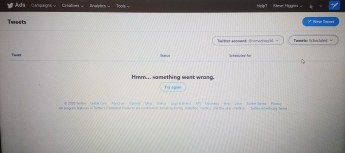
Over on Twitter I tend to schedule my posts for the next few days but just lately Twitter doesn’t seem to want to display my scheduled tweets on my laptop. In fact I get a page looking something like this.

Now this can be a problem because there is no point in scheduling a post for 12:03 on Thursday if I’ve already set one to pop up at a similar time. Emails to Twitter and posts on various forums got me nowhere fast and once again I had to use all my willpower to prevent the violent smashing up of my laptop. The only solution was to schedule the posts using my iPad which happily displays the relevant scheduling page without any issues.

OK. Days have passed, even weeks and after getting my video cut near to perfection it was time to download the result and narrate a much more confident voiceover. Here’s when some more technology issues began to slow me down.

I noticed that when I recorded the voiceover, the recording seemed to be jumping and missing out various words. So, I clicked over to Google and searched for information about optimising sound recordings. I found I had set my recordings to DVD quality and maybe my laptop just couldn’t cope with that. OK, time to reset to CD quality and finally that was another problem sorted. (I’m happy to report I resisted the temptation to just smash my laptop to smithereens again.)

I noticed then that when I had my narration on my computer screen and scrolled down as I read, the microphone was picking up the clicks on the scroll button. I couldn’t print off the narration as I had no ink in the printer so what I did was upload the narration to my OneDrive and open it up on my iPad and read it from there. On my iPad I was asked to log in to OneDrive. I did but they wanted further confirmation. They wanted a passcode entered which they sent to my mobile. Off I went in search of the mobile. I entered the pass code but I was too late. It had expired! I did it again but this time the password was wrong!

(Steve don’t do it. Don’t smash the laptop to smithereens!)

No I didn’t. Instead I recorded the first section of the voiceover, paused, scrolled the text and recorded some more. Brilliant!

OK, final narration added, time for a few quick changes here and there and that was it. The big problem with editing is that when you are replaying your work over and over, it’s easy to miss the odd error. A few things I missed were some text on the screen that was in dark blue but wasn’t easy to see against a dark background and some other similar bits and pieces. I like to leave the finished video for a few days then take another look and then those minor errors are much easier to see.

In the old days of editing video, the editor began at the beginning and just carried on adding the next clip and then the next and so on. Today, working in digital video, the approach is slightly different. A scene can be easily compiled into a rough cut but then the editor can go back and change clips earlier in the video, trimming a bit here or re-ordering things there. Another great thing about modern video editing is that you can save your project so if, at a later date, you want to change something, you don’t have to start all over again. You just open up your saved project, change whatever you want and create a video file for the new version.

I’ve often thought about how wonderful it would to be a professional video editor but then I always see myself at work and the boss comes in and says ’can you have that ready by this afternoon?’. I doubt if I would last long at that company when I handed in the finished product two weeks later.

One of my favourite video editing stories is about Charlie Chaplin. Exactly a hundred years ago in 1920, Chaplin had just completed his first major film as a director, The Kid. He was in the middle of a messy divorce from his first wife Mildred Harris and thinking she was about to seize the unreleased film, Chaplin smuggled the negative to Salt Lake City where he completed the edit in his hotel room. Despite this, The Kid was released to rave reviews and became the second highest grossing film of 1921. I doubt whether A Letter to my Younger Self will get a similar response but it I do love messing about with video or as Liz tends to say twatting about on my laptop!

By the way, that’s the laptop I didn’t smash into a thousand pieces.

Willpower, wow! . .


What to do next:

Share this post on your favourite social media!

Hit the Subscribe button. Never miss another post!

Buy the book! Click here to visit Amazon and download Floating in Space to your Kindle today!