The BBC does do a good documentary and the other day I settled down to watch a documentary about the film star Cary Grant; Becoming Cary Grant.
Grant was the smooth talking and sophisticated star of many a Hitchcock film, indeed the documentary revealed ‘Hitch’ to be his favourite director. Grant and Hitchcock were both immigrants from the UK.
Cary Grant was born Archibald Leach in Bristol in the south of England. He had a rather sad childhood during which his mother disappeared. Various explanations were put to the young Archie including the lies that she had gone on holiday and later that she had died. In fact his father had his wife committed to an asylum where she languished until her rich and famous son returned to her much later. In fact, Grant did not learn that his mother was still alive until he was thirty-one years old.
Archie’s father remarried but Archie was not included in the new family. Instead he was sent to live with his grandparents. At school he developed a love of theatre and spent much time helping and later working at small theatres in Bristol. When he was only 11 he began working with a small troupe known as the Pender Troupe and when they went to undertake a new tour in the USA, the young Archie went with them, following in the footsteps of other performers like Charlie Chaplin and Stan Laurel.
In the USA, Archie toured the vaudeville circuit with the Pender Troupe and decided to stay on in the USA when the troupe returned home. He and some others formed their own troupe and Archie spent a lot of time doing various acts like stilt walking and unicycle riding. Gradually he moved on to better roles in various theatre productions and even had a screen test in the early 1930s, which was shown on the documentary. Archie, now using the name Cary Grant comes over as a loud-voiced individual, making many faces for the camera. Of course, as a vaudeville actor he was used to talking loudly and making exaggerated expressions but he soon learned to tone down his performance for the cameras.
The documentary uses text from Grant’s unpublished autobiography and it is clear an experience in later life had a great effect on him. Grant took part in a form of psychoanalysis using LSD which enabled him to confront issues from his early life which the actor felt had unduly affected his relationships as an adult, particularly with women, in fact he was married five times.
The film was interesting but focused mainly on the unpublished autobiography and many of his friendships and relationships that I have read about in other books were not even mentioned. A great part of the film also was Grant’s collection of home movies which were used throughout the film although many times what we were seeing was not properly explained. Towards the end of the film Grant’s daughter was interviewed and visits Cary’s old home. In one scene we see her visiting the patio shown in a earlier shot on one of Cary’s home movies. More interviews and perhaps some more location footage would have benefited this film enormously. Still, it was interesting and at the time of writing this, the film can be found on the BBC i-Player if you missed the original broadcast.
The Peter Sellers Story: As He Filmed It.
A similar and much superior film to the Cary Grant documentary is this one, The Peter Sellers Story: As He Filmed It, made by the BBC Arena team in 1995. It was created largely from cine film shot by Sellers himself, who was a lifelong camera enthusiast. If I remember correctly, Sellers’ widow, Lynne Frederick had died and left behind a lot of Sellers’ effects, including his home movies which is how the film came to be made.
Normally, I’d say that you have to be interested in movie people and how movies are made to like this documentary but this film is so special I don’t think that rule applies.
The original film was in three parts and began with Sellers’ early days, and his early films. The first cine films we see are black and white movies and as Sellers’ career takes off, his cine equipment also improves and he upgrades to colour and then on to sound. His own images show his young self as a sort of ‘spiv’, a Flash Harry sort of character with his double-breasted and shoulder padded jackets. An uneasy relationship with his mother emerges, as does a rather spoilt and volatile personality. His first wife talks about their early days and their life together and friends like Spike Milligan talk happily about successes like the Goon show and their beginnings in show business. Milligan had a 8mm camera and Sellars a 16mm one. Of course ‘Peter was richer,’ comments Milligan. ‘Richer by 8 millimetres!’
Sellers’ cine film is blended with interviews from various people who played a part in Sellers’ life.
A fascinating section concerned Casino Royale, the spoof James Bond film. Various directors were involved but Joe McGrath shot one segment with Peter Sellers and Orson Welles. McGrath was a TV director relishing the move into feature films, that is until Sellers told him he didn’t want to be in the same shot as co-star Welles. A heated debate ensued which became physical. Sellers said he was going off to calm down. He never returned and if you ever see the completed movie, you’ll understand why Sellers’ character abruptly disappears too!
Sellers claimed to have no personality of his own and ‘borrowed’ them from the characters he impersonated. It’s interesting to watch the TV interviews included in the film where Sellers seems to mimic the Yorkshire tones of Michael Parkinson and again, in other snippets he is taking on the accents and style of his interviewers.
The film overall has a sort of melancholy feeling which I feel accurately represents Sellers’ persona. He was a sad character, disappointed in his life and loves. He was not happy with his last wife, Lynne Frederick and he even junked many of his cine films prior to his death as they didn’t seem to match his expectations. The mood of the film is further enhanced by a wonderful soundtrack full of sad saxophones and jazz tones.
There are some that put down documentaries that are full of so-called ‘talking heads’ but personally, if the talking head has something interesting to say, I like to hear them. However, in 2002 the BBC re edited the film by taking the soundtracks from the ‘talking heads’ and combined them with Sellers’ self filmed visuals. The result is now available as a BBC DVD. The original is much better though.
If you are interested the original is available in three parts on vimeo.
Floating in Space, a novel by Steve Higgins and set in Manchester, 1977 is available from Amazon as a Kindle download or traditional paperback. Click the links at the top of the page to buy or for more information.
The nights are growing shorter and the weather is cooling rapidly. In fact, the U.K. Is heading for a three-week freeze according to the latest weather report and Liz and I have lit our first coal fire since those long departed days of winter.
This has been a long Formula One season. The days when the season fizzled out towards the end of the summer are long gone. Nowadays there are new races and new venues, some in countries that have no native F1 drivers or teams, nor even in some places, any noticeable motor sporting traditions.
This year two four time world champions are battling it out for the honour of becoming only the third ever five times champion. The very first of course was Fangio, someone I heard described as the Godfather of F1 the other day, and Michael Schumacher, who went on to take 7 world titles in total.
Schumacher made a return to F1 in 2001 with the Mercedes team and didn’t exactly cover himself in glory, finally retiring again a couple of years later. When Lewis Hamilton decided to leave McLaren in favour of the Silver Arrows I thought that was probably the biggest mistake of his career but luckily, Hamilton ignored my advice, moved to Mercedes and now as I write this, is poised on the verge of championship number 5.
It is perhaps fair to mention here that despite a life long love of the sport, every prediction I have ever made, regarding formula one, has been completely wrong. JJ Lehto, who I predicted would one day be a multiple F1 champion, failed to live up to my hopes and in fact his career nose-dived in a sad and unhappy way after an accident whilst testing the new Benneton. Jean Alesi, another driver who I noted early on was destined to be a world champion won only one grand prix, once again confirming my credentials as a bad, very bad, F1 forecaster.
Sebastian Vettel has an outside chance of challenging for the 2018 title but the odds are really against him. This has been a season of lost opportunities for the German driver and, as was mentioned in the channel 4 US Grand Prix coverage, he is looking increasingly unhappy at Ferrari. Ferrari came out tops in the recent US Grand Prix although it wasn’t Vettel who won the race but teammate Kimi Raikkonen. Kimi, known as the Iceman because of his rather inexpressive demeanour, scored a popular victory. This is his last season with Ferrari and next year he will return to Sauber, the team in which he made his F1 debut in 2001.
It’s good that Kimi is not leaving the F1 grid, after all, like me he hardly has a career as an F1 pundit to look forward to.
Last Saturday, the qualifying hour for the US Grand Prix was shown live on Channel Four in the UK. I really do love the irregular live coverage we get on terrestrial TV as I have no intention of splashing out, as I have mentioned before on these pages, for Sky TV. Anyway, due to the time difference the coverage started at 8:30 pm in the UK, just about the time Liz and I were due to leave for our local pub. Friends had mentioned to us that a ‘great’ band were playing in the pub so we decided to go and see what they were like, quaff a few beers and generally show support for our local which had just reopened under new management.
We were chatting away with friends who were sitting just by the stage when the band started up. The music wasn’t anything I would call ‘great’ but then again, they were playing at a volume several decibels above the normal volume of a rocket launch from Florida so Liz and moved to an area of the room furthest away from the racket. Did I say racket? Well, noise, cacophony, you get the picture. Not long afterwards our friends joined us, having been blasted away from their table by the volume. Even at the furthermost reaches of the pub, conversation was difficult and I spent a lot of time nodding to people who were telling things I hadn’t even heard. Anyway, the beer was good and our new table was happily near to a TV set showing the qually so I was able to keep my eye on events in Texas. Although I tend to moan about F1 not being as good as the old days, one new aspect of the sport I really do like is the qualifying. The qually hour is now divided into three; qually one where the slowest four cars are dropped. Times are reset and then the top ten cars from qually two go forward to qually one for the top ten shoot out.
On this particular occasion, Hamilton was fastest just ahead of championship rival Sebastian Vettel. Unfortunately, Vettel was demoted to fifth place due to a rule infringement during the practice session, where he failed to slow sufficiently during a red flag period. Importantly for Ferrari though, Kimi Raikkonen, Vettel’s team-mate was therefore elevated to second place.
During a break from the band someone at the table noticed me watching the TV and asked what I saw in motor racing. ‘After all, it’s just cars going round and round.’ ‘Well that’s one way of looking at it’ I replied but isn’t football just a bunch of guys running up and down a field kicking a ball about? There are good races and boring ones, just like any football or cricket match. You either like racing or you don’t I argued and no amount of tinkering with the format will make people watch it if they don’t like the sport. Nothing will never make me tune in to a football match even if they decide to have naked dancing girls at half time.
The band finished their set, mercifully, and the lead vocalist called out ‘Do you want one last number?’
Our table called ‘No’ in unison but clearly deafened by their own acoustics, the band went on to crucify another final song. At least the bar staff and a few deaf regulars were there to listen to them. We were off!
On Sunday evening then, it was rather nice to sit in my favourite armchair after our Sunday dinner, a glass of red to hand, coal fire roaring away in the grate and enjoy the US Grand Prix live from Austin, Texas. It was a fairly exciting event. Kimi stole the lead from Hamilton at the start and using his super soft tyres carved himself a fair old lead. Hamilton and the Mercedes team dropped the ball by coming in for tyres too early, Kimi switched to a harder compound and held the lead to the end. Verstappen had a great drive from 18th to second place and Vettel who had yet another comeback drive after tangling with another car in the opening laps, this time Ricciardo, came home fourth and so keeps the championship alive for this weekend’s race in Mexico. In order to win the championship, Vettel has to win all three remaining races with Hamilton scoring only 4 points. Bit of a tall order really, even for Vettel.
Pity we haven’t got Sky TV though, might be an exciting championship finale . .
Floating in Space, a novel by Steve Higgins and set in Manchester, 1977 is available from Amazon as a Kindle download or traditional paperback. Click the links at the top of the page to buy or for more information.
I’ve been interested in the JFK assassination since I was a schoolboy and one of my earliest memories dates back to 1968 when JFK’s brother Bobby was shot at the Ambassador hotel after winning the California presidential primary. I was 12 years old at the time and I remember being so very shocked by his murder. The shooting of RFK and the circumstances surrounding his murder are probably even more questionable than the murder of JFK in Dallas but the mainstream media seem to look down on anyone who questions the accepted theories in both cases and the phrase they have coined for those of us who dismiss the tired old mainstream ‘lone nut’ ideas, is ‘conspiracy theorist’, and it really does annoy me.
It’s one of those phrases that pour scorn and ridicule without proper debate or discussion but having said that, there are some people who call out conspiracy without even thinking. I mean, seriously, can anyone actually doubt that Neil Armstrong and Buzz Aldrin landed on the moon in 1969? Was it all a hoax just to win the space race?
And as for 9/11, can people really think that the CIA and George Bush actually engineered the Twin Towers attack in New York just for an excuse to begin the second gulf war? Surely not!
That of course brings me in a roundabout way to Princess Diana. She was killed in a Paris car crash in 1997. She was estranged from her former husband and father of her two sons Prince Charles and was involved at the time with Dodi al Fayed, son of Mohammed al Fayed, the owner of Harrods. The crash was an accident wasn’t it? So why talk about conspiracy? What conspiracy?
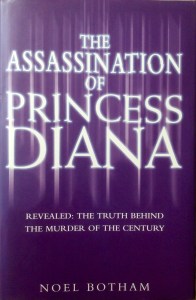
Many years ago I remember seeing a BBC documentary about the accident and it raised more questions than answers and so one day, in my favourite new Blackpool secondhand bookshop what did I spy but a book about Diana’s death. The Murder of Princess Diana by Noel Botham.
In the book the author alleges that Diana’s death was not an accident but was engineered by the British secret service. What happened then on the night of August 30th and the early morning of the 31st, 1997?
Diana was in Paris with her boyfriend Dodi al Fayed. The two of them were spending time together but had been hunted down mercilessly by the paparazzi, desperate for pictures of the couple. Diana felt that she was under constant surveillance and in fact British security services did monitor the phone calls of the Royals for supposedly ‘security’ purposes. Some years earlier, mobile phone recordings of Diana and one of her lovers had been revealed to the public in the so-called ‘Squidgy’ tapes. Ken Wharfe, Diana’s former bodyguard told a UK inquest in 2008 that the tapes had been recorded by GCHQ, the UK government’s secret listening station and deliberately leaked. They were apparently broadcast on a loop until an amateur radio ham picked up the messages and passed them to the media.
The princess’s friends suspected the “Squidgy” tapes were leaked to smear her at a time when her failing relationship with the Prince of Wales was at its most acrimonious. From then on, the Princess was very concerned with eavesdropping and hired private security consultants to sweep her apartments for bugs and listening devices.
August 30th around 4:30 p.m.: Diana and Dodi Fayed arrive at the Ritz Hotel in Paris, owned by Dodi’s father, Egyptian businessman Mohamed al Fayed. They enter through the back door and are shown to the Imperial Suite.
5:40 to 6:30 p.m.: Reportedly, Fayed ventures to Repossi jewellers and two rings are later delivered to the Imperial Suite. Perhaps they are gifts, perhaps Dodi is considering marriage.
Around 7 p.m.: Diana and al Fayed exit the Ritz through the rear entrance and are driven to his residence, near the Arc de Triomphe.
9:50 p.m.: The couple return to the hotel and head for its L’Espadon restaurant, after forgoing reservations at Benoît Paris because of continued paparazzi attention. Diana reportedly orders Dover sole, vegetable tempura and a mushroom and asparagus omelette. Dodi began to feel suspicious that photographers might be posing as restaurant patrons and requested their food be delivered to their room.
August 31st 12:20 a.m.: With bodyguard Trevor Rees-Jones, al Fayed and Diana reportedly attempt to evade photographers by leaving the hotel through its rear entrance to return to his apartment. They enter the backseat of a black Mercedes S280 to be driven by Ritz security employee Henri Paul.
12:23 a.m.: The Mercedes, in an attempt to outrun photographers, collides with a concrete pillar in the Pont de l’Alma tunnel. Bodyguard Trevor Rees-Jones was the only passenger in the Mercedes to be wearing a seatbelt. He was also the only one to survive the crash.
Fayed and Paul died at the scene. Following the accident, Dr. Frédéric Maillez who happened to be driving by, stopped and tended to Diana before the arrival of the emergency services.
In Noel Botham’s book, he notes that the paparazzi carried on photographing the scene while the doctor worked to save Diana; some even poked their lenses inside the smashed car. Finally help arrived and Diana was taken away in an ambulance.
Approximately 2:00 a.m.: Diana arrives at Pitié-Salpétrière Hospital, undergoing surgery minutes later.
4:00 a.m.: The princess, who celebrated her 36th birthday the previous month, is pronounced dead.
That then, was the timeline of events. It looked like a simple car crash especially when Police revealed that Henri Paul, the Ritz security man and Dodi’s driver that night was revealed to have had a blood alcohol level that was more than 3 times the legal limit. However, despite that he appears relaxed and normal on the Ritz CCTV images. Not only that, no one appeared to notice Henri as having been drunk or intoxicated. In the book, the author reveals that Henri’s autopsy indicated that he had a high reading for carbon monoxide in his blood which would have been totally incompatible with someone driving a car. According to tests carried out by two French medical experts hours after the Paris crash, the levels of carbon monoxide in Mr Paul’s blood ranged between 12 and 21 per cent. That compares to a normal reading of around two to four percent.
With that carbon monoxide level, Henri Paul would have been unconscious and totally unable to drive a car. There was however another death that night, a man who was depressed and took his own life by inhaling his car’s exhaust fumes. Could the blood sample have come from this unknown male the author asks?
Another factor was a Fiat Uno which was ahead of Diana’s Mercedes which according to the Police was untraceable. In fact the car was traced to a journalist with connections to the security services. The Fiat Uno blocked the Mercedes in the Alma Tunnel and Henri Paul swerved to the left to avoid it although his front wing clipped the Fiat.
Ahead of the Mercedes was a scooter with a pillion passenger and some reports claim that an incredibly bright light was flashed by the pillion passenger back towards the Mercedes which would have blinded the occupants and forced the driver to crash. This same scenario was featured in an MI6 file according to former agent Richard Tomlinson. Tomlinson had seen an MI6 secret plan to assassinate Slobodan Milosevic which used the exact scenario of the crash that led to Diana’s death. When Tomlinson tried to give this information to the magistrate in charge of the French inquiry into the incident, he was arrested at gun point by the DST, the French secret service, beaten up and interrogated for eighteen hours.
Police said they were unable to trace the Fiat Uno but Mohamed al Fayed claimed the owner was a journalist, James Andanson, with connections to the various security services. He had boasted to friends about inside knowledge of Diana’s death but he was found dead in 2000. He had driven to a remote spot and set himself and his car on fire, a gruesome way to commit suicide but that was the official verdict. A few weeks after his death an armed raid was carried out on the agency for which Andanson had worked. The only material and records removed were Andanson’s.
Ultimately, if we believe that Diana was deliberately murdered then we have to ask the question why? Who would want to murder Diana? What would be the point? To enable Charles to marry Camilla? In present day UK do the marriages of the Royals have any relevance anymore? After all, this is the 21st century and the days of royal murders and plots to change the succession are all part of history, ancient history.
Author Noel Botham claims that a certain element of the British secret service was used by a sinister hard core of palace watchdogs under oath to defend the royal family against scandals, whether that is the case I do not know but the author clearly believes that. Mohamed al Fayed has gone further, naming the Duke of Edinburgh as the author of the plot to kill Diana. Is al Fayed a grieving father making wild accusations or do his claims have some substance?
I have to say this book was an interesting read, not just the conjecture about assassinations but also the background to Charles and Diana and Camilla. The incredible love story, the blossoming of the princess, the failure of the Royal marriage, Diana’s efforts to outdo the Royals in revenge for Charles’ betrayal of her with Camilla. All in all, a fascinating read.
The Assassination of Princess Diana by Noel Botham.
Click here for a fascinating pdf file on the results of Operation Paget, the Metropolitan Police Investigation into the various conspiracy claims in 2004.
Steve Higgins is the author of Floating in Space, a novel set in Manchester, 1977. Click the links at the top of the page to buy or for more information.
I’ve just returned from yet another jaunt to France, a short one this time, six days in Liz’s motorhome, meandering around the Loire area, which we both love. One of our aims was to spend our nights ‘wild camping’, that is to say camping wherever we could without using commercial camping sites.
France is actually very motorhome friendly with many municipal sites providing free camping and toilet emptying facilities free of charge with optional charges for things like fresh water or electrical hook up and so on. We found a lovely spot by a lake, actually a plan d’eau, called Lac du Homme. In the summer when we visited it was a busy bustling place with a bar and restaurant and many spots for bathing and picnicking. The french take their picnics seriously and always bring huge hampers of food, always covering the many wooden and stone picnic tables with table cloths before opening up their bundles of cutlery, plates and food. At the Lac du Homme there were also quite a few areas with barbecue facilities dotted about, all that was needed were the hot coals and some steaks and burgers to cook.
Now in early October a last burst of summer had come and the restaurant and bar were boarded up for the winter. Most of the time we had the lake to ourselves, joined only by the few occasional visitors. The last two days were so hot we even ventured out onto the man-made beaches for a refreshing dip into the cold, very cold, waters.
One of the great things about being at this quiet lake was not only the quiet, calm and relaxing atmosphere but also the chance to read. I read a great deal but at home and at work I tend to read in short bursts, on my dinner breaks at work, in quiet moments in a morning or before I go to sleep. Holidays are when you can really get to grips with a book, really read it through without having to put the book down and go back into work. On this short break I finished off a book I was reading at work, ‘The Assassination of Princess Diana’ (more about that in an upcoming post) and started on one of the P G Wodehouse Jeeves and Wooster books. It was amusing and interesting and thoroughly English but it wasn’t quite my cup of tea.
One other book I read was one of last year’s reads, Meditations by Marcus Aurelius. Marcus was an emperor of Rome and when he was compelled to go out with his armies to do battle he spent many hours alone in his tent compiling a series of philosophic writings that became known as the Meditations. Marcus was concerned with the force of nature, the force that drives the universe and all its workings. Nature for him was probably more akin to God than what we understand nature to be but his thoughts and ideas are very moving, even more so as they were written prior to the year 180, nearly 2000 years ago. A lot of his thoughts are about life and death, simple things like a man who enjoys a long life and a man who experiences a short one both lose the same thing when they die. Death is a natural state he explains. Why fear it when everyone who has ever lived before us, has experienced it. To those of us who hunger for fame (potential authors perhaps) Marcus asks what is the point? One day you will die, one day those who remember you will die so one day your fame will vanish when no one remembers you. Time, says Marcus, is like a river, for as soon as something happens, the river of time carries it away, then some other event comes, also soon to be washed away.
In the opening of Annie Hall, one of Woody Allen’s most popular films, he talks about life in this way: “There’s an old joke, two elderly women are at a Catskill mountain resort, and one of ’em says, “Boy, the food at this place is really terrible.” The other one says, “Yeah, I know; and such small portions.” Well, that’s essentially how I feel about life – full of loneliness, and misery, and suffering, and unhappiness, and it’s all over much too quickly.” Woody Allen and Marcus Aurelius, both philosophers in their own ways.
I’ve spent a lovely couple of hours this week watching To Rome with Love, one of Woody Allen’s more recent films. Woody, if you have read one of my earlier posts about directors, is my all-time favourite director. I love his subtle observations about life and love, and his humour. What is a little sad lately, is that Woody’s image and persona have been challenged by his adopted daughter Dylan, who claims Woody assaulted her when she was young, 7, I think, and that he should be arrested and prosecuted. Woody stands by an investigation into the charges from 1975 that exonerated him but of course now, in the age of digital media, Dylan is able to go straight to the people with social media and put forward her case.
Someone who has defended Woody Allen is Moses Farrow, Woody and Mia’s adopted son. He has claimed in a blog post that his mother Mia was abusive and domineering and referring to the details of Dylan’s claims that there was no railway in the attic-supposedly where the attack took place- and that the attic was only a crawl space, not a place where father and daughter could play.
Many actors and actresses have come forward saying they will never work with Woody again and his reputation seems to sink lower every day and the body of work he has produced is now, by association, tainted. There is even a possibility that his latest film may not be released. I am a big fan of Woody Allen and although these revelations did not put me off watching ToRome with Love, it does set off a small alarm bell in the back of one’s mind. Did Woody do it? Did he molest the young Dylan? Well, two people know for sure: One is Dylan and the other is Woody. Woody claims Dylan’s claims were fabricated by Mia Farrow, his one-time partner and the mother of Dylan as part of a war of hate aimed at Woody because he became involved with another of Mia’s step daughters, Soon-Yi, and in fact, later married her. Mia, according to Woody, has brain washed Dylan with her abuse claims, so if that is true, then only Woody himself knows the truth. It seems to me that if Woody was an abuser then he would have abused other women and as no one else has come forward then that means Woody is innocent -doesn’t it?
Anyway, I don’t expect to see Jimmy Saville on old episodes of Top of the Pops, or Gary Glitter for that matter. Their actions and behaviour have airbrushed themselves out of history. Still, I will be very sad if they stop showing Woody’s films on TV.
Getting back to our trip to France, it was my birthday while we were away and it was nice to celebrate it in the sunny Loire valley instead of cold and rainy England. On our previous motorhome trip we had a lot of issues with mobile wi-fi which can be a bit of a pain when you have a blog deadline for Saturday morning. I wasn’t happy with Virgin media because my mobile data didn’t work in France, despite an expensive phone call to Virgin. Anyway, they sent me a new SIM card and I was happy to find that on this trip my mobile phone connected to the internet without problems. I even found that I could connect my iPad to my mobile and use my mobile internet on my pad, so much easier than writing a blog post on your phone. Of course I had written my last post about Comics and Superheros in advance and had it scheduled but even so, I always like to tinker with my posts right up to that last moment.
After we returned, Liz and I went to a birthday meal for Liz’s sister-in-law who has a similar birth date to me. One of the other guests, a young girl, asked me about my birthday and how old I was. I was reluctant to say but finally answered 62. “62?” She said, “I didn’t think you were that old!”
Maybe that’s a good thing, that I look younger than I actually am and in fact that comment was really a boost for my personal image but there’s no getting away from that figure of 62. Still, here is one last quote from Marcus;
When you arise in the morning, think of what a precious privilege it is to be alive – to breathe, to think, to enjoy, to love.
Floating in Space is a novel by Steve Higgins set in Manchester, 1977. Click the links at the top of the page to buy or for more information.
When I was a school kid which now I think of it, sometimes feels like years ago and other times feels like yesterday, I was a big, very big fan of comics. All my pocket-money went on comics and I would spend many a happy hour reading, lost in the world of comic book heroes. My Dad used to get me a copy of the Hotspur even though I knew it was really for him despite his denials. I read the Hotspur after I managed to prise it off him and a number of other comics like the Beano, The Tiger, TV Comic, TV 21 which was based on Gerry Anderson’s TV series and whole host of other comics, all of which have faded into the world of comic history. Looking round the newsagents these days you don’t seem to see comics any more. Perhaps today’s youngsters are too grown up, too enthralled with computer games and television. Still, I loved those old comics and still do and I tend to think they kick started my imagination and made me want to be a writer.
Another type of comic I used to buy were American comics which back then were split into two types, DC comics and Marvel comics. Superman and Batman were the stars of DC comics along with the Flash, Green Lantern and Wonder Woman. On the Marvel side were Spiderman, the X-men, the Hulk, Ironman and many others.
Every summer I used to beg my mother for the latest summer 80 page Giant, which was usually one of the DC comics. It consisted of 4 stories from an ordinary comic reprinted in one bumper edition. A great staple of the 80 page Giant was the superhero ‘origin’, the story of how that particular superhero began his life of crime busting and derring do.
Fast forward to the present day and those superhero characters have made the leap from comic book pages to the big movie screen, mainly with the help of modern-day computer generated effects.
Superman.
Superman, made in 1978, started off the movie superhero craze and starred Christopher Reeve as the Man of Steel. It was a movie made before the aforementioned CGI were even thought of. Many traditional techniques were used in the film such as back projection, miniatures and matte paintings. Wire riggings were used, suspended from cranes or the studio ceilings, to enable Christopher Reeve to fly as Superman.
Marlon Brando appeared as Superman’s father, Kal-El and many other major film stars added to the cast list and the budget. The shooting was constantly marred by cash flow issues but somehow the producers kept everything together and the film was released in December 1978 becoming a major financial hit, in fact the 6th highest grossing film of all time, despite a multi million dollar salary paid to Brando who appears in only part of the film.
Batman.
Batman hit the big screen in 1989 in a film directed by Tim Burton and starring Michael Keaton as the Caped Crusader. A series of films followed with various actors taking on the role of Batman. Burton’s film was a dark, serious version of Batman in some ways returning to the vision of Batman that the original authors, Bob Kane and Bill Finger had first presented in 1939 when the comic strip began. The film depicts Gotham City as an ugly and bleak city where crime is an every day hazard.
I’m not sure I’d put the Batman films down as my all time favourites. They are actually a little slow with outbursts of action and violence. The Batman film franchise, like all film franchises, has rebooted itself several times. In 2005 came the film Batman Begins, based upon a new comic book version called the Dark Knight. Batman Begins starred Christian Bale as Batman and the first time I saw it, I wasn’t impressed. It didn’t resonate with my 1960s comic book memories and it seemed to me to be a sort of Batman meets Kung Fu, the 1970’s TV series. One of my work colleagues told me recently it was his favourite film ever so I watched it again after a busy late shift at work and actually, perhaps it’s not such a bad film.
Thor.
Thor was another comic book hero that became a feature film. In the comic as I remember it, Thor is actually a doctor who finds Thor’s hammer disguised as a walking stick, and when he bashes the stick to the ground the good doctor is transformed into the God of Thunder. The movie version released in 2011 was actually rather boring. I only managed about 40 minutes of it before changing channel. The X-men movie suffered a similar fate at the hands of my remote control. I think I managed about 30 minutes before going channel hopping. I don’t remember Wolverine from the comic books either. Cyclops, the Beast and Professor Xavier were all part of the X-men comic book version that I used to read, as was Invisible Girl, although perhaps that was the Fantastic Four. I did get to the end of the movie version of the Fantastic Four though, although another failure was Iron Man.
The Hulk.
Bruce Banner was a scientist who is accidentally exposed to gamma rays and finds that when he gets angry he morphs into a huge green-skinned mutant with incredible strength. There was a TV series made in the 1980s and a catchphrase of Bruce Banner’s, played by Bill Bixby was, ‘you won’t like me when I’m angry!’
In the 2003 film Erica Bana plays Banner and the Hulk is a creation of computer technology. I wasn’t crazy about the film, in fact the computer imaging looked more like a cartoon than CGI effects. The Hulk franchise was rebooted again in 2008 as The Incredible Hulk, this time Edward Norton playing Bruce Banner. In this film Banner is on the run from the American miliary and trying to cure himself of the effects of the gamma rays that transform him into the Hulk. The military however, want to use the gamma ray effect to create a ‘super soldier’ so they are intent on tracking Banner down. The film connected with the comics I used to read much more than some other superhero films and I enjoyed the film very much. The CGI effects were a big improvement on the earlier Hulk film too.
Spiderman.
One of my absolute comic book superhero favourites was Spiderman. The great thing about the 60s comic book version was that it wasn’t all about Spiderman. A lot of the appeal of Spiderman was the story of Peter Parker, the nerdy student who has a crush on red head Mary Jane Watson.
Peter gets bitten by a radioactive spider which gives him incredible spider powers: strength, agility and in the comics Peter develops this incredible synthetic web which he can shoot from his wrist, spin a web and swing from skyscraper to skyscraper across New York City. In 2002 the amazing Spiderman hit the big screen in a film directed by Sam Raimi and starring Toby McGuire as Spiderman. James Franco appeared as Peter’s fellow student but had I been casting the film, I think I might have been tempted to have Franco play Peter Parker. I thought that perhaps Toby McGuire was a little too wimpy!
Oh well, maybe I should stick to the comic books or even the old TV cartoon series. I did love that theme song . .
What to do next: Here are a few options.
Share this post on your favourite social media!
Hit the Subscribe button. Never miss another post!
Looking back at some of my previous posts I see that back in April I was waxing lyrical about the onset of spring, the lengthening of the days and how nice it was to finish a night shift and find myself greeted by daylight as I left my workplace.
This week I was back on the night shift again but as I climbed into my car I had to crank up the heater for the first time in many months. I always think that September going into October is a sad time of the year. The days get shorter, the weather is colder and it is time to start wearing my fleece to work.
Being back home after three weeks in France is frankly, something of a let-down. The washer is humming away cleaning our holiday gear. I’m thinking about where I can put all that unnecessary stuff I bought at the brocantes and vide greniers we visited. The prospect of returning to work is no longer looming on the horizon, the moment is actually here. There was a time, I remember sadly, when I actually loved my job and looked forward to going back to work. Alas, those days are gone.
My car, my trusty Renault Megane convertible is a veritable hive of CDs. The glove compartment is full of them as are the pockets in the driver and passenger doors. Down in the passenger footwell there is a box of CDs which is interchangeable with one in the boot. When I get fed up with the selection I swap them round and the box I am tired of goes in the boot and the other one comes into the front. When I am tired of both boxes, I take them back home and make up a new selection.
Today, going back into work I had a good search through them for something new to listen to. Radio adverts are just not on my agenda. TV adverts, OK I can live with them, you can pop into the kitchen and make a cup of tea, yes, OK but radio ads: Not on my watch as they say. Anyway, the CD I decided to listen to was an album of songs from the TV show Ally McBeal, mostly by Vonda Shepard but with a sprinkling of guest singers. Ally McBeal was a comedy drama that aired back in the nineties and it’s surprising that it hasn’t turned up on some random Freeview TV channel yet. Ally McBeal played by Calista Flockhart was a Boston Lawyer and the show focussed on the antics of Ally and her colleagues not only in the courtroom but also in the local bar, which is where the music comes in. There were a heck of a lot of songs sung in that bar.
Music played a major part in the show and Vonda Shepard covered some classic pop tunes all slotted in carefully with lyrics that corresponded to the storyline of the show. One of my absolute favourites was Vonda’s cover of Gilbert O’Sullivan’s ‘Alone Again (Naturally)’ a hit single for O’Sullivan from 1972.
Gilbert O’Sullivan featured regularly in the music charts until the 1980’s when he began a legal battle with his music publisher Dick James regarding royalties and the ensuing legal contest stopped him from releasing his music.
In Ally McBeal, John Cage and Richard Fish were the co-owners of the law firm where Ally works. Cage was an oddball attorney nicknamed ‘the biscuit’. I loved his odd ways, his ‘taking a moment’, his antics in the communal toilet area and his invocation of the spirit of Barry White when he needed a confidence boost. Richard Fish was another oddball lawyer and also part of the firm was Billy, Ally’s former boyfriend and his new wife Georgia. Legal cases were up there in the foreground, actually the background and in the background, actually the foreground, if you see what I mean, were the loves and lives of the cast.
One thing that was important on returning home from holiday was checking the hard drive on my TV recorder and finding out just what was lurking there. What had recorded and what had failed.
There was of course three weeks of our favourite soap, Coronation Street lying in wait so we decided to have a duvet day, actually two duvet days of non-stop soap action. In some ways Corrie is best watched just like that. Fast forward through the adverts and no waiting between Friday night’s cliff hanger episode and the Monday night follow-up.
Some things seem to sort of leap out when you watch a soap in that fashion. One storyline involved Sean Tully, one of the Street’s gay characters. Sean packed his job in at the local factory in favour of a new job and new flat in the city centre. It turned out though that his job had fallen through, then he returned to live with friends who had to give him notice due to some new arrangements. Then it was revealed Sean had lost his job and now was actually homeless. Sean endured a few weeks of living rough in a tent and trying to conceal the shame of his new position from friends but suddenly, the way it is in soaps, his old friend Billy offered him a room at his house, he got his old job back and hey presto, all is well again.
It was nice that the soap tried to show a little of what life is like for the homeless but couldn’t they have carried the storyline on a little longer, like things are in, you know, real life?
Then again there was the storyline when poor old Rita started losing her memory and was diagnosed with dementia. Luckily there was that quick lifesaving operation and Rita’s brain power and memory were restored just like it never happens in real life. And there was the one about young Simon who had become violent towards his mother. Luckily, he quickly grew out of that phase. Oh well, that’s soaps for you.
Also there on my hard drive were two formula one Grands Prix. The Belgian Grand Prix from the impressive and historic Spa Francorchamps and the Italian race from the equally historic Monza. There was a time too when I would have hungered to watch those races. As it is, Formula One still has its moments and I do still love the sport but not like the days when I bought a shed load of racing magazines every week and hungered for every snippet of racing information I could find.
While in France I subscribed to Radio Five Live’s F1 podcasts. Now the podcasts are not quite what I had thought they were going to be. I thought they might be an audio version of the race highlights with the commentators breathlessly describing the race track action in the way Murray Walker used to do in the old days. (Murray, for those of you who have never heard of him, was a BBC commentator who was once described as a man who talks like his trousers are on fire -in his quieter moments!)
No, the podcasts were not like that. They start off, unlike the TV highlights show on Channel 4, by telling you the results, and just how they came about. Then there are 30 to 50 minutes of driver interviews and endless discussion about what happened, why it happened and why didn’t something that didn’t happen, not happen. Yes, interesting but maybe the production team assumed we listeners had watched the race on TV. Actually we hadn’t, or at least I hadn’t, which is why I was listening to the podcast in the first place.
There were some exciting elements to those races, Hamilton and Vettel colliding at the first corner at Monza and Hamilton hunting down Raikkonen’s Ferrari and just pipping him for the win. Still, watching those races a few weeks after they had happened just wasn’t my cup of tea.
Anyway, soon it was time to go back to work but before that we sat down one evening after our tea looking for something to watch. Nothing was on TV (naturally) so once again I scanned through the hard drive and came across a film I had recorded about Eddie the Eagle.
In 1988, Eddie became the first skier to represent Britain in Olympic Ski jumping since 1928. The film describes Eddie’s life as an Olympic obsessed youngster and his progression to ski jumper. He self-trains in Germany where the seasoned skiers belittle him. However by grit and determination, Eddie qualifies for the Olympics in Calgary despite resistance by the Olympic team for his amateur and uncouth appearance. Eddie turns the tables on everyone by his determination and humour and in fact becomes the star of the Olympics, feted by the world’s press.
The film is an enjoyable and affectionate portrait. I’m not sure just how accurate or true it is but I enjoyed every minute of it and if I had been there at the Olympics, I would have been cheering for Eddie myself.
Well, that first night shift was hard. Not actually hard in itself just hard to endure, sitting there wishing I was back in my rented villa tapping away on my laptop trying to finish a new blog post so that I could hurry out for a dip in the pool, after decanting some vin rouge to breathe, of course.
When I finished at 6 am it was still dark and rather cold. As I pulled away from the car park I turned up the heat and switched on the CD player. Vonda Shepard was singing another of my favourite songs, a cover of the Dusty Springfield’s hit, I Only Want to be With You . .
Floating in Space is a novel by Steve Higgins set in Manchester, 1977. Click the links at the top of the page to buy or for more information.
Travelling to the Loire Valley region of France this summer I brought four cameras with me. My trusty Nikon D100 SLR was left behind in favour of my Action cam, my GoPro Hero+, my Canon G7X and my always reliable Panasonic HD pocket camcorder. The Canon comes highly recommended as the top vlogging camera of its kind. If you want to look good on YouTube, this is the camera to have, and when I bought it after many moons of trying on eBay I was looking forward to branching out from merely writing about stuff to actually talking and showing you stuff too. My action cam I’ve had for a while but it’s really just a cheap copy of a GoPro camera and the thing is when you have a cheap copy, you tend to want the original. The only thing is, working with GoPro cameras isn’t that easy.
The first thing I noticed about my GoPro Hero+ is that there is no viewing screen so it’s not so easy to set up a shot. However, you can link the camera to your mobile and get a visual confirmation of your shot. Okay, skim back to the manual and I see I have to enable wi-fi. Nothing happened so back to the instructions and then I see I need the wi-fi app. Okay, download that and am I getting anywhere? No. Have I set up a password? No, okay, I sort the password out and finally, we are getting somewhere, can I shoot some video? Yes! Have I brought my mini memory card adapter to transfer video to my laptop? Er, actually, no. Can I do it by wi-fi? Yes, to my phone but I don’t want the stuff there I want it on my laptop. So, I have to download the GoPro pc application. Does it finally work? Yes. Am I bothered? No, cos I’m hot and stressed and I’m off to the pool!
Since then I’ve had a radical rethink and perhaps the age-old written word is more my style after all.
Why the change of heart you may ask. Well, there is not only the hassle of dealing with modern technology as I’ve mentioned above, there is also this. I am getting on a little, in fact not so very long ago I hit the big six O which was quite a turning point for me. The big four O didn’t make much of an impression. The big five O, well there was something, some feeling of me getting on a little but nothing too bad but then along came the six O and there was a feeling of, six O, really? Am I actually that old? The thing is, aging only really happens on the outside. On the inside a guy is pretty much the same guy he has always been. Inside, I don’t think I’ve really changed since I was, well, eighteen, nineteen or maybe twenty. My thinking has always been the same, I’ve matured a little, become a little more sensible (a little) but generally speaking I’m just the same, so how has this sixty thing just crept up on me?
The answer is I don’t really know. I’ve just been chugging along, getting on with my life and suddenly I’m sixty. I have to say I’m not too happy about it and perhaps I should look into making a complaint. The council comes to mind or the government. Perhaps they should have sent me a letter or something. Perhaps they should have picked up the phone and said hello, Steve, do you know what year it is? Maybe it’s time to take it easy, chill out a little or something of that nature.
Come to think of it, I did get a letter -from the civil service offering me semi-retirement- which is why I now only work three days a week. To think, they knew I was getting older but I never twigged!
Anyway, getting back to my cameras, I started off by shooting some background stuff here at our rented gite in the Loire; you know our villa, the pool and so on. While I was messing about and getting used to my New GoPro camera I shot some stuff of me checking out the villa, the pool and the grounds. Then I tried some shots of me typing away on my laptop, knocking out my latest post. I figured I could put a good narration together from some of my old ‘Sun Lounger Thoughts’ blogs or perhaps talk about being a blogger or a self-published author at work, that sort of thing.
One evening after the usual day of swimming, sunbathing, reading and drinking wine, you know, the average sort of holiday day, I thought I might as well review some of that stuff, that video that I’ve been shooting. The big shock was really, who is that old guy in the video who resembles my old Dad? Do we have a serious problem with lenses or filters or can that old overweight guy really be me?
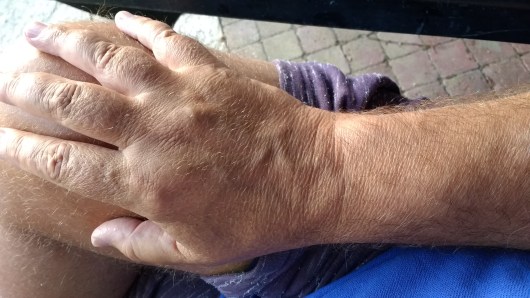
Taking a serious look at myself even my hands look big. Did I say my hands? Just taking another look at those hands and I realised they were my old Dad’s hands, only bigger and chubbier than his ever were. No wonder I’m always pressing the wrong key on my mobile phone with those big chubby mitts!
We find only one tool, neither created nor invented, but perfect: the hand of man.” ― Julio Ramón Ribeyro
The other day in a cafe in the village of Parçay Le Pins, Liz took this picture of me sitting at our table having just eaten fish and chips and supping a pint of lager.
The picture isn’t a bad one. Ok I’m not as young as I used to be but I look reasonably well, I suppose, although I’m clearly not the cool dude in that graphic at the top of the page!
The thing is in a still picture you can put on your winning smile, (not exactly winning in this picture but you know what I mean) turn your best side to the camera, hold in your tummy and all will be ok but with video, things can be a little more revealing.
So, I think I might just put my vlogging plans on hold for a while, just a little while, well perhaps indefinitely. My next video will probably feature me but probably on the narration rather than the visuals . .
Steve Higgins is the author of Floating in Space, a novel set in Manchester, 1977. Click the links at the top of the page to buy or for more information.
Eagle-eyed readers will have surely spotted the lack of the usual video version to my summer book bag 2018. Alas, I filmed three versions, all of which suffered from hesitation, repetition and deviation, so much so that not only would I not have lasted long on the radio show ‘Just a Minute’ but any addition to YouTube would be sorely lacking, particularly in the area of presentation.
However, due to the miracle of technology, particularly in the field of editing, a fairly reasonable video version has been made available for my long-suffering YouTube audience and I feel it only fair that they should not suffer alone and that my WordPress followers should also be invited to watch.
If any viewer is unduly affected by this video, a free counselling service is available. Please contact your local healthcare provider immediately should any adverse symptoms occur.
 The BBC does do a good documentary and the other day I settled down to watch a documentary about the film star Cary Grant; Becoming Cary Grant.
 The nights are growing shorter and the weather is cooling rapidly. In fact, the U.K. Is heading for a three-week freeze according to the latest weather report and Liz and I have lit our first coal fire since those long departed days of winter.
 I’ve been interested in the
  I’ve just returned from yet another jaunt to France, a short one this time, six days in Liz’s motorhome, meandering around the Loire area, which we both love. One of our aims was to spend our nights ‘wild camping’, that is to say camping wherever we could without using commercial camping sites.
 When I was a school kid which now I think of it, sometimes feels like years ago and other times feels like yesterday, I was a big, very big fan of comics. All my pocket-money went on comics and I would spend many a happy hour reading, lost in the world of comic book heroes. My Dad used to get me a copy of the Hotspur even though I knew it was really for him despite his denials. I read the Hotspur after I managed to prise it off him and a number of other comics like the Beano, The Tiger, TV Comic, TV 21 which was based on Gerry Anderson’s TV series and whole host of other comics, all of which have faded into the world of comic history. Looking round the newsagents these days you don’t seem to see comics any more. Perhaps today’s youngsters are too grown up, too enthralled with computer games and television. Still, I loved those old comics and still do and I tend to think they kick started my imagination and made me want to be a writer.
 Looking back at some of my previous posts I see that back in April I was waxing lyrical about the onset of spring, the lengthening of the days and how nice it was to finish a night shift and find myself greeted by daylight as I left my workplace.
 The picture isn’t a bad one. Ok I’m not as young as I used to be but I look reasonably well, I suppose, although I’m clearly not the cool dude in that graphic at the top of the page!
 Letters from an Unknown Author!