I started this post by looking at an old one, a post about famous Pilots. That inspired me to make a sort of seagoing version. I started thinking about famous captains but I was struggling to think of any so I went with famous ships. Perhaps I could have stuck with captains after all; Captain Kirk, Captain Ahab, Captain and the Tenille and so on. Oh well, I think I’ll save that for another time so here we go with famous ships.
Victory
I should think that almost everyone reading this will know that HMS Victory was Nelson’s flagship at the battle of Trafalgar. The ship was one of 12 that had been ordered by the British government in 1758. The hull was laid down in 1759 and finally launched in 1765. 6,000 trees were used in the construction and 6 foot copper bolts were used to hold the construction together as well as treenails or dowels used to secure lesser elements of the ship. Once the frame was completed it was usual to let the wood dry out or ‘season’ before fitting the ship out further. Due to the end of the Seven Years’ War, the hull was left to dry for three years and the ship was finally launched in May of 1765.
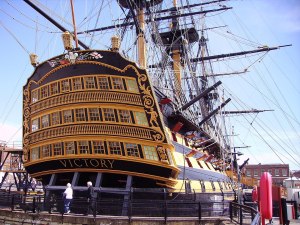
By Ballista – Own work, CC BY-SA 3.0, https://commons.wikimedia.org/w/index.php?curid=749934
The ship had various adventures with the Royal Navy before becoming Admiral Nelson’s flagship in the battle of Trafalgar.
On the 21st of October, 1805, the Victory and the British Fleet began battle with the French. The British ultimately won but a sniper on the French ship Redoutable fired at Nelson hitting him with a musket ball which fatally wounded him. The musket ball was later recovered by the Victory’s surgeon William Beatty and he later had it mounted into a locket which he wore for the rest of his life. On Beatty’s death, the locket was presented to Queen Victoria.
The Victory was badly damaged in the battle and had to be towed back to England. It was repaired but was no longer a first rate ship and was relegated to various duties, even becoming a prison ship at one point. The Admiralty decided to break up the Victory and use her timbers and fittings in other ships. The public outcry was so great that the Admiralty hesitated to go ahead.
To a great extent the ship was abandoned to rot away and in 1922, the ship was found to be in such a state of disrepair that it was moved into a dry dock at Portsmouth, actually dock no 2, the oldest dry dock in the world. Restoration began after an appeal to the public for funding and dock number 2 became the Victory’s permanent home.
Bismarck
Bismarck was the first of two battleships built for Nazi Germany’s navy. Named after Chancellor Otto von Bismarck, the ship was laid down at shipyards in Hamburg in July 1936 and launched in February 1939. Final construction work was completed in August 1940, when she was commissioned into the German fleet. Bismarck and her sister ship Tirpitz were the largest battleships ever built by Germany.
In May 1941 the Bismarck planned to enter the shipping lanes of the Atlantic and attack convoys bringing much needed supplies into Britain. The Bismarck in company with the Prinz Eugen was engaged by the HMS Hood and the Prince of Wales. The Hood was destroyed in the battle while the Prince of Wales was badly damaged and forced to retreat.
The British began a relentless pursuit of the German vessel and two days later she was severely damaged by torpedoes fired by aircraft from the HMS Ark Royal. The rudder had been damaged on the Bismarck and the ship was forced to steam in a wide circle. The battleship came under further attack from the British ships and a major hit on the Bismarck’s bridge killed or disabled Captain Lindemann and Admiral Günther Lütjens. The remaining executive officer ordered the crew to abandon and scuttle the Bismarck in order to prevent the British capturing and boarding the vessel which eventually capsized and sunk.
The entire episode was made into a film in 1960 called Sink the Bismarck. Kenneth More starred as the head of the underground naval operations war room and he and his staff coordinate the hunt for the Bismarck.
Bounty
Another famous seagoing story that has been made into a feature film, several films in fact, is the story of the mutiny on the Bounty. The mutiny occurred in April 1789 and was led by Fletcher Christian who was an acting Lieutenant on board the Bounty. The Bounty’s mission was to sail to Tahiti and collect breadfruits and then deliver them to the West Indies. It may have been that a five month layover on Tahiti, where many of the men formed relationships with the native women, was at the heart of the mutiny. William Bligh, the captain of the Bounty, had at one point been a great admirer of Fletcher Christian, even promoting him to the rank of acting second lieutenant and thereby becoming his second in command. The relationship soured later though and when the ship began the journey home Christian decided to stage a mutiny. Bligh and his supporters were made to leave the ship on the Bounty’s launch, a 23 foot boat and were given food and water for 5 days. Bligh sailed to a nearby island for supplies and then made an astonishing journey in the small boat to Timor where the authorities were alerted to the mutiny.
The mutineers fled in the Bounty and returned to Tahiti but Christian realised that this would be the first place the navy would come to search for them. Sixteen crew members opted to stay on Tahiti, Christian and the rest of the mutineers together with a contingent of Tahitans then tried to settle on another island but the natives there were unfriendly and the Bounty left in search of another island. The mutineers then came across Pitcairn Island and seeing that it was marked incorrectly on naval charts decided to settle there. Numerous disagreements arose later with the Tahitans as many of the British considered them as slaves. Fletcher Christian was later murdered on the island although he was survived by a son and other children.
Today, the descendants of the mutineers still live on the island.
Various film versions of the story were made but the most famous featured Clark Gable as Fletcher Christian and Charles Laughton as Captain Bligh. In the 1960’s a version was made with Marlon Brando and Trevor Howard. Brando was so taken with Tahiti where numerous scenes were shot, he made it his home for many years. Another version, The Bounty appeared in 1984. It was a project originally started by director David Lean and writer Robert Bolt but after various disagreements with the producer, Lean backed out and the New Zealand director Roger Donaldson took over.
Titanic
The story of the Titanic is one that has captured the imagination of many over the years and even today seems to be still in the news after a deep diving mini submersible was crushed in the depths of the ocean while taking sightseers to view the wreck of the great ship.
The ship was the largest afloat and was designed to be the epitome of luxury. It was known as the ‘unsinkable’ ship and made its maiden voyage in 1912 from Southampton to New York in the USA. On the voyage the ship struck an iceberg and the hull was ruptured. The Titanic sank with a great loss of life. A major flaw however was that there were not enough lifeboats for the crew and passengers in the event of a tragedy. Another was that the 16 watertight compartments were not truly watertight and when the first one filled with water, the water then spilled over into the next one and so on until the ship sunk.
Numerous films and TV shows have been made about the sinking. Kenneth More starred in A Night To Remember, a 1958 British film about the Titanic. In the 1960’s the first episode of the time travel TV show The Time Tunnel featured a story about two American scientists who are transported back in time and arrive on board the doomed ship. A more recent film blockbuster was the 1997 Titanic directed by James Cameron. Leonardo DiCaprio and Kate Winslet star in the film that weaves a tragic love story with the fate of the famous ship. Titanic was the most expensive film ever made at the time with a budget of 200 million dollars. A huge reconstruction of the ship was made in Rosarito, Mexico and was built on a lifting platform which was able to tip the ship to simulate the sinking. The film was a great success winning 11 Oscars including one for Best Picture.
Personally I rather like Raise The Titanic, a 1980 British film version produced by Lew Grade and his ITC Entertainment company and based on the novel by Clive Cussler


 I was watching television today, one of my usual pastimes and I settled down to watch the old 60’s TV show

 The atom bomb had been created by the top-secret Manhattan project based in Los Alamos headed by Robert Oppenheimer. Two types of bomb had been devised, one code named Little Boy and another more complicated but also more powerful design, Fat Boy. Colonel Paul Tibbets of the US Air Force was tasked to put together a combat group able to deliver the bombs to their targets on the Japanese mainland. The 509th Composite Group was created in December 1944 and the group began training with specialist bombardiers to drop the bombs.
 Khrushchev was the first Soviet leader who tried to humanise the Soviet Union. This huge monolithic state that represented tyranny and state control had been created by Stalin and though Stalin himself brought Khrushchev into his inner circle, it was Khrushchev who later rejected the brutality of the Soviet State.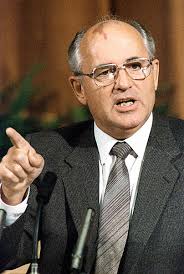
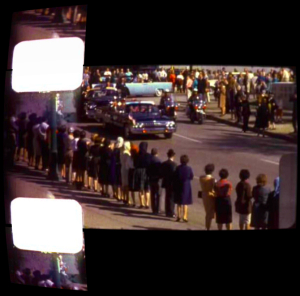
 I have a lot of memories of childhood, like everyone I suppose but a lot of those memories, certainly my earlier ones, I would be hard pushed to link them to a certain date or time. The first memories in which I can actually do that are those from 1968. Surprisingly for someone who has never even visited the USA, a lot of my 1968 memories concern, yes, the USA. Lyndon Johnson was the President of the USA in 1968. He had inherited the presidency from John F Kennedy on that fateful day in Dallas in 1963 when Kennedy was cut down by an assassin’s bullet. He won the election in his own right in 1964 easily beating Republican opponent Barry Goldwater.
 The President in Washington sends word that he wishes to buy our land. But how can you buy or sell the sky? The land? The idea is strange to us. If we do not own the freshness of the air and the sparkle of the water, how can you buy them?
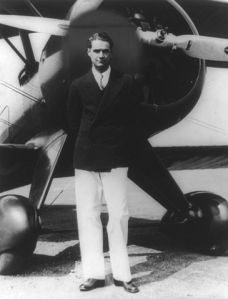 For one man though, sitting alone in a Nevada hotel suite, sealed off from the world by his Mormon minders, the death of Bobby Kennedy was an opportunity. The elderly Hughes, lying naked on a bed watching TV, his hair, long and unkempt and his finger and toenails uncut, was a far cry from the young film maker, aviator, and entrepreneur he had once been. Immediately he wrote a memo to his chief executive and public alter ego, Robert Maheu. He said basically that now Kennedy was lying dead or dying on the pantry floor of a California hotel this was a once in a lifetime opportunity to put on the payroll the entire Kennedy election team, in particular electoral strategist Larry O’Brien. O’Brien had served under Presidents Kennedy and Johnson and would later become chairman of the Democratic National Convention. Not a thought for the dying Kennedy, just the opportunity to get hold of a ready-made election team and put his own man in the white house. At the time Hughes had the idea of promoting Governor Laxalt of Nevada for the job. Fantastic as it may seem the genesis of what would become Watergate lay in Hughes actions on that night.

