Remembering Cary Grant

I’ve been a fan of Cary Grant for a very long time. I love his smooth and debonair style, his handsome and tanned good looks and that rather languid transatlantic brogue of his.

In the TV series Archie currently streaming on ITV X they seem to be saying that all of that was an invention, an invention by an Englishman called Archie Leach who transformed himself into a successful Hollywood film star named Cary Grant.

Grant was born Archibald Leach in Bristol, England in 1904. He had a poor upbringing and his mother suffered from depression and his father was an alcoholic. The young Archie was interested in the theatre and performing and his mother was keen on him having piano lessons. His older brother had died before reaching the age of one and this perhaps made his mother a little over protective of the young Archie. Even so, his mother was not a woman who was able to give or receive love easily and the older Cary Grant blamed his childhood relationship with his mother for his problems with women in later life.

When Archie was 9 years old his father placed his mother in Glenside Hospital, a mental institution, telling his son that she had gone away on a long holiday and later, that she had died.

Archie befriended a group of acrobatic dancers known as The Penders and he was able to eventually join them and there he trained as a stilt walker and became part of their act. Later the group toured America and Archie decided to stay, following in the footsteps of others before him like Charlie Chaplin and Stan Laurel who had made their way to the USA in an almost identical way.

On Wikipedia they mention that on the trip over to the USA Archie met Douglas Fairbanks and was greatly impressed by him, so much so that Fairbanks became a role model for the young Archie Leach.

In New York Archie worked in vaudeville with various comedy and theatrical groups. He joined the William Morris theatrical agency and began to pick up many theatre roles. In 1932 he had his first screen test and was given a five year contract with Paramount Pictures. B P Schulberg the general manager of Paramount decided that Archie Leach was not a good enough name for films so Archie came up with the name Cary Grant taking Cary from a stage character he had played and Grant chosen randomly from a telephone directory.

Cary Grant worked hard at his profession and in the TV series Archie they claim that Cary was a role or a part that Archie built up over time. Jason Isaacs who plays Grant says Cary would never be filmed or recorded during an interview because then he was being himself not playing at being Cary. The actor tracked down a recording of Grant made secretly by a student journalist who interviewed Cary over the phone and felt that for the first time he was hearing the real Archie who came over in the recording as very English rather than the usual mid Atlantic voice that we are used to hearing.

It seems to me that many stars who use a different name in the film world are in a way creating a character which they present to the public. You could argue that Marilyn Monroe was a similar personality and that she was a creation of Norma Jeane in the way that Cary Grant was created by Archie Leach.

A breakthrough role for Grant was starring with Mae West in the film She Done Him Wrong and the follow up, I’m No Angel. Grant went on to star in many famous films and amazingly, even though he was a star in Hollywood’s golden years, he was actually the first big star to not be a part of the studio system. He was a freelance actor, not contracted to any studio until 1937 when he signed a four-picture deal with Columbia.

In his early years in Hollywood, Grant shared a house with actor Randolph Scott leading to claims of the two being gay lovers. Still, young bachelors sharing a house with others is not uncommon. David Niven famously shared a house with Errol Flynn and we can hardly class those two as being gay.

Somewhere in my fairly huge book collection I have a biography of Cary Grant but despite an intensive search I couldn’t find it. I also have a copy of David Niven’s Bring on the Empty Horses which if I remember correctly has a short chapter on Grant. Now where did I put that book?
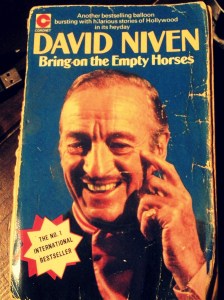
I did do some quite considerable research to produce this blog post. Firstly, I had to watch the four episodes of the TV series Archie, currently streaming on ITV X. That wasn’t anything difficult of course, it wasn’t a chore, in fact it was very enjoyable. Archie is a wonderful four part series and Jason Isaacs plays an outstanding part. He doesn’t try to impersonate Cary but he did manage to create a look of the late star and he caught Grant’s voice and enunciation perfectly. Most of the series follows Cary in later life when he becomes involved with and later marries Dyan Cannon, Dyan was his fourth wife and she was the mother of his only child Jennifer and she and her mother co-produced the series which is definitely well worth watching.

Next, I searched for the biography I had of Cary but despite searching the entire house I couldn’t find it. Oh well, I have a few copies of Bring on The Empty Horses about the house so I thought ok, I’ll grab that and have a read of the chapter on Cary. Once again, I searched through the entire house but could I find that book? No! Eventually I started to put everything back where I had found it and it was only after idly looking in a box of books that I had only recently packed away and had earlier dismissed, that I finally found it.

Anyway, I had a break from writing to look for that book and after a while when I couldn’t find it I popped the TV on. I wasn’t altogether surprised to find there was a Cary Grant film showing. It was An Affair to Remember, a love story in which Grant’s character, a playboy type meets Deborah Kerr on a transatlantic voyage and the two fall for each other. On arrival in the USA they decide to have a 6 month break from each other as they are both in other relationships and then meet at the top of the Empire State building in New York. It’s not really my cup of tea, in fact it’s overtly sentimental but then, sometimes a small dose of sentimentality is good for you. Cary Grant plays, well, Cary Grant and Deborah Kerr plays a very English New Yorker.

I have two of Grant’s other films on DVD, To Catch a Thief and North by Northwest, both directed by Cary’s favourite director, Alfred Hitchcock.

OK, enough TV watching for now. Getting back to Bring on the Empty Horses, David Niven wrote about Cary Grant in a short section of his book called Long Shots and Close Ups where he gives his readers a quick sketch about various film people. The section on Cary is only three and a half pages and not the full chapter I was expecting but Niven clearly liked the man and in those three and a bit pages, picked up on some essential elements of Grant’s character. Niven remembers Cary Grant as an intelligent man, particularly with money and he listed people like multi millionaire Howard Hughes among his friends. Grant invested his earnings well and became one of the richest people in Hollywood. He had an obsession with his health, embarking on various health pursuits and then moving on to the next one. Niven remarks that once when Cary was taking swimming lessons to learn the crawl, Niven mentioned that Cary could already swim the crawl. Grant answered ‘yes but I want to swim the crawl perfectly!’ Cary gave up smoking by hypnotising himself and Niven also mentions his use of LSD during his treatment by a psychiatrist which is also brought up in Archie.

Cary Grant retired from films in 1966 the year his daughter was born and he and Dyan Cannon divorced in 1968. Many tried to bring him out of retirement for various films including his favourite director Alfred Hitchcock but he declined. He must have wanted to keep on working though because he did accept a position on the board of Fabergé.

He died in 1986 aged 82 and left behind an estate reputedly worth around 80 million dollars. Archie is a well made and quite fascinating piece of TV. Look out for it, it’s well worth watching.


What to do next: Here are a few options.

Share this post on your favourite social media!

Hit the Subscribe button. Never miss another post!

Listen to my podcast Click here.

Buy the book! Click here to purchase my new poetry anthology.

Click here to visit Amazon and download Floating in Space to your Kindle or order the paperback version.

The TV Shows of Gerry Anderson

Many years ago when I was still at junior school, one of my friends asked me if I had seen a new TV show about a flying car. I hadn’t but apparently it was really good and so I made a mental note to watch out for it. As a child I was pretty keen on TV. My dad used to call me ‘square eyes’ because I watched so much TV and as you might imagine I soon found the TV show my friend had told me about. It was a short puppet show about a special machine called Supercar that could not only fly but also dive under the sea. It was designed and built by Professor Popkiss and Dr Beaker and the test pilot was a guy called Mike Mercury. I loved Supercar and everything about it and even though I didn’t realise it then, I had become a huge fan of TV producer Gerry Anderson and his Century 21 Productions.

Gerry Anderson was born in 1929 and after the war earned a traineeship with the British Colonial Film Unit. Later he worked for Gainsborough Pictures and had various jobs, subsequently as a director. He and cameraman Arthur Provis formed a production company called AP Films after their two names and began producing TV shows for children. Their first project was in 1957 called The Adventures of Twizzle and was the first time Gerry worked with puppeteer Christine Glanville, musician Barry Gray and special effects supervisor Derek Meddings.

They followed up with more puppet shows, Torchy the Battery Boy and the first series I remember, Four Feather Falls, a cowboy show about a sheriff with magic guns.

Anderson married his wife Sylvia in 1960 and the two collaborated on Supercar, Gerry’s first sci-fi puppet show in 1960. The series marked the first time Gerry used the name Supermarionation to describe the process which enabled the puppet mouths to move in synchronisation with pre-recorded dialogue. All the characters in the shows had American accents so the shows could be sold to the USA and it was Sylvia who was responsible for the characters and their fashions while Gerry concentrated on other aspects of the shows.

The next series was Fireball XL5 about a spacecraft that was part of the World Space Patrol piloted by Steve Zodiac. The following show, Stingray was the first to be filmed in colour. Stingray was a submarine in the service of the WASP, the World Aquanaut Security Patrol and was piloted by Troy Tempest and his colleague ‘Phones’ who was a master at using sonar equipment. The duo discover an undersea kingdom where King Titan holds sway over his people, the Aquaphibians. Troy and Phones rescue the mute undersea girl Marina who joins them onboard Stingray. Most of the characters had sea related names like, Marina, Commander Sam Shore and his daughter, Atlanta. Atlanta was voiced by Lois Maxwell who played the original Miss Moneypenny in the James Bond films.

Stingray was probably my favourite of Anderson’s TV shows. I particularly loved the opening sequence in which Commander Shore exclaims ‘Anything can happen in the next half hour!’

Stingray was filmed in 1964 and the show fitted neatly into the expanding Anderson universe set, like all his sci-fi shows, 100 years into the future. Around this time AP Films developed a merchandising company responsible for licensing all kinds of items related to the shows, things like models and puppets and so on. I used to have a puppet of Venus, the space doctor from Fireball XL5 although I think I would have preferred a Steve Zodiac puppet. I had a Fireball XL5 rocket which could be fired into the air with a big catapult and as it came down, a parachute deployed to float it down gently. I also had quite a few Stingray models. One was a plastic kit I had to put together and another was a plastic Stingray shaped water pistol.

image courtesy flickr

There was also a comic which I absolutely loved called TV21 with comic strips of all the sci-fi Anderson shows. TV21 had a front page fashioned like a newspaper with headlines referring to the stories coming up on the inside pages.

The next project for AP Films was probably Gerry and Sylvia’s greatest success and it was called Thunderbirds. Thunderbirds was about a secret organisation called International Rescue that had a small fleet of highly advanced machines and equipment with which to perform rescue operations. Millionaire ex-astronaut Jeff Tracy was the head man and the organisation was secreted in his island home. His five sons were the Thunderbird pilots, John, Scott, Virgil, Gordon and Alan, all named after US astronauts of the 1960s. The genius behind the Thunderbird craft was Hiram Hackenbacker, known as ‘Brains’. Thunderbird’s nemesis was a secret agent known as the Hood because of his talent for disguise and in many episodes the Tracy brothers had to ask their London agent, Lady Penelope, to track him down and sort him out.

Lady Penelope Creighton-Ward lived in a huge mansion somewhere in southern England and her manservant and chauffeur was Parker, a reformed safecracker. The head of ITV Sir Lew Grade saw the first episode and was so impressed that he asked for the episodes to be extended from 30 minutes to a full hour, less TV adverts of course. Gerry wanted Fenella Fielding to voice Lady Penelope but in the end Sylvia herself took on the role.

Thunderbirds is probably my second favourite of all the Gerry Anderson series. The great thing about it and really, the secret of its success was the highly intelligent scripts which treated its audience of children not as kids but as intelligent young adults. Two scripts that spring to mind were one called The Cham Cham about a code transmitted on a musical melody and another where Parker was called upon to break into the Bank of England. Later in the episode someone is trapped inside the vault and Parker is asked to break in again to rescue the man before the air is used up in the vault. Parker though thinks that his old mate, a bank robber recently released from prison, is about to complete his life’s ambition to break into the bank and so he tries to slow down his and Penelope’s drive into London.

A successful feature film, Thunderbirds are Go, was made in 1966 and AP Films began a new life as Century 21 Productions.

The follow up TV series was called Captain Scarlet and the Mysterons. Captain Scarlet is part of an organisation called Spectrum in which all the members have code names relating to colours. The Mysterons have the power of re-animation and both Scarlet and Captain Black have been re-animated giving them powers of indestructibility. It wasn’t really my cup of tea but the puppets in the series made a step forward in having normal dimensions instead of large heads like the previous shows.

Two further puppet shows followed, Joe 90 about a young boy who becomes a secret agent by using the brain patterns of various people. His father, Professor MacLaine had designed a machine called the Big Rat (Brain Impulse Galvanoscope Record and Transfer -funny how all these old acronyms come back to me!) The Big Rat takes the brain pattern of a pilot for instance, feeds them to the professor’s young son -the Joe 90 of the title- and he is able to fly a plane.

The Secret Service was a mixed puppet/live action series about a secret agent who is shrunk down to a small size and the producers used puppets in normal sized sets. Stanley Unwin played the role of an eccentric vicar who is part of a secret organisation called BISHOP (British Intelligence Service Headquarters – Operation Priest). The series was cancelled after 13 episodes as Lew Grade didn’t think the inclusion of comedian Stanley Unwin and his gobbledegook language would work in the USA.

Gerry Anderson’s ambition was always to leave the puppet shows behind and move on to live action features and after a live action sci-fi film Doppelganger, Gerry began work on UFO. UFO was set in the 1980s and was about a secret organisation called SHADO (Supreme Headquarters Alien Defence Organisation). The Earth is under attack from UFOs and it is SHADO’s job to defend the world. The headquarters is based in the Harlington-Straker film studios with an outpost on the moon called Moonbase. Moonbase tracks the UFO’s with the help of SID (Space Intruder Detector) and launches their interceptors. Ed Bishop, previously the voice of Captain Blue in Captain Scarlet, played Ed Straker and Gabrielle Drake was the Commander of Moonbase.

I loved the series but the TV networks were unsure whether UFO was aimed at children or adults, presumably because of Gerry Anderson’s previous childrens’ shows. Anderson prepared for the second series in which the American networks had asked for more lunar based stories. Many new sets were built and then series 2 was cancelled. Gerry then offered the networks a new show, Space 1999, centred entirely on the moon.

In Space 1999, a series I never really liked, a nuclear explosion pushes the moon out of earth orbit and out into space and the series chronicled the adventures of those still living on Moonbase Alpha. Husband and wife team Martin Laudau and Barbara Bain starred in the show which ran for two seasons but during the production Sylvia and Gerry divorced.

Gerry returned to producing more TV shows for children like Terrahawks and Space Police but even though new technology and techniques helped with the puppetry and filming, without Sylvia and her characterisations, those productions were a little lame.

In the 1990s Gerry produced a new series of Captain Scarlet replacing the puppets with computer animations.

Gerry Anderson died in 2012 aged 83 while Sylvia lived to be 88. In 2015 she made a guest appearance in an episode of a new animated series of Thunderbirds are Go as Great Aunt Sylvia, a relative of Lady Penelope. She died in 2016.

The two left behind a legacy of some much-loved television shows but what was the secret of the success of Gerry and Sylvia’s original productions? Personally, I think there were a number of elements: Outstanding and intelligent scripts that treated the younger viewers as young adults. The fabulous music and theme tunes of composer Barry Gray. The wonderful characters created by Sylvia. The special effects from Derek Meddings who went on to work on the James Bond films and of course Gerry Anderson who brought all those elements together.

This year, 2023, Thunderbirds can be seen on the Talking Pictures TV channel, 58 years after it was first seen on TV.


What to do next: Here are a few options.

Share this post on your favourite social media!

Hit the Subscribe button. Never miss another post!

Listen to my podcast Click here.

Buy the book! Click here to purchase my new poetry anthology.

Click here to visit Amazon and download Floating in Space to your Kindle or order the paperback version.

The Forgotten Stars of Columbo

Famous faces who have appeared in the classic detective series.

If you happen to be a big fan of murder mysteries then Sunday is a great day for you. Over on 5 USA on UK Freeview TV you can watch the classic detective series Columbo to your heart’s content.

Columbo first appeared in the early 1970s as part of the Mystery Movie TV series. Each week followed a different detective trying to track down a murder case, sometimes it was MacMillan and Wife and other weeks McCloud, Banacek or various others. The most popular one by far though was Columbo.

Columbo was a homicide detective for the LAPD and he was played by Peter Falk although the role was originally written for Bing Crosby. Crosby however thought a regular TV slot would interfere too much with his golf so he turned down the role, went back to the fairway and the part went to Peter Falk who made it his own.

If you ever see the original pilot, shot in 1968, you can see how Crosby might have fitted into the part as Falk plays Columbo in a very Crosby like laid back way. The very first guest murderer was Gene Barry who was familiar to TV audiences after playing Amos Burke in Burke’s Law for many years. He also starred in a 1953 film version of War of the Worlds.

The pilot episode also introduced audiences to a particular feature of Columbo in that we see who the murderer is and how he commits the crime first. Then we see lieutenant Columbo gradually solve the clues and get his man, or woman.

Columbo appears to be bumbling along chewing on his cigars and eating chilli but we soon realise that behind this façade and his famous raincoat, is a very shrewd detective.

Roddy McDowell and Ida Lupino

Short Fuse is one of my very favourite episodes and two famous stars make guest appearances. The guest murderer is Roddy MacDowell. Roddy became a child star in the 1940’s appearing in films like How Green Was My Valley and Lassie Come Home. He also played Cornelius in the Planet of The Apes films and in the subsequent TV series. Although he appeared in many films, he also appeared in a huge number of TV series and stage productions. He died in 1998 aged 70.

In the same episode, Ida Lupino plays murderer Roddy McDowell’s aunt, unable to believe that Roddy was the murderer of her husband. She appeared in another episode too, Swan Song, in which she gets bumped off by guest murderer Johnny Cash.

Ida Lupino, like Roddy MacDowell, was born in England, in fact both lived in the Herne Hill area of London. She wanted to be a writer rather than an actress but went into acting as she was part of a theatrical family and it seems that becoming an actor was expected of her. She appeared in many British films before moving to the USA in 1933.
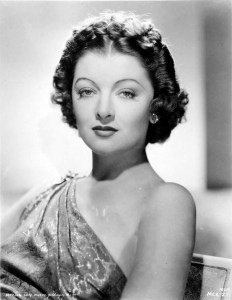
She wasn’t content to just act in films and was very critical of the parts she was offered, being suspended numerous times by Jack Warner, the head of Warner Brothers. She and her husband Collier Young formed a production company called The Filmmakers Inc in 1948. The company produced twelve films, six of which Lupino directed and five of which she wrote or co-wrote. The company closed its doors in 1955 and Lupino began directing for TV. She was one of the very first Hollywood TV and Film directors and was the only woman ever to direct an episode of The Twilight Zone. Ida Lupino died in 1995 aged 77.

Ray Milland

Milland was another British actor who found fame in Hollywood. Milland was born in Wales and served with the British Army. When his army career finished, Milland decided to become an actor. He appeared in several British films before moving to Hollywood in 1929. He worked as a stock actor for MGM then moved to Paramount in 1930. His first lead role was in The Jungle Princess in 1930 with Dorothy Lamour.

He appeared in numerous films but never thought of himself as a serious actor. A great success for him was The Lost Weekend in which he played an alcoholic. The film was directed by Billy Wilder and Milland did a great deal of research for the role and won the Oscar for that year’s best actor, which led to his contract with Paramount being rewritten and making him Paramount’s highest paid actor.

In 1954 he worked for Alfred Hitchcock on Dial M for Murder. Milland decided to retire from acting at one point but soon found he was bored and returned to Hollywood. In 1963 he made the sci-fi film The Man with X Ray Eyes. He appeared in many TV series including of course Columbo.

He was the guest murderer in The Greenhouse Jungle where he plays a man who stages a fake kidnapping of his nephew and then bumps him off to keep the ransom money. In another, Death Lends a Hand, his wife is killed by Robert Culp, one of my favourite Columbo murderers and a classic episode.

Milland died of lung cancer in 1986.

Janet Leigh and John Payne

In 1975 Janet Leigh and John Payne both starred in the episode Forgotten Lady. Both had been stars in a bygone era. Janet Leigh was born in 1927 and made her film debut in 1947. Two notable successes were The Naked Spur and Orson Welles’ Touch of Evil. She appeared with her husband Tony Curtis in Houdini in which Curtis played Harry Houdini.

Another great success for Janet and possibly the film she is most remembered for was the Hitchcock film Pyscho in 1960 however, according to Wikipedia, she was so traumatised after seeing her shower death scene that she avoided showers for the rest of her life.

Clips from one of her films Walking my Baby Back Home, were used in the Columbo episode. She appeared with her daughter, Jamie Lee Curtis in the supernatural horror film The Fog in 1980. Jamie Lee Curtis also had a small role as a waitress in the Columbo episode The Bye Bye Sky High IQ Murder Case.

Janet Leigh died aged 77 in 2004

John Payne appeared in many film noir crime films as well as many 20th Century Fox musicals, his most famous film being Miracle on 34th Street. His final role came in the Columbo episode Forgotten Lady. He died, also aged 77 in 1989.

Myrna Loy

Myrna Loy appeared in the 1972 episode Etude in Black starring guest murderer John Cassavettes. She was born in 1905 in Montana and was the daughter of a Montana rancher. Her father was also a real estate developer and her mother encouraged him to buy land in Hollywood. Some of the land he sold to Charlie Chaplin who built his studio on the plot. The Loy family made a considerable profit on the deal. Myrna’s father took his family back to Montana but when he passed away his widow returned the family to Hollywood.

Myrna studied dance in Los Angeles. She had small parts in many silent pictures but some stills of her appeared in Motion Picture magazine and led to a contract with Warner Bros.

A big success came in 1934 when she appeared in the film The Thin Man with co-star William Powell. The two proved to be a popular screen couple and appeared in 14 films together.

In the late thirties she became one of Hollywood’s busiest and most highly paid actresses but in the 1940s she devoted all her energies to war work and the Red Cross. She was busy throughout the 1950s but in the late 60s began working more in television.

She died in 1993 aged 88.

Jane Greer

Jane Greer was apparently best known for her role as Kathie Moffat in the 1947 film noir Out of the Past. It’s not a film I’ve seen but it does sound like one to look out for. Jane was a beauty contest winner and model and was spotted by Howard Hughes in an edition of Life magazine when she was 18. Hughes became obsessed with the young girl and signed her to a seven year contract. Like many of the girls he had under contract, Hughes had them watched and followed and apart from drama classes, forbade them to go out with anyone except himself.

When Greer decided to ignore Hughes, he bought the studio where she was working, RKO, and continued to try and control her. She married Rudy Vallee and Hughes was still undeterred. She told Hughes she loved Rudy. Hughes replied that she didn’t and she wasn’t going to work until she came to her senses. Jane said OK, I’ll just carry on having babies then.

Hughes later relented and Jane began to work in films again.

She appeared in a number of films in the 1940s and 50s including the 1952 remake of The Prisoner of Zenda.

In television she joined the cast of Falcon Crest and Twin Peaks in her later life before retiring in 1996. In 1975 she appeared with Robert Vaughn in the Columbo episode Troubled Waters in which Columbo finally tracks down guest murderer Vaughn.

Jane Greer died of cancer in 2001 aged 76.


All the images above were reproduced via Wikipedia Creative Commons.


What to do next: Here are a few options.

Share this post on your favourite social media!

Hit the Subscribe button. Never miss another post!

Listen to my podcast Click here.

Click here to visit Amazon and download Floating in Space to your Kindle or order the paperback version.

Buy the book! Click here to purchase my new poetry anthology.


Reviewing the Mission Impossible Franchise

It was a cold afternoon in Manchester and I mumbled something to myself about the supposed heatwave and zipped my jacket up to my neck. At the left luggage office I took out the key that had been given to me earlier and when I opened the compartment I found a small package inside. I took the package and walked the short distance to the square. I sat down on the hard wooden bench and opened it up. Inside was a small tape player and a set of earphones. I put on the earphones and pressed play. There was a short burst of static and then a voice spoke.

‘Good afternoon, Mr Higgins. In the 1970’s a television show called Mission Impossible was produced that became a minor cult TV classic. Many years later the franchise was revived with a series of feature films starring Tom Cruise. Your mission, should you decide to accept it, is to review the TV series and the subsequent films, look at the background to the films, try to understand why they have been successful and put together a blog post revealing your findings. The blog post must be ready for publication by Saturday at 10am.

This tape will self-destruct in 5 seconds.’

I put down the earphones and placed them and the tape player back in the package, moments later the package disintegrated and I dropped the remains into a rubbish bin and walked away.

The TV series 1966 to 1973

The TV show was created by producer Bruce Geller and concerned a team of special agents known as the Impossible Missions Force. They are a US government agency which takes on hostile foreign governments, South American dictatorships and criminal organisations.

In the first series the team is led by Dan Briggs played by Steven Hill but he was replaced for season 2 by Peter Graves in the part of Jim Phelps. Other regular team members were Leonard Nimoy, Martin Laudau and his wife Barbara Bain, Greg Morris and Lesley Anne Warren. Each played a team member with a particular skill, for instance Laudau and Nimoy played agents with a talent for impersonation and disguise, Greg Morris played an electronics expert and so on.

Mission Impossible ran for 7 seasons and was cancelled because, according to Wikipedia, the producers at Paramount found they could make more money by syndicating the existing series rather than making new ones.

A revival series was made in the 1980’s also starring Peter Graves. To save money the series was not filmed in Hollywood but in Australia but it only lasted two seasons and was largely unsuccessful.

A great feature of the series was the opening title sequence which involved a match being struck and then lighting a fuse shown over quick clips of the upcoming episode to the sound of the iconic theme tune written by Lalo Schifrin. Next would be Jim Phelps listening to his tape recorded instructions which after being played would then self-destruct. Phelps would then look through his agents’ files complete with photos and choose who he wanted for the mission. Sometimes a guest star would play one of the agents who would be introduced by Jim checking out his dossier. A team briefing would then take place and the mission would get under way.

The IMF used a great deal of gadgets to accomplish their missions, secret listening devices and other electronic hardware as well as incredible masks and make up to impersonate people. One particular episode that I remember was when the team had to retrieve some stolen gold from a South American dictator’s safe. They did it by drilling a small hole in the safe, heating it until the gold melted and ran out down the small hole then a little gadget sprayed the interior of the empty safe to cover the hole. Mission Impossible was staple viewing in our household in the late 1960’s.

Mission Impossible 1996

Paramount Studios had plans to make a movie version of the series but the plans never seemed to come to fruition until Tom Cruise expressed an interest. He had been a fan of the TV series and hoped to make the film version the first project for his own production company, Cruise/Wagner Productions. The project began with Sydney Pollack as director but Cruise later decided he wanted Brian De Palma. De Palma designed most of the action sequences in the film and the final script was written around these. It just so happens that recently Channel 4 in the UK decided to run all the Mission Impossible films on consecutive nights so that came in pretty handy to refresh my memory on these films.

I enjoyed Mission Impossible much more on this recent viewing than when I had first seen it. The film uses the fabulous TV theme and opens in a similar way to the TV series.

Cruise plays agent Ethan Hunt with John Voight playing Jim Phelps. Hunt is sent to stop the theft of a list of agents kept inside the American Embassy in Prague. The mission fails and Jim Phelps, the agent in charge, is wounded and all of his team are killed except for Ethan Hunt. There is clearly a double agent or mole at work and various things happen until we find out the mole was Jim Phelps which was just a little bit sneaky because all of us who watched the 1960’s TV series knew that Jim Phelps was a character in that show and therefore could not possibly be the mole. The fact that he was made me feel a little cheated by this film because they used my nerdy TV knowledge against me.

I read recently that Peter Graves was asked to play Phelps in the film but declined after seeing his character was the traitor. Other stars from the TV series weren’t happy either.

Mission Impossible II 2000

This second instalment of the franchise was directed by John Woo. It’s about a biological weapon called Chimera. Rogue agent Sean Ambrose steals the virus from its inventor by impersonating Ethan Hunt. He destroys the aircraft on which the inventor is travelling and parachutes to safety. Hunt was played once again by Tom Cruise and his mission is to regain the virus. The opening sequence sees Cruise doing some daring rock climbing which the studio wasn’t happy about. Cruise didn’t have a safety net but did apparently wear a harness. I didn’t like the heavy metal style version of the classic theme and as a matter of fact, I lost interest in the film early on.
Mission Impossible III 2006

This third instalment was directed by JJ Abrams and for the first time the writers decided to show a little of the background to the Ethan Hunt character. He has retired from the IMF and has become a trainer for new agents but is asked to take on a new mission. He is about to get married but his fiancée knows nothing of his espionage work. The IMF team kidnap villain Owen Davian who escapes but decides to take revenge on Ethan. The film is filled with high powered action sequences and although a little implausible, I kind of liked it.

Mission Impossible Ghost Protocol 2011

The IMF are tasked to stop a man only known as ‘Cobalt’ who is trying to initiate a war between the USA and Russia. Tom Cruise as Ethan, infiltrates a Moscow prison to get to a man who has links to Cobalt. Things go wrong and the IMF is closed down by the US government when Cobalt blows up the Kremlin. The IMF team however stay on the hunt for Cobalt and follow him to various parts of the world including Dubai, where Tom Cruise has to climb up the outside of the world’s tallest building, the Burj Khalifa. Cruise does all his own stunts but for a long time I just assumed that all the stuff on the outside of the Khalifa was done in a studio with a green screen and the background digitally inserted. Nope, Cruise actually swung on hidden cables outside the skyscraper. Why he should choose to risk his life in that fashion is beyond me but there it is. A good film full of action and adventure with numerous shootings and explosions.

Mission Impossible Rogue Nation 2015

This next instalment of Mission Impossible is pretty similar to the previous one. The CIA director (Alex Baldwin) asks a government committee to close down the IMF and incorporate them into the CIA which they decide to do. Ethan Hunt escapes from a criminal organisation known as the Syndicate with the help of British double agent Ilse Faust. Various exciting adventures ensue including a highly dangerous motorcycle chase and a deep underwater dive without oxygen. The IMF manage to capture the head of the Syndicate in the end. A government committee decide it would be best to reform the IMF. It’s all a little fantastic but not bad for a Saturday night on TV with a couple of beers and a pizza.

Mission Impossible Fallout 2018

After a week of watching the Mission Impossible films I’m sorry to say I missed this one which is a pity because according to the reviews it’s the best in the series. Still, sometimes it’s important to move one’s lazy behind off the couch, switch off the TV and go out and enjoy oneself. Pity there weren’t a few Mission Impossible questions in the pub quiz that night. After all this research I think I might have done pretty well.

Update

It just so happened that my brother has Fallout on DVD so he brought it round and we gave it a watch. The plot is something about plutonium and atomic bombs and the IMF guys have to swap the captured head of the Syndicate for the plutonium. The plutonium gets put into 2 atomic bombs which cannot be defused but after some highly implausible action-packed chases including a helicopter chase with both helicopters crashing, rolling down a cliff and being suspended on the edge, things finally get sorted. I reckon this would have been a good one to watch in the cinema.

Conclusion

It’s not easy to reboot a successful TV series whether it’s for the small screen or the big one but the producers of the Mission Impossible films have actually done a pretty good job. The films do have something of a link to the old TV series. They have different characters and different actors but the films have kept that opening element from the TV show with the match lighting the fuse.  They have also kept that fabulous theme tune. Then again, could they have really made Mission Impossible without the Mission Impossible theme? I don’t think so.

I did read that some of the TV actors from the original series weren’t happy with the films. Greg Morris apparently walked out of a screening when it was revealed that Jim Phelps was the traitor which was exactly why Peter Graves, the original Jim Phelps declined to reprise his old role as I mentioned earlier.

Personally, with the exception of MI2 I’ve enjoyed all the films and I look forward to the next instalment in the franchise which I believe has already been filmed.

Please step away from this blog post. It will self-destruct in 5 seconds . . .


What to do next: Here are a few options.

Share this post on your favourite social media!

Hit the Subscribe button. Never miss another post!

Listen to my podcast Click here.

Buy the book! Click here to purchase my new poetry anthology.

Click here to visit Amazon and download Floating in Space to your Kindle or order the paperback version.

The Old, the New, Covid and 2022

My first post of 2022 was just a review of 2021 so this one is really my first proper 2022 post. I was due to be working on New Year’s Eve but that scourge of our modern times, Covid 19, stepped in and I had to call in sick.

Covid.

Both Liz and I had been suffering with bad colds and hers was getting worse with a bad headache and a loss of taste and smell. We did Covid tests and Liz was positive. My test was negative which was a surprise but then I haven’t had the headache or the loss of taste. I’m not sure when Liz was exposed to Covid, after all we haven’t been out much lately apart from some last minute shopping and a visit to quiz night at a local pub, the Lord Derby. Anyway, we were of course condemned to a minimum seven day lockdown so that meant no work on New Year’s Eve and no going out either.
We lit the fire, got the red wine on the hearth and settled down while we waited for our curry takeaway to be delivered.

The New.

Just lately I’ve been watching a whole lot of TV. Some of it new and some of it old. I mentioned a few weeks ago about watching And Just Like That, a new series of Sex and the City. Happily, it wasn’t on some subscription TV channel but on normal TV so I was able to watch it. I gave it another try the other day but I wasn’t impressed. Carrie had some hip surgery and Miranda got involved with a lesbian comedian. All pretty routine stuff for modern New Yorkers I suppose but it really wasn’t for me. Another new series was the latest four part JFK documentary by director Oliver Stone. I’ve been interested in the JFK assassination since I was a child and although I didn’t quite expect any new revelations in this new documentary series, I was surprised to find there were.

The so called magic bullet was given a severe bashing by various experts and so was the actual provenance of the bullet. The chain of evidence regarding the bullet was shown to be completely compromised as various new records released by the JFK Assassinations Records Review Board were shown to be either false or incorrect by the hard work of various investigators. The ARRB came into effect after the outcry from Oliver Stone’s 1991 film JFK and the documentary was fascinating but a little disjointed as instead of covering each issue in full, the films returned to the same subjects again in later episodes. Apart from that it was very convincing despite the poor review I read in the Guardian recently.

The Old.

There were the usual films shown over the Christmas period. Many films like Ghost for instance look pretty modern but it was technology that betrayed how old they were.

In Ghost banker Patrick Swayze was using one of those old computers with green text while Tom Hanks and Meg Ryan in the film You’ve Got Mail were still using dial up to get online and pick up their email messages. You’ve Got Mail was released in 1998 and Ghost in1990 making it 32 years old this year, would you believe it! Another film I saw that was also dated by technology was The Net with Sandra Bullock. The Net was a thriller about a computer programmer who gets involved in a conspiracy by a computer security company to mine and manipulate information. Made in 1995, dial up internet and green text were evident and there must have been many young people watching and wondering what exactly a floppy disc was.

Making Bread.

One thing that I really love and could never give up is bread. Yes, some may say it’s fattening and full of calories but it’s a food that has nurtured mankind for many centuries and anyone who tries to keep me away from a ham salad on granary is risking their life. When a bread shortage began to rear its ugly head here in Liz’s kitchen a state of panic began to mount. We were self-isolating so I couldn’t go to the shops, what could be done?

The obvious answer was to bring down my bread maker from the dusty shelf where it had lain for the past god knows how many years and to wipe it down and crank it up. I suppose I’ve had that bread maker for about twenty years. Once I got pretty interested in bread making. I had a few recipe books, I bought flour and yeast and started baking. I had a number of disasters along the way but eventually I managed to make some reasonable bread. Then, some new gadget caught my interest and the bread maker was left on the shelf. Why on earth did I stop making bread when I love it so much?

A quick search in the cupboard produced some flour and some packets of yeast and it was time to start up my bread maker once again. The thing is, making bread takes time. First the machine has to mix the ingredients then the mixture has to prove and rise. Then it gets another mix and finally the gizmo starts to bake. I waited patiently looking forward to warm fresh bread and then, many hours later when a huge rock hard inedible blob emerged I finally remembered why the bread maker had been lying on the shelf for so long.

More Old.

The Net was by no means a great film but Ghost was. I remember seeing it at the cinema back in the 1990s and it was one of those word-of-mouth films where the word was, this is a pretty good film, make sure you watch it. Patrick Swayze plays Sam Wheat, a banker who gets murdered. When his spirit is about to be pulled upward into the next world he looks back towards his girlfriend Demi Moore who is shattered and cradling his dead body and Sam realises it is not time for him to go yet. The ghostly Swayze later finds that his killer is stalking Demi. Frustrated and not knowing what to do, Sam wanders New York and finds a medium played by Whoopi Goldberg with whom he can communicate. Whoopi tells Demi about the stalker and Sam’s best friend Carl goes to find out what is happening. Sam is shocked to see that the murderer and stalker is actually acting on the orders of Carl. Maybe Ghost is a little too sentimental in parts but what the heck, I’ve always enjoyed it.

More New.

One new film (well new to me anyway) I did watch was The Time of Their Lives. It was a 2017 film starring Joan Collins and Pauline Collins. It was on in the background while I was tapping away on my laptop. I didn’t catch much of the beginning but Joan Collins is a faded movie star living in a home who decides to go to the funeral of her film director ex-lover in the hope of somehow breaking back into the film business. The funeral is in France and she somehow persuades Pauline Collins to go with her on the trip so it becomes a sort of French road trip. Over in France they meet an Italian artist played by Franco Nero, the one time spaghetti western star. Joan Collins is wonderful in the part of the former film star and I ended up putting my laptop down and giving the film my full attention. Very enjoyable it was too.

2022.

Most years I make the same New Year resolutions. They usually go something like this; finish my new book. Finish my latest screenplay. Write more poetry. Make better videos. This year I decided not to make any resolutions. I thought why not make 2022 a pressure free year? After all, I never make good on any of those resolutions anyway.

Have a great 2022 and by the way, did you make any resolutions?


What to do next: Here are a few options.

Share this post on your favourite social media!

Hit the Subscribe button. Never miss another post!

Listen to my podcast Click here.

Buy the book! Click here to purchase my new poetry anthology.

Click here to visit Amazon and download Floating in Space to your Kindle or order the paperback version.

TV, Westerns and The Outlaw

Once upon a time Howard Hughes was the richest man in the world. In today’s society being the richest man requires some serious wealth and Howard Hughes ticked all the financial boxes you can think of. He inherited his father’s tool company when he was very young. Too young in fact to take control but he found a law that said if he could prove he was capable of running the company then he could take control. He proved he could and did just that, took control. His father had designed a tool bit that was essential to America’s oil industry but instead of selling the drill bit he patented it and then rented it out. Howard Hughes though had other ambitions which did not involve oil or drilling but the profits from the Hughes Tool Company were vital for his ambitions in aviation and film making.

Hughes combined those two interests in making the WW1 movie ‘Hell’s Angels’ about fighter pilots and for the shoot he assembled the largest private air force in the world. Towards the end of the shooting, sound pictures made their appearance so what did Howard do? He reshot the entire film with sound equipment!

The_Outlaw-poster-trimAnother movie Hughes made that is famous, or perhaps infamous, was the 1943 Movie ‘Outlaw’ starring Jane Russell. Hughes appeared to be obsessed with Jane’s breasts, even to the extent of designing a new bra for her and reshooting a famous close up of her time after time. Hughes clearly had some psychological issues; he was a compulsive, obsessive man. He usually had the same meal when he went out with one of the many starlets he courted. Jane Greer recounted in a TV interview how Hughes would eat things in the same order; the peas first, then the potatoes and finally the meat. Once when they dined Hughes came back to the table and Jane noticed that his shirt was wet. Hughes had spilt something onto his shirt so he had washed the shirt in the men’s room, rinsed and squeezed it out, then put it back on.

As his mental health deteriorated, Hughes retreated into a world of blacked out penthouse suites and midnight telephone calls to his army of assistants, some of whom were private investigators keeping close tabs on anyone Hughes had an interest in, particularly starlets he had signed to personal contracts and his girlfriends like Katharine Hepburn or Jean Peters whom he later married.

Anyway, this isn’t a post about Hughes, it’s about TV and looking through my old posts I noticed a couple that caught my attention. One was about Hughes and I have to confess, I pinched the text above from that post, and another was about my life as a couch potato and avid TV viewer. A few days ago, staying at my mother’s house I once again had a few couch potato days. On the first one I was tapping away on my laptop with the TV on but no sound. On Mum’s old TV you can go through the on screen menu and choose programmes you want to watch and the TV will flip to that channel at the appointed time. It was Saturday afternoon and even though that Saturday’s post had just been published, as usual I was already worrying about the next one.

As I looked up from my laptop I could see a new film had started. I switched on the volume and was surprised to find it was The Outlaw, the Hughes film I mentioned above. I had never seen the film and everything I knew about it came from either books, documentaries or films like the Aviator, the Martin Scorsese film about Hughes himself. Hughes filmed The Outlaw in 1941 but had trouble with the film censors of the time. He had to cut half a minute from the film where the camera had lingered for too long on Jane Russell’s ample bosom. 20th Century Fox however decided not to release the film thinking perhaps it was too hot to handle. Hughes decided to build his publicity on that very idea. The film was released for a quick showing and then Hughes put the film under wraps for the next few years while his publicity people whipped up controversy and hysteria, meaning that when it opened in 1946, released finally by RKO, the film was a huge hit.

Even over half a century later people like me are still liable to be caught up in the controversy because I always thought the film was about Rio, the character played by Jane Russell and was of a risqué nature, or at least as risqué as films could get in 1941. I have to admit I missed the beginning of the film the other day and the famous scene of Jane Russell in the hay must have occurred either before I looked up from my laptop or when I was in the kitchen making a brew.

Hughes seemed to be obsessed with Jane’s breasts and wasn’t happy with the way they looked on screen, so much so he designed a new cantilevered bra for her, perhaps the first push up bra ever made. Russell later claimed that the bra was a nightmare to wear so she simply used her own but padded the cups with tissue, which apparently achieved the effect that Hughes wanted.

The action, such as it was, seemed to revolve around the friendship which blossomed between Billy the Kid and Doc Holliday which seems to make Pat Garrett very jealous as he considered himself a better friend to the Doc than Billy. It was actually a quirky sort of film. Walter Huston, father of film director John, played the part of Doc Holliday and Jack Buetel, an actor I don’t think I’ve heard of before, played Billy.

Billy the Kid has been portrayed a number of times in films, as have Pat Garrett and Doc Holliday. Paul Newman played Billy in The Left Handed Gun, a part originally earmarked for James Dean until Dean was killed in a car crash. In the 1970’s Sam Peckinpah directed Pat Garret and Billy The Kid starring James Coburn as Pat Garret and Kris Kristofferson as Billy. Bob Dylan also had a small part as well as writing the music for the film including the hit single Knockin’ on Heaven’s Door.

Billy the Kid was killed in 1881 by Pat Garrett. There were rumours however that Pat staged Billy’s death so that he would be free of pursuit by the law. That scenario was used in the end of The Outlaw, although in the film it was Doc Holliday who gets the bullet but it was Billy’s name on the gravestone.

One of my favourite cowboy/outlaw films has to be Jesse James, the 1939 film starring Tyrone Power as Jesse and Henry Fonda as his brother. The film was so successful that they made a sequel, The Return of Frank James starring Henry Fonda as Frank on track to find his brother’s killer.

Two more outlaws whose fame has lasted right down to the present day were Butch Cassidy and The Sundance Kid and the two were played by Paul Newman and Robert Redford in a film called just that: Butch Cassidy and the Sundance Kid. I saw a film programme a while back on the BBC where Paul Newman explained that screenwriter William Goldman had approached him about making the film and starring as Butch. Various people were suggested for the Sundance Kid and Newman even met with Steve McQueen about the part but eventually it was Robert Redford who won the role.

The film was released in 1969 but has a very 1970’s feel about it. There is even a musical interlude in the film where Paul Newman tries out a new fangled bicycle with Sundance’s girlfriend Etta to the tune of Raindrops Keep Fallin’ on my Head.

My two favourite westerns both star John Wayne, the quintessential cowboy hero. Wayne starred in The Searchers, directed by John Ford. Wayne stars as a civil war veteran whose niece has been kidnapped by a band of warlike Commanches. Ethan Edwards takes his adoptive nephew on a long search for the kidnapped girl until they finally rescue her.

My other favourite is The Man Who Shot Liberty Valance. Lee Marvin plays a brilliant part in that of Liberty Valance, a mean, no good bully who terrorises a western town until lawyer James Stewart manages to shoot him dead, or so we think. Later, when Stewart decides he is unwilling to base his career on being the man who shot Valance, John Wayne reveals what really happened.

Back in the fifties and sixties was probably the heyday of cowboy films and TV shows. Today it seems that the western is a genre that has been almost forgotten. As a schoolkid I was an avid watcher of The Lone Ranger, Branded, The Virginian, Bonanza, Casey Jones and many others. One of my favourites was Alias Smith and Jones, a series about two outlaws, Kid Curry and Hannibal Hayes who are on the run but have been offered an amnesty on the condition that they give up crime and go straight. They adopt new identities, that of Smith and Jones and try to live law abiding lives. It was a great series with some excellent episodes but in December 1971, Pete Duel, the actor who had played Hannibal Hayes committed suicide. Another actor was substituted in the role but the series was never as popular afterwards.

Another great western was Kung Fu. Kung Fu was an oddball western in many ways; it was about a half Chinese, half American called Kwai Chang Caine played by David Carradine. Caine becomes a Shaolin monk after he has been taken in by the monastery as an orphan. Caine has been tutored in the Buddhist religion and martial arts by master Po. When Po is murdered by the Emperor’s son, Caine retaliates and kills him. Now with a price on his head Caine flees to the USA. In the USA of the old west, Caine encounters many situations which then cause him to reflect on his own upbringing and tutoring in China, shown in many flashback sequences. Caine defends himself in many situations with his mastery of Kung Fu and the series became not only a great success but the forerunner in a world wide Kung Fu craze with many Hong Kong martial arts films also becoming popular.

The western film and TV shows seemed to have all fizzled out by the end of the 1970’s. Perhaps these days audiences prefer sci fi series like Star Wars and Star Trek. Tastes change of course and one day perhaps audiences will once again want more westerns. For now I think I’ll settle down after a busy shift, pour myself a glass of wine and wind down with my copy of John Ford’s The Searchers.


What to do next: Here are a few options.

Share this post on your favourite social media!

Hit the Subscribe button. Never miss another post!

Listen to my podcast Click here.

Buy the book! Click here to purchase my new poetry anthology.

Click here to visit Amazon and download Floating in Space to your Kindle or order the paperback version.

Star Trek: The Blog Post

On many of the posts in this blog you will find references to Star Trek. I’ve been a big fan of Star Trek for many years and even though I’m not an actual ‘Trekkie’, visiting conventions and dressing up as a Klingon and so on, I do love a good episode of Star Trek so it’s high time I put all my Trek thoughts into one handy blog post.

Star Trek the Original series.

Here is something that may be a revelation to you; if you don’t know it already it will vastly improve your understanding of Star Trek. It’s a simple truth and here it is, Star Trek is about three guys, Captain Kirk, Mr Spock and Doctor McCoy. Sometimes there are four, we can maybe throw in Scotty but that’s it, that’s the essential truth about Star Trek and that’s why things like the Next Generation and Deep Space 9 will never come up to scratch, simply because Kirk, Spock and McCoy are not involved. Even the Star Trek people themselves understand this, which is why Star Trek has been reinvented (re-imagined to use movie speak) with new actors playing Kirk and his crew in the latest Trek movies.

The first series of Star Trek starred William Shatner as Captain James T Kirk. Forget Captain pointy head Picard, Kirk is a proper Captain and after a good twenty minutes of any episode he will usually have blasted a number of aliens with his phaser (a sort of ray gun) and done some pretty serious kissing of any beautiful girl, alien, android or otherwise, within a 100 yard area. Mr Spock was played by Leonard Nimoy. He is the ship’s science officer and as a Vulcan rarely displays emotion, logic being his primary motivation. Doctor McCoy played by DeForest Kelley is a doctor of the old school and he and Spock frequently get into verbal confrontations. Together they are the chief officers of the starship Enterprise on its five year mission to go where no man has gone before.

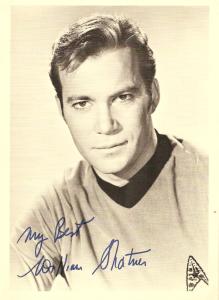
william_shatnerAs a schoolboy I wrote to Desilu studios where I believed Star Trek was made, based on credits shown at the end of the show. After a while I received a set of glossy pictures of the show’s stars. They were all signed by the various actors, Shatner, Nimoy and so on but the signatures, I have long suspected, were made by a machine.
The original Star Trek, like many TV programmes of the sixties was shot on film and today it looks pretty sharp compared to shows from the 80’s that were shot straight to video. It was given a digital makeover a few years back with digital effects and new CGI spacecraft and is looking pretty good these days. Which was my favourite episode? Well I’d have to say it was the one that fans voted the best Star Trek episode ever; City on the Edge of Forever. The crew of the Enterprise arrive at a distant planet searching for the source of some time displacement. The source is a time portal, left among the ruins of an ancient civilisation which although abandoned, still emits waves of time displacement. In the meantime, Doctor McCoy is suffering from paranoia brought on by an accidental overdose of the wonder drug cordrazine which any Star Trek fan will tell you can cure any known Galactic ailment. McCoy in his crazed state bumbles through the time portal, back to 1930’s America (handy for that old 1930’s set on the Paramount back lot) and changes history. Kirk and Spock are forced to also go back in time, stop McCoy from changing history and restore things to the way they were. Joan Collins plays a charity worker at the core of events; does she have to die in order to restore normality?

Star Trek the Motion Picture

After three series the show was cancelled but was remade a few years later as a TV cartoon. The huge fan base of the series caused the producers to think again and in 1977 they decided to make a big screen version of the show to cash in on the huge success of Star Wars. Star Trek the Motion Picture was released in 1979 and was directed by Robert Wise who was one of the editors on the film classic, Citizen Kane. I enjoyed the film very much although I feel the story was a little lacking. An entity called Vega is on the way to destroy the earth and the only starship in interception range is the recently refurbished Enterprise. All the favourites from the TV series make their return with a few additions. It was a good film but not a great one.

The Next Generation

The success of the film made the producers think about a new TV series, not with Kirk, Spock and McCoy but with a new crew. The Next Generation is set further into the future than the original series. Patrick Stewart plays the Captain and Jonathan Frakes is the first officer. There is no Vulcan science officer like Mr Spock but Brent Spiner plays a similar character; Data, an android.

The Next Generation is something I have always found rather lacking. I wasn’t keen on Mr Pointy-head Captain Picard and the cocktail lounge style bridge on his version of the starship Enterprise. Why on earth does he have to run every decision by his first officer, his councillor and everyone else on the bridge when Kirk would have just sorted that situation out like a shot, fired off a few photon torpedos and would even have found a pretty girl to flirt with too? The series was filmed on video and doesn’t look as good today when compared to the pin sharp original series.

Deep Space 9.

What can I say about this series? My knee jerk reaction was that it’s a load of old tosh might sound a bit mean to die hard Trek fans, but it was never my cup of tea. The only episode I ever enjoyed was an episode in which the crew of Deep Space 9 return to the past and get involved in the old original series episode ‘The Trouble with Tribbles’ using some pretty nifty special effects.

Star Trek Voyager.

I wasn’t so keen on Voyager at first, but I have to say I do like the later episodes when Captain Janeway finally got rid of her early weird hair styles and the drippy alien Kes got the bullet from the show.

Captain Janeway was the Star Trek world’s first female captain and as she began to look more normal as far as her hair, the writers decided to shake things up with the new and pretty sexy Seven of Nine character. She was rescued from the Borg, an alien race whose catchphrase is you will be assimilated. Seven was given a very appealing tight fitting catsuit to wear instead of the Space Federation regulation uniform. Catsuits are OK and maybe they are pretty popular in the 24th century but they never seem to have any pockets. What Seven does with her handkerchiefs, lip gloss, mobile phone and purse I really don’t know. In the future people must prefer looking sexy rather than worrying about their stuff, at least they do in the eyes of the Star Trek writers.

Seven is the nucleus of some great episodes especially one where we go back and see how young Annika Hanson (Seven as a young girl), and her family were assimilated by the Borg. The Borg are a race of aliens who assimilate other species into their own and at their centre is the Borg Queen who really likes the idea of Seven coming back to her ‘collective’.

Star Trek Enterprise.

This is supposed to be a prequel to the original series. I can’t say I’ve ever got through a complete episode. My only observations are that the crew go around in overalls and the Captain is played by the guy who used to be in the time travel show Quantum Leap.

Star Trek Discovery.

The latest series in the franchise is Star Trek Discovery, which is rather like watching a very fast music video, I gave it a good 15 minutes and then had to switch off. Sorry, it’s just not my cup of sci-fi.

Star Trek Picard.

Picard airs on Netflix or Amazon or some such channel that I have no access to and have no intention of subscribing to, mainly because I am allergic to opening up my wallet. After watching a few clips of Picard on YouTube I actually found it quite appealing so I decided to search for a cheap DVD of the episodes on eBay. Picard, I have to say is a pretty amazing slice of sci-fi. It’s not perfect and in fact it is rather complicated but it’s about a mystery at the heart of Star Fleet and Admiral Picard, no longer a member of Star Fleet, is determined to find out. Along the way he meets Seven of Nine and various other favourites from the old TV shows. Some of the episodes have been a little slow and yes, I know I’ve slagged off Captain Picard before but for the most part this series has been pretty good and anyone wanting to buy my DVDs is welcome to make me an offer as soon as I have got through series one.

William Shatner has reached the venerable age of 90 this year so it was good to read in the media that he is still going strong. Wonder if there is any chance of him playing Kirk again just one last time? Star Trek Kirk sounds good to me.

More on the Star Trek Films.

Getting back to the Star Trek films; Paramount studios decided to have another go at filming Star Trek for the big screen. For the second film they decided to employ producer Harve Bennett to make a better and cheaper Star Trek film. He apparently watched all the episodes of the TV series and decided to bring back the character of Khan who had once attempted to take over the Enterprise and was later left on a distant planet to start a new life with his crew. In Star Trek II: The Wrath of Khan Mr Chekhov finds that the planet Khan was abandoned on has become a desert and Kahn isn’t happy; he wants revenge on Kirk. Wrath of Khan is a really good film, much more like the original TV episodes than Motion Picture. The crew all sport some new natty uniforms and clearly it must be a little chilly on the Enterprise because all the staff seem to be wearing woolly jumpers and jackets. I don’t remember the Apollo astronauts ever wearing woolly jumpers but maybe astronauts in the 24th century are not made of such stern stuff. Of course it could be that they just have never thought about turning up the central heating.

Trek III was another excellent film. In this one we find that although Spock died in the previous film, his body has been regenerated by the Genesis project. In Star Trek IV the crew return to the 1980’s in order to bring a whale back to the future for reasons which I won’t even begin to get into. Watch out for the scene where Spock deals with a guy playing loud music on the bus; I loved it.

The character of Captain Kirk was actually killed off in the movie Generations which started off pretty well, combining the usual sci-fi elements of Star Trek with an intriguing mystery; who is the mysterious Soran and what is he up to? As it happened what he was up to wasn’t really that interesting, but the film marked the cinema handover from the original Star Trek cast to the new one. Pity really because as I mentioned above, I never really took to the Next Generation.

Just as I’d got to the end of this post I thought it might be an idea to actually watch some Star Trek again for some final opinions. After a quick scan through my DVDs I came across Star Trek III in which the crew of the Enterprise are grieving over the loss of Mr Spock in the previous film. Captain Kirk finds that Spock, who knew he was about to die, had left his Katra, his soul, in the mind of Dr McCoy and the crew undertake to take McCoy and Spock’s body back to the planet Vulcan, Spock’s home. A lot of stuff happens along the way and of course they finally succeed in reuniting Spock’s body with his Katra, although sadly, Kirk’s son is murdered by the Klingons along the way. It’s a great film, very reminiscent of the original episodes but a big factor in the film is the performance of William Shatner. He really is an outstanding actor and I think the success of Star Trek is in no small measure due to him. Shatner went on to play many other roles on TV so he can hardly claim to be type cast but I wonder if he hadn’t played Kirk, would he have gone on to a better career as a film actor.

Star Trek is ultimately about three people, Kirk, Spock and McCoy and the producers probably realised that which is why, in the latest Trek films, a new generation of actors have been asked to recreate the old characters meaning that Captain Kirk lives on again for a new generation of sci-fi fans.


What to do next: Here are a few options.

Listen to my podcast Click here.

Share this post on your favourite social media!

Hit the Subscribe button. Never miss another post!

Buy the book! Click here to purchase my new poetry anthology.

Click here to visit Amazon and download Floating in Space to your Kindle or order the paperback version.

Monaco, TV Ads and the Problem with VHS Tapes

The F1 season starts later this month in Bahrain, in fact the race teams are already gathering there for the pre season testing, getting ready to shake down the new cars and sort out any teething issues before the actual racing. Of course, I’m assuming that despite Covid 19 we will have something of a normal F1 season once again. One of my favourite events, the Monaco Grand Prix traditionally takes place in May and even though the hi tech F1 cars outgrew this road circuit many years ago, they still come here and race fans can hobnob with the rich and famous and look enviously at the harbour when it will be choc-a-block with millionaires’ yachts.

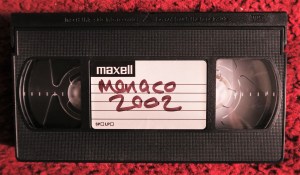
The other day I was once again going through my old VHS tapes, selecting ones to keep, ones to copy to DVD and ones to throw out. One tape was marked Monaco 2002 qually and I was tempted to dispose of it straight away but I put it to one side and then later when the TV schedules declined to offer up anything interesting I thought why not give it a watch?

I have to say I couldn’t quite remember off the top of my head who was winning and who was losing in 2002 or even who was driving for who.

The video started off talking about what was portrayed as a controversial event in the previous race in Austria. Michael Schümacher and Rubens Barrichello were both driving for Ferrari at the Austrian Grand Prix. Rubens, the popular Brazilian was fastest in qually, fastest in the warm up and led the race. At the very last corner he came out ahead of Michael but then lifted off for a moment and it was Schümacher who took the chequered flag. Schümacher and Rubens came to the podium and Michael was not popular, facing a barrage of booing from the crowd. Michael, clearly embarrassed, pushed Rubens on to the top spot but that would not change the result; Rubens had handed the race win to Michael.

I started to fast forward through the TV ads but then saw one that always used to make me laugh. Here it is:

Back to Monaco and the TV coverage back then had passed to ITV and Jim Rosenthal was the TV anchor. He quizzed pundit Tony Jardine and guest and FIA chief Max Mosley about the Austrian Grand Prix. They weren’t happy at all that Rubens had handed the win to Schümacher. Are they bringing the sport into disrepute asked Jim. Max and Tony seemed to think so. The ITV web site was apparently flooded with complaints. Some drivers were interviewed and one I thought was interesting was the comment by Jacques Villeneuve. He said that we all knew that Ruben’s contract said he was number 2 and had to give way to the number 1 driver who was Schümacher. We all knew also that in Schümacher’s contract it said that the number 2 driver had to give way to him so why should we be surprised at what had happened in the race? Schümacher said Villeneuve should act like a man, accept what has happened, stand up on the number 1 spot and accept the boos.

Funny thing is that nowadays, Villeneuve is always in the F1 websites saying something controversial so perhaps I’d forgotten he was a straight talker even back then. Yes, that whole episode was a big scandal back in 2002 although I really don’t know why. Motor racing is a team sport and Ferrari has always been known to give team orders so why was everyone getting upset? Even Stirling Moss, who drove in an era when team orders were pretty much de rigueur felt compelled to say he had lost respect for Michael Schümacher. The thing is, as the two had led the race and Michael of course knew that Rubens would move over, then the two were hardly racing were they, as Ferrari Team Boss Ross Brawn pointed out. If there had been no team orders then Rubens would have had Michael up his exhaust pipes pushing him until he found a way past. To me the whole thing was a fuss over nothing but as I remember, the whole thing rumbled on and on for quite a while.

Anyway, I soon fast forwarded to the action, the actual qualifying which was I have to say, pretty exciting. There was a time when, as an ardent F1 fanatic, I knew race results and team personnel off by heart. Who won at Monaco in 1970? Jochen Rindt of course. 1971? Jackie Stewart. 72? Jean Pierre Beltoise in the rain. What about 1977? Was it Lauda? No, Jody Scheckter. 86? Prost? Yes, Alain Prost. 2002? 2002, there’s a question.

Time to fast forward again but then another advert caught my eye. I haven’t seen it for years but I’ve always found it rather funny. It starred the northern comedian, Peter Kaye.

Getting back to the qually; as I said before, it was all pretty exciting, especially as I couldn’t remember who was driving for whom, never mind who came out on top. Schümacher soon set the top time then David Coulthard driving for McLaren went fastest. Hakkinen his team mate, who was as you may remember, a double world champion, wasn’t doing so well but then Juan Pablo Montoya, one of my favourite drivers claimed the top spot. The cars began to get faster as the track ‘rubbered in’ and got faster. Coulthard went fastest again, in fact there were ten changes of pole sitter until Juan Pablo the Columbian driver finally claimed the top spot. I’ve always liked Juan Pablo. He was a man who told it like it was, he didn’t go in for PR led team speak and I was looking forward to seeing his post qually interview but then something happened, something that always used to happen back in the VHS age.

The other day I was idly watching an episode of Everybody Loves Raymond. It was the one where Ray and Debra his wife are watching their wedding video and suddenly the screen dissolves and on comes a football match. Debra is furious because Ray has taped over the wedding. Yep, those sort of things happened back then and on my video tape something similar occurred. The race video vanished into a hail of snow only to be replaced by a James Bond documentary. I was furious for a moment but then I got interested in the documentary. It focussed on Miriam D’Abo who starred in the 007 film The Living Daylights and she interviewed various ladies who had the dubious honour of being a ‘Bond Girl.’ There were plenty of clips from the Bond films, interviews and bits and pieces of behind the scenes stuff, in fact it was all pretty interesting for a Bond fan like me.

Pity about the Grand Prix but what the heck, pause to get a bottle of lager and a few nibbles and who cares? Wonder who did win the 2002 Monaco Grand Prix though?

(If you’re interested David Coulthard won with Schümacher coming home second!)


What to do next:

Share this post on your favourite social media!

Hit the Subscribe button. Never miss another post!

Buy the book! Click here to purchase my new poetry anthology.

Click here to visit Amazon and download Floating in Space to your Kindle or order the paperback version.

https://youtu.be/5hTLreQ1y5g

A Few Pandemic TV Thoughts

Lockdown may have finished on December 2nd in the UK but if you live in a tier 3 region, like me, it’s still going on. OK, I understand the need for the lockdown, I know we have to prevent the virus from spreading but that doesn’t stop the whole thing being a pain in the neck. No quiz nights at the pub, no restaurant meals out and so on. Not only that but why does the virus have 2 separate names? Is it Covid 19 or is it Coronavirus? And where does the 19 come from? Was there a Covid 18?  Does this mean there have been 18 previous versions of this insidious plague? If so, why have we never heard of them? We, the public, need to know.
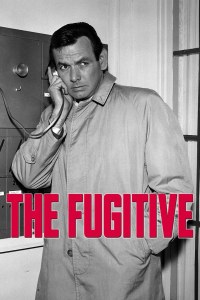
This being December it certainly isn’t the time of the year for relaxing in the back garden but at least we have our TV set to keep us entertained. What TV gems have I found this week?

Showing on an obscure TV channel, Forces TV, I found the old Gerry Anderson TV series UFO. The show still looks pretty good after many years on the shelf. Ed Straker, the boss of SHADO is still trying to defend the world from alien attack and he and his colleagues look pretty good in their natty suits. In fact the whole thing looks pretty futuristic despite its obvious 1980’s origins, more so than Star Trek which, as much as I love it, does look very 1960’s.

It just so happens that I can remember that SHADO stood for Supreme Headquarters Alien Defence Organisation. What is interesting about that is this: The other day I went into the bedroom to get something and forgot what it was I’d gone in there for and yet I still knew what SHADO stood for.  A contributory factor might be that as a youngster I fell off a playground roundabout right onto my head. In fact, I can remember it like it was yesterday, falling off head first and heading towards the ground, actually a concrete slab and taking a hell of a whack on my bonce. Yes, that hurt, it really did but I’m still wondering what I wanted in the bedroom.

Anyway, when I mentioned Star Trek above. I’m talking about the original Star Trek, not the slightly lacking Star Trek:The Next Generation. Captain Picard and the cocktail lounge atmosphere of his space craft was not my cup of sci-fi at all and while Picard was running all the command decisions past everyone from the ship’s counsellor up, Kirk was already hitting the aliens with phasers on stun and getting up close and personal with some gorgeous interplanetary beauty.

The original Star Trek, like UFO was shot on film and today looks pretty sharp compared to the Next Generation which was shot straight to video. The original series was given a digital makeover a few years back with digital effects and new CGI spacecraft and is looking pretty good these days. The franchise has spawned quite a few follow up series and films. After the Next Generation came Deep Space 9 which was just as bad as the Next Generation if you ask me and then Star Trek Voyager. I actually like Voyager but it didn’t start off well for me and as much as I liked Captain Janeway, her oddball hairstyles just annoyed the hell out of me until in the later series they decided to employ someone who actually knew how to style hair and Janeway ended up looking pretty normal.

As Janeway became normal, the writers decided to shake things up with the pretty sexy Seven of Nine character. She was rescued from the Borg, an alien race whose catchphrase is you will be assimilated. Seven was given a very appealing tight fitting catsuit to wear instead of the Space Federation regulation uniform. Catsuits are OK and maybe they are pretty popular in the 24th century but they never seem to have any pockets. What Seven does with her handkerchiefs, lip gloss, mobile phone and purse I really don’t know. In the future people must prefer looking sexy rather than worrying about their stuff, at least they do in the eyes of the Star Trek writers.

While on the subject of cat suits, I feel I must mention, even just for a fleeting moment, the original cat suit girl who, at least in my mind, was Mrs Emma Peel played by Diana Rigg in the TV show The Avengers. The Avengers started off as a crime drama starring Ian Hendry as a police doctor, assisted in solving crimes by the dapper John Steed. Hendry left the show leaving Steed, played by Patrick MacNee needing a new assistant. His assistant was Kathy Gale played by Honor Blackman. She left the series to star in the film Goldfinger and Emma Peel was recruited as Steed’s new assistant. Kathy Gale was also a catsuit wearer although she seemed to prefer a leather version. When Emma Peel joined the series, the show moved from video to film and the production values increased enormously. The show also began to move in a sort of sci-fi fantasy espionage direction. Off the top of my head, I remember episodes about a mad scientist who shrinks other scientists and Steed, down to a small size, killer robots, time travel and cats that become wild animals.

Another problem with tight fitting cat suits must surely come whenever the wearer needs a bathroom break. Imagine having to strip right down just so you can have a wee. On board the Enterprise I can imagine that, like in any spaceship, space must be at a premium so the toilets must be pretty small. Now this is the perfect opportunity to introduce my own personal experience of using a ladies toilet. Years ago, when I had a cigarette vending machine round (writer, blogger, vending machine repairman -I’ve done it all) I remember visiting a pub in Prescot in Merseyside. I can’t remember the name of the place but it was the reverse of a normal pub in that most old pubs usually have a big room; the lounge and a small one, the vault, where men play cards, pool and darts. In this pub, the big room was the vault and the lounge was the small room. Anyway, after servicing the cigarette machine I wanted to use the toilet so I asked the cleaners, who were pretty fierce in that place, could I go in the gents. No she said, the floor was still wet but I could go in the ladies.

The ladies I soon found was actually two rooms, one with three toilet stalls and an outer room where you could wash your hands. The outer room had two huge mirrors for making sure your hair and makeup were OK and two comfy couches where the women could sit and presumably have a good natter before going back to join the men. Yes, that ladies toilet was a real eye-opener for me used to, like all men, smelly urinals.

Diana Rigg left The Avengers to become a Bond girl, just like Honor Blackman before her. Diana starred in On Her Majesty’s Secret Service as the woman who finally got 007 to the altar only to be shot later by Bond’s enemy Blofeld.

Anyway, getting back to Star Trek, the latest series in the franchise are Discovery, which is rather like watching a very fast music video, I gave it a good 15 minutes and then had to switch off, and Star Trek Picard, which sees the return of Captain Picard and various other characters including Seven of Nine from Trek’s back catalogue. I actually quite fancy watching that but alas, not having Amazon Prime I’ve yet to do so. Pity because it actually looks pretty good from the clips I’ve seen on YouTube. Eventually it will filter down to the Freeview channels and one day I’m sure I’ll see it late at night on BBC2 perhaps.

William Shatner who starred as Captain Kirk in the original series is a firm favourite of mine and it would be rather nice to see his character pop up again. Star Trek: Kirk sounds like a pretty good idea for a new series to me. Shatner is now 89 years old and still going strong. His character was actually killed off in the Star Trek film Generations which started off pretty well, combining the usual sci-fi elements of Star Trek with an intriguing mystery; who is the mysterious Soran and what is he up to? As it happened what he was up to wasn’t really that interesting but the film marked the cinema handover from the original Star Trek cast to the new one. Pity really because as I mentioned above, I never really took to the Next Generation.

Star Trek is ultimately about three people, Kirk, Spock and McCoy and the producers probably realised that, which is why, in the latest Trek films a new generation of actors have been asked to recreate the old roles meaning that Captain Kirk lives on again for a new generation of sci-fi fans.

Another old show repeated currently on the CBS justice channel is The Fugitive starring David Janssen as Dr Richard Kimble, falsely accused of the murder of his wife. The show ran for four seasons but as viewer ratings began to fall, the series was cancelled. It was then that the producers hit on what at the time was an unusual idea. Instead of the show just ending, they decided to make an actual finale. Yes, they would wrap up the story of Kimble’s wife’s murder. Kimble had been searching for the supposed one-armed man he had seen leaving the murder scene for the past four seasons, now he would finally find him!
Back in the 1960’s, TV was not very highly thought of even by the TV networks themselves. So what if Kimble never finds the murderer. So what? It’s only a TV show. Of course, the viewers would disagree. They had kept faith with the series for four long years, they deserved a proper ending.

The final episode aired on August 29th 1967 and in the USA the viewing figures were a sensation: 72% of US TV viewers were watching that final episode and the show held the most watched record until November 1980 when someone shot JR in Dallas.

When I watched The Fugitive yesterday, I think we were up to episode 20 in season 4. Hope I remember to watch that final episode, then again, I still can’t remember what I wanted from the bedroom!


What to do next:

Share this post on your favourite social media!

Hit the Subscribe button. Never miss another post!

Buy the book! Click here to visit Amazon and download Floating in Space to your Kindle or order the paperback version

Beer, Chilli and Gentleman Jim

My brother and I usually go out into Manchester every few weeks. We get something to eat and have a few beers and a good natter. It’s always nice to visit our old haunts in Manchester and to find new ones. There always seems to be a new venue popping up and the only flip side to new venues in Manchester seems to be the extraordinary prices they like to charge for food and drink. Maybe, being the fully paid up tightwad that I am, I should stick to the old, less trendy and cheaper places that I know.

Of course, just lately with Manchester and the whole world dealing with a major pandemic I can’t see any new venues popping up, in fact, it looks like things might go the other way, with places closing down. Pubs, bars and restaurants have been the hardest hit during the pandemic and with the new restrictions, like the 10pm closing times, many more venues will sadly close.

These days, rather than go out into Manchester, my brother will come round to visit and we watch something on TV together while we chat.

Years ago, when I was a schoolboy, I was never that good at mathematics. In particular I was always frustrated by the particular rules that we had to remember. You know the ones I mean, the sum of the sides of a triangle equals the hypotenuse and stuff like that.

Here’s one rule that I have discovered myself. The sum of all the new TV channels does not necessarily equal anything worthwhile watching. Back in the old days when things were black and white and there were only 2 channels, there was actually something usually worth watching. Still, perhaps I’m looking back with rose tinted spectacles. I’m sure there was rubbish on the TV back then; maybe we just don’t remember it.

Anyway, with a chilli on the go in my slow cooker and a few bottles of Becks chilling in the fridge and nothing looking interesting to watch on TV, I dug out an old VHS copy of the Errol Flynn film Gentleman Jim.

I’m not sure how true to life this film was but it supposedly told the story of Gentleman Jim Corbett and his fight with John L Sullivan ‘himself’. John L was, according to Wikipedia, the first world champion of gloved boxing, reigning until Gentleman Jim defeated him in a bout fought under the new Marquess of Queensbury rules in 1892.

Looking at John L Sullivan’s picture on the internet it’s surprising just how authentic Ward Bond, who played him in the film, actually looked. My brother and I both remarked that our dad, who died in 2000, twenty years ago this November, loved this film. He liked both Errol Flynn and was a great boxing fan. His favourite boxer was Rocky Marciano, the undefeated champion who was sadly killed in a plane crash not long after ‘fighting’ Mohammed Ali in a TV computer bout. I remember my dad being outraged at the result which gave the win to Ali. Funnily enough, the version shown in the USA gave the result to Marciano which would have pleased dad enormously.

In my favourite Hollywood book Bring on the Empty Horses, David Niven paints an excellent portrait of Flynn. You always knew where you were with Errol, wrote Niven -he always let you down.

Flynn hailed from Tasmania, an island state of Australia. In Australia he became involved in a film production called In the Wake of the Bounty, a documentary film about the mutiny on the Bounty that featured reconstructions with Flynn as Fletcher Christian. After this he made his way to the UK where he became an actor and spent many years in repertory in Northampton. He was fired from Northampton rep but was spotted by producer Irving Asher and given a part in a film made at Teddington Studios in 1934. The film was Murder in Monte Carlo which has since been lost but apparently Asher, who worked for Warner Brothers, sent word to Hollywood recommending Flynn for a contract. After a successful screen test Flynn was given the starring role in the swashbuckling adventure, Captain Blood after Robert Donat turned down the role. The film was a great success and made stars of Flynn and co-star Olivia de Havilland.

David Niven recounts many tales about Flynn. The two shared a house together in Hollywood after Flynn separated from wife Lilli Damita, ‘Tiger Lil’ as Flynn used to call her.

During the making of ‘The Charge of the Light Brigade‘ which Warner brothers decided to set in India rather than the Crimea, Flynn, the new star started to get a little big headed. One big brute of an extra decided to waggle a lance under the behind of Flynn’s horse to teach Flynn a lesson.  The horse consequently threw Flynn off. He got up, dusted himself down and proceeded to teach the big guy a lesson of his own by beating him into a pulp.

Flynn had a yacht named the Zaca and weekends on the boat included sailing trips full of wine, women and song. Many young girls appeared on the boat, none of whom produced any ID which was unfortunate for Flynn as he was later charged with statutory rape. The accusing girls appeared in the courtroom wearing school uniforms and in pigtails but happily for Flynn the court saw through that and he was acquitted, although the image that the press painted of him was not one that he was happy with.

In later life Flynn was bankrupt and became a floating shadow of his former self, sailing the seas in the Zaca. Later he made a great Hollywood comeback playing his great friend John Barrymore in ‘Too much Too Soon.’

In Bring on the Empty Horses, Niven describes a poignant moment after writing his chapter on Flynn.  Niven, living then in the South of France, took a walk along the coast and came across something sadly familiar. It was the abandoned remains of the Zaca lurking quietly in a boat yard.

Gentleman Jim was made in 1942 and was one of Flynn’s favourite films. He took extensive boxing training taking lessons from Mushy Callaghan, a former welterweight champion who worked as a stuntman and boxing advisor after retiring from the ring. During the film Flynn collapsed from a mild heart attack. He had just failed the medical to join the army having suffered from malaria in his younger days as well as having a heart murmur. The production was closed down for a week while Flynn recovered. After the war Flynn was often criticised for not joining the forces but Warner Brothers would not admit that their star, visually a picture of health and vitality, suffered from health issues.

The film is a lot of fun and it was interesting to watch the scenes of John L Sullivan in training. Training in those days apparently consisted of chopping down trees and swigging bottles of beer. Jim Corbett, in a crazy way anticipating the style of Ali many years later, beats Sullivan by his speed and footwork. Alan Hale plays the Irish American head of the Corbett family whose antics in trying to control his brawling clan are always amusing and Alexis Smith plays Flynn’s love interest. Over on Wikipedia Smith is quoted as telling Flynn to takes things easy ‘don’t you want to live a long life?’ Flynn replied that he was not interested in the future, just the present.

By the end of the 1950’s Errol Flynn no longer had a contract with Warner Brothers and his attempt to co-produce a film about William Tell had ended in financial disaster. He was involved with a young girl, 17-year-old Beverly Aadland and in a severe financial state. His health had suffered after decades of alcohol and possibly drug abuse. Beverly was with him when he died in 1959 aged only 50 after a meeting to arrange the leasing out of the Zaca.

I’d not seen Gentleman Jim for many years and I enjoyed it immensely. The chilli was another story though. I’d made an outstanding chilli about a month ago and this latest one was a little tame, not quite right. Pity but at least Errol Flynn still has the power to entertain and that scene where John L Sullivan hands over his world championship belt always brings a tear to my eye.


What to do next:

Share this post on your favourite social media!

Hit the Subscribe button. Never miss another post!

Buy the book! Click here to visit Amazon and download Floating in Space to your Kindle or order the paperback version.